Le Maire H.Livre Rare Book
1 208 résultats
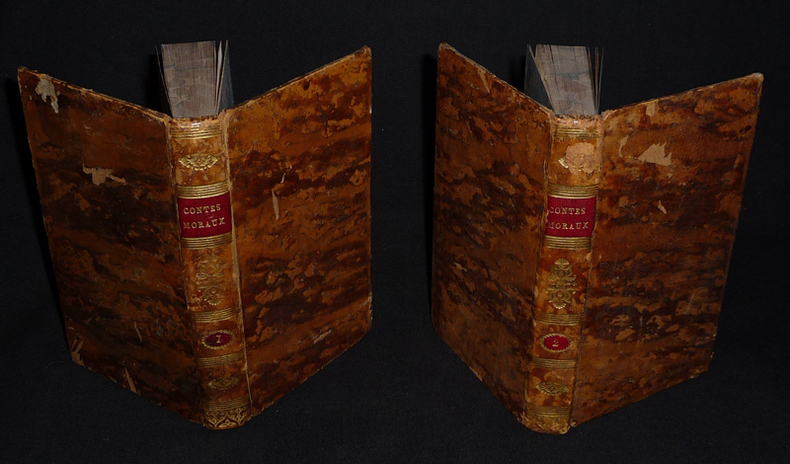
1826zt1006Paris, Ledentu, libraire, quai des Augustins, n°31 Relié 1826 Deux volumes in-12 (10,7 x 17,7 cm), reliure plein veau, dos lisses ornés de dorures, pièces de titre et de tomaison, tranches marbrées, gardes couleur, 330 et 336 pages, quelques gravures hors texte ; quelques épidermures aux plats et dos, mors inférieur du premier plat fendu en queue, par ailleurs assez bon état. Livraison a domicile (La Poste) ou en Mondial Relay sur simple demande.
1886fh794A Paris, A. Quantin, Imprimeur-éditeur Relié 1886 In-4 (21x27,5cm), 36 pages, reliure demi-toile rouge illustrée d'éditeur, premier illustration d'ouvrage de l'artiste Henri Rivière alors âgé de 22 ans, nombreuses illustrations in et hors-textes monochromes (bleu, orange, verte, brun, gris) dont 6 double-pages, très bel ouvrage faisant la part belle à l'illustration avec de judicieuses idées de mise en page, en provenance de la bibliothèque de Denise Delouche ; traces d'usures sur les arêtes des plats ainsi que de petites traces de mouillures, petite déchirure en sur le mors du quatrième plat en queue de coiffe, intérieur frais, bon état général. Livraison a domicile (La Poste) ou en Mondial Relay sur simple demande.
184379391843 Paris, A. Royer, 1843; 2 tomes reliés en 1 volume grand in-8°, demi-chagrin vert à coins de l’époque, filet doré soulignant mors et coins, dos à 4 larges nerfs plats cernés de doubles filets dorés, large palette dorée sur chaque nerf, titre doré, tranches marbrées. Tome I: (2)pp., XVI, 391pp., (2)pp. et 1 frontispice tiré sur chine, 1 portrait et lithographies hors texte en deux tons. Tome II: 404pp., (2 )pp. et 11 lithographies hors texte en deux tons et 2 feuillets de musique. Vignettes et lettres ornées dans le texte aux 2 volumes.
188331047A. Lahure & E. Rouveyre & G. Blond 1883, In-8 relié demi-basane brun, titre et ornements dorés sur le dos, tête dorée, couverture illustrée en couleurs conservée, VI-196 pages. Impression chromotypographique, 45 compositions en couleurs dans le texte.- 820g.- Quelques minimes piqûres sur les pages de garde et faux-titre, sinon exemplaire bien frais, reliure solide et agréable.
190024765Rennes Hyacinthe Caillière 1900 -in-12 demi-velin un volume, reliure demi-vélin ivoire in-douze (binding half vellum in-12)(18,2 x 13 cm), dos long (spine without raised band), Auteur et Titre frappés "or", pièce de titre sur fond noir avec deux filets "or" de part et d'autre, papier marbré marron aux plats, toutes tranches lisses (smooth edges), Tirage limité à 525 exemplaires, un des 500 exemplaires sur papier teinté apré 25 exemplaire sur japon impérial, orné d'un portrait de l'auteur à l'eau-forte en frontispice en noir + une vignette "marque de l'Editeur" en noir en bas du titre + un front de chapitre + un cul-de-lampe historiés en bleu, XI + 308 pages, 1900 Rennes Hyacinthe Caillière Editeur,
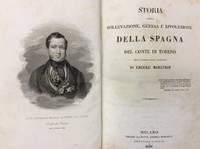
183835980Milano: Bonfanti 1838-1841. In-8 p. mm. 228 x 145 mz. tela coeva con aloni titolo oro al dorso pp. 934 testo su due colonne con ritratto dell'A. Don Giuseppe-Maria-Queypo de Llano Conte di Toreno inc. in rame. Storia della guerra di indipendenza ampliatasi nella guerra peninsulare 1808-13 inizio della rivolta europea contro Napoleone alla cui catastrofe finale si ebbe l'ascesa al trono di Spagna di Ferdinando VII di Borbone 11 dic. 1813. Piccoli fori di tarlo con relativa perdita di alcune lettere del testo alla p. 933; restauro con nastro adesivo per strappo alla pagina 242; qualche rara e lieve fioritura altrimenti testo ben conservato. Bonfanti, hardcover
1885151351885 reliure demi-chagrin grenat in-quarto (garnet binding half shagreen in-quarto), dos 5 nerfs ornés de filets perlés et ceints de filets à froid (spine with 5 raised bands illuminated with a gilt beaded line and encircled of blind-stamping decoration line) - entre-nerfs richement décoré or (between the raised bands richly gilt decoration) - titre frappé or (gilt title) - filets or en tête et en pied (top and at the foot of spine gilt lines), mors et coins à double filet or (joints and corners with double gilt line), papier peigné aux plats (cover with painting paper), marque-page en tissu vert (bookmark in green tissue), tête dorée - gouttière et tranche de queue rognées (gilt top edge - fore-edge and edge of bottom smooth), pages de garde en papier peignées à motif "bouquet" (painting endpapers - model bouquet), page de faux-titre (half title page), illustrations : 170 dessins de (illustrations : 170 drawings of) Just, naissances de rousseurs in fine (beginning of the redness marks at rear), sans mouillure (without scar of waterstain), 247 pages, 1885 à Paris Librairie Plon - E. Plon Nourrit et Compagnie Imprimeurs-Editeurs - 10 rue Garancière,
1840441313Tip. di F. Andreola Venezia 1840. Hardcover. Good copy bound in plain boards. Marbled end-papers. Spine bands and panel edges somewhat bumped and rubbed as with age. Some discoloration to boards. Remains quite well-preserved overall. Physical Description: 59 p. ; In-8°. Tip. di F. Andreola, Venezia hardcover
184529741Boston: Bradbury Soden & Co 1845. 1st edition thus American Imprints 45-2728. Original pink printed wrappers. Series advert to rear wrapper. POS to top of front wrappers. Paper wear to spine ends. A VG set. 2 volumes vi 7 - 160; 2 161 - 320 pp. Cancel copyright notice pasted over that printed on copyright page. Frontis & engraved title page to Part I. 7" x 4-5/8" <br/><br/>First Part begins with a section on Phrenology. Uncommon in original wrappers. Bradbury Soden & Co unknown books
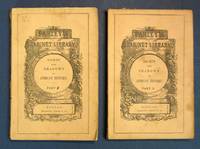
184429742Boston: Bradbury Soden & Co 1844. 1st edition thus American Imprints 44-2697. Original salmon-colored printed wrappers. Series advert to rear wrapper. POS to top of front wrappers. Part I spine paper mostly perished with lower 1" of Part II lacking. Tide-line stain to upper quadrant of last quarter of text Part II. A Good set. 2 volumes 160; 2 161 - 352 pp. Frontis & engraved title page to Part I. Wood engraving p. 8. 7" x 4-5/8" <br/><br/>Contents include: Lucretia and Margaret Davidson; Mrs. Adams; Mrs. Washington; Madame de Sael; Lady Hester Stanhope; Hannah More; Mrs. Barbauld; Madame de Genlis; Josephine; Marie Antoinette; Madame Roland; Madame de Sévigné; Mary Queen of Scots; Elizabeth Queen of England; Isabella of Spain; Joan of Arc. Uncommon especially in original wrappers. Bradbury Soden & Co unknown books
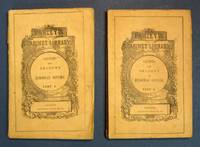
184414970Boston: Bradbury Soden & Co 1844. 1st edition thus American Imprints 44-2679. Original buff printed wrappers. VG some wear to spine paper/pos on wrappers/Part I wrapper misprinted as 'Part 2' which has been corrected by hand. 2 volumes iv 5 - 176; 177 - 336. Frontis engraved title page & occasional intratextual cut. 4 3/4" x 7 1/8" <br/><br/> Bradbury Soden & Co unknown books
184414971Boston: Bradbury Soden & Co 1844. 1st edition thus American Imprints 44-2688. Original buff printed wrappers. VG some wear to spine paper/pos on wrappers. 2 volumes vi 7 - 160; 161 - 320. Frontis title page vignette & occasional intratextual cut. 4 3/4" x 7 1/8" <br/><br/> Bradbury Soden & Co unknown books
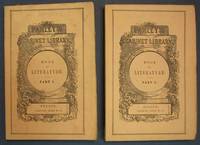
184514956Boston: Bradbury Soden & Co 1845. 1st edition thus American Imprints 45-2739. Original buff printed wrappers. Nr Fine little wear w/ Part I prelims unopened/pos. 2 volumes 176; 177 - 336 pp. Frontis & title page vignette. 4 3/4" x 7 1/8" <br/><br/> Bradbury Soden & Co unknown books
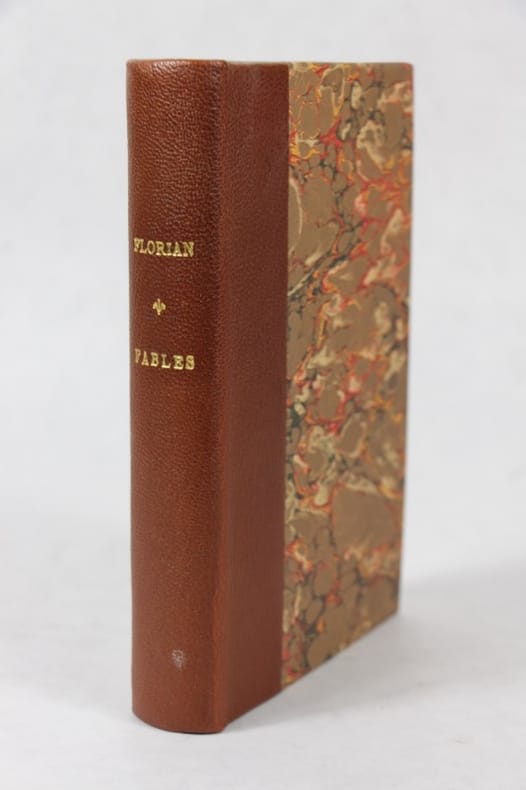
180516584Imp. de F. Dufart 1805 In-12 demi-chagrin, dos lisse rel. moderne, 336 pp. Neuf gravures hors-texte de Marillier. Brunissures éparses.
1889139103Paris, Alphonse Lemerre 1889 In-4 28 x 16,5 cm. Reliure demi-chagrin rouge à coins, dos à nerfs encadrés de fers dorés, tête dorée, 379 pp., édition illustrée de cent soixante dessins de Henri Pille, table. Reliure légèrement frottée, coins émo
181494661Paris, Chez Lefèvre, Libraire, impr. Imprimerie de Crapelet, coll. « Oeuvres complettes de J. La Fontaine, Tomes I & II » 1814 2 volumes. In-8 21 x 13 cm. Reliures de l’époque veau fauve, dos lisses ornés de résilles dorées, plats encadrés de roulettes dorées, portrait de La Fontaine en frontispice, LXXV-242-319 pp. Reliures frottées, intérieur frais.
18792451879 Paris, A. Quantin, 1879.
184057121840 1 Illustrations de 12 vignettes de Montaut. Paris, Marcilly, (1840), demi-percaline bleu éditeur, plats cartonnés lithographiés en couleurs, 54 pages.
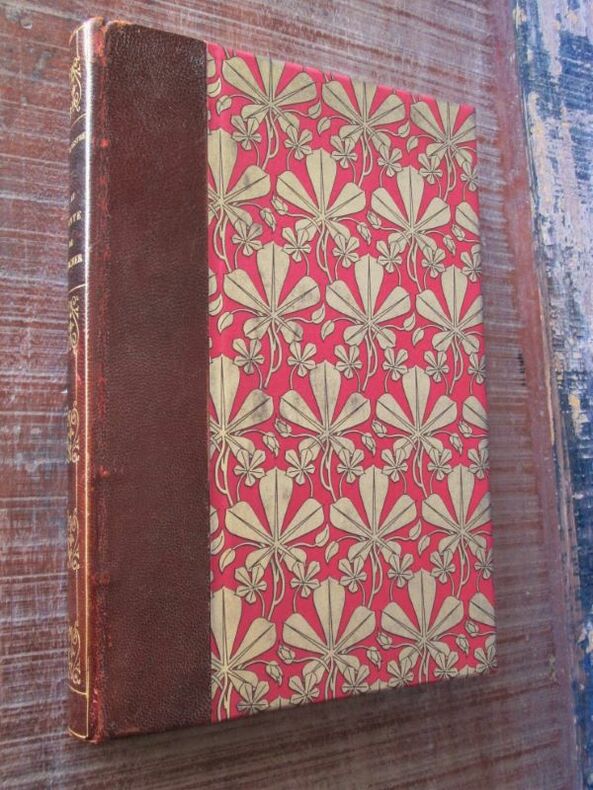
188123671881 Paris, G. Charpentier, 1881. 18 x 11,5 cm, VII - 331 (2) pp. - frontispice gravé à l'eau-forte, reliure de l'époque de demi-veau vert poireau, dos à 5 nerfs orné.
1861WOC-1774Sur Terre, sur Mer, dans les Airs et par tous les Moyens de Locomotion Usités ou Non. Ouvrage illustré de 12 gravures hors-texte de lithographies de A. Coppin sur fond chamois et de vignettes sur bois dans le texte. Paris, Amable Rigaud, Libraire-Éditeur, sans date (1861). Petit in-4 (28x18 cm) cartonnage éditeur bleu passé, plat supérieur orné d'une plaque dorée animée et dos d'un motif doré, tranches dorées et petites fentes dans les charnières. 132pp.
1877EYL-69Paris, E. Plon, 1877 et 1880. 2 vol. in 4 (170 x 255) de 3 ff. (dont frontispice), 344 p. et 3 ff. (dont frontispice), 344 p. Demi maroquin mauve de l’époque, dos à nerfs avec titre dorée, têtes dorées. Bel exemplaire.
1859723311859 Paris, Hachette, 1859, in 8° relié demi-basane brune, dos lisse orné, XIII-194 pages et 1 feuillet d'errata ; petits frottis au dos.
1822#BIBLIO-1044De La Révolution Piémontaise. Troisième Édition Revue Corrigée Et Augmentée De Notes Et De L'Analyse De La Constitution Sicilienne par Conte di Santarosa Santorre Annibale De Rossi Hardback 1822 third edition published by Chez Alexandre Corréard Libraire Paris 1822 224 pages 8-page publisher catalogue at rear <p>Octavo/8vo measures around 5" by 7 3/4" by 1/2". Quarter-leather binding with marbled boards. Gilt lettering and bands to spine. Binding is in exceptionally good condition very clean and containing only the smallest of wear. The binding might be later possibly still 19th century or early 20th century though signs of replacement are not obvious aside from the front free endpaper and pastedowns being of thicker paper than the textblock though it may be that the binding has simply been very well preserved and cared for. A little rubbing at edges and bumped corners. Binding firm. Speckled page edges are browned scuffed a little foxed and otherwise marked. Some marking to endpapers a little writing to recto of front free endpaper. A little loss to several page edges. Considerable foxing and browning to page surfaces throughout and some other marking but no underlining marginalia etc. A few creased page corners to rear. See pictures for further information.</p> Chez Alexandre Corréard Libraire hardcover
180926322Paris: Imprimerie Impériale 1809. Fine. Imprimerie Impériale Paris 1809-1829 71 x 53.50 cm une feuille Original etching in plano uncut extracted from the so-called ""Imperial"" edition of the Description de l'Égypte ou Recueil des observations et recherches faites en Égypte pendant l'expédition française publié par les ordres de Sa Majesté l'Empereur Napoléon le Grand. Executed between February 1802 and 1829 on Napoleon Bonaparte's orders and published from 1809 actually 1810 it was printed in 1000 copies on watermarked laid paper ""Égypte ancienne et moderne"" and presented to institutions. Light marginal foxing not affecting the engraving otherwise very fine condition and preservation. Volume ETAT MODERNE II : The genius of the Institute's scholars is particularly revealed through the plates of the section called Egypte Moderne. Architecture industry social structures sanitary conditions water systems music craftsmanship are presented with exceptional precision and graphic quality. The spirit of Diderot and d'Alembert's Encyclopédie remains underlying in the approach of the draughtsmen of the Description de L'Egypte who accompany the text volumes with numerous detailed plates endeavoring to create a portrait of the populations imbued with beauty and respect. Wealthy pashas or simple potter craftsmen are represented with sensitivity going about their occupations in the midst of aesthetic compositions without falling into idealism or caricature. LA DESCRIPTION DE L'EGYPTE IMPERIAL edition 1809-1829 : La Description de l'Egypte is one of the masterpieces of French publishing and the starting point of a new science: Egyptology. A titanic exposition of Egypt at the time of Bonaparte's conquests between 1798 and 1799 it is divided into 23 volumes including 13 volumes of engravings gathering nearly 1000 plates in black and 72 in color. The 6 volumes of plates entitled Antiquités are devoted to the splendors of Pharaonic Egypt. L'Histoire naturelle is divided into 3 volumes of engravings. One volume is devoted to Cartes géographiques et topographiques while the 3 volumes : Etat Moderne present a striking portrait of Coptic and Islamic Egypt as it was seen by Bonaparte's Army of the Orient. The ""Egyptian campaign"" a military disaster reveals through the engravings of the Description de l'Egypte the scientific success it became thanks to the some 167 scholars members of the Commission of Sciences and Arts of the Institute of Egypt who followed Napoleon's army. The Institute brought together in Egypt the mathematician Monge the chemist Berthollet the naturalist Geoffroy Saint-Hilaire as well as numerous artists engineers architects doctors. They were charged with rediscovering modern and ancient Egypt showing its natural riches and the know-how of its inhabitants. The first edition called ""Imperial"" of the Description de l'Egypte was executed in four large formats two of them specially created for it and named ""Moyen-Egypte"" and ""Grand-Egypte"" formats. A specific press was built for its printing which extended over twenty years between 1809 and 1829. The Imperial edition proved so popular that a second edition in 37 volumes entirely in black and without the ""Egypte ancienne et moderne"" watermark called the ""Panckoucke"" edition was published from 1821 by the C.-L.-F. Panckoucke printing house Paris. The realization of this monument of erudition owes much to Baron Dominique Vivant Denon illustrator diplomat collector and subsequently director of the Napoleon Museum at the Louvre who accompanied Napoleon to Egypt with many other scholars but decided alone to venture into the South of the country while the other invited scientists remained confined to the Cairo region. The fabulous sketches brought back by Denon during his romantic ride gave Bonaparte the idea of sending the other members of the Institute there and thus creating a faithful and complete portrait of the territory. Following Denon it was therefore the gr Imprimerie Impériale unknown
180926321Paris: Imprimerie Impériale 1809. Fine. Imprimerie Impériale Paris 1809-1829 71 x 53.50 cm une feuille Original etching in plano uncut extracted from the so-called ""Imperial"" edition of the Description de l'Égypte ou Recueil des observations et recherches faites en Égypte pendant l'expédition française publié par les ordres de Sa Majesté l'Empereur Napoléon le Grand. Executed between February 1802 and 1829 on Napoleon Bonaparte's orders and published from 1809 actually 1810 it was printed in 1000 copies on watermarked laid paper ""Égypte ancienne et moderne"" and presented to institutions. Light marginal foxing not affecting the engraving otherwise very fine condition and preservation. ISLAMIC ARCHITECTURE OF CAIRO : The set of engravings to which this plate belongs constitutes one of the first reasoned studies of the monuments of Islamic Egypt in Cairo gathering plans sections and elevations of mosques mausoleums and fortifications from the 9th century Tulunid period to the Mamluk constructions contemporary with the arrival of Bonaparte's troops. Furthermore the architects and engineers of the Institute of Egypt realized a large series of plates devoted to dwellings and civil constructions whether of grand or more modest execution providing precious testimony on the life of Cairenes at the end of the 19th century. The few ancient vestiges remaining in the city were also immortalized by the scholars of the Institute who had established their quarters in the capital. Volume ETAT MODERNE II : The genius of the Institute's scholars is particularly revealed through the plates of the section called Egypte Moderne. Architecture industry social structures sanitary conditions water systems music craftsmanship are presented with exceptional precision and graphic quality. The spirit of Diderot and d'Alembert's Encyclopédie remains underlying in the approach of the draughtsmen of the Description de L'Egypte who accompany the text volumes with numerous detailed plates endeavoring to create a portrait of the populations imbued with beauty and respect. Wealthy pashas or simple potter craftsmen are represented with sensitivity going about their occupations in the midst of aesthetic compositions without falling into idealism or caricature. LA DESCRIPTION DE L'EGYPTE IMPERIAL edition 1809-1829 : La Description de l'Egypte is one of the masterpieces of French publishing and the starting point of a new science: Egyptology. A titanic exposition of Egypt at the time of Bonaparte's conquests between 1798 and 1799 it is divided into 23 volumes including 13 volumes of engravings gathering nearly 1000 plates in black and 72 in color. The 6 volumes of plates entitled Antiquités are devoted to the splendors of Pharaonic Egypt. L'Histoire naturelle is divided into 3 volumes of engravings. One volume is devoted to Cartes géographiques et topographiques while the 3 volumes : Etat Moderne present a striking portrait of Coptic and Islamic Egypt as it was seen by Bonaparte's Army of the Orient. The ""Egyptian campaign"" a military disaster reveals through the engravings of the Description de l'Egypte the scientific success it became thanks to the some 167 scholars members of the Commission of Sciences and Arts of the Institute of Egypt who followed Napoleon's army. The Institute brought together in Egypt the mathematician Monge the chemist Berthollet the naturalist Geoffroy Saint-Hilaire as well as numerous artists engineers architects doctors. They were charged with rediscovering modern and ancient Egypt showing its natural riches and the know-how of its inhabitants. The first edition called ""Imperial"" of the Description de l'Egypte was executed in four large formats two of them specially created for it and named ""Moyen-Egypte"" and ""Grand-Egypte"" formats. A specific press was built for its printing which extended over twenty years between 1809 and 1829. The Imperial edition proved so popular that a second edition in 37 volumes entirely in Imprimerie Impériale unknown