30 résultats
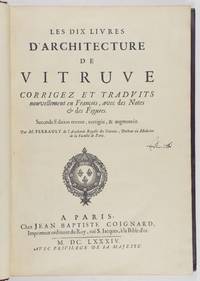
168455420Paris: Jean Baptiste Coignard 1684. Second revised edition. Contemporary Calf. Nearly fine. Folio 40.6 by 27.9 cm. Collation: pi1 a2 e2 i2 o2 A-4Y2 4Z4 -4Z4; = 194 leaves . 18 354 16 pp; engraved hors texte half-title; 68 numbered engraved plates some double-suite in text; woodcut diagrams throughout. Contemporary marbled calf lightly worn at extremities spine with raised bands lettered and tooled in gilt dentelles; marbled endleaves. Occasional light dampstain at top gutter sometimes just encroaching beyond margin else a fine amply-margined copy.<br /> <br /> Second revised edition. "This edition contained few emendations but many important additions which based on various opinions prompted the author to reprint his version. He also changed three figures and added three plates one in Book VI and two in Book X. Although this work could have been further refined it nevertheless rightfully holds a prominent place among the Vitruvian versions and commentaries" Cicognara. Claude Perrault 1613-1688 was a member of the Royal Academy of Sciences and a doctor of medicine and anatomist in the faculty at Paris; he designed the Paris Observatory and participated in the design of the east façade of the Louvre. His published works are evidence of a polymathic mind encompassing architecture physics and natural history. Fowler ranks the present work among "the scholarly editions of Vitruvius Fowler. With engravings signed by: Sébastien Leclerc Jacques Grignon Georges Tournier Nicolas Pitau Gérard Edelinck Pieter Van Der Banck Gérard Scotin Jean Patigny Pierre Lepautre Etienne Gantrel.<br /> <br /> The military and civil engineer Marcus Vitruvius Pollio ca. 70-80 BCE - ca. 15 CE is the author of the only surviving ancient treatise on architecture arranged in ten books. By his own account Vitruvius served in the Roman army under the command of Julius Caesar. Rediscovered by the Florentine humanist Poggio Bracciolini 1380-1459 in the library of Saint Gall Abbey and publicized by Leon Battista Alberti 1404-1472 Vitruvius’ De Architectura would later define the canon of classical architecture. His assertion that structures should exhibit the three qualities of stability firmitatis utility utilitiatis and beauty venustatis became a commonplace in architectural theory. The wide-ranging program of De Architectura deals with “principles of buildings in general building materials designs of theatres temples and other public buildings town and country houses baths interior decoration and wall paintings clocks and dials astronomy mechanical and military engineering.†PMM. Throughout the Renaissance Vitruvius’ work provided inspiration for Michelangelo Leon Battista Alberti Donato Bramante Lorenzo Ghiberti Giacomo Vignola Andrea Palladio and many others. The first printed edition of De Architectura appeared at Rome ca. 1483-90; the first illustrated edition at Venice 1511.<br /> <br /> Provenance: Bookplate of Harold Douthit. Cf. Digital Cicognara Library 730; Cf. Fowler 418 first ed. 1673.<br /> <br /> Full title and imprint: Le Dix Livres d'Architecture de Vitruve Corrigez et Traduits nouvellement en François avec des notes & figures. Seconde edition reveue corrigée & augmentée par M. Perrault de l'Academie Royalle des Sciences Docteur en Medecine de la Faculté de Paris. A Paris chez Jean Baptiste Coignard imprimeur ordinaire du roy ruë S. Jacques à la Bible d'or M.DC.LXXXIV. 1684. Jean Baptiste Coignard unknown
1679032848<p>A Paris: De L'Imprimerie Royale 1679 A fair copy of the 1st edition of the Description de la Grotte de Versailles bound with a very good copy of the 2nd edition of Labyrinte de Versailles in contemporary elephant folio full leather binding. La Grotte has had 5 of the 20 plates cut out but Labyrinte is complete. The binding is sound with raised bands and title label to spine. It is very worn with a lot of wear to corners with leather loss and to spine joints spine ends and edges. The surface of the boards is a little rough. All page edges red. There is an old bookplate to the front pastedown endpaper - Earl Vane from the Library of the Rev. John Vane. Contents: 3 blanks; title 1679; blank verso; Description pp 1-11; Imprimerie to verso p 11; plates 13 single and 2 double; title to Labyrinte 1697; blank verso; Description pp 3-34; blank recto with Explication du Plan du Labyrinte to verso; plate 1; fables quatrains by Isaac Benserade and plates Sebastien Leclerc on opposing pages - 78 pp 39 plates; table 3 pp with L'Imprimerie to verso final leaf; 4 x final blanks. The binding is 50 cm x 35 cms; the page size in Labyrinte matches that of the Grotte but the actual text and plate size is 15.8 x 10.2 cm. Contents are in very good clean condition. Please enquire if you would like to see further images.</p> De L'Imprimerie Royale hardcover
169644496Paris, Antoine Dezallier, 1696. 2 tomes en 1 vol. in-folio, maroquin rouge, doublé de maroquin rouge, dos orné, double rangée de filet, tranches dorées (Fairbain and Armstrong).
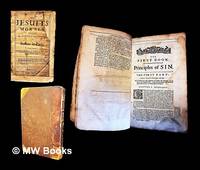
1670451266London : Printed for John Starkey 1670. First Edition. Hardcover. Poor copy in a later half leather binding over cloth boards. Front panel lacking. The title page and subsequent two leaves lack some of their upper corners which have been partly repaired by hand. Some damp staining to the fore-edge. The text block itself remains quite tight and is legible throughout. For its age an internally well-preserved copy. Physical description; 30 392 pages. Notes; Attributed to Nicholas Perrault. Translation by Ezerel Tonge. Subjects; Jesuits--Controversial literature--Early works to 1800. Christian ethics--Catholic authors--Early works to 1800. London : Printed for John Starkey hardcover
167144411Paris: S. Mabre-Cramoisy for Imprimerie Royale 1671. <p>Perrault Claude 1613-88. Mémoires pour servir à l'histoire naturelle des animaux. Bound with: Picard Jean-Félix 1620-82. Mesure de la terre. 12 91 1; 2 30 2pp. Frontispiece and 14 plates by Sébastien LeClerc Mémoires; 5 plates Mesure. With: Perrault. Suite des mémoires pour servir à l'histoire des animaux. 4 93-205 3pp. 15 engraved plates by LeClerc. Together 3 works in 2 vols. double folio. Paris: Imprimerie Royale 1671-76. 561 x 403 mm. Mottled calf ca. 1676 rebacked arms of Louis XIV in gilt on front and back covers light wear edge of Vol. II back cover a little bumped. A few leaves creased light marginal dampstains on 2 or 3 plates but very good. 19th century armorial bookplate; bookplate of Arthur and Charlotte Vershbow.</p> <p> First Editions. Perrault was the leader of a team of comparative anatomists that included Guichard Joseph Duverney Jean Pecquet Moyse Charas and Philippe de la Hire; they were often called the "Parisians" in contemporary literature because of their membership in the Académie Royale des Sciences. Their investigations began with a thresher shark and lion from the royal menagerie and went on to encompass forty-nine vertebrate species. "Although some of the discoveries on which the Parisians most prided themselves—including the nictitating membrane that Perrault first observed in a cassowary the external lobation of the kidneys in the bear and the castoreal glands of the beaver—had been observed earlier no such detailed and exact descriptions and illustrations had been published before" Dictionary of Scientific Biography. In the spirit of rationalism Perrault and his team investigated and debunked many popular myths attached to certain species such as the legend that salamanders live in fire or that chameleons subsist on air. They also recorded their methods of work along with their results providing the only contemporary disclosure of how such anatomical research was conducted in the seventeenth century.</p> <p> The Mémoires were originally issued in two parts in 1671 and 1676 as in our copy; they were later reissued in 1676 with slight changes as one volume with a new title-leaf. The two volumes of the Mémoires contain descriptions of twenty-nine species including the lion the chameleon the shark the lynx the porcupine the eagle the cormorant and the ostrich. Our copy was bound for presentation by Louis XIV patron of the Académie des Sciences; a significant portion of the edition was bound this way. </p> <p>Vol. I of our copy also includes the first edition of Jean-Félix Picard's Mesure de la terre 1671 which contains the first reasonably accurate calculation of the size of the Earth. Picard based his calculation on his measurements of a degree of latitude along the Paris meridian. Using sophisticated instruments Picard obtained a value for the Earth's polar radius of 6328.9 kilometers only 0.44% below the correct value of 6357 km.; his results were thirty to forty times more precise than any that had been obtained previously. Dibner Heralds of Science 84. Norman 1687 Perrault.</p> . S. Mabre-Cramoisy for Imprimerie Royale unknown books