555 résultats
19362092902140600174Japan Esperanto Society 1936. Soft Cover. Fine. Number of pages: Book size: A5 Number of books: 47 Japan Esperanto Society paperback
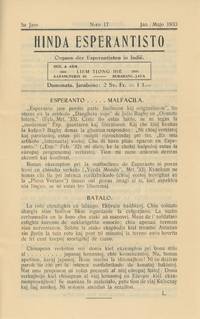
1947List2844Austria; Java Indonesia; London England; and Los Angeles California 1947. Sixteen pieces: two “Friends’ Esperanto Society†bulletins 8 x 12 ½ inch each; two letters 8 ½ x 11 inch each; seven “Hinda Esperantisto†pamphlets 5 ½ x 8 inch four pages each; two “Declaration†forms 4 x 6 inches; one BES pamphlet 4 ½ x 6 inches eight pages; one set of tickets for membership information 2 x 5 inches missing one tear-off ticket and one “Universala Ligo†membership card for 1947 3 x 4 ½ inches. Folded; some chipping and tearing at edges. Overall excellent to near fine. Esperanto is an artificial language created by Polish physician Ludwik Zamenhof 1859–1917 in 1887. Zamenhof intended Esperanto to be a universal second language; his experiences growing up Jewish in the Russian Empire among Russian Polish German and Yiddish speakers—all of whom regarded each other at best with suspicion—led him to believe that an easily-learned neutral second language could by contrast inspire unity between all people. Offered here is a small collection of materials related to various Esperanto societies: the “BES†a Czech group the Universal Esperanto Association the Friends’ Esperanto Society the Esperanto Club of Los Angeles and Hinda Esperantisto – “Indian Esperantist†based in Java Indonesia.<br /> <br /> These materials written largely in Esperanto note that most quotes herein are translated are mostly typical club bulletins advertising events announcing members’ news and reminding the reader of upcoming fees. The BES pamphlet besides advertising its Adresaro member directory solicits donations for a “living monument to Esperantoâ€â€”a headquarters—to be built in PotÅ¡tejn in Czechia<br /> <br /> “in the shape of a five-pointed star which would become a real home for all those who love goodness beauty health truth and progress. The stone-like majestic white building will shine brightly in a beautiful circle from a moderate slope and the fragrant forest behind it will form a charming background.†1932<br /> <br /> This utopian vision was likely prevented at least in part by the Nazi occupation of the country. Esperanto speakers including Zamenhof’s family in particular were among their many targets. The effort to purge the universal language from Europe was clearly not successful; a postwar letter from a language teacher in Austria to a gentleman in California included in this collection notes that the Californian’s address had been printed “in the magazine ‘Die Weltsprache’†– that is “The World Language†February 14 1947.<br /> <br /> Esperanto’s egalitarian and pacifist aims form a large part of its appeal to Quakers. It is unclear whether the Friends’ Esperanto Society which authored two of the items in this collection is the same as the Kvakera Esperanto-Societo which was founded in 1921 and is still active. The March 1935 bulletin announces the F.E.S.’s annual meeting at Friends House in London the headquarters of the Religious Society of Friends in Britain. An obituary for Wilson Henry Sturge the Society’s Vice President remarks on “his desire for international friendship and understanding through Esperanto†March 1935. The January 1936 bulletin calls members to petition their local Registrar of Education for Esperanto to be taught in high schools a request echoed by the Universala Esperanto-Asocio’s declaration form calling on the United Nations to “help to spread the use of this language in every possible way†including supporting its teaching in schools in order “to facilitate communication between the peoples of the world and to promote social progress.â€<br /> <br /> George R. Thompson’s letter to the Los Angeles Esperanto Club as its President strikes a similarly idealistic tone. He gives Club members his “Decalogue†finishing with an exhortation to: “10. Fix our eyes directly on our dear goal the universal brotherhood of humanity and global peace – through linguistic mutual understanding†August 1 1933.<br /> <br /> “Hinda Esperantisto†written by Liem Tjong Hie is somewhat more polemical. Its announcements include news from the Manchurian Federation of Esperantists who proposed to make Esperanto the region’s official language and “to abolish the English language†Jan-May 1933. It criticizes “the European progressive writers†especially the Hungarian Esperantist Kálmán Kalocsay for making the language more difficult for learners. Liem also writes mysteriously:<br /> <br /> “The world does not know that the Belgian Esperanto Institute dir. Frans Schoofs Antwerp is a physically rotting company. The shamelessness of the leaders is shown by the fact that they are so heroic in victimizing distant people knowing that they cannot do anything against them. A black mark to the apparent reputation of the leaders!â€<br /> <br /> These pamphlets also include side-by-side Indonesian and Esperanto blurbs including a review of a new book for Malaysian Esperanto learners – Esperanto caught on quickly in Asia where it still enjoys widespread popularity. <br /> <br /> Of interest to Esperantistoj and historians of Esperanto. unknown
1921628AFrankfurt, Rütten & Loening, 1921. 4°. 24 einseitig bedruckte Tafeln mit farbigen Bildern. Farbig illustrierter Orig. Pappband. Rücken oben und unten mit kleinen Fehlstellen im Papierbezug, Einband gering fleckig. Innen tadellos.
19512090502113700574Not Available 1951. Soft Cover. Fine. The book is in fine condition. Not Available paperback
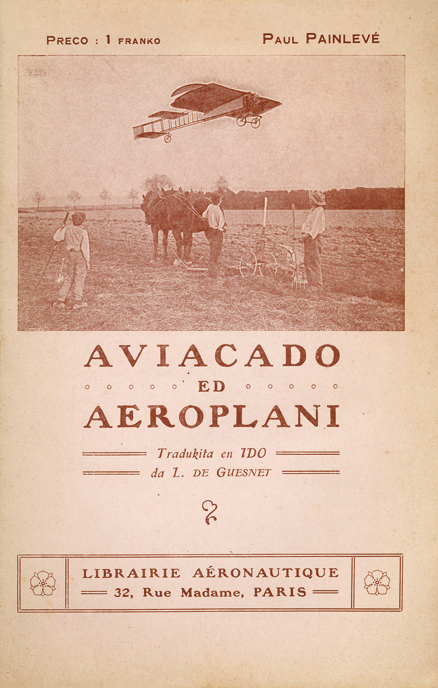
191015619Paris, Librairie Aéronautique, 1910 ; in-8, broché ; 30, (2) pp., couverture rose illustrée, nombreuses photographies et une page de grammaire, prononciation et liste des nouveaux mots ido créés pour cette traduction.
190939599Delagrave, Paris 1909. XI,752 S. OHldr. mit Lederecken, Rückengoldprägung und Marmorschnitt. Gutes Exemplar.
In-8°, in brossura pesante muta e sopracoperta editoriale illustrata da un dipinto di De Chirico, pp. 29(3); seguono 64 tavole in nero di opere e pp. (4) di indici. Tra gli artisti citati Cézanne, Rousseau, Matisse, Modigliani, Dufy, Picasso, Braque, Gleizes, Lhote, Marcoussis, Balla, Severini, Boccioni, Prampolini, Brancusi, Lipsic, Malewicz, Mondrian, van Doesburg, Seligmann, Arp, Ernst, Kisling, Menkes, Grabowski, Campigli, Torres-Carcia e altri; tra le correnti dadaismo, futurismo, cubismo, costruttivismo, neoplasticismo, surrealismo, unismo. 'Dopo una descrizione generale dell'evoluzione della pittura, il libro contiene informazioni dettagliate sulla battaglia tra le due realtà che compongono l'arte: la realtà del mondo esterno e la realtà astratta che esiste nel cervello dell'artista. Un altro capitolo riporta le tendenze dell'arte moderna e lo stato dell'arte. Il linguaggio del lavoro, nonostante la difficoltà della materia, è chiaro, fluente e pulito. Il libro è presentato magnificamente e piacevolmente stampato' (Léon Courtinat, Historio de Esperanto, 1964). Salomon KORNFELD (pseudonimo GRENKAMP, 1896 - 1943), fu scrittore polacco che visse a Parigi; esperantista dal 1914 scrisse e pubblicò molte opere e articoli per il movimento. Jan BRZEKOWSKI (Nowy Wiśnicz, 1903 - Parigi, 1983) è stato un poeta, scrittore, teorico e critico letterario polacco, membro dell'Avanguardia Cracoviana. Brzękowski frequentò la scuola media di Nowy Sącz e Bochnia e si laureò in filologia polacca e farmacia all'Università Jagellonica. Nel 1927 ottenne un dottorato per la tesi intitolata 'La leggenda di Don Juan e la sua influenza sulla letteratura polacca'. Studiò anche alla Sorbona e all'École du Journalisme di Parigi. Debutta nel 1921 come poeta in Gazeta Literacka. Nel 1922 fu associato a un gruppo di giovani poeti di Cracovia che si definivano negativisti. Nel 1925 pubblicò il primo volume di poesie Tętno. Ha curato la rivista 'Linie' ed è stato attivo nel cerchio dell'avanguardia di Cracovia. Ha co-fondato il gruppo di artisti rivoluzionari. Nel 1928 andò in Francia e nel 1929-1930 diresse la rivista bilingue L'Art Contemporain. Ha scritto poesie in francese, pubblicando numerosi volumi illustrati da Hans Arp, M. Ernst e Fernand Léger. Negli anni 1937-1940 fu a capo dell'ufficio stampa dell'Ambasciata della Repubblica di Polonia, fu attivo durante la guerra a bordo della Croce Rossa polacca a Vichy, e partecipò al movimento di resistenza francese negli anni 1940-1944. Dal 1946 al 1964 è stato direttore della spa e dell'hotel ad Amélie-les-Bains, dove ha anche vissuto. Dal 1964 era a Parigi. Nel 1979, dopo 50 anni, ha rinnovato il suo dottorato presso l'Università Jagellonica. Ha pubblicato, tra le altre, nelle riviste di emigranti 'Kultura', 'Wiadomości', 'Oficyna Poerów' e 'Twórczości', 'Tygodnik Powszechny', 'Życie Literackie', 'Miesięcznik Literacki' e 'Poetry'.
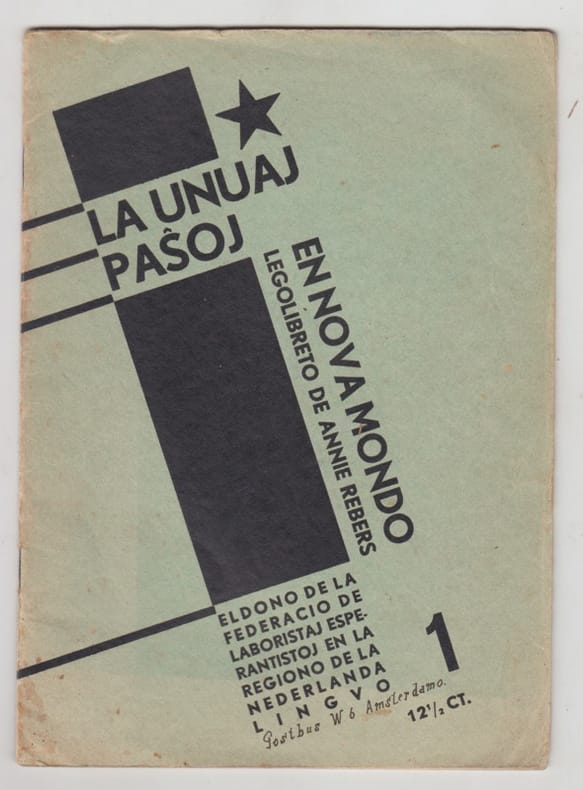
1935271641935 AMSTERDAM Federacio de Laboristaj Esperantistoj en la Regiono de la Nederlanda Lingvo [c.1935].Langeberg, A. Illustrator- 4 fascicules 16 p. : ill. ; 21 cm.,numérotés 1 à 4,bon état,rare
191139601Delagrave, Paris 1911. XXVII,728 S. OHldr. mit Lederecken, Rückengoldprägung und Marmorschnitt. Rücken etwas aufgehellt. Gutes Exemplar.
191239602Delagrave, Paris 1912. XXX,736 S. OHldr. mit Lederecken, Rückengoldprägung und Marmorschnitt. Rücken etwas aufgehellt. Gutes Exemplar.
191039600Delagrave, Paris 1910. XIX,768 S. OHldr. mit Lederecken, Rückengoldprägung und Marmorschnitt. Gutes Exemplar.
In-8°, legatura editoriale in tutta tela con titoli in oro al dorso e al piatto, pp. 559(1). Con 11000 illustrazioni intercalate nel testo. Edizione originale di questo importante metodo della lingua internazionale. William Sol BENSON (Kiev, 1877 - 1945) fu un esperantista americano. Emigrò dalla Russia negli Stati Uniti nel 1889, e lì esercitò la professione di medico osteopata a Newark, nel New Jersey. Fu autore di questo metodo originale per insegnare l'esperanto per immagini, e fondatore di una importante scuola esperanto. Fu membro dell'American Academy of Esperanto negli anni '40.
19049La Esperantista Vagabonda Klubo 1 Wilbury Avenue Hove Sussex. Three from '2-a Serio': 'Nro. 8' 'Marto 1912' 'Nro. 10 'Julio-Augusto 1912' and 'Nro. 11' 'Septembro-Oktobro 1912'. One from 'Serio 4': 'Nro. 1' 'Jan.-Februaro 1914'. 'La Vagabondo' The Tramp was the organ of 'La Esperantista Vagabonda Klubo' founded and edited by the artist Caroline Oxenford. Having previously been named 'La Vagabonda Monatajo' January to March 1908 and 'La Vagabondisto' April to July 1908 it became 'La Vagabondo' from September 1908. The First World War put an end to both club and magazine. The four issues are in fair condition on aged and worn paper. Uniform in design and each 12pp. 4to. although the last number is slightly taller in printed wraps carrying advertisements. The three numbers from '2-a Serio' all by 'W. G. Mead & Co. Printers East Putney S.W.' all in cream wraps have the same illustration on the front cover showing the nighttime silhouette of a house against trees; the number from 'Serio 4' by 'William Bishop Printer Market Street Edinburgh' has an illustration of a bearded tramp in a hat with 'Eric Forbes-Robertson E.F.R.' at the foot. The magazines contain work attributed to various individuals including K. M. Thornton Leo Belmont H. Boucon J. Simpson and Ch. Brunet with club reports by M. S. Rutter and M. McNeillie. There are also a number of illustrations including full-page illustrations by Anne Estelle Rici Eric Forbes-Robertson '"Ekamo." Lignogravurajo. Speciale farila por "La Vagabondo." de Sro. Eric Forbes-Robertson.' and Joseph Simpson. From the papers of Eric Forbes-Robertson. La Esperantista Vagabonda Klubo, 1 Wilbury Avenue, Hove, Sussex. Three from '2-a Serio': 'Nro. 8' ('Marto, 1912'), 'Nro. 10 ('Ju paperback
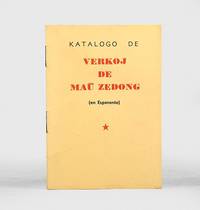
1972150655Beijing: Libroservo de ina Esperanto-Ligo 1972. A rare example of one of the sales catalogues issued by the China Esperanto League for overseas Esperantists wishing to order Mao's works. For catalogues issued in the 1960s and 1970s WorldCat records a total of only nine copies. Shortly after the founding of the People's Republic of China in 1949 the All-China Esperanto Association later renamed the "China Esperanto League" was formed in Shanghai and in the 1950s the League hosted speakers from around the world. While foreign contacts ceased during the Cultural Revolution the League used its network to promote Maoism to Esperanto movements abroad. The present catalogue offers for sale at very cheap prices volumes of Mao's Selected Works as well as pamphlets of his speeches and major essays. At the rear an order form is provided for customers to complete and return to Beijing by post. Though not marked as such the present copy is from the library of Paul Pickowicz b. 1945 a notable scholar of modern Chinese culture and society. In 1971 Pickowicz was one of 15 American scholars invited to visit the mainland the delegation being the first group of American academics to set foot in Mao's China. Duodecimo pp. 18. Stapled as issued original pale orange wrappers front cover lettered in black and red above red five-pointed star. A few marks to wrappers touch of foxing contents else clean and bright. A near-fine copy of this fragile publication. unknown
191117683Belgique, Chez l'Auteur à Bruges 1911. In-4 cartonnage éditeur plein cuir vert de 148 pages au format 18 x 28 cm. Couverture avec titre gravé et doré. Dos rond avec titre. Coins avec petits frottis et tassements. Intérieur frais. Tirage sur couché. Roman d'aventures et de voyage à travers le Canada. Nombreuses photos in et hors texte. L'auteur d'origine Belge, fut écrivain, instituteur et éditeur, et également un des premiers propagandistes de l'espéranto en Belgique. Il devint d'ailleurs président de la ligue espérantiste belge. Superbe état général. Très rare édition originale, enrichie d'une magnifique dédicace autographe, signée, de l'auteur en esperanto.
In-8°, legatura editoriale in tutta tela con titoli in oro al dorso e al piatto, pp. (2)197(3); con due ritratti fuori testo di Onisaburo Deguchi all'inizio del volume. In astuccio editoriale in cartone con titoli. Raccolta di poesie in esperanto, scritta da vari autori della lingua, dedicate al maestro religioso Onisaburo Deguchi per il suo 60° compleanno, raccolte e tradotte in giapponese dall'esperantista Nishimura Koogecu (Shimane, 1883 - Kameoka, 1973). Seconda edizione. Ōmoto (大本教, Grande Fonte o Grande Origine) è un movimento religioso fondato in Giappone nel 1892 da Nao Deguchi, nata a Fukuchiyama nel 1836 e morta nel 1918. Ōmoto è basato sul culto del dio Konjin e originato dallo shintoismo. Il leader più carismatico ne fu proprio Onisaburo Deguchi, genero di Nao, esperantista anch'esso.
19512082402113505555Not Available 1951. Soft Cover. Fine. Number of books: 9 Not Available paperback
In-8°, legatura editoriale in mezza tela e punte, p. 47(1). Le Lettere a un giovane poeta furono realmente indirizzate da Rilke al giovane scrittore Kappus fra il 1903 e il 1908. Pubblicate postume nel 1929, si diffusero in breve tempo nei paesi di lingua tedesca come una specie di breviario – non tanto d’arte quanto di vita. Rara prima traduzione in Esperanto, realizzata da A. Münz e revisionata da Kálmán Kalocsay. Ottimo esemplare.
192876663La Habana Cuba: Jorge Lauderman 1928. First edition. Inscribed by the author on the title page. Octavo. Frontispiece portrait 167 1 pp. Publisher's printed green wrappers with a design by Victor Manuel. Spine and all edges taped slight musty smell poor quality paper but nonetheless a very good copy.Johns was a Polish immigrant in Cuba at this was his doctoral thesis on Esperanto presented to the University of Havana in 1928. At the front of this publication is an errata slip and a notice that Dr. Johns had become a professor at the Department of Modern Languages at the University of Florida. Esperanto was created by Dr. Ludwik Lejzer Zamenhof in 1887 for the purpose of international communication. It was an entirely new language and for some time it held out the hope of a unifying language that could reach around the globe. (Jorge Lauderman) unknown
191021551niort 1910 une photographie originale en noir, format : 29,5 x 20,5 cm, noté sur le drapeau : "esperantista niorta grupo francujo" et au crayon au dos gesinforoj Barreau, sans date (1910 environ)........photo parfaite.....introuvable!!!
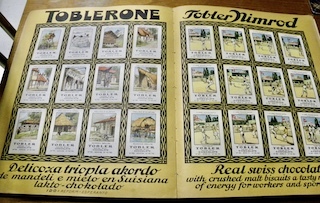
108425Bern, Linguo sans date, vers 1920, 290x235mm, complet des 1200 vignettes en couleurs contrecollées sur 100 pages non numérotées. Cartonnage d’éditeur, dos toilé rouge. Bon état, hormis coins très légèrement cornés. Première page (planche en couleurs) avec rousseurs marginales. Plats supérieur plié.
19282111902156001683Edited by Esperanto Popularization Society Tenseisha 1928. Soft Cover. Fine. The book is in fine condition. Edited by Esperanto Popularization Society Tenseisha paperback
In-8°, in brossura pesante illustrata, pp. 125(3). Raccolta di pensieri e osservazioni dal 1931 al 1932, in forma di diario. Kenelm Ralph Creusé STURMER (Pool, 1903 - Londra, 1960), scrittore anche con lo pseudonimo di Kenelm Robinson, visse a Londra dal 1917. Esperantista dal 1922 fu molto attivo nei club di esperanto di Londra, e forte sostenitore del movimento; fu anche redattore di 'International Language'. Ottimo esemplare.
Fine Esperanto Paperback. Cr. 8vo. (20 x 14 cm). In Esperanto and Turkish. 12 p. A very rare local printing in Aydin city. First and Only Edition. Only one copy in OCLC: 163385249 (Bayerische Staatsbibliothek of Germany).
1960053317Aydin / Izmir: Cümhuriyet Kütüphanesi / Libristo Mehmet Aydin / Mesrutiyet Matbaasi. c. 1960s 1960. Soft cover. Fine. 8vo - over 7¾ - 9¾" tall. Paperback. Cr. 8vo. 20 x 14 cm. In Esperanto and Turkish. 12 p. A very rare local printing in Aydin city. First and Only Edition. Only one copy in OCLC: 163385249 Bayerische Staatsbibliothek of Germany. <br/> <br/> Cümhuriyet Kütüphanesi / Libristo Mehmet Aydin / Mesrutiyet Matbaasi., [c. 1960s] paperback