3 889 résultats
65248Rabat, Félix Moncho, 1929, in 12 cartonnage de l'éditeur, 187 pages ; cartonnage fané.
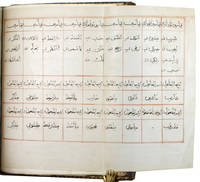
1830ABC_483971830. Contemporary navy blue morocco with the title lettered in gold on spine marbled endpapers. 4to 21.5 x 27 cm. With 2 folding tables 17 lines to the page written in red and black ink. A unique handwritten vocabulary and phrasebook of English and Arabic from the first half of the 19th century. This meticulously prepared manuscript is written in the fashion of a printed book opening with a title page and ending with an index of topics. It is divided into four main sections: nouns adjectives verbs and example sentences. The vocabulary especially in the nouns section is arranged by subjects which include such interesting headings as "Druggist" "Painter" "Merchant" "Cities" "the Bride's Paraphernalia" "Precious Jewels" "War" "The Church" "Clerical Vestments" "Ecclesiastical Degrees & Kinds of Sin" "Festivals" and "Monks their prayers and their dress". Presumably the dictionary was created to help a traveller or merchant who may have had an association with the Church. The final section offers an interesting selection of phrases and sheds some light on the experience of foreign language learning in the early 19th century. The phrases are a mixture of sentences that would be useful in daily life and such as would be included to practice the words from the vocabulary. Examples include: "We roasted a lamb and ate the whole of it and drank wine with it"; "I descended from above with the youth my enemy"; "I shot the bear in the water and he sank"; and "Why dost thou scratch thy head and spit in fire". As a cheat sheet for Arabic grammar the author includes two folding tables of Arabic verb tenses and conjugations. Overall a curious example of a 19th-century Arabic vocabulary and phrasebook.With a presentation note in English indicating it was a Christmas gift in 1881 presented by G. W. Bernard Esq. Binding and spine worn some browning and staining throughout. Otherwise in good condition. unknown
23541My translator says the year 1797 appears in the script. I am obliged to a multi-lingual friend for the information I give. Eight pages pages 7/8 blank not paginated12mo unbound stains on title and its verso not affecting text. See images. Titled "This is the creed of sheikh al-Dardiri". Al-Dardiri was born in 1715 AD in Asyoot in Egypt. He's one of the imams of the Sunni Islam of Maliki school of thought. This document was written by Mohamed Ahmed Ibin Alhaj Mohamed Ahmed Abu Qaseesah in 1797. It discusses the twenty attributes in Sunni Islam that are obligatory for God Almighty according to Al-Dardiri. [My translator says the year 1797 appears in the script.] unknown
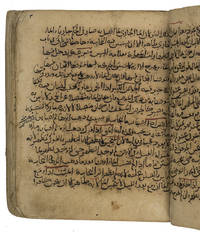
ABC_45853Levant 1290. Contemporary blind-tooled calf mostly covered with later calf leaving only the contemporary back cover exposed. 19th century European paper endpapers. With a loose leaf of 18th century European paper with Arabic manuscript writing on one side. Small 4to in 6s 17 x 14 cm. Arabic manuscript 15 to 17 lines to the page written in clear cursive ta'liq script on brown Middle Eastern paper. With occasional red rubrication. Lengthy and well preserved 13th century Arabic manuscript law book on the fatwa produced in the Levant by an anonymous author. A fatwa is legal advice given by a Muslim authority on request with the purpose of resolving a religious or legal problem that has arisen among members of Islam. The person who gives the legal information is familiar with Islamic jurisprudence fiqh and is referred to as a mufti; the one who asks for legal advice is called Mustafti. According to the famed 13th-century Islamic jurist Ibn al-Qaayyim al-Jawziya mufti were Gods agents". The present anonymous work seems to treat the jurisprudence of the fatwa itself rather than declaring fatwa on something. The title means "The book of kitab analisys or understanding al-waaqi of the fatwa fi'l-Fatawi". As described in the book itself this is the first volume of an unknown total.Fatwas were produced by jurists from the 10th century onward and in the 13th century when the present copy was made several important Islamic lawbooks were compiled in India at the Sultanate of Delhi.Provenance: 1963 Elghanyan to Hagop Kevorkian 1872-1962; sold at Sotheby's 18 April 1983 Kevorkian collection lot 25; private collector.Binding a bit short. Shelf marks on the front pastedown. Later annotations on the 19th century front endpapers. First leaf repaired. A few minor holes throughout paper browned 2 quires in the middle detached. Otherwise in remarkably good condition for its age.l Schoenberg Database: 29775. unknown
Hardcover in-12 cartonnage illustre de l'editeur de XXXVIII-281 pages. Bon etat. [FL-16] Book only - Livre seul.
Hardcover in-12 cartonnage illustre de l'editeur de XXXVIII-281 pages. Near fine - Très bel exemplaire. [FL-16] Book only - Livre seul.
Hardcover in-12 cartonnage illustre de l'editeur de XXXVIII-281 pages. Bon état. [VU-8/83][VU-8/75] Book only - Livre seul.
Fine English Paperback. Roy. 8vo. (23 x 14 cm). In English. 29 p., color ills., a huge map (not opened). Baghdad [Archeological city guide with huge city map]. Foreword by Isa Salman (Director General of Antiquities). Very detailed modern guide including architectural works in Baghdad: Historical shrines, mausoleums and mosques, churches, monuments, etc.
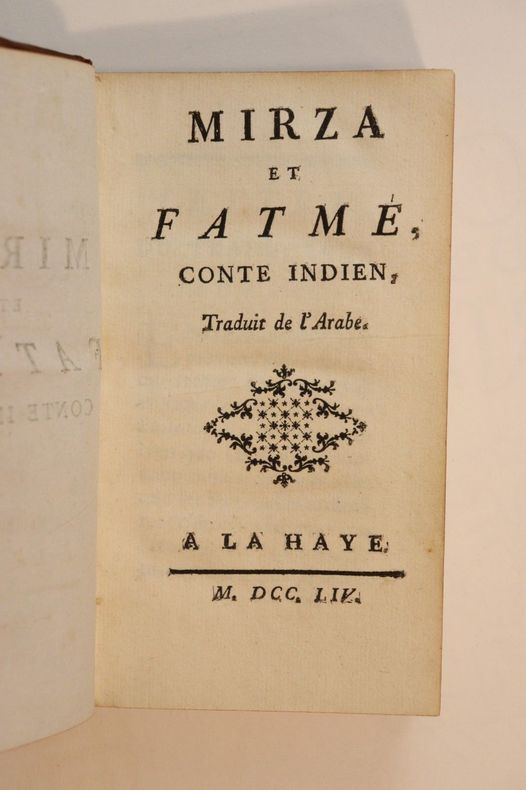
1754AMO-2337A La Haye, 1754 2 parties en 1 volume in-12 (16 x 10 cm) de (2)-322-(6) pages. Reliure de l'époque pleine basane marbrée, dos à nerfs orné, tranches rouges. Usures aux coins et aux coiffes. Petits travaux de vers à la reliure, sans gravité. Intérieur frais avec de légères salissures à quelques feuillets. Complet. Édition originale. "J'ai eu l'honneur de vous parler d'un petit roman, Mirza et Fatmé, à qui la malignité du public a donné une sorte de vogue. Ce roman est encore dans le goût de ceux du comte d'Hamilton et de Crébillon : des fées, des génies, des enchantements, des allégories ; il y a très-longtemps qu'on est excédé de toutes ces choses-là. Cependant les applications très-satiriques qu'on n'a pas manqué de trouver dans plusieurs endroits de ce roman, lui ont fait une espèce de réputation qu'il ne mérite pas ; il n'est pas absolument mal écrit, mais on n'y trouve ni plan, ni conduite, ni intérêt. Je ne sais si j'ai tort d'être tant dégoûté des allégories que je le suis. Ce genre est si froid, si puéril, si insipide. Qu'est-ce que c'est, par exemple, que cette éducation de Mirza, que la fée du malheur a élevée dans l'île des Amis ? Peut-on se résoudre à travestir aussi puérilement une idée qui, quoique commune, ne laisse pas que d'être philosophique : voilà cependant une des plus ingénieuses allégories de ce roman ; ce n'est pas ainsi que nos maîtres en l'art d'écrire avaient de l'esprit. Voici quelques traits qui ont fait le plus de bruit : Le sultan est un prince imbécile, et par conséquent tyran, qui mesure le bonheur de son peuple au poids de son individu, qui veut un ministre qui le fasse rire, et qui prend dans ses titres de qualité de toujours gai, quoi qu'il soit le plus triste des sultans." (Correspondance de Grimm, janvier 1754). La Nouvelle Bibliothèque Universelle des Romans souligne le style vif et pur, et le but vraiment utile de cet ouvrage, puisqu'il tend à démontrer que le malheur est la plus utile des écoles pour tous les hommes, et surtout pour les souverains. Ce qui caractérise particulièrement cet ouvrage intéressant, est-il écrit, c'est la multitude des allégories ingénieuses, sous lesquelles l'auteur peint successivement le malheur, le despotisme, la superstition, le fanatisme, la volupté, l'avarice, l'amour, le désespoir, l'espérance, la terreur, l'amitié, la cour, le peuple, et la philosophie. Il n'est personne de sensé qui ne souscrive aux justes éloges qu'il prodigue à la dernière. "Au commencement du troisième [jour] il se trouve vis-à-vis d'un palais brillant. Le prince approcha, et lut fur le frontispice en gros caractère de diamant : Palais de l'espérance. Il avait été bâti par la Fée de l'Imagination ; on y était introduit par le Génie du Désir : on y attendait tous les jours l'Amour et la Fidélité pour les marier ensemble : le prince, après avoir traversé plusieurs cours, entra par un vestibule de marbre vert, dans un salon tout couvert de glaces de diamant, encadrées dans des bordures d'émeraude : il y avait au milieu un trône de même matière, sur lequel une jeune Fée était assise. [...]" (extrait, pp. 137-138. Où il est question de fées, d'enchanteurs, d'anneaux d'invisibilité ... L'auteur, Bernard-Joseph Saurin (1706-1781), tour à tour avocat, poète et chansonnier, était le fils du mathématicien Jospeh Saurin. Ses tragédies sont oubliées tout autant que ses comédies. S'il ne fallait retenir qu'une seule production de cet auteur ce serait certainement ce conte indien. Bon exemplaire de cet ouvrage peu commun.
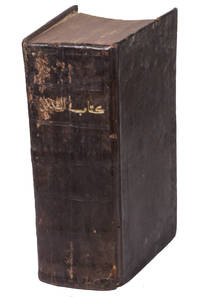
1855ABC_47909London: William Watts 1855. Original elaborately embossed brown calf with the title lettered in gold on the spine red edges. 8vo 22 x 14 cm. Rare edition of one of the best Arabic translations of the Bible. This work is based on the 1671 version from Rome which was the first printed edition of the complete Bible in Arabic. However the version from 1671 was not vocalised written with vowel points but the present edition from London is.The Arabic translation of the Bible from 1671 was done under the direction of Sergius Risi d. 1638 the archbischop of Damascus. It had been requested by the Archbischop of Aleppo and other important figures from the Eastern Church as manuscript copies had become rare and were often found to be incorrect. Risi and his team compared the Arabic manuscripts of the Bible they had access to with Hebrew and Latin versions and then composed their own translation. They first completed the Arabic Pentateuch. The Old and New Testament followed in 1647 and 1650 respectively after Risi's passing. These translations were revised and then finally published in 1671. It was the only Arabic translation of the complete Bible until 1811. Numerous new translations were made in 19th century. The present Catholic edition of the Arabic Bible translation existed alongside the 1860 Protestant translation by Cornelius van Alen van Dyck.According to the title-page this edition of the Old Testament was printed in 1855. However none of the relevant reference works mention an 1855 edition. Since the title-page of the New Testament bears the year 1857 it is possible that the Old Testament was also printed in that year and the date on the title-page is a printing mistake. The 1857 edition is also fairly rare on the market as we have only been able to find it in 1 sales record of the past 100 years.With the label of Watkins' bookbinding factory mounted on the front pastedown and a purple Spanish stamp from the library of someone with a law degree on the final leaf. The edges and corners of the boards are somewhat scuffed the binding is rubbed with some loss of material on the spine. The leaves are somewhat browned mild foxing throughout the back pastedown has a tear in the gutter. Otherwise in good condition.l BM General catalogue vol 2 p. 1276-198/199 other eds.; Darlow & Moule 1684; WorldCat 1402269394 1 copy 1857 ed.; cf. Green Journeymen middlemen: travel transculture and technology in the origins of Muslim printing. In: International journal of Middle East studies vol. 41 2 2009 pp. 203-224. William Watts, unknown
202600257Paris, Sindbad, 1973 ; in-8, 351 pp., br.
60842Paris, Union Latine d'Editions, 1981, 8 volumes reliés pleine peau bleue richement décorée sur les dos et les plats d'un décor arabisant, têtes dorées, grand in 8° (reliure de l'éditeur).
199913971Paris, Esprit, 1999 1 volume 14,8 x 23,9cm Broché sous couverture au 1er plat orné d'une vignette. 307p., 2 feuillets. Bon état.
N°3-4, de Mars-Avril 1999, de la revue fondée par Emmanuel Mounier et dirigée par Olivier Mongin; au sommaire: "Réalignements stratégiques en Asie centrale et en Iran", entretien avec Olivier ROY, "Algérie: les traumatismes de la langue et le raï" par Mohamed BENRABAH; dossier "Le Pari de la réforme": nombreux articles sur les laboratoires de la "troisième voie" et les social-démocraties européennes, et sur le réformisme en France. Français
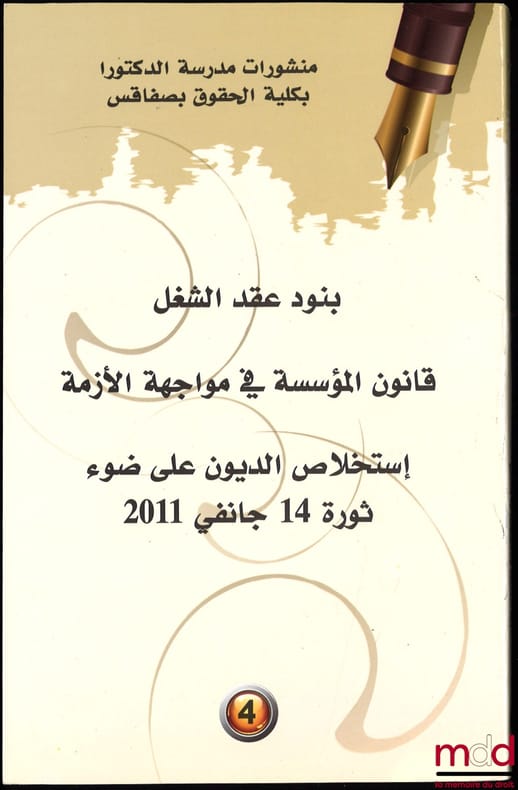
45623, Sfax, École Doctorale de la Faculté de Droit de Sfax 2012, in-8, br., (accroc en couv.) bon état, 338-[1ff.]p.
in-4°, 89 pp., nombreuses photos en couleurs, broché, couverture illustrée. Tres bel exemplaire. [P-18] Catalogue de vente.
1915F0411Paris, Hachette, 1915 ; in-4, 85 pp., reliure d'éditeur pleine toile estampée et imprimée. Contient les contes les plus populaires des 'Mille et Une Nuits' (Ali-Baba, Aladdin, Sheherazade). Nombreux dessins en noir. Bon état.
Paris, Hachette, 1915; in-4, 85 pp., reliure d'éditeur pleine toile estampée et imprimée. Contient les contes les plus populaires des 'Mille et Une Nuits' (Ali-Baba, Aladdin, Sheherazade). Nombreux dessins en noir. Bon état.
LFA-126720464Une plaquette de 14 pages, format 135 x 190 mm, brochée, s.d., Vollot, bon état
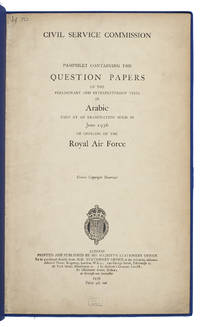
1936ABC_46032London: printed and published at Her Majesty's Stationary Office 1936. Original publisher's printed paper wrappers in later blue paper wrappers. Folio. Printed in English and Arabic. British government publication of an interpretership examination for Arabic translation. It provides the examination questions that officers in the Royal Air Force had to answer correctly to pass as an interpreter of Arabic. The work contains several questions that include translating Arabic texts printed in Arabic type.Library stamp on foot of front cover title-page and pp. 8 and 9: "Liverpool Public Libraries". In good condition.l Consolidated List of Government Publications 1936 p.147; not in WorldCat. printed and published at Her Majesty's Stationary Office, unknown
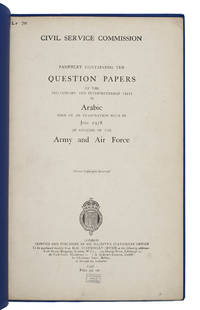
1938ABC_46033London: printed and published at Her Majesty's Stationary Office 1938. Original publisher's printed paper wrappers in later blue paper wrappers. Folio. Printed in English and Arabic. British government publication of an interpretership examination for Arabic translation. It provides the examination questions that officers in the Army and Air Force had to answer correctly to pass as an interpreter of Arabic. The work contains several questions that include translating Arabic texts printed in Arabic type.Library stamp on foot of front cover title-page and pp. 8 and 9: "Liverpool Public Libraries". In good condition.l Consolidated List of Government Publications 1936 p.147; WorldCat 1 copy: British Library. printed and published at Her Majesty's Stationary Office, unknown
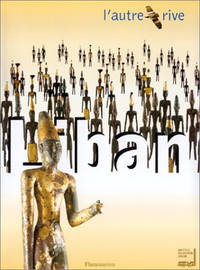
1998PMV521201ZParis: Flammarion / Institut du monde arabe 1998. Hardcover. Good/Good. 240 x 322 x 30 cm. Hardcover • Illustrations en noir et en couleurs jaquette illustrée en couleurs • <b><i>French text original</i></b>. Flammarion / Institut du monde arabe hardcover
in-16°, broché. Bon état. [LP-9] Texte en français et arabe.
23128Probably Persia Circa 18th century. Finely written in Arabic calligraphy in black outlined and highlighted in red and gold. Small Folio 6.5†x 3.75†handsomely presented within a cream mount. A very finely preserved example. Probably Persia unknown