173 résultats
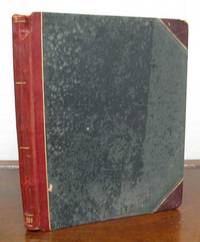
190237237v. p. 1902. Maroon half-leather binding with black cloth boards. General wear with spotting to boards which are bowed. A VG copy. 201 numbered pages of lined paper. 9-7/8" x 7-5/8" <br/><br/>The 'Kilpatrick' began life as the SS Michigan beginning service in September 1891 as a cargo vessel with limited passenger accomodation. In 1898 she was sold to the US government to act as a military transport during the war. She was capable of hauling 840 men and 800 horses. While not an active participant in the Spanish American war she did subsequent duty in transport service to the PI as this log documents. Capt Rogers begins his entries Saturday Dec. 31st 1898 noting relief of Cap. Jeffreys taking command of U.S.A.F. Michigan departing for Havana at 9 pm. The final entry is Sept. 2nd 02 noting position/course details of a "Manila to Frisco" run. This log a first-hand account of the ship's life recording location etc. Details of the Captain's or crew's life are for the most part absent. That being said it is a unique historical document that provides daily facts of the ship it's activities & its location. hardcover books
1898WRCAM54953Puerto Principe Cuba 1898. Broadside 16 1/4 x 12 1/4 inches. Toned old folds and creases minor edge chipping short closed tear slight fold separations. Very good. A very rare possibly unique surviving example of a Cuban broadside dating from the month after the conclusion of the Spanish- American War. The war ceased with a truce between the United States and Spain on August 12 1898; the official end of the war came a few months later on December 10 when the two parties signed the historic Treaty of Paris. Here on September 10 in the interim between truce and treaty the outgoing Spanish colonial governor of the south- central Cuban city of Puerto Principe present-day Camagüey Emilio March y Garcia calls for reinforcement of the truce agreement that would ensure free and open commercial trade in the region in the face of continuing interference by Cuban insurgents. March y Garcia claims that the Cuban revolutionaries are illegally detaining people interrupting the cattle trade trampling property rights carrying arms in flagrant disregard for the law and more. The ARIZONA REPUBLICAN published an English translation of this proclamation in its September 26 1898 issue. The translation reads: <br> <br> "I hereby inform the commanders of insurgent bands who are pillaging in the neighborhood of this city; who not observing the agreement between the Spanish and American governments with regard to the freedom of commercial relations are illegally detaining the country people; who are obliging the land owners to procure special passes and permits in order to put in order their plantations and will not allow them either to sell their cattle under the absurd pretext that the estates are the property of the nominal Cuban state and that its government alone can distribute and sell them and turn their products to what uses it sees fit thus trampling under foot the rights of property whereas on the part of this government the most absolute liberty in making contracts has been allowed and will be allowed in the future thus demonstrating the respect it has for the rights of all persons within its jurisdiction. I must call to notice with real sorrow that if these towns are suffering almost the horrors of starvation it is the result of the measures adopted by the chiefs of the insurgent bands who are impeding free traffic by forbidding the entry of all kinds of provisions especially cattle into the towns. In view of what I have already explained I consider it necessary to publish the following warnings: Article 1. I repeat my order of August 23 last permitting free entry and exit to all towns of this province subject to my authority and the most absolute freedom of trade between all the inhabitants of the province. Article 2. The prohibition to enter towns with arms remains in force and whoever is found with arms in his possession will be punished in accordance with the laws." <br> <br> Don Emilio Augusto March y Garcia Mesa was a career Spanish military commander who spent at least three stretches of time in Cuba the last as military governor of Puerto Principe during the Spanish defeat in the Spanish- American War. He also served as the colonial governor of Puerto Rico and general captain of Arago the Balearic Islands and the Canary Islands. <br> <br> The present broadside is exceedingly rare and quite possibly unique with no copies listed in OCLC and no records at auction. unknown books
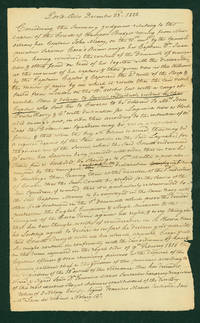
182121602<p>This fascinating archive consists of 27 manuscript documents in English and one in Spanish from litigation between the Baltimore owners of the merchant ship <i>Budget</i> and insurance companies that underwrote its voyage from England to South America. This conflict occurred against a backdrop of the collapse of Spain's American empire as various areas in Central and South America asserted their independence many under the leadership of Simón BolÃvar. The ship carrying weapons and supplies destined for Simón BolÃvar's rebels was captured by a Spanish privateer and condemned in Puerto Rico. The insurance companies refused to pay on their policies leading to two important cases on maritime law neutral rights and the responsibilities of insurance companies.</p> <b>INSURANCE NEUTRALITY SHIPPING SPANISH EMPIRE.</b>Archive of Evidence in <i>Thompson and Bathurst v. Maryland Insurance Company and Thompson and Bathurst v. Phoenix Fire Insurance Company</i> cases 1821-1824. 28 documents 41 pp. most 7¾ x 9¾ in.<p><b>Historical Background</b></p><p>In October 1822 Baltimore merchants Hugh Thompson and Matthew Bathurst insured their ship <i>Budget</i>and its cargo for $5000 with the Maryland Insurance Company and another $5000 with the Phoenix Fire Insurance Company for a voyage from London England to two ports on the "Spanish Main" Spanish colonies in Central America and on the northern coast of South America then back to the United States. The <i>Budget</i> was transporting "munitions of war" from London to the blockaded port of La Guaira Venezuela on the coast ten miles north of Caracas for Simón BolÃvar's rebels in Spanish America.</p><p>On December 1 1822 the Spanish privateer <i>Cora</i> under the command of Captain Don Juan Esiga captured the <i>Budget</i> and had it condemned as a prize of war at a court in Puerto Rico. <i>The Budget's</i>captain John Meany purchased the ship back billing Thompson and Bathurst for doing so. The merchants applied for payment from their insurers in March 1823. By May Thompson and Bathurst had turned over the <i>Budget</i> and its cargo to the Maryland Insurance Company and demanded payment. The insurers demanded more documentation especially of the condemnation proceedings in Puerto Rico. In August the insurance companies returned the copies of the proceedings in Puerto Rico to the ship's owners "to be translated into English." In March 1824 the insurers denied the claims.</p><p>On March 17 1824 the merchants sued the insurance companies in the Baltimore County Court for having "broken their covenant." Chief Judge Stevenson Archer ruled in favor of Thompson and Bathurst. However both the plaintiffs and the defendant's objected to parts of the decisions and filed cross-appeals to the Court of Appeals of Maryland.</p><p>In December 1832 Judge Thomas Beale Dorsey of Maryland's Court of Appeals concurred with the county court's refusing exceptions presented by the insurance companies and dissented on the exceptions offered by merchants. The Court of Appeals therefore ruled in favor of the ship's owners and entered judgment for "a total loss."</p><p><b>Excerpts:</b></p><p>Insurance Policy No. 8881 with the Maryland Insurance Company October 10 1822:</p><p>"<i>Touching the adventures and perils which we the assurers are contented to bear and take upon us in this voyage; they are of the Seas Men of War Fires Enemies Pirates Rovers Thieves Jettisons Letters of Mart and Counter Mart Surprisals Takings at Sea Arrests Restraints and Detainments of all Kings Princes or People of what Nation Condition or Quality soever Barratry of the Master and Mariners and all other Perils Losses and Misfortunes that have or shall come to the hurt detriment or damage of the said vessel or any part thereof.</i>"</p><p>Translation of Order of Francisco Marcos Santaella December 23 1822:</p><p>"<i>Having seen this summary judgment relating to the capture of the transport corvette called the Budget going from New Orleans under the orders & command of her Capt. & supercargo Mr. John Meany the first of the present month by the Spanish Privateer schooner called the Cora or Good Friends armed in this place and under command of her captain Don Juan Esija; taking into consideration the contents of the ships papers & from others found on board together with the declarations taken or made at the time of capture and those which have been made before this tribunal by the captains captor & captured second mate of the corvette and the prize master all tending to show that that vessel sailed from London on the 11th day of October last with a cargo of munitions of War belonging to particular individuals residing in that capitol who destined it for Caracas to be delivered to Messrs. Jones Pawly Harry and C<u>o</u> in Laguira at that time a port blockaded by the enemy in order that pursuant to the particular intention of M<u>r</u> Zeas the Columbian Squadron sh<u>d</u>be placed upon a respectable footing; and for this purpose was to be fitted out the Brigantine New Orleans & to make a regular deposit of said articles at the s<u>d</u> Laguira for the general use of the service where the s<u>d</u>corvette made efforts to enter the said captain bearing orders in case he found the place actually blockaded to carry her into S<u>t</u> Martha a port also occupied by the Insurgents and comprehended in the same declaration of blockade where she sh<u>d</u> be discharged and the cargo left to the judgment of the said individuals of Caracas; that the same Corvette sh<u>d</u> be offered for the service of s<u>d</u> Squadron whenever it shd be found needful that it shd be particularly recommended for the said Capt Meany to be employed in the marine service; with various other particulars which the said document contained and showing the decided protection which the European English and Anglo Americans afford to the insurgents of the continent contrary to all right and how much more worthy would it have been to have refrained out of respect for a short time.</i>"</p><p>Also the original order in Spanish December 23 1822 with a certification by Judah Lord "<i>Commercial Agent of the United States of America for Port Rico</i>" January 2 1823.</p><p>Thompson and Bathurst to President and Directors of Maryland Insurance Company March 12 1823:</p><p>"<i>Having received advise from Captain Maney that he had purchased the Ship Budget after her having been condemned and drawn on us for amount of Cost & Disbursements; we wish to know if we may calculate on receiving from you the amount insured in your Office at the stipulated time expressed in your Policy; say 90 days from proof of loss</i>"</p><p>Thompson and Bathurst to President and Directors of Maryland Insurance Company May 7 1823:</p><p>"<i>We abandoned to you on the 6<u>th</u> February last the Ship & Freight of Ship Budget insured in your Office by Policy N<u>o</u>8881 and at same time handed you a Certified Copy of the Condemnation of said Ship at Porto Rico. The Period of time required by your Policy for payment of Loss after proof thereof having now expired we beg leave to call upon you for the amount thereof.</i>"</p><p>President John Hollins of Maryland Insurance Company to Thompson and Bathurst May 24 1823:</p><p>"<i>Your letter of the 21st Inst has had the attention of a full board of Directors who have instructed me to inform you that they will advance to you $4498.75 on receipt of your & R. Oliver Esqrs joint note at six months bearing interest at the expiration of which time or sooner if convenient you are required to produce to this Company the following documents relative to the Ship Budget Viz The proceedings of the Court at Porto Rico The Log book or authenticated copy thereof The Charter Party or copy authenticated upon receipt of which & their proving satisfactory an adjustm<u>t</u> of the loss shall take place.</i>"</p><p>President John Hollins of Maryland Insurance Company to Thompson and Bathurst March 4 1824:</p><p>"<i>The board of Directors have instructed me to inform you that they do not consider the Company answerable for the claim you make for the ship Budget & freight insured by policy No 8881 this opinion they have formed from advice given by Mr Wirt & Mr Purviance who have had the case under their consideration.</i></p><p>"<i>I am also instructed to say to you that if your note in favor of Messs Rob. & Jno Oliver & by them endorsed for $4498.75 with interest & cost of protest be not taken up & paid at the Bank of Baltimore where it now lays on or before the 10th Inst it will be handed to Mr Purviance to be put in suit against you & those Gentlemen we hope you will prevent this unpleasant business but if not you will know the blame will not be chargeable to this Company.</i>"</p><p>Thompson and Bathurst to President and Directors of Maryland Insurance Company March 9 1824:</p><p>"<i>we are sorry to learn you still seem determined not to admit your liability for the Loss on the Ship Budget condemned at Porto Rico.</i>"</p><p>"<i>We had hoped that the very clear and decided opinions handed you of Mess<u>rs</u>Ogden & Binney Lawyers considered as the best informed in this Country on Marine Insurance would have removed all doubts & have been conclusive on that subject.</i>"</p><p>"<i>It is extremely unpleasant to us being under the necessity of resisting the payment of our Note which our Counsel have advised us to do; at same time we feel confident the result will prove we are in the right & justifiable in doing so.</i>"</p><p><b>Matthew Bathurst</b> 1778-1847 and <b>Hugh Thompson</b> 1760-1826 were partners in a general mercantile business in Baltimore Maryland.</p><p><b>John Meany</b> 1770-1841 was a sea captain in the merchant service and then a merchant and ship-owner in Philadelphia. For many years Hugh Thompson employed him.</p><p><b>John Hollins</b> 1760-1827 was a banker in Liverpool before immigrating to Baltimore where he became a successful merchant. He was president of the Maryland Insurance Company from 1802 to 1827 and he held a variety of local offices.</p><p><b>Simón BolÃvar</b> 1783-1830 was born in Caracas and educated in Spain and France. He joined the group of patriots that seized Caracas in 1810 and proclaimed independence from Spain. He went to Great Britain in search of aid but could get only a promise of British neutrality. When he returned to Venezuela and took command of a patriot army he recaptured Caracas in 1813 from the Spaniards. The Spaniards forced BolÃvar to retreat from Venezuela to New Granada now Colombia also at war with Spain. He took command of a Colombian force and captured Bogota in 1814. The patriots however lacked men and supplies and new defeats led BolÃvar to flee to Jamaica. In Haiti he gathered a force that landed in Venezuela in 1816 and took Angostura now Ciudad BolÃvar. He also became dictator there. BolÃvar marched into New Granada in 1819. His forces decisively defeated the Spaniards at Boyacá in 1819 liberating the territory of Colombia. He then returned to Angostura and led the congress that organized the original republic of Colombia now Ecuador Colombia Panama and Venezuela. BolÃvar became its first president on December 17 1819. BolÃvar crushed the Spanish army at Carabobo in Venezuela on June 24 1821. Next he marched into Ecuador and added that territory to the new Colombian republic. After meeting with another great liberator José de San Martin in 1822 BolÃvar became dictator of Peru in February 1824. His army won a victory over the Spaniards at Ayacucho in December 1824. Upper Peru became a separate state named Bolivia in BolÃvar's honor in 1825. He stepped down as president of Gran Colombia in January 1830 and died of tuberculosis eleven months later.</p> books
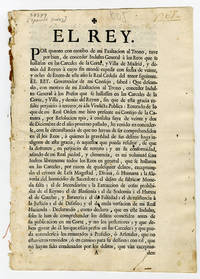
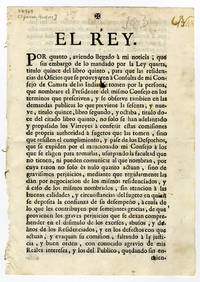
1760WRCAM37579Madrid 1760. 5pp. plus integral blank leaf inscribed. Folio. Dbd. Maltese cross at head of titlepage. Contemporary manuscript inscription and later pencil inscription at top of first page. Accomplished in manuscript at Buen Retiro Spain on Dec. 28 1770. Signed by Juan Manuel Crespo with additional annotation on last page of printed text and additional inscription on verso of last page of text. Integral blank leaf with manuscript note related to the cedula on recto and verso. Very good. A rare detailed royal cedula issued by Charles III King of Spain ordering a general pardon of accused individuals to be enacted throughout the Spanish Indies. Citing earlier royal proclamations issued previously by Charles III concerning clemency for prisoners this cedula reprints texts of decrees from January and February 1760. While most prisoners were to receive pardons a long list of exceptions based on the Jan. 28 cedula is provided. These included those accused of secular and religious treason killing a priest counterfeiting money arson blasphemy sodomy robbery falsehoods and duelling. Numerous other details regarding the earlier clemencies are also provided. The present royal amnesty was to be distributed to the viceroys presidents audiencias governors and other judges throughout the Indies in order that this resolution by properly executed. <br> <br> This copy accomplished in manuscript at Buen Retiro on Dec. 28 1770 is signed by Juan Manuel Crespo with the additional annotation: "Yo El Rey. Por mandado del Rey Nuestro Señor." A manuscript inscription on the blank verso of the final printed page dated Feb. 27 1762 confirms that the decree had been reviewed two days earlier by the President and other high officials in Santiago de Chile. A manuscript note in a separate hand on the recto and verso of the integral blank leaf provides additional information about the receipt of the document in Santiago in 1762. <br> <br> A rare and highly informative proclamation regarding royal pardons to be enacted throughout the Spanish New World and in Spain. Not in OCLC Medina BHA or Palau. unknown books
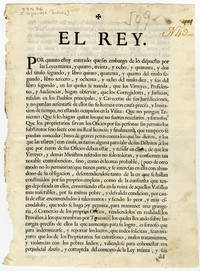
1758WRCAM37576Madrid 1758. 3pp. Folio. Dbd. Maltese cross at head of title. Contemporary manuscript inscription in ink and later pencil inscription at top of first page. Accomplished in manuscript see below with additional inscription on p.3. Additional manuscript inscription on blank verso of final printed page. Extremely light dampstaining in margins occasional light soiling. Very good. A rare royal cedula issued by Ferdinand VI King of Spain confirming earlier published laws stating that viceroys presidents and audiencias are to ensure that corregidores and justices reside in the principle towns and headquarters of their jurisdictions. The decree also states that the judges are not to be absent from their principle residences except under special circumstances when a license is issued indicating the precise cause for the absence and the length of time the judge will be away. In addition the judges can not name their own "lieutenants" or assistants nor can the viceroys presidents and audiencias name judges' assistants without royal approval. This copy accomplished in manuscript at Villaviciosa Spain on Sept. 7 1758 is signed by Juan Manuel Crespo with the additional inscription "Yo El Rey" and the annotation "Por mandado del Reyno exo. señor." A manuscript inscription on the blank verso of the final printed page dated Dec. 4 1759 confirms that the decree has been reviewed by the President and other high- ranking officials in Santiago de Chile. <br> <br> A rare proclamation regarding colonial judges in Spanish dominions throughout the New World. Not in OCLC Medina BHA or Palau. unknown books
1759WRCAM37578Madrid 1759. 3pp. Folio. Dbd. Maltese cross at head of title. Contemporary manuscript inscriptions in ink at top of first page. Accomplished in manuscript at Villaviciosa Spain on Feb. 18 1759 signed by Juan Manuel Crespo with additional inscription on p.3. Light dampstaining in margins occasional light soiling. Very good. A rare royal cedula issued by Ferdinand VI King of Spain confirming that the Secretaries of vice-royal chambers throughout the Americas do not have the rights privileges and emoluments held by governors corregidores and alcalde mayores. The decree refers to past abuses of power and finance by secretaries which were harmful to the realm and directs viceroys presidents and governors to ensure that secretaries officials and other dependents do not assume privileges which are not appropriate to their position. This copy accomplished in manuscript at Villaviciosa Spain on Feb. 18 1759 is signed by Juan Manuel Crespo with the inscription: "Yo el Rey. Por mandado del Rey Nuestro Señor." In addition the inscription notes that this printed text is a copy of the royal cedula located in the books of the Secretary of Peru located in Madrid as of March 31 1759. <br> <br> A rare proclamation regarding the limits of compensation for particular royal officials in Spanish dominions throughout the New World. Not in OCLC Medina BHA or Palau. unknown books
1778WRCAM37240Madrid: Pedro Marin 1778. 219262pp. plus engraved leaf with royal coat of arms. Quarto. Contemporary mottled calf gilt spine gilt extra. Edges of covers slightly worn corners heavily worn. Modern bookplate on front pastedown old book dealers' descriptions on front pastedown. Contemporary ownership inscription "Castillo" on titlepage. Occasional minor soiling and dampstaining in upper margins of a few leaves remainder of text fresh and clean with wide margins printed on heavy paper. Very good plus. Detailed rules and regulations governing Spain's late 18th-century commercial policy in Latin America with a preliminary section of nineteen pages providing a summary of the articles and tariffs documented in the main portion of the text. With this REGLAMENTO. the Crown terminated Cadiz and Seville's monopoly of trade with Spanish America allowing other cities of the realm to participate. In addition to much information on commerce and numerous tariffs on a large variety of Spanish and American goods several sections discuss shipping ports and other maritime activities directly related to commercial activity. The work also includes the text of concessions granted to Louisiana. PALAU 255843. SABIN 68890. MEDINA BHA 4845. Pedro Marin unknown books
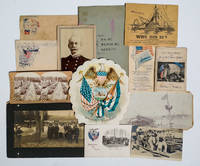
21688On February 15 1898 a mysterious explosion destroyed the battleship USS Maine while it was anchored in Havana Harbor killing 260 men and helping to propel the United States into war with Spain. Although the cause of the explosion was unclear American newspapers were quick to allege that the ship had been brought down by a Spanish bomb. Led by William Randolph Hearst in the New York Journal and Joseph Pulitzer in the New York World the press demanded action. Hearst's headline "Remember the Maine!" became a rallying cry that helped turn American public opinion strongly in favor of war with Spain. By April President McKinley had given into to additional pressure from hawkish senators and his own vice-president Theodore Roosevelt and war was declared. Although brief the Spanish-American War had important consequences. It ended Spain's colonial empire in the Western Hemisphere and secured the position of the United States as a Pacific power. "U.S. victory in the war produced a peace treaty that compelled the Spanish to relinquish claims on Cuba and to cede sovereignty over Guam Puerto Rico and the Philippines to the United States. The United States also annexed the independent state of Hawaii during the conflict. Thus the war enabled the United States to establish its predominance in the Caribbean region and to pursue its strategic and economic interests in Asia" Office of the Historian U.S. State Department.<br/><br/>This collection consists of approximately 120 items including original photographs printed and real photo postcards stereoviews commemorative programs patriotic covers postal stamps calling cards song sheets lithographs and other ephemera showing the Maine as she appeared before the disaster the wreckage and salvage efforts the funeral service and burials of the victims first at Cristobal Colon Cemetery in Havana later at Arlington National Cemetery and some of the myriad ways in which the Maine was memorialized and mythologized in American popular culture. Original photographs and real photo postcards capture the ship and crew prior to the disaster crowds of sailors lined up to pay their respects to the victims the coffins being transported the cemetery dotted with freshly dug graves elaborate floral wreaths and memorials and salvage efforts in the immediate aftermath of the disaster and in 1911 when the ship was raised before being towed out to sea to its final resting place at the bottom of the ocean. The wide reach of the patriotic feelings aroused by the disaster can be seen in two cabinet cards of young children wearing U.S.S. Maine hats as well as on items that have no military or national connection e.g. a high school commencement program a blotter advertising corsets yet bear images of the Maine or the "Remember the Maine" slogan. On envelopes and stationery we see images of Uncle Sam punching a Spainiard an eagle dubbed "the New Bird in Havana Harbor" and troops walking toward a ship under the heading "On to Cuba." A mendicant uses the Maine as his theme on a card handed out to solicit alms; a song by a writer of sensational crime broadsides is reported to have been "composed and written during the indecision of the U.S. Government" and urges "Let's show all foreign powers Aye the haughty sons of Spain they will brook no insult like the Sinking of the Maine." A particularly unusual item is an envelope illustrated with an image of the remains of the ship captioned "WHO DID IT" containing illustrated sheets of tissue with instructions to blow them up via a small "fuse" on the back. In all an illuminating collection that helps demonstrate the impact of both the incident and how it captured the popular imagination -- such that many Americans still recognize the "Remeber the Maine!" rallying cry today even if they no longer know what it represents. unknown books
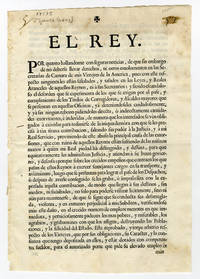
1758WRCAM37969Madrid 1758. 3pp. Folio. Dbd. Maltese cross at head of title. Contemporary and later manuscript annotations in ink and later pencil annotation on first page. Accomplished in manuscript with additional manuscript annotations. Manuscript inscription on blank verso of final printed page. Extremely light dampstaining in margins occasional minor soiling and ink stains the latter touching a few letters. Very good. A rare proclamation by Ferdinand VI King of Spain demanding that earlier laws regarding the appointment of judges in the Spanish Indies be observed. The decree states that disregard of these laws and guidelines in the past has been a great injustice causing injury to royal interests and to the general population. This proclamation was to be sent to the viceroys and audiencias throughout the Spanish Indies. This copy accomplished in manuscript at Aranjuez Spain on August 20 1758 is signed by Juan Emanuel Crespo with the inscription "Yo El Rey" and the annotation "Por mandado del Reyno exo. señor." A manuscript inscription on the blank verso of the final printed page dated December 4 1759 confirms that the decree had been reviewed by the President the fiscal and other high-ranking officials in Santiago de Chile. Not in OCLC Medina BHA or Palau. unknown books
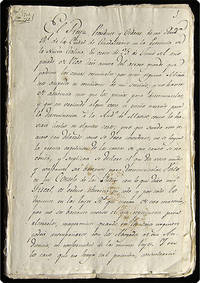
18504251850. 8vo. 215 x 160 mm. 8 ½ x 6 ¼ inches. 306 leaves chapters separated by blanks. 19th century leather backed marbled paper boards; inner hinge cracked edges bumped some abrasion to the head of the spine; sound. Beautifully written manuscript volume containing an extensive discussion of library management and practices written by an anonymous Spanish author in the middle of the 19th century. This dissertation organized in 70 chapters begins with a discussion of the library profession and its importance to civil society. His first chapters describe the "Archive" with reference to Spanish monastic governmental and diplomatic collections that have been preserved. He focuses his attention on Aragon Mallorca Navarra and Santiago. He turns to France to furnish some interested information on the archives in Paris before getting into the chapters on classification of materials and the creation of inventories. After nearly 200 leaves of text on the subject of archives the authors turns his attention to libraries. From the beginning he takes a historical approach focusing his attention on both books and manuscripts mentioning the collections at Cambridge University. Paleography is a subject he spends some time describing and then he moves into the history of printing typography Gutenberg and the spread of printing to Spain. The final dozen chapters are devoted to the rules for managing a library lessons in classification and inventory control. He quotes from both DeBure and Brunet in his lessons on cataloguing. A rather remarkable piece of work thought to be unpublished. An examination of both United States and Spanish national collections turned up no reference to this anonymous piece of library scholarship. unknown books
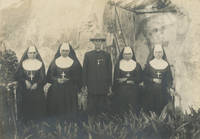
1900List518Most Cuba or Jacksonville 1900. Silver gelatin or albumen photographs various sizes ranging from 3 x 3 to 6 x 8 most captioned to verso. With handwritten manuscript four leaves discussing various diseases. The Spanish-American War was the first war in which nurses formed their own dedicated units as well as the first war in which they were accepted within military hospitals. While no nurses died in battle 153 died during the war from disease. Nurses were responsible for both treating soldiers as well as maintaining sanitary conditions within the camps. Conditions were often poor leading some to work until they were too sick to continue. <br /><br /> The current collection of photographs documents the experiences of a Mrs. Waters who was originally from Groton Massachusetts. The collection begins with a couple early photographs including a portrait as a young woman and a cyanotype of one of Waters' leprosy patients at Johns Hopkins Hospital in Baltimore. The next section shows Waters' training in Jacksonville Florida with either the Fourth or Seventh Army Corps at what was called Camp Cuba Libre both Corps trained there in 1898. The photographs of Jacksonville show life around the military camp and environs with some notable photographs of African-American inhabitants of the region. Three photographs quite notably show the Congregation of American Sisters a small group of American Indian nuns led by Reverend Francis Craft. The photographs taken in Cuba are notable for their portrayal of local life. Several photographs of military installations are taken around the "trocha" or line established by General Valeriana Weyler from Mariel to Majana. Another notable photograph is a cabinet card of a large group of nurses taken by the Havana photographer R. Testar. <br /><br /> The group overall shows very early photographic records of military nurses in training as well as a scarce photographic record from a woman in a combat situation. The photographs are generally well preserved in very good to excellent condition with some light fading. Accompanying the photographs is a four page manuscript essay presumably by Waters discussing leprosy as well as the booklet Spanish Phrase Book for American Soldiers and Sailors published by the National Relief Commission of Philadelphia. <br /><br /> Offered in partnership with Daniel / Oliver Gallery. books
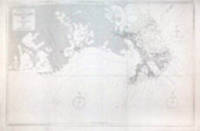
188015998Madrid: Published by the Spanish Admiralty 1880. Engraving. Printed on wove paper. In excellent condition. Image size: 24 x 37 1/4 inches. A wonderful sea chart of the Mississippi Delta produced by the Spanish Admiralty at the close of the nineteenth century.<br/> <br/>This is an impressive sea chart of the Mississippi Delta produced by the Spanish Admiralty in 1880. The coast line is clearly mapped out with little detailing except for the soundings around the Delta. There are two compasses and a number of lighthouses identified along the shoreline. The chart uses the surveys conducted by the U. S. Coast Survey which were carried out between 1853 and 1877. It is a wonderful chart of this important area and superb collector's piece for anyone interested in early maps of the Americas. Published by the Spanish Admiralty unknown books
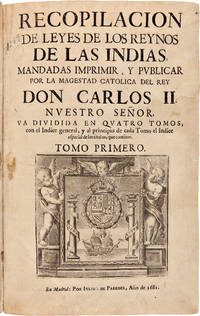
1681WRCAM40803Madrid 1681. Three volumes of four. 5299; 3298; 3302 leaves. Lacks the fourth volume and one preliminary leaf in first volume. Folio. Later sheepskin leather labels. Binding rubbed at extremities. Light soiling to titlepages titlepage of first volume backed with paper. Minor soiling to text; some heavier dampstaining to first volume. Overall very good. The first comprehensive compilation of the laws of the Spanish Indies. Antonio RodrÃÂguez de León Pinello compiled it by 1635 but it circulated only in manuscript until Fernando Jiménez de Paniagua brought it up to date and saw the work through the press in 1681. Prior to the publication of this massive work it was common practice for lawyers and courts in the various legal districts of the New World i.e. audiencias to compile in manuscript the laws in force in order that they might be used as precedents. Upon publication of this code the number of precedents did not decrease but increased: the courts continued to accept the cases and laws in the old local manuscript compilations as well as those on point and laws contained in the Recopilación. In sum this is a major work for all collections of international and Hispanic specific law. SABIN 68386. PALAU 252516. EUROPEAN AMERICANA 681/135. hardcover books
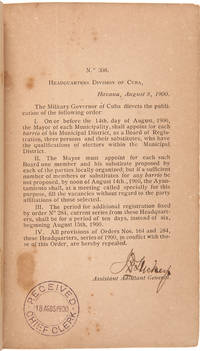
1900WRCAM51843Havana 1900. Approximately 520; 600pp. including several folding charts. Over 200 separate imprints. Original half leather and brown cloth boards spine gilt. Corners and edges worn spine rubbed boards scuffed. Initial leaves of first volume torn away but present. Several other leaves chipped and torn throughout. With many official signatures and docketing stamps. Good. Two volumes of orders promulgated in 1889 and 1900 by the American military government of Cuba after the cessation of hostilities in the Spanish-American War. Under the terms of the Teller Amendment to the Congressional Joint Resolution for war with Spain in 1898 the United States denied the intention of using the conflict as a pretext for the annexation of Cuba and promised to leave the island following the termination of the war. The American military therefore oversaw the creation of the new independent Cuban government before departing in 1902. The documents contained in this collection consist of over two hundred orders in both English and Spanish from the Headquarters Division of Cuba that helped to shape the emerging civilian government. They include instructions for the running of elections the organization of the courts and school system the appointments for various government offices provisions for tax regulations and many other critical issues facing Cuba at its independence. The directives cover two periods from January to July in 1899 and from July to September in 1901. Many of the orders are signed in manuscript by the assistants to the military governor for the island Gen. Leonard Wood including assistant adjutant generals J.B. Hickey and L.W.V. Kennon and Brig. Gen. Chief of Staff Adna R. Chaffee. An interesting documentation of the first American occupation of Cuba. hardcover books
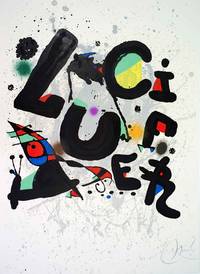
1197Original lithographic poster in color. published by the Martha Graham Dance Company New York printed by Maeght Paris 1975. Mourlot 1050. <br /><br />Copy #51 of 75 signed by Miro in pencil on handmade paper there were also 500 unsigned copies with "letters" published as an advertising poster for the performance. Mourlot. The Lithographs of Joan Miro #1050; Picazo. The Posters of Joan Miro #86. 31" x 21". Image/sheet size 30 3/4 x 22 1/4 in. 78.0 x 56.4 cm unmatted Deckled edges. <br /><br />Miro created this lithograph as an advertising poster for the modern ballet Lucifer performed by the Martha Graham Dance Company featuring Margot Fonteyn and Rudolf Nureyev as guest artists. Lucifer premiered June 19 1975 at The Uris Theater in New York City as the main feature of The Martha Graham Gala. <br /><br />In Martha Graham's words "Many people have asked me why I did Lucifer with Rudolf Nureyev. Lucifer is the bringer of light. When he fell from grace he mocked God. He became half god half man. As half man he knew men's fears anguish and challenges. He became the god of light. Any artist is the bringer of light. That's why I did Lucifer with Nureyev. He's a god of light. And Margot Fonteyn was such a glorious complement to him at it. Luminous as night. When I first saw Margot Fonteyn she was a great and beautiful figure." Unidentified interview with Martha Graham 1975.<br /><br />Fonteyn provides background as to the Premiere of Lucifer in 1975. "It was certainly a star occasion. Tickets for the performance went on sale from $10000 down to $50. Fans wore Martha Margot Rudi buttons. Among other things the Gala may have been a sort of official celebration of the marriage between classical ballet and modern dance. Martha dominated her Gala from a Chinese chair beside the proscenium arch where she announced each ballet. The fashion designer Halston made the Lucifer costumes." It was the first performance for Fonteyn without toe shoes. Margot Fonteyn Autobiography Knopf 1976<br /><br />Provenance: Through the family of former Rhode Island governor and United States senator John Orlando Pastore 1907-2000. books
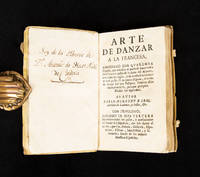
175834566Madrid: The Author 1758. 16mo. ca. 150 x 103 cm. Full contemporary vellum with manuscript titling to spine leather ties. 1f. recto title verso blank 1f. "Al Lector i privileges dated July 2 9 and 10 1737 iii "Advertencia" 72 pp. text 20 engraved plates of choreographic notation of dances including those by Feuillet and Pecour with music with alternate rectos and versos blank as issued. With one folding plate of engraved music between pp. 35 and 37.<br/><br/>With charming woodcut depictions of both male and female dancers one with an accompanying musician illustrating positions of the arms and feet and dance etiquette including bowing and managing one's hat. Diagrams and choreographic notation within text. <br/><br/>The final textual section "Explicacion del Danzar a la Española" offers detailed definitions of 46 steps used in Spanish dance followed by descriptions of "Danzas a la Española ." including the pabana the gallarda the españoleta the villano the impossibles and the hermosa. <br/><br/>Plates include:<br/>- Explicn. de la Chorographia<br/>- Movimentos de los Brazos Codos etc.<br/>- Demonstracion de la Bretaña<br/>- Rigodon ô Allegro de la Bretaña<br/>- El Amable con otra Chorographia<br/>- La Pastoril demonstda. redonda y larga<br/>- La Diligenta delinda. â lo largo ô larga<br/>- La Cortesana Cont. quadrada ô en quadro<br/><br/>Free front endpaper with elaborate contemporary paraph verso with contemporary inscription: "Soy de la Libreria de Dn. AntonÃo de Hozes Ferñz de Cordova."<br/><br/>Binding slightly worn; ties partially lacking; endpapers slightly worn; free front endpaper slightly stained. Minor internal wear and soiling; some leaves browned; occasional foxing; several small virtually invisible professional archival repairs. Rare third edition of the work demonstrating the foundations of dancing in the French style considered of greater elegance than the Spanish first published in 1737. Derra de Moroda 1856 edition of 1758. Malkin 79 edition of 1737. Niles & Leslie pp. 360-361 edition of 1758. Waterloo p. 144 RISM Écrits p. 587 editions of 1758 and 1768. All with variant titles no recorded copies with this title. <br/><br/>Minguet's manual incorporates material from two other important early 18th century dance treatises Feuillet's Chorégraphie Paris 1700 and Rameau's Le Maître de danser Paris 1726.<br/><br/>"A compilation of Feuillet Rameau and De la Cuisse. His engravings however are superior to the originals of the fore-mentioned and make his Arte de Danzar perhaps the most important treatise in 18th century Dance literature in Spanish." Niles & Leslie<br/><br/>"Spain was one of the first countries to record its social dances in a system of dance notation and notation was to be an important element in dance manuals of the eighteenth century. The first Spanish book devoted entirely to dance was Discursos sobre el arte de danzado 1642 by Juan de Esquivel Navarro dancing master to Philip IV. The next dance book by Bartolemé Ferriol y Boxeraus did not appear until a century later in 1745. Pablo Minguet e Irol a famous engraver as well as an author and translator published works on a wide range of subjects; his dance books included several important works which incorporated the French dance notation of Raoul-Auger Feuillet." International Encyclopedia of Dance 5 p. 670. <br/><br/>"A particularly lovely set of illuminations can be found in Pablo Minguet e Yrol's Arte de danzar à l a francesca." op. cit. 6 p. 124. <br/><br/>Antonio de Hoces Fernández de Córdoba 1722-1782 was a "Master of Seville" and served as mayor of Cordoba. [The Author] unknown books
150136083Madrid Barcelona & elsewhere: Various publishers 18281927. Mostly small 8vo. Bound in 43 volumes. <br><br>This considerable gathering of Spanish 19th- and early 20thcentury plays includes in 43 sammelbande plays by Hartzenbusch Rodriguez Rubi Breton de los Herreros Lopez de Ayala Garcia Gutierrez Echegaray Zorrilla Eguilaz Gil de Zarate and many others. => One play was expressly written for the actress María Ana de Jesús Guerrero Torija. => Three of the plays are presentation copies from the playwrights.<br>Â Â Â Â Evidence of Readership: Six plays are marked up either as prompt or acting copies or by very interested readers.<br>Â Â Â Â => A list of the collection is available. All volumes are in good condition except one which has waterstaining throughout. Texts sometimes have foxing or stains. Ten plays lack title-leaves. Such condition problems have been taken into account in establishing the price. Various publishers unknown books
150734851Barcelona Madrid Valldolid Spain Aranjuez Mexico City & elsewhere 170179. Small 4to folio & larger. Approximately 135 ff. <br><br>Explaining why manuscript cedularios were made in the era of the printing press is called for here and the answer is simple: The number of copies that were printed of any given royal cédula tended to be smaller than the number of lawyers clerks judges and other legal sorts who needed a copy. And within months of the issuance of the decree no printed copies were available for love or money. Owning the various editions of the Recopilación de leyes de Indias was insufficient for most cédulas related to => specific issues peculiar to one person place institution or event and such specificity is not included in the recopilaciones though the royal decrees provided good useful precedents to cite.<br>Â Â Â Â QED: Every colonial-era lawyer had to resort to maintaining his own cedulario.<br>Â Â Â Â This cedulario was assembled in Mexico during the 18th century probably around 1778 or 1780 for the use of a lawyer before the audiencia or perhaps for an audiencia judge or a judge's staff member. The decrees relate to a wide variety of topics: criminal cases the army and navy confiscation of property the use of stamped paper the royal treasury royal officials in Nicaragua cabildos proselytization of Indians commodities dress codes bigamy and other social matters in the regions of Mexico New Galicia and Guatemala. Of the 43 items 22 are printed decrees all but one printed in Spain and the remaining 21 are manuscript. Fifteen bear => true rather than stamped royal signatures: six are signed by Felipe V and nine are by Ferdinand VI. Of the 28 documents not signed by a king 17 are printed and 11 are manuscript. The documents are sewn and were once bound; binding removed some time ago. 18th-century numbering of documents shows that 10 documents were removed som time before the collection came into our hands. There are some stains a few holes at folds a few edges a little tattered nothing worse. => A sound and interesting collection. unknown books
155067900First Edition in Spanish of Ecclesiasticus BIBLE IN SPANISH. ENZINAS Francisco de translator. Ecclesiastics. Libro de Jesus Hiio de Syrach qu'es llamado el Ecclesiastico. traduzido de Griego en lengua Castellana En Leon i.e. Strassburg: en Casa de Sebastian Grypho i.e. Augustin Fries 1550. First edition in Spanish of Ecclesiasticus. Small octavo 6 x 3 5/8 inches; 151 x 91 mm. 3 109 leaves. With numerous woodcut initials. With an imitation Gryphius woodcut device printed in reverse on title. We could only locate 3 copies at libraries Cambridge Madrid and Copenhagen. No other copy besides this present copy has been at auction in the past 50 years. Early 19th-century mottled sheep. Boards tooled in gilt. Spine stamped in gilt. With red morocco spine label lettered in gilt. Board edges tooled in gilt. Marbled endpapers. Some minor dampstaining mainly to lower blank margin of preliminaries. Signature G is toned. Leaves O3 and O4 with marginal paper repair not affecting text. Final leaf is toned and has a near invisible paper repair not affecting text. Overall a very good copy. "A native of Burgos educated at Louvain and Wittenberg Francisco de Enzinas 1518-52 was a humanist scholar and Protestant convert who produced the first Spanish version of the New Testament printed in 1543 in Antwerp. He formed a partnership with the Strassburg printer Augustin Fries to publish Spanish translations of Greek classics and the remainder of the Bible of which he was only able to complete Psalms Ecclesiasticus Job and Proverbs before his death. Baudrier VIII 241 not having seen or located a copy citing Brunet supplement II 712" "Even before the complete edition of Castellio's Latin Bible appeared Enzinas who had already produced a Spanish Bible New Testament in Antewerp in 1543 had translated the Psalter the Wisdom of Solomon Jesus Sirach present copy and the book of Job into Spanish. All of these appeared with the false address 'En Leon en casa de Sebastian Grypho' though they were in fact his translations from manuscript versions of Castellio's edition. Enzinas continued to work on his translations until his death on 30 December 1552. He had planned to have his Spanish Bible printed in Geneva but this fortunately for Calvin never came to pass." Gilly Spanien und der Basler Buchdruck pp. 342-9 510-11. Found in Sebastian Castellio 1515-1563: Humanist and Defender of Religious .By Hans R. Guggisberg Bruce Gordon. "FRIES Augustine: printer in Zurich and Strasburg began to print at the former place about 1540. In 1547 he printed two books in English by John Hooper Heitz p. 39. Soon after this he moved to Strasburg and there printed among other things several works in Spanish by Franzisco de Enzinas in 1550 and 1551 Wiffen I pp 179 etc." A Century of the English Book Trade: Short Notices of All Printers. By Edward Gordon Duff. HBS 67900. $8500 en Casa de Sebastian Grypho [i.e. Augustin Fries] hardcover books
19601338Pablo Picasso Spanish 1881 - 1973<br /><br /><b>Vallauris Exposition 1960</b><br /><br />Linocut on Arches Bloch 1290 signed in pencil "Picasso. " 1 of 170 copies. Image Size: 25 x 21 inches. Size: 29.5 in. x 24.5 in. 74.93 cm x 62.23 cm.<br /><br />In the late 1940s Picasso became interested in ceramics. He wanted to design a ceramic form that could be produced in a small limited edition just as he would produce a print on paper.<br /><br />In 1953 Picasso met artist Jacqueline Roque at Madoura Pottery in Vallauris where she worked. Together they created his ceramics. In 1961 they married and moved to Mougins France where Picasso continued creating ceramics until his death in 1973.<br /><br />Annually he created a poster to advertise his show and sale of new ceramics. This run of posters included a small signed limited edition on special paper as here. Nicely framed. Picasso books
1617WRCAM34089Madrid: Por la viuda de Alonso Martini 1617. 4344 leaves plus several pen and ink illustrations. Folio. Later speckled calf maroon gilt morocco label spine gilt. Covers with slight wear and scuffing at extremities. Faint dampstain in lower margin. Occasional contemporary manuscript notes and marks. Overall internally clean. Very good. A comprehensive list of rules addressed to ship captains governing the proper provisioning of Spanish vessels based in Sicily and Naples both then under Spanish rule. The text includes a bevy of rules expense guidelines and more and offers a fine window into the near-obsessive attention to detail that marked the administration of the Spanish military at the peak of its powers. <br> <br> Of particular interest are several pen and ink sketches that include tools a ship in dry dock and storage bins as well as two much larger harbor plans of Palermo and Naples. Each drawing is keyed to a printed description of the location and shows fortifications lookouts and in the case of Naples dormitories. These are charming and well accomplished. <br> <br> Good evidence of the Spanish navy at work at the height of empire with rules which certainly applied to vessels in the Americas as well. Extremely rare. Por la viuda de Alonso Martini unknown books
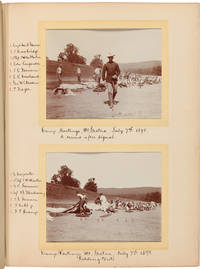
1898WRCAM54683Various places including Pennsylvania Virginia at sea New Jersey and Puerto Rico 1898. 171pp. with 342 photographs. Four large quarto photograph albums. Matching contemporary three-quarter crimson morocco and cloth front covers gilt. Minor shelf wear and some rubbing. Images in overall very good condition. An amazing assemblage of photographs documenting the Spanish-American War experiences of the First Troop Philadelphia City Cavalry which was at that time the oldest volunteer military unit in continuous service to the United States. The photographs are arranged chronologically in four contemporary photo albums with the images occasionally annotated in a contemporary hand and including the identification of numerous members of the Troop. <br> <br> The first volume opens with images of Mt. Gretna Pennsylvania "where troops were sworn into U.S. service May 7th 1898 by Maj. Thompson U.S.A." The photographs record field exercises camp building and tent organization at Camp Hastings cavalry drills an image of "Capt. Groome reading the Articles of War to Troop June 1898" a "first arrival of government horses" several shots of men training and "throwing" their horses shooting practice "Capt. Groome assigning Government horses to Troopers" and various shots of the men at work and even some play. Over the course of the album the names of numerous soldiers are recorded below several of the photographs. <br> <br> The second album opens with several photographs of the Troop striking their tents in preparation for leaving Camp Hastings at Mt. Gretna headed for Camp Alger at Dunn Loring Virginia. Here the Troop was ordered to increase their enlistment numbers. At Camp Alger the Troop was also fitted out with federal supplies and assigned to the Second Army Corps commanded by Maj. Gen. William Graham who is pictured here. Other photographs capture the camp scene at Alger "the First Troop picket line" the Troop receiving their federal-issue khaki uniforms the Troop at roll call and some shots featuring African-American helpers. <br> <br> In late July the Troop was sent to Newport News and several photographs record their brief time there with about a dozen shots of their temporary camp. On July 28 1898 the Troop left Virginia on the transport ship MASSACHUSETTS bound for Puerto Rico. Several images here capture the frenetic loading of the troops and their horses onto the ship with the remaining half dozen or so shots recording the Troop's time on board. <br> <br> The third album picks up where the second left off with the First City Troop embarked on the transport ship MASSACHUSETTS headed for Guanica Puerto Rico. Shipboard activities captured here include a few shots of groups of men being showered with water hoses. Several shots record the arrival of the men in the port of Guanica where they encounter the hospital ship NUECES which reports of the news of the "surrender of Ponce." After the men disembark they pitch their camp around Cathedral Virgin del Carmen on August 5. The next day several photographs record the unloading of horses and stores in the harbor at Ponce. The remaining thirty-eight photographs in this volume record scenes in the interior of Puerto Rico and are the most heavily annotated of the four albums. The images record scenes from the "road from Port of Ponce to Ponce" several scenes capturing a market day in Ponce and recording numerous native islanders the Troop's "temporary camp about 2 miles beyond Ponce" the "Troop wagon leaving camp beyond Ponce to join wagon train for Guayama" on August 8 a shot of the Troop's wagon "on road to Guayama in a Porto Rico mudhole" images of the wagon train to Guayama with the H Troop 6th U.S. Cavalry the "Point of Advance Guard entering Guayama within the lines" the Troop itself "entering Guayama passing General Brooke's Headquarters" a "View of First Troop Phila. City Cavalry U.S.V. Camp at Arroyo August 10th to 6A.M. Aug. 13th 1898" with the last ten images recording the camp or the streets at Arroyo. <br> <br> The fourth album documents the Troop's voyage home to Philadelphia. This time they take passage on the transport ship MISSISSIPPI and about half of the images record their voyage on board. On Sept. 10 1898 they reach Jersey City in New York harbor where they camp for a short time before returning to camp in Pennsylvania where the album ends. A couple of months later all three officers and the ninety- eight enlisted men of the First City Troop were mustered out of federal service for the Spanish-American War. <br> <br> Originally founded in 1774 by twenty-eight Philadelphia patriots as the "Light Horse of the City of Philadelphia" the First Troop of Philadelphia Cavalry is the oldest mounted military unit operating in continuous service to the American republic being the first volunteer cavalry troop organized in defense of the colonies. Among the Troop's original founders was John Dunlap printer to Congress from 1778 to 1789 publisher of the first American daily newspaper and the first printer of the Declaration of Independence. Most of the earliest members were similarly notable professional men of Philadelphia. The Troop served with valor in the American Revolution the War of 1812 the Mexican- American War the Civil War the Spanish- American War and every major American war through the Korean War. <br> <br> The present albums present a unique and important visual record of the First City Troop's activities before during and on the way home from the Spanish-American War. hardcover books
1713WRCAM53351Minorca Spain 1713. 690pp. Thick quarto. Later three-quarter calf and marbled boards. Moderate wear to edges and spine extremities boards rubbed corners bumped. Small later ownership inscription on front pastedown. Light foxing and tanning marginal dust soiling. Composed in a neat legible hand. Very good. Untrimmed. A lengthy and highly detailed manuscript volume containing documents related to the British takeover of Minorca after its capture from Spain during the War of Spanish Succession and an investigation into the governance of the island. In September 1708 British forces occupied the Mediterranean island with little opposition the inhabitants and nobles having mostly supported the Anglo-Dutch designs for the Spanish throne. The inherent importance of the island as a military outpost and trading way point in the Mediterranean led the British to occupy it for the rest of the war and to receive it as a possession in the Treaty of Utrecht which ended the conflict in 1713. <br> <br> The documents collected here relate to the English Brigadier Lewis Petit who served as Lieutenant Governor and Chief Engineer of the island during its occupation. As Chief Engineer Petit was in charge of improving the fortifications and defenses of Minorca and although a Spanish ally was named as titular Governor Petit exercised the true authority over the island. Although his improvement plans may have been sound his management of the island's public moneys was suspect. <br> <br> "Petit somehow found time to enter into commercial speculations on his own account. In partnership with two Spaniards and Stanhope's secretary Arent Furley Petit purchased a French prize at Mahón for 7800 dollars with which to trade between Minorca Majorca Sardinia and the Spanish and Barbary coasts. He advised Furley that he had found it necessary to use funds supplied for the fortifications to complete the purchase and urgently requested capital from his partners to repay this misappropriation. Petit's participation was valuable to the enterprise owing to his ability to land cargoes at Mahón without paying duty an activity much objected to by the local town government. <br> <br> "Petit was soon to find himself under the scrutiny of the inspectors sent from London to investigate irregularities in the expenditure of the army in Spain as an attempt to disgrace the previous ministry.The accusations against him concerned imperfections in his accounts including allegations of missing vouchers irregularities and overcharging in the numbers of workmen and mules and alleged differences between prices contracted and prices paid among other charges" - DNB. <br> <br> The documents compiled here therefore relate principally to the investigation of those actions by a specially convened Board of Commissioners and contain Petit's written responses to specific inquiries about his expenditures. In transmitting these answers the reports provide a detailed perspective regarding the management of Minorca's finances defenses and engineering improvements under Petit's charge. Moreover in order to buttress or to undermine those claims voluminous correspondence financial figures construction reports testimonies affidavits and other material are reproduced that span the length of the British occupation of the island before it officially became a possession. As a result the manuscript documents contained here provide a thorough encapsulation of the economic and military situation on Minorca and the growth of its importance as a British outpost in the Mediterranean. <br> <br> A highly valuable set of manuscript documents that meticulously details the development and management of a British possession gained through the War of Spanish Succession worthy of much deeper research. Paul Latcham "Petit Lewis 1665-1720" in OXFORD DICTIONARY OF NATIONAL BIOGRAPHY Oxford University Press 2004 http://www.oxforddnb.com/view/article/22038. hardcover books