6 567 résultats
201904891Paris, Robert Laffont, 2012 ; in-8, 305 pp., br. Broché bon état.
185675Barcelone, Imprenta del Gobierno, 13 juin 1820 placard in-folio (42 x 31 cm), texte sur deux colonnes, en feuille.
1770ABC_47902Córdoba 1770. 8vo. Contemporary limp parchment. With a large engraving of Juan de Santiago on the second leaf and a pen drawing on page 102. 4 "159" = 162 pp. Manuscript version of the only contemporary source on the life and death of the Córdoban Jesuit Juan de Santiago 1689-1762. It follows a work by the same name by Vincent Morales 1708-1765 which was probably published for the first time in 1763 in Córdoba. The copper engraving in the present manuscript likely comes from this edition. Judging from the ownership annotation the present manuscript was also made in Córdoba probably for a local university or convent. It contains an extra paragraph at the end about a feast held in honour of Juan de Santiago including six epigrams written for him. This part is not present in the printed versions of this work.Juan de Santiago was born in Écija. He became known as the "niño de la razón" because of his love for studying. He entered the Jesuit College at Sevilla at a young age. After he was ordained he moved to Córdoba College where he stayed for 40 years. He was seen as a model of holiness and many miracles were attributed to him. One of these occurred when he put out his hand to a blind woman who tried to enter the church and said to her: "Come in and take a good look." Upon which the woman cried "I see it I have recovered my sight." Throughout his life he was much loved in Córdoba because he helped and advised a great number of inhabitants. When he died there was an enormous grieving crowd in town and the City Council ordered that one of the three keys of his coffin should be kept in the city archive. The work by Morales was written at the request of the grieving Córdobans.With a crossed out ownership annotation on the verso of the title page. The parchment is stained and wrinkled with a few small holes and is somewhat smaller than the paper leaves. The borders of the first two leaves are frayed the manuscript is somewhat stained throughout. Otherwise in good condition.l Cf. De Backer-Sommervogel 1894 V 1284 printed ed. unknown
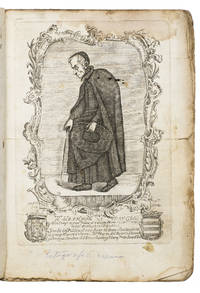
1760WB19204Spain 1760s. Hardcover. Very Good. 4to. Contempoary vellum. Wonderful manuscript on paper consisting of several sections each illustrated with hand-drawn folding diagrams many of which quite intricate. This work can be assuredly connected to Jesuit professor Cristiano Riegen of the Reial Academia de Ciencies Exactes in Madrid as there are several mentions of his name in each work. The manuscript is one that clearly took great effort and the drawings are finely executed. <br/><br/> hardcover
221778Madrid, Imprimerie royale, 1819 in-8, 61 pp., demi-chagrin cerise, dos à nerfs orné de chaînettes dorées (rel. du XXe siècle). Dos un peu frotté.
Edition 2008 : Coffret : contient 1 livre in-8 broché + 2 CDs. Très bon état. [P-54]
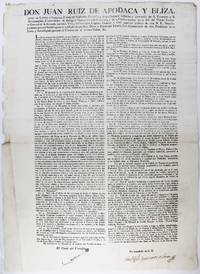
18203330Mexico City: July 11 1820. About very good. Large double-sheet broadside approximately 23.5 x 17 inches. Two sheets joined at central horizontal fold. Five chips at left edge not affecting text and some additional minor edge wear; otherwise light toning and dust soiling. Two contemporary manuscript signatures at foot; contemporary duty stamps on blank verso. Fascinating and otherwise unrecorded broadside that dictates the organization and process for the 1820 election of Mexican deputies to the Spanish Cortes during the second and last period of constitutional monarchy in Mexico. Colonial Mexico first achieved some representation in the Spanish government under the liberal Constitution of 1812 which lasted for two years before being revoked by Ferdinand VII upon his return to power in 1814. The reinstatement of the liberal constitution and the Cortes of Cadiz in 1820 however was not enough to prevent Mexico from obtaining full independence one year later. This broadside promulgated in Mexico on July 11 1820 by the colonial Viceroy Juan Ruiz de Apodaca y Eliza announces the renewed representation via regional elections to select Provincial Deputies for the Cortes and contains eight articles delineating the process by which these elections are to be held. In brief these articles order representation be apportioned according to the population as approximated from the 1792 census; divides Mexico into provinces for the purposes of the election; and places parameters on representation for each province. In all a very interesting window onto the formation of the brief final period of Spanish colonial rule in Mexico. July 11 unknown
Buenos Aires, Espasa Calpe, 1960 [Austral]. 4to. menor; 163 pp. Cubiertas originales.
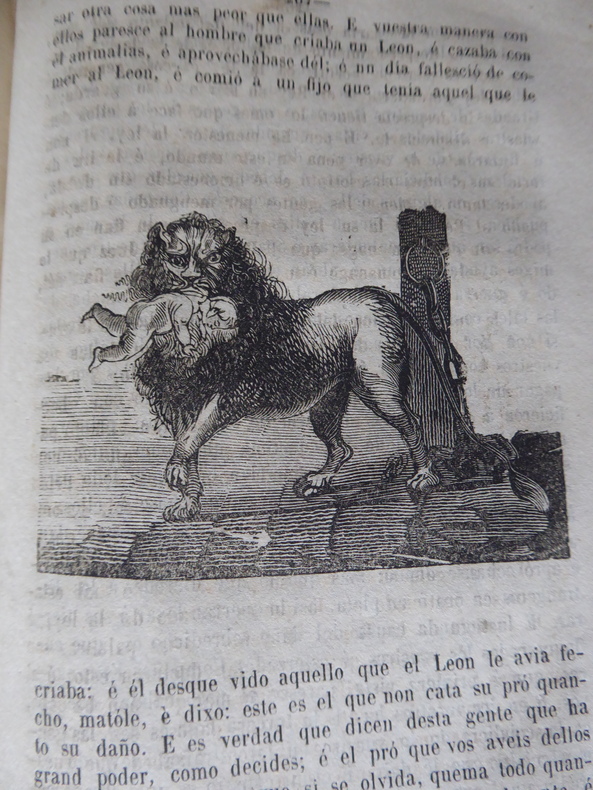
12mo in full vellum; 191p. Spanish. Uncommon. / Religion, Christianity, Catholicism. Spirital and moral dialogues.
Santiago de Chile, Editorial Ercilla, 1936. 4to. menor; 64 pp. Cubiertas originales.
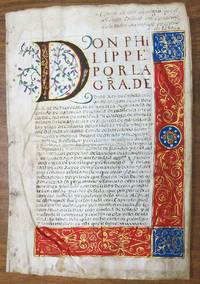
1572RF 1076<p><strong>Royal Provision of Phillip II Confirming and Ratifying the Privileges Granted by the Masters of the Order of Santiago to the Village of Corral de Almaguer Toledo 1572</strong></p><p>Manuscript. Small folio. 12 1/4 x 8 1/4". 8 double-sided vellum manuscript leaves originally bound together now unbound hand painted and decorated in blue red and gilt at various points throughout the text. The first page is hand-painted and decorated along the edge and includes a large decorative initial in multiple colors. Manuscript text in gothic style. Signed "Yo el Rey" on the back of the final leaf by King Phillip II of Spain in 1572.</p><p>ATTRACTIVELY ILLUMINATED EARLY MANUSCRIPT. JUDAICA INTEREST. Our manuscript contains the 4 confirmed provisions originally drafted by Infante Henry Duke of Aragon 1421 and 1440 Alonso de Cárdenas here listed as "Alfoso" sic in 1480 and then "The Catholic Kings" in 1494 all of whom at various times served as "Grand Masters of the Order of Santiago". The provisions were instigated against the Jewish communities of the villages of Corral de Almaguer and Ocana in Toledo province. Residents of the towns affiliated with the Order of Santiago repeately complained throughout the 15th and 16th centuries to the the authorities of that order of that the Jews and later conversos had bought land from Christians and had not paid any taxes on their purchases. Ultimately the Jews of Corral de Almaguer were ordered to pay comparable taxes to the Christians for said property but the Jews of Ocana were excepted because of their previous payments of other taxes. Given the fact that this manuscript copy dates from 1572 and was signed and reconfirmed by King Phillip II so long after the expulsion of 1492 shows there were still clearly tensions and persecution of local conversos even long after the communities had converted to Catholicism.</p><p>The top left margin on the front of the first leaf contains a handwritten note in ink stating in Spanish "It consists of this-privilege that Juan Collado was a secretary of the Order of Santiago in the year 1480". There are a few additional scant marginal notes in ink throughout and additional handwritten notes and signatures some indecipherable on the verso of the final leaf under the King's signature.</p><p>This document provide a fascinating and invaluable resource to those studying the history of Jews in Spain during the 15th and 16th centuries.</p><p>Text in Spanish.</p> hardcover
1639ABC_50152Madrid 1639. Folio c. 29 x 20.1 cm. Diego Diaz Unbound housed in a plastic folder. 2 ll. Rare 17th-century Spanish pamphlet documenting the maritime activities of the Royal Armada of Dunkirk and privateers along the coasts of France England and other territories from 1 May to 31 December 1638. This detailed account lists 118 captured vessels including warships frigates and small craft many laden with highly valuable cargoes such as silk spices wine sugar salt precious metals and pearls.Printed in Madrid it served both as a record of naval prizes and a public announcement of military success during the turbulent years of the Eighty Years War 1568-1648 and concurrent Franco-Spanish conflicts. Dunkirk then a major Spanish port in the Low Countries was a base for state-authorised privateers corsarios whose daring raids on enemy shipping are vividly detailed here including the disposition of artillery captured crews and the fate of vessels either incorporated into the Spanish fleet or destroyed.The present work emphasizes the skill and bravery of the Dunkirkers noting that despite repeated attempts by Dutch fleets to block them only one Spanish warship was lost over thirty months of operations while over 800 enemy ships were captured. It is an exceptional example of early modern naval reporting illustrating not only the logistics and spoils of naval warfare but also the political and economic role of privateering in Spanish maritime strategy.The leaves are slightly browned and foxed the gutter of the second leaf has been reinforced with a manuscript page number "124" and "125" at the recto of the first leaf and the verso of the last leaf. Otherwise in good condition.l Catálogo y Biblioteca Digital de Relaciones de Sucesos CBDRS 0001964; WorldCat 1025513992 224450878 7 copies. unknown
1847G456Sevilla, Imprenta de D. Carlos Santigosa, editor, 1847. In-8, (1) f. blanc-XIII[dont faux-titre et titre]-(1)-360 pp., demi-chagrin poli vert très foncé, dos lisse estampé à froid, palettes en tête et en queue, titre, dorés, papier de couvrure gaufré, orné de motifs floraux ( reliure de l’époque ; traces de frottements sur les coupes ; à l’intérieur, quelques rares rousseurs ; assez bel exemplaire). ÉDITION ORIGINALE ? : on trouve parfois la mention d’une édition parue en 1845 (in content.library.pdx.edu), il semble que celle de 1847 soit bien l’E.O. ; une « segunda edicion » paraîtra la même année , chez le même éditeur, même pagination, page de titre refaite. LES « ACTEURS » : à tout saigneur, tout honneur. Pedro (Burgos, 1334-Montiel, 1369) était le seul fils légitime d’Alphonse XI, Le Juste (Salamanca, 1311-Gibraltar, 1350), et de Marie –Constance (1313-Evora, 1357), fille d’Alphonse IV de Portugal. Ce mariage politique et forcé n’était pas heureux ; le gendre prit pour maîtresse Leonor de Guzman (Séville, 1310-Talavera de la Reina, 1351), jeune et jolie veuve , qui lui donna une ribambelle de bambins, dont Henri, comte de Trastamare (Séville, 1334- Santo Domingo de la Calzada, 1379). On ne faisait pas de vieux os dans la Sagrada Familia : 1350, Alphonse XI meurt de la peste à Gibraltar ; 1351, Léonor est torturée et assassinée grâce à Pedro ; 1357, La Reine Marie-Constance, assassinée, au choix, sur ordre de Pedro ? ou sur ordre de son propre père le roi du Portugal ? ; 1361, la Reine Blanche est assassinée sur ordre de son mari; 1369, Pedro, assassiné par son demi-frère Henri, qui devient illico roi de Castille ; surnommé « Le Magnifique », parfois « Le fratricide » ... qui finira empoisonné en 1379. . C’est la souche de la lignée royale des Trastamare, dans laquelle figureront Henri III « Le Maladif », puis Henri IV « L’Impuissant » qui ne fut pas roi de France…
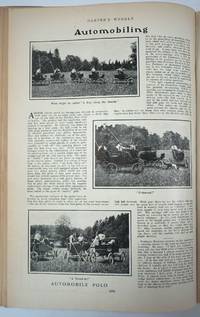
190228399New York: Harper's 1902. First printing. Hardcover. Good overall. Content on the Russo-Japanese & Spanish American War; Automobiling early cars playing polo!; Teddy Roosevelt Chinese rugby cartoon Blackwell Island Bridge Thomas Nast cartoon Henley regatta. Half year bound volume of Harper's Weekly with woodblock illustrations throughout.<br /> <br /> Color supplements were included in the Christmas issue. Chinese playing rugby cartoon p1582; US Naval Academy p1498; Blackwell Island Bridge p1308; Wall Street p1180; Thomas Nast p1972. <br /> <br /> Folio 1155pp. Weekly issues bound up into a large single volume with 3/4 leather and marbled boards. Leather spine chipped cracked at hinge binding firm internally very clean. Harper's hardcover
196521361Paris DEL DUCA 1965 in-8 oblong cartonné album à système (pop-up pages) grand in-octavo Editeur (20,5 x 26,5 cm), dos muet bleu-ciel (blue spine - no title), premier plat illustré en couleurs (front cover illustrated in colours), texte en espagnol , font face au texte 8 illustrations en relief "POP-UP" de V. KUBASTA(illustrations in relief of KUBASTA), 1960 à Prague Artia Editeur, [Sistema de disco (páginas pop-up) Editorial octavo mayor (20,5 x 26,5 cm), cielo azul de nuevo en silencio (columna azul - Sin título), primer color ilustra plana (portada ilustrada en colores) texto en español, frente a los de texto en relieve ilustraciones 8 "pop-up" V. Kubasta (ilustraciones en el alivio de Kubasta), 1960 en Praga Editorial Artia,]
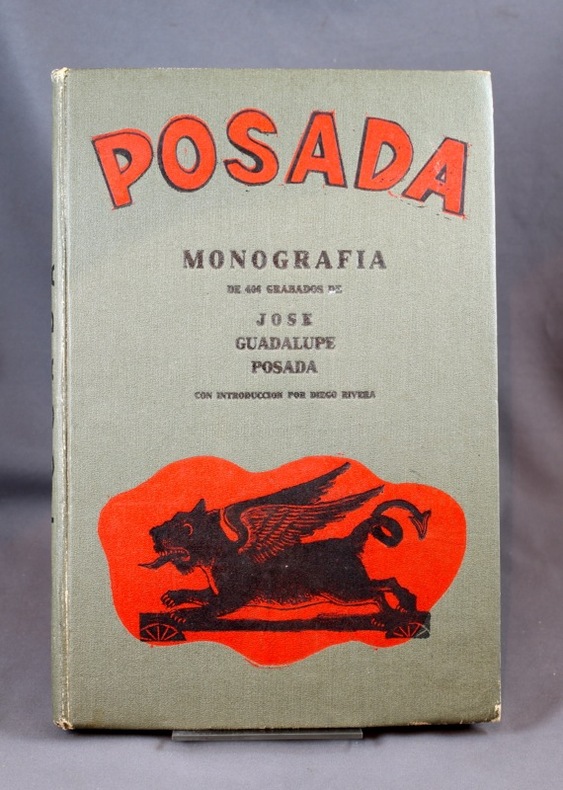
19304653Mexico, Mexican Folkways (Frances Toor, Paul O’Higgins et Blas Vanegas Arroyo), 1930. In folio de[8]-208-[8] pages, pleine percaline verte, illustration en rouge et noir sur le premier plat, imprimé sur papier vergé.
221992Madrid, veuve Ibarra, 1789 in-16, 27 pp., demi-veau cerise, dos lisse orné de guirlandes et pointillés dorés, coins en vélin (reliure moderne).
202136S.l.n.d., (1746) in-4, 50 feuillets, demi-basane brune, dos lisse (reliure moderne). Epidermures au dos. Ex-libris Marquis de Pontecroix, Archives et bibliothèque du marquisat de Beauvau, Amadeo Delaunet. Cachet et étiquette de la bibliothèque de ce dernier.
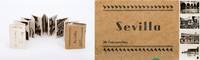
193729733AB1937. Sevilla L. Roisin Fotografo 1937 10 cm x 7.5 cm. 20 photographic cards connected as Leporello. Original Softcover. Excellent condition with some minor signs of wear only. Signed by the member of Na-Fianna Eireann from Graignamanagh Captain Padraig Quinn in 1937. paperback
200402791Paris, NRF Gallimard, 1974 ; in-8, 402 pp., br.
Madrid, La Novela Policiaca, 1918. 4to; 40 pp. sin numerar. Cubiertas originales. Zigomar, creado en 1909, y precedente de Fantomas, puede ser considerado el primer héroe de la literatura pulp. Su autor Sazie, es recordado hoy en el arte de la esgrima por ser el creador del denominado "point d'arrêt à trois branches".
Madrid, Imprenta de Repullés, 1832. 8vo.; 63 pp. Cubiertas mudas en cartulina.
Madrid, Imprenta de Repullés, 1835. 8vo.; 37 pp., 1 h. Cubiertas mudas en cartulina.
Madrid, se hallará en casa de Don Bernardo Alberá, 1781. 4to.; 2 hs., 223 pp., y 2 láminas grabadas en cobre por Patiño. Manchas antiguas de humedad. Encuadernación de época en piel con tejuelos, ligeramente fatigada. .
Madrid, Imprenta de Moreno, 1829. 8vo.; XVI pp., 114 pp. Encuadernación de época en piel, con lomera ornada y tejuelo.