Tàpies, Antoni - Cirici, AlexandreAntiquariat.de

6 567 résultats
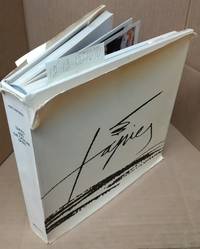
109Barcelona, Editiones Poligrafa, no date - o.J. 4° (27.5 x 26.5cm). Spanish edition. 364 p., color & b/w pls., photos, chronology, index of workes, bibliography, exhibits. Orig cloth with dust-jacket. Dust-jacket damaged, apart from that good copy.
19751321670New York: Rizzoli International Publications Inc 1975. First U.S. Edition. Hardcover. Small Quarto; pp 382; VG-/G; ivory spine with black text; dust jacket has modest sun darkening to exterior edges as is; sunned spine; few chips to edges; small tape mend to rear tail edge; cloth has light toning to exterior; strong boards; text block has slight toning to exterior edges; illustrated endpapers; interior shows light toning toward edges; profusely illustrated; arts - Modern; additional shipping may be necessary due to size/weight restrictions for international/expedited orders.<br /> <br /> <p> This book is part of the overstocked 15's kept in Room X. 1321670. FP New Rockville Stock. Rizzoli International Publications, Inc hardcover books
48680Paris Galerie Lelong 1989 in 4 (31,5x22) 1 volume broché, couverture à rabats illustrée en couleurs, 30 pages [1], avec reproductioons photographiques. Bel exemplaire ( Photographies sur demande / We can send pictures of this book on simple request )
Barcelona, Gustavo Gili, Editor, 1927. 4to. menor; 3 hs., 173 pp. y 1 h. Cubiertas originales.
Acquaforte e bulino, circa 1810/15. Il titolo dell’opera è tratto da una scrittura a mano in una prova di stampa dell’opera che Goya include nell’album dei “Disastri della guerra” che donò al suo amico Ceán Bermúdez e che ora è conservato al British Museum di Londra. Il disegno preparatorio dell’opera è conservato al Prado di Madrid. Esemplare nel terzo stato di quattro, inserito nella Gazette des Beaux-Arts (1867); si tratta della prima vera edizione dell’opera, conosciuta altrimenti solo attraverso due prove di stampa. "A seated prisoner raises his clasped hands, both fastened with chains, in a gesture of supplication. We cannot see his features since his face is hidden beneath his long, dark hair. His feet are fastened in large shackles. Both the chains and the shackles are of considerable size, underlining their importance in any interpretation of the print. In fact, just as the title of the etching shows, the painter is comparing the excessive zeal employed in preventing the prisoner from escaping to the brutality of the crime he is accused of. It is possible that the way in which the prisoner is secured in this work by Goya was habitual at the time, an idea which is supported by certain passages of Forensic Discourses (Discursos forenses), by Juan Meléndez Valdés (Ribera del Fresno, Badajoz, 1754- Montpellier, 1814), whose portrait Goya painted in 1797. This book, published in Madrid in 1821, speaks of the cumbersome chains and shackles used to hold one María Vicente, put to death on the 23rd April 1798. Goya could well have known of her story: "But it is said that Doña María Vicente must have been treated, as the noblewoman that she is, in a very different manner, and not locked in shackles; and even thus fettered it was the judge's responsibility to examine their state and quality beforehand, to order them put on correctly". The painter has made extensive use of the etching technique here, building up the background with short, horizontal lines, whilst leaving large areas on the prisoner's clothing untouched and white, underlining his innocence. This etching would have been made at the same time as two others: The custody of a prisoner does not call for torture and If he is guilty, let him die quickly. In these images, Goya openly expresses his repulsion of the way in which prisoners were treated, as well as his opposition to the death penalty, echoing the ideas of Cesare Beccaria (Milan, 1738- Milan, 1794). In the pages of the work entitled Dei deliti e delle pene, published between 1763 and 1764, the Milanese talks of the need to modify the penal system, to lessen the severity of punishments and to seek out mechanisms for preventing crime. It is possible that these etchings also contributed to the debate on the abolition of torture which was being discussed in the Courts of Cádiz. Goya reiterates this same topic in some of the prints in his Disasters of War series, such as no. 15, And it can't be helped, no. 31, That's tough!, no. 32, Why?, no. 34, On account of a knife, no. 35, One can't tell why and no. 36, Not in this case either. Despite the gritty subject matter, the figure depicted in this etching possesses great dignity, recalling some earlier precedents which Goya may have been familiar with. One of these is an anonymous print based on Interior of a Prison (16th century, Museum of Fine Arts, Boston), by Giulio Romano (Rome, 1499-Mantua, 1596). When he was making this print, Goya may also have had in mind the disturbing, gloomy ambience of the prisons of Giambattista Piranesi (Mogliano Veneto, Treviso, 1720- Roma, 1778)." (cfr. https://fundaciongoyaenaragon.es/eng/obra/tan-barbara-la-seguridad-como-el-delito/712). Tomás Harris ritiene che la matrice di rame si trovi in una collezione privata di Parigi. Bibliografia Harris 26 III/IV; Delteil 31. Etching and engraving, circa 1810/15. The title of this work is taken from the handwritten title of a state proof that Goya included in the album of his Disasters of War prints which he gave to his friend Ceán Bermúdez and which is now in the British Museum, London. The preparatory drawing for this etching is in the Prado Museum, Madrid. Example of the third state of four, form the Gazette des Beaux-Arts (1867), firts edition of this work, before known only for proof states. "A seated prisoner raises his clasped hands, both fastened with chains, in a gesture of supplication. We cannot see his features since his face is hidden beneath his long, dark hair. His feet are fastened in large shackles. Both the chains and the shackles are of considerable size, underlining their importance in any interpretation of the print. In fact, just as the title of the etching shows, the painter is comparing the excessive zeal employed in preventing the prisoner from escaping to the brutality of the crime he is accused of. It is possible that the way in which the prisoner is secured in this work by Goya was habitual at the time, an idea which is supported by certain passages of Forensic Discourses (Discursos forenses), by Juan Meléndez Valdés (Ribera del Fresno, Badajoz, 1754- Montpellier, 1814), whose portrait Goya painted in 1797. This book, published in Madrid in 1821, speaks of the cumbersome chains and shackles used to hold one María Vicente, put to death on the 23rd April 1798. Goya could well have known of her story: "But it is said that Doña María Vicente must have been treated, as the noblewoman that she is, in a very different manner, and not locked in shackles; and even thus fettered it was the judge's responsibility to examine their state and quality beforehand, to order them put on correctly". The painter has made extensive use of the etching technique here, building up the background with short, horizontal lines, whilst leaving large areas on the prisoner's clothing untouched and white, underlining his innocence. This etching would have been made at the same time as two others: The custody of a prisoner does not call for torture and If he is guilty, let him die quickly. In these images, Goya openly expresses his repulsion of the way in which prisoners were treated, as well as his opposition to the death penalty, echoing the ideas of Cesare Beccaria (Milan, 1738- Milan, 1794). In the pages of the work entitled Dei deliti e delle pene, published between 1763 and 1764, the Milanese talks of the need to modify the penal system, to lessen the severity of punishments and to seek out mechanisms for preventing crime. It is possible that these etchings also contributed to the debate on the abolition of torture which was being discussed in the Courts of Cádiz. Goya reiterates this same topic in some of the prints in his Disasters of War series, such as no. 15, And it can't be helped, no. 31, That's tough!, no. 32, Why?, no. 34, On account of a knife, no. 35, One can't tell why and no. 36, Not in this case either. Despite the gritty subject matter, the figure depicted in this etching possesses great dignity, recalling some earlier precedents which Goya may have been familiar with. One of these is an anonymous print based on Interior of a Prison (16th century, Museum of Fine Arts, Boston), by Giulio Romano (Rome, 1499-Mantua, 1596). When he was making this print, Goya may also have had in mind the disturbing, gloomy ambience of the prisons of Giambattista Piranesi (Mogliano Veneto, Treviso, 1720- Roma, 1778)." (cf. https://fundaciongoyaenaragon.es/eng/obra/tan-barbara-la-seguridad-como-el-delito/712). Tomás Harris believes that the plate for this etching may be in a private collection in Paris. Literature Harris 26 III/IV; Delteil 31. Harris 26, III/IV; Delteil 31.
Buenos Aires, Ediciones Siglo Veinte, 1946. 4to.; 318 pp. Cubiertas originales.
Madrid, Ediciones Oriente, 1929. 4to.; 324 pp. Cubiertas originales con un dibujo de Puyol.
Buenos Aires, Ediciones del Carro de Tespis, 1957. 4to.; 61 pp., 1 h. Cubiertas originales.
0366942085.Gpaperback. Good. Access codes and supplements are not guaranteed with used items. May be an ex-library book. paperback
White b&w and color illus octavo, 125 pages, (likely b&w) illustrations ; 24 cm. In Spanish. Scarce || Series: Coleccion AnÛmalos. Language, Creative writing, Shorthand, Typewriters. Typewriter Art. Concrete poetry
173p., illus. Four color plates & 5 B/W illus. Hardcover Good condition; spine & rear board soiled
Madrid, Editorial Tartessos, 1942. 4to. menor; 243 pp. Cubiertas originales.
3384521552.Gpaperback. Good. Access codes and supplements are not guaranteed with used items. May be an ex-library book. paperback
1824122523Stuttgart, bei Friedrich Franckh 1824. (3), 159, (6 Seiten). Unbeschnittenes Exemplar. Originalbroschur. (Papier etwas fleckig. Einbandblatt mit kleinem Einriss u. stärker angestaubt). 17x11 cm
Barcelona, Imprenta de Manuel Texéro, véndese en la Librería de Solá, 1836. Dos tomos en un volúmen en 8vo.; 182 pp., 1 h. y 193 pp. Encuadernación en piel marbreada con tejuelo, de época.
Book is in excellent condition, Fine, as new. Binding is solid and square, covers have sharp corners, exterior shows no blemishes, text/interior is clean and free of marking of any kind. Dust jacket is Fine also. 79 pages with a great many color photos, architectural drawings, floorplans elevations etc. for projects such as: Forest of Tombs museum, Naoshima Contemporary Art Museum & Annex, Gallery for Japanese Screens, Chikatsu-Asuka historical Museum, Suntory Museum, Museum of Wood, Nariwa Museum, Oyamazaki Villa Museum, Sayamaike historical Museum, Pulitzer Foundatio for the Arts, etc. Text is in English, German, French and Spanish.
Small octavo in light blue wrappers; illus., map; 207 p., 20 cm. In English. Series: Vocabularios Bolivianos No. 2.
Paperback octavo with beige spine. 207 pages : b/w illustrations. 20 cm. In Spanish || Series: Vocabularios bolivianos ;; no. 2; || Tacana language (Bolivia) -- Dictionaries -- Spanish.
Octavo in full leather, xxiv, 352 pages; frontispiece (portrait) 21 cm In Spanish. Appears to lack last eight pages. Poetics -- Early works to 1800. PoÈtique -- Ouvrages avant 1800. Poetics. poetica. Early works. / Francisco Cascales (1564ñ1642) was a Spanish erudite, humanist and writer. Cascales is perhaps best known for his Cartas Filologicas
2020100142375DE JUILLET 2020 120 pages in4. 2020. Broché. 120 pages.
Almería, Universidad, 1996. 4to.; 138 pp. Cubiertas originales.
Small white octavo; 192 p, [3] leaves of plates; 19 cm. In Spanish. Art; Philosophy.
68660Paris, Editions Autrement, 1987. 13 x 19, 55 pp., photos en N/B, reliure d'édition carton imprimé, très bon état.
Paris, aux Éditions du Seuil, 1967. 4to.; 327 pp. Cubiertas originales.
Madrid, Sociedad de Autores Españoles, 1916. 4to; 87 pp. Cubiertas originales.