THOMAS (Antoine-Léonard)Livre Rare Book
1 284 résultats
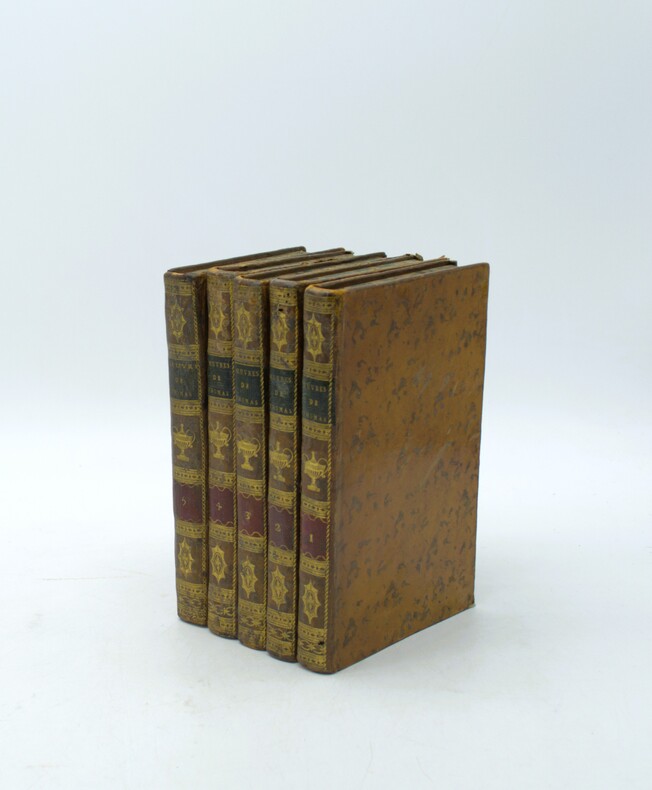
1802PHO-2173Paris, Desessarts, 1802. 5 volumes (7) in-8 (20x13cm), xxviii-248pp.- 1f, 2ff.-266pp.-1f., 2ff.-294pp., 2ff.-309pp.-1f.-31pp., xx-262pp., Relié basane marbré époque, dos lisse orné avec pièces de titre noires et tomaison rouges, tranches marbrées, quelques frottements et épidermures, coins usés,
Pages tanned. Very minor shelfwear to book. DJ is tanned/slightly browned with a some small closed tears. A bit of soiling to DJ spine. ; Wilfried Stroh, Die Nachahmung des Demosthenes in Ciceros Philippiken. Gualtiero Calboli, La retorica precicironia e la politica a Roma. Alain Michel, La théorie de la rhétorique chez Cicéron: éloquence et philosophie. J. Classen, Ciceros Kunst der Uberredung. A. D. Leeman, The technique of persuasion in Cicero’s Pro Murena. M. Winterbottom, Cicero and the silver age. Walter Rüegg, Cicero – orator noster. ; Entretiens Sur L'Antiquité Classique Tome XXVIII; 344 pages
(Collana : -) (1.XXX.1). - Il ricavato della vendita di questo libro sarà destinato ai progetti di ricerca e formazione promossi dalla "Fondazione Salvatore Calabrese"
(Collana : Collana d'oro) Traduzione di Maria Tacconi (1.XXIX.1). - Il ricavato della vendita di questo libro sarà destinato ai progetti di ricerca e formazione promossi dalla "Fondazione Salvatore Calabrese"
(Collana : -) Romanzo (1.VI.4). - Il ricavato della vendita di questo libro sarà destinato ai progetti di ricerca e formazione promossi dalla "Fondazione Salvatore Calabrese"
15912981Amsterdam: Herman Jansz. Muller 1591. 8vo 143 x 95 mm. Collation: A-T8 T8 blank. 302 pp. Text in gothic types stage directions and lists of actors in italic. Title woodcut of a family meal six text woodcuts of which 5 half-page and one smaller. Wormtrack in gutter of first few leaves dampstaining to foremargins and lower corners a fewer quires with larger dampstain. 17th-century stiff parchment manuscript spine title. Provenance: "Herman Lamberts Bellaer Anno 1685" signature on front flyleaf Bellaer was a notary in Weesp North Holland from 1656 to 1658; "no. 38" written on title; sheet of 20th-century paper with note tipped in at front.Only Edition of an anonymous vernacular play collection a late survival of a popular medieval performance tradition. These seven plays in Dutch verse dramatize the seven Works of Mercy from Matthew 25:35-46. They were written and performed in the open air on seven consecutive Sundays by the amateur Amsterdam literary and theatrical confraternity or "chamber of rhetoric" known as de Egelantier or Eglantier eglantine or wild rose allegedly in order to encourage the citizens of Amsterdam to participate in a lottery for the benefit of the Amsterdam insane asylum Poll p. 113. The edition was printed by one of the Eglantier members.In each play of the present collection an allegorical figure with a name like "Good Education" or "Brother Love" knocks on the door of the house of a different stock character - a burgher an artisan a farmer etc. - asking to be fed or clothed or given shelter. While these tradesmen comply a selfish character named "Most of the World" invariably rejects the stranger. Each play has a prologue and an epilogue that provides the moral of the story explaining that the stranger the naked the hungry the thirsty etc. are all Christ on the Cross.By the early sixteenth century every town and many villages of the Low Countries possessed their own "college" or chamber of rhetoric; these were literary confraternities whose origin lay in medieval French-speaking theater groups of Flanders and Brabant which performed mystery and miracle plays. Endowed with corporate structures emblematic names often flowers and their own blazons and regalia the chambers of rhetoric became a central cultural institution of Netherlandish life. After the Reformed church came to power in the northern provinces in 1581 it attempted to halt public performances of religious plays and even to suppress the chambers altogether but largely failed the chambers especially of larger towns usually retaining the support of local authorities. Hence one finds such "throwbacks" as the present series of religious plays. A peculiar to the modern reader mixture of traditional farce and didactic allegory it is typical of rhetoricians' plays which were usually "absolutely middle-class in tone and opposed to aristocratic ideas and tendencies in thought" EB 1911 8:721 with simple dramatic plots that were secondary to their educational value.Although founded later than many others at the end of the 15th century Amsterdam's de Eglantier was the most prominent Chamber of Rhetoric in the northern Netherlands. Its prestige was enhanced by the infusion of humanist writers and writers from the southern Netherlands who emigrated to the north during the religious wars. The Zeven Spelen is unique in containing the productions of a single city's Rhetorical Chamber: all other known Renaissance Dutch rhetoricians' collections contain the productions of several different towns performed in elaborate literary competitions known as landjuweelen.Six of the seven simple but charming woodcuts illustrating this edition in a consistent style and apparently by the same wood-engraver possibly the printer represent the first six acts of mercy the seventh play is illustrated with a smaller Last Judgment cut evidently from the printer's stock. Their charm lies in their portrayal of scenes from daily life: a family dining as a servant brings a platter and a mother feeds her baby; a vintner sitting cross-legged on a wine barrel in a medieval square pouring a welcome drink to a pair of wanderers while a neighbor quaffs behind him; naked men being clothed a prisoner in a stockade; a sickbed with a woman stirring gruel. The printer-publisher Harmen or Herman Jansz Muller ca. 1540-1617 was a member of a family of engravers printers and print- and booksellers who operated under the sign of "Den Vergulden Passer." Under his direction from ca. 1566 until his death the bookselling activities of the firm reached their apogee. As in many of his imprints Muller identifies himself here as a figuersnyder and it is possible that the title woodcut and the five larger cuts were his own work cf. Thieme-Becker 25:230 who suggested as much. Muller was also a member of De Egelantier and pubished a number of works for them.OCLC locates 5 copies in American libraries Folger Newberry National Gallery of Art Harvard and U. Michigan. STCN 844000841; The New Hollstein / The Muller Dynasty Part III 1999 75 and pp. 21-22; E. W. Moes De Amsterdamsche boekdrukkers en uitgevers in de zestiende eeuw 1900-1915 I p. 315 no. 223; Univ. of Amsterdam Library Catalogus van oudere werken op het gebied der Nederlandsche letteren 1921 no. 6; Scheepers collection Catalogus van een zeer belangrijke verzameling fraaie en zeldzame boeken der 16e-19e eeuw 1947 I:66. Cf. G. Kalff Geschiedenis der Nederlandsche letterkunde in de 16de eeuw part 2 1889 pp. 25 & 48-55; Klaas Poll Over de tooneelspelen van den Leidschen rederijker Jacob Duym 1898 p. 113-14; A. van Dixhoorn "Chambers of Rhetoric: performative culture and literary sociability in the Early Modern Northern Netherlands" in The Reach of the Republic of Letters: Literary and Learned Societies in Late Medieval and Early Modern Europe 2008 119-148; A-L. Van Braene "Faith on Stage: the Chambers of Rhetoric and Civic Religion in the Low Countries 1400-1700" K. Eisenbichler A Companion to Medieval and Early Modern Confraternities Brill 2019 pp. 365-84. Herman Jansz. Muller hardcover books
139 pages. Hook surfer's attention. Write informative persuasive web text. Create dynamic personal and corporate web pages. Several light pencil markings. Very light wear. Clean. Excellent copy in attractive glossy covers. Book
200516287BBLivermore, Calif, WingSpan Press, 2005. 8°, 238 S., Text: englisch, farbig illustr. original Kartonage (Paperback), 1st ed. sieben Seiten mit Kugelstreicher-Unterstreichungen bis S. 46, sonst ein gutes Exemplar.
557 pages. Clean and unmarked. Some curl to front cover. Moderate wear. Quality copy. Book
406 pages. Intended to encourage students to be critical and active readers and to 'talk back' to the texts both verbally and in writing. Minor quantity of markings. Moderate wear. Solid copy. Book
Minor curling of wraps along foreedges. Light shelfwear. ; Wit has many uses in political discourse—to entertain, to underscore or unmask, to hinder or enhance insight. Wit and the Writing of History focuses on how this potential is realized in the historiography of the earlier Principate. Preeminently in Tacitus, to a lesser degree in Suetonius and Dio Cassius, wit is a vehicle for political understanding and judgment of the historical account. As part of Roman political life, hostile anecdotal or epigrammatic wit was deeply embedded in the sources used by historians and is reflected in the rhetoric of their narratives. Some anecdotes may, in fact, have been mere jests later taken as fact, hence the frequent problem of credulity. But what is historically false can be politically true. Not only were political jokes a weapon for making some fair points against the Principate; ancient rhetorical theory recognized that wit in general arises from a violation of normal, expected ways of thinking. What is “funny” is thus disturbing in a serious way as well as amusing, and in the hands of Tacitus wit becomes scalpel as well as sword. ; Wisconsin Studies in Classics; 182 pages
63349, Brepols, 2023 Hardback, 480 pages, Size:156 x 234 mm, Language: French. ISBN 9782503604947.
1903WIRT0226Wien, Wr. Volksbuchhdlg. Ignaz Brand 1903. IX, 719 S., schön illustr. OLnbd., abgegriffen, etwas braunfl., bestoß., vord. flieg. Vors. herausgeschnitten, Falz vor Inhaltsverz. aufgerissen, altersbed. schwach gebr., Farbkopfschn.
CLASSICI ITALIANI collezione fondata da Ferdinando Neri, diretta da Mario Fubini, 5 - Introduzione - Nota bibliografica - Volgarizzamenti dal Provenzale - ...dal francese - ...dal latino: Opere didattiche, filosofiche, religiose - Opere retoriche e storiche - Opere poetiche 1 23x14,5 cm., legatura in piena tela, fregi e titoli impressi in oro sul dorso, frontespizio incorniciato-filettato con fregi, sopraccoperta in acetato, pp. 646, 6 tavole in nero, di pagine d'opera, fuori testo, ristampa, in italiano, ottime condizioni.
Ricordi e meditazioni sui sentimenti in crisi e sui valori smarriti (1.XXV.4). - Il ricavato della vendita di questo libro sarà destinato ai progetti di ricerca e formazione promossi dalla "Fondazione Salvatore Calabrese"
(1.VI.7). - Il ricavato della vendita di questo libro sarà destinato ai progetti di ricerca e formazione promossi dalla "Fondazione Salvatore Calabrese"
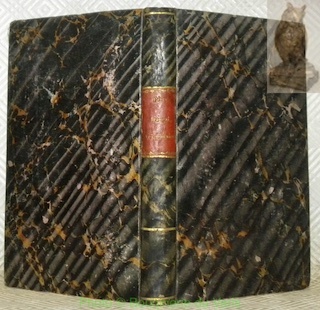
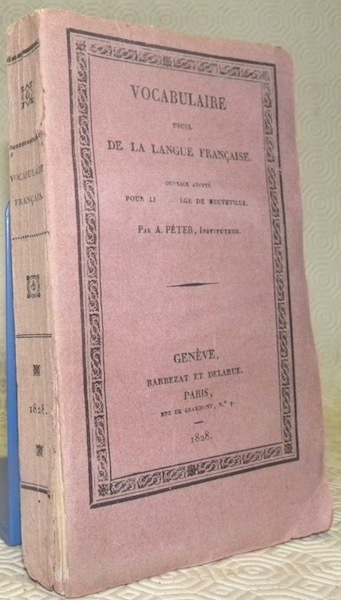
29243Genève, Barbezat et Delarue 1828, 175x110mm, VIII - 360pages, reliure d'éditeur. Ouvrage adopté pour le collège de Neuveville.
78419Genève, Barbezat et Delarue 1828, 180x110mm, VIII - 360pages, broché. Non rogné. Bon état. Ouvrage adopté pour le Collège de Neuveville.
(Collana : La Scala) Romanzo (1.VI.6). - Il ricavato della vendita di questo libro sarà destinato ai progetti di ricerca e formazione promossi dalla "Fondazione Salvatore Calabrese"
(Collana : Classici Italiani. Collezione diretta da Ferdinando Neri) Saggio (1.XXVI.5). - Il ricavato della vendita di questo libro sarà destinato ai progetti di ricerca e formazione promossi dalla "Fondazione Salvatore Calabrese"
In-12°, (36cc), 491pp, legatura in pergamena, nervi e titolo manoscritto al dorso, buone condizioni. Avancini è considerato il più importante esponente del teatro gesuita in lingua tedesca. Fu uno scrittore ascetico, un gesuita, professore di retorica, filosofia e teologia e poi rettore (1664) a Passavia, Vienna e Graz, visitatore della Boemia e infine, dal 1682, a Roma, assistente per la Germania del vicario generale dell'Ordine. Autore di una Vita et doctrina Jesu Christi (1665), oltre che di poesie latine, sermoni, orazioni e drammi per la gioventù (Hecatombe odarum, 1651; Poësis dramatica, Poësis lirica, 1659). La sua opera più popolare fu le sue Meditazioni sulla vita e le dottrine di Gesù Cristo. Quest'opera, scritta in latino, fu tradotta nelle principali lingue europee e ebbe numerose edizioni, e la versione inglese contiene parti tratta dalle opere di altri autori. Queste meditazioni, nella loro forma semplice e estesa, hanno aiutato molte più efficacemente nel difficile compito della meditazione quotidiana. In-12 °, (36cc), 491pp, vellum binding, bands, handwritten title on the spine, good condition. Avancini is considered the most important exponent of the German language Jesuit theater. He was an ascetic writer, a Jesuit, professor of rhetoric, philosophy and theology and then rector (1664) in Passau, Vienna and Graz, a visitor to Bohemia and finally, from 1682, in Rome, assistant to Germany of the vicar general of the Order . Author of a Vita et doctrina Jesu Christi (1665), as well as Latin poems, sermons, prayers and plays for youth (Hecatombe odarum, 1651; Poësis dramatica, Poësis lirica, 1659). His most popular work was his Meditations on the life and doctrines of Jesus Christ. This work, written in Latin, was translated into the main European languages and had numerous editions, and the English version contains parts taken from the works of other authors. These meditations, in their simple and extensive form, have helped many more effectively in the difficult task of daily meditation.
preghiere e orazioni della tradizione popolare siciliana con traduzione a fronte ed illustrazioni (1.I.8). - Il ricavato della vendita di questo libro sarà destinato ai progetti di ricerca e formazione promossi dalla "Fondazione Salvatore Calabrese"
(Collana : Lunario) Con un disegno di Chiara Malabarba (1.XXIX.10). - Il ricavato della vendita di questo libro sarà destinato ai progetti di ricerca e formazione promossi dalla "Fondazione Salvatore Calabrese"
(Collana : Quaderni di poesia contemporanea - n. 5) Prefazione di Mario Luzi - Rime (1.XXIX.10). - Il ricavato della vendita di questo libro sarà destinato ai progetti di ricerca e formazione promossi dalla "Fondazione Salvatore Calabrese"
(Collana : Lo specchio. I prosatori del nostro tempo) Romanzo (1.VI.5). - Il ricavato della vendita di questo libro sarà destinato ai progetti di ricerca e formazione promossi dalla "Fondazione Salvatore Calabrese"