1 284 résultats
15912981Amsterdam: Herman Jansz. Muller 1591. 8vo 143 x 95 mm. Collation: A-T8 T8 blank. 302 pp. Text in gothic types stage directions and lists of actors in italic. Title woodcut of a family meal six text woodcuts of which 5 half-page and one smaller. Wormtrack in gutter of first few leaves dampstaining to foremargins and lower corners a fewer quires with larger dampstain. 17th-century stiff parchment manuscript spine title. Provenance: "Herman Lamberts Bellaer Anno 1685" signature on front flyleaf Bellaer was a notary in Weesp North Holland from 1656 to 1658; "no. 38" written on title; sheet of 20th-century paper with note tipped in at front.Only Edition of an anonymous vernacular play collection a late survival of a popular medieval performance tradition. These seven plays in Dutch verse dramatize the seven Works of Mercy from Matthew 25:35-46. They were written and performed in the open air on seven consecutive Sundays by the amateur Amsterdam literary and theatrical confraternity or "chamber of rhetoric" known as de Egelantier or Eglantier eglantine or wild rose allegedly in order to encourage the citizens of Amsterdam to participate in a lottery for the benefit of the Amsterdam insane asylum Poll p. 113. The edition was printed by one of the Eglantier members.In each play of the present collection an allegorical figure with a name like "Good Education" or "Brother Love" knocks on the door of the house of a different stock character - a burgher an artisan a farmer etc. - asking to be fed or clothed or given shelter. While these tradesmen comply a selfish character named "Most of the World" invariably rejects the stranger. Each play has a prologue and an epilogue that provides the moral of the story explaining that the stranger the naked the hungry the thirsty etc. are all Christ on the Cross.By the early sixteenth century every town and many villages of the Low Countries possessed their own "college" or chamber of rhetoric; these were literary confraternities whose origin lay in medieval French-speaking theater groups of Flanders and Brabant which performed mystery and miracle plays. Endowed with corporate structures emblematic names often flowers and their own blazons and regalia the chambers of rhetoric became a central cultural institution of Netherlandish life. After the Reformed church came to power in the northern provinces in 1581 it attempted to halt public performances of religious plays and even to suppress the chambers altogether but largely failed the chambers especially of larger towns usually retaining the support of local authorities. Hence one finds such "throwbacks" as the present series of religious plays. A peculiar to the modern reader mixture of traditional farce and didactic allegory it is typical of rhetoricians' plays which were usually "absolutely middle-class in tone and opposed to aristocratic ideas and tendencies in thought" EB 1911 8:721 with simple dramatic plots that were secondary to their educational value.Although founded later than many others at the end of the 15th century Amsterdam's de Eglantier was the most prominent Chamber of Rhetoric in the northern Netherlands. Its prestige was enhanced by the infusion of humanist writers and writers from the southern Netherlands who emigrated to the north during the religious wars. The Zeven Spelen is unique in containing the productions of a single city's Rhetorical Chamber: all other known Renaissance Dutch rhetoricians' collections contain the productions of several different towns performed in elaborate literary competitions known as landjuweelen.Six of the seven simple but charming woodcuts illustrating this edition in a consistent style and apparently by the same wood-engraver possibly the printer represent the first six acts of mercy the seventh play is illustrated with a smaller Last Judgment cut evidently from the printer's stock. Their charm lies in their portrayal of scenes from daily life: a family dining as a servant brings a platter and a mother feeds her baby; a vintner sitting cross-legged on a wine barrel in a medieval square pouring a welcome drink to a pair of wanderers while a neighbor quaffs behind him; naked men being clothed a prisoner in a stockade; a sickbed with a woman stirring gruel. The printer-publisher Harmen or Herman Jansz Muller ca. 1540-1617 was a member of a family of engravers printers and print- and booksellers who operated under the sign of "Den Vergulden Passer." Under his direction from ca. 1566 until his death the bookselling activities of the firm reached their apogee. As in many of his imprints Muller identifies himself here as a figuersnyder and it is possible that the title woodcut and the five larger cuts were his own work cf. Thieme-Becker 25:230 who suggested as much. Muller was also a member of De Egelantier and pubished a number of works for them.OCLC locates 5 copies in American libraries Folger Newberry National Gallery of Art Harvard and U. Michigan. STCN 844000841; The New Hollstein / The Muller Dynasty Part III 1999 75 and pp. 21-22; E. W. Moes De Amsterdamsche boekdrukkers en uitgevers in de zestiende eeuw 1900-1915 I p. 315 no. 223; Univ. of Amsterdam Library Catalogus van oudere werken op het gebied der Nederlandsche letteren 1921 no. 6; Scheepers collection Catalogus van een zeer belangrijke verzameling fraaie en zeldzame boeken der 16e-19e eeuw 1947 I:66. Cf. G. Kalff Geschiedenis der Nederlandsche letterkunde in de 16de eeuw part 2 1889 pp. 25 & 48-55; Klaas Poll Over de tooneelspelen van den Leidschen rederijker Jacob Duym 1898 p. 113-14; A. van Dixhoorn "Chambers of Rhetoric: performative culture and literary sociability in the Early Modern Northern Netherlands" in The Reach of the Republic of Letters: Literary and Learned Societies in Late Medieval and Early Modern Europe 2008 119-148; A-L. Van Braene "Faith on Stage: the Chambers of Rhetoric and Civic Religion in the Low Countries 1400-1700" K. Eisenbichler A Companion to Medieval and Early Modern Confraternities Brill 2019 pp. 365-84. Herman Jansz. Muller hardcover books
In -4°, pp. (20), 82, (2). Marocchino, fregi dorati ai piatti e al dorso. Il conte Enrico Trivelli (1709-1737) fu un turbolento intellettuale e poeta napoletano, con ascendenze abruzzesi. La famiglia era di Vasto, ma trasferitasi temporaneamente a Napoli, dove nacque Enrico, che però compì gli studi nella cittadina abruzzese, dove la famiglia era tornata pochi anni dopo la sua nascita. Tornò a Napoli e poi andò a Roma dove, indebitato e in ristrettezze, si impiegò come copista presso la bottega di Martorello e Martino Dominici. Autore di poesia umoristica, satira, pasquinate, dialoghi irriverenti fra cardinali, sonetti contro la Chiesa cattolica e opere politiche. Si attirò il dispetto delle autorità politiche ed ecclesiastiche, compreso Clemente XII, e fu decapitato davanti a Castel Sant’Angelo, “per composizioni di scritture malediche e sediziose contro il Pontefice della Santa Sede”. Questo trattato è l’unico vero e proprio volume pubblicato dal Trivelli, che nello stesso anno aveva pubblicato anche un opuscolo celebrativo proprio di Clemente XII (la “Canzone del conte Errico Trivelli per l’esaltazione di N.S. Papa Clemente XII”, Firenze, 1732, della quale però non si conoscono copie complete): il trattato in sé è un fitto concentrato di erudizione retorica e letteraria, nel quale spicca l’affollamento di riferimenti, di citazioni e di autori rammentati, sia nell’ambito della composizione in volgare (da Dante, Petrarca, Ariosto, a Castiglione, Sannazzaro, Marino “e i suoi poco giudiziosi seguaci”), della critica (Valla, Muratori), degli autori classici (l’elenco dei citati è impressionante considerata la relativa esiguità del testo; numerose le citazioni composte in caratteri greci). Al di là dell’intento esibitorio condotto nel testo dal giovane Trivelli nei confronti del lettore, sono numerosi gli spunti e i dettagli originali, nell’arco del trattato: un esempio su tutti può essere la segnalazione di un’“improprietà” in un componimento del Sannazzaro (“non condonabile” la definisce T.), la seconda egloga, in cui il poeta pecca di superficialità nel tempo della narrazione, visto che la notte subentra al “mezzo giorno”, secondo Trivelli, “in brevissimo spazio di tempo, in cui appena Montano, ed Uranio avevan potuto far un colloquio di pochi versi”: la parte più originale del libro è proprio quella in cui l’autore, ambizioso e “scapestrato” si dedica a criticare speciosamente alcuni passi di autori, senza risparmiare dalla sua lente Ariosto, Tasso, Ovidio e via dicendo. L’urgenza di ottenere riconoscimento è peraltro confermata dalla collezione di testi che fanno da prefazione alla “Lettera” vera e propria, firmati Matteo Egizio (con lettera e replica dell’autore, a sua volta inclusa nel volume), Tommaso Bugassi, Matteo Piccoli Lettor Celestino. Nobile e letterato di area napoletana, il Francesco Caraffa (sc. Carafa) destinatario della “lettera” aveva pubblicato nel ’30 una poderosa raccolta di “Rime varie… Composte nella sua solitaria dimora nel monte Caprario della baronia di Formicola” (Firenze, 1730). Una nota manoscritta al recto del foglio di guardia anteriore recita “Ad usum Friderici Valignani ex dono Authoris…” Valignani (Chieti, 1700 – Torrevecchia Teatina, 1754) era considerato un letterato piuttosto illustre, che ebbe contatti con molti personaggi importanti dell’epoca (uno su tutti il Muratori, citato moltissime volte nella “Lettera” del Trivelli), e nel 1720 aveva fondato la “Colonia Tegea” dell’Arcadia Romana (accademia nella quale era stato accolto anche Trivelli, a Roma, col nome di Idasio Nivalgo. D’interesse la pagina degli imprimatur, che chiude il volume, e comprende la nota di approvazione del Vico. La nota manoscritta che precede il volume prosegue – da altra mano – “Qui Roma ob satyram in Clementem XII Pont: Max severi percussus fuit frustra ante mortem elegenti carmine eniam petente quam tamen assecutus fuerit a clementis principe si ipsa carmina ad aures opportuno tempore pervenissent.” Count Enrico Trivelli (1709-1737) was a turbulent thinker and poet, from Naples but with ancestry from Abruzzo, in Central Italy. In Rome, where he was living in poverty, emploied himself as a copyst in Dominici Brothers’ typography. Humour and satyric writer, he clashed against Vatican, included pope Clemente XII, and he was beheaded in front of Castel Sant’Angelo because of his “seditious” compositions against the Pope. This work is the only real volume ever published by Trivelli: it’s a dense concentrate of rethorics and erudition, with a large number of captions and mentions of authors from Italian, Latin, Greek and classic tradition. Beyond its meaning to exhibit knowledge, the book contains some original thoughts and interesting details. A manuscript note before the title page: “Ad usum Friderici Valignani ex dono Authoris…” Valignani was a well considered literary man with relations with many contemporary important personalities (as the Muratori, for instance). On “imprimatur” page there’s also the authorization to print by Giovan Battista Vico.
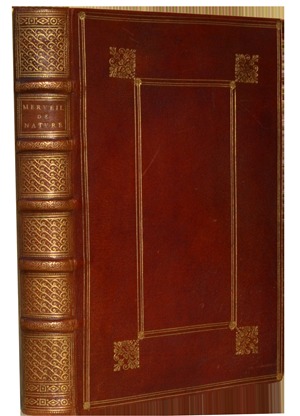
1621113011621 1 Titre allégorique gravé (signatures anciennement et proprement noircies !) 6 ff.n.ch. (2 dédicace, 2 épistre, indice des matières, advertissement) 569 pp. (au verso, privilège du 16 janvier 1621 pour dix ans). Manque la page de titre. Ex-libris armorié "Gualterius Young" (Trip Coll Dub, en pied) à la devise : Robori - Prudentia - Praestat. Rouen, Romain de Beauvais et Jean Osmont, 1621, petit in-4° reliure moderne plein maroquin bordeaux, titre or sur dos 5 nerfs à élégant décor géométrique aux caissons dans double filets d'encadrement, roulette sur les nerfs, plats à la Du Seuil, triple filets à petits écoinçons avec fer extérieur dans un triple filet d'encadrement, tranches rouges, roulettes sur les coupes, dentelle intérieure, contreplats peignés, gardes mobiles blanches ; deux éraflures au premier plat ; minime galerie de vers en pied du petit fond des 40 premières pages ; petit trou en I et en I3 avec atteinte à une lettre p. 63 et p. 68 ; manque en pied sans atteinte au texte p. 341.
Rivista periodica arte e cultura internazionale con ampie monografie d'artisti 16 ANNATE - 32 VOLUMI 28x20 cm., 400 ca per ciascun volume, Numerose in b/n e a colori - Numerose tavole f.t., Cartone plasticato - Fragi e titoli in oro al dorso, Ed., INGLESE - FRANCESE OTTIME CONDIZIONI
A Cura: Grasolari Jacopo (morto nel 1534) Jacobus Grasolarius, veneziano . Pagine: XXII+260+110 Fogli . Illustrazioni: Marca tipografica con il sole fra le viti sorrette da due cavalli . Formato: 16° . Rilegatura: Cartonato muto coevo con al dorso legatura a vista originale con successione doppia di filo, inserito in due tasselli a pergamena. . Stato: Buono . Caratteristiche: Alla seconda opera manca il frontespizio: nelle note a mano antiche ritrovate all'antiporta si dichiara che questa mancanza è molto antica. Molte note antiche scritte in latino ai margini. Da notare la lettera a pg. 2 della seconda opera, dalla quale si capisce il curatore dell'opera (Jacopo Grasolari), il mecenate (Cristoforo De Prioli) e il maestro del curatore, Giorgio Alessandrino Merula. Edizione rarissima. Prima pagina bianca con molte firme antiche un pochino sciupata. . Note epoca: 1527 anche la seconda opera, stampata assieme
15531214091553 Lutetia, Cura ac diligentia Caro Stephani, Cum privilegio Regis - M.D.LIII (1553) - Edition princeps - Grand in-octavo, reliure plein veau, dos à cinq nerfs, caissons et fleurons dorés, titre doré - Ex-libris sur l'intérieur du premier plat "Ex-Libris Antoni Marioe Dumas Rectoris de Chauffaille" - 611 pages - Texte sur deux colonnes - Ouvrage en latin
In-folio, pp. (32), 563, leg. settec. p. perg. rigida, tit. ms. al dorso. Grande marca tipogr. sul front., graziose testatine, iniz. e fregi silogr., testo in nitidissimo car. corsivo. Dedica dell'a. al ''Cardinale di Ferrara'' (Ippolito II d'Este). Seconda edizione di quest'opera, ''primo trattato di Rettorica che si avesse in lingua italiana''. L'immediato successo e ''lo spaccio sì pronto'' della prima ediizone costrinsero il Giolito a ristampare l'opera ''che uscì nell'anno stesso..., la quale, per essere corretta ed in più luoghi migliorata dall'autore stesso, è degna d'essere preferita'' (Bongi II, p. 72-76). Il Cavalcanti (Firenze 1503 - Padova 1562) fu letterato ed uomo politico, al servizio di svariati eminenti personaggi dell'epoca. Ottimo esempl. di opera impressa con notevole cura (timbro ed ex-libris ms. sul tit., lievi ingialliture agli ultimi 8 ff.).. BMC 162. Gamba 1307 (terza ediz.)..
[Torun (Polonia), s.n., 1697-1698], manoscritto su carta, in-4, legatura settecentesca in mezza pelle con punte (spellature diffuse) cc. 221 totali, non numerate (specifica dei vari titoli: cc. [74] ultime 5 bianche - [34] - cc. [60], ultime 2 bianche - [8], ultime 2 bianche - [10] - [6], ultima bianca - [8] - [5] - [16]). Steso in chiara grafia, da una sola mano, in lingue latina (in gran parte) e polacca. Interno in condizioni più che buone. Dell'estensore del manoscritto, Giovanni Francesco Pagnini che studiava a Torun nel 1697, non sappiamo nulla, se non che apparteneva ad un ramo della famiglia Pagnini originaria di Prato, che ebbe ramificazioni a Volterra, Lucca e, appunto, in Polonia. Ben più ampie le notizie disponibili sul suo professore, Raczynski, nato a Podlasie nel 1664, e che negli anni 1697-1708 insegnò retorica a Torun, Lublino e Poznan. La sua opera maggiore è l'"Historia naturalis curiosa regni Poloniae, magni ducatus Lituaniae annexarunque provinciarum" edita nel 1721, che, nonostante sia, in buona parte, una raccolta di descrizioni da varie fonti, costituisce una delle maggiori opere di storia naturale polacche del XVIII secolo. Morì nel 1737 a Danzica. Nel volume da noi presentato segnaliamo il secondo titolo che affronta argomenti intorno alla convivialità e alla gastronomia.
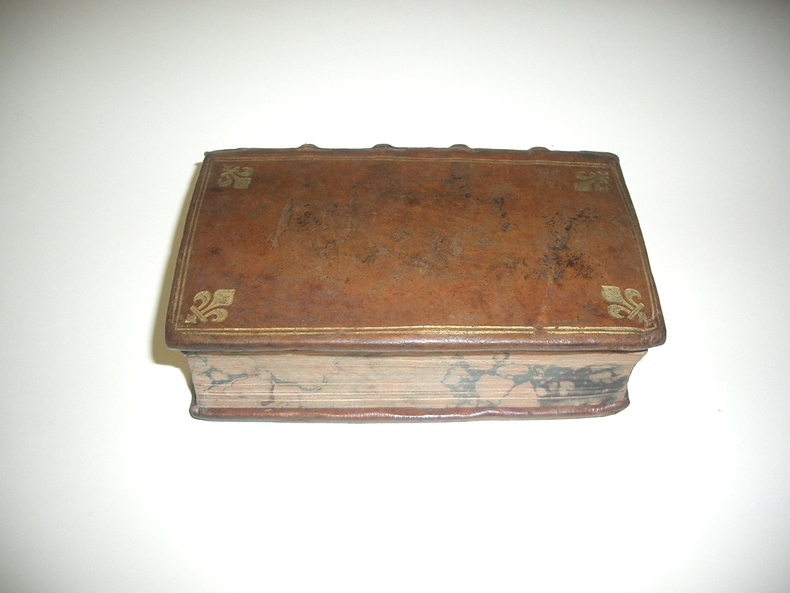
65859Parisiis, Apud Simonem Colinaeum, 1545, 1 volume de 7.5x11.5 cm environ, (1) ff., 218 ff. (1 numéro pour 2 pages) iv ff., (2) ff., reliure plein veau havane, dos à 4 nerfs avec titres dorés, entre-nerfs ornés de fleurs de lys,plats encadrés d'un double filet doré et d'une fleur de lys à chaque coins, tranches marbrées. Rares frottements, petit bijou bien conservé.Impression en italique.
[Postincunabolo- Legatura] (cm34) Bella e accattivante legatura originale, in piena pergamena con unghie ( Rinforzate in antico) e tracce di lacci. Nervi in pelle bianca (soatto) in parte esterni, sguardie non incollate che lasciano in vista il dorso frammenti di codice membranaceo del XIII sec. Manoscritti e rubricati a tempera. Titolo manoscritto al dorso e al piatto anteriore. -cc. 8nn., cc.198, c. 1 nn., cc.54 + c.1nn. con l'errata. Registro e al verso la stessa marca tipografica del frontis. Carattere romano, 42 linee, varie parole in greco, capilettera figurati. Edizione originale, curata dal J. Sichardus, veramente rara, di grande bellezza tipografica e ben completa delle due parti con in fine 19 capitoli delle "Declamationes" che pur non essendo di Quintiliano, sono state conservate sotto il suo nome. Dopo l'editio princeps del 1470 in Roma per cura di Joan. Antonii Campani, questo celebre trattato di retorica ebbe molte pubblicazioni e recensioni; è una delle più eccellenti opere che possediamo dell' antichità romana. L'autore ebbe successo e fama ed annovera fra i suoi scolari Plinio il giovane, Alcuni fili di tarlo ben restaurati all'angolo basso bianco, all'interno di alcune carte, ben lontno dal testo, lieve alone all'estremo margine bianco basso, altrimenti esemplare veramente bellissimo, nitido e a grandi margini, impresso su carta grave con tracce di coloritura originale ai tre tagli. * Graesse V 526 con collazione e note; * Biblioteca Panizzi 4847; * Moranti "Cinquecentine di urbino" 2848; * Adams Q 29; * BM:STC. German 721.[f68] Libro
154611249Venise, Hieronymus Scotas, 1546 ; in-folio ; plein vélin ivoire en partie manuscrit (reliure de l'époque) ; (6) ff., 142 ff. recto-verso, (3) ff. le dernier, blanc, a été découpé.
In-12°; seconda e migliore edizione delle opere complete, comprende in prima edizione il secondo volume; pp. (36), 322, (2); 155, (1) tre legni nel testo, al frontespizio e all’ultima pagina marca tipografica, capilettera incisi su legno. 2 tomi in un volume, ciascuno con un proprio frontespizio; legatura in piena pergamena con titolo manoscritto al dorso. Contiene: Discorso in mteria del suo theatro, L’idea del Theatro, Trattato delle materie (sull’eloquenza), Trattato della imitatione, Oration prima al re christianiss. di Francia per il vescovo palavicino, Oratione seconda, Rime, De verbi semplici (in cui parla anche della traduzione e delle figure retoriche), Lettere a Marc’Antonio Flaminio, Pietro Aretino, a una anonima Signora (con una tavola in alfabeto ebraico e una tavola di anagrammi del nome Lucretia); nel secondo: La topica overo dell’elocutione, Discorso sopra l’idee di Hermogene, La Grammatica, Espositione opra il primo e secondo sonetto di Petrarca. Giulio Camillo, detto Delminio, (Friuli nel 1480 circa - 1544) fu umanista, filosofo, letterato e scrittore; si interessò di retorica e oratoria, mnemotecnica e cabala. Tutte le sue opere furono pubblicate postume. Adams S 454; Gamba 1283; Cicognara 754; Young p. 56, Yates p. 174. giolito giulio camillo delminio teatro theatre retorica eloquenza poems poesia traduzione, translation anagrammi grammatica petrarca memoria mnemotecnica memory
In -8° pp. (8), 146, (2); mezza pergamena e carta marmorizzata, con nervi fregi e titolo al dorso; ril. con CARO, Annibal, “Rime”, Manuzio 1569, (8), 103, (9). Due rare prime edizioni: il Nazanzeno manca in Iccu e le rime del Caro sono la prima edizione postuma, curata da G.B. Caro e Paolo Manuzio. Two rare first editions, the Caro is the first edition post mortem.
Edizione originale. In-8°; pp. (16), 498 (la numerazione salta da p. 480 a 485), (52), (1), 2 cc.bb. Legatura in piena pergamena con titolo in oro al dorso. Piccolissimi restauri al margine interno bianco delle prime carte. Il cardinale Sforza Pallavicino (1607-67), storico del Concilio di Trento, entrò nella Compagnia di Gesù nel 1637 a seguito del noviziato con Giampaolo Oliva; insegnò filosofia al Collegio Romano e si distinse per la sua produzione letteraria e la stima dei letterati del tempo. Questo suo Trattato di estetica sulla composizione e lo stile, sulla scorta di Aristotele, affronta i problemi della retorica e della poetica. L’opera è suddivisa in Stile e Dialogo, è considerata un testo cruciale per il pensiero poetico tassiano. C. Scarpati, E. Bellini, Il vero e il falso dei poeti. Tasso Tesauro Pallavicino Muratori, Milano, 1990.
155945366Pesaro, Bartolomeo Cesano, 1559. 4to. Bound in a bit later full vellum with titlelabel in brown leather on spine with gilt lettering. (12),563 pp. Printers woodcut device on titlepage. With 7 large woodcut initials. The first 5 leaves with a few contemporary notes and underlinings. A fine clean copy.
155945366Pesaro Bartolomeo Cesano 1559. 4to. Bound in a bit later full vellum with titlelabel in brown leather on spine with gilt lettering. 12563 pp. Printers woodcut device on titlepage. With 7 large woodcut initials. The first 5 leaves with a few contemporary notes and underlinings. A fine clean copy. <br/><br/><em>There were printed 2 editions the same year one in Pesaro the item offered and one in Venice.Cavalcanti 1503-62 was a Florentine scholar-diplomat who served the Republic 1527-30 went into exile 1537 and spent his remaining years working for the Este and Farnese families. He died in poverty in Padua . His works reflect his interest in politics and scholarship: an oration to the Florentine militia 1530 political memoranda diplomatic letters translations from Polybius essays on classical political thought 1571 and an amazingly successful Retorica ten editions from 1559 to1585. The last a comprehensive compendium of classical rhetoric written in Italian with Italian examples maintains that the function of rhetoric is civic and practical rather than literary.Adams C 1176. </em> hardcover
In -4°, cc. (20), carta colorata. Prima edizione della traduzione di Giovanni Cattaneo del Panegirico di Isocrate: questo libro è giudicato come la prima testimonianza della presenza dell’umanista a Roma (v. Dbi, s.v.). Giovanni Maria Cattaneo, umanista nato a Novara verso la metà del XV secolo e morto intorno agli anni Trenta del secolo successivo, trascorse molto tempo a Roma, dove entro in contatto con il mondo culturale e strinse un sodalizio con lo stampatore Mazzocchi: questa traduzione è la sua prima pubblicata dall’editore romano e anche il suo testo in generale più noto. The first edition of Cattaneo’s translation of Isocrates’ Panegyric: this book is considered as the first evidence of the presence of Cattaneo in Rome. Giovanni Maria Cattaneo was a humanist, born in Novara in the second half of XV century and dead around 1530. He spent much time in Rome, where he kept in touch with the contemporary cultural world and got along to the printer Mazzocchi: this translation is his first one published by the Roman editor and, in a wider sense, his better known text.
In-8°; pp. 164, (2), legatura in mezza pergamena con tassello e titolo in oro al dorso. il nome dell’autore, Cesare Beccaria Bonesana (Milano 1738 - 1794) , è in fondo alla dedica a Carlo. La seconda parte dell’opera annunciata nella lettera al lettore uscirà solo nel 1809. L’opera, qui in edizione originale e in forma organica, fu il frutto di alcuni studi e ricerche che Beccaria pubblicò sul la rivista il “Caffè”, e che avevano come oggetto la libertà dello stile dall’autorità della tradizione letteraria. In quest’opera l’autore teorizza il rinnovamento dei generi letterari e la maggiore aderenza delle parole alle cose. Ex libris Avv. Queirolo. Firpo II, p. 512. retorica lingua italiana italian language discorso stile style illuminismo milano critica letteraria linguistica beccaria milano
7 tomi , 26x21,leg. p. pergamena, con nervi , tasselli, fregi e tit. in oro al dorso, tagli col. rosso, pp. I- Quo Rhetorica conrinentur, editio tertia, emendatissima, pp. XXX+656, /II- Philosophicorum, editio tertia, emendatissima, PP. 674/IV- qui orationum primus, editio tertia, emendatissima, PP. 683/V- qui orationum fecundus, editio tertia, emendatissima, PP. 687/VI- qui orationum tertius, editio tertia, emendatissima, PP. 677/VIII- in quo epistolae ad atticum, editio tertia, emendatissima, pp. 364.(2 tomi in unico vol. )IX Indices ciceroniani quatuor, pp.303.firma d'appartenenza all'interno dei piatti su tutti i voll., spaccature della pergamena alla cerniera dei tomi II e VI, e in alcune parti dei dorsi, altrimenti in ottimo stato, buone le legature, ordinari segni del tempo.ATTENTION.If the book is older than 50 years Please contact us BEFORE to order it.In this caseits not immediately available to export and we will send you more information about cost and timing.Luogo di pubblicazione GinevraEditore Fratres CramerAnno pubblicazione 1758Materia/Argomento Filosofia , Retorica
17479287La Haye JEAN NEAULME 1747 1 La Haye, Jean Neaulme, 1747. In-8, veau marbré, triple filet d'encadrement doré, dos à ornements imitant les nerfs, tranches jaspées, 102 pages.
In-8°; pp. 796, mancano le ultime due carte, legatura in mezza pelle con tassello al dorso, più tarda. Con molti legni e diagrammi nel testo. Seconda edizione, la prima del 1538, le Lucubrationes dell’umanista fiammingo rappresentano un’opera “enciclopedica” nel senso che raccolgono trattati nei diversi campi del sapere, di particolare interesse la sezione scientifica dedicata all’ottica, alla prospettiva, astronomia, geometria e matematica, anche per le molte illustrazioni. Sembra le la parola “enciclopedi” si trovi per la prima volta proprio sul frontespizio di quest’opera, sotto la forma di kiklopedia.
164211765Lyon 1642 10 Lugd. Batavor (Lyon), Ex Officina Elzeviriana, 1642,10 volumes in-16, plein veau fauve, dos orné de fleurons, pièce de titre maroquin vert, tranches dorées, motifs de rubans sur les plats, filets sur les coupes.
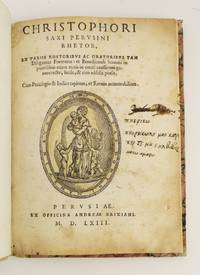
1563ST16379-038Perusiae Perugia: ex officina Andreae Brixiani 1563. SOLE EDITION. 210 x 155 mm. 8 1/4 x 6". 4 p.l. 78 4 leaves. <br/> 19th century vellum-backed pink marbled paper boards smooth spine black morocco label remnants of paper shelf label at foot of spine newer endpapers. Printer's device on title page. With Greek inscription in ink on title page occasional ink marginalia and with a page of inked notes written in Latin in an early hand on blank verso of final leaf. Leaf 3r with an inexpert but endearing pen-and-ink drawing of a rider on a galloping horse below the dedication with some pencilled embellishments around it; A4r with an ink-drawn small face in one margin. EDIT 16 CNCE 23145; Gehl "Advertising or fama: local markets for schoolbooks in sixteenth-century Italy" in Costas ed. "Print Culture and Peripheries in Early Modern Europe" 2012. Corners a little bumped boards lightly chafed title page a bit soiled and browned four leaves affected by the same small burn hole a handful of words partially obscured another leaf with very small damage from ink burn-through occasional faint foxing or minor ink stains but still a pleasing copy the binding perfectly satisfactory and the interior with no major defects the historical charm of the annotations compensating for any blemishes they cause.<br/> <br/> This is the first and only printing of a scarce textbook on rhetoric by a Perugian professor of the subject charmingly decorated and annotated by an early--not very attentive--pupil. In the 16th century the market for textbooks tended to be regional. Schools and teachers wanted works produced by local scholars and printers a preference Gehl relates to their earlier reliance on manuscripts shared and recopied by the teachers who used them. He notes that "Perugia . . . had a particularly lively market for learned books that lasted from the early days of printing right into the 17th century" and local professors were a ready resource for publishers like Andrea Bresciano.<br /> <br /> In the present work Saxus ca. 1499-1574 a pupil of the great Perugian humanist Francesco Maturanzio 1443-1518 outlines the principles of persuasion giving examples of the various rhetorical devices and modes citing classical sources. According to Gehl our author "was an innovator . . . who made a serious attempt to facilitate learning by catering to the limited attention span of students and by including teaching tips to grammar masters." We have evidence of what he was up against in regard to the former in the doodles of a prior owner of this text who was apparently dreaming of galloping away from the classroom on a trusty if seemingly headless steed. On another page the face of a master or fellow student peers critically from a margin. But some attention was paid as shown by the notes at the end of the book. <br /> <br /> Saxus' writings never managed to break into the major markets of Rome and Venice but continued to be printed after his death in Florence and Perugia where Gehl says "he could be considered a regional celebrity" whose former students used his textbooks to teach their own classes. We could trace just one copy of this work in auction records. ex officina Andreae Brixiani unknown
1670jj6151A Paris, par la Compagnie des Libraires Relié 1670 Dix volumes in-12 (10 x 16,7 cm), reliure plein veau, dos à 5 nerfs orné de caissons dorés, tranches dorées, gardes couleur, 10 volumes sur 12 (il manque les tomes 1 et 2), Tome 3 : Les Oraisons : I. Pour C. Rabirius - II. Les IV contre L. Catilina - III. Pour L. Flaccus - IV. Pour P. Cornelius Sylla - V. Pour le poëte Archias - VI. Apres son retour au Sénat - VII. Pour sa maison (588 pp.) ; Tome 4 : Les Oraisons : I. Touchant les devins - II. Pour Plancius - III. Pour P. Sextius - IV. Contre Vatinius - V. Pour M. Celius Rufus - VI. Touchant les provinces consulaires (480 pp.) ; Tome 5 : Les oraisons I. Pour L. Corn. Balbus - II. Contre L. Calp. Pison - III. Pour T. Annius Milon - IV. Pour C. Rabirius Postume - V. Pour Marcellus - VI. Pour Ligarius - VII. pour le Roy Dejotarnus - VIII. Pour la Paix - IX. Les Paradoxes (464 pp.) ; Tome 6 : Les Philippiques (631 pp.) ; Tome 7 : Les I.II.III.IV.V.VI.VII.&VIII Livres des Epîtres familières (534 pp.) ; Tome 8 : Les IX.X.XI.XII.XIII.XIV.&XV. Livres des Epîtres familières (581 pp.) ; Tome 9 : Le XVI. Livre des Epîtres familières - Les offices, ou les devoirs de la vie civile - Les lettres de Brutus et de Cicéron (606 pp.) ; Tome 10 : Les Tusculanes (499 pp.) ; Tome 11 : De la nature des dieux - La consolation de Cicéron sur la mort de sa fille Tullia (456 pp.) ; Tome 12 : Le dialogue de la vieillesse - Le dialogue de l'amitié - Des orateurs illustres - Le songe de Scipion (439 pp.) ; manque de cuir à la coiffe supérieur et/ou inférieure des volumes, coins frottés, quelques marques de frottement sur les plats, par ailleurs intérieur frais, bon état général. Livraison a domicile (La Poste) ou en Mondial Relay sur simple demande.
Edizione: Prima edizione . Pagine: 572 . Illustrazioni: Vignetta al frontespizio raffigurante il peccato originale con il motto " De Hoc stipite omnes" . Formato: 24° . Rilegatura: Pergamena originale molto allentata. . Stato: Buono . Caratteristiche: Sono presenti le Sententiae di Cicerone ( da pg. 1 a 262), e citate per il resto delle pagine ( 263-569) sentenze di numerosissimi altri autori classici. Frontespizio mancante di 1 cm di carta, senza lesioni sul testo. Scritte antiche sul retro della rilegatur