22 résultats
1695X95494Wittembergae [Wittemberg], Christiani Kreusigii [Kreusig] 1695 [24] pp., 19cm., blind wrappers, paper slightly browned, text in Latin with some fragments in Hebrew and in Greek, good condition, rare, X95494
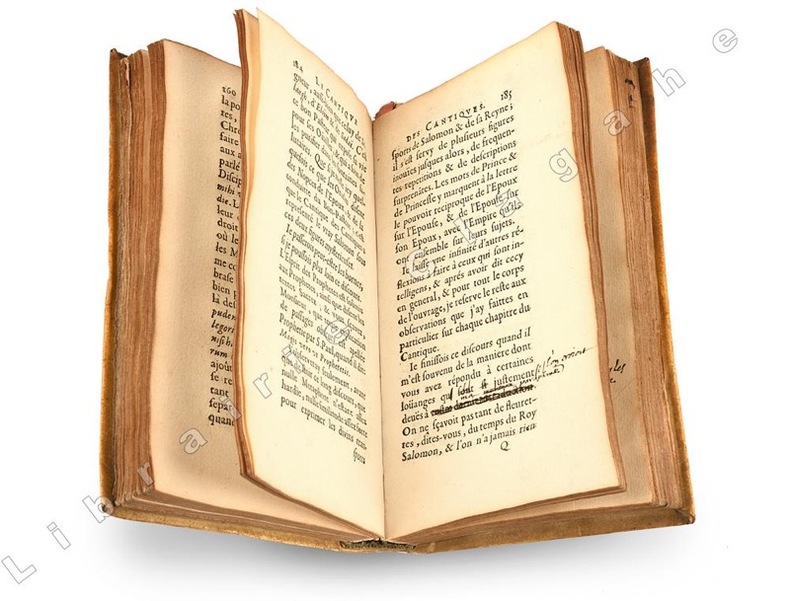
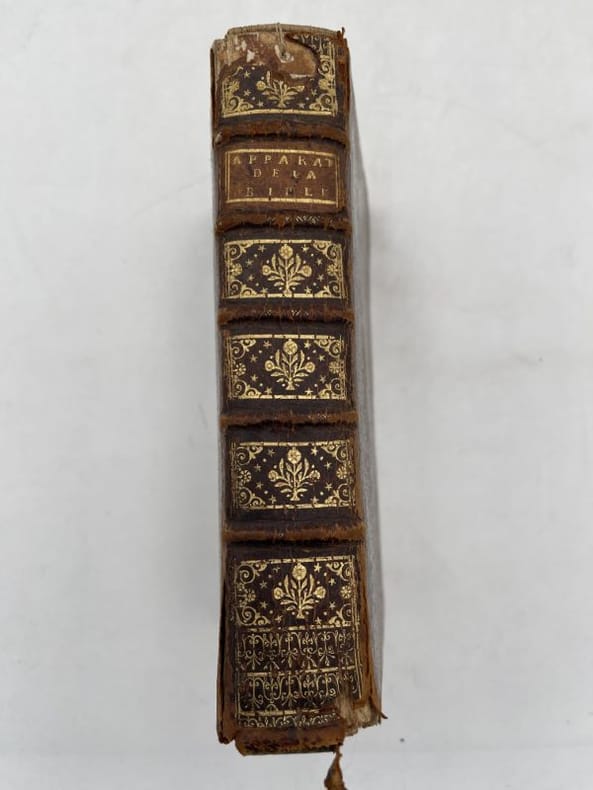
1697177364André Pralard A Paris, chez André Pralard, 1697. In-8 relié plein veau brun, dos à nerfs très orné, pièce de titre. Page de titre avec la belle marque typographique de l'imprimeur et sa devise "Inimicos Virtute Superabis", 14 pages pour l'avertissement, approbation, privilège et table des chapitres + 618 pages + Table alphabétique des principales matières contenues dans cet Apparat de la Bible, additions et corrections. Bandeaux gravés. Reliure abimée en dos avec manque de cuir à la coiffe et en queue, mors un peu fendus, coins émoussés, Pas de page de garde blanche, ex-libris contrecollé en partie déchiré. Le corps de l'ouvrage est en état correct et bien complet de ses gravures dépliantes : La Terre comme lorsque l'Evangile fût publié - La Judée divisée par tribus et en provinces - Ancienne ville de Jérusalem et les environs (une déchirure sur 4 cm sans manque) - Temple, tabernacle, arche d'alliance - Plan ichnographique du Temple de Jérusalem selon les notions qu'on a pu tirer du Prophète Ezechiel, de l'Histoire de Joséphe et du Talmud - Plan et élévation du Temple de Jérusalem, de ses édifices et des bâtiments sur lesquels il était soutenu (petite déchirure sur 2 cm sans manque) - La représentation du Souverain Pontife - La représentation d'un Juif (déchirure sans manque sur 3 cm) - Comparaison des monnaies anciennes et leur proportion avec les poids de Paris - Comparaison des Vases hébraïques et leur proportion avec ceux de Paris - Comparaison des Mesures Longues Anciennes et leurs proportions avec celles de Paris - L'ouvrage est divisé en deux livres : Apparat de la Bible et Introduction à l'intelligence de la Sainte Ecriture. Contient sur 17 pages une "Table ou l'on voit une nouvelle disposition de l'Ecriture Sainte". Quelques pages présentent des taches ou rousseurs. Edition originale rare.
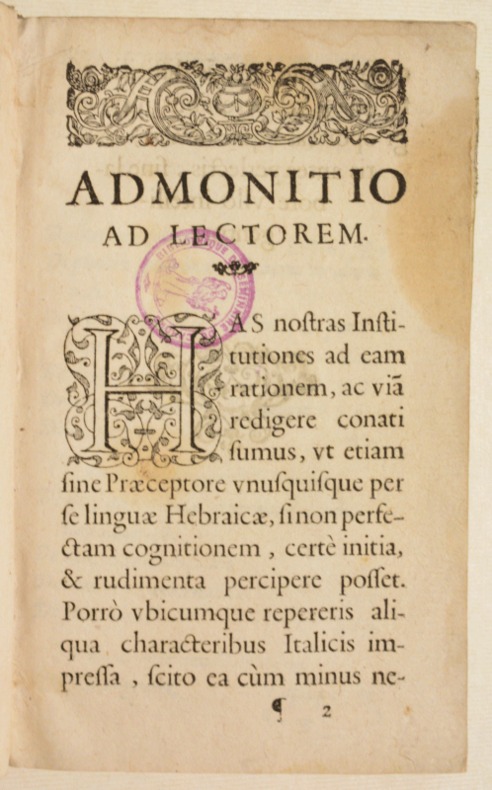
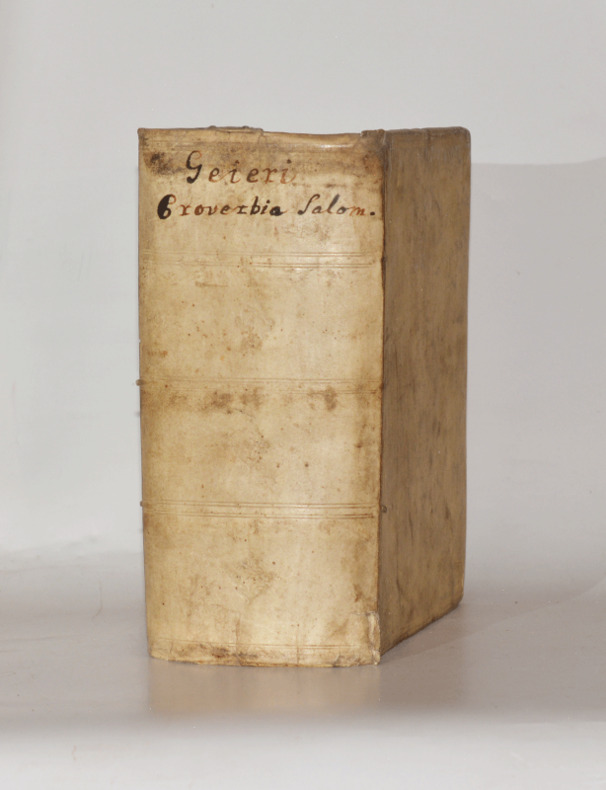
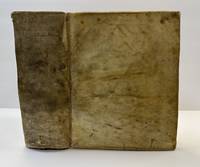
16170006401617 Coloniae Allobrogum [Genève], Johannes Pratensis, 1617. In-12 (106 X 162 mm) vélin rigide ivoire, titre calligraphié à l'encre noire au dos (reliure de l'époque) ; (4) ff. de titre, avis au lecteur et index, 334 pages. Cachet à l'encre violette sur le second feuillet, restauration au premier plat, mouillures très claires en marge de quelques feuillets.
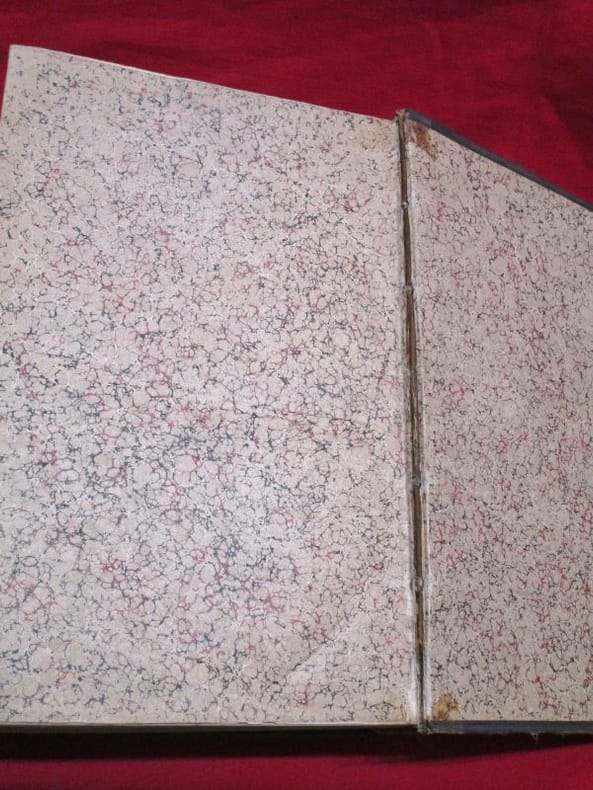
165740141657 trois tomes reliés en un volume, reliure d'époque plein veau brun (binding full calfskin) in-folio un peu défraichie, dos à nerfs (spine with raised bands) décoré or (gilt decoration) - titre frappé or (gilt title) - coiffes supérieures et inférieures légèrement manquantes (head and tail of the spine lightly faded), plats frottés (rubbed) épidermés (lights scratches) manque en haut d'un mors sur 3 centimètres carrés, coins écornés (corners dog-eared), toutes tranches lisses (all edges smoothes) jaspées (marbled edges) sans illustration (no illustration) sauf une vignette sur la page de titre (engraved title page) pour chaque volume et lettrines (dropped initial) + culs-de-lampe (tailpiece) gravés sur bois (engraving-wood) en noir, (360 + index) + (376 + index) + (335 + index) pages , 1657 Antwerp (Anvers) Apud Jacobum Meursium Editeur,
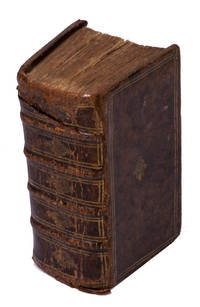
164940171649 reliure plein veau in-folio, dos 6 nerfs - titre frappé or -, plats défraichis, 2 volumes reliés en 1, 1649 Lugduni Petri Prost,deux tomes reliés en un volume, reliure d'époque plein veau brun (binding full calfskin) in-folio un peu défraichie, dos à nerfs (spine with raised bands) décoré or (gilt decoration) - titre frappé or (gilt title) - coiffes supérieures et inférieures légèrement manquantes (head and tail of the spine lightly faded), plats frottés (rubbed) épidermés (lights scratches) manque en haut d'un mors sur 3 centimètres carrés, coins écornés (corners dog-eared), manque de cuir sur 2 centimètres carrés, toutes tranches lisses (all edges smoothes) jaspées (marbled edges) sans illustration (no illustration) sauf une vignette sur la page de titre (engraved title page) pour chaque volume et lettrines (dropped initial) + culs-de-lampe (tailpiece) +) + fronts-de-chapitre bandeaux (headpiece), gravés sur bois (engraving-wood) en noir, (610 + index) + (554 + index) pages , 1649 Lyon Pierre Prost, Philippe Borde et Laurent Arnaud Editeurs,
1609112551plantin rapheleng 1609 Ex Officinia Plantiniana (Plantin), Raphelengii (Ravlenghien, Rapheleng), [Lugduni Batavorum - Leyde], 1609, 1 volume in-16 de 100 x 160 mm environ, (8) ff. (Page de titre, préface), 495 pages, (1) f. blanc, (30) ff. d' Index sur deux colonnes. Reliure cartonnée portant dos titré à l'encre sur pièce de papier. Reliure de travail, frottements et déchirures par endroits, un tampon de bibliothèque sur une garde, traces de mouillures sur une douzaine de feuillets, galeries de vers dans les marges inférieures de l' Index, marges un peu courtes, sinon bon état général.
1616R119865Antverpiae [Antwerpen], Ex officina Plantiniana, apud viduam & filios Ioannis Moreti [Moretus] 1616 206 + [2] + [4bl.] pp., 18x12cm., text in Latin and partly in Hebrew, contemporary full vellum binding (intact, with few marginal stains), text is clean and bright except for few old handwritten annotations in the margin of the text, good condition, cfr. De Backer-Sommervogel I col.1151-1152 no.4, R119865
165610488Rouen Jacques Cailloue et Jean Viret 1656 Un volume in-folio plein veau, dos à nerfs, caissons décorés, titre doré, [11] ff., 595 pp., titre, [2] ff., 386 pp., [bl.], illustrations in-texte, bandeaux et culs-de-lampes, lettrines ornées, texte sur deux colonnes. Coins émoussés, coiffes arasées, manque le feuillet de titre, petit travail de vers en marge, sans atteinte au texte, petits manques de papiers aux marges des premiers et derniers feuillets.
166221448Paris, Pierre le Petit, 1662 ; in-12, velin ivoire de l’époque, titre manuscrit au dos; [8], 417 pp.
16530026141653 Lipsiae [Leipzig], Impensis Haered. Henningi Grosfii, Literis Friderici Lanckisii Exscribebat, Chriftophorus Cellarius, 1653. Fort volume petit in-quarto (170 X 200 mm) vélin rigide, plats ornés d'un encadrement de filets avec fleurons d'angles à froid, dos lisse cloisonné de filets avec fleurons à froid dans les compartiments, titre calligraphié à l'encre noire, tranches teintées en bleu (reliure de l'époque) ; frontispice, (5) ff., 1724 pages, (11) ff. d'index et errata. Accroc avec petite fente de deux centimètres en queue du mors supérieur, tache d'encre sur le titre, feuillets brunis, infime travail de ver (trou de la taille d'une tête d'épingle) affectant les 19 premiers feuillets, cerne de mouillure dans la marge inférieure de quelques feuillets. Initiale manuscrite «F. » répétée sur les 3 premiers feuillets.
166638497Amsterdam: Joseph Athias. Very Good with no dust jacket. 1666. 1st. Leather. 240 7 pages; First Leusden edition. Small 8vo late 19th century black morocco top edge gilt other edges seemingly untrimmed. Title page toned and dampstained chipped at bottom fore edge - no loss to printing gutter of title page re-enforced lightly toned throughout small chipping at bottom fore edge corners at front and back dampstaining to running heads throughout occasionally touching text lacking leaf Ss4 the terminal blank. Parallel Hebrew/Dutch text. Right hand pages Hebrew text and on the left pages Dutch translation. . Joseph Athias hardcover
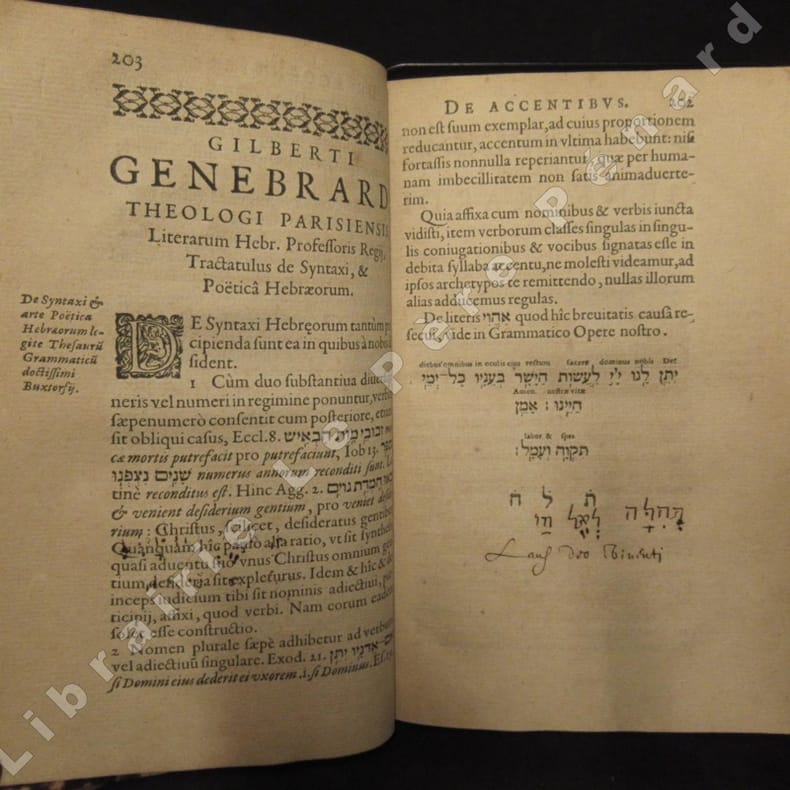
16921327694Lipsiae: Johannis Casparis Meyeri/Gottfried Liebezeit 1692. Fifth Revised edition. Hardcover. Two works of Judaica bound together in a single volume: Henrico Opitio Heinrich Opitz with B. Wasmuthi. Hazer leshon ha-qodesh: Hoc est atrium linguae sanctae. Lipsiae: Johannis Casparis Meyeri 1692. Fifth Revised edition. 156 pages. Henrico Opitio Heinrich Opitz. Novum Lexicon Hebraeo-Chaldaeo-Biblicum. Lipsiae: Gottfried Liebezeit 1692. 1095 pp. Hebrew 62 pp. Chaldaean. Square quarto in full vellum binding with faded hand-written titles on spine. All edges tinted blue. Pagination restarts with each part. Text in Hebrew and Latin. Condition: Very Good. The binding is shaken with some shelf-wear and bumping. The spine and boards are sunned and somewhat warped and there are some splits at hinges and gutter. Medium age-toning and some foxing. Scattered marginalia some of which are in Hebrew and some of which appear to be lists of occurrences of particular Hebrew words in the Hebrew Scriptures. Dimensions 7 x 8.125 x 3.125<br /> <br><br /> <br><br /> shelved case 4. 1327694. Shelved Dupont Bookstore. Johannis Casparis Meyeri/Gottfried Liebezeit hardcover books
16921327694Lipsiae: Johannis Casparis Meyeri/Gottfried Liebezeit 1692. Fifth Revised edition. Hardcover. Two works of Judaica bound together in a single volume: Henrico Opitio Heinrich Opitz with B. Wasmuthi. Hazer leshon ha-qodesh: Hoc est atrium linguae sanctae. Lipsiae: Johannis Casparis Meyeri 1692. Fifth Revised edition. 156 pages. Henrico Opitio Heinrich Opitz. Novum Lexicon Hebraeo-Chaldaeo-Biblicum. Lipsiae: Gottfried Liebezeit 1692. 1095 pp. Hebrew 62 pp. Chaldaean. Square quarto in full vellum binding with faded hand-written titles on spine. All edges tinted blue. Pagination restarts with each part. Text in Hebrew and Latin. Condition: Very Good. The binding is shaken with some shelf-wear and bumping. The spine and boards are sunned and somewhat warped and there are some splits at hinges and gutter. Medium age-toning and some foxing. Scattered marginalia some of which are in Hebrew and some of which appear to be lists of occurrences of particular Hebrew words in the Hebrew Scriptures. Dimensions 7 x 8.125 x 3.125<br /> <br> <br /> <br> <br /> shelved case 4. 1327694. Shelved Dupont Bookstore. Johannis Casparis Meyeri/Gottfried Liebezeit hardcover
1680506930Samuel Roycroft 1680. Leather. NEAR FINE. 16 1328pp. 4to recently and finely rebound in brown calf with burgundy morocco label with tissue repairs by the same binder to a few outer leaves and an earlier tape-backing to the title page by an earlier and less-skilled hand; pen markings to a few pages of the preface original trim with petina to edges entirely sound and clean internally. Samuel Roycroft unknown
1609112554geneve roviere 1609 Aureliae Allobrogum (Genève), Petrus de la Roviere (Pierre de la Rovière), 1609, 1 volume grand in-folio de 240 x 370 mm environ, (14) ff. (Page de titre, Praefatio) - 183 - 283 - 84 - 203 pages; [suivi de] (4) ff. (Page de titre, Praefatio) - 186 - 134 pages. Complet dans le canon catholique. Demi-chagrin brun postérieur, dos à 5 nerfs portant titre doré. Exemplaire solide mais en modeste condition : reliure abimée (débuts de fente sur les mors externes, mors internes fendus, manques de cuir, plats tachés, coins dénudés), nombreuses rousseurs et pages brunies, des traces de mouillures, quelques déchirures sans manque, travail de vers sur une dizaine de pages du Nouveau testament.
16211162551621 Lutetiae. Ex officina & Typis Gulielmi Lebe - CI . I C. XXI (1621) - In-12, demi-basane brune (reliure postérieure), faux-nerfs, filets et titre en doré au dos - 247 pp. - Ouvrage en latin
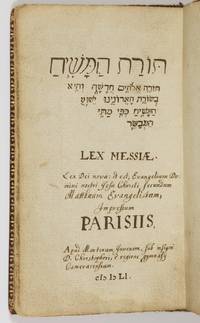
1700557661700. Very good-. Small octavo 14.1 by 8.5 cm. Manuscript in black and brown ink; 18-20 lines per page; text in vocalized Hebrew. 6 title and editor's preface 146 12 blank 10 notes. Lacks the first leaf which has been supplied in manuscript by a later owner. 19th-century limp morocco rubbed at extremities gilt dentelles marbled endleaves. Faint dampstain along bottom margin occasional smudges and mild stains else very good with crisp text.<br /> <br /> Early modern transcription of the Hebrew version of the Gospel of Matthew published in 1551 at Paris by Martin le Jeune with notes at the rear likely the work of a student. This edition was prepared by Jean Cinqarbres Quinquarboreus; 1514-1587 who jointly held the chair of King's Professor of Hebrew Literature at the University of Paris with Jean Mercier d. 1570. Lapide describes this as a "literal" edition and notes that the learned French bibliographer and father of the Oratory Jacques Le Long regarded it as the "true and authentic Gospel of Matthew." Like many of the surviving copies it lacks the Appendix which comprised the Seven Penetential Psalms Psalm CXIX Daniel's Prayer and the Ten Commandments. Apart from minor formatting changes e.g. breaks between chapters the text appears to be a faithful copy including vowel points and some of the additional cantillation marks the printed marginalia new Hebrew page numbers and Cinqarbres's dated preface. As the original version contains only 17 lines of text per page the transcription is not a page-for-page copy. Here the copiest appears quite fastidious in providing appropritate new catchwords! The Latin portion of the title however differs notably from the original which reads: Sanctum Domini nostri Iesu Christi Hebraicum Evangelium secundum Matthaeum.<br /> <br /> "In 1537 Sebastian Münster published his Hebrew version of the Gospel of Matthew at Basel the first printed edition of the New Testament in the so-called 'mother tongue of the evangelist' as he states in his preface" Lapide. Like the Paris edition of Hebrew Matthew upon which the present copy is based Münster entitled his version Torat ha-Mashiah The Teaching of the Messiah. While Münster's version of Matthew was long believed to be based on the 14th-century Hebrew translation by the Jewish polemicist Shem Tov ben Isaac ibn Shaprut more recent scholarship has called this attribution into question. "There are medieval Hebrew forms of Matthew that most scholars think of as retroversions from the Greek of canonical Matthew often made to serve in arguments between Christians and Jews. However some claim that these texts are a guide to the original Hebrew of Matthew French scholars like J. Carmignac and M. Dubarle have contributed to this thesis. Still other scholars think they can reconstruct the original Hebrew or Aramaic underlying the whole or parts of the Greek text of canonical Matthew on the assumption that the original was in Semitic. The vast majority of scholars however contend that the Gospel we know as Matthew was composed originally in Greek and is not a translation of a Semitic original" Brown.<br /> <br /> Provenance and annotations: The copiest has added notes following the main text comprising a Seder shel Miqra / Ordo Bibliorum in which the tripartite division of the Scriptures according to Jewish tradition is described. Then follows several pages of Hebrew terminology with biblical references and definitions in Latin. Along with one or two references to rabbinic literature an erudite reference to the Passover Haggadah notes Rabbi Judah's grouping of the ten plagues into three acronyms.<br /> <br /> At the head of the leaf inserted after Cinqarbres' preface is the note "When I bought this Mss. the first chapter from verse one unto verse 14 and part of verse 15. I filled in the missing verses. May. 18th. 1901. Llewellyn Saunderson 10 De Vesse Terrace Kingstown Co. Dublin" References: R. Brown Introduction to the New Testament 1997 p. 210; P. Lapide Hebrew in the Church Grand Rapids 1984 see Chap. IV "Modern Christian Hebraica" esp. pp. 53-58. Cf. Adams B1890 wanting the appendix; Darlow & Moule 5095: An independent edition of Shem Tob's version see no. 5088 which notes: The editor S. Münster obtained an imperfect MS. copy of St. Matthew's Gospel in Hebrew which had been made as early as 1385 for polemical purposes by Shem Tob b. Shaprut a Jew of Tudela in Castile. He revised and completed this for the press Basel: H. Petri 1537 adding a Latin translation of the Hebrew.; Delaveaux & Hillard 4644 noting Ibn Shaprut as the ulitmate source; Le Long/Masch 2 1781 p. 10. Schwarzfuchs Paris 212. Steinschneider 6591.26 under Münsterus.<br /> <br /> Full title noting original imprint: תורת המשיח תורת ××œ×”×™× ×—×“×©×” ×•×”×™× ×‘×©×™×¨×ª ×”××“×•× ×™× ×• ישוע המשיח כפי מתי המבשר <br /> Lex Messiae. Lex Dei nova: id est Evangelium Domini nostri Iesu Christi secundum Matthaeum Evangelistam Impressum Parisiis: apud Martinum Iuvenem sub insigni D. Christophori è regione gymnasii Cameracensium M.D.LI. 1551. unknown
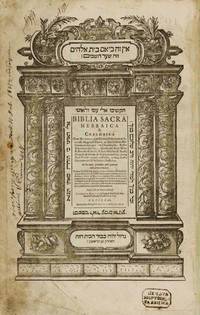
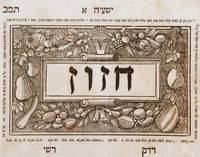
161948847Basel: Ludwig König 1619. First editions. Hardcover. Good. Seven parts in two volumes folio biblical texts and commentary in four parts continuously foliated; two supplemental sections each with separate foliation; Tiberias 1620 with separate pagination here bound after the second part - Vol. 1: 6 title and prelims 1-228 1 sect. title 234-441 1 blankff.; 6 sect. title and prelims 2 blank 114 2 blankpp. Vol. 2: 442-946; 8 Targum Yerushalmi; last leaf unfoliated; 67 Masora 1 blankff. Largely arranged in two columns of biblical texts in square font surrounded by commentaries in rabbinic Rashi font; text reads from right to left. This copy with collective Latin title surrounded by biblical quotations in Hebrew set within elaborate woodcut architectural borders. Hebrew sectional titles set within the same woodcut borders for the second and fourth parts with a plain letterpress half-title for the Five Megillot. The third sectional title for the Latter Prophets is lacking as are the Ashkenazi Haftarot readings not found in all copies. Apart from these lacks the Rabbinic Bible collates complete despite numerous errors in foliation throughout as per the detailed notes in Prijs Die Basler hebräischen Drucke. Opening word of each biblical book set in large one-third to one-half page cartouche vignettes with elaborate woodcut borders and surrounding letterpress Hebrew text. Main Latin title dated 1619 with the editor's Latin preface to the reader appearing at the verso. Jewish date chronogram for the second section Former Prophets dated 5378 1618/1619. Early twentieth-century black cloth boards worn at extremities gilt-lettered spine. Title moderately soiled re-inforced at gutter; neat old repairs to corners and fore-edge of title and next three leaves; old Russian stamp at bottom margin title manuscript entry in Russian along fore-edge dated 1837; intermittent mild to moderate marginal dampstains largely confined to corners and embrowning throughout both volumes somewhat more heavily in the first especially throughout Tiberias; top right corner of the opening leaf in vol. 2 repaired with loss of about 12 words surrounding title cartouche recto and some text in 9 lines of the commentary at the verso. Overall a good set with a notable chain of provenance. <br /> <br /> Sixth Rabbinic Bible in Hebrew: Mikra'ot Gedolot edited by Johann Buxtorf I 1565-1629 professor of Hebrew at the University of Basel and the foremost Christian Hebraist of his era with the assistance of the Jewish scholars Abraham Braunschweig who served as the principal corrector and Mordechai Gumplin of Posen. This was "a truly audacious undertaking for his time" Burnett From Christian Hebraism to Jewish Studies as no Christian scholar had yet attempted to edit the entire biblical corpus including the Aramaic versions Targumim and masoretic notes. Based mainly on the third Rabbinic Bible published by Daniel Bomberg at Venice in 1546-1548 the editor has carefully incorporated elements from two other Venetian editions. At the verso of the Latin title Buxtorf provides a detailed bibliographical excursus on the earlier Venetian editions and offers a tribute to Bomberg's industry by reprinting the colophon of the second Venetian Rabbinic Bible 1524-1525 at the conclusion of the masoretic appendix with text by the Hebrew grammarian and lexicographer Elijah Levita 1468 or 1469-1549 and a new introduction by Abraham Braunschweig. The design of the sectional titles and separate book title vignettes closely model those of the Venetian editions. "Buxtorf did not plan simply to reprint one of the existing Venice editions but rather to assemble the best features of them all into one work" and "to provide theologians with what he considered the most important tools for interpreting the Old Testament" Burnett. Buxtorf served in an official capacity as Basel's Hebrew censor charged with the oversight of all Jewish printing in the city and insuring that "no 'blasphemies' or slurs against Christians or Christianity appear in any book printed in Basel" Burnett. He carefully edited the Jewish commentaries in the Rabbinic Bible in accordance with this mandate "and removed many words and phrases which had escaped the attention of earlier censors" Burnett. <br /> <br /> The Rabbinic Bible contains the vocalized Masoretic text of the Hebrew Scriptures with accents and a vocalized Targum an Aramaic paraphrase of the biblical text: Onkelos for the Pentateuch; Jonathan b. Uzziel for the Prophets; and Targum Hagiographa for the Writings. The Hebrew and Aramaic versions are printed in square characters and presented in facing columns at the center of each page. The Jerusalem Targum of the Pentateuch appears as an appendix. In addition to the Aramaic paraphrases the Rabbinic Bible includes a massive scholarly apparatus of biblical commentaries by Rashi Ibn Ezra Baal ha-Turim Jacob b. Asher R. David Kimchi Radak R. Levi b. Gershon Ralbag Saadia Gaon and R. Isaiah along with the Masora a corpus of critical notes on the external form of the Biblical text compiled by Jewish scholars from late antiquity through the medieval era. As frequently occurs a copy of Buxtorf's work on the textual history of the Hebrew Bible Tiberias the 1620 first edition is bound-in. This work was made possible by the publication in 1538 of Elijah Levita's Masoret ha-Masoret a commentary on the Masora which Buxtorf translated into Latin for his own private use in 1593. "Buxtorf was concerned with the integrity of the consonantal text and the origin and integrity of the vowel points and accents of the Hebrew Bible from the very beginning of his scholarly career" and while he had earlier published a long excursus on the age of the vowel points and accents in his 1609 Thesaurus Grammaticus "Tiberias is Buxtorf's fullest and most impressive work on the history of the biblical text" Burnett. Intended as a reference work for Christian students and scholars interested in studying the Masora Buxtorf was also keen to refute the view advanced by Levita that the Hebrew vowel points were early medieval innovations. Our folio version of Tiberias was intended to accompany the Rabbinic Bible and has the same architectural borders at the title. König also published a quarto edition in the same year but only the folio version includes a critical commentary on the Masora in which Buxtorf proposes various corrections to the Masoretic notes. <br /> <br /> As noted at the title Buxtorf's faithful study and tireless labor studio fido et labore indefesso yielded notably long-lasting results: "The Basel rabbinical Bible became a standard tool for research among Christian scholars and would remain so. until the end of the nineteenth century" Burnett. A vast array of early modern scholars including Protestants like Johannes Drusius and John Selden as well as Roman Catholics like Robert Bellarmine and Andreas Masius owned a copy or two of the Rabbinic Bible. "Johannes Buxtorf's thoroughly censored "Christian" version of the Rabbinic Bible Basel 1618-19 only made it easier for Hebraists to own copies of their own" Burnett Christian Hebraism in the Reformation Era p.163.<br /> <br /> A note on the date of publication: "The actual printing began between the mid-August and mid-September of 1618. According to the colophon production ended on the 24 of Ab 5379 = August 4 1619 but since this date also appeared on the colophon of the Bomberg Biblia rabbinica edition of 1524-25 reprinted unchanged in the 1546-48 and 1568 editions it is suspect. Prijs suggested that the probable completion date was sometime during Ab of 5379 between July 12 and August 10 of 1619" Burnett. <br /> <br /> Provenance: from the library of acclaimed theologian and biblical scholar Brevard Childs with his entry at the free endpaper in the second volume. The earlier bookplate of judge Samuel Heller with his motto in Hebrew: Mi-kol melamdai hiskalti from all my teachers I have learned appears at the front paste-down. An old blue ink-stamp in Hebrew characters makes occasional appearances the text: Bet ha-Midrash ha-Gadol Minsk The Great Synagogue of Minsk. A Russian entry dated 1837 appears at the fore-margin of the main title along with an old ink stamp in Russian at the bottom margin the last word of which reads "Rabbina" References: Biblia Sacra: Burnett 7. Cowley 87. Darlow & Moule 5120 bound with the 1665 second edition of Tiberias cf. 5093. Davidson Otsar ha-shirah vol.1 p.406 no.8954. Prijs 219. Steinschneider 423 423b. VD17 23:675325G. S. Burnett Christian Hebraism in the Reformation Era Leiden: Brill 2012 p.163. Tiberias: Burnett 111. Prijs 222a. For detailed analyses of both works see: S. Burnett From Christian Hebraism to Jewish Studies Leiden: Brill 1996 pp.169-239 chaps. 6 & 7.<br /> <br /> Full Latin title: Biblia Sacra Hebraica & Chaldaica cum Masora quae critica Hebraeorum sacra est Magna & Parva ac selectissimis Hebraeorum interpretum commentariis Rabbi Salomonis Jarchi R. Abrahami Aben Esrae R. Davidis Kimchi R. Levi Gerson R. Saadie Gaon R. Jeschajae & Notis ex authore quem Baal Turim vocant collectis quibus textus grammaticè & historicè illustratur. In his nunc primum post quatuor editiones Venetas textus Chaldaicus qui Targum dicitur à deformitate punctationis & pravitate vocum innumeratum vindicatus; loca in Masora transposita deficientia pugnantia numeris depravata subsidio diversorum exemplarium & Concordantiarum Hebraicarum quantum fieri potuit reposita restituta & conciliata sunt ut in praefatione amplius declarabitur. Studio fido & labore indefesso Johannis BuxtofI linguae sanctae in Academia Basileensi Professoris Ord. Basileae: Sumptibus & typis Ludovici König 1619.<br /> <br /> Collation vol. 1 Rabbinic Bible: ital.a6 a-z8 A-E8 F4 G-Z8 Aa-Hh8 Ii9 Ii10 blank; 1 blank :3 1 blank A-N4 O5.<br /> <br /> Collation vol. 2 Rabbinic Bible: Kk-Rr8 Kk1 lacks Ss6 Tt10 Vv-Zz8 AA-PP8 QQ-TT6 VV9 VV10 blank XX-ZZ8 Aaa-Nnn8 Ooo3 Ooo4 blank PppTtt8 Vuu3 Vuu4 blank Xxx-Zzz8 AAaa-EEee8 8 A-G8 H6 I5 I6 blank. Ludwig König hardcover
1609371891Geneva: Pierre de la Rouière 1609. In two columns. 28 184 283 1 84 203 1; 8 186 2 134 2pp. Folio 15 x 9-1/2 inches. Contemporary pigskin covers blocked in gilt and blind remnants of paper label on the spine gauffered edges lacks bosses and hinges and clasps worn at extremities and bottom of spine. Provenance: Johann Georg Feuchter of Jura-Weickersroda inscription on pastedown that the bible was purchased at an August 6 1728 auction for 4 florins and 30 groschen; General Theological Seminary blindstamp. In two columns. 28 184 283 1 84 203 1; 8 186 2 134 2pp. Folio 15 x 9-1/2 inches. Edited with introduction by Benito Arias Montanus 1527-1598 Spanish orientalist and editor of the Antwerp Polyglot a reprint of Plantin's similar edition. Darlow & Moole 5113 OT and 4662 NT Pierre de la Rouière unknown
161952679Basel: Ludwig König 1619. First edition in part. Hardcover. Good. Eight parts in three volumes folio biblical texts and commentary in four parts continuously foliated; three supplemental sections each with separate foliation; Tiberias 1655 with separate pagination here bound after the Haftarot - Vol. 1: 6 title and prelims 1-228 1 sect. title 234-441 1 blank ff. Vol. 2: 1 sect. title 442-705 3 blank 707 sect. title-837 1 blank ff. Vol. 3: 839 half-title-881 1 blank 883-946; 8 Targum Yerushalmi; last leaf unfoliated; 67 Masorah 1 blank; 1 title 2-36 Haftarot ff.; 8 title and prelims 108pp. Despite the gap in foliation between the first and second parts and numerous errors in foliation throughout the Rabbinic Bible collates complete with all blanks noted in Prijs Die Basler hebräischen Drucke and the Haftarot bound at the end. Largely arranged in two columns of biblical texts in square font surrounded by commentaries in rabbinic Rashi font; biblical texts read from right to left. This copy with collective Hebrew title surrounded by biblical quotations in Hebrew set within elaborate woodcut architectural borders; brief preface in Hebrew by Abraham Braunschweig at the verso. Hebrew sectional titles set within the same woodcut borders for the three other biblical sections and the Haftarot with a plain letterpress half-title for the Five Megillot. Opening word of each biblical book set in large one-third to one-half page cartouche vignettes with elaborate woodcut borders and surrounding letterpress Hebrew text. Main title Jewish date chronogram = 5378 1618-1619. Near-contemporary half calf over speckled boards worn and rubbed; spines with raised bands gilt morocco lettering pieces and old paper labels heavily faded. About two-thirds of the text embrowned ranging from minimal to moderately heavy; worm tracing in a 1- by 2-inch section at leaves 541-553 affecting text. A good complete set notably containing the Ashkenazi Haftarot readings not found in all copies.<br /> <br /> Sixth Rabbinic Bible in Hebrew: Mikra'ot Gedolot edited by Johann Buxtorf I 1565-1629 professor of Hebrew at the University of Basel and the foremost Christian Hebraist of his era with the assistance of the Jewish scholars Abraham Braunschweig who served as the principal corrector and Mordechai Gumplin of Posen. This was "a truly audacious undertaking for his time" Burnett as no Christian scholar had yet attempted to edit the entire biblical corpus including the Aramaic versions Targumim and masoretic notes. Based mainly on the third Rabbinic Bible published by Daniel Bomberg at Venice in 1546-1548 the editor has carefully incorporated elements from two other Venetian editions. At the verso of the Latin title Buxtorf provides a detailed bibliographical excursus on the earlier Venetian editions and offers a tribute to Bomberg's industry by reprinting the colophon of the second Venetian Rabbinic Bible 1524-1525 at the conclusion of the masoretic appendix with text by the Hebrew grammarian and lexicographer Elijah Levita 1468 or 1469-1549 and a new introduction by Abraham Braunschweig. The design of the sectional titles and separate book title vignettes closely model those of the Venetian editions. "Buxtorf did not plan simply to reprint one of the existing Venice editions but rather to assemble the best features of them all into one work" and "to provide theologians with what he considered the most important tools for interpreting the Old Testament" Burnett. Buxtorf served in an official capacity as Basel's Hebrew censor charged with the oversight of all Jewish printing in the city and insuring that "no 'blasphemies' or slurs against Christians or Christianity appear in any book printed in Basel" Burnett. He carefully edited the Jewish commentaries in the Rabbinic Bible in accordance with this mandate "and removed many words and phrases which had escaped the attention of earlier censors" Burnett. <br /> <br /> The Rabbinic Bible contains the vocalized Masoretic text of the Hebrew Scriptures with accents and a vocalized Targum an Aramaic paraphrase of the biblical text: Onkelos for the Pentateuch; Jonathan b. Uzziel for the Prophets; and Targum Hagiographa for the Writings. The Hebrew and Aramaic versions are printed in square characters and presented in facing columns at the center of each page. The Jerusalem Targum of the Pentateuch appears as an appendix. In addition to the Aramaic paraphrases the Rabbinic Bible includes a massive scholarly apparatus of biblical commentaries by Rashi Ibn Ezra Baal ha-Turim Jacob b. Asher R. David Kimchi Radak R. Levi b. Gershon Ralbag Saadia Gaon and R. Isaiah along with the Masora a corpus of critical notes on the external form of the Biblical text compiled by Jewish scholars from late antiquity through the medieval era. As frequently occurs a copy of Buxtorf's work on the textual history of the Hebrew Bible Tiberias the 1655 revised edition is bound-in. This work was made possible by the publication in 1538 of Elijah Levita's Masoret ha-Masoret a commentary on the Masora which Buxtorf translated into Latin for his own private use in 1593. While "Buxtorf was concerned with the integrity of the consonantal text and the origin and integrity of the vowel points and accents of the Hebrew Bible from the very beginning of his scholarly career." While he had earlier published a long excursus on the age of the vowel points and accents in his 1609 Thesaurus Grammaticus "Tiberias is Buxtorf's fullest and most impressive work on the history of the biblical text" Burnett. Intended as a reference work for Christian students and scholars interested in studying the Masora Buxtorf was also keen to refute the view advanced by Levita that the Hebrew vowel points were early medieval innovations. Our folio version of Tiberias was intended to accompany the Rabbinic Bible and has the same architectural borders at the title. König also published a quarto edition in the same year but only the folio version includes a critical commentary on the Masora in which Buxtorf proposes various corrections to the Masoretic notes. <br /> <br /> As noted at the title Buxtorf's faithful study and tireless labor studio fido et labore indefesso yielded notably long-lasting results: "The Basel rabbinical Bible became a standard tool for research among Christian scholars and would remain so. until the end of the nineteenth century" Burnett. A vast array of early modern scholars including Protestants like Johannes Drusius and John Selden as well as Roman Catholics like Robert Bellarmine and Andreas Masius owned a copy or two of the Rabbinic Bible. "Johannes Buxtorf's thoroughly censored "Christian" version of the Rabbinic Bible Basel 1618-19 only made it easier for Hebraists to own copies of their own" Burnett Christian Hebraism in the Reformation Era p.163.<br /> <br /> A note on the date of publication: "The actual printing began between the mid-August and mid-September of 1618. According to the colophon production ended on the 24 of Ab 379 = August 4 1619 but since this date also appeared on the colophon of the Bomberg Biblia rabbinica edition of 1524-25 reprinted unchanged in the 1546-48 and 1568 editions it is suspect. Prijs suggested that the probable completion date was sometime during Ab of 379 between July 12 and August 10 of 1619" Burnett. References: Biblia Sacra: Burnett 7. Cowley 87. Darlow & Moule 5120 like our copy bound with the 1665 second edition of Tiberias cf. 5093. Davidson Otsar ha-shirah vol.1 p.406 no.8954. Prijs 219. Steinschneider 423 423b. VD17 23:675325G. S. Burnett Christian Hebraism in the Reformation Era Leiden: Brill 2012 p.163. Tiberias: Burnett 114. Prijs 272a. For detailed analyses of both works see: S. Burnett From Christian Hebraism to Jewish Studies Leiden: Brill 1996 pp.169-239 chaps. 6 & 7. Ludwig König hardcover
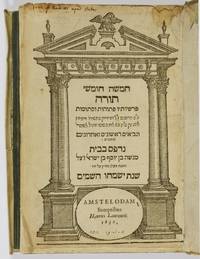
163155459Amsterdam: printed by Menasseh ben Israel for Henricus Laurentius 1631. First edition. Hardcover. Very good-. Octavo 16.8 by 11.4 cm. Collation: aleph-lamed-zayin8 = 296 leaves. 612 i.e. 592 pp: p. 464 erroneously numbered 484 465 as 485 and so on throughout. Two column text in unvocalized Hebrew; every fifth verse numbered in the margin. Title within architectural border; half titles with letterpress ornamentation for the Former and Latter Prophets. Contemporary vellumwith exposed thongs edges stained blue; yapp fore-edges; front joint cracked but holding strong. Intermittent light toning to text outmost leaves a bit more darkened; very occasional small stains. Title-page slighltly trimmed 4 mm at bottom edge; expert marginal repairs at bottom corners of 2 leaves; 1 leaf re-margined at fore-edge with no loss of text else a very good copy with crisp clean text.<br /> <br /> First Hebrew Bible published in Amsterdam printed by the rabbi diplomat publisher and religious thinker Menasseh ben Israel 1604-1657 one of the most distinguished members of the Portuguese Jewish community of Amsterdam and the first Jewish printer in the Northern Netherlands. The Amsterdam printer and publisher Hendrick Laurensz Lauretius provided the financing for this edition along with two other Bible editions and two editions of the Hebrew Psalms printed by Menasseh between 1631 and 1646. "These publications were not only made for the local market but mainly for international trade. Thanks to this financial help Menasseh was able to organize his printing office in a more professional way" Fuks hiring a Jewish compositor Judah Leb ben Mordecai Gimple from Posen and a gentile compositor Bartholomeus Laurensz. <br /> <br /> The printing activity of Menasseh was especially important in the steadily growing productions of the Hebrew press in the Northern Netherlands. Fulfilling the needs of the Sephardic community for Jewish ritual texts eliminated the need for expensive imports from Venice and Poland. Menasseh undersood that the relatively cheap paper and tools available in Amsterdam made it possible to compete in quality and prices with the Hebrew presses of Poland Italy and Basel. "Gentile publishers and booksellers in Amsterdam such as Jansonius and Laurentius were quick to see the opportunity of the opening Eastern European market and financed several of Menasseh's publications" Fuks. Menasseh was the first to introduce in the Netherlands waybertaytsch types for Yiddish publications along with illustrated Hebrew books. He was also the first Jewish printer to adopt the Dutch pocket-book format made famous by the Elzeviers.<br /> <br /> Notes on publication date and issue: The title is dated 1630 in Arabic numerals; the colophon notes the date of completion in Hebrew characters as 5 Adar 5391 = 7 February 1631 along with the printer's apology for being unable to provide the index of pericopes promised on the title-page due to lack of printing material. Darlow and Moule describe this issue as Variant A with a Latin imprint appearing in the cartouche beneath the Hebrew title.<br /> <br /> Provenance and annotations: early entry in brown ink at front paste-down with short Greek inscription Theos. dated 1700; old Latin inscription in black ink at top margin title in reference to Hebrew roots; date of 1812 beside Yiddish entry penned in black ink within imprint cartouche at title; old entry in German penned in black ink at verso title beneath which is an oval cartouche in imitation of the one at the title in which an owner has penned in black ink the Hebrew imprint information regarding Hendrick Laurensz as it would appear in the Varient B issue; old library shelf marks at rear paste-down; recent owner entry in blue ink in Hebrew at front paste-down. References: Darlow and Moule 5123a; Fuks/Fuks-Mansfeld no. 152; pp. 105; 111f.; Steinschneider no. 453; Vinograd Amsterdam 22.<br /> <br /> Full title and imprint: חמשה חומשי תורה פרשיותיו פתוחות וסתומות ×¢"פ ×”×¨×ž×‘× ×–"ל ומדוייק בחסירו' ויתרות להעתק ס"ת ×¢× ×œ×•×— בסופו מועיל לסופרי' ×•× ×‘×™××™× ×¨××©×•× ×™× ×•××—×¨×•× ×™× ×•×›×ª×•×‘×™×: × ×“×¤×¡ בבית ×ž× ×©×” בן ישר×ל ז׳׳צל והוגה בעיון × ×ž×¨×¥ על ידו ×©× ×ª ישמחו השמי×<br /> Amstelodami sumptibus Henrici Laurentii 1630. printed by Menasseh ben Israel for Henricus Laurentius hardcover
161018174Leiden 1610. 24mo in 8s 11 x 6 cm. Franciscus II Raphelengius Gold-tooled mottled calf ca. 1720 sewn on 4 cords each board with a small central flower ornament and a frame of double fillets the spine with a lozenge ornament in each of the 5 compartments a roll on each raised band and at the head and foot and further double fillets gold-tooled board edges mottled edges. With 4 letterpress title-pages for the Pentateuch early prophets major and minor prophets and Psalms etc. and decorations built up from arabesque typographic ornaments. Set in sephardic meruba Hebrew types unpointed with the imprints in semi-cursive rabbinical but the place of publication in meruba. 4 volumes bound as 1. 264; 227 1 blank; 238 2 blank; 287 1 blank pp. vols. 1-2 with arabic numerals 3-4 with Hebrew. A pocket-sized edition of the Hebrew Old Testament in four volumes volume 1 containing the Pentateuch or Torah volume 2 the early prophets Joshua Judges Samuel Kings volume 3 the later major Isaiah Jeremiah Ezekiel and minor prophets and volume 4 the Psalms Job Song of songs Ruth Lamentations Ecclesiastes Esther Daniel Ezra and Chronicles. It was produced by Franciscus II Raphelengius grandson of Christoffel Plantin and son of one of Europe's first great Hebrew scholars Plantin's son-in-law Franciscus I Raphelengius 1539-1597 who helped prepare Plantin's magnificent 1572 Polyglot Bible succeeded to the Leiden branch of Plantin's printing office and became professor of Hebrew at Leiden University. Plantin himself had produced the Dutch Republic's first Hebrew book there in 1585 and Raphelengius produced many more beginning in 1588.With occasional very minor foxing or faint discolouration but otherwise in very good condition. The spine and joints are worn with superficial cracks a repair at the head and a small tear at the foot and the sewing is slightly loose. A charming little Hebrew Bible from the first Dutch printing office to produce Hebrew books.l aleph.nli.org.il 001366023 4 copies; Darlow & Moule 5114; Fuks 25 2 copies; Steinschneider 386; WorldCat 8 or 9 copies. ABE CAT Bibles Sermons & Psalmbooks unknown