28 résultats
1709TBLBBIBL62<p>Kiel: Printed by Barthold Reuther for the Editor 1709. 1709. thick 4to. first title in Hebrew & Latin. Latin glosses. engraved title/frontis. woodcut ornaments & initial. contemporary calf gilt edges worn head & foot of spine defective some foxing. few old marginal notes. First Edition Edited by Heinrich Opitz 1642-1712 German Orientalist and professor of Greek and of divinity at Kiel. "The editor was as learned as he was pious: and the present unostentatious volume printed with a fine large Hebrew type.was the fruit of thirty years incessant toil in the study and correction of the sacred text. The result was eminently successful; for Opitius is justly classed among the most erudite of Hebraic critics.". Dibdin Darlow & Moule 5142. Dibdin 4th Edn. I pp. 64-65. F. Hardcover.</p> Kiel: Printed by Barthold Reuther for the Editor, 1709. hardcover
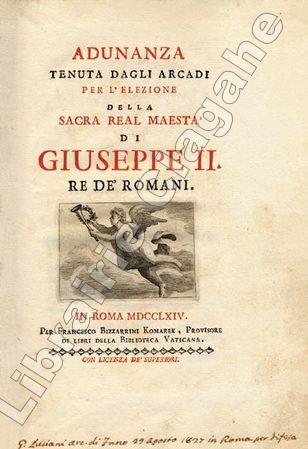
17644373Roma, 1764, per Francesco Bizzarini Komarek, Provisore di libri della Bibliotheca Vaticana ; grand in-8, plein vélin ivoire, titre manuscrit (reliure de l'époque) ; VIII, 120 pp., vignette de titre, lettrine et cul-de-lampe gravés, ouvrage entièrement imprimé en rouge et noir.
179318880Leipzig: I. G. I. Breitkopf and Associates 1793. First edition. Hardcover. Good. Two volumes octavo 18.1 by 10.6 cm. xii 6 360 302; 352 404 pp. Title-pages and first-volume preface in Latin; half-titles for the Pentateuch Former Prophets Latter Prophets and Hagiographa. Main text in Hebrew. Contemporary green paper boards with title-labels edges stained red. Illustrated head pieces such as the heavens before Genesis and King David at prayer before Psalms. First volume covers slightly warped. Spines sunned. Library stamp on title and back pages. Minor worm tracing at first the 32 leaves vol. 2 resulting in the loss of a word or two along the line else a good or better ex-library copy.<br /> <br /> Complete Old Testament in Hebrew with traditional cantillation marks and scholarly footnotes indicating varying textual readings. Latin chapter headings summarize content. Preface in Latin by Johann Heinrich Meisner offers a history of the project. In the back is an appendix showing variant readings from the De Rossi Codex. There is also a chart giving the weekly readings from the Pentateuch and prophets. This Bible exemplifies early modern Protestant interest in being able to read the Old Testament in the original Hebrew. This was a product of their belief in sola scriptura that only the basis for religious authority was the Bible. <br /> <br /> Provenance: Stamps of the Franciscan monastery at Eggenfelden in Bavaria. References: Darlow & Moule 5163; Orme Bibl. Biblica pp. 238-9.<br /> <br /> Full title and imprint: Biblia Hebraica olim a B. Christiano Reineccio edita et ad optimorum codicum et editionum fidem recensita et expressa nunc denuo ad fidem recensionis Masoreticae cum variis lectionibus ex ingenti codicum copia a B. Kennicotto et I. B. de Rossi collatorum ediderunt D. Io. Christoph. Doederlein. et Joannes Henricus Meisner. Lipsiae: impensis I. G. I. Breitkopfii et Soc. MDCCXCIII. I. G. I. Breitkopf and Associates hardcover
1767J2005Sumtibus Orphanotrophei Halle: . 1767 Four Parts in one volume with separate title pages. pp. xvi 1334; 79 1; 48; 75. Engraved title vignette by Grundler. Woodcut printer's ornaments and initials. 8vo. Foxed. Disbound. XLib. Second Revised Edition First - 1752 of this manual version of E. van der Hooght's text prepared by J. Simonis Professor at Halle. The appendices include a dictionary and an explanation of the Massoretic notes. Printed at Francke's famed Orphan House Press. The Pietist August Hermann Francke 1663-1727 was a German Lutheran Pietist clergyman philanthropist and Biblical scholar. He ranks high also in the history of education owing to the establishment 1695 of his orphan asylum around wh ich he grouped various institutions suited to the needs of teachers and pupils. He also turned his attention to foreign missions; the Pietists promoted the dissemination of the Bible through the establishment 1710 by Freiherr von Canstein of a bible house at the Halle orphan asylum where the orphans were taught the important trades of printing and binding. Darlow & Moule 5157. JUN2A/SE 2/3. PRICE JUST REDUCED! 0.0. No Binding. Fair. Sumtibus Orphanotrophei, Halle: . unknown
1756DEMO015781ILeipzig: Bernh Christ. Breitkopfium 1756. Third edition. Hardcover. Very Good. Thick 16mo 516 580 iv pp. newly rebound in half leather marbled boards spine label <br/><br/>Reineccius's 3-volume polyglot Hebrew Bible first appeared in 1750. Post-Gutenberg the Christians printed most of the Bibles Bernh Christ. Breitkopfium hardcover
17520729IJohann Gottlieb Bierwirth Halae Magdeburgiae Halle: . 1752 Several parts in one volume. pp. 640 320 384 72. Thick 16mo. 200 mm. Preface in Latin. First edition. Foxed. Disbound. Dusty. Johann Simonis 1698-1768 conrector of the gymnasium and professor of Church history and antiquities in the University of Halle. Simonis's object in editing this edition of the Hebrew Bible was to publish a correct but at the same time a cheap edition of Van der Hooght's text. But in spite of all care some inaccuracies have crept into the text. HEBREW BASEMENT. 1st Edition. No Binding. Good. Johann Gottlieb Bierwirth, Halae Magdeburgiae (Halle): . unknown
175253923Halae / Magdeburgicae (Bierwirth), 1752. 640 Seiten, nur 1. Teil gebundene Ausgabe, Halbleder, Buchblock locker, sonst Exemplar in gutem Erhaltungszustand
175263875Halae / Magdeburgicae (Bierwirth), 1752. 8, 640, 320, 384, 79, 72 Seiten. 19,5 x 12 cm - Komplett, mit einem hebräisch-chaldäischen Wörterbuch des Alten Testaments. gebundene Ausgabe, Pergamentband, Vorsatzblätter hinten und vorne unten angefranst,
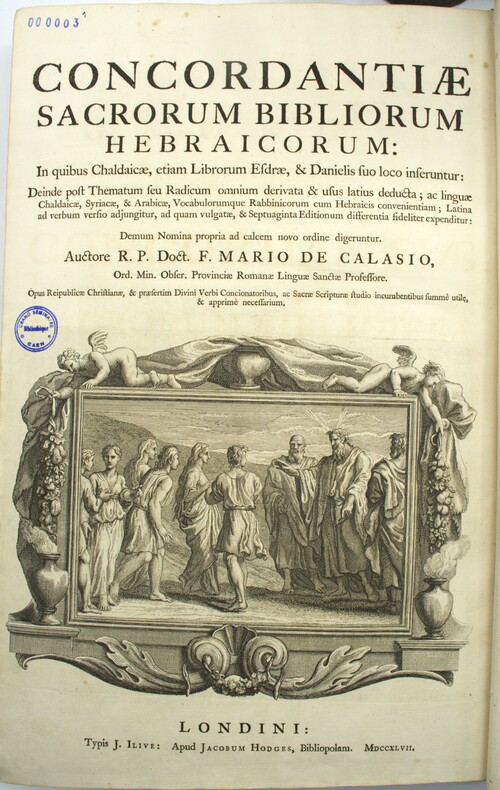
1747PHO-1817Londini, Jacobum Hodges, 1747-1749, 4 tomes en 4 vols in folio avec 4 grandes vignettes, gravées d’après Louis Chéron, aux titres ; texte hébreu-latin en 4 colonnes. Reliure plein veau époque, dos à nerfs orné. Petits accrocs et frottis (une déchirure du cuir à un plat avec manque), des coiffes absentes, cachets, corps d’ouvrage en excellente condition.
179052510New York: John Fenno no. 41 Broad-Street near the Exchange 1790. First edtion. Softcover. Fine. Two leaves folio 16.25 by 10 in. Edges slightly trimmed; a touch of mild foxing else a fine crisp copy. Housed in linen clamshell box with gilt paper label at spine and previous owner's dediction pasted to inside cover.<br /> <br /> The first known published appearance of Jewish support for the newly elected president of the United States George Washington. One week after Washinton's inauguration Levi Sheftall on behalf of the newly reorganized Savannah Hebrew Congregation wrote him an elegant and effusive letter of congratulation. This letter along with Washington's reply was published for the first time by the United States Gazette:<br /> <br /> "Sir We have long been anxious of congratulating you on your appointment. and of testifying our unbounded confidence in your integrity and unblemished virtue. Your unexampled liberality and extensive philanthropy have dispelled that cloud of bigotry and superstition which has long as a veil shaded religion -- unrivetted the fetters of enthusiasm -- enfranchised us with all the privileges and immunities of free citizens and initiated us into the grand mass of legislative mechanism. May the great Author of worlds grant you all happiness and a continuance of guardianship to that freedom which under the auspices of heaven your magnanimity and wisdom have given these States."<br /> <br /> Washington's reply is undated but addressed "To the Hebrew Congregation of the City of Savannah." After accepting their congratulations he extends this hope: "May the same wonder-working Deity who long since delivering the Hebrews from their Egyptian Oppressors planted them in the promised land -- whose providential agency has lately been conspicuous in established these United States as an independent nation -- still continue to water them with the dews of Heaven and to make the inhabitants of every denomination participate in the temporal and spiritual blessings of that people whose God is Jehovah. George Washington." <br /> <br /> Provenance: old entry of . Hopkins at top margin first leaf trimmed. Six weeks later <br /> <br /> References: Enc. Jud. first ed. 1972 vol. 16; Evans Amer. Bibl. vol. 8; From the Ends of the Earth Judaica Treasures of the Library of Congress. John Fenno, no. 41 Broad-Street, near the Exchange unknown
1789120591789 tres modeste basane sans nerfs. in-8, VIII-191pp., P. Méquignon, 1789,
1775R76955Stutgardiae, Sumptibus Ioh. Philippi Erhardi 1775 [ Praemissa est dissertatio de iusto hodierni studii quod in excutiendis codicibus vet. testamenti mss. collocatur pretio et moderamine], xii + 256 + [12]pp., 20cm., original 1775-edition, hardback (modern cart.binding, marbled plates), few foxing throughout text, library stamp at verso of frontispiece and on title page, rare, [text in Latin], OCLC 310833754, R76955
17081994Chez Jean Moreau,1708.-1 volume petit in-8 plein veau. Dos à nerfs à compartiments ornés, coins et coiffes usés. Les versets sont présentés en latin, avec la tradustion en regard, et une interprétation de l'auteur. Assez bon état.
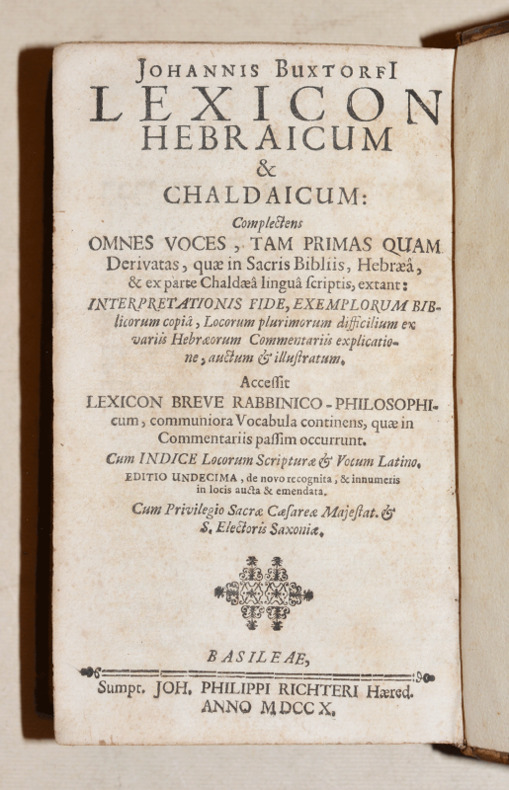
17100006381710 Basileae [Bâle], Joh. Philippi Richteri, 1710. Fort volume grand in-12 (110 X 173 mm) veau granité, encadrement de double filet noir sur les plats, dos cinq nerfs richement orné, pièce de titre maroquin rouge, tranches rouges (reliure de l'époque) ; (8) ff., 1 portrait gravé, 976 pages, (38) ff. d'Index.
173749261Leiden: Jean Luzac 1737. First edition. Two volumes large quarto. 52 544; 2 545-1232 63 indices 1 corrigendapp. Text in two columns with Hebrew text and facing Latin translation interspersed with commentary. Titles in red and black with engraved vignettes. Contemporary speckled calf; gilt-tooled spine with raised bands and morocco lettering pieces; gilt dentelles; edges daubed in red and green. Light scuffing to boards and fading to spines. A very good set with crisp clean text throughout.<br /> <br /> First edition of this comprehensive commentary to the biblical Book of Job by the Dutch scholar of Semitic languages Albert Schultens 1686-1750 who maintained "that the true nature of the Hebrew language and the meaning of many of its words and idioms are to be found chiefly in the Arabic" Orme. Fifty-five pages of the indices constitute a brief lexicon and provide Latin as well as Arabic equivalents for more than 1000 Hebrew words. Schultens studied theology and eastern languages at Groningen where he received his degree in theology in 1709. After a brief career as a preacher in Wassenaar he was nominated professor of Hebrew and Jewish antiquities at Franeker in 1713. In 1729 he decamped for Leiden were he was first appointed reader in eastern languages and finally full professor in 1732.<br /> <br /> At this time a chief concern of Calvinist theologians was to liberate Old Testament exegesis from the Jewish Rabbinic as well as Catholic traditions. Schultens' influential and controversial solution was revealed as early as 1706 in his first public thesis Disputatio theologico philologica de utilitate linguae Arabicae in interpretanda S. Scriptura A Theologico-Philosophical Dissertation on the Utility of the Arabic Language for the Interpretation of the Holy Scriptures "a forceful attack" Brugman & Schröder on the Protestant sola scriptura methodology of Biblical exegesis. "With the help of Jacobus Golius' Arabic dictionary he perused with zeal and fervour the Old Testament and wrote prolifically. The lexical superiority of Arabic had led him to a reconsideration of the position of Hebrew: at first he had called Arabic 'the most splendid daughter of mother Hebrew' but in his oration of 1729 he proclaimed Hebrew and Arabic cognate twin sisters. This shocked conservative theologians as an outright profanation of God's Word" Brugman & Schröder. "In 1737 he applied his theories in his bilingual edition of the book of the prophet Job whom he regarded as an Arab. The Hebrew text and the Latin translation are all but totally submerged by the extensive commentary in which Schultens draws abundantly on Arabic texts such as the Hamasa an anthology of early Arabic poetry by the ninth-century poet Abu Tammam" Vrolijk & van Leeuwen. Schultens was not without his critics and by 1824 William Orme notes a turning of the tide: "Different opinions are entertained of the correctness of his views and also of his success in applying them; but it is now generally admitted that he carries his notions of the advantage of Arabic learning to the interpretation of the Scriptures too far." <br /> <br /> Jean Luzac 1728-1777 was a member of a well-known Huguenot family of printers; he published many works for the University of Leiden including three Hebrew books of Albert Schultens. Isaac van der Mijn is noted as the printer at the colophon of the second volume.<br /> <br /> Provenance: printed label of the Bibliotheca Seminarii Warmondani at the front endleaf of the first volume. Full title: Liber Jobi cum nova versione ad Hebraeum fontem et commentario perpetuo in quo Veterum et Recentiorum Interpretum cogitata præcipua expenduntur: genuinus sensus ad priscum Linguae genium indagatur atque ex filo et nexu universo Argumenti nodus intricatissimus evolvitur. Curavit et editit. Albertus Schultens. Tomus Primus. -Tomus Secundus<br /> <br /> References: J. Brugman & F. Schröder Arabic Studies in the Netherlands Leiden: E.J. Brill 1979 p.26f. Fuks/Fuks-Mansfeld 78. Orme Bibl. Biblica p. 390. A. Vrolijk & R. van Leeuwen Arabic Studies in the Netherlands a Short History in Portraits 1580-1950 Leiden: E.J. Brill 2014 pp. 73-79. Jean Luzac unknown
1765N4664Frankfurt & Berlin: J.J. Speier 1765. First Edition . Half Leather. Very Good. 4to. 1. Theil und 2. Theil bound together. 124pp123pp.First part called "'Ir Heshbon" on Arithmetic and Algebra; the second part : "Berure Middot" on Geometry. MODERN HALF LEATHER BINDING WITH MARBLED BOARDS. Title page with stamp some old handwriting and markings. Upper corner of title page some 3 cm missing and replaced with old repair. Pages with some browning and occasional minor soiling. First pages of the second part trimmrd to text. Last page of the second part with repair to edges End papers with some old writing and minor soiling . OTHERWISE VERY GOOD.AN EXTREMELY RARE AND INTERESTING WORK of MATHEMATICS in HEBREW. this work is mentioned in Zeitlkin Bibliotheca Hebraica.- Elijah ben Moses Gershon Zahalon was a Jewish Talmudist mathematician and physician living in Pinczcow Russian Poland. <br/> <br/> J.J. Speier hardcover
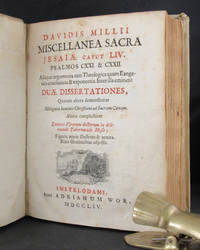
175430845Amstelodami Amsterdam: apud Adrianum Wor 1754. First and Only Edition. Very handsomely decorated and illustrated with title in red and black with engraved device and 6 very fine and large engraved folding plates showing the Tabernacle and other decorations and a portrait of the author. With some Hebrew and Greek text. Small 4to bound in contemporary blind-stamped vellum with manuscript title at the spine. 11 326 329-414; 2 329-402 xcviii 6 403-438 4 pp. A very pleasing and handsome copy with clean fresh text and fine plates a very faint and occasional sign of old damp at lower inner margin. VERY RARE FIRST EDITION IN EXEMPLARY CONDITION. This was the only edition of this scarce melange of theological commentary and philological criticism of the Hebrew Scriptures along with the author’s speculations on the construction of the Israelite tabernacle the latter accompanied by five large engraved illustrations. <br> Born at Königsberg Prussia the noted German Orientalist David Mill 1692-1756 was professor of theology at the University of Utrecht. His inaugural oration “De fatis theologiae exegetica†was delivered 10 October 1729 and is included in the present collection along with his “Oratio de erudita pietate†25 March 1743 a number of commentaries on various psalms and his "Dissertatio de Tabrnaculo Mosis to which five very large folding engraved plates are added. The volume comprises a tribute to professor Mill on the occasion of twenty-five years of service to the University and concludes with two verse encomia: “De erudita pietate peroranti†by Otto Arntzenius; and an “Elegia ad virum celeberrimum Davidem Millium†by Jacobus de Rhoer. In his later years Mill built a model of the Jerusalem Temple which eventually found its way to the attic of the University Library at Utrecht from whence it was rescued in the late nineteenth century by Leendert Schouten for his Biblical Museum Bijbels Museum in Amsterdam. With a fine engraved portrait of Mill.<br> Walch Bibliotheca theologica selecta 4: 834. Not in Horne.<br> apud Adrianum Wor hardcover
1760PHO-375
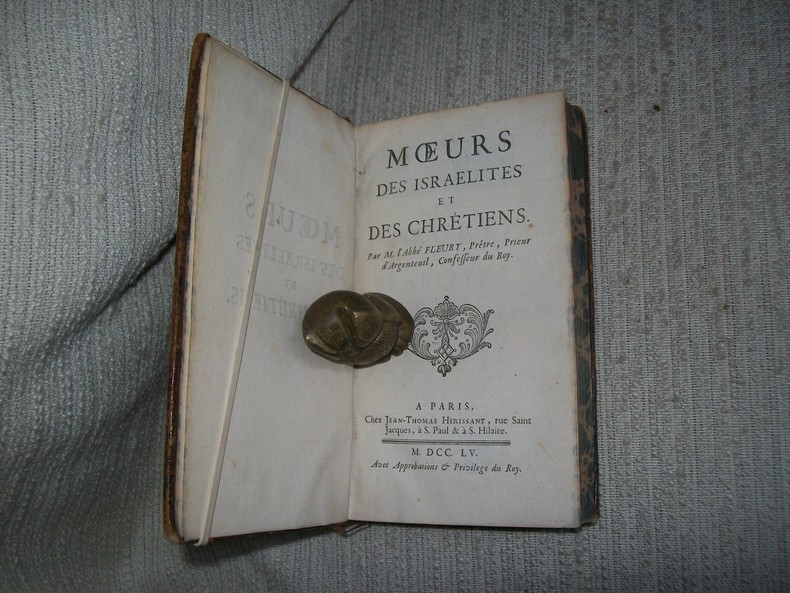
1755GIT01329A Paris chez Tomas Hérissant 1755. In-12 403pp 2ff n ch 1f blanc. Pleine basane havane, dos à nerfs orné de compartiments dorés, tranches marbrées, rel époque. 1 coiffe usée, 1 mors fendu sur 6cm.
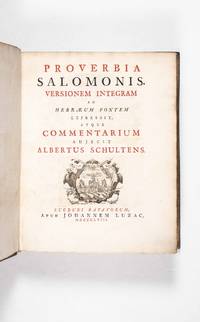
174849255Leiden: Jean Luzac 1748. First edition. Hardcover. Very Good. Quarto. 8 cviii 522 60 indices & corrigendapp. Text in two columns with Hebrew text and facing Latin translation interspersed with commentary. Title in red and black with engraved vignette; woodcut ornaments. Contemporary Dutch paneled vellum with blind-stamped vignettes and ruled borders; manuscript title at spine. Covers lightly soiled. Occasional touches of soiling and some leaves with mild embrowning. A very good copy generally crisp and clean.<br /> <br /> First edition of this comprehensive commentary to the biblical Book of Proverbs by the Dutch semitic language scholar Albert Schultens 1686-1750 who maintained "that the true nature of the Hebrew language and the meaning of many of its words and idioms are to be found chiefly in the Arabic" Orme. Forty-one pages of the indices constitute a brief lexicon and provide Latin as well as Arabic equivalents for more than 1000 Hebrew words. Schultens studied theology and eastern languages at Groningen where he received his degree in theology in 1709. After a brief career as a preacher in Wassenaar he was nominated professor of Hebrew and Jewish antiquities at Franeker in 1713. In 1729 he decamped for Leiden were he was first appointed reader in eastern languages and finally full professor in 1732.<br /> <br /> At this time a chief concern of Calvinist theologians was to liberate Old Testament exegesis from Jewish Rabbinic as well as Catholic traditions. Schultens' influential and controversial solution was revealed as early as 1706 in his first public thesis Disputatio theologico philologica de utilitate linguae Arabicae in interpretanda S. Scriptura A Theologico-Philosophical Dissertation on the Utility of the Arabic Language for the Interpretation of the Holy Scriptures "a forceful attack" Brugman & Schröder on the Protestant sola scriptura methodology of Biblical exegesis. "With the help of Jacobus Golius' Arabic dictionary he perused with zeal and fervour the Old Testament and wrote prolifically. The lexical superiority of Arabic had led him to a reconsideration of the position of Hebrew: at first he had called Arabic 'the most splendid daughter of mother Hebrew' but in his oration of 1729 he proclaimed Hebrew and Arabic cognate twin sisters. This shocked conservative theologians as an outright profanation of God's Word" Brugman & Schröder. <br /> <br /> Like his earlier commentary on the Biblical Book of Job one here finds that the "Hebrew text and the Latin translation are all but totally submerged by the extensive commentary in which Schultens draws abundantly on Arabic texts such as the Hamasa an anthology of early Arabic poetry by the ninth-century poet Abu Tammam" Vrolijk & van Leeuwen. Schultens was not without his critics and by 1824 William Orme notes a turning of the tide: "Different opinions are entertained of the correctness of his views and also of his success in applying them; but it is now generally admitted that he carries his notions of the advantage of Arabic learning to the interpretation of the Scriptures too far." <br /> <br /> Jean Luzac 1728-1777 was a member of a well-known Huguenot family of printers; he published many works for the University of Leiden including three Hebrew books of Albert Schultens. Isaac van der Mijn is noted as the printer at the colophon of the second volume.<br /> <br /> Provenance: bookplate of the Crozer Theological Seminary - Bucknell Library; bookseller's ticket of Librairie Ancienne et Moderne de Frederik Muller Amsterdam at the front paste-down. References: J. Brugman & F. Schröder Arabic Studies in the Netherlands Leiden: E.J. Brill 1979 p.26f. Fuks/Fuks-Mansfeld 78. Orme Bibl. Biblica p. 390. A. Vrolijk & R. van Leeuwen Arabic Studies in the Netherlands a Short History in Portraits 1580-1950 Leiden: E.J. Brill 2014 pp. 73-79. Jean Luzac hardcover
1732005149Paris Claude Simon - Barthelemy Alix 1732 In-8 demi basane Fauve Bon
1732GITe872Sans lieu 1732. In-12 5 feuillets non chiffrés I-XXXVI 1-228pp (réflexions sur la captivité) / 1 feuillet non chiffré II-VI 1-432pp (suite ou recueil de quelques écrits). Pleine basane brune, dos à nerfs orné de compartiments dorés, tranches brique, reliure de l'époque. Coiffes usées avec manque de cuir en queue sur 3cm, 2 coins émoussés, 1 mors fendu. Intérieur en bon état et complet.
18005749Roedelheim: Wolf Heidenheim 1800. First printing of a mahzor that was popular with the Jewish communities of Poland and Germany. It went through several printings in the first half of the 19th century. The editor Wolf Heidenheim established a printing press at Roedelheim in 1799 and immediately began his edition of the Mahzor with a Hebrew commentary by himself and a German translation. He based the text on a surviving Medieval manuscript dated 1258 as well as on the earliest Italian and German editions. 21 cm; volume 6 only of 9 of the liturgy for festivals this volume covering services for the evening of Yom Kippur. Text primarily in Hebrew. Preface in Yiddish. Bound in utility marbled boards worn ; pages evenly toned. Occasional stains especially on title page. Inscription in German on front blank dated 1828. Inscription in Hebrew at base of title page. Good overall. Wolf Heidenheim hardcover books
1703PHO-1998Ienae : sumptibus Bielckianis, 1703, in-4 (19,5x16cm), 10ff.-96pp., demi toile postérieure, titre au dos, titre renforcé, rousseur, papier uniformément bruni, mouillure. Texte en hébreu et latin en regard, imprimé sur deux colonnes.
176542165Mets Metz Bi-defus Mosheh Mai 1765. Hardcover. 8vo; Hebrew Date 525. Period full leather with raised bands and interspersed gilt floral design and leather spine label 4to large 18 leaves i.e. 36 pages 152 leaves i.e. 304 pages 69 leaves i.e. 138 pages i.e. 478 pages total. 27 cm. In Hebrew and Judeo-German German in Hebrew script. Includes indexes. Vinograd Metz 10.<br> "In France Hebrew presses were established in Metz c. 1760 Strasbourg 1770 and later in Paris 1806" Jewish virtual library this being an early example of Hebrew printing in Metz. <br> SUBJECTS: Judaism -- Liturgy -- Texts. Repentance -- Prayers and devotions. Judai¨sme -- Liturgie -- Textes. <br> OCLC: 265896805. OCLC lists 6 copies worldwide British Library Loyola NYPL YIVO Stanford HUC. The British library holding lists an engraved frontis; however no other holdings nor auction records which we have seen ever list an engraved frontis so we assume that to either be a mistake or added later or a variant. <br> Some wear to leather boards as expected especially at corners but paper and binding remain clean and strong. About Very Good- Condition. A beautiful copy with attractive leather binding. BK5 Rab-66-33-'belccm. Mets [Metz] Bi-defus Mosheh Mai hardcover