Elimelech Shmi HebrewBiblio.com
459 résultats
A9780983673019Paperback / softback. New. paperback
B9780983673019Paperback / softback. New. paperback
0983673012.Gpaperback. Good. Access codes and supplements are not guaranteed with used items. May be an ex-library book. paperback
2001N2365Ben Gurion Univ. & Yad Tabenkin 2001. Original Wrappers with DJ. Very Good. 4to. 248pp Hebrew text. Richly illustrated. Very good and clean copy. <br/> <br/> Ben Gurion Univ. & Yad Tabenkin unknown
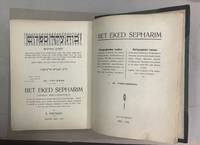
1928N2508Antwerpen 1928. First Edition . Half-Leather. Very Good. 4to. 1928-1931. 844pp Hebrew text together with a register of authors and a table of contents. Very well bound in one thick volume half leather of the period. Minimal occasional wear and minimal markings. A very good and clean copy of the FIRST EDITION. <br/> <br/> hardcover
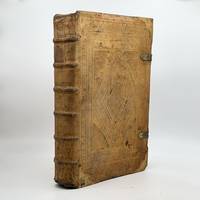
1609371891Geneva: Pierre de la Rouière 1609. In two columns. 28 184 283 1 84 203 1; 8 186 2 134 2pp. Folio 15 x 9-1/2 inches. Contemporary pigskin covers blocked in gilt and blind remnants of paper label on the spine gauffered edges lacks bosses and hinges and clasps worn at extremities and bottom of spine. Provenance: Johann Georg Feuchter of Jura-Weickersroda inscription on pastedown that the bible was purchased at an August 6 1728 auction for 4 florins and 30 groschen; General Theological Seminary blindstamp. In two columns. 28 184 283 1 84 203 1; 8 186 2 134 2pp. Folio 15 x 9-1/2 inches. Edited with introduction by Benito Arias Montanus 1527-1598 Spanish orientalist and editor of the Antwerp Polyglot a reprint of Plantin's similar edition. Darlow & Moole 5113 OT and 4662 NT Pierre de la Rouière unknown
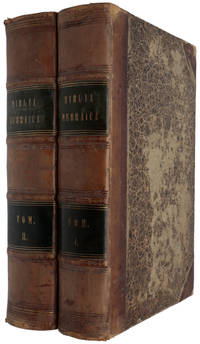
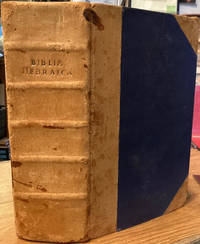
179318880Leipzig: I. G. I. Breitkopf and Associates 1793. First edition. Hardcover. Good. Two volumes octavo 18.1 by 10.6 cm. xii 6 360 302; 352 404 pp. Title-pages and first-volume preface in Latin; half-titles for the Pentateuch Former Prophets Latter Prophets and Hagiographa. Main text in Hebrew. Contemporary green paper boards with title-labels edges stained red. Illustrated head pieces such as the heavens before Genesis and King David at prayer before Psalms. First volume covers slightly warped. Spines sunned. Library stamp on title and back pages. Minor worm tracing at first the 32 leaves vol. 2 resulting in the loss of a word or two along the line else a good or better ex-library copy.<br /> <br /> Complete Old Testament in Hebrew with traditional cantillation marks and scholarly footnotes indicating varying textual readings. Latin chapter headings summarize content. Preface in Latin by Johann Heinrich Meisner offers a history of the project. In the back is an appendix showing variant readings from the De Rossi Codex. There is also a chart giving the weekly readings from the Pentateuch and prophets. This Bible exemplifies early modern Protestant interest in being able to read the Old Testament in the original Hebrew. This was a product of their belief in sola scriptura that only the basis for religious authority was the Bible. <br /> <br /> Provenance: Stamps of the Franciscan monastery at Eggenfelden in Bavaria. References: Darlow & Moule 5163; Orme Bibl. Biblica pp. 238-9.<br /> <br /> Full title and imprint: Biblia Hebraica olim a B. Christiano Reineccio edita et ad optimorum codicum et editionum fidem recensita et expressa nunc denuo ad fidem recensionis Masoreticae cum variis lectionibus ex ingenti codicum copia a B. Kennicotto et I. B. de Rossi collatorum ediderunt D. Io. Christoph. Doederlein. et Joannes Henricus Meisner. Lipsiae: impensis I. G. I. Breitkopfii et Soc. MDCCXCIII. I. G. I. Breitkopf and Associates hardcover
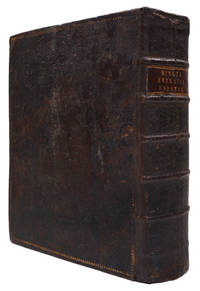
99104Oxford Clarendon Press 1750. . First edition; two volumes in one; 4to 24 x 19.5 cm; text in Hebrew; contemporary calf boards with gilt borders spine with raised bands leather label joints and spine cracked.<br /> A non-vocalised edition of the Pentateuch based on E. van der Hooght's text Darlow & Moule 5141. It is the earliest edition of the Hebrew Bible apart from the London Polyglot to be printed in England.<br /><br />The editor Nathaniel Forster D. D. 17181757 was an English cleric and biblical scholar. Son of a minister he was educated at Eton and at the Corpus Christi College in Oxford. In 1750 he became domestic chaplain to Bishop Joseph Butler who died in his arms two years later in Bath Somerset.<br /> ESTC T147721; Darlow & Moule 5151. Oxford, Clarendon Press, 1750. hardcover
1767J2005Sumtibus Orphanotrophei Halle: . 1767 Four Parts in one volume with separate title pages. pp. xvi 1334; 79 1; 48; 75. Engraved title vignette by Grundler. Woodcut printer's ornaments and initials. 8vo. Foxed. Disbound. XLib. Second Revised Edition First - 1752 of this manual version of E. van der Hooght's text prepared by J. Simonis Professor at Halle. The appendices include a dictionary and an explanation of the Massoretic notes. Printed at Francke's famed Orphan House Press. The Pietist August Hermann Francke 1663-1727 was a German Lutheran Pietist clergyman philanthropist and Biblical scholar. He ranks high also in the history of education owing to the establishment 1695 of his orphan asylum around wh ich he grouped various institutions suited to the needs of teachers and pupils. He also turned his attention to foreign missions; the Pietists promoted the dissemination of the Bible through the establishment 1710 by Freiherr von Canstein of a bible house at the Halle orphan asylum where the orphans were taught the important trades of printing and binding. Darlow & Moule 5157. JUN2A/SE 2/3. PRICE JUST REDUCED! 0.0. No Binding. Fair. Sumtibus Orphanotrophei, Halle: . unknown
1949043214Stuttgart: Virtembergicum Institutum Biblicum 1949. Aduvantibus W. Baumgartner et el. Edidit Rud. Kittel; textum masoreticum curavit P. Kahle. Editio quinta typis editionis tertiae expressa. xl 1434p. 2 maps original black cloth in very nice condition. Virtembergicum Institutum Biblicum unknown
1756DEMO015781ILeipzig: Bernh Christ. Breitkopfium 1756. Third edition. Hardcover. Very Good. Thick 16mo 516 580 iv pp. newly rebound in half leather marbled boards spine label <br/><br/>Reineccius's 3-volume polyglot Hebrew Bible first appeared in 1750. Post-Gutenberg the Christians printed most of the Bibles Bernh Christ. Breitkopfium hardcover
19110727AEditio Stereotypa C. Tauchnitii Sumptibus Ernisti Bredtii Lipsiae / Leipzig: . 1911 pp. xx 1392 24. 8vo. 220 mm. Original full leather binding worn at extremities. The brief introduction dated 1831 is in Latin. The rest of the text is in Hebrew. This version of the Torah was mainly based on that of Everardus van der Hooght 1642-1716; and August Hahn 1792-1863. HEBREW BOX Basement. Hardcover. Good. Editio Stereotypa C. Tauchnitii Sumptibus, Ernisti Bredtii, Lipsiae / Leipzig: . hardcover
18146255Philadelphia: Printed by William Fry for Thomas Dobson 1814. First edition. <p>First edition of the first Hebrew Bible printed in America - this copy with the extremely rare inserted publisher's notice of February 1814 explaining the genesis of the edition a leaf that Goldman's bibliography of American Hebrew printing records in the Jewish Theological Seminary copy alone. Proposed in 1812 by Jonathan Horwitz an émigré newly arrived from Amsterdam with a font of Hebrew type the project passed early in 1813 to the publisher Thomas Dobson - already famous for the first American encyclopaedia - and the printer William Fry. The text reprints the great Amsterdam tradition of Athias Leusden and Van der Hooght whose 1705 edition was the received Hebrew text of the age printed here without vowel points and aimed at the Christian Hebraists of Harvard and Andover; American Jews continued to import pointed Bibles. It remained the only Hebrew Bible printed in America until Leeser's pointed edition of 1848. Bookseller's ticket of Talbot Watts New York dated March 1847.</p>. The Hebrew Bible Comes to America. <p>First edition of the first Hebrew Bible printed in America - the editio prima Americana of the sacred tongue of major importance in the field of American Judaica - this copy preserving the publisher's inserted notice of February 1814 recounting the genesis of the edition a leaf so rarely retained that Goldman's standard bibliography of American Hebrew printing records it in the Jewish Theological Seminary copy alone and omits it from the collation of the edition. Until these two octavo volumes left William Fry's Philadelphia press no complete biblical text in Hebrew had ever issued from an American press: congregations and colleges alike read from Bibles carried or ordered across the Atlantic. Their publication was the most ambitious Hebrew typesetting yet attempted in the United States and a measure of the standing Hebrew learning held in the early republic - a symbolic weight out of all proportion to the number of its readers. Abraham Karp surveying the Judaic treasures of the Library of Congress singled out the inserted notice as the key document of the edition's history found 'in some of the first copies of the first volume off the press'; the present set is one of the very few in which that first-state leaf escaped the binder's discard. Only one other copy described with the notice has been traced in auction records Philadelphia 2024.</p> <br /> <p>The notice itself dated February 1814 and printed on a single inserted leaf compresses the whole story of the enterprise into four paragraphs. In 1812 Jonathan Horwitz had proposed an edition of the Hebrew Bible 'the first proposal of the kind ever offered in the United States'; clergymen of standing endorsed the undertaking and subscriptions were gathered. Early in 1813 Horwitz transferred his rights and his subscriber list to Thomas Dobson who now reported the first volume published and the second well advanced. The publisher then turned his readers into proof-correctors: gentlemen of learning into whose hands the volume might come were entreated to note typographical errors and transmit their lists to Dobson in Philadelphia so that an accurate table of errata might be printed at the close of the work - a table which the collations of recorded copies suggest was never executed. A final line explains both the leaf's function and its disappearance: the title pages and preface would be furnished with the second volume. The earliest purchasers therefore received volume one as a bare text block this notice standing in for the missing preliminaries; when the second volume appeared with the title leaves and Van der Hooght's preface binders bound the proper preliminaries in and discarded the now-superfluous notice. The variable placement of those preliminaries among recorded copies - the four preface leaves stand at the front of the second volume in another documented set at the front of the first in the present one - is itself a fossil of this two-stage issue. The notice's survival here bound after the first title with the prefatory selections following marks the present set as one assembled from the first copies issued and fixes a terminus for its earliest American owner.</p> <br /> <p>Behind the notice lies a publishing race conducted in the newspapers of two cities. Jonathan Horwitz d. 1852 a Jewish émigré recently arrived from Amsterdam brought with him a font of Hebrew type and the conviction that the United States was ready for its own Hebrew Bible. He was nearly right and nearly first: the New York theological booksellers Whiting & Watson announced a rival Hebrew Bible under the patronage of the Theological Seminary at Andover; the missionary leaders John M. Mason and James McFarlane stood ready to enter the field; and in London Joseph Samuel C. F. Frey - the converted president of the London Society for Promoting Christianity Amongst the Jews - had in 1812 already published the first volume of a vocalized Hebrew Bible for the English-speaking world with rumours that he would cross the Atlantic to distribute it. Horwitz counter-attacked in the New York Evening Post of 16 January 1813 declaring that Harvard College and the Andover Theological Institution patronised his edition and had subscribed for forty copies each. Within weeks however he chose security over glory: he sold his Hebrew type to the printer William Fry made over his publication rights and subscriber list to Dobson and enrolled in the medical department of the University of Pennsylvania taking his M.D. in 1815. He practised medicine for the rest of his life marrying into the family of Haym Salomon the Jewish financier of the Revolution; his son Phineas rose to head the United States Navy's Bureau of Medicine. The Whiting & Watson Bible never appeared.</p> <br /> <p>The men who carried the project to completion were two of the most substantial figures in the Philadelphia book trade. Thomas Dobson 1751-1823 Scottish-born and Philadelphia-established from 1785 had already accomplished the most audacious publishing feat of the young republic: Dobson's Encyclopaedia 1789-1798 the first encyclopaedia published in the United States eighteen quarto volumes re-edited from the third Encyclopaedia Britannica with George Washington among the subscribers. His shop at 41 South Second Street was known simply as the Stone House and the Bible's title page Latinises the address into the imprint: edita ex aedibus lapideis. William Fry a printer praised for the accuracy of his presswork - his former partnership of Fry & Kammerer had printed the elegant 1809 specimen of Binny & Ronaldson the first permanent type foundry in the United States - executed the Hebrew text with the font acquired from Horwitz. Horwitz's prospectus had promised a new pica Hebrew to be cast for the purpose at the Binny & Ronaldson foundry but the type Fry actually employed appears to have been the Amsterdam font Horwitz had carried across the Atlantic: the foundry's surviving papers record only the freight on a parcel of Hebrew type shipped into Philadelphia in 1813 and every contemporary account of the project has Horwitz selling his own font to Fry. The Hebrew of the first American Bible was thus fittingly Dutch metal - cast in the same typographic culture that had produced the very editions the text reproduces. The choice of so compact a programme - the bare consonantal text without the apparatus of points and accents - kept the undertaking within the powers of a shop that had never before set a Hebrew book and the result is remarkably clean: the printer allowed himself a single flourish closing the first volume with the note Placuit Typographo has Deo agere gratias in fine hujus Tomi ex Jes. 40:29 - it pleased the typographer to give thanks to God at the end of the volume in the words of Isaiah.</p> <br /> <p>The text the Philadelphians chose was the most authoritative available anywhere: the Amsterdam tradition running from Joseph Athias through Everardus van der Hooght. Athias c. 1635-1700 the great Sephardic printer of Amsterdam produced in 1659-61 the first Hebrew Bible with numbered verses its proofs read by Johannes Leusden professor of Hebrew at Utrecht; on its completion Athias was admitted to the Amsterdam printers' guild an unprecedented honour for a Jew and the improved second edition of 1667 won him a gold chain and medal from the States General of the Dutch Republic. Long regarded as the most accurate Hebrew text in print the Athias-Leusden Bible became the foundation of virtually all subsequent editions. Everardus van der Hooght 1642-1716 a Dutch Reformed minister - the V.D.M. of the title page - corrected it once more for his Amsterdam and Utrecht edition of 1705 working not from manuscripts but from the printed tradition checked against the Masorah and prized above all for the exceptional clarity of its type. Van der Hooght's became the de facto received text of the Hebrew Bible for a century and a half: Houbigant Kennicott Hahn and Letteris all took it as their base as did the Bible Society editions of the nineteenth century. The 1814 Philadelphia edition declares this lineage on its title page and retains the essentials of Van der Hooght's apparatus in selection: four preliminary leaves headed Everardi van der Hooght ex praefatione selectae in hac editione retentae the Latin marginal annotations keyed to the text and the Masoretic verse-count summaries at the close of each biblical book with their mnemonic signs expounded in Latin notes.</p> <br /> <p>The two volumes carry the traditional tripartite Bible whole. The retained preface opens by expounding the division the volumes follow: the Torah or Law in its five books; the Prophets former and latter from Joshua to the Twelve; and the Hagiographa Psalms to Chronicles with the five scrolls read publicly at the festivals of the synagogue year. Divisional titles in Hebrew and Latin mark the great sections - Prophetae Posteriores announces Isaiah Jeremiah Ezekiel and the Twelve on a separate leaf - and each book runs under bilingual headlines the chapters numbered in roman and in Hebrew letters the text set in single column with Van der Hooght's Latin apparatus in the margins. At the end of each book the Masoretic colophons are reproduced and explicated: the close of Kings gives the count of 1534 verses with its mnemonic the close of Chronicles - and of the whole Bible - the count of 1656 each Hebrew letter-numeral resolved into figures in the Latin notes. These terminal apparatus pages easy to mistake for printer's ornament are in fact the working machinery of textual integrity that the Masoretes had built and Van der Hooght transmitted: a self-auditing text carried intact into the New World.</p> <br /> <p>One deliberate omission defined the edition's audience and its fate. As the title page announces the text is printed sine punctis Masorethicis - without the vowel points and cantillation marks of the Masoretic apparatus. Pointed Hebrew composition in which every consonant carries superimposed and subjacent sorts was beyond the capacity and the budget of the project; the unpointed text halved the difficulty of the typesetting at the cost of presupposing readers who could vocalise Hebrew for themselves - for the points are not ornament but the entire vocalisation tradition of the text fixed by the Masoretes of Tiberias and a bare consonantal page demands that the reader supply from memory what the apparatus would otherwise dictate. The practical consequence was that the first American Hebrew Bible was of limited use to American Jews: a text without points cannot serve the synagogue lectern or the elementary schoolroom and Jewish communities continued to import pointed Bibles from Europe. The book was aimed instead at the Gentile scholars ministers and seminarians whose institutions had subscribed for it - the constituency of the great religious revival then transforming American Protestantism which had made the recovery of the biblical languages an urgent devotional project. The edition thus occupies a curious position in Jewish book history: a Hebrew Bible produced in a land of Jewish refuge initiated by a Jewish immigrant and yet calculated for Christian use - a precise mirror of the state of Hebrew learning in the early republic.</p> <br /> <p>American Hebraism had deep roots but before 1814 almost no Hebrew press to show for it. Judah Monis's Grammar of the Hebrew Tongue Boston 1735 the first book printed in America with substantial Hebrew text had required type procured from London; Monis taught Hebrew at Harvard for nearly forty years and his grammar served as the College's required text. Hebrew figured in commencement exercises at Harvard Yale and Columbia; Ezra Stiles president of Yale made it a personal devotion. The founding of the Theological Seminary at Andover in 1808 institutionalised the revival of biblical philology and in 1813 the year Horwitz surrendered his project Andover's Moses Stuart published the first Hebrew grammar of the independent United States - finding no compositor equal to the task he set much of the Hebrew himself. A legend that the revolutionary generation had considered replacing English with Hebrew as the national language - traced by Shalom Goldman to a passing remark of the Marquis de Chastellux inflated by mocking British reviewers - has no documentary basis but its long circulation testifies to the symbolic standing the sacred tongue enjoyed in a republic that read itself as a new Israel. It was this climate - colleges teaching Hebrew seminaries multiplying a reading clergy hungry for the text in its original - that made a two-volume Hebrew Bible a plausible commercial venture in a country of perhaps three thousand Jews.</p> <br /> <p>Contemporary reception bore out both the promise and the irony. Karp observed that the appearance of a Hebrew work bearing the approbation of leading Christian clergymen and leading Jews alike marked the beginning of a friendlier intellectual discourse between the two communities - a discourse conducted warily since several of the divines most active in promoting Hebrew study were also active missionaries and Frey's conversionist society stood behind the rival London Bible. The standing of the edition among Jewish readers is caught a generation later in the letter of Rabbi Sabato Morais of Philadelphia printed by John Wright in Early Bibles of America: the edition was good the annotations helpful and copious. The endorsement carries its own quiet symmetry - Morais Leeser's successor at Mikveh Israel was a founder of the Jewish Theological Seminary the institution in whose library the one leaf-bearing copy recorded by Goldman now rests. The political setting sharpens the point: at the time of printing fewer than half of the original states extended full political equality to their Jewish citizens. The first Hebrew Bible printed in America thus appeared into a republic that honoured the language of Israel while still hedging the rights of Israelites - and the book itself passing between Jewish projector and Gentile publisher between seminary subscribers and synagogue importers embodies that unresolved moment.</p> <br /> <p>The edition kept its primacy for a generation. No second printing followed; Fry's Hebrew font surfaced only in smaller Philadelphia work; and the next complete Hebrew Bible printed in America - the first with vowel points - came only in 1848 when Isaac Leeser hazzan of Mikveh Israel in Philadelphia and the dominant figure of antebellum American Jewish letters produced his pointed Biblia Hebraica with the Episcopalian Hebraist Joseph Jaquett its Latin introduction dated September of that year. For thirty-four years the Dobson-Fry edition stood alone the only Hebrew Bible printed in America; every American who studied the Scriptures in their original from an American-printed book studied it from these sheets. Bibliographically the edition is anchored in every standard apparatus of the field - Rosenbach's pioneering American Jewish Bibliography Singerman's Judaica Americana Goldman's Hebrew Printing in America Darlow & Moule's catalogue of printed Scripture - and it is one of the few American books of its decade to have earned a separate bibliographical study Vaxer's account in the Journal of Jewish Bibliography for 1940.</p> <br /> <p>Sets of the Bible itself though held by the major Judaica collections - the Library of Congress and the Jewish Theological Seminary among them - appear on the market only at intervals: a recent cataloguer could count just five sets at auction in the preceding decade. The February 1814 notice is of another order of rarity altogether. The leaf was ephemeral by design superseded by the very preliminaries it promised and the bibliographers' collations treat it as a supernumerary survival rather than a constituent of the edition: Goldman's census-level note - locating the leaf in the Jewish Theological Seminary's Karp copy alone among the copies he recorded - remains the standard statement of its scarcity and the single auction copy described with the notice together with the present set brings the number of traceable examples to a small handful. For a collector of American Judaica the distinction is decisive: with the notice the set is not merely the first Hebrew Bible printed in America but a first-state copy carrying the edition's own birth certificate - the document from which every account of the book's genesis from Wright in 1894 to Karp in 1991 ultimately derives.</p> <br /> <p>An early trace of the set's American life survives on the front pastedown of the first volume: the printed ticket of Talbot Watts 'The Cheapest Store in the World' for books prints and oil paintings at 102 Nassau Street New York dated March 1847. Doggett's city directory for 1846-47 lists Watts as an agent for books and paintings at that address in the heart of the Nassau Street quarter that was already New York's second-hand book row; his ticket places the volumes in the New York trade barely a generation after publication circulating among the city's collectors and curiosity buyers while Leeser's pointed Bible was still in preparation.</p> <br /> <p>The two volumes close a circle in the history of the Hebrew book: a text perfected in seventeenth-century Amsterdam by Athias and Van der Hooght carried across the Atlantic in a font of type by an Amsterdam Jew and reborn in Philadelphia as the young republic's first Scripture printed in the original tongue. The line they opened runs forward through Leeser's pointed Biblia Hebraica of 1848 to the whole subsequent tradition of American Jewish Bible publishing and backward to Monis's lonely Harvard grammar of 1735 - the two poles between which this edition stands as the decisive event. Few books document so compactly the moment the Hebrew Bible came to America: the race of projectors fought out in the newspapers the immigrant's font of Dutch type the Stone House imprint rendered into Latin and in the copies issued first a printed leaf asking the learned gentlemen of a young republic to help perfect the word.</p> <br /> <br /> References:<br /> Goldman Hebrew Printing in America 4 - Rosenbach An American Jewish Bibliography 171 - Singerman Judaica Americana 236 - Darlow & Moule 5168a - Shaw & Shoemaker 30857 - O'Callaghan American Bibles 1814:8 - Wright Early Bibles of America 3rd ed. 1894 pp. 122-24 - Wolf & Whiteman The History of the Jews of Philadelphia p. 306 - M. Vaxer 'The First Hebrew Bible Printed in America' Journal of Jewish Bibliography II 1940 pp. 20-26 - A.J. Karp From the Ends of the Earth: Judaic Treasures of the Library of Congress Washington 1991 pp. 291-92 - S. Goldman God's Sacred Tongue: Hebrew and the American Imagination Chapel Hill 2004 - R.D. Arner Dobson's Encyclopaedia Philadelphia 1991.<br /> <br/> <br/> <p>Two vols. 8vo 221 × 139 mm ff. 6 296; 2 312 titles to both volumes dated 1814; the first volume with the inserted publisher's notice dated February 1814 and the four leaves of selections from Van der Hooght's Latin preface bound after the title. Contemporary American half calf over marbled boards smooth spines ruled in gilt with black lettering-pieces 'Biblia Hebraica' 'Tom. I'/'Tom. II'; binding moderately rubbed with loss of leather at the corners and some chipping at the spine ends; scattered foxing and some marginal staining the text generally clean. Printed ticket of Talbot Watts bookseller 102 Nassau Street New York dated March 1847 on the front pastedown of vol. I. Preserved in a custom cloth case with gilt-lettered morocco back.</p> . Printed by William Fry for Thomas Dobson unknown
183977139London: James Duncan 1839. Large 8vo. 634 pp. Half light tan leather over navy cloth boards gilt lettering and raised bands to spine; all edges marbled. A little staining and flaking to the leather. Pencil note ink previous owner's name and a few marks to title and prelims otherwise clean with only a few pencil highlights to the text. This edition based as with most others in the 18th and 19th centuries on Van der Hooght's celebrated edition of 1705. . Very Good. Half Leather. 1839. James Duncan 1839 hardcover
1831HEBREWBI014067Samuel Bagster London. 1831. Reprint of the 1823 Bagster edition. 12mo. 585 pages. Period binding of full dark green leather with raised bands and gilt decoration to spine gilt rules and blind decoration to covers marbled endpapers all edges gilt. Double-column Hebrew text.Some light spotting to prelims. Very good indeed. A bright copy. Samuel Bagster, London. hardcover
17520729IJohann Gottlieb Bierwirth Halae Magdeburgiae Halle: . 1752 Several parts in one volume. pp. 640 320 384 72. Thick 16mo. 200 mm. Preface in Latin. First edition. Foxed. Disbound. Dusty. Johann Simonis 1698-1768 conrector of the gymnasium and professor of Church history and antiquities in the University of Halle. Simonis's object in editing this edition of the Hebrew Bible was to publish a correct but at the same time a cheap edition of Van der Hooght's text. But in spite of all care some inaccuracies have crept into the text. HEBREW BASEMENT. 1st Edition. No Binding. Good. Johann Gottlieb Bierwirth, Halae Magdeburgiae (Halle): . unknown
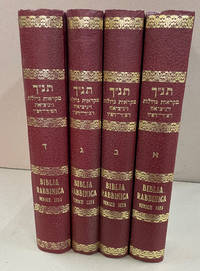
N4183fJerusalem: Makor 1972. Original Half Leather. Near Fine. Folio. 4 volumes 20pp separate Introduction brochure in English by Moshe Goschen-Gottstein." THE FIRST AND THE MOST IMPORTANT EDITION OF THE BIBLE Mikraot Gedolot which includes the Targum the traditional commentaries and the Massora as published by the renowned press of DANIEL BOMBERG. Based on manuscripts partly lost this is the prototype of all later Rabbinic Bibles." - A SUPERB FACSIMILE EDITION. Truly minimal wear on head of spine of vol.1. A FINE AND CLEAN COPY IN THE ORIGINAL HAND BOUND HALF LEATHER. - Due to the heavy weight of these four big volumes additional shipping cost above the indicated fees will apply $ 100 to Europe $ 180 to the USA - shipping with EMS airmail courier <br/> <br/> Makor hardcover
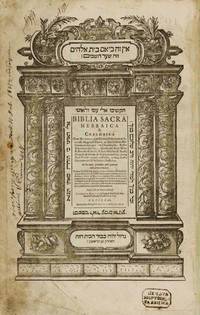
161948847Basel: Ludwig König 1619. First editions. Hardcover. Good. Seven parts in two volumes folio biblical texts and commentary in four parts continuously foliated; two supplemental sections each with separate foliation; Tiberias 1620 with separate pagination here bound after the second part - Vol. 1: 6 title and prelims 1-228 1 sect. title 234-441 1 blankff.; 6 sect. title and prelims 2 blank 114 2 blankpp. Vol. 2: 442-946; 8 Targum Yerushalmi; last leaf unfoliated; 67 Masora 1 blankff. Largely arranged in two columns of biblical texts in square font surrounded by commentaries in rabbinic Rashi font; text reads from right to left. This copy with collective Latin title surrounded by biblical quotations in Hebrew set within elaborate woodcut architectural borders. Hebrew sectional titles set within the same woodcut borders for the second and fourth parts with a plain letterpress half-title for the Five Megillot. The third sectional title for the Latter Prophets is lacking as are the Ashkenazi Haftarot readings not found in all copies. Apart from these lacks the Rabbinic Bible collates complete despite numerous errors in foliation throughout as per the detailed notes in Prijs Die Basler hebräischen Drucke. Opening word of each biblical book set in large one-third to one-half page cartouche vignettes with elaborate woodcut borders and surrounding letterpress Hebrew text. Main Latin title dated 1619 with the editor's Latin preface to the reader appearing at the verso. Jewish date chronogram for the second section Former Prophets dated 5378 1618/1619. Early twentieth-century black cloth boards worn at extremities gilt-lettered spine. Title moderately soiled re-inforced at gutter; neat old repairs to corners and fore-edge of title and next three leaves; old Russian stamp at bottom margin title manuscript entry in Russian along fore-edge dated 1837; intermittent mild to moderate marginal dampstains largely confined to corners and embrowning throughout both volumes somewhat more heavily in the first especially throughout Tiberias; top right corner of the opening leaf in vol. 2 repaired with loss of about 12 words surrounding title cartouche recto and some text in 9 lines of the commentary at the verso. Overall a good set with a notable chain of provenance. <br /> <br /> Sixth Rabbinic Bible in Hebrew: Mikra'ot Gedolot edited by Johann Buxtorf I 1565-1629 professor of Hebrew at the University of Basel and the foremost Christian Hebraist of his era with the assistance of the Jewish scholars Abraham Braunschweig who served as the principal corrector and Mordechai Gumplin of Posen. This was "a truly audacious undertaking for his time" Burnett From Christian Hebraism to Jewish Studies as no Christian scholar had yet attempted to edit the entire biblical corpus including the Aramaic versions Targumim and masoretic notes. Based mainly on the third Rabbinic Bible published by Daniel Bomberg at Venice in 1546-1548 the editor has carefully incorporated elements from two other Venetian editions. At the verso of the Latin title Buxtorf provides a detailed bibliographical excursus on the earlier Venetian editions and offers a tribute to Bomberg's industry by reprinting the colophon of the second Venetian Rabbinic Bible 1524-1525 at the conclusion of the masoretic appendix with text by the Hebrew grammarian and lexicographer Elijah Levita 1468 or 1469-1549 and a new introduction by Abraham Braunschweig. The design of the sectional titles and separate book title vignettes closely model those of the Venetian editions. "Buxtorf did not plan simply to reprint one of the existing Venice editions but rather to assemble the best features of them all into one work" and "to provide theologians with what he considered the most important tools for interpreting the Old Testament" Burnett. Buxtorf served in an official capacity as Basel's Hebrew censor charged with the oversight of all Jewish printing in the city and insuring that "no 'blasphemies' or slurs against Christians or Christianity appear in any book printed in Basel" Burnett. He carefully edited the Jewish commentaries in the Rabbinic Bible in accordance with this mandate "and removed many words and phrases which had escaped the attention of earlier censors" Burnett. <br /> <br /> The Rabbinic Bible contains the vocalized Masoretic text of the Hebrew Scriptures with accents and a vocalized Targum an Aramaic paraphrase of the biblical text: Onkelos for the Pentateuch; Jonathan b. Uzziel for the Prophets; and Targum Hagiographa for the Writings. The Hebrew and Aramaic versions are printed in square characters and presented in facing columns at the center of each page. The Jerusalem Targum of the Pentateuch appears as an appendix. In addition to the Aramaic paraphrases the Rabbinic Bible includes a massive scholarly apparatus of biblical commentaries by Rashi Ibn Ezra Baal ha-Turim Jacob b. Asher R. David Kimchi Radak R. Levi b. Gershon Ralbag Saadia Gaon and R. Isaiah along with the Masora a corpus of critical notes on the external form of the Biblical text compiled by Jewish scholars from late antiquity through the medieval era. As frequently occurs a copy of Buxtorf's work on the textual history of the Hebrew Bible Tiberias the 1620 first edition is bound-in. This work was made possible by the publication in 1538 of Elijah Levita's Masoret ha-Masoret a commentary on the Masora which Buxtorf translated into Latin for his own private use in 1593. "Buxtorf was concerned with the integrity of the consonantal text and the origin and integrity of the vowel points and accents of the Hebrew Bible from the very beginning of his scholarly career" and while he had earlier published a long excursus on the age of the vowel points and accents in his 1609 Thesaurus Grammaticus "Tiberias is Buxtorf's fullest and most impressive work on the history of the biblical text" Burnett. Intended as a reference work for Christian students and scholars interested in studying the Masora Buxtorf was also keen to refute the view advanced by Levita that the Hebrew vowel points were early medieval innovations. Our folio version of Tiberias was intended to accompany the Rabbinic Bible and has the same architectural borders at the title. König also published a quarto edition in the same year but only the folio version includes a critical commentary on the Masora in which Buxtorf proposes various corrections to the Masoretic notes. <br /> <br /> As noted at the title Buxtorf's faithful study and tireless labor studio fido et labore indefesso yielded notably long-lasting results: "The Basel rabbinical Bible became a standard tool for research among Christian scholars and would remain so. until the end of the nineteenth century" Burnett. A vast array of early modern scholars including Protestants like Johannes Drusius and John Selden as well as Roman Catholics like Robert Bellarmine and Andreas Masius owned a copy or two of the Rabbinic Bible. "Johannes Buxtorf's thoroughly censored "Christian" version of the Rabbinic Bible Basel 1618-19 only made it easier for Hebraists to own copies of their own" Burnett Christian Hebraism in the Reformation Era p.163.<br /> <br /> A note on the date of publication: "The actual printing began between the mid-August and mid-September of 1618. According to the colophon production ended on the 24 of Ab 5379 = August 4 1619 but since this date also appeared on the colophon of the Bomberg Biblia rabbinica edition of 1524-25 reprinted unchanged in the 1546-48 and 1568 editions it is suspect. Prijs suggested that the probable completion date was sometime during Ab of 5379 between July 12 and August 10 of 1619" Burnett. <br /> <br /> Provenance: from the library of acclaimed theologian and biblical scholar Brevard Childs with his entry at the free endpaper in the second volume. The earlier bookplate of judge Samuel Heller with his motto in Hebrew: Mi-kol melamdai hiskalti from all my teachers I have learned appears at the front paste-down. An old blue ink-stamp in Hebrew characters makes occasional appearances the text: Bet ha-Midrash ha-Gadol Minsk The Great Synagogue of Minsk. A Russian entry dated 1837 appears at the fore-margin of the main title along with an old ink stamp in Russian at the bottom margin the last word of which reads "Rabbina" References: Biblia Sacra: Burnett 7. Cowley 87. Darlow & Moule 5120 bound with the 1665 second edition of Tiberias cf. 5093. Davidson Otsar ha-shirah vol.1 p.406 no.8954. Prijs 219. Steinschneider 423 423b. VD17 23:675325G. S. Burnett Christian Hebraism in the Reformation Era Leiden: Brill 2012 p.163. Tiberias: Burnett 111. Prijs 222a. For detailed analyses of both works see: S. Burnett From Christian Hebraism to Jewish Studies Leiden: Brill 1996 pp.169-239 chaps. 6 & 7.<br /> <br /> Full Latin title: Biblia Sacra Hebraica & Chaldaica cum Masora quae critica Hebraeorum sacra est Magna & Parva ac selectissimis Hebraeorum interpretum commentariis Rabbi Salomonis Jarchi R. Abrahami Aben Esrae R. Davidis Kimchi R. Levi Gerson R. Saadie Gaon R. Jeschajae & Notis ex authore quem Baal Turim vocant collectis quibus textus grammaticè & historicè illustratur. In his nunc primum post quatuor editiones Venetas textus Chaldaicus qui Targum dicitur à deformitate punctationis & pravitate vocum innumeratum vindicatus; loca in Masora transposita deficientia pugnantia numeris depravata subsidio diversorum exemplarium & Concordantiarum Hebraicarum quantum fieri potuit reposita restituta & conciliata sunt ut in praefatione amplius declarabitur. Studio fido & labore indefesso Johannis BuxtofI linguae sanctae in Academia Basileensi Professoris Ord. Basileae: Sumptibus & typis Ludovici König 1619.<br /> <br /> Collation vol. 1 Rabbinic Bible: ital.a6 a-z8 A-E8 F4 G-Z8 Aa-Hh8 Ii9 Ii10 blank; 1 blank :3 1 blank A-N4 O5.<br /> <br /> Collation vol. 2 Rabbinic Bible: Kk-Rr8 Kk1 lacks Ss6 Tt10 Vv-Zz8 AA-PP8 QQ-TT6 VV9 VV10 blank XX-ZZ8 Aaa-Nnn8 Ooo3 Ooo4 blank PppTtt8 Vuu3 Vuu4 blank Xxx-Zzz8 AAaa-EEee8 8 A-G8 H6 I5 I6 blank. Ludwig König hardcover
1998Q-9004109390Brill 1998-03-20. Hardcover. New. New. In shrink wrap. Looks like an interesting title! Brill hardcover
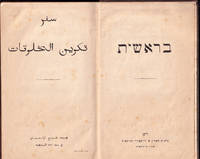
1872056106Vienna Wien: A.Riechert = A. Rikhard ve-Shutafot Beç 1872. 1st Edition . Hardcover. Very Good. 8vo - over 7¾ - 9¾" tall. Original cloth binding with a bilingual title in Hebrew and Ottoman Turkish in Arabic script on the front board and blind-tooled decorations on both boards. Demy 8vo 22 x 14 cm. Text in Ottoman Turkish and Hebrew. 4 176 pp. Cloth slightly faded; foxing to the first and last blank leaves and pastedowns as well as to some margins; hinges slightly split. Overall a good copy. Extremely rare early Viennese edition of this bilingual "Genesis" in Hebrew and Ottoman Turkish one of only three produced by the Adolf Holzhausen Printing House in Vienna a major centre for Hebrew book production in its time. According to the Özege catalogue it represents one of the few bilingual Holzhausen editions. Adolf Holzhausen 1868-1931 was an influential Austrian-Jewish publisher and bookseller notable for his contributions to the world of printing and publishing in Vienna. He was the son of Adolf Holzhausen the Elder 1827-1892 who led the Viennese court and the university's book printing company. Growing up in a family deeply rooted in the book trade Holzhausen received thorough training in the family business; his father had owned the prestigious Manzsche Buchdruckerei Manzsche Book Printing Company since 1858. Holzhausen developed specialized expertise in typesetting and printing of oriental scripts and he supplied his company with carefully crafted oriental typefaces which were highly valued in scholarly and literary circles. Building on this expertise he eventually established his own university book printing company as well as a private publishing house focusing primarily on art books historical works and scholarly publications. Following the upheavals of the First World War Holzhausen was appointed head of the Austrian Military Geography Institute reflecting both his organizational abilities and his intellectual reputation. Beyond his publishing and military contributions he was a strong advocate for collaboration among Austrian educational book publishers promoting greater unity and standards in the production of educational materials. Through his dual roles as a printer and publisher Holzhausen left a lasting impact on Viennese cultural and academic life bridging traditional craftsmanship with modern publishing practices and fostering scholarship in art and history. TBTK 12907. For later edition see Özege 19925. As of March 2026 OCLC lists no copies in a Western library see 236007780 but for the earlier edition 1860 it can be traced only in the Stanford University Cecil H. Green Library see 71019424. <br/> <br/> A.Riechert = A. Rikhard ve-Shutafot, Beç hardcover
7678429-nnew. unknown
7678429like new. unknown
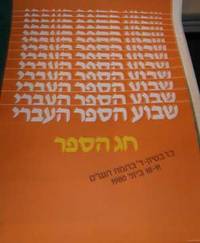
73-3628Tel Aviv: Hebrew Book Week 1980. 69x48 cm. Color poster. Very Good. Text in Hebrew. Tel Aviv: Hebrew Book Week, 1980 unknown
1956N4680The Vatican Rome: Bybliotheca Vaticana 1956. Original Wrappers. Very Good. 4to. 199pp. Codex 1- 115 of the Hebrew manuscripts in the Apostolic Library of the Vatican. Minimal outside markingsUNCUT. A VERY GOOD CLEAN AND FRESH COPY <br/> <br/> Bybliotheca Vaticana unknown
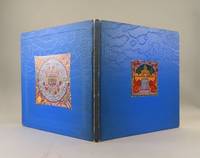
19288323Blue moire with pictorial pastedowns to covers. Previous owner's inscription to rear of board dated 1951. A total of 15 colored plates with tissue guards and 13 Hebrew poems opposite. A nice clean copy without any other markings. 8.25 x 8.25 in Miller-Lynn Publishing Co. hardcover