Ujvári PéterBiblio.com
459 résultats
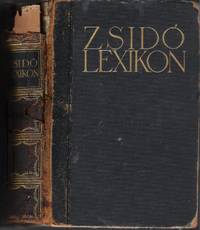
1929biblio1022<p>1028 pages. Damaged spine.</p> A ZsidoÌ Lexikon Kiadasa hardcover
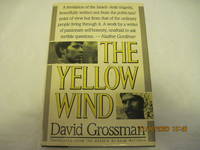
19884159-111420J<p>Temple X– Lib small library sticker FLEP Pocket intact else content appears as unread and unblemished with fine blue& black boards in DJ displaying no significant surface/edge wear as shown. Lib. ID at spine heel.</p><p><strong>Synopsis: </strong>A profound exploration of the Israeli-Palestinian conflict capturing the complexities of identity belonging and the human experience amidst political strife. The book originally written in Hebrew and translated by Haim Watzman combines personal narratives reflections and observations from Grossman's travels in the West Bank and Gaza Strip during the 1980s.<P>Through vivid storytelling Grossman illustrates the daily lives of both Israelis and Palestinians delving into their hopes fears and the impact of the ongoing conflict on their existence. The book highlights the psychological and emotional ramifications of living in a divided land emphasizing themes of empathy understanding and the search for peace.</p><p>Overall "The Yellow Wind" serves as a poignant commentary on the realities of life in a troubled region encouraging readers to confront the complexities of human relationships in the face of political divides.</p><p>Tidbit Commissioned by a local news magazine David Grossman wrote an issue-long article about the West Bank of the Jordan River in commemoration of the anniversary of the Six-Day War. Now in book form it has become one of the bestselling books in Israel's history…. Six Day War <strong>I</strong></p><p><strong>nsurance & handling is included free. Extra Charges/Fees apply on Shipments Outside The U.S. and Expedited Shipments. Oversize and/or heavy books may require additional fees. Will advise </strong> . 11.08.20J #4159-111420J Updated 1.30.21 Img #5175 Updated <strong>5.1.2025 </strong> </p> Farar, Straus, & Giroux, Inc. hardcover
11047Jerusalem 1929. Hb. Bound vol of 6 items related to the Hebrew University Jerusalem in English Hebrew and German inc. Hebrew Teachers College Palestine Orphan Comittee etc. CCovers scuffed o/w G. Jerusalem 1929. unknown
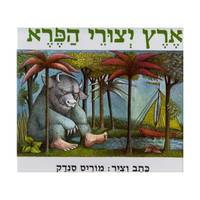
20101-9650717935Keter Publishing 2010. Hardcover. New. hebrew translation edition. 38 pages. Hebrew language. 9.90x9.10x0.40 inches. Keter Publishing hardcover
ria9780197501481_inpHardback. New. New Book; Fast Shipping from UK; Not signed; Not First Edition; When Near Becomes Far explores the representations and depictions of old age in the rabbinic Jewish literature of late antiquity 150-600 CE. Through close literary readings and cultural analysis the book reveals the gaps and tensions hardcover
177653321Oxford: The Clarendon Press 1776. First edition. Hardcover. Near fine. Two volumes folio published in 1776 and 1780. xxiii title and subscribers' list 1 blank VIII preface 684 1 catalogue of manuscripts 1 blank; 4 title and subscribers' list 732 129 1 blank 6 indicespp. Expertly rebound in modern quarter vellum over marbled boards spines titled in gilt. Titles darkened and dusty; very occasional light foxing or oxidation spots; dampstain at bottom quarter of the first twenty and final four leaves in the first volume else a nearly fine wide-margined set crisp and uncut.<br /> <br /> First edition and the "earliest attempt to provide a critical edition of the Hebrew Scriptures on a large scale†D&M and a notable early example of a large-scale scholarly project which attracted international financial and scholarly support. The biblical scholar Benjamin Kennicott 1718-1783 was educated at Oxford and "instructed in Hebrew by Professor Thomas Hunt and the greater part of his life was spent in the collation of Hebrew manuscripts with the object of producing a definitive original text of the Old Testament. Robert Lowth always his major patron first inspired him with a desire to test the accuracy of the Hebrew text of the Old Testament. With his formidable knowledge of Syriac early Latin the Septuagint and the Samaritan Pentateuch it was recognized that he was very well qualified for the task. His critical examination of manuscripts initially in the British Museum and the libraries of Oxford and Cambridge began in 1751 and when Thomas Secker then bishop of Oxford and also a member of Exeter College urged him in March 1758 to undertake their collation he agreed to the request. In return Secker when archbishop of Canterbury gave Kennicott his unstinting support and friendship when for a time he nurtured a project for producing a revised Authorized Version of the Bible. Meanwhile in 1753 Kennicott issued The State of the Printed Hebrew Text of the Old Testament Considered: a Dissertation and in 1759 he brought out a second dissertation on the same subject. He identified his object thus: to compare Scripture with itself to explain a difficult phrase or passage by a clear one that bears some relation to it to consider the natural force of the Original Words the tendency of the Context and the Design of the Writer; to compare the most ancient editions of the Original with one another and with the best copies of the most celebrated versions vol.1 p.12. These volumes were translated into Latin by W. A. Teller and published at Leipzig the first in 1756 the second with additions in 1765.<br /> <br /> Kennicott's scholarly endeavours attracted support in Britain and beyond. In England subscriptions amounted to £9119 7s. 6d.; in France the duc de Nivernois a former French ambassador to the court of St James patronized him and helped him to gain access to Parisian manuscript collections in 1767; the king of Denmark offered him the use of six ancient manuscripts; four quarto volumes of variant readings were sent to him on the king of Sardinia's orders; and the stadholder of the Netherlands made an annual donation of 30 guineas. His first report On the Collation of the Hebrew Manuscripts of the Old Testament was forwarded to the subscribers in December 1760 and a similar statement appeared each year until 1769. This annual summary afforded him an opportunity to defend the accuracy of his own collations the Hebraic scholarship of the staff assisting him and to print lists of subscribers. A copy of the entire work was personally presented by Kennicott to George III. Lowth called the 1776 variorum Old Testament 'a work the greatest and most important that has been undertaken and accomplished since the Revolution of Letters' B. Hepworth Robert Lowth p. 145" Nigel Aston ODNB. An early judgement on this seminal edition is provided by William Orme in his 1824 Bibliotheca Biblica: “This is beyond all comparison the most splendid edition of the Hebrew Scriptures ever published. It was patronized by most of the crowned heads of Europe. It occupied its learned editor in preparation or actual labour more than thirty years. More than six hundred MSS. and editions were collated for it in all parts of Europe. The text is that of Vander Hooght without the points. The Samaritan Pentateuch where it differs from the Hebrew text is printed in parallel columns in the Hebrew character. The various readings are almost innumerable and occupy in general the largest half of every page. The Dissertatio Generalis annexed to the second volume is invaluable for the information which it contains respecting the state of the original text and the sound principles of criticism which it exhibits." The final leaf lists 312 manuscripts and some printed editions which provided the various readings noted throughout the apparatus. The concluding Dissertatio Generalis was republished separately at Braunschweig in 1783 by professor Paul Jakob Bruns who assisted Kennicott in his collations.<br /> <br /> Provenance: Engraved bookplate of the Parochial Library of St Phillips Birmingham in the County of Warwick at front endleaf in both volumes. References: N. Aston "Benjamin Kennicott" in: ODNB. Darlow & Moule 5160. ESTC T147508. Orme Bibl. Biblica 238. For a notable recent discussion see J. Turner Philology: The Forgotten Origins of the Modern Humanities Princeton Univ. Press 2014 77f. An earlier assessment of the critical endeavors of Kennicott and De Rossi appears in N. P. Wiseman's 1836 Twelve Lectures on the Connexion between Science and Revealed Religion pp.368-371 ed. Dublin 1866. The Clarendon Press hardcover
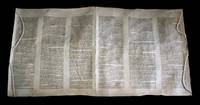
69267NP. HEBREW MANUSCRIPT. n.p.n.d. ca 18th Century.<br> <br> Two Sefer Torah parchment manuscript fragments taken from Exodus. Each with three columns of Hebrew manuscript. The two leaves sewn together with thin cords and the whole piece is rolled up as a scroll. The verso is reinforced with tabs along edges and seam. The two fragments measure 22 3/4 x 23 3/4 inches and 22 3/4 x 21 3/4 inches. Some minor creasing and soiling along edges and margins. A few light stains. Still overall a very good example.<br> <br> "Exodus "Shemot" is the second book of the Torah Judaism's foundational text. It describes the Israelites' enslavement in Egypt their miraculous redemption through ten plagues and the splitting of the Red Sea. Under Moses' leadership they begin their travels in the desert where they experience God's revelation receive the Ten Commandments at Mount Sinai and build the mishkan tabernacle. Interspersed throughout the book are more than one hundred mitzvot commandments." Sefaria dot org.<br> <br> HBS 69267.<br> <br> $1250. NP unknown
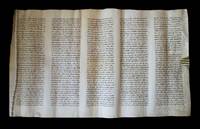
69603Italy. HEBREW MANUSCRIPT. Italy n.d. ca 18th Century.<br> <br> Two Sefer Torah parchment manuscript fragment scrolls taken from Genesis. Each with five columns of Hebrew manuscript. The columns contain 42 lines. The first fragment measures 23 x 15 3/4 inches; 400 x 560 mm and the second measures 24 1/2 x 14 inches; 360 x 600 mm. Some creasing from being rolled and a bit of minor soiling along edges and margins. A few light stains. Still overall very good examples.<br> <br> Both scrolls contain passages from the Book of Genesis. The first scroll contains verses Gen. 9:11-14:14 which begins by describing the promise God made to mankind through Abraham that there would not be a second Great Flood and concludes with Abraham's tribulations during the wars against neighboring tribes. The second scroll contains verses Gen. 29:15- 32:10 which recounts the events involving Laban Jacob and Esau.<br> <br> HBS 69603.<br> <br> $3000. [Italy] unknown
0265079233.Gpaperback. Good. Access codes and supplements are not guaranteed with used items. May be an ex-library book. paperback
0260445746.Ghardcover. Good. Access codes and supplements are not guaranteed with used items. May be an ex-library book. hardcover
0332119165.Ghardcover. Good. Access codes and supplements are not guaranteed with used items. May be an ex-library book. hardcover
1334823774.Gpaperback. Good. Access codes and supplements are not guaranteed with used items. May be an ex-library book. paperback
0267353057.Ghardcover. Good. Access codes and supplements are not guaranteed with used items. May be an ex-library book. hardcover
a104073Berlin 1764 Isaac Jacob Speirer. large hardcover book 14-3/4 x 9-1/2 x 2 inches thick. Wood boards with full leather cover on boards. Some metal nails. Had clasps at one point in time which are now gone. Backstrip is nearly all chipped away. Binding is secure; light even toning of text. Owner stamps of Rabbi Dr. A Cohn of Basel. Several other ink signatures and notations. Fully in Hebrew. Fair. Vol 3 of a 4 volume set. Pictures available on request. . hardcover
a1040741793. large hardcover book 14-3/4 x 9-1/3 x 1-1/2 inches thick. Papercovered boards. Black cloth spine. Ink mss title on slip of paper mounted on spine. Binding is secure hinges not cracked in or out; rouged page ends; two small tears/chips in black spine cloth; light even toning of text. Owner stamps of Rabbi Dr. A Cohn of Basel. Several other ink signatures and notations. In Hebrew. One end paper is fully covered with signatures and ink notes. Good. Vol 3 of a 4 volume set. Pictures available on request. . hardcover
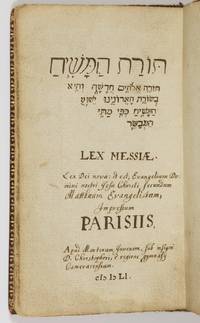
1700557661700. Very good-. Small octavo 14.1 by 8.5 cm. Manuscript in black and brown ink; 18-20 lines per page; text in vocalized Hebrew. 6 title and editor's preface 146 12 blank 10 notes. Lacks the first leaf which has been supplied in manuscript by a later owner. 19th-century limp morocco rubbed at extremities gilt dentelles marbled endleaves. Faint dampstain along bottom margin occasional smudges and mild stains else very good with crisp text.<br /> <br /> Early modern transcription of the Hebrew version of the Gospel of Matthew published in 1551 at Paris by Martin le Jeune with notes at the rear likely the work of a student. This edition was prepared by Jean Cinqarbres Quinquarboreus; 1514-1587 who jointly held the chair of King's Professor of Hebrew Literature at the University of Paris with Jean Mercier d. 1570. Lapide describes this as a "literal" edition and notes that the learned French bibliographer and father of the Oratory Jacques Le Long regarded it as the "true and authentic Gospel of Matthew." Like many of the surviving copies it lacks the Appendix which comprised the Seven Penetential Psalms Psalm CXIX Daniel's Prayer and the Ten Commandments. Apart from minor formatting changes e.g. breaks between chapters the text appears to be a faithful copy including vowel points and some of the additional cantillation marks the printed marginalia new Hebrew page numbers and Cinqarbres's dated preface. As the original version contains only 17 lines of text per page the transcription is not a page-for-page copy. Here the copiest appears quite fastidious in providing appropritate new catchwords! The Latin portion of the title however differs notably from the original which reads: Sanctum Domini nostri Iesu Christi Hebraicum Evangelium secundum Matthaeum.<br /> <br /> "In 1537 Sebastian Münster published his Hebrew version of the Gospel of Matthew at Basel the first printed edition of the New Testament in the so-called 'mother tongue of the evangelist' as he states in his preface" Lapide. Like the Paris edition of Hebrew Matthew upon which the present copy is based Münster entitled his version Torat ha-Mashiah The Teaching of the Messiah. While Münster's version of Matthew was long believed to be based on the 14th-century Hebrew translation by the Jewish polemicist Shem Tov ben Isaac ibn Shaprut more recent scholarship has called this attribution into question. "There are medieval Hebrew forms of Matthew that most scholars think of as retroversions from the Greek of canonical Matthew often made to serve in arguments between Christians and Jews. However some claim that these texts are a guide to the original Hebrew of Matthew French scholars like J. Carmignac and M. Dubarle have contributed to this thesis. Still other scholars think they can reconstruct the original Hebrew or Aramaic underlying the whole or parts of the Greek text of canonical Matthew on the assumption that the original was in Semitic. The vast majority of scholars however contend that the Gospel we know as Matthew was composed originally in Greek and is not a translation of a Semitic original" Brown.<br /> <br /> Provenance and annotations: The copiest has added notes following the main text comprising a Seder shel Miqra / Ordo Bibliorum in which the tripartite division of the Scriptures according to Jewish tradition is described. Then follows several pages of Hebrew terminology with biblical references and definitions in Latin. Along with one or two references to rabbinic literature an erudite reference to the Passover Haggadah notes Rabbi Judah's grouping of the ten plagues into three acronyms.<br /> <br /> At the head of the leaf inserted after Cinqarbres' preface is the note "When I bought this Mss. the first chapter from verse one unto verse 14 and part of verse 15. I filled in the missing verses. May. 18th. 1901. Llewellyn Saunderson 10 De Vesse Terrace Kingstown Co. Dublin" References: R. Brown Introduction to the New Testament 1997 p. 210; P. Lapide Hebrew in the Church Grand Rapids 1984 see Chap. IV "Modern Christian Hebraica" esp. pp. 53-58. Cf. Adams B1890 wanting the appendix; Darlow & Moule 5095: An independent edition of Shem Tob's version see no. 5088 which notes: The editor S. Münster obtained an imperfect MS. copy of St. Matthew's Gospel in Hebrew which had been made as early as 1385 for polemical purposes by Shem Tob b. Shaprut a Jew of Tudela in Castile. He revised and completed this for the press Basel: H. Petri 1537 adding a Latin translation of the Hebrew.; Delaveaux & Hillard 4644 noting Ibn Shaprut as the ulitmate source; Le Long/Masch 2 1781 p. 10. Schwarzfuchs Paris 212. Steinschneider 6591.26 under Münsterus.<br /> <br /> Full title noting original imprint: תורת המשיח תורת ××œ×”×™× ×—×“×©×” ×•×”×™× ×‘×©×™×¨×ª ×”××“×•× ×™× ×• ישוע המשיח כפי מתי המבשר <br /> Lex Messiae. Lex Dei nova: id est Evangelium Domini nostri Iesu Christi secundum Matthaeum Evangelistam Impressum Parisiis: apud Martinum Iuvenem sub insigni D. Christophori è regione gymnasii Cameracensium M.D.LI. 1551. unknown
39481Philadelphia: Printed by C. Sherman 5605. 8vo 5 volumes. 8 7/8 x 5 1/2 inches. Hebrew and English text on facing pages. Each volume inscribed at the head of the English-language title "To my beloved wife from her affectionate husband" the first volume with a later family annotation. Contemporary purple morocco spine in six compartments with raised bands lettered in gilt in the second and fourth repeating gilt decoration in others marbled edges marbled endpapers.<br/> <br/> Provenance: Solomon Nunes Carvalho each cover stamped in gilt<br/> <br/> Rare large-paper association copy of the first Jewish translation of the Pentateuch into English.<br/> <br/> More than any other person of his time Isaac Leeser 1806-1868 envisioned the development of a major center of Jewish culture and religious activity in the United States. He single-handedly provided American Jews with many of the basic religious texts institutions and conceptual tools they needed to construct the cultural foundation of what would later emerge as the largest Jewish community in the history of the Jewish people. Printed in 1845 this edition of the Pentateuch in five volumes included a vocalized Hebrew text of each of the Five Books of Moses together with an English translation and notes as well as the haftarot prophetic readings. Leeser actually began working on The Law of God in 1838. Among the factors involved in his decision to begin systematically working on a translation was the recent opening of Rebecca Gratz's Sunday School which met for the first time in March 1838 in Philadelphia and was desperately in need of appropriate study material. Students were compelled to use the King James Bible for want of a Jewish alternative. Religiously objectionable passages in other texts provided by Protestant organizations were either pasted over or torn out by Gratz's staff. Leeser who supported the Sunday School and was its chief academic resource person felt compelled to find more suitable texts for the students. The impetus for Leeser throughout was always his desire to provide the Jews of America with an English text of the Bible that was produced by one of their own and was not tainted by conversionist motivations. This copy with provenance to Solomon Nunes Carvalho who was a noted American painter photographer writer and inventor best known for traveling with John C. Fremont on his fifth expedition through Kansas Colorado and Utah. He published an account of that journey titled "Incidents of Travel and Adventure in the Far West; with Colonel Fremont's Last Expedition" 1860 and was considered a pioneer in travel photography. Isaac Leeser the hazzan of Congregation K.K. Mikveh Israel married Carvalho and his wife Sarah Miriam Solis on October 15 1845 in Philadelphia where Carvalho's father had a workshop.<br/> <br/> Rosenbach 569; Singerman 884; Goldman 7; Lance J. Sussman "Another Look at Isaac Leeser and the First Jewish Translation of the Bible in the United States" Modern Judaism Vol. 5 No. 2 Gershom Scholem Memorial Issue. May 1985 pp. 159-190. Printed by C. Sherman unknown
dola3200Berlin: 1906-04. Thirteenth Edition of the Delitzsch translation of the New Testament. 16mo. Hebrew text. contemporary calf spine ends rubbed foxing to outer leaves. dola3200 Berlin: 1906-04 unknown
371476Amsterdam: Joseph Jacob and Abraham the sons of Solomon Proops 5522. Titled printed in red and black. 2 178 2 179-332 10 Introduction etc. 2 160 2 161-350pp. Publisher's introduction and other preliminaries misbound preceding the later Prophets. Folio 15-7/8x10 inches. Nineteenth or early 20th century half morocco and marbled paper boards rear joint splitting worn at joints and head and tail of spine. Foxing principally to the title tear to the final text leaf. Provenance: General Theological Seminary bookplate. Titled printed in red and black. 2 178 2 179-332 10 Introduction etc. 2 160 2 161-350pp. Publisher's introduction and other preliminaries misbound preceding the later Prophets. Folio 15-7/8x10 inches. Besides being the first bi-lingual edition in Hebrew and Spanish this edition is the first Hebrew book whose publication was financed by an American - Abraham Mendes de Castro 1689-1762 of Curaçao - intended for use in the West Indies with the sale proceeds to benefit the Jewish communities of Jerusalem and Hebron. Cowley 102; Darlow & Moule 5156; Zedner 102; not in Steinschneider or Roest Joseph, Jacob and Abraham, the sons of Solomon Proops unknown
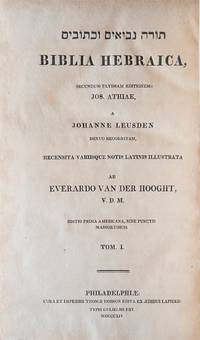
1814372931Philadelphia: Cura et Impensis Thomae Dobson edita ex aedibus Lapideis. Typis Gulielmi Fry 1814. First American edition. Text in Hebrew with notes in Latin. 6 296; 2 312 leaves. Half titles present in each volume. Uncut. 2 vols. 8vo. Original blue paper boards rebacked with plain paper. Provenance: Hugh Blair Grigsby booklabels. In a blue cloth folding box. First American edition. Text in Hebrew with notes in Latin. 6 296; 2 312 leaves. Half titles present in each volume. Uncut. 2 vols. 8vo. The first complete Hebrew Bible printed in America. Hebrew type was first used in the North American colonies in the Bay Psalm Book printed in 1640 in Cambridge. Over the next ninety-five years Hebrew type appeared in a handful of American imprints usually in brief examples of single words or short sentences. Paucity of appropriate type would continue to be a problem over the years that followed. The first Jewish Psalter was finally published in 1809 followed by this complete Bible five years later. "In 1812 Mr. Horwitz had proposed the publication of this edition of the Hebrew Bible the first proposal of the kind in the United States; early in 1813 be transferred his right and list of subscribers to Mr. Thos. Dobson who published soon afterwards the 1st volume" O'Callaghan. The title page indicates that this work is a reprinting of the second edition of the Joseph Athias Bible edited by Leusden with Latin notes by Everardo Van der Hought and that the Hebrew is printed without vowels. An important piece of American printing and of Jewish Americana. Darlow and Moule 5168a; Goldman 4; Rosenbach 171; Shaw and Shoemaker 30857; Singerman 236; M. Vaxer "The First Hebrew Bible Printed in America" Journal of Jewish Bib. 1940 vol. 2 pp. 20-26 Cura et Impensis Thomae Dobson edita ex aedibus Lapideis. Typis Gulielmi Fry unknown
170536556Amsterdam & Utrecht: H. Boom Joh. II van Waesberge Goethals Ger. Borstius Joh. Wolters Fr. Halma W. van de Water & W. Broedelet 1705. Third Edition . Hardcover - as published. Engraved title page in red & black plus four additional engraved title pages for each of the four parts into which the text is divided: 1 Genesis - Deuter.; 2 the Prophetae antiores; 3 the Prophetae posteriores; and 4 Hagiographa. Text is in Hebrew with the preliminaries and preface by van der Hooght & others as well as the printed marginalia in Latin. This is actually the third editon edited & revised by van der Hooght of the famous Hebrew Bible originally published by Joseph Athias in 1661. Thick octavo; a.e.g. Some light worming to end leaves pastedown & rear board; lacking rear front fly leaf & front rear fly leaf. Also first engraving detached. Spine is dry and rubbed along raised bands 5 panels with some light wear to edges & joints; head of spine is torn but without loss; rubbed label in 2nd panel present & readable; some worming at head of spine; small gouge on back board. A very nice internally clean tight copy of a scarce title. H. Boom, Joh. II van Waesberge, Goethals, Ger. Borstius, Joh. Wolters, Fr. Halma, W. van de Water, & W. Broedelet hardcover
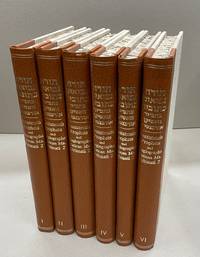
1979N4282aJerusalem: Makor 1979. Limited Edition . Original Half Leather. Fine. 4to. A LIMITED FACSIMILE EDITION OF 390 NUMBERED COPIES THIS COPY 112 A FINE COPY.- additional shipping fees for the 6 vols set will apply please enquire. <br/> <br/> Makor hardcover
1995088202Eliner Library. Near fine hardcover in very good dust jacket. . Near Fine. Soft cover. 1995. Eliner Library paperback
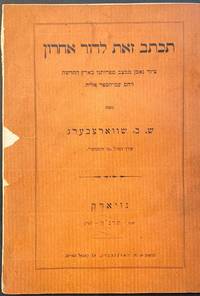
189842441Nuyork New York: Rozenberg 1898. paperback. 1st edition. Original orange printed wrappers 8vo 33 pages. 23 cm. In Hebrew. Title translates as: “Write This For The Last Generation: A Faithful Picture of the State of Our Literature in the New Land and the Attitude of the People of the Book To It.†<br> Extremely critical observations on the state of Hebrew literature and its readership in America by Schwarzberg 1865-1929 a Hebrew publisher and editor in Poland and the U.S. Singerman 5473. Goldman 1110. <br> "Schwartzberg published this pamphlet following the failure of Ner Hamerabi Goldman #908 a Hebrew periodical he edited." In it he “poured forth a bitter complaint against 'the people of the book' for their indifference to Hebrew and its literature . He draws a dark picture of the state of Hebrew culture and literature in this country" Waxman. Goldman notes that the work remains an important source on Ner Hamerabi. <br> “Schwarzberg who was born in Lipno Poland published Hebrew books at the close of the 19th century in Warsaw among them I. L. Peretz' Hebrew poems Ha-Ugav 1894. Arriving in the United States in 1897 he became editor of the Hebrew monthly Ner ha-Ma'aravi which appeared from 1895 to 1897. In 1898 he published a 33-page pamphlet Tikkatev Zot le-Dor Aharon "This Shall be Written for the Final Generation" a scathing attack on the attitude of the Jews toward the new Hebrew literature. <br> He fought Yiddishism and its standard-bearer Chaim Zhitlowsky. He also published a bibliography of the works of Senior Sachs†Eisig Silberschlag in EJ. Deinard 886; AJYB 1930-31 155; Not in Bibliography of the Hebrew Book 1470-1960. SUBJECTS: Hebrew literature Modern -- United States -- History and criticism. Litte´rature he´brai¨que moderne -- E´tats-Unis -- Histoire et critique. OCLC: 649820031. <br> OCLC: 649820031. OCLC lists 5 copies outside of Israel YIVO Am Jewish U Yale HUC YU. Spine rebacked touch of edgewear to orange wrapper which remains bright. About Very Good- Condition. Important. B AMR-67-38-DL-'b. Nuyork [New York]: Rozenberg unknown
0331890240.Ghardcover. Good. Access codes and supplements are not guaranteed with used items. May be an ex-library book. hardcover