Bible GreekBiblio.com
875 résultats
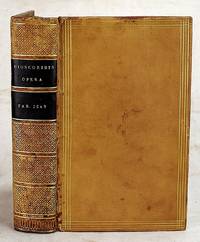
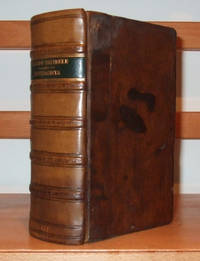
1653097655<p>Londini: Excudebat Rogerus Daniel 1653. First printing in England of the Septuagint with the rare second part Greek type title in red and black and with large engraved printer's device bound with In Sacra Biblia Græca ex versione LXX. interpretum scholia; simul et interpretum cæterorum lectiones variantes Greek type title with woodcut printer's device lacking final blank Roger Daniel. Collation 81279186pp 1pp lectori. probably lacking last blank. Book measures 7 x 4 3/4 inches. Bound in full leather. At some time the binding has been rebacked retining the period boards raised bands leather title label. Binding in very good clean firm condition. Internally new endpapers. Pages in very good clean condition throughout. A very nice copy in an attractive solid binding. Full Leather. Very Good Plus. Small 8vo.</p> Excudebat Rogerus Daniel hardcover
1653097655Londini: Excudebat Rogerus Daniel 1653. First printing in England of the Septuagint with the rare second part Greek type title in red and black and with large engraved printer's device bound with In Sacra Biblia Græca ex versione LXX. interpretum scholia; simul et interpretum cæterorum lectiones variantes Greek type title with woodcut printer's device lacking final blank Roger Daniel. Collation 81279186pp 1pp lectori. probably lacking last blank. Book measures 7 x 4 3/4 inches. Bound in full leather. At some time the binding has been rebacked retining the period boards raised bands leather title label. Binding in very good clean firm condition. Internally new endpapers. Pages in very good clean condition throughout. A very nice copy in an attractive solid binding. Full Leather. Very Good Plus. Small 8vo. Excudebat Rogerus Daniel Hardcover
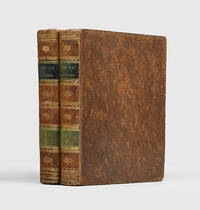
1798191868London: Printed for T. Cadell Junior and W. Davies 1798. The official publication of a scholarly pastiche First illustrated edition and the first authorized public one. These fictitious letters describing Athens during the Peloponnesian War were the work of a circle of Cambridge dons and students including the Bluestocking Catherine Talbot 1721-1770 who is named in the author key to this edition. Athenian Letters names more than one prominent female letter-writer from antiquity real and fictive. The work's instigators Philip Yorke second Earl of Hardwicke 1720-90 and his brother Charles 1722-70 are pictured in the frontispieces. The first edition of 1741 consisted of 12 copies followed by 100 in 1781 and a pirated edition. 2 vols quarto 274 x 212 mm pp. lxii 2 436; xv 1 466. Portrait frontispieces to each volume 12 engraved plates of busts folding map. Contemporary tree calf flat spines divided by gilt rolls blue and green labels central gilt tools to compartments green edges. Contemporary booklabels of Fasque the Gladstone family home. Head caps a little worn and split spines rubbed a few patches of stripping corners worn minimal foxing. A very good set. ESTC T84382. unknown
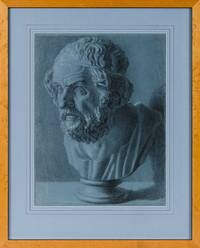
1823100020AG1823. Germany 1823. Stunning original extra-large 19th century Pencil Drawing on coloured paper. Beautifully Framed. Size of frame with drawing: 61.5 cm x 76 cm. Size of the actual drawing: c. 45 cm x 57 cm. Excellent condition. Signed by C. Schaafhausen d. 18. December 1823. Framed in a wonderful Biedermeier style. unknown
189891338Boston MA: Little Brown & Co. As New. 1898. Five 5 Volume Set. Hardcover. FREE UPGRADE to Courier/Priority Shipping Upon Request - IN STOCK AND IMMEDIATELY AVAILABLE FOR SHIPMENT - -- with a bonus offer-- . Little, Brown & Co. hardcover
199338837Vorres Museum of Contemporary Greek Art;. As New. 1993. Paperback. FREE UPGRADE to Courier/Priority Shipping Upon Request IN STOCK AND IMMEDIATELY AVAILABLE FOR SHIPMENT - TEXT PRISTINE - Text in English French and German. 45 works catalogued; many color illustrations. Among the artists represented: C. Caras; Z. Skiadaressi; A. Droungas; and others. -- with a bonus offer-- . Vorres Museum of Contemporary Greek Art; paperback
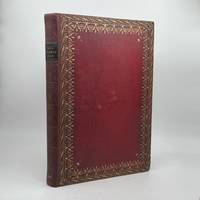
1566D14106Geneva: Henricus Stephanus 1566. Hardcover. Very Good. Early-19th century red morocco boards and spine ruled in gilt gilt-stamped lettering in second spine compartment 5 raised bands; 4to 257x158m; pp. 4 539 33 index with woodcut printer's device on title-page. Spine and edges of boards somewhat darkened; binding a bit scuffed. Text block is lovely. Provenance: Arthur Machen acquired at the Anderson Auction Company December 1903. <br/><br/>Estienne's important edition of the Greek Anthology which provided a far superior text than its predecessors. For this edition Henri devised a system of diacritical marks peculiar to himself notae sibi peculiares to denote various classes of proper nouns and also employs in the margins the symbol of the hand with pointing finger to call attention to gnomic expressions in the text Schreiber. Adams A-1187; Schreiber 159. Henricus Stephanus hardcover
1886008070London: Chatto and Windus 1886. First Edition. Full Morocco. Custom cloth clamshell box. Fine. Extra-illustrated large paper and a special Bayntun full brown crushed morocco onlay binding featuring a centerpiece of the Palace of Westminster. No. 85 of 111 large paper editions. With a gorgeous Bayntun onlay binding featuring a centerpiece of the Palace of Westminster the current Parliament building. 4to. 26 by 21 cm. xxvii 1 403 1 pp. Including folding frontis nine of the additional plates are hand-colored four of which are choice Gillray prints. Many of the plates are double paged and a few are folding. Regarding the binding all edges gilt. Gilt ruled borders on boards -- six evenly spaced lines with jutting squared corners suggestive of a fortification design. These within a simple outer ruled border close to the edge. Five raised bands with compartments decorated with ruled rectangles and corner dots. Turn-ins with corner abstracted floral decoration. Attractive armorial bookplate of Colonel Sir Harold Mitchell 1900-1983 businessman and politician who was at one point vice chairman of the Conservative Party under Churchill. He was created a baronet in 1945. The title became extinct with his death. Clamshell box has stains especially heavy on one of the sides and one spine edge is worn through with its cloth entirely lifted and rolling away with frayed threads apparent and the underlying card exposed. Still this box retains structural integrity and has clearly helped preserve the pristine quality of the book's extradordinary binding. Photo File. Chatto and Windus unknown
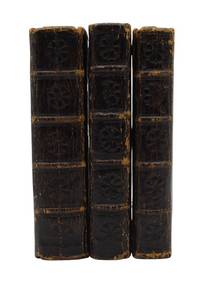
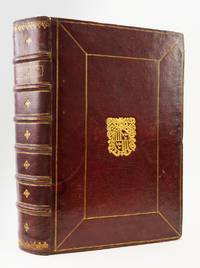
1665AQ28955Cantabrigiae i.e. Cambridge: Excusum Per Joannem Field Typographum Academicum 1665. 2 19 1; 755 1; 516pp. Lower corner of K6 torn away with some loss. Darlow & Moule 4701. ESTC R236848. Wing B2719. Bound uniformly with: BIBLE N.T. Greek. Greek title. Cambridge. John Field 1665. 12mo. 2 419pp 1. Small thumbnail sized piece torn away from margin of A4 with a little loss. ESTC R25629. And: PSALTER - Church of Scotland. The psalms of david in meeter. Newly translated and diligently compared with the originall Text.Allowed by the Authority of the Generall Assembly of the Kirk of Scotland and appointed to be sun in Congregations and Families. Edinburgh. Printed by Evan Tyler 1650. First edition. 18mo. 72pp. ESTC R235432. Three volumes bound uniformly with the first mentioned bound in two volumes and the second and third mentioned bound together in the third volume in contemporary blind-decorated sombre black panelled morocco with central flower device to each spine compartment. Marbled endpapers. A little rubbed some small chips to spines at head and foot some occasional shaving of pagination. With the later ownership inscriptions of several members of a Scottish Mylne family and those of W.W. Greg dated 1925 in the first volume. A choice copy of the third English edition of the Greek Septuagint printed by John Field at Cambridge bound uniformly - in handsome seventeenth-century sombre bindings - with Field's companion New Testament in Greek a reprint of the Thomas Buck edition Cambridge 1632 and the 1650 first edition of the Scottish Metrical Psalter. The first edition of the Septuagint printed in England was published by Roger Daniel 1653 with the second appearing in Walton's Polyglot edition of 1657. This edition published by John Field Printer to Cambridge University is also the first to contain the praefatio paraenetica of J. Pearson. Issued in two slight variant forms with differing Greek titles this is the issue without the Apocrypha. The presence of the Scottish Psalter printed by Evan Tyler of Edinburgh at the end of the final of these three volumes combined with the later Scottish provenance makes this cataloguer wonder if these volumes were used - and perhaps even bound - in Scotland. Provenance: Sir Walter Wilson Greg 1875-1959 Shakespearean scholar and bibliographer best known for his A Bibliography of the English Printed Drama to the Restoration. . Third English edition. 12mo. Excusum Per Joannem Field, Typographum Academicum unknown
1642371830Paris: Ek basilikēs typographias Imprimerie Royale 1642. Engraved title by by Claude Mellan engraved head and tail pieces and initials. 2 453 3 pp. Extra-illustrated with a later English printed "Abbreviations and Connexions" leaf inserted after the title. Folio 15-1/2 x 10-5/8 inches. Late eighteenth or early nineteenth century red morocco gilt marbled endpapers gilt edges. Neatly rebacked. Cloth slipcase and chemise. Engraved title by by Claude Mellan engraved head and tail pieces and initials. 2 453 3 pp. Extra-illustrated with a later English printed "Abbreviations and Connexions" leaf inserted after the title. Folio 15-1/2 x 10-5/8 inches. Known as the Mazarin edition "since it appeared under the auspices of the great Cardinal" D&M it is the first edition of the Greek New Testament from the Imprimerie Royale founded just two years prior.<br /> <br /> Inserted before the engraved title page is a partly-printed certificate of the Collegium Mazarinaeum awarding this volume as a prize in Rhetoric to Philippus Matthaeus Guillot dated MDCC in manuscript i.e. 1700 and signed by the college's master P.-J. Le Chapelier Pierre-Jean le Chapelier de Mauron abbé de Ste Marie de Boquen in Brittany with the trace of a seal below. The College Mazarin or College des Quatre-Nations was established by bequest of Cardinal Mazarin 1602-1661 and opened its doors to students in 1688. Darlow & Moule 4687. Provenance: Philippus Matthaeus Guillot certificate his signature at foot of title engraving; Montagu Barton armorial bookplate; John Horatio Nelson gift inscription dated 1841; General Theological Seminary bookplate perforated stamp Ek basilikēs typographias [Imprimerie Royale] unknown
158448696Antverpiae: Ex officina Christophori Plantini 1584. Folio 6 parts in 1; pp. 8 186 2; 128; collating: ¶ⴠA-Yâ´ Zâ¶; Aa-Qqâ´; woodcut device on title page; bound with: Biblica Hebraica Antverpiae 1584 Hebrew-Latin Old Testament Greek-Latin Apocrypha etc. in various pagings from back of book viz.: pp. 20 183 1; 283 1; 84; 203 1; collating from the back: †ⴠ‡ⶠA-OⶠPâ¸; a-xⶠy-z⸠aa-ggⶠAA-RRâ¶; in all 551 leaves; text in double column in Hebrew Greek and Latin; early 18th century calf blindstamped panels on covers red morocco label on spine; covers with dampstains corners bumped and showing small cracks starting at the extremities of the joints occasional light minor dampstaining but in all a very good and reasonably sound copy. Terminal flyleaf with elaborately penned inscription: "Isaac Sharpe flourishes dono Patris 1719." On the rear pastedown is Sharpe's early "Coll. Mag." bookplate dated April 4 1683 - possibly the date of his matriculation at Magdalene College Cambridge. The Greek N.T. starts at the beginning of the volume and the Hebrew O.T. at the end with the Greek Apocrypha of 128 pages between them. Each Testament has its own title page and the mention of the Apocrypha on both suggests that it was intended to form an appendix to either of the Testaments if they were issued separately. See Darlow & Moule 4645 and 5106: "This forms the latter half of the complete Bible in the original languages with an interlinear Latin translation; the whole reprinted from the Antwerp polyglot"; Voet A2 p. 320. Ex officina Christophori Plantini unknown
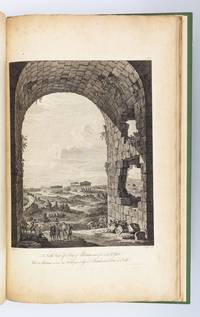
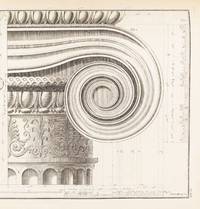
1768ST17496-011London: Chez l'auteur 1768. First Edition in French. 590 x 380 mm. 23 1/4 x 15". 52 2 pp. <br/> Modern brown quarter morocco over green linen boards brown morocco label with gilt lettering on smooth spine edges untrimmed. WITH 25 FULL-PAGE ENGRAVED PLATES OF GRECIAN RUINS and seven smaller engraved plates in text including one on dedication page. A Large Paper Copy. Fowler p. 157; Millard British 41; Blackmer 1065; Brunet III 1329. Head of spine partly torn but with no loss contents with not infrequent light marginal soiling though plates uniformly clean other minor imperfections but an excellent copy with greatly generous margins with deep impressions of the type and with strong impressions of the plates.<br/> <br/> This work is the first significant account of the ancient city of Paestum being in the words of Blackmer "larger and much more complete than any of the previous publications." Located in the Tyrrhenian Sea off the coast of southern Italy Paestum or Poseidonia in Greek was founded by Greek colonists in the sixth century B.C. and still contains beautifully preserved ruins from that period including temples an amphitheater and painted tombs. Abandoned in the Medieval period Paestum wasn't rediscovered by the West until the 18th century with the first modern publication of the site not appearing until 1764 when a suite of plans by G. P. M. Dumont appeared with no text based on the observations of Jacques-Germain Soufflot. As Millard indicates the genesis of the present publication has an extremely complex history we do not even know with certainty who wrote the text but we do know that engraver Thomas Major 1729-99 whom DNB calls "the first great English landscape engraver" was responsible for preparing the plates. Because he had no first-hand knowledge of the site Major relied on images by other artists including Antonio Joli Gaetano Magri Robert Mylne and Jacques-Germain Soufflot. The text was first published in English and then in French the same year. According to Fowler "this work . . . was an important eighteenth-century pioneer contribution to the knowledge of Greek architecture in England"; and Millard tells us that "the book was surprisingly well received by reviewers" in both England and France remaining "the standard reference to Paestum until 'Les Ruines de Paestum ou Posidonia' by C.-M. Delagardette was issued in 1798.". Chez l'auteur unknown
15492307040014Paris: Benoit Prevost for P. Haultin; Apud Petrum Haultinum 1549. Hardcover. Good. Pharmacology: Early printing Greek / Roman Medicine Bound In 19th century polished calf. Gilt spine. Triple gilt ruled covers. All edges gilt. Front hinge starting. Blue marbled end sheets. Woodcut printer's device. Printed in double columns in Greek and Latin. 20 392 leaves. <br> Dioscorides's 1st-century A.D. materia medica remained authoritative into the early modern era. Today the Greek physician is considered the father of pharmacology for his work in herbal medicine. Provenance: From the library of Nicolas Yemeniz 1783-1871 one of the great French bibliophiles of the late 19th-century. "Lugdun" bookplate. Refs: Adams D-657; Durling 1135; Wellcome I 1779. Paris: (Benoit Prevost for) P. Haultin; Apud Petrum Haultinum hardcover
1653255179Londoni: Excudebat Rogerus Daniel: prostat autem venale apud Joannem Martin & Jacobum Allestrye sub signo Campanae in Cometerio D. Pauli 1653. The first edition of the Septuagint printed in England. 8 1279 1; 186 2 pp. plus terminal blank. 1 vols. 4to signed in 8's 195 x 143mm. Old vellum titled and dated in manuscript on the spine. Terminal leaves slightly soiled two ownership inscriptions on front endsheets and small Lincoln's Inn release/sale stamp vellum a bit handsoiled occasional modest foxing and dusting along upper margins but a very good copy. The first edition of the Septuagint printed in England. 8 1279 1; 186 2 pp. plus terminal blank. 1 vols. 4to signed in 8's 195 x 143mm. The first edition of the Septuagint printed in England with the Scholia the scarce printing in quarto format. The text is derived from the Sixtine text and edited by John Biddle 1615-1662 the Unitarian controversialist who was imprisoned by the Parliamentary Commissioners for his religious views. <br /> The SCHOLIA . has a separate title-leaf register and pagination. The same setting was imposed in both quarto and octavo formats the latter with rules separating the columns of text. In regard to institutional representation the edition in quarto is much more uncommon than that in octavo: ESTC locates 4 copies of the quarto printing in North America as opposed to 19 of the octavo printing. Occasionally Daniel's reprint of the New Testament is bound up with the octavo printings to form a complete Bible. Brunet cites that format but notes the sale of a copy on "Gr. Pap." presumably a copy in this format. Over the last 35 years ABPC records sale of one copy in quarto 1999 and four in octavo. ESTC R12599 & R236817; Wing B2718 octavo edition only; Darlow & Moule 4692; Brunet I:863 Excudebat Rogerus Daniel: prostat autem venale apud Joannem Martin & Jacobum Allestrye, sub signo Campanae in Cometerio D. Pauli unknown
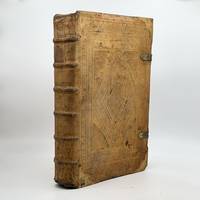
1609371891Geneva: Pierre de la Rouière 1609. In two columns. 28 184 283 1 84 203 1; 8 186 2 134 2pp. Folio 15 x 9-1/2 inches. Contemporary pigskin covers blocked in gilt and blind remnants of paper label on the spine gauffered edges lacks bosses and hinges and clasps worn at extremities and bottom of spine. Provenance: Johann Georg Feuchter of Jura-Weickersroda inscription on pastedown that the bible was purchased at an August 6 1728 auction for 4 florins and 30 groschen; General Theological Seminary blindstamp. In two columns. 28 184 283 1 84 203 1; 8 186 2 134 2pp. Folio 15 x 9-1/2 inches. Edited with introduction by Benito Arias Montanus 1527-1598 Spanish orientalist and editor of the Antwerp Polyglot a reprint of Plantin's similar edition. Darlow & Moole 5113 OT and 4662 NT Pierre de la Rouière unknown
18622029721862-1867 1862. VG. A remarkable collection of touching personal letters written by Joseph Grego aged 19–24 to his younger brother Hubert Charles Grego aged 11–16 during his school years—believed to be at Cumberland House a boys' boarding school run by James Mallinson. The volume includes 300 charming illustrations / cartoons integrated throughout the text along with four tipped in. Several letters to their mother and additional correspondence sent from abroad are also present.14.5 x 21.5 cm full green leather with triple gilt line borders to the front and rer and titles and decoration to the spine. The binding has a little rubbing to the spine tips corners and joints. Internally clean with just a little browning and curling to the edges of some letters. The writer Joseph Grego began his career at Lloyds before moving into the world of art as a collector journalist and respected authority on Gillray Rowlandson Morland and Cruikshank. Amongst his publications he was instrumental in the 1873 edition of James Gillray's Works and edited Rowlandson the Caricaturist 2 vols. 1880. Although he gathered extensive material for a biography of Morland it remained unfinished.A skilled draughtsman Grego designed theatrical costumes etched the work of others and developed a method of reproducing eighteenth century colour prints so accurate they were often mistaken for originals. He served as a director of Carl Hentschel Ltd. and Kegan Paul & Co. and was associated with the Graphic Company. In 1897 he contributed to the Victorian Era Exhibition at Earl's Court where his Dickens collection was described as "the fullest collection of Dickensiana ever gathered into one focus." His vast holdings were dispersed after his death via sales at Christie's and Puttick and Simpson's. Included with the book are letters from 1978-79 between Mrs Bruce-Johnston and the Folio Society regarding her submission of the volume for potential publication. All in all a fabulous set of family letters elevated by some excellent often humorous illustrations. Hubert Grego died in 1889 and Joseph in 1908 both unmarried. Their sister Louisa "Louie" from 1901 onward inherited Joseph's estate. She married George Bruce Johnston in 1902 and their son Roy Grego Bruce Johnston was born in 1905. Roy married Margaret Evelyn Palmer "Evelyn" in 1929. Included with the book are letters from 1978–79 between Mrs. Bruce Johnston and the Folio Society regarding her submission of the volume for potential publication. Rainford & Parris Books welcomes enquiries so please do not hesitate to ask if you require further images or have any questions. All books are packaged with great care. hardcover
1653371930London: Roger Daniel 1653. Title in red and black. Engraved printer's device on the title state B. Text in two columns. 8 1279 1 pp. 4to 7-3/8 x 5-3/8 inches. Eighteenth century red morocco panelled in gilt spines gilt with black morocco lettering pieces marbled endpapers gilt edges. Provenance: Viscount Palmerston bookplate; General Theological Seminary bookplate. Title in red and black. Engraved printer's device on the title state B. Text in two columns. 8 1279 1 pp. 4to 7-3/8 x 5-3/8 inches. The rare first printing in England of the Septuagint the earliest translation of the Hebrew Old Testament into Greek the scarce printing in quarto format. The text is derived from the Sixtine text and edited by John Biddle 1615-1662 the Unitarian controversialist who was imprisoned by the Parliamentary Commissioners for his religious views. <br /> <br /> "Roger Daniel's version of the text of the Sixtine edition was prepared for the use of the scholars at Westminster School. This appeared in 1653 and was edited by the Socinian John Biddle. Its publication may have owed something to the interest in the Septuagint generated by Codex Alexandrinus and the frustration produced by the failure of Young's attempts to edit it" S. Mandelbrote "English Scholarship and the Greek Text of the Old Testament" p. 87.<br /> <br /> A rare issue from the same setting as the octavo edition imposed in quarto without rules separaring the columns. Wing 2nd ed. B2718A; ESTC R12599; Darlow & Moule 4692 Roger Daniel unknown
1758ST17496-017Paris: H. L. Guerin & L. F. Delatour Jean-Luc Nyon and Jean Neaulme 1758. FIRST EDITION. 608 x 445 mm. 24 x 17". xiv 56; 2 vi 28 pp. Two parts in one volume. <br/> Later early 20th century quarter sheep over marbled boards raised bands compartments gilt reddish-brown leather label with gilt lettering all edges untrimmed. With large woodcut vignette on title and 60 ENGRAVED PLATES by Le Bas Littret de Montigny Neufforge and Patte after Le Roy. Brunet III 103; Millard French 101. A little rubbing to corners and head and tail of spine leather a bit faded chafed and freckled in places but the binding entirely sound and still quite pleasing; very faint diagonal crease at lower corner of many leaves a handful of plates slightly browned one more noticeably so other minor issues but quite a fine copy internally--the vast majority of the contents clean and bright with deep impressions of the text with the engravings richly impressed and with vast margins.<br/> <br/> With engravings by the some of the most esteemed artists of the day this imposing work contains beautiful depictions of Greek ruins and monuments that proved extremely influential to the development of French Neoclassical architecture. The text is divided into two parts the first covering the history of various monuments and Le Roy's thoughts on the principles of architecture and the second primarily containing a discussion of the orders of columns--particularly the Doric order--as well as several reconstructions of ruined temples. According to Millard this work "breaks new ground in providing a synthesis of archaeological findings with a body of architectural theory developed and expanded from the important controversy of Claude Perrault and Francois Blondel i.e. quarrel of the Ancients and the Moderns. . . . Perhaps most important Le Roy's treatise provides the theoretical framework and many of the actual models for French neoclassical architecture." Although "Les Ruines" came under some criticism especially by British rivals James Stuart and Nicholas Revett it nevertheless "made a strong public impact" in the words of the Dictionary of Art Historians and "greatly influenced the architects of the day particularly Jacques-Denis Antoine Jean-Arnaud Raymond Alexandre-Théodore Brongniart and François-Joseph Bélanger." This was in no small part due to the exquisite plates that included many picturesque views engraved by talented artists such as Louis-Joseph Le Lorrain Pierre-Charles Le Mettay Claude-Antoine Littret de Montigny and Jacques Philippe Le Bas among others. The son of the horologer to Louis XV Julien-David Le Roy 1724-1803 was an architect art historian and archaeologist. He was a protégé of Jacques-François Blondel 1705-74 whom he later succeeded as professor at the Académie Royale d'Architecture. After winning the Prix de Rome in 1754 Le Roy spent time in Greece studying and measuring ancient architecture and developing many of the theories that he would eventually publish in the present work. H. L. Guerin & L. F. Delatour, Jean-Luc Nyon, and Jean Neaulme unknown
1597ST19351Frankfurt: heirs of Andreas Wechel Claude de Marne & Johann Aubry 1597. Fourth Complete Greek Bible printed in Germany. 388 x 258 mm. 15 1/8 x 10 1/8". 4 p.l. 1 blank leaf attached to backing of folio :4 1098 2 pp. <br/> VERY STATELY 17TH CENTURY RED MOROCCO covers with mitered gilt frame gilt supralibros of Baderon de Maussac Olivier 745 at center raised bands spine panels with gilt flower gilt lettering all edges gilt. Printer's Pegasus device on title and final page. Front flyleaf with ink inscription recording the purchase on 24 February 1680 at Toulouse for 24 livres. Darlow & Moule 4653; VD16 B 2578; Adams B-979. ◆Three minute dents to front board a hint of wear to bands and corners isolated faint foxing blank recto of frontispiece leaf and blank verso of final leaf with faint blue shadow from endpapers but all of these quite trivial and otherwise A BEAUTIFUL COPY--fresh clean and bright internally with very wide margins and strong impressions of the plates and in a lustrous binding showing few signs of use.<br/> <br/> This handsome and remarkably well-preserved tall folio Greek Bible from a distinguished German printing firm comes in a shiny armorial binding with aristocratic French provenance. Darlow & Moule assigns the editing of this issue to Franciscus Junius François du Jon or Friedrich Sylburg noting that the Old Testament "is based on the Basel edition of 1545 . . . with correction from the Complutensian text and useful notes." The New Testament follows the text of Robert Estienne's 1568-69 edition. The Wechel family had a long tradition of humanist printing with an emphasis on Greek texts beginning with the press of Christian Wechel fl. 1520-54 in Paris and continuing after his son Andreas d. 1581 fled to Frankfurt to escape the persecution of Protestants in France. Andreas' descendants carried on the business through the first quarter of the 17th century. Olivier's "Reliures Armoriées Françaises" 1926 pl. 745 offers three possible attributions for the supralibros here all from the Languedoc region during the first half of the 17th century: Jean de Baderson; Jacques de Baderon seigneur de Maussac a member of the Parlement of Toulouse; and Jacques de Baderon de Maussac seigneur de Montagnac et de Corneillan and commandant of the city of Collioure. The inscription on the flyleaf here indicating that the book was purchased in Toulouse perhaps supports the case for the member of the Parlement in that city. The 24 livres paid for our imposing volume in 1680 would have represented as much as two months' wages for a worker in the region of its purchase. heirs of Andreas Wechel, Claude de Marne & Johann Aubry unknown
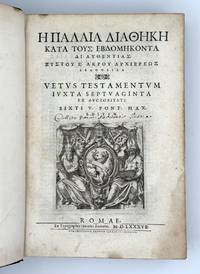
1587371783Rome: Franciscus Zanetti 1587. Text in Greek with short Latin notes at the end of each verse in two columns. Large engraved vignette on title with figures of Moses and Esdras on either side of the arms of Sixtus V. aâ´ A-3Sⶠ3Tâ¸. 8 783 1pp. Folio. Eighteenth century red morocco arms of the second Duke of Newcastle on the covers marbled endpapers gilt edges minor darkening to spine and wear to joints. Scattered minor dampstaining at lower outer corner of a few leaves. Provenance: Collegii Paris. Societas Jesu.early inscription on title; Douglass Maxwell Moffat booklabel with original invoice purchasing the volume from Davis & Orioli in 1940; General Theological Seminary bookplates. Text in Greek with short Latin notes at the end of each verse in two columns. Large engraved vignette on title with figures of Moses and Esdras on either side of the arms of Sixtus V. aâ´ A-3Sⶠ3Tâ¸. 8 783 1pp. Folio. Commissioned by Pope Sixtus V to assist the revisers who were preparing the Latin Vulgate edition ordered by the Council of Trent the "Sixtine" or "Roman" edition of the Septuagint was edited by Cardinal Antonio Carafa based on the Codex Vaticanus and became the standard for all the later editions of the Septuagint for three centuries after its publication. Darlow & Moule no. 4647; Adams B1246; BM STC Italian 1465-1600 p. 94 Franciscus Zanetti unknown
153326505Basel: Hieronymus Froben e Nikolaus Episcopius 1533. The Editio Princeps the first printing of the work in the original Greek. Greek and roman type. Woodcut printer’s device of Johann Froben by Hans Holbein der Jünger The Younger on the title-page and on fol. CC4v Heitz-Bernoulli 50. Woodcut decorated headpieces decorated and animated initials on black ground from different alphabets designed by Holbein; on fol. a1r 8-line initial showing Heraclitus and Democritus from the capital Latin alphabet of May 1520 drawn by Holbein and by Jacob Faber cfr. Hollstein’s German xivB n. 119. 4to 210x146 mm. In a very rarely encountered contemporary binding of Dutch blind-tooled leather over wooden boards. The covers are framed by two borders of blind tooled fillets a floral tool at each corner; the central panel is divided into diamond designs with rosettes on the upper cover and fleur-de-lys on the rear. Turn–ins and cords fixed at the inner boards. Antique spine and clasps renewed at a somewhat later date and accomplished with the greatest skill. The guard leaves are composed of two bifolia from a 14th-century manuscript breviary. Collation: 1 2 3 4 a-z4 A-Z4 aa-zz4 AA-CC4 fols. 1v CC4r blank. 8 573 3 pp A beautiful and fine broad-margined copy in a wonderful contemporary binding faint water staining to the inner corner of the first quires a minor repair to the gutter of the first leaves two tiny wormholes in the last three quires. Provenance: John Alfred Spranger 1889-1968; book-plate on front pastedown and stamp on title-page. EXTREMELY RARE FIRST PRINTING OF THE EDITIO PRINCEPS OF THIS REMARKABLY IMPORTANT BOOK AND A COPY WHICH IS OF THE VERY FINEST STATE AND CONDITION. The editio princeps of Diogenes Laertius’ Lives of the Famous Philosophers is the most important source of our knowledge in the history of Greek philosophy from Thales to Pyrrho. <br> The text was known only in the Latin translation by Ambrogio Traversari 1386-1439 which made its first appearance in print in Rome around 1472 and which was widely reprinted during the fourteenth and the first decades of the sixteenth century. This is the first printing of the book in its original language.<br> The edition is dedicated by the typographers Froben and Episcopius to the scholars and in their epistle they declare their publishing plan: to print at least a work per year able to combine usefulness and pleasure. <br> The text follows a manuscript provided by the professor of Greek and Hebrew at the University of Wittenberg Matthaeus Goldhahn 1480-1553 called Aurigallus probably a copy of the codex Raudnitzianus Lobkowicensis vi.F.c.38 at the time preserved in Komotau Bohemie in the house of the politician Bohuslav Lobkowitz von Hassenstein c. 1460-1510 and presently in the Library Národní Knihovna of Prague. Hieronymus Froben e Nikolaus Episcopius hardcover
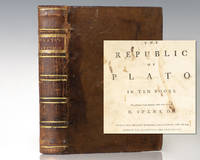
1763138322Glasgow: Printed by Robert and Andrew Foulis 1763. First edition in English of Plato's Republic marking the first appearance in the English language of Plato's profoundly influential dialogue concerning the nature of justice. Quarto bound in full polished calf with raised gilt bands to the spine morocco spine label lettered in gilt all edges speckled red. Harry Spens was a minister at the parish of Wemyss in Fife and respected classicist. In his introduction he professes his intent in his translation is: "To give the English Reader a view of Plato's sentiments and manner of writing and to stir up the youth to the study of the Ancients." Richard Garnett in his own introduction of the Everyman's Library reprint of this translation laments the relative lack of critical attention paid to it writing: "On the whole Spens's version should not be lightly esteemed. It is clearly the work of a scholar and a man of considerable literary ability." The brothers Robert and Andrew Foulis were renowned printers of classical works in their time sometimes referred to as 'the Elzevirs of Britain.' Their works mostly intended for scholars were "much sought after as admirable specimens of typography and are noticeable for their severely plain elegance" DNB 7: 514. In very good condition. Rare and desirable. "Its setting and its characters are full of political meaning. Its arguments are tantalizing and its fables fascinating… Plato's utopia is alarming and his metaphysics are intoxicating" Levi 348. The Republic "has reinforced dedication awakened vocations to leadership and strengthened the morale of those modest and competent souls who are always in reality the guardians of society" Rexroth 79. Printed by Robert and Andrew Foulis unknown
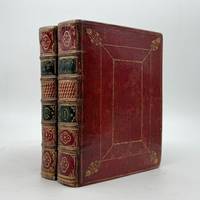
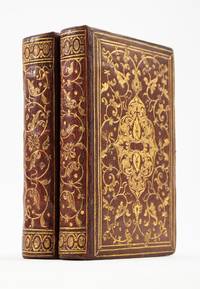
1568ST20921Lutetia Paris: Robert Estienne II 1568. 128 x 87 mm. 5 x 3 1/2". Two volumes. <br/> LOVELY CONTEMPORARY RED MOROCCO GILT covers with large central azured arabesque surrounded by curling vines with azured leaves smooth spines with similar vines head and foot of spines with egg-and-dart roll similar to one used by Claude de Picques second volume with faint blind lettering to spine all edges gilt perhaps with some minor early restorations but if so then done with such care as to preclude certainty. Housed in modern suede-lined calf-backed clamshell boxes with magnetic closures. Printer's device on titles and final page decorative initials and headpieces. Front pastedown of volume I with ex-libris of Georgios Arvanitidis. Renouard 171:1; Schreiber 239; Darlow & Moule 4633; Adams B-1670. See: Verron "Les Reliures de l'Entrée de Charles IX à Paris 1572 . . . réalisées par Claude Picques" in Bulletin du Bibliophile 2014 no. 2 pp. 282-98. Just a touch of rubbing to extremities front hinge of second volume open but everything quite tight text with occasional mild browning small spots trivial smudges or tiny worm trails but A BEAUTIFUL COPY clean and fresh internally and the bindings tight and lustrous with very bright gilt<br/> <br/> With exceptional visual appeal these two precious volumes shining with gilt and containing the Greek New Testament from the renowned Estienne family of printers are of special interest because of their typography their bindings and their provenance. With the expressed goal of printing Greek texts from manuscripts in the royal library at Fontainebleau François I established the post of royal printer in Greek in 1539 appointed Robert Estienne I 1503-59 to the position in 1542 and commissioned the renowned Claude Garamond to cut a new Greek font for this project. To design the type the King called on his own celebrated calligrapher Angelo Vergecio who produced in collaboration with Garamond three different sizes of what came to be called the Royal Types or "grecs du roi." According to Schreiber "These cursive Greek types are universally acknowledged as the finest ever cut." In 1548 and 1549 Robert Estienne issued the press' first Greek Testament known as the "O mirificam" edition for the opening of the dedication to the king in 16mo or "pocket" format using the smaller font of Garamond's "grecs du roi." In 1550 Robert a Protestant moved to Geneva while his son Robert II 1533-70 a Catholic remained in Paris and took over as the royal printer in Greek. Our 1568 Testament--the only one issued by the son--is a reprinting of the "O mirificam" edition but expanded with the critical apparatus from the 1550 folio edition issued by the father. Schreiber notes that our edition is interesting from a typographical point of view as it contains an even more minute version of the already small grecs du roi type for the Table of Chapters. The exceptionally pretty volumes are done in the style of royal binder Claude Picques fl. 1539-78 and employ a decorative roll very similar to one that appears on the spine of the vellum bindings Picques did for "L'Entrée de Charles IX à Paris" 1572. Our volumes once graced the library of Constantinople collector Georgios Arvanitidis 1876-1953 whose library included a number of Estienne Greek editions. They were later in the distinguished library of Frederick B. Adams 1910-2001 director of the Pierpont Morgan Library from 1948-69 and then president of the prestigious Association Internationale de Bibliophilie from 1974-83. And they were featured in the celebrated 1929 Gumuchian catalogue of 398 historically exceptional bindings as item #71. Robert Estienne II unknown
14943126Florence: Lorenzo son of Francesco di Alopa 1494. <p>Median 4to 226 x 162 mm. A-Ω AA-KK8; ΛΛ8 A1r blank A1v Greek alphabet and diphthongs title and table of contents A2r-KK8v text; ΛΛ1r Lascaris' verse epilogue in Greek ΛΛ1v-7v editor's dedicatory letter to Piero de' Medici in Latin ΛΛ7v Latin colophon ΛΛ8 blank. 280 leaves. Types: 5a and 5b:114Gk text and 116R dedication. 28 lines. Spaces for initials. Irregular line-endings. Occasional light foxing small marginal dampstain in last quire. Bound ca. 1800 in red morocco gilt for the Duke of Roxburghe sides panelled with triple gilt fillets Roxburghe arms stamped at center spine gilt lettered edges gilt a few small scrapes slightly rubbed maroon morocco-backed folding case. Provenance: contemporary marginal and interlinear annotations in a neat Greek humanist hand including numerous metrical marks; a few later marginalia one note on N5v shaved; John third Duke of Roxburghe 1740-1804 binding purchased from Molini Paris for £17.17 May 1789 note in red ink on first blank page Roxburghe sale 1812 lot 2354 £14.5; George W. Fitzwilliam of Milton Hall Peterborough bookplate sale Sotheby's 29 April 1918 lot 19 to Quaritch; C.S. Ascherson bookplate; Viscount Mersey Bignor Park bookplate sale Christie's 27 November 1991 lot 4 to Carlo Alberto Chiesa; sale Christie’s London 29 November 2000 lot 39 to Pierre Berès.<br /> <br /> Editio Princeps of the Planudean Anthology the first of Lorenzo di Alopa’s important series of Greek editions; first issue with the editor’s dedicatory letter to Piero de’ Medici; the fine Roxburghe copy.<br /> <br /> Many Hellenistic poets published books of epigrams; these were collected from an early period. A vast collection assembled ca. AD 900 by the Byzantine schoolteacher Constantine Cephalas included the earlier collections as well as a large number of inscriptional epigrams collected from various parts of Greece and Asia Minor. The Palatine Anthology assembled by an unknown scholar soon after expanded Cephalas to approximately 3700 epigrams adding much Christian and ekphrastic poetry. “To this manuscript we owe almost our entire knowledge of Greek epigram from Meleager to Agathias†Oxford Classical Dictionary 3rd rev. ed. p. 102. In the 13th century the Byzantine monk Maximus Planudes produced this reduced version of the Palatine Anthology rearranging the epigrams in seven books with extensive subdivisions adding some epigrams not included by the Palatine Anthologist most of which came from a different version of Cephalas’ collection but also bowdlerizing erotic passages and omitting what he considered improper. Most manuscript copies were made from the Planudean Anthology the earlier Palatine Anthology having been forgotten. Until the latter’s rediscovery in 1606 the Planudean Anthology was the Greek Anthology and it exerted a huge influence throughout the Renaissance. “The Greek Anthology is one of the great books of European literature a garden containing the flowers and weeds of fifteen hundred years of Greek poetry from the most humdrum doggerel to the purest poetry†OCD.<br /> <br /> Although Planudes’ holograph manuscript was by this time in the collections of Cardinal Bessarion in Venice the Greek scholar Janus Lascaris used a different manuscript for the present edition; this version was followed by all subsequent editors until the latter half of the eighteenth century. <br /> <br /> This was the first of three editions with the Euripedes and the Gnomae printed by di Alopa using a striking uppercase typeface in two fonts designed by Lascaris to imitate epigraphic letter-forms appropriately for these epigrams many of which had been preserved in stone carvings. As he explains in his dedicatory letter in this way he hoped to avoid the complications of reproducing Greek script. Lascaris’ type contained ONLY CAPITAL LETTERS with breathings and accents cast and set separately and attached to the letters of the smaller font by means of solder or wax so that its body matched perfectly that of the larger font. Though visually arresting such a typeface proved insufficiently compact for the printing of scholia and two years later a true lowercase fount − just as complicated as those condemned by Lascaris − was introduced to print the commentary for the editio princeps of the Argonautica. <br /> <br /> This copy is from the first issue containing the final unsigned quire with Lascaris’ dedicatory letter in Latin to Piero de' Medici which was suppressed from some copies no doubt those still unsold after Piero was proscribed from Florence and fled the city following the entry of King Charles VIII on 8 November 1494. The neat annotations in this copy are in precisely the kind of Greek humanist hand that Aldus would use for his Greek type.  Some of the later annotations appear to supply textual corrections from the Palatine Anthology.<br /> <br /> ISTC ia00765000; Goff Suppl. A-765; CIBN A-410; Walsh 2962; Bod-inc. A-308; BMC VI 666; BSB-Ink A-557; GW 2048; Flodr Anthologia 1; Proctor Printing of Greek pp. 78-79; Barker Aldus Manutius and the Development of Greek Script and Type pp. 39-42; Wilson From Byzantium to Italy pp. 98-99.</p> Lorenzo (son of Francesco) di Alopa unknown
1514372265Alcala de Henares: Arnao Guilem de Brocar 1514. First edition of the New Testament in Greek published as volume 5 of the Complutensian Polyglot. Woodcut arms of Cardinal Jiménez on title page with woodcut borderswoodcut initials. Text in Greek and Latin in two columns Collation: a4 A-Q6 a6 R-Z6 AA-LL6 MM8 2a11 3a6 b-f6 g4 -g4. 271 of 272 leaves lacking final blank. 1 vols. Folio. Recent full black morocco spine gilt gilt turn-ins red morocco doublures gilt marbled flyleaves. Minor toning or soiling to a few leaves. A clean fresh copy. First edition of the New Testament in Greek published as volume 5 of the Complutensian Polyglot. Woodcut arms of Cardinal Jiménez on title page with woodcut borderswoodcut initials. Text in Greek and Latin in two columns Collation: a4 A-Q6 a6 R-Z6 AA-LL6 MM8 2a11 3a6 b-f6 g4 -g4. 271 of 272 leaves lacking final blank. 1 vols. Folio. Produced under the patronage of Cardinal Ximenes archbishop of Toledo and founder of the university of Alcala. As part of the Complutensian Polyglot Bible the New Testament was printed first dated 10 January 1514; the Old Testament was completed only in 1517 and publication was delayed until 1522.<br /> <br /> "Undoubtedly the finest Greek fount ever cut and the only one of which it can be affirmed with certainty that it is based on the writing of a particular manuscript" Proctor. Pope Leo X lent the Codex Vaticanus to Ximenes and it was upon this manuscript that Brocar modelled his type. Proctor used it as the model for the type in his edition of the Oresteia of 1904. This volume complete with the six leaves of the travels of St. Paul printed only in Greek and often lacking as it was printed later.<br /> <br /> This is the first Greek New Testament ever printed 1514 but as it was not published until 1522 this text was unknown to Erasmus when he published his Greek New Testament in 1516.<br /> <br /> Douglas Maxwell Moffat 1881-1956 Yale class of 1903 was a Grolier Club member from 1929 until his death; the libraries at Yale University and the General Theological Seminary were beneficiaries of gifts from his widow. "As a collector he was interested in three fields primarily: editions of Vergil; Greek and Latin lyric poetry; and fine printing. Almost all his books were in superb condition and often of very interesting provenance" Yale University Library Gazette 35:2 p. 122.<br /> <br /> THE MOST FAMOUS PIECE OF PRINTING EXECUTED IN SPAIN. Darlow & Moule 1412/4593; PMM 52; Adams B968 Vol. 5; Norton Printing in Spain 1501-1520 27; Proctor Printing of Greek p. 144. Provenance: Douglas Maxwell Moffat bought from E.P. Goldschmidt; General Theological Seminary gift of Mrs. Douglas M. Moffat Arnao Guilem de Brocar unknown