875 résultats
1503375382.Gpaperback. Good. Access codes and supplements are not guaranteed with used items. May be an ex-library book. paperback
1503375390.Gpaperback. Good. Access codes and supplements are not guaranteed with used items. May be an ex-library book. paperback
1503375447.Gpaperback. Good. Access codes and supplements are not guaranteed with used items. May be an ex-library book. paperback
1503375439.Gpaperback. Good. Access codes and supplements are not guaranteed with used items. May be an ex-library book. paperback
1142909506.Gpaperback. Good. Access codes and supplements are not guaranteed with used items. May be an ex-library book. paperback
1164941887.Gpaperback. Good. Access codes and supplements are not guaranteed with used items. May be an ex-library book. paperback
1357419961.Ghardcover. Good. Access codes and supplements are not guaranteed with used items. May be an ex-library book. hardcover
1437143024.Gpaperback. Good. Access codes and supplements are not guaranteed with used items. May be an ex-library book. paperback
1437269230.Ghardcover. Good. Access codes and supplements are not guaranteed with used items. May be an ex-library book. hardcover
1928055999Istanbul: Manuscript 6 February 1928 1928. No Binding. Very Good. Atlas Folio - over 23 - 25" tall. A 10-line autograph letter entirely written in Ottoman Turkish in elegant handwriting with a signature in Greek. 37x23 cm.Vertical and horizontal fold marks slight chippings on extremities repaired contemporarily by tape. Otherwise a very good document. A rare letter in Ottoman Turkish written in elegant handwriting and sent to Muammer Rasid Sevig 1885-1973 a prominent jurist and politician who served as a judge at the Permanent Court of International Justice in The Hague and as Rector of Istanbul University during the period when he was practicing as a lawyer specializing in international law. The letter was written by a Greek Orthodox Rum citizen of Istanbul stating that his house had been assigned by the state without his consent to a Thessaloniki immigrant within the context of the ongoing Population Exchange. It also includes details regarding the legal fees associated with the matter. "Avukat Muammer Rasid Sevig Beyefendiye Beyoglu'nda Pangalti'da Sehid Muhtar Bey Caddesi'nde 107-81 numerolu hanemi Istanbul Iskân Müdüriyeti Selânik muhacirlerinden Osman Fehmi Bey'e bilâsebeb Kanûn-i Takrîz edilmek üzere mezkûr hanemi bittahkîk mümaileyhi iskân ettirmis oldugundan muhakeme-i iadesine müracaa ile haleldar olan hukukumu müdafaa ve hukuk-i tasarrufiyyemi temîn etmek üzere lâzim gelen muamele-yi kanûniyyenin ecrâmi için zât-i âlîlerini bir kit'a vekâletnâme ile tevkîl eylemis oldugumdan icraât-i vekâlet olarak maktûen bin lira iadesini tehir eylerim. Isbu bin liradan üçyüz lirasini. Fî 16 Subat sene 1928." English translation: To Lawyer Muammer Rasid Sevig Bey As the Istanbul Resettlement Directorate Iskân Müdüriyeti has without any legitimate reason assigned my residence located in Beyoglu Pangalti on Sehid Muhtar Bey Street No. 107-81 to Osman Fehmi Bey one of the immigrants from Thessaloniki with the aim of formalizing it under the relevant law Kanûn-i Takriz and as my property has been unlawfully occupied in this manner. I have applied for a retrial muhakeme-i iade and in order to defend my compromised rights and secure my rights of ownership hukuk-i tasarrufiyye I have authorized Your Excellency by means of a power of attorney vekâletnâme to carry out the necessary legal procedures muamele-i kanuniyye. For these legal services to be carried out on my behalf I request that the fixed sum of one thousand liras be paid. From this amount three hundred liras are to be. Dated: 16 February 1928". On January 30 1923 the Convention and Protocol Concerning the Exchange of Greek and Turkish Populations was signed and entered into force. According to Article 1 of the agreement a compulsory population exchange was to be carried out between Muslims residing in Greek territory and Greek Orthodox Christians settled in Turkish territory beginning on May 1 1923 Oran. The primary rationale behind this exchange was the desire of both countries to create ethnically homogeneous societies within their respective borders. Article 2 of the agreement stipulated that Greeks residing in Istanbul and Muslims residing in Western Thrace were excluded from the exchange and considered established residents établis. However the different interpretations of this article by the two countries led to significant disagreements Metintas. These disagreements persisted for a long time and when no resolution could be reached the matter was brought before the League of Nations. Still no solution emerged and the case was eventually referred to the Permanent Court of International Justice which issued a non-binding advisory opinion. Yet the issue remained unresolved Firat. Bilateral negotiations continued for years and finally led to the signing of the Ankara Agreement between the two governments on June 10 1930. According to Articles 10 and 14 of the agreement Greek Orthodox residents of Istanbul and Turks of Western Thrace who had settled in these regions before October 30 1918 <br/> <br/> Manuscript, 6 February 1928 unknown
2009x-1605111147Cambridge Univ Pr 2009. Hardcover. New. 235 pages. 9.00x6.00x0.63 inches. Cambridge Univ Pr hardcover
194566739New York: The Greek American Council 1945. Wraps. Good. No dust jacket. 6 137 3 pages. 28 cm. Cover is worn soiled front cover creased and small piece of corner missing. Minor water staining at bottom of several pages. Minor loss of material at botton of several pages. Pencil erasure residue on t-p. Produced by Co-op Mimeo Service of New York City. From Wikipedia: "The National Liberation Front was the main movement of the Greek Resistance during the Axis occupation of Greece during World War II. Its main driving force was the Communist Party of Greece KKE but its membership throughout the Occupation period included several other leftist and republican groups. EAM became the first true mass social movement in modern Greek history and even established its own government the Political Committee of National Liberation in the areas it had liberated in spring 1944. At the same time from late 1943 onwards the political enmity between EAM and rival resistance groups from the centre and right evolved into a virtual civil war which was ended only with the Lebanon conference in May 1944. The organisation reached its peak after Liberation in late 1944 when it controlled most of the country before suffering a catastrophic military and political defeat in the December 1944 events. This marked the beginning of its gradual decline and the open persecution of its members accusing it for crimes against political rivals and Soviet perspective and leading eventually to the outbreak of the Greek Civil War.After Liberation in October 1944 the tensions between EAM and right-wing nationalist or western-oriented republican forces which were supported by Great Britain escalated. Originally as agreed at the Lebanon conference EAM participated in the government of national unity under George Papandreou with 6 ministers. Due to disagreements regarding the disarmament of ELAS and the formation of a national army on 1 December the EAMite ministers left. EAM organized a demonstration in Athens on December 3 1944 against British interference. The exact details of what happened have been debated ever since but gendarmes opened fire on the crowd resulting in 25 dead protesters including a six-year-old boy and 148 wounded. This clash escalated into a month-long conflict between ELAS and the British and Greek governmental forces known as the "December events" Dekemvrianá which resulted in a British and Greek government victory. In February the Varkiza agreement was endorsed leading to the disbandment of ELAS. In April the S and LD parties left EAM. EAM was not dissolved but was hence for all intents and purposes merely an expression of the KKE. During the 1945-1946 period a conservative terror campaign the "White Terror" was launched against EAM-KKE supporters. The country became polarized eventually leading to the outbreak of the Greek Civil War in March 1946 which lasted until 1949. In its aftermath and in the context of the Cold War KKE was outlawed and EAM/ELAS vilified as an attempt at "Communist take-over" and accused for various crimes against political rivals. The issue remains a highly controversial subject to this day. With the coming of Andreas Papandreou to power in 1981 however EAM was recognized as a resistance movement and the fighters of ELAS were honored and given state pensions." The Greek American Council paperback
87996Giessen Basel Brunnen 1994 - 1997. 2 vols: 36899;34507 p. Hardb. 23 cm unknown
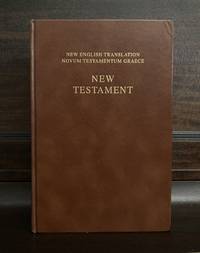
616Deutsche Bibelgesellschaft NET Bible Press. 27th Edition. Hardcover. Very Good. :: Greek - English diglot. :: Edition of the New Testament featuring the Greek text of NA with apparatus and the English text of the NET BIBLE with customized notes to help facilitate the study of the New Testament by students and pastors everywhere. ::<br /> <br /> Bound in publisher's tan bonded leather front board bears title in gold. Title and publisher lettered in gold upon spine. Octavo 9 1/2 x 6 1/4 inches; 242 x 160 millimeters. 887 pages. <br /> <br /> Condition: Very Good-. Upper right corner of front board bumped. Bonded leather has rubbed in several places exposing the boards. Prior owner's name written at the bottom corner of the front free endpaper. Pages are clean. I would say this is a good reading and study copy but not a fine gift copy. Deutsche Bibelgesellschaft NET Bible Press hardcover
1836173024Oxonii : e Typographeo Academico 1836. 1st Edition in this form. Hardback. Near fine copy in contemporary gilt-blocked cloth. Slightest suggestion only of dust-dulling to the spine bands and panel edges. Remains particularly well-preserved overall; tight bright clean and strong. Book contains minor pen annotations. ; 8vo 8"" - 9"" tall; 471 pages; Physical desc.: 4711p. ; 20 cm. 8vo. Subjects: Bible - New Testament - Greek - Religion. Language: Greek. Oxonii : e Typographeo Academico hardcover
1814071A46Bostoniae: Excudebat Esaias Thomas Jun. Typis Watson & Bangs: 1814. 1814 478 p. Browned but not brittle. 12mo. 170 mm. Original full leather binding worn. Autograph ownership of: Henry Kurtz 1796-1874 a German immigrant to the United States. In 1828 Kurtz was baptized a Brethren and two years later was called to the ministry. By the early 1830's he had secured a printing press and begun publishing German periodicals. Kurtz's desire to unify the increasingly scattered Brethren led to his launching in 1851 a paper to serve the church - The Gospel Visitor. Through his publishing activities he became one of the most influential figure of the Brethren church. Also with the autograph ownership of Henry Miller. The Greek New Testament was first printed in the U.S. by Isaiah Thomas in 1800. American Imprints 30833; O'Callaghan 122; Hall. American Greek Testaments pp. 12 & 65. For Mill's text see: Darlow & Moule 4725. PRICE JUST REDUCED! JUN5 BOX1 Language: eng. Full Leather. Hardcover. Good. Bostoniae: Excudebat Esaias Thomas, Jun. Typis Watson & Bangs: 1814. hardcover
19662iiiAd0053bNew York: Ballantine Books/Published by Arrangement With Simon & Schuster Inc. 1966. Book. Very Good. Mass Market Paperback. 1st Printing: March 1966. 12mo or 12° Duodecimo: 6¾" x 7¾" tall. 447 pp. A rare hard-to-find out-of-print collectible gem! A wonderful nearly spotlessly clean coyp! Solidly bound copy with minimal external wear crisp pages and clean text. Slightly creased spine. Light foxing around edges of pages not affecting text. Ballantine Books/Published by Arrangement With Simon & Schuster, Inc. Paperback
1928055980Constantinople Istanbul: Typescript - Apoyevmatini 1928. No Binding. Very Good. 8vo - over 7¾ - 9¾" tall. Original typescript letter with autograph signature and a commercial seal. 27 x 21 cm. In French. 16 lines. A rare and historically interesting typescript letter signed by Vasileiadis editor of the Greek-language minority newspaper Apoyevmatini published in Istanbul addressed to the Electric Company. In this letter Vasileiadis voices a formal complaint regarding the discriminatory exclusion of Apoyevmatini from a discounted electricity rate campaign extended to other members of the press highlighting the unequal treatment of minority publications despite their longstanding contributions to the city's journalistic and cultural landscape. Apoyevmatini was originally founded through a partnership between Konstantinos Vasileiadis who held the publishing license and Odysseas Krystalidis the owner of the printing facilities and an experienced figure in newspaper distribution. The first editor-in-chief Kavalieros Markouizos served until 1927. He introduced the newspaper's enduring motto a quote from Victor Hugo: "New epochs bring new missions." This phrase aptly captured the spirit of the era reflecting the profound transition faced by the Greek community in the wake of the Ottoman Empire's dissolution and the rise of the newly established Republic of Turkey. In 1927 Grigorios Giaveridis succeeded Markouizos as editor-in-chief a position he held until his death on 1 August 1979. <br/> <br/> Typescript - Apoyevmatini unknown
0259109517.Gpaperback. Good. Access codes and supplements are not guaranteed with used items. May be an ex-library book. paperback
17867475Londini London: Excudebant A. Rivington & J. Marshall 1786. 12mo pp. 368 2 ads. Contemporary sheep spine divided by gilt rolls and rules red morocco label edges sprinkled red. A touch of spotting. Rubbed and a little marked some small sections of leather peeling. A scarce Greek New Testament recorded by ESTC in three North American institutions - Harvard Union Theological Seminary and Tennessee - and one private collection. ESTC N63834. Excudebant A. Rivington & J. Marshall hardcover
17997575Londini London: Apud G.G. & J. Robinson et al 1799. 12mo pp. 347 1. Half-title discarded. Contemporary sheep spine divided by gilt rules red morocco label edges sprinkled blue. Somewhat rubbed some areas of peeling and insect damage to rear board a little wear to extremities. Ownership inscriptions of Charles Kinloch to first few leaves dated 1802. A scarce London printing of the Greek New Testament: ESTC records just 5 copies. ESTC T176685. Apud G.G. & J. Robinson [et al] unknown
17517788Edinburgi Edinburgh: Apud Tho. & Wal. Ruddimannos 1751. 12mo pp. iv 402 frontispiece. Contemporary calf spine divided by raised bands between double gilt rules red morocco label. Somewhat rubbed joints starting some wear to extremities front flyleaf excised. Armorial bookplate of Sibbald to pastedown struck-through inscription of Charles Sibbald dated 1831 and of Donald Bruce to verso of frontispiece pencil notes to rear blanks. A pocket Greek New Testament printed by the Ruddimans. ESTC T94884; Darlow & Moule 4751. Apud Tho. & Wal. Ruddimannos hardcover
17632548Oxonii Oxford: E Typographeo Clarendoniano 1763. 8vo pp. iv 676. Near-contemporary tree calf spine elaborately gilt in compartments red morocco label marbled endpapers edges yellow. Some light toning and spotting. Expertly rebacked by Bernard Middleton with old backstrip laid down hinges relined. An attractive copy. In 1758 Baskerville proposed the casting of a new set of Greek types to the Oxford University Press and they ordered 2000 copies of this octavo New Testament plus 500 in quarto to be printed with the resulting type - which ended up being its only use. Negative critical reception may have contributed to its abandonment but Baskerville’s Greek face has recently been reassessed by Gerry Leonidas as an important predecessor of more modern types if perhaps not quite as elegant as that used by the Foulis press that had fallen afoul of an arbitrary typographic orthodoxy. Gaskell Add. 2; ESTC T94889; D&M 4756. E Typographeo Clarendoniano unknown
a66202Oxonii 1763 Typographeo Clarendoniano. Printed by John Baskerville. In Greek. Octavo 676pp. full leather with mounted leather spine label. Fairly Good front cover held on by binding string rear board cracked along outer hinge spine label chipped. Text bright and clean. Scarce Greek Bible in usable condition. . hardcover
1514372265Alcala de Henares: Arnao Guilem de Brocar 1514. First edition of the New Testament in Greek published as volume 5 of the Complutensian Polyglot. Woodcut arms of Cardinal Jiménez on title page with woodcut borderswoodcut initials. Text in Greek and Latin in two columns Collation: a4 A-Q6 a6 R-Z6 AA-LL6 MM8 2a11 3a6 b-f6 g4 -g4. 271 of 272 leaves lacking final blank. 1 vols. Folio. Recent full black morocco spine gilt gilt turn-ins red morocco doublures gilt marbled flyleaves. Minor toning or soiling to a few leaves. A clean fresh copy. First edition of the New Testament in Greek published as volume 5 of the Complutensian Polyglot. Woodcut arms of Cardinal Jiménez on title page with woodcut borderswoodcut initials. Text in Greek and Latin in two columns Collation: a4 A-Q6 a6 R-Z6 AA-LL6 MM8 2a11 3a6 b-f6 g4 -g4. 271 of 272 leaves lacking final blank. 1 vols. Folio. Produced under the patronage of Cardinal Ximenes archbishop of Toledo and founder of the university of Alcala. As part of the Complutensian Polyglot Bible the New Testament was printed first dated 10 January 1514; the Old Testament was completed only in 1517 and publication was delayed until 1522.<br /> <br /> "Undoubtedly the finest Greek fount ever cut and the only one of which it can be affirmed with certainty that it is based on the writing of a particular manuscript" Proctor. Pope Leo X lent the Codex Vaticanus to Ximenes and it was upon this manuscript that Brocar modelled his type. Proctor used it as the model for the type in his edition of the Oresteia of 1904. This volume complete with the six leaves of the travels of St. Paul printed only in Greek and often lacking as it was printed later.<br /> <br /> This is the first Greek New Testament ever printed 1514 but as it was not published until 1522 this text was unknown to Erasmus when he published his Greek New Testament in 1516.<br /> <br /> Douglas Maxwell Moffat 1881-1956 Yale class of 1903 was a Grolier Club member from 1929 until his death; the libraries at Yale University and the General Theological Seminary were beneficiaries of gifts from his widow. "As a collector he was interested in three fields primarily: editions of Vergil; Greek and Latin lyric poetry; and fine printing. Almost all his books were in superb condition and often of very interesting provenance" Yale University Library Gazette 35:2 p. 122.<br /> <br /> THE MOST FAMOUS PIECE OF PRINTING EXECUTED IN SPAIN. Darlow & Moule 1412/4593; PMM 52; Adams B968 Vol. 5; Norton Printing in Spain 1501-1520 27; Proctor Printing of Greek p. 144. Provenance: Douglas Maxwell Moffat bought from E.P. Goldschmidt; General Theological Seminary gift of Mrs. Douglas M. Moffat Arnao Guilem de Brocar unknown