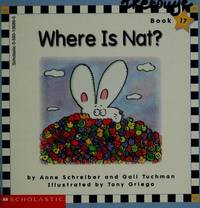
Where is Nat Scholastic phonics readers
1997Q-0590931237Scholastic 1997-01-01. Paperback. New. In shrink wrap. Looks like an interesting title! Scholastic paperback
GridFreed LLC · États-Unis116,28 $US≈ 98,38 €
22 324 résultats
[(Harlequin Intrigue Series # 101] Canadian advertising executive Nadia Roberts immediately boarded a plane to Athens when told her beloved brother, Gerald, had been found. Murdered. Next to a marble quarry in northwestern Greece. The case was supposed to be open and shut. To avoid scandal, the government let Nadia join crack detective Lukas Stylianos on his investigation northward Sparks at first flew, cooled by growing trust as they encountered hostile villagers, old war wounds and traps set by a man nicknamed the Wolf. Corrupt and evil, he was intent on hiding secrets that cost Gerald his life and which now imperiled Nadia and Lukas. 253p. (Freda Vasilos and Tina Vasilos are both pseudonyms of Freda Vasilopoulos,a Canadian writer) Book
158704Boston etc., D.C. Heath, (1900).
Minor shelfwear. ; Xx, 307pp, xii, + plates with 31 illustrations. Text is in English. Biography of the man known as the "Father of Archaeology". ; 307 pages
The first biography in English Johann Joachim Winckelmann. 312p. +xii. Plates.bibliography.index Book
2480425 August 1891; Grandholme Aberdeen. See his entry in the Oxford DNB. 2pp 12mo. Bifolium. In good condition lightly aged with spike hole to one corner. Folded once. From the context the recipient is clearly James S. Cotton editor of the Academy. He explains that ‘Mr S. Reinach’ the French archaeologist Salomon Reinach 1858-1932 recently wrote to him to say that he would send him ‘a copy of his book Chroniques d’Orient if I would review it. I said I would with pleasure review it somewhere. Yesterday the book reached me addressed to me probably owing to some mistake of the publishers as “redacteur de l’Academyâ€â€™. If the editor has not received another copy Paton will either forward the copy he has received ‘or if you will permit me retain it and write a notice of the book for the Academy.’ 25 August 1891; Grandholme, Aberdeen. unknown
22055No date or place. 1p 4to. In good condition with slight creasing to extremities on a leaf of 'Onion Skin' paper. A sixteen line poem in three stanzas beneath which is written boldly and in pencil: 'W B. Stanford Trinity College Dublin'. The poem is one of Stanford's best and best-known and features in Donagh MacDonagh's 'Poems from Ireland' 1944 and Brendan Kennelly's 'Penguin Book of Irish Verse' 1970. The present version exhibits no variations from the text printed by Kennelly. The first stanza reads: 'When the landfolk of Galway converse with a stranger softly the men speak more softly the women light words on their lips and an accent that sings in traditional cadences once plucked by harpists to cheer melancholic carousals of kings when the landfolk of Galway converse with a stranger.' No date or place. unknown
Mm 240x280 Nuovo - Volume in copertina rigida con sovraccoperta, 136 pagine con 77 figure a colori e 34 in nero. Opera in stato di nuovo - brand new in original shrinkwrap. SPEDIZIONE IN 24 ORE DALLA CONFERMA DELL'ORDINE
Foxing/dustsoiling to top of textblock. Minor Shelfwear. Review of book by Marsh McCall tipped in (signed by Mccall to Philippa Goold). ; Oxford Classical Monographs; 283 pages; Euripides' Hecuba is is dominated by the vengence which Hecuba takes on the faithless Polymestor, and explores in a complex and profound manner the potential of revenge as a subject for tragedy. The sacrifice of Polyxena is in counterpoint to the revenge action; the whole is set in the chaotic aftermath of the fall of Troy. The combination of plots creates one of Eruipides' most effective dramas, full of pathos, suspense, and excitement. This, the first book-length study of the play in English, argues that it has been greatly undervalued by critics who have failed to appreciate the power of its rhetoric, the subtlety of its characterization, and the beauty of its choral odes. The book also examines and seeks to explain the powerful influence of Hecuba in the Renaissance, and compares the play with English revenge tragedy of the 16th and 17th century.
Gift inscription to W. J. Slater from Calder III to titlepage. Very minor shelfwear. Light wear to back upper corner. ; Die Festschrift vereinigt die Vorträge amerikanischer und deutscher Wissenschaftler, die anläßlich des 70. Geburtstags William M. Calders III (Professor of Classics at the University of Illinois) im September 2002 auf einem Kolloquium in der Fondation Hardt (Vandœuvres/Genf) gehalten wurden. Zu Ehren des Jubilars, der sich in den vergangenen Jahrzehnten um die Wissenschaftsgeschichte der Altertumskunde international anerkannte Verdienste erworben hat, war dieses Kolloquium dem großen deutschen Gräzisten Ulrich von Wilamowitz-Moellendorff (1848-1931) gewidmet. Die Vielfalt wissenschaftsgeschichtlicher Fragestellungen spiegelt sich in den Beiträgen wider: Während sich die einen mit Wilamowitz' Forschungen über antike Schriftsteller, wie Sophokles, Aristophanes, Seneca und die Autoren des griechischen Romans, und mit seiner Arbeit über unterschiedlichste Bereiche antiker Kultur, etwa die Astrologie, das griechisch-römische Drama und die attische Demokratie, beschäftigen, erhellt ein anderer, welche allgemeine Bedeutung für die Kultur und Bildung des 19. Jahrhunderts Wilamowitz dem Griechischen zumaß. Weitere Studien sind hingegen von biographischem und historischem Interesse und gelten z. B. Seiner Haltung zu Meinungsfreiheit und politischer Zensur. Nicht zuletzt werden in diesem Band wichtige Originaldokumente erstmals ediert, so der umfängliche Briefwechsel zwischen Wilamowitz und dem Altertumswissenschaftler Franz Boll. ; Spudasmata Band 92; 324 pages; Signed by One Author
Gift inscription to W. J. Slater from Calder III & Hose to half-title. Very light dust-soiling to top of textblock. Very minor shelfwear. ; Spudasmata Band 81; 723 pages; Signed by Editors
98046Leiden, Brill, 1909.
15456Leiden, Brill, 1909.
vii + 436pp., orig.omslag (rug verstevigd), grotendeels onopengesneden
1888F39825Haarlem, Tjeenk Willink 1888 vii + 436pp., orig.omslag (rug verstevigd), grotendeels onopengesneden
13944Halle, Niemeyer, 1920.
Very Good English Paperback. 12mo. (17 x 12 cm). In English. [14] p., color ills. Why TRNC? Let us embrace. "The Turkish Republic of Northern Cyprus" (TRNC) a new born independent state in this beautiful world. (It was only after our visit to the Turkish Republic of Northern Cyprus that we could perceive the existence of the Turkish Cypriots in Cyprus. May 13, 1983, Chei. [Propaganda brochure]. It's written verso: "The Turkish Republic of Northern Cyprus will be recognized. Must be recognized. This is the only way out of the dilemma., June 6, 1984, Lord Hanword, Member of the British House of Lords". Not in OCLC. A rare propaganda brochure.
Some creasing to DJ flaps. Lower corners of book a bit bumped. ; Why Homer Matters is a magical journey of discovery across wide stretches of the past, sewn together by the poems themselves and their metaphors of life and trouble. Homer's poems occupy, as Adam Nicolson writes "a third space" in the way we relate to the past: not as memory, which lasts no more than three generations, nor as the objective accounts of history, but as epic, invented after memory but before history, poetry which aims "to bind the wounds that time inflicts." The Homeric poems are among the oldest stories we have, drawing on deep roots in the Eurasian steppes beyond the Black Sea, but emerging at a time around 2000 B. C. When the people who would become the Greeks came south and both clashed and fused with the more sophisticated inhabitants of the Eastern Mediterranean. ; 320 pages
Fine English Paperback. Pbo. Roy. 8vo. (24 x 18 cm). In English. [5], 41 p. Why did the inter-communal talks on Cyprus (1968-71) fail? Revelations in the light of British official documents released recently. CYPRUS Cypriot question Intenational relations Greek British foreign affairs.
Victoria Clark travelled across most of Eastern Europe to write Why Angels Fall. Having worked as a journalist in Romania, the former Yugoslavia and Russia for six years, she was fascinated by the Eastern Orthodox churches and keen to unravel their history and beliefs. To do so she journeyed from Mount Athos, to Serbia, Macedonia, Greece, Romania, Russia, Cyprus and finally Istanbul, interviewing clergy and other believers. We're treated to a series of vivid cameos, a few of whose subjects glow almost visibly with holiness, a few terrify and many show qualities rare and needed in the West. As Clark puts it, after the ancient split between eastern and western Christianity, "each side lost something it could not happily do without . at the risk of over-simplifying for the sake of clarity, western Christendom can be said to have lost its heart, eastern Christendom its mind." Her keenness to explain Orthodoxy to westerners stems from a fear that the continent is in the process of fracturing along a thousand-year-old fault line, between the Catholic and Protestant west and the Orthodox east. The book combines high quality, highly readable travel writing with a powerful mix of politics and religion. Perhaps, most of all, it demonstrates the power of history, and of different peoples' conflicting versions of history.460p.+ plates, map. bibliograpy.index Book
1997Q-0590931237Scholastic 1997-01-01. Paperback. New. In shrink wrap. Looks like an interesting title! Scholastic paperback
Book has shelfwear.. Former owner's name to ffep. Foxing passim. ; With twelve ill. And a map. ; 87 pages
Set in German-occupied Greece during WW II, this spare, elegant, often emotionally shattering novel tells the story of a young mans emergence into manhood in a land of tyranny.218p.illus Remainder mark, else as new Book
Collection of charming illustrated short stories by Greek American writer and artist (born in Macedonia 1896) reflecting the characters, folklore and events he remembered from the Greek villages of his youth. "Greece has sent its young men into all parts of the world; but whether pig-herding in Macedonia, waitering in an aristocratic cafe in Constantinople, or washing dishes or professoring in Boston, a Greek remains a Greek. George Demetrios is such a remembering Greek. With the sure wisdom of an economical drawing pencil and magic freshness of word, he has evoked unforgettably the Greek landscape and psyche. In twenty-five drawings and stories, small masterpieces all, he has made real as the fingers on your hand a few scoundrels and more credibly good people than you are likely to run into soon again." 245p. illus.Text neat and complete, paper slightly age-toned DJ repaired now in protective sleeve. Book