[New Jersey] [Latin America]. [Florida]Biblio.com
1 201 résultats
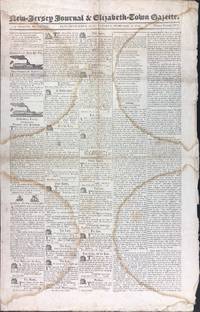
182541367Elizabethtown NJ: J. & E. Sanderson 1825. First edition. Self wrappers. A very good- copy with 4 large semi-circular dampstain marks throughout. Unpaged 4 pp. Illus. with b/w in-text drawings. 20 3/4 x 13 inches. Contents include: a full column on the Liberation of Peru led by General Sucre; the first meeting at the new seat of Government in Florida where the governor states "No part of North America is so little known.Visitors.had pronounced it a bank of sand not worth the money paid for it"; republished letters from Andrew Jackson John Quincy Adams and Henry Clay. This issue not at the American Antiquarian Society. Uncommon. J. & E. Sanderson unknown
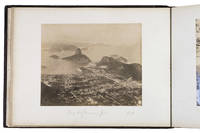
1885ABC_488551885. Contemporary gold-tooled dark purple quarter morocco brownish-purple pebble-grain cloth sides with a paper label "3" mounted on the front. Oblong ca. 38 x 27.5 cm. With 20 albumen prints 43 plates engraved and lithographed and 3 drawings. Remarkable album documenting the travels of HMS Calliope 1837-1883 a British warship in the first few years after her launch. The ship first sailed to Madeira and Tenerife after which she crossed the Atlantic Ocean to visit various harbour cities in Brazil Argentina Uruguay and Chile. Many of the illustrations and photographs include handwritten annotations about the ship's journey with the exact dates of when she arrived where. As such the album was likely compiled by someone who sailed on the ship during these years possibly a crew member. The album contains photographs drawings and plates relating to the places the Calliope visited between 1838-1840. It starts with photographs of Madeira and Tenerife like the Loo Rock in the harbour of Madeira locals carrying a tourist down the Pico Grande the town of Güímar in Tenerife and an age-old Dragon Tree. As the ship's next destination was Brazil the album contains a number of photographs and illustrations of Rio de Janeiro as well as a drawing of a picnic at the summit of the Corcovado. The Calliope then sailed to Buenos Aires and Santa Fe arriving in August 1838. This part of the album contains a drawing of a gaucho and 6 beautiful photographs by Samuel Boote 1844-1921 one of the most important photographers working in Argentina in the 19th century. His work shows the interior and exterior of the St. Felicitas Church in Santa Fe as well as daily life in this city. The ship then carried the British ambassador from Argentina to Montevideo arriving in June 1839 before continuing to Valparaíso. The final pages of the album contain a map of Montevideo views of Valparaíso and the mountains nearby and a drawing of a bridge.The plates in the album were taken from other works such as Journal of a voyage to Brazil 1824 by Maria Graham and A history of the Brazil 1821 by James Henderson. The photographs were taken in the 1880s which means the album must have been compiled several decades after this particular voyage of the Calliope. However as some of the annotations mention that a location looked different on the plate than when the Calliope arrived the album must have been compiled by a crew member.The Calliope sailed to China after the visit to Valparaíso to serve in the First Anglo-Chinese War 1839-1842. After she sailed to New Zealand and primarily operated in that region until she was converted into a floating chapel in 1855 and deconstructed in 1883. With the yellow bookseller's label of "A & N.C.S.Ld Stationery Dept. 105 Victoria St. S.W." mounted on the back pastedown. The leaves and plates are somewhat foxed likely lacking a plate or drawing on the recto of leaf 16. Otherwise in good condition. hardcover
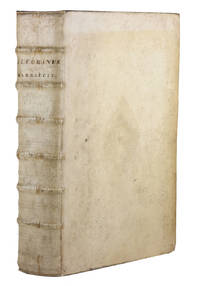
1698H4GD9LIIY5STPadova: Typographia Seminaria 1698. Blind-tooled vellum ca. 1800 reusing and retooling vellum from a slightly earlier blind-tooled binding sewn on 6 double cords each board with a large scrollwork centrepiece over traces of the old one in a panel design made of fillets and corner pieces with the title finely lettered in pen and ink in the 2nd of 7 compartments the old title still faintly visible underneath it and the old volume number VIII faintly visible in the 3rd compartment. Folio 35.5 x 25 cm. With 2 title pages 1 primary and 4 secondary divisional titles in volume 1 more than a dozen woodcut head- and tailpieces plus numerous repeats and dozens of woodcut decorated initials about 9 series plus numerous repeats. Set in roman italic and Arabic types 3 sizes of Arabic with incidental Greek and Hebrew. 2 volumes bound as 1. The first scholarly printed Quran prepared by the anti-Islamic Catholic Ludovico Marracci with a much more accurate Arabic text than any previously printed and the first accurate Latin translation also including extensive notes based on the Islamic commentaries as well as the editor's extensive "refutations" of each sutra. Each sura is given first in Arabic then in Latin translation followed by notes and then the refutation. The entire first volume of about 430 pages is taken up with preliminary matter including a 24-page life of Muhammad one of the first detailed biographies ever printed and again more accurate than its predecessors an 8-page profession of faith with the Arabic and Latin in parallel columns and additional commentaries and introductory matter. The fact that this edition was produced explicitly as an attempt to refute the views of Islam has naturally led Islamic scholars to dismiss it but both the Arabic text and the Latin translation were far better than any previously printed and had no serious rival until the Leipzig edition of 1834. The commentaries also made a great deal of Islamic scholarship available to a European audience for the first time and both the Arabic and the Latin text influenced nearly every edition for the next 150 years.With two bookplates and an occasional early manuscript note and a few letters or numbers inscribed in the foot margin of one leaf. With a tear running into the text of one leaf repaired but otherwise in very good condition. With generous margins. The boards are slightly bowed and there is a small tear repaired at the foot of the spine. A ground-breaking work of Quranic scholarship a valuable source for the study of the Quran and an essential source for European views of Islam.l Cat. Bibl. A.-R. Courbonne dont la vent . 1er février 1842 30 this copy; A. Hamilton Europe and the Arab world 34; Schnurrer 377; O. A. Sheikh Al-Shabab The place of Marraccis Latin translation of the Holy Quran: . in: Journal of King Saud University: language & tanslation 13 2001 pp. 57-74; USTC 1736471/1737617/1748538; not in Atabey; Blackmer; Philologia orientalis but cited in 225g 360a 380b 381c. Typographia Seminaria, hardcover
68-4810Paris France & Rome Italy: Societe Nouvelle Pathe Cinema 1961. 16.5 x 23 cm. B&W Photo. Very Good. [Paris, France & Rome, Italy: Societe Nouvelle Pathe Cinema, 1961?] unknown
73070Stockholm P. A. Norstedt & Söner 1921-41. 8:o. Sammanbundna i blåa kbd med något nötta kanter. Två volymer. Från Oscar Östergrens bibliotek med stämplar på främre omslagens insidor. I årsboken för 1929-30 återfinns en historik över Södra latin 1879-1929 unknown
260791828. On one side of 31 x 21 cm. A frail survival worn aged and with closed tears with the backing damaged and stained. Text clear and entire in Greek key border. Blind stamp of Cardinal Zurla at bottom left. Signed by 'J. Patr. Constantinop. Vicesgs.' and by the scribe who completed the printed document in manuscript. Somewhat crudely printed with Zurla's arms at the head. Headed: 'D. PLACIDUS ORDINIS S. BENEDICTI / CONGREGATIONIS CAMALDULENSIS / TITULI S. CRUCIS IN JERUSALEM S. R. E. PRESBYTER / CARDINALIS ZURLA / SSmi Domini Nostri PAPAE VICARIUS GENERALIS.’ The manuscript part of the document concerning 'sacred particles from the neck of Saint Theresa the Virgin reads: 'sacras particulas ex ossibus S. Teresiae Virg; quas ex authenticis locis extractas reverenter collo cavimus in thea ex aurichalco argento obducto ovalis figurae unico crystallo munita’. See scan. 1828. unknown
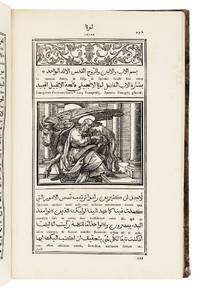
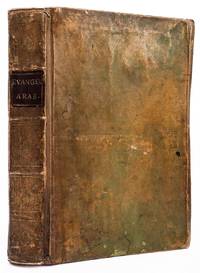
65425Romae Rome: In Typographia Medicea 1591. FIRST EDITION. Folio 32.25 x 21.25 cm. pp.9-4621 colophon. Full 18th-century marbled vellum spine with gilt rules gilt decoration and red morocco label. With 149 text woodcuts by Leonardo Parassole c.1570-c.1630 after Antonio Tempesta 1555-1630 their monograms appearing on a number of the illustrations. The woodcuts are remarkable examples of Tempesta's work notable for their clarity of composition and their didactic narrative of the episodes depicted. Old bibliographical remark in Latin to verso of final leaf. From a German private collection. Some partial browning due to paper stock and occasional light foxing generally a very handsome copy. First edition of the Gospels in Arabic and Latin - a landmark cultural encounter. In 1584 the last year of the papacy of Gregory XIII who had constantly endeavoured to effect a union between the Church of Rome and the eastern Christians Cardinal Ferdinando de' Medici the brother and later the successor of the Grand Duke of Tuscany founded a printing press in Rome with a vast selection of oriental types cut by the French typographer Robert Granjon. Run by a versatile orientalist Giovan Battista Raimondi the press had various aims. One was to produce propaganda which would attract the eastern Christians to Roman Catholicism. Another was to corner the publishing market in an area where typography was prohibited and to make a financial profit from the sale in the east of books printed in Arabic. The third aim was to further European knowledge and to provide good editions of Arabic versions of certain standard non-religious texts. These included the writings of Avicenna al-Idrisi's geographical compendium al-Tusi's adaptation of Euclid's text on geometry and various works on Arabic grammar and syntax. The first major publication was the 1591 edition of the Gospels. This copy has an interlinear Latin translation but the work was also issued solely in Arabic. It contains 149 fine woodcut illustrations made by Leonardo Parasole mainly after designs by one of the best known Florentine artists of his day Antonio Tempesta who owed much of his fame to the frescoes he painted in the Vatican and in a number of Roman palaces. The woodcut in the Gospel of St Mark of the presentation of the head of John the Baptist to Salome Mark 6:28 by a man in Turkish dress reminds us of the common association between the great enemy of Christendom in the sixteenth century and the ancient heathens. The Arabic text is printed in Robert Granjon's famous large fount generally considered the first satisfactory Arabic printing type; as all early printed editions of the Arabic Gospels it is based on the Alexandrian Vulgate cf. Darlow/M. 1636. The Latin version is by Leonardo Sionita. The work begins with page 9 without a title-page or any preliminary matter at all: "the intended prefatory matter was apparently never published" Darlow/M.; these first eight pages were not supplied until the 1619 re-issue. Brunet 1122-1123 Romae [Rome]: In Typographia Medicea, 1591. hardcover
63499Romae Rome: Ex Typographia Medicea 1619. Folio 33.5x21 cm. pp. 4 9-462 2 with at recto the printer's letter repeated with the date of the 1591 original edition blank at verso. Contemporary green vellum spine with raised bands and gilt-decorated compartments red Morocco label marbled endpapers edges dyed red. Title printed in red and black with Medici's woodcut coat-of-arms printer's advice "Typographus lectori". With 149 text woodcuts by Leonardo Parassole c.1570-c.1630 after Antonio Tempesta 1555-1630 their monograms appearing on a number of the illustrations. The woodcuts are remarkable examples of Tempesta's work notable for their clarity of composition and their didactic narrative of the episodes depicted. Ex libris Luigi Bossi Milan 1758-1835 with his engraved heraldic bookplate to front pastedown along with T. Fenteman & Sons Leeds booksellers label to upper corner. Title-page lightly browned boards faded and discoloured some occasional light toning generally a very good copy printed on thick paper the woodcuts in strong impressions throughout. Rare 1619 reissue or of the original 1591 stock of the Arabic Medicean Gospels. The text lines are almost identical with those of the Arabic issue but now have an interlinear Latin version added which was prepared by Antonius Sionita. In 1584 the last year of the papacy of Gregory XIII who had constantly endeavoured to effect a union between the Church of Rome and the eastern Christians Cardinal Ferdinando de' Medici the brother and later the successor of the Grand Duke of Tuscany founded a printing press in Rome with a vast selection of oriental types cut by the French typographer Robert Granjon. Run by a versatile orientalist Giovan Battista Raimondi the press had various aims. One was to produce propaganda which would attract the eastern Christians to Roman Catholicism. Another was to corner the publishing market in an area where typography was prohibited and to make a financial profit from the sale in the east of books printed in Arabic. The third aim was to further European knowledge and to provide good editions of Arabic versions of certain standard non-religious texts. These included the writings of Avicenna al-Idrisi's geographical compendium al-Tusi's adaptation of Euclid's text on geometry and various works on Arabic grammar and syntax. The first major publication was the 1591 edition of the Gospels. This copy has an interlinear Latin translation but the work was also issued solely in Arabic. It contains 149 fine woodcut illustrations made by Leonardo Parasole mainly after designs by one of the best known Florentine artists of his day Antonio Tempesta who owed much of his fame to the frescoes he painted in the Vatican and in a number of Roman palaces. The woodcut in the Gospel of St Mark of the presentation of the head of John the Baptist to Salome Mark 6:28 by a man in Turkish dress reminds us of the common association between the great enemy of Christendom in the sixteenth century and the ancient heathens. The Arabic text is printed in Robert Granjon's famous large fount generally considered the first satisfactory Arabic printing type; as all early printed editions of the Arabic Gospels it is based on the Alexandrian Vulgate cf. Darlow/M. 1636. The Latin version is by Leonardo Sionita. The work begins with page 9 without a title-page or any preliminary matter at all: "the intended prefatory matter was apparently never published" Darlow/M. Darlow & Moule 1637 & 1643; Schnurrer Bibliotheca arabica 318; Brunet II 1122-23; Graesse II 531 Romae [Rome]: Ex Typographia Medicea, 1619. hardcover
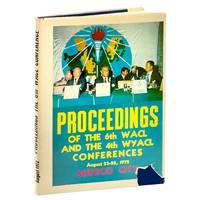
19727342Mexico City Mexico: WACL WYACL & FEMACO 1972. First Edition First Printing. Hardcover. pp. 216 30 unnumbered leaves of photographic plates. Small 4to. measuring 7.5" x 10.5". Bound in illustrated navy-blue cloth over boards with gilt lettering to the front board. Generously illustrated with dozens of chiefly black-and-white some colour photographic plates capturing conference proceedings and participants. Provides a comprehensive record of the conference proceedings organized by the Mexican affiliate of the World Anti-Communist League WACL namely the Federación Mexicana Anticomunista FEMACO comprising a detailed list of delegates from participating nations - including Australia Canada South Korea Hong Kong India Indonesia Japan Malaysia New Zealand the Philippines Thailand South Vietnam Jordan Lebanon Saudi Arabia Turkey Lesotho Liberia France the United Kingdom West Germany Italy Sweden the United States Guatemala El Salvador Costa Rica and Nicaragua - along with representatives holding observer and candidate status. Prefaced with messages of support from key anti-Communist leaders such as Chiang Kai-shek Ferdinand E. Marcos Park Chung-hee Leabua Jonathan and Nguy n V n Thi u. Outlines the detailed programme of events for the week-long milieu as well as printed texts of proposals studies deliberations and resolutions many of which include sharp criticisms of the Soviet Union the Peoples Republic of China their allied states and security apparatuses. A rare extant copy offering valuable insight into the operations and rhetoric of this unusual virulently anti-Communist and far-right Cold War organization later to be implicated in myriad allegations of wrongdoing. Light rubbing to the cloth extremities contents uniformly without blemish; near fine and housed in very good illustrated dustjacket showing small loss to the lower-right margin of the front panel and one short closed tear dustjacket now housed in protective mylar cover. Overall very good. Highly rare. Equally rare amongst institutional holdings. Corresponds to OCLC #123216394 which records only two holdings at time of cataloguing. Rare indeed. <br/><br/>¶ Founded in 1966 in Taipei Taiwan as a global coalition of right-wing groups opposing communism the WACL evolved from the Asian People's Anti-Communist League APACL. Supported and led by staunch anti-Communist figures such as Chiang Kai-shek Taiwan Park Chung-hee South Korea John K. Singlaub USA and Charles A. Willoughby USA the WACL backed authoritarian regimes paramilitary groups and anti-Communist insurgencies including the Nicaraguan Contras. It would subsequently face criticism for its ties to extremists former Nazis and death squads particularly in Latin America. At the close of Cold War in 1990 the organization would rebrand as the the World League for Freedom and Democracy WFLD. WACL, WYACL & FEMACO hardcover
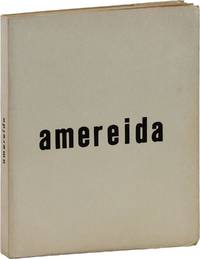
196787336Santiago: Editorial Cooperativa Lambda 1967. First Edition. Octavo 24cm. Coated card wrappers with French flaps; unpaginated 193pp; illus. Very light wear to covers; internally complete and clean but for a few faint pencil marginal markings by the previous owner the noted poet and translator Nathaniel Tarn. Near Fine. Text entirely in Spanish.<br /> <br /> A collaborative book-length work combining poetry and conceptual imagery; published anonymously but compiled and edited primarily by Chilean avant-garde poet Godofredo Iommi. "Amereida" a composite neologism for "American Aeneid" is a conceptual chronicle of a literal cross-country trek from Tierra del Fuego to Southern Bolivia undertaken in 1965 by a group of like-minded poets architects designers philosophers and artists including Iommi 1925-2001 the architect Alberto Cruz 1917-2013 sculptor Claudio Girola 1923-1994 French philosopher François Fédier 1935-2021 and numerous others. Many of the participants in this first "Travesia Amereida" had originally coalesced around the surrealist group in post-war Paris and were later responsible for modernizing the faculty and curriculum of the College of Architecture at the Universidad Católico de Valparaíso. In 1971 the group founded an intentional community the "Ciudad Abierta" "Open City" in Ritoque Chile some kilometers southwest of Valparaíso; the community is still in existence and the tradition of the "Travesias" continues with annual journeys through the South American wilderness that become stages for performance poetry readings and art installations. La Ciudad Abierta quoting the editorial introduction to the poem in the Oxford Book of Latin American Poetry ".is probably the only site in the world where architecture is conceived as an outgrowth of poetry" OBLAP p.362ff. The current volume nominally the community's founding document is notoriously scarce almost never encountered in commerce; OCLC locates only about a dozen holdings worldwide 8 in North America. Editorial Cooperativa Lambda unknown
5415LETTERS: 30 September 1977 and 3 July 1979 both on letterhead of Yale University Department of Classics; OFFPRINT from 'Harvard Studies in Classical Philology': Cambridge Massachusetts: Harvard University Press 1963. Both letters two pages quarto. LETTER ONE annotated in ink with some ink marks in the blank space beneath Goold's signature: Written at the point at which Goold was relinquishing the University College Latin Chair to return to Yale. 'I told you I should be visiting Yale this autumn; and now I have to tell you that I shall be going on to Stanford after Christmas till March. Still if I shan't have the pleasure of coming in occassionally to the bookshop it probably means that I shall be ordering more books from you!' Orders a couple of copies of Austin's 'Aeneid'. 'To my great delight classics are thriving at Yale as also at Harvard where I went to a party a week or so ago; I don't know whether this reflects a national trend quite likely not but I'm glad to be at a place where there are so many people taking classics courses that one hasn't to worry about being sacked because of the dearth of students.' Discusses his wife's job 'we see each other only at weekends' and 'the Marshalls' 'they very kindly met us at Boston airport & contributed much to our being able to settle down so well'. 'The printers of the Loeb Classical Library of which Goold was Chief Editor continue to make the most appalling mistakes. They bound the whole of my Manilius before discovering that they had printed ASTRONMICA rather than - NOMICA on the spine! The result is that the spine will now have a costly cover-up job done on it and another two months' delay. Absolutely infuriating. I can I suppose comfort myself with the thought that this is likely to be the best £3.90 worth in Latin studies - but I've shed as much of my blood on thhe book as I care.' Asks if Blackwell's want to stock his edition of Horace's odes. LETTER TWO with negligible coffee stain: Is sorry to learn that Quinton has 'been put on half-time'. 'But I gather reading between the lines that Blackwell's is not devoid of humanity and that some special i.e. better arrangement may be possible. And it may be congenial for you to work on second-hand books exclusively'. Speculates that there are enough copies of out of print classics books 'to enable one English bookseller to do a good trade'. Places an order for three works. 'I need hardly say that I look forward to a continuation of our personal contact & promise my undiminished interest in whatever you can come up with in the second-hand book line. Discusses the complicated publishing plans for the Harvard Servius. 'I don't expect any difficulty although I anticipate being pressured into cutting back on typographical excellence.' 'I get the impression that Britain's new government is proving more popular & successful than most thought possible. Contrariwise the oil crisis has hit America hard: the other day I had to wait 2 hours in a nearly mile-long queue of cars to get my tank filled'. Discusses car dependency and the cutting out of wasteful consumption. THE OFFPRINT is of eighteen pages octavo stapled into original grey printed wraps. Very good with a trace of rust to the staples. Front wrap inscribed to 'P. Q. with best wishes from G. P. G.' LETTERS: 30 September 1977 and 3 July 1979, both on letterhead of Yale University Department of Classics; OFFPRINT (from 'Harvar paperback
22075115-nnew. unknown
22075115like new. unknown
1333915349.Gpaperback. Good. Access codes and supplements are not guaranteed with used items. May be an ex-library book. paperback
1333902530.Gpaperback. Good. Access codes and supplements are not guaranteed with used items. May be an ex-library book. paperback
1333905041.Gpaperback. Good. Access codes and supplements are not guaranteed with used items. May be an ex-library book. paperback
1527883892.Gpaperback. Good. Access codes and supplements are not guaranteed with used items. May be an ex-library book. paperback
0282654658.Gpaperback. Good. Access codes and supplements are not guaranteed with used items. May be an ex-library book. paperback
1999biblio191<p>This copy has never been unsealed. Completely new. This book traces the history of Buena Vista an estate located in the southern foothills of Puerto Rico's central mountain range. Now a popular living history museum Buena Vista flourished in the nineteenth century—first as a farm that furnished food for the city of Ponce and surrounding plantations later as a producer of corn and cornmeal ground at the estate's water-powered mill and finally as a coffee plantation.</p><p>Photo on request.</p> UNC Press hardcover
1874110346Macmillan and Co. London. 1874. Macmillan and Co. London. 1874. First edition thus. Cathedral style binding with black morocco covered wooden boards. Gilt text to spine marbled endpapers all page edges gilt over red. xxiv 383 pages. Every page of text has an illustrated border 10 engraved plates on quality paper with captioned tissue-guards plus other plates and illustrations. A very attractive edition in a handsome binding. hardcover
1331931223.Gpaperback. Good. Access codes and supplements are not guaranteed with used items. May be an ex-library book. paperback
ST12778-0082South Germany or more probably Austria second half of the 12th century. 429 x 304 mm. 16 7/8 x 12". Double column 36 lines of text in a fine proto-gothic hand. <br/> ◆Text a bit faded on one side an upper corner slightly defective minor soiling and with the grain of the vellum apparent on verso but with the beautiful text entirely legible and the leaf as a whole quite pleasing.<br/> <br/> The hand here is memorable featuring wide upright letters that could not be more regular. Elected pope in 590 Gregory ca. 540-604 was one of the most influential pontiffs in the history of the Church. In addition to revising liturgical worship he wrote extensively on theology offering homespun wisdom rather than esoteric debates. He was declared a saint immediately upon his death. unknown
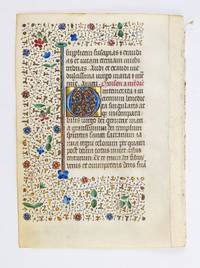
1475ST19653NNorthern France ca. 1475. 155 x 110 mm. 6 x 4 1/4". Single column 16 lines in a gothic book hand. <br/> Rubrics in dark pink ONE EXQUISITE FOUR-LINE INITIAL painted blue with white detailing filled with red and blue vines and leaves on a burnished gold ground with a painted and gilt bar border on one side each end capped with a flower the text surrounded on three sides with a border of acanthus leaves dense rinceaux colorful flowers gold ivy leaves and bezants. A couple negligible imperfections but IN VERY FINE CONDITION<br/> <br/> One of the most popular optional prayers in the 15th century Book of Hours "O Intemerata" "Oh immaculate virgin" is a brief supplication in which the Virgin is glorified for her purity as the "unspotted and forever blessed singular and incomparable Virgin Mary Mother of God." The present leaf is given special emphasis with the presence of a three-quarter rinceaux border surrounding the text and the opening of the prayer is marked by an especially pretty and finely detailed initial that glitters with burnished gold. The leaf is unusually beautiful precisely rendered and in very fine condition. unknown
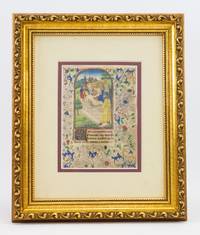
ST19540bSouthern Netherlands Bruges third quarter of 15th century. Matted leaf: 150 x 150 mm. 5 7/8 x 4 3/8". Frame: 307 x 258 mm. 12 x 10 1/4". Single column with four lines below the miniature and the obverse with 17 lines in a batarde hand. <br/> Attractively matted and framed the leaf slightly shifted in the mat revealing top and side edges but in no danger of damage. Rubrics in red four one-line initials and three three-line initials all but one in burnished gold on blue and red ground with white tracery the initial beneath the miniature painted pink on a burnished gold ground and filled with painted ivy vines AN ARCH-TOPPED LARGE MINIATURE DEPICTING THE ENTOMBMENT the body of Christ surrounded by seven other people depicted in an outdoor setting with the turrets of a walled city in the background the miniature in a double frame of gold and pink surrounded by A FULL BORDER composed of hairline vines acanthus colorful flowers and gilt bezants and inhabited by a small bird. Minor soiling and a faint thumb print to borders but IN VERY FINE CONDITION THE MINIATURE BEAUTIFULLY PRESERVED.<br/> <br/> This is a beautifully rendered and deeply touching scene depicting the entombment of the crucified Christ and the pathos experienced by those at his side. Holding the sheet on which the body is lowered into the sarcophagus are on the far left the richly clothed Joseph of Arimathea and on the far right Nicodemus who dons an especially lovely yellow garment with delicate embroidery. Between the two men in the foreground but behind the body are the Virgin Mary who presses the hand of her deceased son to her lips; John the Evangelist whose body is turned toward the Virgin in a gesture of support but whose gaze is focused on the Savior; and Mary Magdalene who holds a small ointment jar. Two other women with halos stand closely behind them consoling one another. The artist has done a masterful job at creating a composition that captures the emotional gravity of the scene: Christ's body gently cradled in a white sheet is on full display with blood still trickling from the wounds on his head and side. Despite there being seven people crowded around him our attention is drawn to the action between Christ and the Virgin who gently grasps his hand with motherly affection and bids him a final farewell. Flickers of different emotions appear on the faces of his followers including pity sorrow stoicism and disbelief--echoing perhaps the viewer's own range of feelings upon viewing this image. The level of detail excellence of composition care seen in the molded bodies and faces and the convincing setting suggest that the artist was quite practiced and that the original manuscript from which the leaf comes was of very high quality. unknown
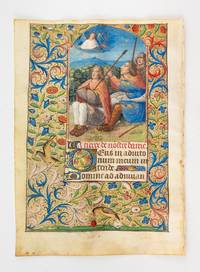
1500ST20810PParis ca. 1500. 165 x 117 mm. 6 1/2 x 4 5/8". Single column 18 lines in a gothic book hand. <br/> Rubrics in red line fillers in blue and pink with gold bezant five one-line initials in burnished gold on pink and blue ground one two-line initial in blue on gold ground with a flower in the center one three-line initial in blue filled with ivy on gold ground recto with panel border of colorful flowers vase and acanthus verso with A LARGE ARCH-TOPPED MINIATURE OF THE ANNUNCIATION TO THE SHEPHERDS surrounded by A FULL BORDER of acanthus flowers and two birds all on a painted gold ground. Slight soiling to vellum but a very well-preserved leaf in fine condition.<br/> <br/> From what was surely a costly Book of Hours this leaf features a charming and skillfully painted miniature of the Annunciation to the Shepherds attributable to the workshop of Jean Pichore fl. ca. 1502-20 a major figure among illuminators of the period and one of the most sought-after artists in France at the turn of the 16th century. Depicting the traditional subject associated with the hour of Terce our miniature portrays as usual an angel appearing to shepherds tending their flock bringing news of the birth of Christ. Although the biblical narrative suggests that the shepherds were startled by the angel's appearance the three figures in this miniature appear remarkably unmoved--in fact only one of them seems to take any notice at all. The first shepherd sits on the ground looking straight ahead; the second holds his hands in prayer but looks little more than well prayerful at the angel in the sky; and a third figure maintains a slightly aloof expression taking no particular interest in the unfolding miraculous event. What may seem to be indifference can be explained easily enough by the artist's successful portrayal of nighttime cold! All three shepherds are thickly dressed one with his arms pressed tightly against his chest another with a hood partly covering his face and the sheep are tightly huddled together into one woolly white cluster. Another manifestation of the artist's success here is seen in the particularly well done molding of the faces with subtle shading attractively rendered features and clear individuation. Moreover although the shepherds seem essentially unmoved their garments are dusted with a glistening gold radiance from above a further subtle touch revealing a high level of achievement on the part of the painter. Finally the borders are one last source of delight with a small bird shown in mid-flight and a second one investigating a single strawberry that seems to have been placed there just for him. All of these indications of sophistication suggest that the original manuscript must have been commissioned by a patron able to pay a premium for the work of a highly skilled atelier. unknown