47 résultats
155341084ABLyon, Jean de Tornes und Guilherme Gazeau 1553. Kl.-8° (13 x 8 cm). 735 S., [6] Bll. Späteres HPgmt mit rotem Rückenschild. Teils leicht stockfleckig, wenige Bll. braunfleckig.
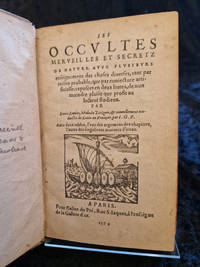
1574001927<p>Paris: pour Galliot du Pre 1574. 3rd Edition . Hardcover. Very Good. French translation from the 1st edition in Latin Occulta Naturae Miracula published 1559. 12mo collated as Title page with woodcut of viking ship pp2 pp213 plus 30 pages of alphabetical index to rear. Hardcover issued without dust jacket. Slightly later rebind of full leather with 5 raised bands and leather title label to spine and half of the "Gen de Paris" stamp to front cover. Binding in good condition with some rubbing to all edges and boards and a little chipping to top of back board. Inside except for the very odd mark all pages with all edges dyed red in excellent clean and bright condition with no foxing waterstains fingermarks etc. . For added interest the bookplate of Baron Hyacinthi Theodori dean of the Faculté de médecine de Paris circa 1720s is pasted to front pastedown. Levinus Lemnius was a celebrated Dutch physician whose medical writings were much translated. He studied under the famous Swiss botanist and bibliographer Konrad Gesner at the University of Louvain and under the famous Flemish anatomist Andreas Vesalius at the University of Padua. This Renaissance treatise on natural philosophy and medicine draws on classical sources particularly Aristotle with Lemnius being influenced by the "airs waters places" doctrine from the Hippocratic Corpus. This important work includes explanations of demonology somnambulism and the physical causes of mental illness the properties and healing virtues of herbs and gemstones alongside oddities like hermaphrodites. An superb copy of a very scarce early work with an interesting provenance. <br /><br /></p> pour Galliot du Pre hardcover
1574096271Excusum Londini: by Thomas Vautrollerius per assignationem Francisci Floræ 1574. STC 16427. A revised translation by Walter Haddon of the first prayer book of Edward VI.At foot of title: Cum priuilegio Regiæ Maiestatis. Calendar printed in red and black. Liber Psalmorum Davidis prophetae et regis. ." has separate title page with date 1574 on leaf 2A4r. In this issue leaf 2P3r lacks colophon. Another issue STC 16427 has colophon: Londini excudebat Thomas Vautrollerius. 1574. Book measures 6 x 4 inches. 28 299 leaves engraved title page. Bound in full leather. Professionally rebound not recently retaining most of the leather from the original or early top board calf light rubbed some loss of leather on corner of top board. Generally a very good clean firm binding. Internally small abrasion hole on margin of title page minor repair to inner margin of title page early annotaion in ink partially erased on verso of title some light browning to edges of about 10 pages. Pages in very good clean condition throughout. A very nice copy. Full Leather. Very Good. Small 8vo. by Thomas Vautrollerius] per assignationem Francisci Floræ Hardcover
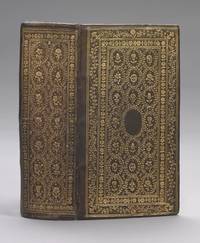
158608537Paris: A. L'Angelier 1586. CONTEMPORARY RICHLY GILT CALF DECORATED IN THE DUODO-STYLE WITH NINETEEN DIFFERENT TOOLS. The outer borders have three double-rules with olive branches trefoils curved rules and a floral roll between. Sewn with S fermés quatrefoils and open circles the central field has twenty ovals each with one of six small tools in it. A single compartment the flat spine presents the same decor but with additional tools its base and crown ruled on the bias; board edges ruled one slightly defective all edges gilt. THICK PAPER COPY. The binding by Clovis Ève adopts the design favored by the Venetian ambassador to Paris Pietro Duodo 1554-1611. The chic S fermé symbolizes love sage seul secret soucieux. Fresh inside and out one lower corner neatly restored.<br /> ¶Balsamo & Simonin A. L’Angelier 163; Delaveau & Hillard Bibles imprimées du XVe au XVIIIe siècle 3417; BnF Enrichissements 1961-1973 1974 1051; Brun Le Livre français illustré 130 & 278 “gravés très délicatementâ€.  For similar Duodo-style decor see Nixon’s Sixteenth-Century Gold-Tooled Bookbindings 59 and Esmerian’s Bibliothèque I 6.VI.1972 59-61 and Hobson & Culot’s Italian and French 16th-Century Bookbindings 68-9. A. L'Angelier unknown
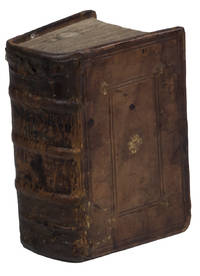
1587ABC_48453Antwerp: Christoffel Plantin 1587. Contemporary elaborately blind-tooled pigskin over bevelled wooden boards sewn on 4 double supports with the corresponding raised bands on the spine the manuscript title in the first compartment and the original manuscript shelf mark label "H.36" of the Monastery of Buxheim in the fifth compartment both boards with an ornamental roll and a roll with the portraits of Salvater sic! Maria S. Bruno and S. Johannes in a panel design two original brass clasps and catches ornamented with a small star leather tabs and six original bookmarkers plaited into a big knot. 8vo. With a woodcut vignette with Peter and Paul by Peeter van der Borcht on the title page 6 full-page woodcuts ca. 112 x 75 mm by Antoon van Leest after Peeter van der Borcht 6 half-page square woodcuts 55 x 55 mm in border one signed by Antoon van Leest one woodcut 90 x 76 mm by Antoon van Leest after Peeter van der Borcht and 2 smaller oval woodcuts. The work is printed in red and black. Plantin edition of the revised Roman Missal following the directives of the Council of Trent first published in Rome in 1570 by order of pope Pius V 1504-1572 and later approved by Clemens VIII 1536-1605 and Urbanus VIII 1568-1644. The work was quite popular as Plantin published a new missal nearly every year from 1571 onwards. All editions were printed in different sizes and in two issues one with woodcut illustrations and one with engravings. The present copy is the octavo edition with woodcut illustrations and comes from the library of the famous Carthusian monastery of Buxheim Maria Saal near Memmingen Bavaria.The monstery of Buxheim was founded in 1402 and dissolved after the secularisation in 1803. The rich library was auctioned in 1883 by Förster and in 1884 by Ludwig Rosenthal in Munich. The Museum of the Charterhouse Buxheim today is actively studying the history of the library and the present location of its books and manuscripts. The present copy is bound in contemporary pigskin which was likely bound for the monastery itself as the rolls depict Saint Bruno who was the founder of the Carthusian order. The Missal is therefore probably bound in a South-German bindery in the surroundings of the monastery.With an ownership annotation on the title page "Cartusiae Buxheim". The binding is somewhat rubbed and soiled. The leaves are lightly browned some of the leaves are slightly stained especially around the leather tabs. Otherwise in good condition.l Belg. Typ. 6335; Imhof Plantins 1574 Missale Romanum in octavo in: De Gulden Passer 73 1995 pp. 67-82; Nagler I 1459; USTC 406791; Voet 1701 A; Weale-Bohatta no. 1269; not in Haebler. Christoffel Plantin, hardcover
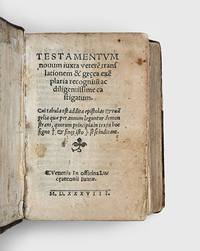
1564S1550Antwerp 1564. 16mo 11.2 x 7.2 cm. Christophe Plantin Contemporary blind- and gold-tooled calf each board with a doubler frame of blind double fillets with a small gold fleuron in the centre and a gold curl at each corner of the inner frame gilt and elaborately gauffered edges including floral decorations and six-pointed stars. With Plantins woodcut compasses device on both title pages "Labore et constantia" with woodcut decorated initials throughout the first work and 1 in the second. Hebrew and Greek types in 2nd work. 2 works in 1 volume the 1st in 2 parts. 316 68; 111 1 blank ll. Two complementary works printed by Plantin: a Latin New Testament and an alphabetical list of Hebrew Greek and Latin names of biblical people and places appearing together in a lovely binding with beautifully decorated edges. The New Testament opens with Saint Jerome's preface and his short introductions also accompany the different books. The order of the ecclesiastical year with the different readings is included at the end. The present New Testament appeared in a series of parts of the Bible Voet 682 I-VI & VI bis all in a 16mo format. The second work "must be considered to be the last volume of this edition" Voet I p. 352.Rebacked with the remnants of the original spine laid down slightly damaged with faint water stain on front board not affecting the book block. Minor corrosion spots only on the inside of the front board and in the margins of the first few leaves not affecting the text some very slight very light foxing throughout. A good copy of Plantins 16mo New Testament in a contemporary binding with extensively and beautifully decorated edges.l Ad 1: Belg. Typ. 443; Voet 682 VI and VI bis 8 copies. Ad 2: Belg. Typ. 443 and 1390; Voet 1750 2 copies. ABE CAT Bibles Sermons & Psalmbooks unknown
154049324Paris: F. Gryphius 1540. Two parts in one volume 16mo in 8s. 199 1 blank; 136 16 indexff. "Novvm testamentum" in cartouche vignette at title-page along with Gryphius' griffin device Renouard 413; 90 three-quarter page including repeats and 15 smaller woodcut illustrations including repeats; 21 historiated initials and woodcut lettrines; cartouche vignettes with book titles; printed marginalia; half-title for the second part Epistles and the Book of Revelation. Text not divided into verses; occasional quotations in Greek. Later vellum over boards; manuscript title at the spine faded; speckled paper endleaves; edges stained red. Light dampstain at bottom margins extending up into text and gutter at the later leaves; small puncture at leaf 140 resulting in slight loss of text. A good complete copy of a very scarce illustrated New Testament with clean woodcut illustrations throughout.<br /> <br /> Collation: a-z8 &8 Aa8 A-T7 blank leaf 200; lacks final blank T8.<br /> <br /> Third Gryphius New Testament in 16mo format. Arranged in two parts with the Epistles and the Book of Revelation presented separately it reproduces the Vulgate text edited by Robert I Estienne for his Latin Bible edition of 1532. While some of the woodcuts appear in Gryphius' complete octavo Bible of 1541 this separate Testament is even more lavishly illustrated. Based upon Mortimer's description of the 1541 Bible we can ascertain that at least some of the Apocalypse woodcuts in the present volume are based on Holbein while most of the other illustrations whose blocks had been completed by 1539 "are relatively independent of earlier sets" Mortimer.<br /> <br /> An important shift in Bible illustration occured in the Netherlands in the late 1520s as printers began to focus on copiously illustrated small format editions of the New Testament to better explain the text and assist private devotion. The subtitle in our volume "cum ad ueritatem historiae tum ad uenustatem singulari artificio expressis" with the truth of history as well as beauty expressed by a singular artifice is clearly suggestive of this shift. Adopting this new format François Gryphius became the "first Paris printer to illustrate a Bible in the Renaissance style" Johnson quoted in Mortimer. These illustrations first appeared in the Acts of the Apostles and the Book of Revelation in Gryphius' pocket New Testament edition of 1537 Novum Testamentum additis picturis in Acta Apost. et Apocalipsin quibus miracula et visiones exprimuntur The New Testament with added illustrations in the Acts of the Apostles and the Book of Revelation depicting miracles and visions. Subsequent editions would include an expanding suite of woodcuts and were published at Paris by Gryphius under the present title in 1539 1540 1541 and 1542; Antwerp editions appeared in 1542 and 1545. The suite of illustrations in the present work is identical in placement and inventory with the data cited by Mortimer for the 1541 edition 90 cuts by repetition of 58 blocks from the larger set and 15 cuts by repetition of 6 small blocks and confirmed by inspection of the digitized version of the 1541 edition at the Bibliothèque de la Ville de Lyon. The only notable differences in graphic materials between the two editions appears occasionally in the selection of woodcut initials; the later edition also has several more unset initials indicated by guide letters than appear in our 1540 edition. <br /> <br /> All editions are quite scarce with only a handful of copies of each surviving.<br /> <br /> Provenance and annotations: Old entries at paste-down and front endleaf of George Woodhouse with his note about prior provenance dated May 1875; E. Holwell noting "This curious edition published in A.D. 1540" References: Cf. Deleveau & Hillard Bibles imprimées Paris 1539 and 1542; Antwerp 1542; Le Long/Masch 2.3 1783 p.279 Paris ed. 1542; R. Mortimer French 16th Century Books no.70 ed. 1541 illustrating woodcuts on a3 recto and P3 recto as per our copy and no. 69 8vo Bible 1541. For a discussion of the development of the woodcut series in these Gryphius pocket bibles see: A.F. Johnson "Some French Bible illustrations" Gutenberg Jahrbuch 1935 p.190.<br /> <br /> Full title and imprint: Novvm testamentum illvstratum insignium simulacris cum ad ueritatem historiae tum ad uenustatem singulari artificio expressis. Excudebat Fran. Gryphius An. M.D.XL. Cum priuelegio Regio.<br /> <br /> Typeface: Gryphius's own Brevier Roman or Petite-Text with scattered Greek. U. Aberdeen note via OCLC. F. Gryphius unknown
154447206ABStraßburg, Rihel 1544. 8°. [8] Bl. (das 5. leer), 281 Bl. (das 3. leer), [17] Bl. Schweinsleder der Zeit mit reicher Prägung. Einband etwas altersfleckig und geringf. bestoßen, Schließen fehlen. Anstreichungen und Marginalien (alt) von verschiedenen Händen. Bl. 137v mit kl. Federzeichnung. Titel und wenige Folgeblätter mit Wasserrand, Titel am Kopf auch mit etwas Papierverlust. Bogen ss und MM mit Wasserrand (MM auch minimal sporfleckig), sonst nur stellenweise leicht im Bug oder Kopfsteg wasserrandig. Bl. 158 im Kopfsteg mit kl. Einriß, Bl. NN2 mit druckbedingtem Einriß (kein Textverlust).
154641473ABVenedig, Aldi Filio 1546. 8°. 179, 136, [recte 137, 1], 56, 45, [3] Bl. (davon das mittlere leer). Pergament der Zeit mit hs. Rückentitel. Vorsätze neu. Teils leicht sporfleckig, durchgehend schwacher Wasserrand bzw. leicht gebräunt. Der Kopfsteg schräg beschnitten. Die ersten 14 Lagen mit Fehlstelle (wohl Tierfraß) im unbedruckten Fußsteg. Das letzte Blatt des 1. Teils mit Fehlstelle im weißen Rand. Ein Teil mit kl. Eckergänzungen im weißen Rand. Leichter 'Keller'-Geruch.
15703029FBVenetiis [Venedig], apud Hieronymum Scotum [Girolamo Scotto], 1570 [1569]. 8°. 16 x 11 cm. 156 Blatt. Pergamentband der Zeit mit Lederschleifenverschluss. [4 Warenabbildungen]
1593371924London: Excudebant G. Bishop R. Newbery & R. Barker 1593. Six parts in one. Text printed in verse form double column references and notes in margins. 81771 blankpp; 31041 blank leaves; 3 75 i.e. 73 leaves; 6 numbered 1-12pp 13-129 leaves 1 blank; 3 4-74 leaves; 3 198 leaves. With additional blanks bound in at the front and rear. 1 vols. Folio. Eighteenth century reverse calf covers blocked in blind red morocco lettering piece repairs to joints minor loss at head of spine. Repairs at hinges scattered minor paper repairs. Provenance: Peckham Williams armorial bookplate; General Theological Seminary bookplate. Six parts in one. Text printed in verse form double column references and notes in margins. 81771 blankpp; 31041 blank leaves; 3 75 i.e. 73 leaves; 6 numbered 1-12pp 13-129 leaves 1 blank; 3 4-74 leaves; 3 198 leaves. With additional blanks bound in at the front and rear. 1 vols. Folio. The third edition of the Latin Bible printed in England in this case printing Tremellius and Junius's version of the Old Testament with Beza's translation of the New Testament accompanied by Tremellius's version based on the edition printed in Geneva in 1590 see D&M 6182. Texts printed in double columns. The complete text was printed in six parts each with a divisional title and independent pagination or foliation. The fifth part Junius's translation of The Apocrypha was never bound into this copy. A variant of this edition with the imprint for "Guliel. N." i.e. William Norton appeared the same year. ESTC S106974; STC 2061.5; Darlow & Moule 6185; BM 1. b. 12; Copinger 534 Excudebant G. B[ishop] R. N[ewbery] & R. B[arker] unknown
1558303259Lugduni: Apud Haered. Seb. Gryphi 1558. 478 p.; 333 1 16 pp. 108 woodcut vignettes by repetition of 78 blocks by Jacques Le Fevre. Printer's griffin device on title-page. 2 vols. 16mo. 19th-century polished calf; joints starting spine of first volume chafed; vol. I title soiled worn and remargined at gutter some toning and soiling to text throughout. 478 p.; 333 1 16 pp. 108 woodcut vignettes by repetition of 78 blocks by Jacques Le Fevre. Printer's griffin device on title-page. 2 vols. 16mo. Published by Sebastian Gryphius a German bookseller and printer who settled in Lyon in the 1520s. Described by Febvre and Martin as the "Prince of the Lyon book trade" in the 1540s he supported local humanist culture and used the italic type developed by Aldus Manutius to print compact beautiful books.<br /> <br /> A famous illustrated New Testament important "chiefly because of its influence on Bernard Salomon's New Testament cuts". Baudrier VIII 290; Mortimer French 16th Century Books 90 edition of 1560; OCLC: 551931968 locates one copy Apud Haered. Seb. Gryphi unknown
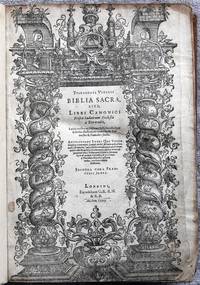
15934599Londini: Excudebant G. Bishop R. Newbery & R. Barker An. Dom. 1593. 1593. 1593 Folio. Collates para4A-P6 2A-2S6 3A-3M6 3N4 4A-4V6 4X4 5A-5L6 5M8 A-2K6 2L4. In six parts each with divisional title page and separate pagination or foliation. The title pages to the Old Testament read "Bibliorum pars secunda -tertia quarta ." and "Libri apocryphi sive appendix Testamenti Veteris .". The divisional titles to part 4 and the Apocrypha are dated 1592. That to the New Testament reads "D.N. Jesu Christi Testamentum Novum ." and bears the imprint "Londini excudebant reg. typograph. Anno salutis humanæ 1592.". Tremellius's and Be`ze's versions of the New Testament are printed in parallel columns. P6 2S6 4X4 and 2L4 are blank. Bound in modern tan goatskin with handmade paper endpapers. Old endpapers preserved. Titlepage laid down with minor loss at lower corner. Some wear to lower blank corners at both ends of the volume evidence of its having been disbound fora considerable time. Occasional unobtrusive ink marka and a few other signs of use but the contents generally clean and crisp. A very good copy. STC 2061.5. Londini: Excudebant G. B[ishop] R. N[ewbery] & R. B[arker], An. Dom. 1593. unknown
1538165636Venice: by the heirs of Lucantonio Giunti 1538. A miniature edition of the New Testament in the Vulgate from the celebrated Giunta workshop. The printing was begun by Lucantonio Giunta but completed after his death. This is the only book listing both his name and his heirs in the imprint Camerini. Sextodecimo in half sheets 110 x 71 mm. 1-35 A-Z Aa-Bb maltese cross-2maltese cross ; 496 of 497 leaves bound without terminal blank. Contemporary calf covers blocked in bind with cross centrepiece. Spine backing partly lost exposing cords and manuscript backing title browned and contents toned very slight staining towards rear. Still a very good copy. Paolo Camerini Annali dei Giunti 416. unknown
152966850Lyons: Per Johanem Crespin 1529. BIBLE IN LATIN. Lyons: Per Johanem Crespin 1529.<br> <br> Second Crespin edition reprinted from the 1527 edition. Folio 13 15/16 x 10 inches; 354 x 252 mm. 304 leaves 18 CCLXVIII 18 leaves. Complete with final blank leaf. Gothic type. Text in double columns within rule borders. Title printed in red and black with small woodcut of St. Jerome repeated three times in the text with Jerome's prefaces within a four-part woodcut border showing God the Father and two angels in a tympanum the six days of Creation and the Last Supper. Large six-part Creation woodcut at the beginning of Genesis half-page woodcut of King Solomon at the beginning of Proverbs full-page Nativity woodcut at the beginning of the New Testament and 121 small text woodcuts including twenty-three repetitions: ninety-one Old Testament woodcuts within strip borders including eight repetitions and thirty New Testament woodcuts without borders including fifteen repetitions. Decorative woodcut initials. The Eusebian canons leaves D1-D3 are printed in red and black in a red architectural framework.<br> <br> Contemporary pigskin over wooden boards roll-tooled in blind to a panel design. Lacking clasps. Original index tabs. Binding worn with some loss of pigskin on upper corner of front cover. Title soiled lower margin of first few leaves wormed and frayed with some loss to woodcut title border a few short marginal tears some mostly marginal dampstaining minor worming to lower inner margins a few inkstains slight discoloration throughout. Despite these minor flaws this is a beautiful example of a French woodcut Bible completely unsophisticated. Contemporary ink inscription on back pastedown dated 1534 contemporary ink inscription on the recto of D4 beneath the Nativity cut eighteenth- or nineteenth-century inscription on title: B.V. Maria in Fürstenfeld. Some early underlining and coloring of woodcuts in red. A few early ink marginalia. Housed in a custom quarter brown morocco clamshell case.<br> <br> The illustrations follow the schema of the Sacon Bibles printed in Lyons in 1518 and 1521. Crespin's blocks with the exception of the Creation are close copies of those used in Jacques and Jean Mareschal's Lyons Bibles of 1523-1541 as is the layout of the text within ruled columns. The borders for the Old Testament blocks include a strip with the initials "PBA."<br> <br> Fairfax Murray French 36. Harvard French 66. Not in Brunet Rothschild Darlow and Moule.<br> <br> HBS 66850.<br> <br> $9500. Per Johanem Crespin unknown
160035401ABFrankfurt, Spiess 1600. 2. Auflage. 8°. [26] Bll., 603, [1] S. Pgmt der Zt mit hs. Rückentitel. 1 Bl. mit geringf. Randeinriß, Titel mit 2 kl. Papierfehlern (Rasuren?), dort minimaler Buchstabenverlust. Teils etwas gebräunt (blaßer Wasserrand), wenige Anmerkungen von alter Hd. [3 Warenabbildungen] 2
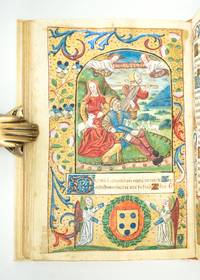
1516ST20620Northern France late 15th or early 16th century. 176 x 128 mm. 7 x 5". Single column 23 lines in a neat batârde hand. i blank 101 ii blank leaves. Lacking one leaf after f. 87 possibly containing a miniature otherwise complete. Contents: Calendar f. 1r; Gospel Lessons f. 7r; Passion according to John f. 10v; Hours of the Virgin f. 15v; Penitential Psalms and Litany f. 45r; Office of the Dead f. 54v; Hours of the Cross f. 68v; Hours of the Holy Spirit f. 70v; Prayers to the Trinity St. Veronica "Obsecro Te" "O Intemerata" and "Stabat Mater" f. 72v; Suffrages f. 79r; Prayers in French to be said on various occasions f. 86v; verse prayer in French beginning "Royne des cieulx glorieuse" f. 90r; additional prayers in French and Latin f. 93v. <br/> Attractive 19th century vellum with lacy gilt border raised bands ruled in gilt gilt lettering tan silk endleaves all edges gilt. Housed in a felt-lined reddish-brown pebbled morocco clamshell box with gilt lettering on spine. Rubrics in red numerous one- and two-line initials in painted gold on burgundy or blue ground WITH 27 SMALL MINIATURES one miniature of Christ Carrying the Cross measuring 60 x 68 mm. the rest depicting saints and measuring between eight and nine lines each surrounded by a full border of acanthus flowers and small dots on bare or painted vellum and 14 LARGE MINIATURES EACH OPENING WITH A FULL BORDER either with acanthus and flowers as before or architectural some borders embellished with figures animals or hybrids two with a small scene in the lower margin and about a dozen with the added coats of arms and/or mottos of Jean Boutin. The subjects of the large miniatures include the following: St. John of Patmos f. 7r; Annunciation f. 15v; Visitation f. 23r; Nativity f. 27v; Annunciation to the Shepherds f. 29v; Adoration of the Magi f. 31v; Presentation in the Temple f. 33v; Flight into Egypt f. 35v; Death of the Virgin f. 38v; Bathsheba bathing f. 45r; Funeral Mass f. 54v; Crucifixion f. 68v; Pentecost f .70v; Trinity f. 72v. See: Fairfax-Murray "French" p. 265-266. Vellum binding soiled but perfectly sound. Small portions of some border figures and perhaps three or four miniatures touched up in the 16th century see below occasional chipping to white paint small hole in the border of ff. 11 & 29 light scattered spotting fading thumb soiling and other minor issues but an attractive and substantially complete manuscript the illumination extensive and mostly well preserved.<br/> <br/> This heavily illustrated Book of Hours is a lovely example of provincial illumination; it calls attention in an interesting way to the influence of printed books on manuscript art; and it contains intriguing traces of an early prominent owner. Our manuscript contains a total of 41 large and small miniatures by a skilled artist who clearly had some training and familiarity with the prevailing styles of the time. The overall appearance of the work suggests the artist or workshop was located in Northern France and although the figures and backgrounds are indicative of a provincial hand the rich colors profuse use of liquid gold and sumptuous borders are unmistakable marks of luxury. The image of the Trinity is particularly lovely demanding the viewer's attention with God the Father's piercing gaze and conveying the majesty of the subject with a patterned throne set against a starry sky. Of special interest here are the compositions of the large miniatures many of which seem to have been copied from printed Books of Hours of the period. When we talk about the transition from manuscripts to print culture in the late-15th and 16th centuries the discussion often focuses on how the art of manuscripts influenced the appearance of printed works. There is no better example than Books of Hours which in printed editions often mimic the look of their manuscript predecessors in appearance and the way many were finished by hand. However as the present example demonstrates the opposite was also true as printed works inevitably made their way into the hands of manuscript artists. Some even worked simultaneously both as illustrators for publishers working with metal- and woodcuts and as manuscript painters. As a reflection of this point in the present work we find distinct similarities between our miniatures and a series of metalcuts used by Philippe Pigouchet for the publisher Simon Vostre beginning in 1496 Fairfax-Murray's set 2. According to Fairfax-Murray "These cuts . . . were evidently very favourably received by Pigouchet's rivals and imitators for one finds several close copies and adaptations in the various productions of other presses" including a very close imitation of woodcut images commissioned by the publisher Antoine Vérard. Evidently the popularity of these plates extended to manuscript artists and it is fascinating to see the adaptation of each composition to suit the painter's own style and the patron's needs. Most of the compositions in our manuscript are essentially simplified versions of the printed miniatures retaining the central figures their gestures garments and props but with complex backgrounds eschewed as are extra figures deemed unnecessary to fulfill the narrative. The resulting miniatures are far less busy than their printed counterparts allowing the viewer to focus on the central story. In a few instances the artist has added small scenes beneath the large miniatures. An example on f. 35 depicts the so-called "Miracle of the Wheat" featuring harvesters misleading Herod's soldiers by truthfully saying that the fleeing Holy Family passed by when their now miraculously matured crop was just being sown. This kind of inclusion may have been influenced by the copious small metalcut scenes that decorate the borders of numerous printed Books of Hours of this period. The text here follows a fairly typical structure but includes prayers in French to be said for each day of the week and on various occasions such as when one awakens or when one leaves a house. Also in French are additional verses to the Virgin--one of which is credited to the Franciscan preacher Jean Tisserand d. 1497 who founded an order for repentant women. Another accessory prayer included here f. 98 appeared in both prayer books and conjuring manuals of the period straddling the line between religion and popular magic. Based on an apocryphal encounter between Pope Leo III and Charlemagne during the Battle of Roncevaux this prayer was often used as a protective amulet against all manner of evil; here it is said to "conquer demons and one's enemies." Although we do not know for whom this manuscript was originally made the book shows a number of marginal customizations in the form of different coats of arms the motto "Soit avenu" "Let it come to pass" and the name of Jean Boutin written on ff. 23 and 35. This owner could have been Jean Boutin Sieur de la Court et de Chamballan and Mayor of Nantes from 1575-76. In addition to the marginal customizations the manuscript may possibly have some very neat replenishing of white facial paint in a handful of marginal figures and perhaps in a very small number of the miniatures. Using magnification and strong light we are unable to find convincing evidence that this retouching took place at least in the miniatures and if it was we think it was done quite early perhaps in the 16th century. Worst case it would necessarily be termed subtle and skillful enough to cause uncertainty now and whatever the verdict is in this respect the manuscript remains very fresh and attractive features attractively executed paintings is complete but for one leaf and would provide ample room for additional research. unknown