1 201 résultats
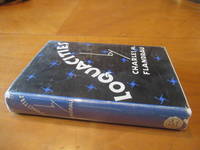
1931032535New York: D. Appleton and Company 1931. 1st Edition 1st Printing. Blue Cloth. Near Fine/Very Good. 232 Pp. Blue Cloth Cover And Spine Labels Printed In Green. First Printing "1" On Last Page Of Text. Humorous Travel Writing. Book With Touch Of Wear At Corners Some Aging To Spine Label Cover Label Bright. Ownership Signature Of Fellow Travel Writer Emil Heikel Dated "'31" And With A Small 1931 Christmas Seal. Dj With Light Edge Wear And Small Losses At Corners. <br/> <br/> D. Appleton and Company hardcover
68-731920th Century Latin American Publisher ca. 1960. Autographed B&W post card 14 x 8.5 cm. Very Good. Text in Spanish [20th Century Latin American Publisher, ca. 1960?] unknown
1976ZB393682Athens 1976-1984. numbers 1-17 an uninterrupted run in original paper wrappers minor ownership markings overall very good; sold as a lot only. - If you are reading this this item is actually physically in our stock and ready for shipment once ordered. We are not bookjackers. Buyer is responsible for any additional duties taxes or fees required by recipient's country. Photos available upon request. Athens unknown
2010biblio1172 volumes. 453 pages including bibliography; 657 pages including bibliography. Octavos 8 3/4" x 6" bound in original stiff wrappers. First editions. <br /><br />The College of Mexico was founded in 1940 by Alfonso Reyes and Daniel Cosio Villegas who led a group of Mexican intellectuals and Spaniards who had found refuge in Mexico after leaving their country due to civil war. Today to fulfill its 70th anniversary the institution confirms its original commitment: to contribute to Mexico's development through the training of experts in social sciences and humanites and performing rigorous and purposeful research to further contribute to the solution of national problems. Contents Volume 1: "<i>Introducción general" </i>by BrÃgida GarcÃa and Manuel Ordorica; "L<i>as proyecciones de la población hasta la mitad del siglo XXI</i>" by Manuel Ordorica; "<i>Envejecimiento demográfico</i>" by Roberto Ham Chande; "<i>Evolución de la mortalidad: pasado presente y futuro</i>" by Alejandro Mina Valdés; "<i>DesafÃos de la atención a la salud</i>" by Rosario Cárdenas; "<i>El VIH/sida: un nuevo reto para la salud pública</i>" by Fátima Juárez y Cecilia Gayet; "<i>Hacia un nuevo modelo de nupcialidad"</i> by Julieta Quilodrán; "<i>Salud reproductiva y desigualdades en la población</i>" by Ivonne Szasz y Susana Lerner; "<i>La construcción de la titularidad para el ejercicio de los derechos reproductivos</i>" by Juan Guillermo Figueroa Perea; "<i>Hombres y reproducción</i>" by Olga Rojas; "<i>Migración interna" by Virgilio Partida Bush; "Población económicamente activa: evolución y perspectivas" by BrÃgida GarcÃa Guzmán; "Evolución de la población que labora en actividades agropecuarias en términos sociodemográficos</i>" by Edith Pacheco Gómez; "<i>PolÃticas de población: viejos y nuevos desafÃos</i>". <br /><br />Volume II Contents: "<i>Introducción general</i>" by Gustavo Garza and Martha Schteingart; "<i>Le transformación urbana de México 1970-2020</i>" by Gustavo Garza; "<i>Evolución de las desigualdades regionales 1960-2020</i>" by Carlos Vilalta; "<i>Ciclio económicos y competitividad de las ciudades" by Jaime Sobrino; "Las metrópolis mexicanas: comceptualización gestión y agenda de polÃticas</i>" by MarÃa Eugenia Negrete Salas; "<i>La pobreza em México y en sus principales ciudades</i>" by Araceli Damián; "<i>Estructura de las ciudades de la frontera norte</i>" by Tito AlegrÃa; "<i>El sistema carretero como articulador de las ciudades</i>" by Luis Chias Héctor Reséndiz and Juan Carlos GarcÃa Palomares; "<i>División social del espacio y segregación en la ciudad de México. Continuidad y cambios en las últimas décadas</i>" by Martha Schteingart; "<i>El espacio público en la ciudad de México. De las teorÃas a las prácticas</i>" by Emilio Duhau y Ãngela Giglia; "<i>Escenarios metropolitanos de la movilidad cotidana" by ValentÃn Ibarra; "Dos sistemas de movilidad cotidana en la ciudad de México: domicilio-escuela y domicilio-trabajo</i>" by Clara Eugenia Salazar Cruz; "<i>Evolución recente y situación actual del derecho a la vivienda</i>" by René Coulomb; "<i>La hechura jurÃdica de la urbanización. Notas para la historia reciente del derecho urbanÃstico</i>" by Antonio Azuela; "<i>La participación ciudana</i>" by Christina Sánchez Mejorada Fernández <br /><br /><b>Condition: <br /></b><br />Volume 1 slightly bumped on spine and edges cover slightly detached from heel of spine otherwise at very good set. Colegio de México, A.C. paperback
2004A0801364 pages with maps and bibliography. Royal octavo 9" x 6 1/4" bound in original wrappers. First edition limited to 1000 copies.<br /><br />After hearing about the fall of the Aztec Empire cazonci Tangáxuan II sent emissaries to the Spanish victors. A few Spaniards went with them to Tzintzuntzan where they were presented to the ruler and gifts were exchanged. They returned with samples of gold and Cortés' interest in the Tarascan state was awakened. In 1522 a Spanish force under the leadership of Cristobal de Olid was sent into Tarascan territory and arrived at Tzintzuntzan within days. The Tarascan army numbered many thousands perhaps as many as 100000 but at the crucial moment they chose not to fight. Tangáxuan submitted to the Spanish administration but for his cooperation was allowed a large degree of autonomy. This resulted in a strange arrangement where both Cortés and Tangáxuan considered themselves rulers of Michoacán for the following years: the population of the area paid tribute to them both. When the Spanish found out that Tangáxuan was still de facto ruler of his empire but only supplied the Spanish with a small part of the resources extracted from the population they sent the ruthless conquistador Nuño de Guzmán who allied himself with a Tarascan noble Don Pedro Panza Cuinierángari and the cazonci was executed. A period of violence and turbulence began. During the next decades Tarascan puppet rulers were installed by the Spanish government but when Nuño de Guzman had been disgraced and recalled to Spain Bishop Vasco de Quiroga was sent to the area to clean up. He rapidly gained the respect and friendship of the natives who ceased hostilities towards the Spanish hegemony.<br /><br />Condition:<br /><br /> Light edge wear else a near fine copy. Universidad Nacional Autonoma de Mexico (UNAM) paperback
38893London: Arthur Humphreys 1919. . 8vo. pp.xxxii275 uncut quarter cloth with printed paper label to spine blue paper-covered boards t.e.g.; slight partial sunning to boards light rubbing to boards with light creasing and wear to paper covering at corners else a very good copy. No dust-jacket. London: Arthur Humphreys, 1919. hardcover
0483145793.Gpaperback. Good. Access codes and supplements are not guaranteed with used items. May be an ex-library book. paperback
0243970404.Gpaperback. Good. Access codes and supplements are not guaranteed with used items. May be an ex-library book. paperback
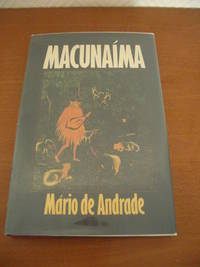
1984000151Random House 1984. 1ère Édition . Couverture rigide. Très bon/Comme neuf. DJ has a mylar protector with no adhesive applied so that the jacket is as new except for barely visible rub marks on the bottom foredge corners; the book is also as new except for a discrete remainder mark in red on top edges flush with the head of spine. Tightness of binding indicates it probably is an unread copy.This copy is hard to find in such fine condition; highly collectible. Translated from the Brazilian Portuguese to English by E.A. Goodland. <br/> <br/> Random House unknown
928081012X.Gpaperback. Good. Access codes and supplements are not guaranteed with used items. May be an ex-library book. paperback
1333902530.Gpaperback. Good. Access codes and supplements are not guaranteed with used items. May be an ex-library book. paperback
1333905041.Gpaperback. Good. Access codes and supplements are not guaranteed with used items. May be an ex-library book. paperback
1755CA0114<p>24531 pages with engraved allegorical frontispiece and index. Small folio 11 1/2" x 8 1/2" bound in original full leather with raised spine bands and decorative gilt lettering. Palau 266572. Sabin 70785 First edition.<br /><br />Full of original documents respecting the establishment of the Church in the Indies and the protection of the Indians together with all the bulls referred to from that of Alexander VI to the time of publication. With the additional 24 preliminary leaves not in all printings.<br /><br />The ancestors of Rivadeneira on both sides had served the Crown for centuries in the Reconquista in high positions of Church and State and in the conquests of Mexico and the Darién. Among his relatives is the Marquis de Moncada lieutenant colonel of the Puebla Regiment. Rivadeneira received a bachelor's degree in Philosophy and Law from the University of Mexico. He obtained a scholarship at the Colegio Mayor de Todos Santos on November 11 1731 served in various positions competed for the Chair of Institutes and remained in residence until 1746. The Audiencia de México approved him to practice as a lawyer in 1733. While still in Todos Santos Rivadeneira began serving in various positions. He was an advisor to the mayors of the city and town of Carrión in Valle Atrisco. The interim viceroy-archbishop Juan de Bizarrón appointed him a lawyer for the poor of the Courtroom of the Audiencia in 1739 with similar capacity in the Tribunal del Santo Oficio the city of Puebla and the Agustino Convent of Mexico. In 1744 Rivadeneira became fiscal agent of the room of the Crime. He served as an advisor to the viceroy Duke of the Conquest and was commissioned to settle a dispute over land by his successor the Count of Fuenclara. In 1746 Rivadeneira decided to go to Spain for family businesses and to secure a position. For a payment of 13000 pesos he obtained the appointment as supernumerary judge of the Audiencia de Guadalajara by decree of January 30 and title of February 20 1748. Without occupying this position he obtained the criminal prosecution of the Audiencia de Mexico on December 22 of 1753. He obtained a license to sail to New Spain with the servants José Ostos of Écija; Diego Ibiricu from Cádiz; Antonio de la Cruz from Zacatecas and Manuel Tagle a "free black". Rivadeneira returned to New Spain in 1755 in the same vessel in which the new viceroy Marquis de las Amarillas went and assumed his post on October 30 1755. As a prosecutor he opposed the activities of the Tribunal de Acordada. Assigned to the civil prosecutor's office to replace Luis de Mosquera and Aranda by consultation of April 28 and title of June 21 1760 the following year by consultation of May 14 and title of August 15 was appointed to replace the deceased Francisco López Adán as judge of the Audiencia. He served until his death. While he was an oidor he was denounced for possessing forbidden books. While in Spain in 1752 Rivadeneira published <em>El Pasatiempo for the use of Ex.mo Señor Carvajal and Lancaster a history of the world from creation to Fernando VI</em> in three volumes. This long didactic and religious poem was an effort to obtain a position and Beristain perhaps not knowing of the payment of 13000 pesos by Rivadeneira considered his first appointment of audience due to the sponsorship of José de Carvajal. As a prosecutor in 1755 Rivadeneira wrote the <em>Handbook compendium of the Indian Board of Trustees</em> which traced the royal patronage to the Book of Genesis an achievement for which the Crown gave him 4000 pesos. He also wrote the <em>Defense of Royal Jurisdiction</em> in 1763 <em>the remarkable newspaper of His Excellency Marquise de las Amarillas</em> and the draft of the protest sent to Spain by the City Council of Mexico City in 1771 on a claim of appointments for Americans.<br /><br /><strong>Condition:</strong><br /><br />Missing some of spine label small crack along the heal font hinge spine ends chipped light rubbing to extremities with the corners rubbed through internally very nice over all a very good copy.</p> Antonio Marín hardcover
1952004317Buenos Aires Argentina: Ediciones del Ministerio de Agricultura y Ganaderia 1952. Vol 1 - 254pp plus approx 50pp of color charts. Vol 2 Folio size approx 25 multi-color maps. Both clean and in very good or better condition. . 2nd Edition. Trade Paperback. Very Good/No Jacket - Wraps. 4to - over 9¾" - 12" tall. Ediciones del Ministerio de Agricultura y Ganaderia paperback
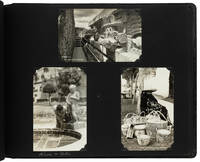
1930205481930. Early twentieth century travel photo album compiled by "Jake"documents the working life and global mobility of a merchant ship crewman during the 1930s and 1940s with sustained visual attention to port cities across Africa the Americas and the United States. The album supports research into maritime labor informal American commercial presence abroad and everyday interactions between traveling workers and local populations under late colonial conditions. Photographs taken in Beira and Dondo in Mozambique and Angola Durban and Cape Town in South Africa and Accra in the Gold Coast record encounters shaped by European colonial infrastructures and tourist economies including images captioned "Typical Ricksha Boy" depicting South African rickshaw pullers in elaborate headdress and dress and scenes of women in Accra balancing baskets and trays of food. Additional captions such as "Sam and his 'girls'" showing uniformed workers marked "Sea View Hotel" and "me and my gals" portraying informal social contact provide direct evidence of how American maritime workers framed and recorded relationships with local communities. The album further situates this mobility within a broader circuit including the Panama Canal Mexico City and Vera Cruz and U.S. port cities such as Galveston New York and Boston.<br /> <br /> Travel photo album compiled circa 1930s to 1940s likely by an American merchant marine crewman identified as Jake. String-bound black cloth album containing 44 leaves with 218 silver gelatin photographs and postcards mounted or cornered in along with one original sketch of an African man. Images span multiple global locations including Beira Dondo Durban Cape Town Accra Vera Cruz Mexico City the Panama Canal Powell River Vancouver Galveston New York and Boston. Several photographs depict shipboard life and crew activity aboard the S.S. Nemiskam Park with additional images of small craft landings including African men canoeing crew members ashore. A sequence of photographs taken in Boston shows the compiler in maritime work gear wearing thigh-high boot wraps rubber gloves and an oxygen mask captioned "At last -- working for a change." Nineteen photographs document Mexico including rancheros and rancheras in embroidered dress scenes of bullfighting and crew members wearing sombreros and sarapes.<br /> <br /> This album provides a concentrated record of interwar and wartime-era maritime circulation linking North American labor to colonial and postcolonial port environments offering primary visual evidence of how working-class American travelers documented race labor and leisure across imperial geographies. The inclusion of commercial signage hotel uniforms and transport labor such as rickshaw pulling situates the photographs within local economies shaped by tourism and global trade while the Panama Canal images anchor the album within a critical artery of twentieth-century shipping and U.S. strategic infrastructure. The juxtaposition of African Mexican and U.S. scenes underscores the continuity of maritime networks that connected these regions and the album's captions provide insight into informal language humor and perception among traveling crewmen. Minor edge wear to album corners with some mounts loosening; leaves and photographs remain clean and stable. Overall very good condition. unknown
1953029488Managua: Editorial "San Jose 1953. 1st Edition 1st Printing. Soft cover. Very Good. 35 Pp Including Index At End. Grey Wrappers Printed On Spine And Front Cover. Also Inscribed On Front Cover "A John E Englekirk Con La Estamacion De E Rodriguez Demorizi". John E. Englekirk 1905 -1983 Was President Of The American Association Of Teachers Of Spanish And Portuguese In 1949 And He Served As President Of The International Institute Of Ibero-American Literature In 1965-67. During His Career He Also Represented The United States In Many Official And Educational Capacities In Brazil Spain France Great Britain Mexico Peru And Other Countries. He Was The First Visiting Professor Of American Literature At The University Of Madrid In 1955-56. Many Of His Sabbaticals Were Spent Lecturing Teaching And Pursuing Research In Spain And Latin America. John's Publications Include Some Of The Best Known Books And Studies In The Latin American Field. His Earliest Works Immediately Earned Him An International Reputation A Reputation Which He Expanded With The Passing Of The Years. His Doctoral Dissertation Poe In Hispanic Literature Written Under The Direction Of Federico De Onís At Columbia University Has Become A Classic. <br/> <br/> Editorial "San Jose paperback
1731102630London: J. Senex W. Innys J. Osborn and T. Longman. 1731. Vol 2 only of 2. Full leather early binding 25 engraved folding platespp xv 285 indx xix. Spine heavily rubbed hinges fragile stitching weak corners rubbed. Worming to bottom edge including through the inner corner of pages heavier at earlier and latter pages but not affecting any of the text with some tanning to these pages. Peter Cowan's the Australian writer copy wih his ownership signature to front paste-down. Good condition. 's Gravesande was a Dutch mathematician and natural philosopher who helped to propagate Isaac Newton's ideas in Continental Europe and laid the foundations for the teaching of Newtonian mechanics through experimental demonstrations. Vol. II of "Mathematical Elements of Natural Philosophy" studies Newton's ideas on fire the refraction and reflection of light opacity and colours the planetary system and celestial motions including universal gravity. The publisher John Senex was one of the principal cartographers of the 18th century. This edition published only a few years after Isaac Newton's death and complete with all twenty-five engraved plates showing experiments. 4th Edition. Leather. J. Senex, W. Innys, J. Osborn and T. Longman hardcover
1287846521.Gpaperback. Good. Access codes and supplements are not guaranteed with used items. May be an ex-library book. paperback
1341140040.Ghardcover. Good. Access codes and supplements are not guaranteed with used items. May be an ex-library book. hardcover
197813858Livraria Agir Editora 1978. 2nd Edition . Soft cover. Very Good. Numbered copy 2038; BW plates 208 pages text in Portuguese. Mild general exterior wear. <br/> <br/> Livraria Agir Editora paperback
1820E0028xxxvi396 pages Octavo 9" x 5 1/4" bound in stiff boards with cloth spine and spine label. Howes R380. Sabin 72202 First edition.<br /><br />Francisco Xavier Mina Spanish revolutionist and filibuster was born at Idocín Navarre in northern Spain on December 3 1789. As a student at the University of Zaragoza in 1808 when his countrymen rebelled against French control he joined the Spanish liberals and quickly became a leading guerrilla. When Ferdinand VII returned to the Spanish throne and renounced the liberal constitution of 1812 Mina opposed him and was eventually forced to flee. In October 1814 he arrived in England where he became acquainted with General Winfield Scott of the United States and Father José Servando Teresa de Mier Noriega y Guerra an ardent Mexican liberal who encouraged Mina to strike at Ferdinand VII through an invasion of Mexico. Scott also is thought to have encouraged Mina and to have assured him of the support of the United States for an expedition to free Mexico from Spain. As a result of this encouragement Mina made preparations to form an expedition. On May 15 1816 he left Liverpool in the ship Caledonia expecting to attack Mexico. On June 20 1816 the Caledonia reached Norfolk Virginia. Mina left it there to proceed to Washington while the ship moved on to Baltimore. At Washington he presumably conferred with high officials but this is not certain. He proceeded then to Baltimore where merchants of that city were willing to gamble on the expedition by furnishing the ship Calypso and arms and munitions for the enterprise. In July Mina visited Philadelphia and in August he went to New York always enlisting aid for his cause. New York merchants gave him two vessels and supplies. By the end of August 1816 he was ready to sail but complications arose with the Spanish minister in Washington who was bringing pressure to bear on the United States to prevent the expedition. Two vessels the Caledonia and the Dolphin however were dispatched to Port-au-Prince on September 1 1816. Father Mier who was with Mina on the expedition was sent ahead on September 19 1816 to contact revolutionary forces in Mexico. Mina in the Calypso left Baltimore on September 26 bound for Port-au-Prince where he arrived on October 13 1816. After difficulties and delays including disease and desertion he was able to set sail from Port-au-Prince on October 27 with four vessels headed for Galveston to join Louis Michel Aury who was also planning an invasion of Mexico. Mina reached Galveston on November 22 with about 140 officers and men. After some bickering with Aury Mina was permitted to land and began to organize his forces. Mier meanwhile had been forced by bad weather to land in New Orleans and in early December left for Galveston with the information that aid and assistance could be raised in New Orleans probably with the proviso that Mina proceed to Pensacola rather than Mexico. Mina proceeded to New Orleans in February 1817 and conferred with his New Orleans associates but decided against an attack on Pensacola deploring the commercial character of such an expedition. He bought two ships the Cleopatra and the Neptune at New Orleans. On March 16 he was again at Galveston where he received the force of Colonel Henry Perry 100 men. An arrangement was made whereby Aury was to be naval commander of the expedition while Mina was to have command of the military. The invasion point of Mexico was to be Soto la Marina Tamaulipas. The expedition left Galveston Island on April 7 with a force of eight ships and 235 men. After stopping at the mouth of the Rio Grande for water the force reached the mouth of the Santander River on April 11. The troops were disembarked on April 15. Mina captured Soto la Marina without difficulty and proceeded inland. After many small victories over the Spanish all the while trying to restore unity among insurgent leaders he was defeated and captured at Venadito on October 27. He was taken to Mexico City tried and executed at Fort San Gregorio with twenty-five companions on November 11 1817 at the age of twenty-eight years.<br /><br />Condition:<br /><br />New cloth over boards with original label attached to spine spine reinforced with later fabric back-strip some toning to the pages throughout hinges tender else a good copy. Printed for the author [by] Lydia R. Bailey, printer hardcover
026727050X.Ghardcover. Good. Access codes and supplements are not guaranteed with used items. May be an ex-library book. hardcover
1331837790.Gpaperback. Good. Access codes and supplements are not guaranteed with used items. May be an ex-library book. paperback
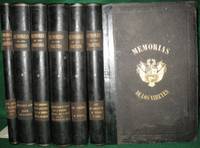
1859CA02406 volumes. xxx379index pages; 426index pages; 388index pages; 51620 tables and index pages; 39317 tables and index pages; 39456 tables and index with large fold out map at back and 12 plates. Folio 12 1/4" x 8 1/4" bound in original publisher's dark brown pebbled cloth ruled in blind with front boards with armorial gilt device. New spines with original title in gilt laid on. Palau 95426 Sabin 26119 First editions.<br /><br />These memoirs prepared by ten of the viceroys were intended to apprise each successor of the nature and duties of his post of the distribution of offices and presidencies of the privileges of the natives their hereditary customs and character. The work forms a glorious monument of statesmanship; and it may be conjectured that if the Spaniards had always formed their conduct according to these Memorias they would never had lost their colonies in the New World. Bibliographico-Linguistica 312 part III<br /><br />The series was edited under the direction of the Ministerio de Hacienda.<br /><br />Some foxing in all volumes some water staining varying in degrees in volumes worming to some volumes in varying degrees a few affecting text but all readable. Spine replaced with original spine labels affixed else a good set of a scare colonial item. Due to the size and/or weight of this lot extra shipping and/or handling charges may apply. Libreria Central de Felipe Baily hardcover
1974Q-0292750080University of Texas Press 1974-06-01. Hardcover. New. New. In shrink wrap. Looks like an interesting title! University of Texas Press hardcover