26 128 résultats
1145332668.Gpaperback. Good. Access codes and supplements are not guaranteed with used items. May be an ex-library book. paperback
Paperback in good condition. Lightly marked and shelfworn cover. Previous owner's name penned on half title page. Highlighting on the pages throughout - all text remains legible. The binding is sound. CM Used
1992Q-0520065530University of California Press 1992-02-25. Paperback. New. New. In shrink wrap. Looks like an interesting title! University of California Press paperback
0520065522.Ghardcover. Good. Access codes and supplements are not guaranteed with used items. May be an ex-library book. hardcover
1163289728.Gpaperback. Good. Access codes and supplements are not guaranteed with used items. May be an ex-library book. paperback
1432683527.Gpaperback. Good. Access codes and supplements are not guaranteed with used items. May be an ex-library book. paperback
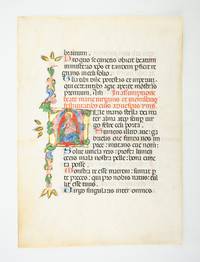
ST20973Italy 15th century. 364 x 260 mm. 14 3/8 x 10 1/4". Single column 22 lines in a rounded gothic book hand. <br/> Rubrics in red versal initials alternating red and blue with purple penwork one three-line initial in blue with purple penwork A SIX-LINE "A" DEPICTING THE ASSUMPTION OF THE VIRGIN the initial painted pink with red green and blue nodes and acanthus on a burnished gold ground with extensions running the length of the text column incorporating more acanthus and small gold embellishments with sprays of the gold leaves at the top bottom and center. A little rubbing to the paint negligible soiling and small spots to margins but in excellent condition overall.<br/> <br/> This very large handsomely preserved leaf features a strikingly attractive initial of the Virgin opening the beloved hymn "Ave Maris Stella" "Hail Star of the Sea". Dating back to at least the ninth century and traditionally associated with the hour of Vespers on Marian feast days as here the hymn praises the Virgin's purity meekness and mercy calling upon her as the "Nurturing Mother of God" to dispel evil and free us from our sins. Inside the gilt and painted initial is a lovely portrait of the Virgin who is depicted seated against a red mandorla dressed in pink and wrapped in a green and blue mantle--perhaps a reference to the colors of the ocean. Her hands are raised in prayer fingers lightly touching above her heart and her well-defined features appear both strong and serene. Judging from the size of the initial liberal use of gold and the wide margins of this leaf the original manuscript must have been a costly item produced for a wealthy church or monastery. unknown
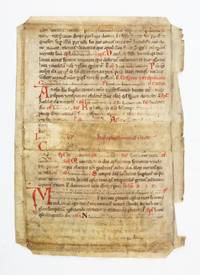
ST19350-013Germany early 13th century. 273 x 193 mm. 10 3/4 x 7 1/2". Single column 31 lines text in two sizes in a gothic hand. <br/> Rubrics in red several one- and two-line initials in red and two larger initials in red. A few lines with neumes later notations in the margins now quite faded. ◆Vellum a bit soiled and creased as expected fading to four or five lines where the spine was placed several notches along one edge other imperfections due to its reuse as binding scrap but still an excellent specimen that is almost entirely legible.<br/> <br/> Written in a neat and attractive hand this sizable leaf from a Missal remains mostly quite legible with all its rubrication intact despite having been used as part of a binding. A few lines also show musical notation from the earliest generation of neumes. They are described as "in campo aperto" which means literally "in an open field" because they and they alone occupy the space or "field" above the text. They are also described as adiastematic because they appear in a straight line whereas later diastematic neumes reflect changes in pitch by being placed in a higher or lower vertical position above the text. At the time the present leaf was written out the neumes here simply served as an "aide memoire" to the singer who had already learned the melody orally. unknown
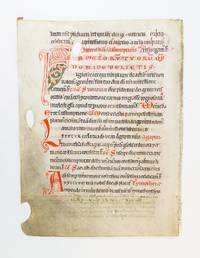
ST17236Germany mid- to late 12th century. 290 x 217 mm. 11 3/8 x 8 1/2". Single column 21 lines in an attractive proto-gothic book hand. <br/> Rubrics in red several one-line initials in red five red initials measuring two to four lines long and with penwork embellishment A LOVELY SEVEN-LINE WHITE-VINE INITIAL outlined in red and with a pale yellow wash along the edge the lower half of the ground filled with green wash. Lower margins with notations in later Medieval hands. ◆A handful of original holes in the vellum no doubt from stretching the skin during processing with the scribe writing around the flaws where necessary a little soiling to lower outside corner one or two negligible spots otherwise IN FINE CONDITION the ink unusually rich and the paint very bright.<br/> <br/> From a Sacramentary a service book that contained the prayers said during Mass subsumed by the Missal in the 13th century this early leaf was once part of an attractive manuscript of very high quality. The very large and superb "F" opens the Mass for the Feast of the Assumption and the other readings here include Masses for Sts. Hippolytus and Cassian celebrated on 13 August; St. Eusabius 14 August; Vigil of the Assumption of the Virgin 14 August; Assumption of the Virgin 15 August; St. Agapitus 18 August; and the beginning of the Mass for Sts. Timothy Hippolytus and Symphorian 22 August. Sister leaves from this same manuscript have previously appeared in Sam Fogg Cat. 16 "Text Manuscripts and Documents 2200BC to 1600AD" 1995 nos. 30 and 31; Maggs Bros. European Bulletin 20 1995 no. 37; Quaritch Cat. 1270 "Bookhands of the Middle Ages VI" 2000 nos. 69 and 70; Sotheby's 6 December 2001 lot 8; and Bloomsbury 6 December 2017 lot 16. The Fogg description notes that similar initials can be seen in French German and Flemish manuscripts of the period "but very few manuscripts have the special characteristics of this one." For example the initials on the sister leaves described by Fogg contain atypically mauve and green as well as an "unusual . . . exterior contoured ground which is not confined by any geometric form." This means there is no line or shape to box in or define the capital's form; rather it appears as if surrounded by an aura or gentle shadow. Our initial contains a green ground only no mauve but the same unusual and attractive yellow aura. It is rare to find Romanesque leaves of this size and caliber in such fine condition and the present leaf with its beautiful regular proto-gothic hand exceptional white-vine initial and several large decorative initials in red is especially desirable. unknown
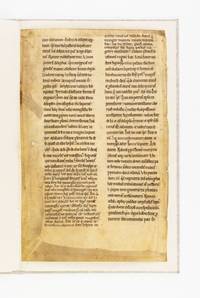
ST17768<p>England second half of 12th century but before 1180. 313 x 198 mm. 12 1/4 x 7 3/4. Double column 32 lines in a lovely late Caroline hand verso with some lines erased and corrected in a smaller hand. <br />Mounted in a fine tan cloth folder between sheets of textured acid-free paper. Front pastedown with book label of the Schøyen Collection with their shelf mark MS 237 written in ink. ◆Recovered from a binding and thus with overall toning and soiling recto somewhat browned from binder's glue but almost entirely confined to three margins and the verso virtually unaffected other trivial imperfections but in surprisingly good condition given its history the very rich ink especially dark and well preserved.<br /><br />This is an exceptionally lovely example of an early English book hand standing at the crossroads of the Caroline and proto-gothic calligraphic traditions. According to Thompson "In the twelfth century the scribes seem to have vied with each other in producing the best types of book-writing of which they were capable with the result that remarkable precision in the formation of the letters was attained and that the century may be named as excelling all others for the beauty of its MSS." "Greek and Latin Paleography" p. 436 The present leaf certainly lives up to this description being notable for its exceptionally neat and legible script written with uncommonly pretty and regular letter forms by a practiced and confident hand. The Caroline tradition is apparent in certain tendencies such as the use of "&" for "et" and the lack of biting curves between letters while a shift toward the proto-gothic can be seen in the vertical and compressed letter forms as well as the increased use of abbreviations and ligatures. Although the present work has often been credited to Haymo of Halberstadt due to a longstanding error in attribution reaching back to the 15th century modern scholarship now recognizes Haimo of Auxerre a monk at the Abbey of Saint-Germain in Auxerre d. ca. 875 as its true author. A prominent theologist and writer during the Caroline Renaissance Haimo produced a number of influential commentaries on various books of the Bible. The provenance on this leaf can be traced back as far as the mid-19th century when it was auctioned at Sotheby's on 21 August 1858 lot 119.2 sold as part of an album containing various leaves and fragments put together by Philip Bliss 1787-1857 registrar of the University of Oxford. It then went into the celebrated collection of Sir Thomas Phillipps 1792-1872 and was eventually sold by the Robinson Brothers on 24 April 1911 lot 390.3. This leaf has previously appeared in Quartich's catalogue 1036 "Bookhands of the Middle Ages" no. 79.5 and was most recently in the collection of Martin Schøyen his MS 237.</p>
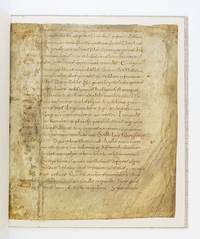
ST17766Probably Germany third quarter of ninth century. 285 x 245 mm. 11 1/4 x 9 3/4". Single column 25 lines in a Caroline minuscule book hand. <br/> Tipped into a paper folder and presented in a tan cloth binding with ink notation on spine and a small sticker on upper cover. Rubrics in red. Front pastedown of folder with the bookplate of the Schøyen collection. With several pages of typed and handwritten notes including Bernard Rosenthal's cataloguing and a copy of a letter from Bernhard Bischoff to Rosenthal concerning the dating of the leaf. ◆Recovered from a binding and thus with some expected browning staining and wrinkling a long vertical fold through the text touching a couple letters of each line recto with the first few words of each line roughened and somewhat obscured a couple of other words a bit hard to make out but the vast majority of text very legible with fore and tail margins very ample and in all quite a good specimen representing a remarkable survival.<br/> <br/> Featuring a lovely Caroline miniscule hand this very early leaf from a Lectionary may have been made for the use of a particular church or individual and comes with recent distinguished scholarship and provenance. Although the text here contains familiar passages from the Old and New Testaments their juxtaposition in this context presents a bit of a conundrum: as the enclosed cataloguing explains the story of the wicked husbandmen from Matthew followed by the story of Esau surrendering his birthright to Jacob from Genesis "is an irregular and indeed unrecorded liturgical sequence of texts and suggests that this particular collection of lections was compiled for a particular church or private chapel." It is also possible that the Lectionary was made for the use of an individual rather than an institution with certain needs or preferences—perhaps a scholar or theologian or even a Carolingian nobleman many of whom were literate and educated. The hand here is an excellent example of the legible and elegant Caroline minuscule that dominated Western Europe in this period; distinctive letter forms include clubbed ascenders such as on the letters "b" "d" and "l" a long "s" with the shaft on the line and the use of the ampersand as a general abbreviation for the letters "et" occurring anywhere in a word for example "conter&" for "conteret". Termed the "integrated ampersand" this usage is especially characteristic of Caroline minuscule manuscripts of the late eighth and ninth centuries. Our leaf comes with bookseller Bernard M. Rosenthal's catalogue description noting that it was "Purchased from Schab New York Feb. 1969." William H. Schab was a book and art dealer in the firm of Gilhofer and & Ranschburg in Vienna before fleeing Austria in 1938 and settling in New York where he founded his own business. Also included here is a copy of a handwritten note regarding the date of the present leaf from renowned paleographer Bernard Bischoff. The leaf was also featured in Quaritch's 1991 catalogue 1147 Bookhands of the Middle Ages V no. 25.5 and was until recently part of the Schøyen Collection their MS 623. Four additional pages of cataloguing are also included here. Despite having been used as binding scrap at some point in its life this leaf is very well preserved with no words lost from trimming with distinctly visible ink and in a clear and very pleasing hand. unknown
158704Boston etc., D.C. Heath, (1900).
Minor curling of wraps along foreedges. Light shelfwear. ; Wit has many uses in political discourse—to entertain, to underscore or unmask, to hinder or enhance insight. Wit and the Writing of History focuses on how this potential is realized in the historiography of the earlier Principate. Preeminently in Tacitus, to a lesser degree in Suetonius and Dio Cassius, wit is a vehicle for political understanding and judgment of the historical account. As part of Roman political life, hostile anecdotal or epigrammatic wit was deeply embedded in the sources used by historians and is reflected in the rhetoric of their narratives. Some anecdotes may, in fact, have been mere jests later taken as fact, hence the frequent problem of credulity. But what is historically false can be politically true. Not only were political jokes a weapon for making some fair points against the Principate; ancient rhetorical theory recognized that wit in general arises from a violation of normal, expected ways of thinking. What is “funny” is thus disturbing in a serious way as well as amusing, and in the hands of Tacitus wit becomes scalpel as well as sword. ; Wisconsin Studies in Classics; 182 pages
18993612602Berlin, Kühl, 1899. Insgesamt 333 S. (getrennte Paginierung). Mit Mit 2 Faksimile und 2 Tafeln. OHlwd (Stempel auf Vorsatz und Titelrückseite).
2416Sumptibus Methueni et Sociorum Londonii, Sumptibus Duttonis, Neo-Eborici, MCMLXI
One small tear to lower edge of rear panel of DJ (1"). DJ Spine a bit sunned. ; 0.75 x 7.7 x 5.28 Inches; 160 pages; The enchanting tales of Pooh and his friends were first brought to readers in classic Latin form in 1960 with the publication of Winnie Ille Pu. It remains the only book in Latin ever to grace The New York Times List.
Liber celeberrimus omnibus fere pueris puellisque notus nunc primum de anglico sermone in Latinum conversus auctore Alexandro Lenardo Librum . Novi-Eboraci : Sumptibus Duttonis. Revised edition with notes and glossary prepared in consultation with Dr. Israel Walker. Novi-Eboraci : Sumptibus Duttonis Book
Liber celeberrimus omnibus fere pueris puellisque notus nunc primum de anglico sermone in Latinum conversus auctore Alexandro Lanardo. Librum exornavit E.H.Shepard. Londinii : Sumptibus Methueni et Sociorum Novi-Eboraci : Sumptibus Duttonis MCMLXI." 121p. illus. 3rd Printing. Vintage copy of Latin translation of this children's classic.Neat booksellers label from Foyles of Charing Cross Rd under front flap. Book
Liber celeberrimus omnibus fere pueris puellisque notus nunc primum de anglico sermone in Latinum conversus auctore Alexandro Lanardo. Librum exornavit E.H.Shepard. Novi-Eboraci : Sumptibus Duttonis MCMLX." Vintage copy of children's classic in Latin. 121p. illus. Laid in are contemporary reviews clipped from newspapers. These left marks on the end papers - now in a plastic folder. Book
2000008536Brazil: EMBRAER Centro de Comunicacoes 2000. 144pp/illus. History of the Brazilian Air Force in the Amazon pioneers also led Embraer's Journey through time. It is therefore not surprising that on a given moment the two paths crossed. And it was certainly without pomp and circumstance that the first Bandeirante turboprop appeared over the great forest". Profusely illustrated with colour and b/w photographs. Clean. 1st Edition. Hard Cover. Fine/Near Fine. 4to - over 9¾" - 12" tall. EMBRAER, Centro de Comunicacoes hardcover
197413830Petropolis RJ Brasil: Vozes 1974. Soft cover. Good. Wim L. Van Dijk. Laid out in newspaper column style so that each page the left column is the text in Portuguese and on the right is the text in English. There are several color plates of oil paintings many of the Petropolis region where incidentally the iconic lay left Catholic press Vozes is located as well and others of his native Holland. Title page is signed by Van Dijk and dated Nov.2 1987. Pictorial gatefold glossy wraps have rub marks on spine and edges the text is in fine condition. 91 pages index BW & Color plates of his drawings and paintings on glossy paper stock. <br/> <br/> Vozes paperback
198958333BBDarmstadt, Wissenschaftliche Buchgesellschaft, 1989. 127 Seiten. Original-Leinenband.
1986R118873Turnhout, Brepols 1986 Complet en 2 tomes, 1171pp. (pagination continuée) + 6 planches hors-texte, 25cm., dans la série "Corpus Christianorum Continuatio Mediaevalis" volumes LXIII-LXIIIA (63-63A), reliures toile d'éditeur avec titre doré, ISBN 2-503-03631-1 & 2-503-03633-5, (introduction en français, texte en latin), texte frais, petit cachet ex-libris sur la feuille de garde blanche et au verso de la page de titre, bon état, poids: 2.3 kg., R118873
This is a near fine softcover copy with almost no wear. Completely clean. This catalog was prepared to accompany the exhibition at the Rosa Esman Gallery and at Exit Art, both in New York in the Soho district from November 20 to December 31, 1986. Essays by Lucy Lippard, John Yau, Rosa Esman, Martha Wilson, and Jeannette Ingberman. Illustrated in color and black & white with images on every page. Papo Colo (1946- ) is a Puerto Rican artist who works both in New York and Puerto Rico, where he has a studio in El Junque rainforest. In 1982 Papo Colo, with Jeanette Ingberman, founded Exit Art. Limited edition of 1000 copies. 11" high X 8" wide, about 40 pages. This book will be securely packed and shipped with tracking.