PhaedrusAntiquariat.de

19 318 résultats
167520314Paris, Frederic Leonard, 1675. (30), 101, (65) SS. Mit Holzschnittdruckermarke am Titel, gest. Frontispiz (F. Chauveau in. / J. Langlois sculp.), einem gest. Kopfstück und mehreren Zierstücken und Initialen in Holzschnitt. Pergamentband der Zeit mit goldgepr. Deckelsupralibros (Wappen des Stiftes Kremsmünster) und Deckelmonogrammierung "ASAC" (recto) sowie -datierung "1719" (verso). Hs. Rückentitel. 4to.
Mm 245x350 Bilingual Russian / English - This is a limited edition of 500 copies of an eight-volume set. «The ublication of this first facsimile edition of the working notebooks of Alexander Pushkin is an important event. Pushkin was one of the great masters of Russian Literature. His inspiration is timeless and universal. The publication of this facsimile edition will help bring the priceless tresure of his work to people throughout the world, who will now be able to judge for themselves the importance of all he contributed to European culture.» Riproduzione in facsimile dei taccuini di lavoro di Aleksandr Puskin. Opera completa in otto volumi in cartonato rigido, titoli in oro al dorso e fregi oro al piatto anteriore, sovraccoperta originale tranne, come pubblicato, per il volume V in cofanetto editoriale (il solo). Libri in condizione di nuovo-new. SPEDIZIONE IN 24 ORE DALLA CONFERMA DELL'ORDINE.
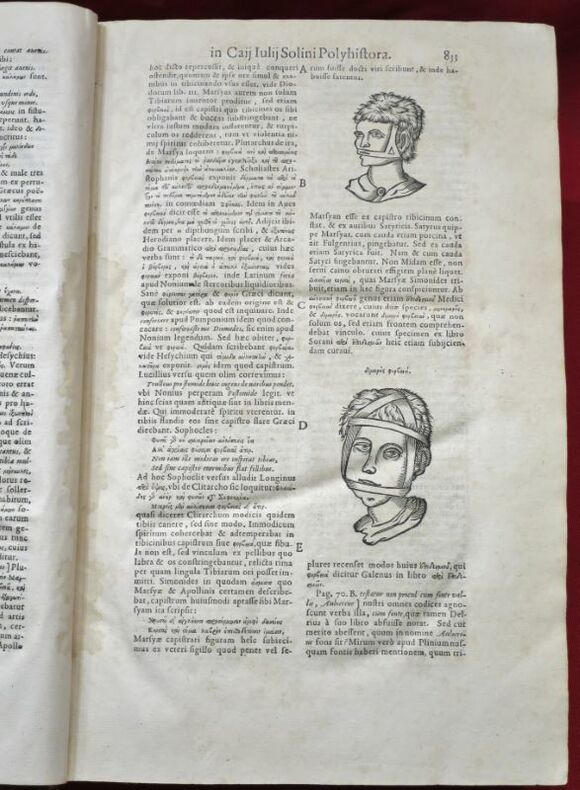
109830Parisiis, Apud Hieronymum Droüart via Iacobaea sub Scuto Solari, 1629, 2 volumes in-folio de 355x230cm environ, plein veau fauve d'époque, dos à 6 nerfs portant titres et tomaisons dorés sur pièces de titre havane, orné de caissons à fleurons dorés, encadrements des plats d'un double filet doré, tranches mouchetées, impression sur 2 colonnes par page (3colonnes dans l'index).Tome 1 : 1f.blanc, 26ff. ( faux-titre, titre avec vignette de titre à la marque de l'imprimeur : bouquet de chardons à la devise " Patere aut abstine, nul ne si frote", Serenissimae Venetorum reipublicae, prolegomena in solinum, Caii Iulii Solini grammatici polyhistor ab ipso edius et recognitus, C. Iulius solinus adventos), 824 pages, avec 20 figures gravées dans le texte. Trous de ver dans les marges et sur les contreplats, des rousseurs et pages brunies, un tampon sur la page de titre, - Tome 2 : page de titre avec de titre à la marque de l'imprimeur, tipographus lectoris, pagination continue sur les 2 volumes, tome II : 825 (numéroté 285 par erreur) à 1367 pages (addenda compris), +254 ff. ( Index rerum & verborum), avec 28 figures gravées dans le texte. Mouillure dans la marge des 16 premières pages (tome II), frottements, épidermures, rayures et traces d'adhésif sur le cuir, mors en partie fendus, coiffes manquantes, nombreuses erreurs de pagination mais aucun manque n'est à déplorer, des galeries de ver dans les marges, sans atteinte au texte. Texte en latin.
156844398Leipzig, (Ernst Vögelin), 1568. (6), 351, (1) SS. Mit Holzschnittdruckermarke am Titel (am letzten Bl. verso wdh.). Brauner Lederband des 16. Jhs. mit Streicheisenlinienmuster und späterem hs. Rückentitel. Dreiseitiger Rotschnitt. 8vo.
Very Good Hebrew Contemporary 1/4 leather bdg. Demy 8vo. (21 x 14 cm). In Hebrew with interspersed with Arabic; a preface in French. [xvi], 144 p. Goldenthal was an Austrian Orientalist; born at Brody, Galicia, April 16, 1815; died at Vienna Dec. 28, 1868; educated at the University of Leipsic. In June, 1843, he became principal of the Jewish school at Kishinef, Bessarabia, and held the office for some years. He was appointed professor of rabbinical and Oriental languages at the University of Vienna in Sept. 1849, and held the chair until his death. Upon the nomination of Hammer-Purgstall, he was elected a corresponding member of the Vienna Academy of Sciences, and member of the Asiatic Societies of Germany, of Paris, and of London. His chief literary activity consisted in editing the following manuscripts: "Mozene ?ede?," a treatise on philosóphical ethics by Al-Ghazali, translated into Hebrew by Abraham ibn ?asdai, with an introduction on the lives and works of Al-Ghazali and Ibn ?asdai, 1838. "Bi'ur ibn Roshd," Todrosi's Hebrew translation of Averroes' commentary on Aristotle's "Rhetorica," with a historical and philosophical introduction, 1842. "Mesharet Mosheh," commentary by Kalonymus on Maimonides' system of Divine Providence, with his explanation of Ps. xix. and xxxvii., 1845. "Maftea?," methodology of the Talmud by Nissim ben Jacob of Kairwan, with an introduction, notes, and references, 1847. "Mi?dash Me'a?," Moses Rieti's didactic poem on ancient philosophy and the history of Jewish literature, with an Italian and Hebrew preface, 1851 (see "Allg. Zeit. des Jud." 1859, p. 124). Goldenthal further published a catalog of Hebrew manuscripts in the Imperial Library of Vienna, 1854, and an Arabic grammar in Hebrew for the use of the Oriental Jews, with a French preface, 1857. Volume i. of the "Denkschriften" of the Vienna Academy of Sciences contains his "Beiträge zu einem Sprachvergleichenden Rabbinisch-Philosophischen Wörterbuche." He issued "Das Neue Zion," a monthly periodical, Leipsic, Nisan, 1845, of which only one number appeared. Another periodical which he edited, "Das Morgenland," was also short-lived. (Jewish Encyclopedia). In his Hebrew preface, Goldenthal notes that knowledge of Arabic is particularly important for Talmudists, illustrating his point by a passage from Rabbenu Nissim's commentary to Tractate Shabbat found in a manuscript in the Palatine Library of Vienna. (Source: K&C). First Edition. OCLC 40972030.; Friedberg M-2669.
171142086Nürnberg, Joh. Ziegeri, 1711 et 1702. 4to. Bound in one contemp. hvellum. Handwritten titles on spine, light wear. Some loss of the marbled paper on covers. Title in red/black. (14),856,(46) pp. and 71 engraved textillustrations. Probably a frontispiece lacks. Second work: Engraved portrait. Engraved frontispiece. Titlepage in red/black. (12),398,(16) pp. a 1 leaf Errata. Many textengravings.
192113832Uppsala, Lund, 1921-85. Vol. 1-60 bound in 31 solid hcalf and hcloth.
181850614Kjöbenhavn Gyldendal 1818. Lidt senere hldrbd. Rygforgyldning. Skindtitel på ryg. Lille revnedannelse øverst på forreste fals. Ryg med lettere brugsspor. XII312 pp. De første og sidste sider brunplettede. Enkelte marginalnoter i gl. hånd. <br/><br/><em>Originaludgaven af Prisskriftet Rasks hovedværk og et grunlæggende arbejde i Nordisk Sprogvidenskab. - Før Rasks værk er indbundet: PETER ERASMUS MÜLLER. Om det islandske Sprogs Vigtighed. Et af det kongelige Selskab for Norges Vel kronet Prisskrift. Kiøbenhavn Sebastian Popp 1813. 102062 pp. Lidt spredte brunpletter.First edition of Rask's main work a founding work in Nordic Philology as he was the first to study the ancient Nordic languages systematically and discovered the correspondance of consonant relations between the Indo-European languages which led Jacob Grimm to formulate the rules underlying the Germanic as well as the High-German sound-shifts. </em> unknown
181850614Kjöbenhavn, Gyldendal, 1818. Lidt senere hldrbd. Rygforgyldning. Skindtitel på ryg. Lille revnedannelse øverst på forreste fals. Ryg med lettere brugsspor. XII,312 pp. De første og sidste sider brunplettede. Enkelte marginalnoter i gl. hånd.
Nürnberg, Joh. Ziegeri, 1711 et 1702. 4to. Bound in one contemp. hvellum. Handwritten titles on spine, light wear. Some loss of the marbled paper on covers. Title in red/black. (14),856,(46) pp. and 71 engraved textillustrations. Probably a frontispiece lacks. Second work: Engraved portrait. Engraved frontispiece. Titlepage in red/black. (12),398,(16) pp. a 1 leaf Errata. Many textengravings.
Uppsala, Lund, 1921-85. Vol. 1-60 bound in 31 solid hcalf and hcloth.
Kjöbenhavn, Gyldendal, 1818. Lidt senere hldrbd. Rygforgyldning. Skindtitel på ryg. Lille revnedannelse øverst på forreste fals. Ryg med lettere brugsspor. XII,312 pp. De første og sidste sider brunplettede. Enkelte marginalnoter i gl. hånd.
Notae Dionysii Gothofredi J.C. ad Varronem, Festum & Nonium. Variae lectiones in Fulgentium et Isidorum. Index generalis in omnes superiores authores - in 8° - pp.1925 + 77 - testo su due colonne - numerazione a colonna - Mezza pelle - Iniziali e fregi xil - Testo in latino - Prima edizione - Legatura non originale, numerazione errata in una trentina di pagine, numerazione da da 1550 a 1569 assente. Prime tre pagine sciupate - M. Terentius Varro De lingua Latina. M. Verrii Flacci fragmenta. Festi fragmenta a Fuluio Vrsino edita. Schedae Festi a Pomp. Laeto relictae. Sext. Pomp. Festus, Paulo diacono coniunctus. Nonius Marcellus. Fulgentiuis Plantiades. Isidori Originum libri 20……
196761328BBStuttgart, Verlag Klett-Cotta, 1967-2006. 4°. 25 cm. ca. 15000 Seiten. Hellgrüne Original-Leinenbände mit Original-Schutzumschlägen.
112560aafLeipzig und Eisenach, M. G. Griessbach, 1756, in-8vo, 12 Bl. (Titel mit gest. Vignette - Widmungsbl. an Joachim Fr. Freyh. von Beust - 3 Bl. Widmung - 7 Bl. Vorwort) + 312 S. + 12 Bl. Register, unbeschnitten, Rez. Pappband. Rotes-Leder Titelschild.
17736Lyon, Ludovic Perrin, 1840, 1 demi veau aubergine, dos à nerfs, orné. in-4 de 1 feuillet blanc, faux-titre, titre frontispice à encadrement ornemental ou l'on voit les calvinistes métamorphosés en singes, se livrer à toutes sortes de profanations et pillages, XVI-(2)-117 pages, illustré de 39 gravures dans le texte (la 40ème gravure représentant des scènes de libertinages n'est jamais reproduite), tiré à 120 exemplaires sur papier vergé fort ;
191223823München und Leipzig, Georg Müller, 1912. 4 Bände. Handgebundene weinrote Original-Maroquinbände mit Rückenvergoldung, goldgeprägten Deckelvignetten, Deckel- und Innenkantenfileten sowie Kopfgoldschnitt (Hübel & Denck, Leipzig). Lesebändchen. 8vo.
Wiesbaden, F. Steiner Verlag GMBH, 1963-1979, annate 16 ben rilegate in tutta tela bleu, con cartelli in pelle rossa e scritte oro sui dorsi. Conservate le copertine di ogni fascicolo. Manca l'annata 1975.
2 tomi in 1 volume in-4, pp. 368 (tome premier), pp. 188 (tome second), 38 fascicoli in totale, con le belle copertine editoriali figurate, legati in m. marocchino blu coevo, titolo in oro su dorso a nervi. Raccolta illustrata da oltre 600 vignette in silogr. di Bertall, Nadar, Béguin, Otto, Lorentz, ed altri artisti. Redatta da Lireux, Vertot, G. de Nerval, Fauchery, e altri. Collezione completa e rara di questa rivista satirica di indirizzo repubblicano. Rifiutando di sottomettersi alla legge del 27 luglio 1849, che limitava la libertà di stampa, la rivista cessa di essere stampata in dicembre. Perfetto esemplare, freschissimo. . Brivois, Illustrés du XIX siècle, p.349-350.
Bruselas, en casa del dicho Juan Mommarte, 1660. Dos tomos en un volumen en 4to. cuadrado; 4 hojas, 278 hojas sin numerar y portada propia, 234 hojas sin numerar, para la versión francés-español. Impresión a doble columna. Encuadernación de época, en piel, con lomera ornada. Presenta pequeñas faltas y roces.
Testo su due colonne. Indice delle parole latine, greche e degli autori con le relative opere. Ex libris araldico e timbro di precedente appartenenza. Esemplare molto fresco in perfetto stato. Kg. 1,100 frontespizio a due colori con marca tipografica, capilettera, testatine, finalini ornati
M., Herederos de Francisco del Hierro, 1737, 34 x 25 cm., perg., 6 h. - 656 págs. (Único tomo que disponemos de esta primera edición del célebre Diccionario de Autoridades compuesto por la Real Academia Española)
Lisboa, Impressao Regia, 1805, 19 x 12 cm., cubiertas provisionales en papel moderno, 50 págs. + 1 hoja. (Obra rara publicada por primera vez en 1778 en Roma por la Propaganda Fide. El autor anónimo era posiblemente un jesuita que vivió en Roma después de su expulsión de Portugal. Marathi es una de las principales lenguas indo-arios que se hablan en la India occidental y central). First published in 1778 in Rome by the Propaganda Fide. The anonymous author was possibly a Jesuit living in Rome after his expulsion from Portugal. Marathi is one of the major Indo-Aryan languages spoken in Western and Central India.
Bella legatura coeva in tutta pergamena morbida, titolo manoscritto al dorso, carte fresche e senza difetti. Interessante esempio di vocabolario metodico in dieci libri. Ciascun libro elenca le parole che riguardano una delle "dieci salde colonne" poste a fondamento del mondo il quale viene definito come "ricco edificio" ovvero "fabrica". I vocaboli sono tratti da quelli che nel Cinquecento erano ritenuti i "buoni autori" della lingua volgare, e specialmente da Dante, Petrarca, Boccaccio e Bembo. La Fabrica si presenta quindi come un dizionario ordinato in sezioni specifiche: due corposi indici permettono una agevole ricerca delle singole parole.Sc. D.
185112534ABLeipzig, F. Fleischer, 1851. VIII + 323 + 2 S. OBrosch.