522 résultats
1741KART0239Den Haag, Pieter de Hondt 1741. 2°. Titelbl., 1 nn. Bl., 44 S., 53 Tafeln (davon 52 doppelseitig), großteils mit reichen figuralen Kartuschen, Titelblatt in Rot- und Schwarzdruck, mit Titelblattvignette, Initialen u. Schlussvignette. Neuer Halbpergamentband, Deckel mit grünem Kleisterpapierbezug u. Pergamentecken, Schuber. Titelbl. u. Vorsätze gebräunt, flieg. Vorsatzbl. fleckig u. mit 2 kl. Wurmspuren. Textteil stellenweise etwas stockfleckig. Tafeln an den Rändern mit leichten Feuchtigkeitsspuren, vereinzelt verso leicht fingerfleckig, die letzten 10 Taf. am unteren Rand stärker gebräunt u. im rechten Rand mit schwarzem Tintenfleck. Vorletzte Tafel oben mit Eckabriss im weißen Rand. Insgesamt in gutem Erhaltungszustand, breitrandig und unbeschnitten. Koeman I,1:631; Goffart, Historical Atlases 544; Acta Cartographica 27,201; BM Catalogue of Maps 9; ADB 13,137f. ? Der Historiker Georg Horn (1620-1670) war 1653-70 Professor für Geschichte an der Universität Leiden, er verfasste neben anderem Lehrbücher für Universalgeschichte, die in ihrer Gesamtheit ein umfassendes Nachschlagewerk für Geographie und Geschichte bildeten und viele Jahre bei den Studierenden Hollands und Deutschlands sehr geschätzt waren. Vorl. eine Ausgabe - mit dem erklärenden Text in französischer Sprache - seiner 1667 erstmals erschienenen ?Accuratissima orbis delineatio?, mit allen im Verzeichnis genannten Karten. Das Werk beinhaltet gestochene Landkarten der bedeutendsten Kartographen dieser Zeit, die meisten stammen von oder sind gearbeitet nach Johannes Janssonius (1588-1664), weitere auch von Abraham Ortelius (1527-1598), Nicolas Blankaart (1624-1703), Johann Lauremberg (1590-1658) und enthält u. a. Karten zur biblischen Geschichte (11), Karten von Ägypten (2), Zypern, Griechenland (4), Spanien, Italien (5), Großbritannien (3) Frankreich zur Zeit Julius Caesars, des Heiligen Römischen Reiches, sowie eine Karte zur Illias, eine zur Expeditionsroute Alexander des Großen, eine des Fränkischen Reiches unter Karl dem Großen und auch eine Wiedergabe der Tabula Peutingeriana auf 4 Tafeln mit je 2 Abschnitten. Beeindruckender kompletter Atlas mit gut erhaltenen Kupfern.
173718598Turin, Mairese, 1737. Text- und Tafel-Bd. 4 Bll., 307 S. 1 Kupferporträt und 79 Kupfertafeln. Fol. Mod. HLdr. unter Verwendung der alten Buchdeckeln (bestoßen und beschabt). [5 Warenabbildungen]
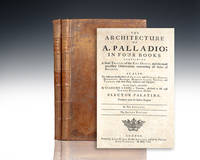
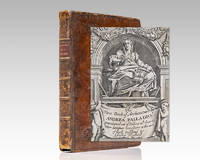
1721146284London: Printed by John Darby for the Author 1721. Rare second English edition of Leoni's English translation of Palladio's monumental work containing new typesetting but reusing the same plates from the first edition. Folio two volumes bound in full contemporary polished calf with gilt titles and ruling to the spine in six compartments within raised bands double gilt ruling and decorative stamping to the front and rear panels engraved frontispiece portrait of Palladio illustrated with 104 numbered engraved plates on 203 leaves including 15 double-page plates as well as 12 engraved in-text plates. Armorial bookplate to the pastedown of each volume. In very good condition. One of the giants of Venetian Renaissance architecture of the 16th century Andrea Palladio based his designs on the values of Greek architecture and the traditions of Roman architecture as outlined by Vitruvius. He is regarded as one of the greatest architects in the history of Western art best known for his villas in the Veneto as well as his palaces Vicenza and churches Venice all located within the Venetian Republic. His architectural theories were laid out in his treatise Quattro Libri dell Architettura The Four Books of Architecture which had a profound impact on building design throughout Europe and America. His style of architecture - a blend of Greek Roman and Renaissance art later known as Palladianism - accorded the greatest priority to maintaining symmetry perspective and overall harmony in the manner of Greco-Roman temple architecture and was widely imitated during the 17th and 18th centuries. Printed by John Darby for the Author hardcover
1760260692Brünn: Johann Paul Krauss 1760. Engraved title in each volume vols. II-IV reading "Unser Lieben Frauen .". 189; 2 193-390; 2 393-590; 190 pp. 8vo. Contemporary Italian binding of full brown morocco covers gilt with two outer border rolls corner-pieces and arms of Prince-Bishopric of Trent spine gilt in six compartments a.e.g. Dutch gilt endpapers. Light wear to corners else fine. In original morocco pull-off case tooled in gilt to match lined with Dutch gilt paper. Some wear and splitting to edges of box. Engraved title in each volume vols. II-IV reading "Unser Lieben Frauen .". 189; 2 193-390; 2 393-590; 190 pp. 8vo. A beautiful Italian armorial binding of the mid 18th-century similar in style to those promoted by the Salvioni firm in the original pull-off case. OCLC locates only one copy of this scarce German breviary in the Bayerische Staatsbibliothek. Johann Paul Krauss unknown
1760260692Brünn: Johann Paul Krauss 1760. Engraved title in each volume vols. II-IV reading "Unser Lieben Frauen .". 189; 2 193-390; 2 393-590; 190 pp. 8vo. Contemporary Italian binding of full brown morocco covers gilt with two outer border rolls corner-pieces and arms of Prince-Bishopric of Trent spine gilt in six compartments a.e.g. Dutch gilt endpapers. Light wear to corners else fine. In original morocco pull-off case tooled in gilt to match lined with Dutch gilt paper. Some wear and splitting to edges of box. Engraved title in each volume vols. II-IV reading "Unser Lieben Frauen .". 189; 2 193-390; 2 393-590; 190 pp. 8vo. Italian Armorial Binding in Original Box. A beautiful Italian armorial binding of the mid 18th-century similar in style to those promoted by the Salvioni firm in the original pull-off case. OCLC locates only one copy of this scarce German breviary in the Bayerische Staatsbibliothek. Johann Paul Krauss unknown books
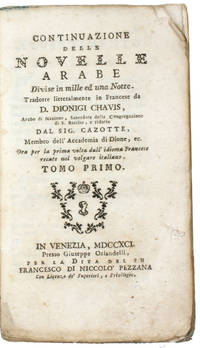
1791ABC_49342Venice: Giuseppe Orlandelli per la dita del fu Francesco di Nicolò Pezzana 1791. Near contemporary wrappers with the manuscript title on the spine. 12mo. With a small vignette built up from typographical ornaments on each title page. 4 volumes. First Italian edition of the Continuation des mille et une nuits an ambitious project to extend the Arabian Nights as translated by Antoine Galland. The Galland Manuscript the Arabic source ended at Night 282 and Galland had to supplement his work with original inventions or by translating French novels that were only orally transmitted.In the 1780s the Syrian monk Diyunisus Shawish renamed Dom Denis Chavis arrived in Paris. Short of money he decided to take advantage of the literary vogue of the moment and announced that he could prepare a more complete manuscript of the Thousand and one nights than Gallands. He proceeded to transcribe the existing corpus introducing numerous changes and expanding it with other stories from a manuscript he had brought with him from Syria. The operation proved successful: the Genevan publisher Paul Barde who was producing an impressive anthology of fairy tales entitled Cabinet des Fées commissioned Chavis to translate much of the material into French and then entrusted the text to the writer Jacques Cazotte who carefully revised it and even added stories of his own invention. The result of this singular collaboration was this beautiful Continuation first published at Geneva in 1788.Wrappers worn and chipped the edges are somewhat frayed. Otherwise in good condition.l OPAC SBN ITICCULO1E019383 7 copies; WorldCat 4 copies incl. 1 possibly only vol. 1; cf. not in Chauvin. Giuseppe Orlandelli per la dita del fu Francesco di Nicolò Pezzana, unknown
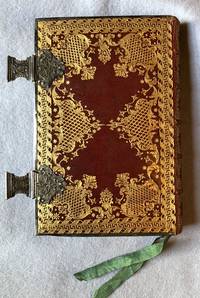
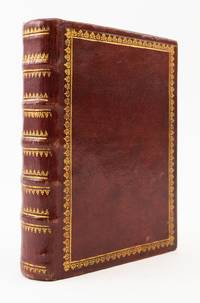
17562896Rome: Gioacchino & Giovanni Giuseppe Salvioni 1756. 8vo 208 x 133 mm. 24 407 1 pp. 2 parts the Office of the Dead separately titled. Printed in red and black. Engraved frontispiece and 12 full-page engravings by Arnold Van Weserhout and Jacob Frey after Joseph Passarus Giuseppe Passaro two engraved title vignettes 12 engraved tailpiece vignettes a few unsigned others by Frey after Passaro or by M. Schedi engraver 3 engraved capital initials numerous red-printed woodcut initials. Foxing occasionally severe short marginal tear to fol. Z7.Slightly later eighteenth-century Roman gold-tooled red goatskin covers with large dentelle border composed of a triple neo-classical roll-tooled outer frame enclosing six large ornaments each with a basketweave design of diagonally crossing gilt fillets framed in volutes and leafy sprigs a few tiny petal or star tools board edges protected with a probably later frame of silver or silver-plated metal discreetly nailed to the binding two elaborately chased silver fore-edge clasps and catches spine in six uniformly gold-tooled compartments gilt edges with gauffred border design pair of green ribbon page markers marbled endpapers; 20th-century black morocco felt-lined case. Provenance: with Gumuchian Catalogue XII/1930/225; Maurice Burrus bookplate purchased from Gumuchian in 1934 purchase notes at end. A striking rococo binding in fine condition on a luxuriously printed and illustrated Office of the Virgin from the official Vatican press.From the mid- to late eighteenth century the Salvioni press used one or more bookbinding workshops that produced finely gold-tooled bindings for their Vatican publications. Although often referred to as the "Salvioni bindery" this appellation is circumstantial: "the Salvioni firm was responsible for promoting the bindings but it is not known which workshop produced them" British Library Database of Bookbindings. Some of these "Vatican" bindings incorporated variously colored or mottled leather. This example with its basketweave cartouches relies purely on tooling for its effect. An example evidently from the same workshop on a book printed at Rome in 1791 by Salomini using analogous cartouches as corner-pieces as well as a similar "spiraling" border design and some of the same leafy spray and star tools is reproduced in Legature papali no. 264."Whereas the . more flamboyant bindings produced by the Salvioni Bindery rely frequently on polychrome enamel heightening these Vatican bindings strike a somewhat more sober note with their very fine dark-red morocco and rich gold-tooling of high quality" Martin Breslauer Catalogue 107/428.Gumuchian Catalogue de Reliures du XVe au XIXe siecle no. 225 plate 68. Cf. British Library Database of Bookbindings Shelfmark c27e18; For other "Salvioni" bindings see Miner / Walters Art Gallery The History of Bookbinding no. 523; Biblioteca Apostolica Vaticana Legature papali da Eugenio IV a Paolo VI no. 264 plate CXCIII. Gioacchino & Giovanni Giuseppe Salvioni hardcover books
1733151582London: Printed for A. Bettesworth and C. Hitch and J. Osborn in Pater-noster-Row 1733. Finely bound eighteenth century example of Godfrey Richards' English translation of the first book in Palladio's monumental work. Octavo bound in full contemporary polished calf with a morocco spine label lettered in gilt front and rear panels decoratively stamped in blind title page printed in red and black additional engraved pictorial title page illustrated with 71 engraved plates and full-page illustrations 4 folding including a view of St. Paul's Cathedral woodcut illustrations advertisement leaf at end. Twelfth edition. Neat ownership inscriptions and small bookplate to the front free endpaper. Bookseller's ticket to the pastedown. In very good condition with the engravings very crisp and bright. One of the foremost architects of the Venetian Renaissance Andrea Palladio 1508–1580 based his designs on the principles of classical Greek architecture and the traditions of Roman building as described by Vitruvius. He is widely regarded as one of the most influential figures in the history of Western architecture particularly known for his villas in the Veneto as well as his palaces in Vicenza and churches in Venice all within the Venetian Republic. His architectural theories were codified in his treatise I Quattro Libri dell’Architettura The Four Books of Architecture which exerted a lasting influence on architectural practice across Europe and the United States. Palladio’s style later termed Palladianism combined elements of Greek Roman and Renaissance design emphasizing symmetry proportion and harmony in a manner inspired by classical temple architecture. Printed for A. Bettesworth and C. Hitch, and J. Osborn in Pater-noster-Row unknown
17562896Rome: Gioacchino & Giovanni Giuseppe Salvioni 1756. <p>8vo 208 x 133 mm. 24 407 1 pp. 2 parts the Office of the Dead separately titled. Printed in red and black. Engraved frontispiece and 12 full-page engravings by Arnold Van Weserhout and Jacob Frey after Joseph Passarus Giuseppe Passaro two engraved title vignettes 12 engraved tailpiece vignettes a few unsigned others by Frey after Passaro or by M. Schedi engraver 3 engraved capital initials numerous red-printed woodcut initials. Foxing occasionally severe short marginal tear to fol. Z7.<br /> Slightly later eighteenth-century Roman gold-tooled red goatskin covers with large dentelle border composed of a triple neo-classical roll-tooled outer frame enclosing six large ornaments each with a basketweave design of diagonally crossing gilt fillets framed in volutes and leafy sprigs a few tiny petal or star tools board edges protected with a probably later frame of silver or silver-plated metal discreetly nailed to the binding two elaborately chased silver fore-edge clasps and catches spine in six uniformly gold-tooled compartments gilt edges with gauffred border design pair of green ribbon page markers marbled endpapers; 20th-century black morocco felt-lined case. Provenance: with Gumuchian Catalogue XII/1930/225; Maurice Burrus bookplate purchased from Gumuchian in 1934 purchase notes at end. <br /> <br /> A striking rococo binding in fine condition on a luxuriously printed and illustrated Office of the Virgin from the official Vatican press.<br /> <br /> From the mid- to late eighteenth century the Salvioni press used one or more bookbinding workshops that produced finely gold-tooled bindings for their Vatican publications. Although often referred to as the “Salvioni bindery†this appellation is circumstantial: â€the Salvioni firm was responsible for promoting the bindings but it is not known which workshop produced them†British Library Database of Bookbindings. Some of these “Vatican†bindings incorporated variously colored or mottled leather. This example with its basketweave cartouches relies purely on tooling for its effect. An example evidently from the same workshop on a book printed at Rome in 1791 by Salomini using analogous cartouches as corner-pieces as well as a similar “spiraling†border design and some of the same leafy spray and star tools is reproduced in Legature papali no. 264.<br /> <br /> “Whereas the . more flamboyant bindings produced by the Salvioni Bindery rely frequently on polychrome enamel heightening these Vatican bindings strike a somewhat more sober note with their very fine dark-red morocco and rich gold-tooling of high quality†Martin Breslauer Catalogue 107/428.<br /> <br /> Gumuchian Catalogue de Reliures du XVe au XIXe siecle no. 225 plate 68. Cf. British Library Database of Bookbindings Shelfmark c27e18; For other “Salvioniâ€Â bindings see Miner / Walters Art Gallery The History of Bookbinding no. 523; Biblioteca Apostolica Vaticana Legature papali da Eugenio IV a Paolo VI no. 264 plate CXCIII. </p> Gioacchino & Giovanni Giuseppe Salvioni unknown
179010313Wien, Artaria, 1762 (recte um 1790). Grenzkolorierte Kupferstichkarte von Anton Weinkopf in 4 Blättern (jeweils ca. 49 cm x 54 cm). Gesamtgröße: Ca. 90,5 cm x 103 cm).
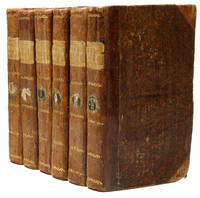
1791ABC_49348Venice: Giuseppe Orlandelli per la dita del fu Francesco di Nicolò Pezzana 1791. Contemporary half calf marbled paper sides with vellum corners a title label lettered in gold on the spine. 12mo. With a small vignette built up from typographical ornaments on the title page of each volume and with some headpieces built up from typographical ornaments. 6 volumes. Second Pezzana edition following that of 1784. That Niccolò Pezzanas company which in the meantime had been succeeded by Giuseppe Orlandelli returned to print the Arabian Nights testifies to the great favour the stories had found among readers in Venice. Also in 1791 the "Continuation of the Thousand and one nights" left its presses in a major publishing project to rediscover oriental fables.With the black ownership stamp of Ettiénne della Valle on the title page of each volume. Overall in good condition.l OPAC SBN ITICCUPUVE023925 4 copies incl. 3 incomplete; WorldCat 960425061 and other numbers for vols. 2-6 1203593861 3 copies; cf. Callegari Le edizioni veneziane delle Novelle arabe divise in mille ed una notte nel XVII secolo in Antoine Galland 1646-1715 et son journal: Actes du colloque international organise a lUniversite de Liege 16-18 fevrier 2015 a loccasion du tricentenaire de sa mort 2020 pp. 105-116 here at 108. This edition not in Chauvin. Giuseppe Orlandelli, per la dita del fu Francesco di Nicolò Pezzana, hardcover
1740ST19100aVenetiis Venice: Giambattista Pasquali 1740. FIRST EDITION. 132 x 90 mm. 5 1/4 x 3 1/2". 20 p.l. 427 5 pp. <br/> FINE CONTEMPORARY VENETIAN RED MOROCCO GILT covers with border of repeating botanical tools raised bands flanked by decorative gilt rolls green silk pastedowns all edges gilt and gauffered. HOUSED IN THE ORIGINAL PULL-OFF MARBLED CALF CASE the book and its case within a brown cloth chemise and matching slipcase. ENGRAVED THROUGHOUT with numerous floral initials 20 charming tailpieces frontispiece and 15 full-page illustrations by M. Pitteri all designed by Giambattista Piazzetta. Front flyleaves with book labels of John Saks Arthur and Charlotte Vershbow and David R. Godine. See: Boorsch "Venetian Prints and Books in the Age of Tiepolo" p. 20 and no. 98; Selby Carol E. "A Small Masterpiece from the Eighteenth Century Publishing World." Bulletin of the Detroit Institute of Arts vol. 43 no. 3/4 1964 pp. 60-63. ◆A hint of rubbing to extremities one tiny abrasion to front cover flyleaves with offsetting from binder's glue one page with tiny ink spot in margin but AN EXTREMELY FINE COPY ENTIRELY CLEAN FRESH AND BRIGHT internally in a beautifully preserved binding and case.<br/> <br/> Preserved in its original pull-off case and in superb unsophisticated condition this is a very charming prayer book engraved by a trio of talented artists that is called "a small masterpiece" in the "Bulletin of the Detroit Institute of Arts" in 1964 and described in the June 2013 Christie's catalogue of the Vershbow sale as "one of the most desirable Venetian illustrated books of the 18th century." The plates here were designed by Giovanni Battista Piazzetta 1682-1754 a painter and illustrator whom Britannica calls "one of the outstanding Venetian artists of the 18th century." Piazzetta was known for his masterful use of chiaroscuro and dynamic compositions--both of which can be seen to great effect in the present work. The engravings were executed by a close collaborator of Piazzetta Marco Alvise Pitteri 1703-86 whom Selby calls "one of the most able and popular engravers in Venice being in demand for the reproduction of works of his most distinguished contemporaries." Using his own unique blend of engraving techniques described by Boorsh as "unprecedented and unimitated" Pitteri is able to translate Piazzetta's animated compositions into a small-scale format with figures that are beautifully highlighted and seem to glow on the page. But perhaps the most impressive part of this work is the text itself. What at first glance appears to be more than 400 pages of letterpress is in fact entirely engraved--an extraordinary feat of precision and patient craftsmanship by Angela Baroni daughter of engraver Giuseppe Baroni. It seems likely that Angela learned the craft from her father but little else is known about her life. Regardless Angela's talents speak for themselves through this work. As Carol Selby tells us "Engraving a book like this one is an undertaking indeed. . . . The more than 400 pages must each have been engraved in reverse on copper plates which being almost impossible to correct allowed little margin for error. The effect is charming lively controlled but free." Thanks to the original and very pretty pull-off case this little gem has remained in outstanding condition inside and out. The volume has a distinguished provenance having belonged to collectors known for their taste and discrimination in the acquisition of a range of especially desirable books: John A. Saks who bought it from Bernard Quaritch in 1981 then Arthur and Charlotte Vershbow then David Godine who bought it at the Vershbow sale for $3000. Giambattista Pasquali unknown
174558875ABLeipzig, Schuster und Leipzig, Breitkopf (ab Band 8), 1745-50. 4to. Marmorierte Lederbände der Zeit mit geprägtem Rückentitel, reicher -vergoldung, intarsierte Deckel mit Blindprägung und einfacher Goldfilete.
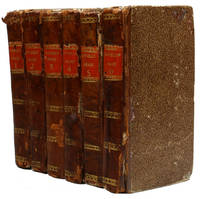
1784ABC_49347Venice: Francesco di Nicolò Pezzana 1784. Near-contemporary gold-tooled half calf marbled paper sides with a red morocco title label lettered in gold on the spine. 12mo. With a small vignette built up from typographical ornaments on each title page and some headpieces built up from typographical ornaments. 6 volumes. First edition by Pezzana a both prolific and diligent publisher of exotic tales. After Coletis first Italian edition of 1721-22 and that of Domenico Occhi between 1741 and 1743 Nicolò Pezzana was the third to issue the "Arabian Nights" in Italian: the text is the same as Coletis as is the size 12mo. From the time of their appearance the Novelle Arabe had been considered a work of literature for wide consumption and circulation . It was no coincidence that as early as 1780 the stories had been included in the group of works released from their privilege and subsequently raffled off among the less affluent members of the Guild. The printer Pietro Piotto who owned only a print shop without a bookshop was awarded the rights to the publication on 22 October; when he failed to exploit that privilege it was quickly seized by Pezzana Callegari. A very rare edition recorded in only six copies in the Italian OPAC SBN.The bindings are a little rubbed and the spines show some signs of wear around the head and foot. The work is somewhat browned throughout. Otherwise in good condition.l OPAC SBN ITICCULO1E019227 6 copies; Cf. Callegari Le edizioni veneziane delle Novelle arabe divise in mille ed una notte nel XVII secolo in Antoine Galland 1646-1715 et son journal: Actes du colloque international organise a lUniversite de Liege 16-18 fevrier 2015 a loccasion du tricentenaire de sa mort 2020 pp. 105-116 here at 108; this ed. not in Chauvin; WorldCat. Francesco di Nicolò Pezzana, unknown
177116613In Parigi, Apresso Agostino Delalain, Pietro Durand, Gio. Claudio Molini, 1771. 2 volumes grands in-4 de 331; 340 pages, plein maroquin rouge, dos à nerfs ornés de fleurons et petits fers dorés, triple filet doré en encadrement des plats, double filet aux coupes et roulette dorée aux chasses, tranches dorées.
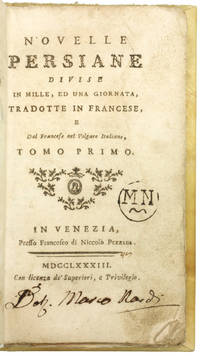
1783ABC_49353Venice: Niccolò Pezzana 1783. Later vellum with the manuscript titles and volume numbers in red on the spines. 12mo. With small vignettes built up from typographical ornaments on the title pages and some headpieces built up from typographical ornaments. 5 volumes. Extremely rare charming five-volume Italian edition of the Heyaryek-Rouz or Thousand and One Days so called to give the work an air of originality Chauvin IV 124. A Persian manuscript of this work was given to Francois Petit de la Croix in Isfahan in 1675 but enjoyed far fewer editions and translations than the Alf layla wa-layla. As Chauvin notes it cannot be determined whether the Thousand and One Days or the Thousand and One Nights was composed first nevertheless to this day the Heyarek-Rouz is much less well-known to the Western world IV 123f. Chauvin quotes one commentator who declares the Heyarek-Rouz much more ingenious and more realistic as it sometimes includes marvels following the taste of the Oriental.The present edition is printed by Niccolò Pezzana who only the following year would produce the Thousand and One Nights part of an ambitious publishing project catering to the Venetian public which at the time was rediscovering a taste for exotic fairy tales.With an owner's stamp MN on each title page and a manuscript inscription "Dot. Marco Nardi on the title page of vols. I and II. Both the inscription and the stamp belong to Dr. Marco Nardi. Further with some manuscript annotations in brown ink on the blank flyleaves. The endpapers are slightly worn some marginal worming to vol. V not affecting text some leaves are very slightly dust soiled. Otherwise in good condition.l OPAC SBN ITICCULO1E019364 3 copies incl. 2 incomplete; cf. this edition not in Chauvin; WorldCat. Niccolò Pezzana, hardcover
17911106531791. Signiert und datiert. Auf festem Bütten. 44 x 34 cm (oval). 51 x 37,5 cm (Papier).
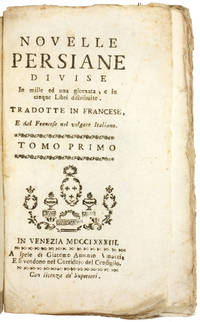
1783ABC_49354Venice = Naples: Giacomo Antonio Vinaccia 1783. Contemporary grey paper wrappers with manuscript volume numbers on the spines. Stored in a brown decorated paper slipcase. 12mo. With vignettes built up from typographical ornaments on each title page and some ornamental headpieces. 5 volumes. Very rare highly remarklable pirated edition in five volumes of the Heyaryek-Rouz or Thousand and One Days so called to give the work an air of originality Chauvin IV 124. A Persian manuscript of this work was given to Francois Petit de la Croix in Isfahan in 1675 but enjoyed far fewer editions and translations than the Alf layla wa-layla. As Chauvin notes it cannot be determined whether the Thousand and One Days or the Thousand and One Nights was composed first nevertheless to this day the Heyarek-Rouz is much less well-known to the Western world IV 123f. Chauvin quotes one commentator who declares the Heyarek-Rouz much more ingenious and more realistic as it sometimes includes marvels following the taste of the Oriental.The place of printing given on the title page of the present edition is Venice but the costs were borne by the well-known Neapolitan publisher Giacomo Antonio Vinaccia and the books were also sold in Naples in the Corridoio del Consiglio. It is known that Vinaccia drew on the great publishing pool of Venice for many of his publications creating actual counterfeits and it is thought that even Venetian publishers themselves relied on his presses to encourage the distribution of their works in the south as well without having to pay duties or apply for printing licences cf. A. Scannapieco. In 1784 the following year an identical edition appeared giving Naples as the place of printing.The wrappers are worn mainly around the spines the edges of the leaves are somewhat frayed. Otherwise in good condition.l OPAC SBN ITICCUNAPE028513 4 copies incl. 3 incomplete; WorldCat 955557595 1 copy also in OPAC SBN; cf. A. Scannapieco Un editore goldoniano nella Napoli del secondo Settecento in Problemi di critica goldoniana IV 1997 pp. 7-152; This edition not in Chauvin. Giacomo Antonio Vinaccia, unknown
1774ST12037<p>Vicenza: per Gio. Battista Vendramini Mosca 1774. FIRST EDITION. 305 x 216 mm. 12 x 8 1/2". lxxvi pp.</p><p>Original paste paper boards covered in red and green block-printed patterned paper. In a modern red cloth folding box. Frontispiece engraving of the arms of bride and groom engraved allegorical vignettes on title page and at end woodcut head- and tailpieces and foliated initials all done with considerable charm. Spine and head edge just slightly faded a couple of very small snags in backstrip one page with mild thumbing but A SUPERB COPY EXCEPTIONALLY CLEAN FRESH AND BRIGHT both the text and original printed paper wrappers in an almost unbelievable state of preservation.<br /><br />This is a remarkably well-preserved Italian "wedding book" a souvenir produced for friends and guests of a noble bride and groom. It contains a collection of romantic poems by 28 different authors along with engravings of the newlyweds' arms. This kind of book was popular in Italy particularly in the north during the second half of the 18th and early part of the 19th centuries. Such occasional works were produced by printers in the major cities like Venice Vicenza Padua Trento and Milan for assorted noble patrons. Copies of these fête books are to be found today in Italian and Swiss libraries but only two copies of any such volumes are held in North America one by the New York Public Library and one by the Getty. KVK locates four copies of our work one of them damaged in three Italian libraries. The groom here Count Lodovico Tiene or Thiene was a scion of one of Vicenza's most important families. His ancestor also named Lodovico built the Palazzo Thiene that was memorably remodelled by Vicenza's most famous son Andrea Palladio. Our volume was obviously a treasured keepsake that was carefully stored away from light and dust and it looks amazingly like it must have on the day of the happy nuptials.</p> per Gio. Battista Vendramini Mosca
1750190343-1Leipzig, J. Schuster (ab Bd. 8: Leipzig, B. C. Breitkopf) 1745-1750. 4°. Marmor. Lederbände d. Zt. mit reicher Rverg., Stehkantenvergoldung u. Marmorpapiervorsätzen und jeweils braunrotem Rückenschild.
18001979-03Paris 1800-07. Orig.-Radierung. "Presso l'Autore a Strada Felice nel Palazzo Tornati vicino alla Trinitá de' monti." Bez.: "Giovanni Battista Piranesi Architetto dis. ed inc." 43,5 x 55,5 cm. (Plattengr.). Unter Passep., ger. Einwandfrei. EA.
172641526ABLa Haye, Pierre Gosse, 1726. Folio (46x29cm). (8), 115; (2), 46; (2), 38; (2), 20, (4)pp. With engr. frontispiece, engr. portrait, 204 engr. plates and 12 text-engravings (illustrations numbered 1-230). Contemp. full calf with 6 raised bands, gilt-stamped label, richly gilt.
176764856Lemgo, Meyer, 1764-1767. 4°. Mit einer gefalt. Tabelle. Zus. ca. 2.900 S., HPgmt.-Bde. d. Zt. m. durchzogenen Bünden u. Rotschnitt.
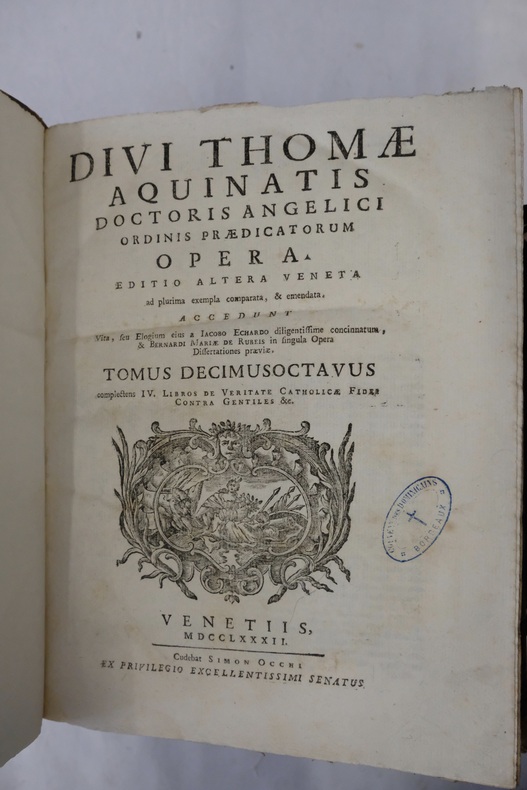
1775REL12MTome I : Commentaria in Librum Job, in Psalmos LI et in Canticum Canticorum. (avec portrait gravé de A. sur le frontispice) 535pp, 1775. Tome II : Commentaria in Esaiam et in Hieremiam, eiusque Threnos. 327pp, 1775. Tome IV : Auream Catenam in Mattaei et Marci Evangelia. 565pp, 1775. Haut du dos abîmé. Tome V : Auream Catenam in Lucae et Ioannis Evangelia, 592pp, 1775. Tome VI : Epistolas D. Pauli ad romanos, et ad corinthios. 464pp, 1775. Tome VII : Epistolae D. Pauli Ad pp, Galatas, Ad Ephesios, Ad Philippenses, Ad Colossenses, Ad Thessalonicenses, Ad Timotheum, Ad Titum, Ad Philemonem et Ad Hebraeos. 495pp, 1775. Haut du dos abîmé. Tome IX : Scriptum in Primum Sententiarum Librum. 535pp, 1776. Tome X : Scriptum in Secundum Sententiarum Librum. 568pp, 1777. Tome XI : Scriptum in Tertium Sententiarum Librum. 568 pp, 1780. Tome XII : Scriptum in Distinctiones duas supra viginti Libri Quarti Sententiarum. 524pp, 1780. (Quelques pages cornées). Tome XIII : Scriptum in reliquas viginti & octo Distinctiones Libri Quarti Sententiarum. 531pp, 1780. Tome XVIII : IV. Libros de Veritate Catholice Fidel Contra Gentiles &c. 500pp, 1782. Tome XX : Summe Theologice Primam Partem. 531pp, 1787. Tome XXI : Summe Theologice Primam Secunde. 535pp, 1787. Tome XXII : Summe Theologice Secunde Secunde priores quaestiones c. 428pp, 1787. Tome XXIII : Summe Theol. Secundae Secundae reliquas supras c. quaestiones. 348pp, 1787. Tome XXIV : Summe Theologice Partem Tertiam. 496pp, 1787. Tome XXV : Summe Theologice Supplementum Partis Tertiae. 395pp, 1787. Tome XXVI : Summe Theologice Indices. 323pp+131pp, 1787. Tome XXVII : Rerum Indicem ab A usque ad L. 468pp, 1788. Tome XXVIII : Rerum Indicem ab M. usque ad. Z item Indicem locorum S. Scripturae a D. Thoma illustratorum. 499Pp, 1788.
173081849Radierung 1730. 25,1 x 35,2 cm. Widmung von einer eigenen Platte gedruckt.