42 317 résultats
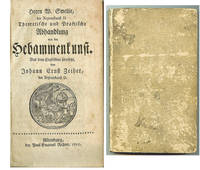
14877Altenburg Paul Emanuel Richter 1755. RARE: Antiquarian book in Old German Gothic Script. Hebammenkunst is Midwifery. Size: 7.00 x 4.00 inches approx. Not knowing German or the Gothic script it is difficult to know the exact translation of the title but it could be A Treatise on the Theory and Practice of Midwifery which is an antiquarian publication in English. Well used boards with background staining hardback name of a previous owner to front endpaper dated 1927 some browining but thoroughly readable engraved vignette to title page 492 numbered pages engraved embellishments all edge red full of character. Smellie William Theoretical and practical treatise on the art of midwifery. Translated from English by Johann Ernst Zeiher. VIII 492 pages . Altenburg PE Richter 1755. Extracted from the internet: 'First German edition of the classic work on obstetrics. -. "Smellie 1697-1763 contributed more to the fundamentals of obstetrics than virtually any individual in his Treatise 'he more accurately than any previous Described the mechanism of parturition writer stressing the importance of exact measurement of the pelvis Hey. Was the first to lay down rules regarding the safe use of forceps and personally Introduced the steel-lock the curved and the double forceps. He invented the Smellie maneuver 'to deliver breech cases. " Garrison / Morton 6154 the original-outputs. 1752 . - Smellie "is rightly considered the father of natural childbirth help . The op surgery he tried to limit as much as possible" Hirsch . ' . Altenburg, Paul Emanuel Richter, 1755, hardcover
Very Good English Modern cloth bdg. Foolscap 8vo. (18 x 12 cm). In Turkish. 85, [3] p. Turkish novel edition of Shakespeare's 'Romeo and Juliet'.
Very Good Turkish, Ottoman (1500-1928) Contemporary burgundy cloth. Cr. 8vo. (20 x 14 cm). In Ottoman script (Turkish with Arabic letters). 223 p., 224 p. (Two books bound together with 'Düsünce fikrinin gayr-i matbua' es'arindan'). Extremely rare first Turkish edition of Shakespeare's 'Antony and Cleopatra', translated by Abdullah Cevdet, (1869-1932). This is the last translation of Shakespeare into Turkish language made by Abdullah Cevdet. Cevdet translated and published five of Shakespeare's plays in his own printing house first in Cairo and then in Istanbul, beginning with Hamlet in 1908 and ending the series with Antony and Cleopatra in 1921. OCLC 66685311, 907298598. Library of Congress. Karl Süssheim Collection, no. 605.
Very Good Turkish Paperback. Cr. 8vo. (20 x 14 cm). Bilingual in English and Turkish (Modern, with Latin letters). 109, [3] p. Occasional foxing and stains on covers. Otherwise a very good copy. First separate edition in book form of Shakespeare's sonnets, covering 40 sonnets selected by Halman, among 154 sonnets. Talât Sait Halman, (1931-2014), was a famous Turkish poet, translator and cultural historian. He was the first Minister of Culture of Turkey. From 1998 onward, he taught at Bilkent University as the Dean of the Faculty of Humanities and Letters. The sonnets had been translated into Turkish, some of the long and heavily rhymed poems of Shakespeare such as Venus and Adonis, The Rape of Lucrece, and A Lover's Complaint remained yet to be translated. These remaining verses were translated by Talat Halman and published in 1964, and then in 2014, as a complete edition. This book is published as the publisher's 137th book. Agop Arad, (1913-1990), was a Turco-Armeno painter, graphic designer, cover and book illustrator, and journalist.
Very Good Turkish, Ottoman (1500-1928) In a contemporary creme cloth. Cr. 8vo. (19 x 14 cm). In Ottoman script (Old Turkish with Arabic letters). 165 p. Kütüphane-i Ictihad, Aded, 20. First Turkish edition of Julius Caesar by Shakespeare. Between 1908 and 1910, Abdullah Cevdet produced a large oeuvre of translations, including four translations of Shakespeare's tragedies: The translations of Hamlet and Julius Caesar (translated by Cevdet as Jül Sezar) were published in 1908, the same year as the declaration of the Second Constitution. [.] Nonetheless, Abdülhamid II seemed to be even less tolerant of the dissemination of Hamlet, Macbeth, and Julius Caesar, since they were about unjust rulers who were executed in the end. It is not surprising that the performances of these plays were subject to strict censorship in the Ottoman lands and banned (Paker 1986: 91). This could be shown as a reason why Abdullah Cevdet was able to publish the translations of these plays only after 1908, though he had finished translating Hamlet in 1902, Julius Caesar and Macbeth in 1904, and Romeo and Juliet in 1905 (Süssheim 1987). Due to the fact that Abdullah Cevdet was a culture-planner, his literary translations cannot only be judged on their "aesthetic" level. It will be discussed in this chapter that Abdullah Cevdet's translations of Hamlet, Julius Caesar, and Macbeth could be read as critical texts directed against Abdülhamid II's absolutist regime. Due to the fact that the selection of source language and culture is an important factor in accounting for any kind of "translation policy", Abdullah Cevdet's selection of source language and culture needs to be questioned (Toury 2000: 202). Even though Abdullah Cevdet does not include Julius Caesar (translated by Abdullah Cevdet with the title Jül Sezar) among what he calls "the four inauspicious tragedies", it was the only play for which Abdullah Cevdet wrote an impressive preface, and it was the second play he translated and published after Hamlet. In a sense, special importance was attributed to Julius Caesar by Abdullah Cevdet for ideological reasons and it was also highly esteemed by other revolutionaries in the Union and Progress Party (Enginün 1979: 119). Abdullah Cevdet was an Ottoman-born Turkish intellectual and physician of ethnic Kurdish descent. He was one of the founders of the Committee of Union and Progress (CUP). In 1908, he joined the Democratic Party, which later on merged with the Freedom and Accord Party in 1911. He was also a translator, radical free-thinker, and an ideologist of the Young Turks until 1908. The son of a physician, and himself a graduate from the Military College in Constantinople as an ophthalmologist, Cevdet, initially a pious Muslim, was influenced by Western materialistic philosophies and came to oppose institutionalized religion, but thought that "although the Muslim God was of no use in the modern era, the Islamic society must preserve Islamic principles". He published the periodical Içtihat from 1904-1932, in which articles he used to promote his modernist thoughts. He was arrested and expelled from his country several times due to his political activities and lived in Europe, in cities including Vienna, Geneva and Paris. His poetry was linked with the Symbolist movement in France, and he received accolades from leading French authors like Gustave Kahn. Özege 9788. Four institutional copies in OCLC: 4026865.
Very Good Turkish, Ottoman (1500-1928) In modern, handsome full brown morocco. Foolscap 8vo. (18 x 12.5 cm). In Ottoman script (Old Turkish with Arabic letters). 159 p. Extremely rare first Turkish translation of Macbeth, printed in Ottoman Cairo. Macbeth reflected Abdullah Cevdet's reaction against Hamidian despotism and his love and advocacy of liberty. One must also remember him as one of the founding members of the Party of Union and Progress - a secret organization that conspired to overthrow Abdülhamid's absolutist regime. The argument that Abdullah Cevdet's translation of Hamlet, Julius Caesar and Macbeth reflected his opposition to Abdülhamid II's absolute monarchy could be justified with the fact that the themes of the translated plays were perceived by the political authorities as threatening since they were about the murder of kings and heads of state. In Abdullah Cevdet's view, Macbeth is famous as a drama of "ambition for status" (hirs-i cah). Abdullah Cevdet was an Ottoman-born Turkish intellectual and physician of Kurdish ethnic descent, and one of the founders of the Committee of Union and Progress (CUP). In 1908, he joined the Democratic Party that later on merged with the Freedom and Accord Party in 1911. He was also a translator, radical free-thinker, and ideologist of the Young Turks until 1908. The son of a physician, and himself a graduate from the Military College in Constantinople as an ophthalmologist, Cevdet, initially a pious Muslim, was influenced by Western materialistic philosophies and came to oppose institutionalized religion but thought that "although the Muslim God was of no use in the modern era, the Islamic society must preserve Islamic principles." He published the periodical Içtihat from 1904 to 1932, of which articles he used to promote his modernist thoughts. He was arrested and expelled from his country several times due to his political activities and lived in European cities including Vienna, Geneva and Paris. His poetry was linked with the Symbolist movement in France and he received accolades from leading French authors like Gustave Kahn. (Source: DR. ABDULLAH CEVDET'S TRANSLATIONS (1908-1910): THE MAKING OF A WESTERNIST AND MATERIALIST "CULTURE REPERTOIRE" IN A "RESISTANT" OTTOMAN CONTEXT; Ayluçtarhan, Sevda). "Between 1908 and 1910, Abdullah Cevdet produced a large oeuvre of translations, including four translations of Shakespeare's tragedies: The translations of Hamlet and Julius Caesar (translated by Cevdet as Jül Sezar) were published in 1908, the same year as the declaration of the Second Constitution. Macbeth, translated by Cevdet as Makbes, was published in the following year. [.] Nonetheless, Abdülhamid II seemed to be even less tolerant of the dissemination of Hamlet, Macbeth, and Julius Caesar, since they were all about unjust rulers who were executed in the end. It is not surprising that the performances of these plays became subject to strict censorship in the Ottoman lands and banned (Paker 1986: 91). This could be shown as a reason why Abdullah Cevdet was able to publish the translations of these plays only after 1908, though he had finished translating Hamlet in 1902, Julius Caesar and Macbeth in 1904, and Romeo and Juliet in 1905 (Süssheim 1987). As Abdullah Cevdet was a planner of culture, his literary translations cannot merely be judged on an "aesthetic" level. It will be discussed in this chapter that Abdullah Cevdet's translations of Hamlet, Julius Caesar and Macbeth could be read as critical texts directed against Abdülhamid II's absolutist regime. [.] Due to the fact that the selection of source language and culture is an important factor in accounting for any kind of "translation policy", Abdullah Cevdet's selection of both these instruments needs to be taken into account (Toury 2000: 202). Özege 12009. Only one copy in OCLC: 949612474 (Bogaziçi University Library of Turkey).
Very Good Turkish, Ottoman (1500-1928) Full morocco in Ottoman style. Foolscap 8vo. (18,5 x 12 cm). In Ottoman script (Old Turkish with Arabic letters). 176 p. Extremely rare first Turkish translation of the Merchant of Venice by Shakespeare in book form. The Merchant of Venice (1885) and The Comedy of Errors (1886-87) were the earliest translations into Turkish by Hasan Sirri, which had the chance to be published in book form. Translators in the Ottoman era had to cope with three obstacles: cultural differences, difficulty in language, and censorship. Shakespeare's works were no exception, as Gönül Bakay argues "the early, Ottoman-period translators and producers expunged the negative imagery" (2004: np) of the Turks in his plays. Even The Merchant of Venice was banned because "it was believed that the theme would offend the Empire's (after 1923, the Republic's) Jewish population". The first play fully translated for print was actually the Merchant of Venice, published in 1885 in Turkish (Arabic letters - Ottoman script). There is a good deal of conjecture about the name of the translator: Only two initials appear on the book, H. and I. now claimed to be the first letter of the first name and the last letter of the last name of a Hasan Sirri. The translator of this book Örikagasizâde Hasan Sirri, (1861-1939), was an administrator and educator who grew up during the reign of Abdulhamid II and was in state service for almost forty years. He was the son of Turkish diwan poet Ahmet Nafiz Pasha and the father of author Nahid Sirri Örik. Özege 22638.; Only three copies in OCLC: 929866546 (NY Uni Lib.; Bogaziçi Uni Lib.; and Library of Congress. Karl Su?ssheim Collection, no. 1527).
Very Good Turkish, Ottoman (1500-1928) Original wrappers. Slightly chipped on extremities of cover. Overall a good copy. Roy. 8vo. (24 x 17 cm). In Ottoman script (Old Turkish with Arabic letters). 71 p. First Turkish translation ever of Shakespeare's works after the proclamation of the Republic in Turkey (1923); the rare second Turkish edition in the literature. After 19 years from the first translation of Hamlet to Ottoman Turkish, the first Shakespeare publication in the Republican period was also a Hamlet: This book translated by Kâmuran Serif would also be the second and the last Shakespeare published, on the brink of the Alphabet Reform in 1928. The fact that the Hamlet translation of Kâmuran Serif was published in the "State Printing House" can be considered as a symbolic indicator of the patronage that both Hamlet and all the works of language and literature together with Shakespeare's works will find in the Republic of Ataturk. Özege 6775.; Türkçe Çeviriler Bibliyografyasi Dünya Edebiyatindan Çeviriler, 14509.; Only one copy in OCLC (Orient Institut) 1030919478 / 283805564.
14181Without place or date. 1p. landscape 12mo. On bifolium addressed on reverse of second leaf to 'Mr. Richd. Lambe'. In fair condition on aged and lightly-worn paper with unobtrusive spike hole through the centre of both leaves. The letter reads: 'Mr. Say's compliments to Mr. Lamb sic has no knowledge of Ld. Jersey himself but have no doubt of getting an introduction and will see about it to morrow Morng. could you inform me who painted it that would be the best method of proceeding - Yours truly W. Say.' Without place or date. unknown
5508Date and place not stated. Dimensions roughly four and a quarter inches by eight wide. Good on lightly aged paper and with traces of previous grey-paper mount adhering to reverse which is docketed in a nineteenth-century hand 'Handwriting of the Author of Lorenzo de Medici'. Also docketed in left-hand margin of recto. Begins 'One of the most fatal enemies to the tranquility & happiness of human life is that jealous & timid apprehension which foresees evils at too great a distance & often imagines them when they do not exist'. Initialled in top left-hand corner. Date and place not stated. unknown
2471727 August 1936; c/o Jonathan Cape Ltd 30 Bedford Square WC1 London. See his entry in the Oxford DNB. 1p 12mo. In good condition lightly aged. Folded twice for postage. Reads: ‘Dear Miss Cond / I have pleasure in sending you my signature. As you will see it is quite an ordinary one. / Yours very truly / William Plomer’. The signature is in fact rather stylish in an understated way and the underlining has two small curls in it. In ink on otherwise-blank reverse by someone who misread the signature: 'William Ploms'. See Image. 27 August 1936; c/o Jonathan Cape Ltd, 30 Bedford Square, WC1 [London]. unknown
181656987London, 1816. origi.Lederband, kl.8°, 168 Seiten.
1849022826Baudry's European Library, Galignani, Paris 1849. Leinen Gut
Hardcover, 284 pages, English & Latin , 240 x 170 mm, NEW, rounded spine, sewn, dust jacket, reading ribbon. ISBN 9789464447668. Pascasius Justus Turcq was born in the Flemish town of Eeklo. As a young man, he travelled through Spain before devoting himself to the study of philosophy and medicine in Italy. On gaining his doctorate, he returned north and settled in Bergen-op-Zoom, where he worked as a physician and eventually became the city?s mayor. He attended to William the Silent as one of the physicians who worked to save the Prince?s life after the assassination attempt of 1582. Alongside tales of gambling princes and perceptive accounts of the mental suffering experienced by problem gamblers, Pascasius? De alea is remarkable for its singular insights into 16th-century medical science. Basing himself on the authority of the ancient, late-antique and mediaeval traditions, Pascasius first fuses discrete theoretical systems into an innovative framework, allowing him to propose a novel description of compulsive gambling as a psychological disorder. Secondly, Pascasius articulates a series of pioneering cures. He describes this therapy in cognitive terms reminiscent of approaches to non-substance addiction in use today. On Gambling was routinely referenced in scholarship on gambling into the 18th century before disappearing almost entirely from view. Newly available here, with a critical Latin text and English translation, On Gambling epitomises the creative potential of 16th-century medical humanism.
63-6503West Hartford CT: William L. Stull 1990. Signed typed letter on University of Hartford letterhead 11" x 8.5" Single Leaf Very Good. Provenance: Herb Yellin 1935-2014 was the highly respected publisher and founder of Lord John Press considered by many to be one of the most important small presses of the 20th century. West Hartford, CT: William L. Stull, 1990. unknown
63-5281West Hartford CT: William L. Stull 1990. Signed typed letter on University of Hartford letterhead 11" x 8.5" Single Leaf Very Good. Provenance: Herb Yellin 1935-2014 was the highly respected publisher and founder of Lord John Press considered by many to be one of the most important small presses of the 20th century. West Hartford, CT: William L. Stull, 1990. unknown
6374584249Human Kinetics Publishers pp. 344 . Hardback. New. Human Kinetics Publishers hardcover
2004Q-0761929673Corwin 2004-04-20. Paperback. New. In shrink wrap. Looks like an interesting title! Corwin paperback
18290From 48 Stockwell Park Crescent London S.W. On letterhead of the Savage Club Lancaster House Savoy W.C. 22 December 1886. 2pp. 12mo. Bifolium. In good condition lightly aged. Headed 'Private'. He writes that he called the previous day at Coffin's chambers and that he will do so the following day 'and will bring that bit for the wall'. He states 'in confidence' that he wishes to 'pay a surgeon on Saty next £6. 5. 0 rent for Studio - he is a good fellow but he wants his rent'. Callcott has in the studio 'a number of works & I would let you have if agreeable a good picture recent work size 61in x 41 - Rocky Coast - never used yet in Exhibition or otherwise'. He can let Coffin have the painting at an 'awfully low' price. From 48 Stockwell Park Crescent, London S.W. On letterhead of the Savage Club, Lancaster House, Savoy, W.C. 22 December 1886. unknown
1977754010PN. New. 1977. Soft Cover. Date is original print. This is a reprint edition. . PN paperback
Remainder mark to bottom of textblock. Slight soiling to wraps. Contents clean and bright. ; English introduction and notes with William Herebert's (1317-1319) extant works-- six sermons in Latin, and twenty-three lyrics in Middle English. ; Studies and Texts - Pontifical Institute of Mediaeval Studie; 173 pages
6593'Monday' no date but docketed 'Dec 1837'; '33 New B. S.' i.e. 33 New Burlington Street London. 12mo 1 p 10 lines. On worn discoloured paper with slight loss due to the breaking of two seals. Text clear and entire. The letter has been readdressed in another hand hence the two seals to 'Mr Price Crease & Sons Smithfield'. Harrison quotes his 'friend of the L. G. i.e. the Literary Gazette' as follows: 'Your D'Israeli paper may be useful as there is a new Edition. May I do as I like with its matter' He asks for 'an answer as soon as possible'. 'Monday' [no date, but docketed 'Dec 1837']; '33 New B. S.' [i.e. 33 New Burlington Street, London]. unknown
10448Chelsea London 28 Jan. 1849. One page 12mo good condition. From a batch of letters many of which are addressed to A. Williams of the "Liverpool Mercury" but no certain identification. Hazlitt says "I send you sundry autographs genuine as imported. I will not forget your wishes in this respect when other notable Manuscripts occur to me." Chelsea, [London], 28 Jan. 1849. unknown
0266363008.Ghardcover. Good. Access codes and supplements are not guaranteed with used items. May be an ex-library book. hardcover
1528569660.Ghardcover. Good. Access codes and supplements are not guaranteed with used items. May be an ex-library book. hardcover