329 résultats
17806432ABLondon, Longman, Cabel, Conant, 1780. 27,5 : 22 cm. 2 leaves, 200 pages Bound in contemporary calf with ornamental lines, ack lable.
1797E16937BHartford: J. Babcock 1797. First American edition. unbound. Poor. First American edition. 18mo. 4" x 6 1/2" Disbound and sewn without blanks 108 pp. A working copy only complete but with some loss to the title and final leaves not affecting the text short tear to two internal leaves again not affecting the text. Preceeds the 1798 American editions published in New Haven by G. Bunce and in Northampton Mass. by William Butler. Sold as is. The novel first appeared in London in 1687 and long remained in favor having several 18th century British printings. Charlotte Elizabeth Morgan notes in "The Rise of the Novel of Manners' 1911 that ".in the late 18th century a New England publisher passed it off as an original American production." . The summary continues:".the story is the usual one of love contrary to the commands of parents the desertion of the hero and the consequent suicide of the heroine. The use of portents is an interesting feature. J. Babcock unknown
175622212London: Printed for J. Morgan 1756 1756. First edition one of two issues; this one without the errata on page 76. ESTC T22278; Eddy Samuel Johnson Book Reviewer in the Literary Magazine 26; Hanley Samuel Johnson Book Reviewer pages 134-36. First and final leaves a little dust-soiled; very good copy. 8vo modern brown quarter buckram blue paper boards gilt lettering. With half-title. ¶ A defense of Admiral John Byng 1704-1757 of the Royal Navy who was on trial for treason based on dubious charges. He was found guilty and was tragically executed the following year. Shebbearre 1709-1788 a pamphleteer and contrarian wrote numerous tracts during the political crises of 1755-56 attacking the misadventures of the English government abroad. None according to Shebbearre were more blatantly wrongheaded than the trial of John Byng. Shebbearre's perceived lack of patriotism landed him in prison and he was roundly criticized and lampooned by the likes of Johnson Smollett and Griffith. Johnson eventually sided with Shebbearre in the Byng matter and approvingly reviewed An Appeal to the People in the Literary Magazine in October 1756. ESTC attributes An Appeal to John Byng himself and he did write pamphlets in his own defense but both Hanley and Eddy show convincing evidence that this was indeed by Shebbearre. <br/><br/> London: Printed for J. Morgan, 1756 unknown books
176822414London: Printed for T. Davies 1768 1768. First edition. ESTC T3451; NCBEL II 841; Fleeman 68.12HC/1a. First and final leaves slightly foxed; fine copy. 8vo modern brown boards stamped with black lettering. With half-title. ¶ The first of three plays by John Hoole 1727-1803 translator and aspiring writer. Hoole was a friend of Samuel Johnson and a member of his Essex Head Club. Johnson wrote the dedication to Cyrus and John Hawksworth wrote the epilogue. Hoole was best known for his translation of Tasso which earned him the nickname of "Tasso Hoole." See the ODNB. <br/><br/> London: Printed for T. Davies, 1768 unknown books
177610256London, Printed for T. Lowndes, 1776-1777. 5 volumes in-12 (sur 6) de [4]-282-[2]; [4]-283; [4]-284; [2]-285-[3] et [2]-287 pages, plein veau blond, dos à 5 petits nerfs ornés de filets, roulettes, tomaison et titre dorés, étiquettes de titre bordeaux, roulette dorée sur les coupes. dos frottés, petit manque à 2 coiffes supérieures, un mors fendu sur 2 cm au vol.4, 2 petits manques de peau au vol. 2, 2 ex-libris par volume.
17838371Edinburg, at the Apollo Press, [for John Bell], 1783. 3 volumes in-16 (13 x 8,5 cm) de [6]-XXII-196-[10] (la numérotation en arabe suit celle en romain et débute donc à 24) / [4]-XIV-191-[2] (num. arable débute à 16) et [4]-187-[6] pages. Plein veau glacé, dos lisses ornés de filets dorés, étiquettes de titre bordeaux, roulette dorée sur les coupes. Bel état.
17545748London, Thomas Payne, [1754]. In-8 de [8]ff., 439p., plein veau marron, dos à nerfs, pièce de titre beige, coins un peu frottés.
17848368Edinburg, at the Apollo Press, [for John Bell], 1784. 3 volumes in-16 (13 x 8,5 cm) de [6]-XVIII-179-[2] (la numérotation en arabe suit celle en romain et débute donc à 20) / [4]-208-[2] et [4]-188-[2] pages, plein veau glacé, dos lisses ornés de filets dorés, étiquettes de titre bordeaux, roulette dorée sur les coupes. Petit choc en tête et petite tache sur tranche du vol. 3, jolie condition générale néanmoins.
17759712London, W. Strahan and T. Cadell, 1775. 2 volumes in-4 de VIII-711 et X-690 pages, plein veau moucheté, dos à 5 nerfs ornés de filets dorés, étiquettes de titre et tomaison bordeaux, tranches mouchetées, roulette dorée sur les coupes. Mors fendus, quelques épidermures, rousseurs se limitant aux premiers feuillets.
17848370Edinbourg, at the Apollo Press, [for John Bell], 1784. 3 volumes in-16 (13 x 8,5 cm) de [6]-XLVII-131-[6] (la numérotation en arabe suit celle en romain et débute donc à 50) / [8]-202-[2] et [4]-XIV-219-[6] (num. arable débute à 16) pages. Plein veau glacé, dos lisses ornés de filets dorés, étiquettes de titre bordeaux, roulette dorée sur les coupes. Petit choc à un bord et tache au second plat du volume II, infime manque à la coiffe sup. du volume I.
1793205717Exeter : printed by R. Trewman and Son 1793. First Edition. Paperback. Fair pamphlet copy loosely bound with plain paper wrappers. Edges somewhat dulled and worn. Pages browned with foxing throughout. Minor pencil marks to title page. Worming evident in top margins. Previous owner's pen annotations at bottom of pages 20-21. ; 8vo 8"" - 9"" tall; 23 pages; Description: 23p. 18 x 11cm. Notes: p.23 signed ""An English freeholder."" Subjects: Equality -- Liberty -- Politics -- Religion -- Political pamphlets -- 18th century -- England -- Great Britain. Exeter : printed by R. Trewman and Son paperback
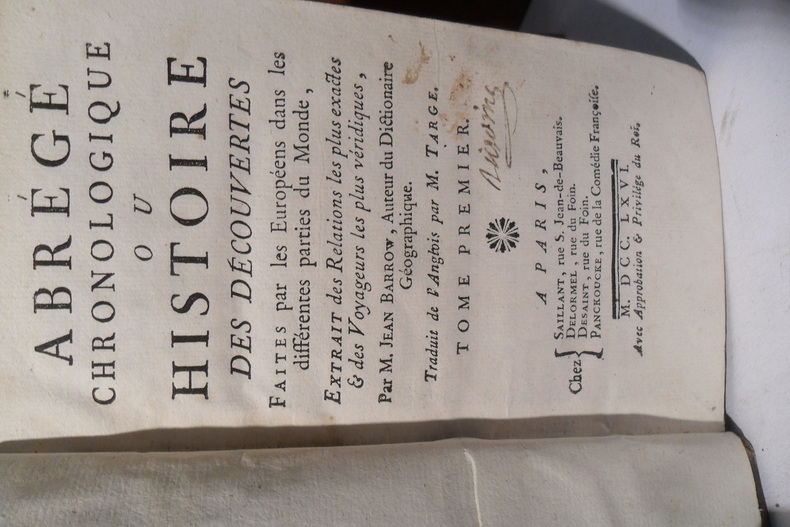
1766198131766 A Paris, chez Saillant, Delormel, Desaint & Panckoucke - 1766 - Première édition française - 11 tomes sur 12 volumes (manque T. V) - In-12 - Reliure de l'époque veau (frottée, coiffe usagée)- Dos lisse orné - Tranches marbrées - Filets sur les coupes - 1 Vignette par Tome - IV-448, 461, 459, 454 + Errata, 439, 428, 431 + Errata, 447, 449, 440 & 438 + Errata + (é)Approbation & Privilège - Propre intérieurement
1758PHO-1642Londres , Lille (Panckoucke) Paris (Desaint & Saillant) , 1758.In 12°, ix-36-369pp. (manque les pages 363-369 de la table de matière).Reliure de l'époque, plein veau marbré, dos fleuronné avec pièce de titre, tranches rouges, coins usés, frottements et manque au dos, petite mouillure en début d’ouvrage.
1707623337London, Nicholson, 1707. 3 Bl., 507 S., 10 Bl.; 2 Bl., 187 S. Leder d. Zeit (leicht berieben, Rücken erneuert). [2 Warenabbildungen]
177545046ABLondon, Evans 1775. 2 Bände. [4] Bll., CXVI, 185 S.; [2] Bll., VI, 7-271 S., [2] Bll. Moderne Pappbände mit Rückenschildern. Kl. Monogramm-Stempel (alt) am Titel. Jeweils 3 Endblätter im Rand gebräunt (Leimspur), sonst sehr sauber. Teils schwache Knickspur im 2. Band.
17357081Norwich: Printed and sold by L. Goddard 1735. First edition. 8vo 1 v 6-107pp. Engraved initial tables. Modern rebind in decorated paper boards backed in brown leather gilt spine label new endpapers page edge speckled red. Upper joint split holding soundly at endpaper. Contents clean with a couple of contemporary ink marks to blank verso of last page. <br /> List of supporters of candidates in the 1734 parliamentary election in Norwich which included Horatio Walpole 1st Baron Walpole. Full title:<br /> <br /> An alphabetical draught of the polls of Sir Edward Ward Bart. Miles Branthwayt esq; and of Horatio Walpole Waller Bacon esqs; for members of parliament for the city of Norwich: Taken May the 15th 1734. And of Miles Branthwayt Esq; and Thomas Vere Esq; Taken February the 19th 1734. Incorporated in one list.<br /> <br /> ESTC T161984. Printed and sold by L. Goddard unknown
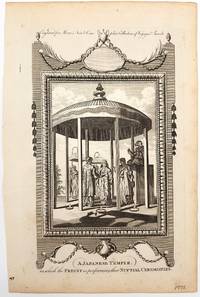
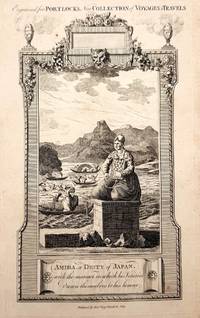
17781964London 1778. Engraving on cream laid paper 11 1/2 x 7 1/2 inches 290 x 190 mm full margins. In good condition with minor age tone and an unevenly trimmed left sheet edge. Ink inscription in the left margin recto and pencil inscription in the right margin recto both well outside of the image area. unknown
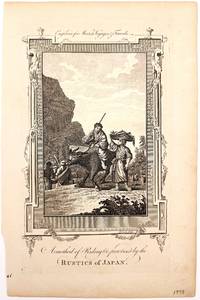
17781968London 1778. Engraving on cream laid paper 11 1/2 x 7 1/2 inches 290 x 190 mm sheet full margins. In good condition with minor age tone and an unevenly trimmed left sheet edge. Ink inscription in the left margin recto and pencil inscription in the right margin recto both well outside of the image area. unknown
17781974London 1778. Engraving on cream laid paper 11 1/2 x 7 1/2 inches 290 x 190 mm sheet full margins. In good condition with minor age tone and an unevenly trimmed left sheet edge. Ink inscription in the left margin recto and pencil inscription in the right margin recto both well outside of the image area. unknown
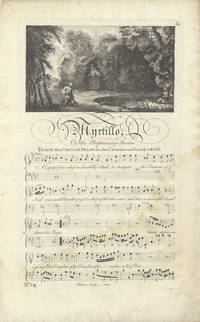
174036706London 1740. Unbound. Very Good. 4 leaves with large elaborate vignettes to heads illustrating the song with music and text below set for voice and figured bass. Ca. 326 x 200 mm. 12.75" x 7.85" plate mark; ca. 392 x 247 mm. 15.45" x 9.75" sheet size.<br /> <br /> Slightly worn; minor browning to edges; minor soiling and dampstaining; inner edges slightly frayed; small tears to edges. From the second edition of Bickham's monumental work first published in 1737-1739. BUC p. 107. RISM BII p. 245. <br /> <br /> "Bickham 1706-1771 was principally famous in music circles for his two illustrated folio volumes The Musical Entertainer first issued in fortnightly parts each containing four plates from January 1737 to December 1739. The 200 plates are songs headed and surrounded with pictorial embellishments illustrative of the song . and engraved in the style of and even copied directly from Gravelot and Watteau. This work was the first of its kind to be published in England and quickly produced imitators such as Lampe's British Melody engraved by Benjamin Cole." Frank Kidson et al. in Grove Music Online. <br /> <br /> A charming group of engravings.<br /> <br /> The Musical Entertainer is considered one of the finest 18th century illustrated books. Complete copies of this monumental work are exceptionally rare. unknown
176745044ABLondon, printed for Dodsley [Bände III und IV]: printed for T. Becket und P.A. De Hondt 1767-68. 4 Bände. Kl.-8°. [10] Bll., 203; 216 S.; [2] Bll., 192 S.; [2] Bll., 207 S. Leder der Zeit auf 5 Bünden, Rückentitel, Rücken-Numerierung, etwas Rückenvergoldung, Deckelfileten in Gold. Minimal berieben. Jeweils 3 Endblätter im Rand gebräunt (Leimspur). Wenige kl. Knickspuren.
1779000210London: Harrison and Co 1779 Book. Fair. Full-Leather. Full leather but very very worn. Interesting book plate to front pastedown initials WS and crest of hand holding a pistol above this printed name William Clarke. Contains a Nath. Lee Theodosius; or the force of love. 15p. Ink owner's name to title. b Sir John Vanbrugh. The city wives confederacy. 24p repair to title. c Solomon an oratorio. 4p. d Mr Havard King Charles I.14p. e Mr Farquhar Sir Harry Wildair being the sequel of the trip to the jubilee. 19p. f Saul an oratorio. 6p. Small hole to inner margin of last page. g Altered from Beaumont and Fletcher. Philaster. 16p. h Ben Johnson Jonson Every man in his humour. 23p. i Shakespeare. Coriolanus. 22p. j Beaumont and Fletcher. The chances. 1780. 21p. k Jephtha a sacred drama. 4p. l Esther an oratorio. 4p. m W Whitehead The roman fathers. 14p. n Mr Moore The foundling. 18p. o Colley Cibber The school-boy; or comical revival. 8p. p Theobald Electra. 14p. q Brome and Roome. The jovial crew. 17p. r Samuel Foote The englishman returned from Paris. 10p. s Dryden and Lee. Oedipus 22p. t Dryden and Hawkesworth Amphitryon 20p. u Theodora an oratorio. 5p. v Shakespeare Timon of Athens 19p. w Richard Steele. The funeral or grief a la mode. 20p. x Henry Fielding The Covent Garden tragedy. 6p. y Shakespeare Macbeth 19p. browned. z Smauel Foote The patron. 13p. aa Hawkesworth Zimri an oratorio. 5p. All with foxing and staining some more severe than others. No frontis present to any of plays original stab holes visible to inner margins of most pages. Ms list of contents at front. This and ffep almost detached. a - f published 1779 g - aa published 1780. See ESTC for details of which were published together. Harrison and Co hardcover
1788FB4792 /11<p>Navy calf spine with red and brown title plates gilt decoration and title. Blue and brown marbled boards and end papers.</p><p>Signed by the author Jardine Alexander this is a stand alone book full of individual historic letters. A First Edition of a second volume from a two volume set.</p><p>First edition. Jardine died. 1799 a Royal Artillery officer was for much of his career stationed in Gibraltar from where he conducted a mission to the sultan of Morocco Muhammad III in 1771; after the end of his active military career in 1776 he became a British agent in Spain. His Letters are "notable for their defence of sexual equality" ODNB which Jardine based on the profitable intermingling of the sexes which he observed on his travels: Jardine was a friend of William Godwin's and his book was read by Mary Wollstonecraft who reviewed it favorably in the fourth volume of the Analytical in 1789 O'Neill The Burke-Wollstonecraft Debate p. 116. It proved a demonstrable influence on her Vindication of the Rights of Women which was published in 1792 Chernock Men and the Making of Modern British Feminism p. 21 A very good copy.</p><p>CONTENTS OF THE SECOND VOLUME. LETTERS FROM SPAIN TO FRIENDS IN ENGLAND. LETTER I. On entering Spain from France. The Coun∣try. The Mountains. National and Provincial Objects. French Government. LETTER II. Guipuscoa. Lime. Police. People. Women. Frontier. Industry. Liberty. Policy. Pasage. St. Sebastian's. LETTER III. Romantic Ruins and Situations. Strangers attached to Spain. Society of Arts. Good Conde. Industry. LETTER IV. Iron. Trades. Music. Timber. Bilbao. Wool. Clergy. Commerce. Bourbons. Smuggling. The Poor. Mr. Bowles. Roads. LETTER V. Mountains. Cannon. St. Ander. Ships. Foundery. Military. Asturias. Liberty with Security. Monopolies. Govern∣ment. LETTER VI. Rivadeo. Winds. Provincial Characters and Distinctions. Galicia. Government. Marine. LETTER VII. Of Travel and French Opinions. Spanish Dependence and Decline. Reflections. Dr. R—. Truth. Books. LETTER VIII. Bowles. Manufactories. Pontz. History. Letters. Campomanes. Knowledge and useful Arts. LETTER IX. Talents. Conversation. Trades. Improve∣ments. Princes. LETTER X. Government and Character of the French and Spaniards. LETTER XI. Travellers. Galicia. Lands. Taxes. Law. Women. LETTER XII. Chimneys. Windows. Trees. Theft. Religion. LETTER XIII. Reflections on Home on Finance &c. LETTER XIV. Andalusia. Cadiz. Trade to the Colonies. Laws of Ports. LETTER XV. Virtue public and private. Reformers. Abuses. Mysteries. Government. LETTER XVI. General Knowledge. Universities. Arts. Travel. Military. LETTER XVII. Theory with Practice. Public Diversions. Women. Theatre. Letters. Learning. LETTER XVIII. Wit. Manners. Character. Taste. Language. Authors. LETTER XIX. Sierra Morena. Olavide. Cordova. The Moors their Arts Manners Taste. Walks. Society. Cortejos. Situation. LETTER XX. Nobility. Mirth and Happiness. Antiqui∣ties. Arts and Population. LETTER XXI. Country. Seguidillas. Timber. Sheep. Corporations. Nitre. Military Schools. Aranjuez. LETTER XXII. Madrid. Arts. People. Escurial. Old Castile. Flocks. Towns. Church. Corn. Water. Government. LETTER XXIII. Examples. Colonies and Companies. East Indies. LETTER XXIV. Spanish Improvements. Roads. Canals. People. Laws. Languor. LETTER XXV. Tolls. Mountains. Mauragatos. Galicia. St. Jago. Societies. Commerce. LETTER XXVI. The Peninsula of Spain and its Inhabitants. LETTER XXVII. On Government. LETTER XXVIII. Spanish ancient Government. Decline. Cha∣racter. Peculiarities. Edicts and want of Confidence. LETTER XXIX. Spanish Manners. Taste. Passions. Hap∣piness. Female Character. Ministry. Princes. LETTER XXX. Situation. Trade. Prohibitions and high Duties. LETTER XXXI. Commerce. Policy. War. Gibraltar. Family Compact. Mediterranean. LETTER XXXII. Spanish Charity and Poor. Spirit of Power of Control and of Government. LETTER XXXIII. Of Changes. Towns. Police. Of Princes. LETTER XXXIV. Rural Taste and Improvements. Servants. Population. Money &c. Impediments to the Rise of Spain. LETTER XXXV. Military and Geographical Observations. Conclusion. LETTERS FROM PORTUGAL TO FRIENDS IN ENGLAND. LETTER I. Galicia and North of Portugal. Vigo. Spanish Councils. Defensive War. Industry Taste Science of the Portuguese. Water Finders. Frontier Coast. LETTER II. Form &c. of Portugal. Vegetable and animal Life. Character. Count la Lippe. LETTER III. Policy. Industry. Character. Law. LETTER IV. Manners and Education. Inquisitorial and Monastic Spirit. Toleration. Romish Church &c. LETTER V. Appearance of the Country. People. Braga. Oporto. Brazils. Wine Trade. Lower Classes. LETTER VI. Lisbon. Marquis de Pombal. Sovereigns and Government. Character &c. LETTER VII. Of Books. Of Man. Portugal. Of Societies. The World. Europe. Confe∣deracies. Letters. War. Travelling &c. in a variety of miscellaneous Re∣flections. A LETTER FROM JERSEY. To A. J.</p><p>Barbaria by Jan Janssonius shows the coast of North Africa an area known in the 17th century as Barbaria c. 1650</p><p>The Barbary pirates Barbary corsairs or Ottoman corsairs were mainly Muslim pirates and privateers who operated from the Barbary states. This area was known in Europe as the Barbary Coast in reference to the Berbers. The main purpose of their attacks was to capture slaves for the Barbary slave trade. Slaves in Barbary could be of many ethnicities and of many different religions such as Christian Jewish or Muslim. Their predation extended throughout the Mediterranean south along West Africa's Atlantic seaboard and into the North Atlantic as far north as Iceland but they primarily operated in the western Mediterranean. In addition to seizing merchant ships they engaged in razzias raids on European coastal towns and villages mainly in Italy France Spain and Portugal but also in the British Isles the Netherlands and Iceland.</p><p>An action between an English ship and vessels of the Barbary Corsairs</p><p>While such raids began after the Muslim conquest of the Iberian Peninsula in the 710s the terms "Barbary pirates" and "Barbary corsairs" are normally applied to the raiders active from the 16th century onwards when the frequency and range of the slavers' attacks increased. In that period Algiers Tunis and Tripoli came under the sovereignty of the Ottoman Empire either as directly administered provinces or as autonomous dependencies known as the Barbary states. Similar raids were undertaken from Salé and other ports in Morocco.</p><p>A Sea Fight with Barbary Corsairs by Laureys a Castro c. 1681</p><p><strong> Background:</strong> The Barbary corsairs were pirates and privateers who operated out of North Africa based primarily in the ports of Tunis Tripoli and Algiers. This area was known in Europe as the Barbary Coast in reference to the Berbers. Their predation extended throughout the Mediterranean south along West Africa's Atlantic seaboard and even to the eastern coast of South America with Brazil and into the North Atlantic Ocean as far north as Iceland but they primarily operated in the western Mediterranean. In addition to seizing ships they engaged in raids on European coastal towns and villages mainly in Italy France Spain and Portugal but also in England Scotland the Netherlands Ireland and as far away as Iceland. The main purpose of their attacks was to capture Europeans for the slave market in North Africa. The Barbary states were nominally part of the Ottoman Empire but in practice they were independent and the Ottoman government in Constantinople was not involved. Attacks:Since the 1600s the Barbary pirates had attacked British shipping along the North Coast of Africa holding captives for ransom or enslaving them. Ransoms were generally raised by families and local church groups. The British became familiar with captivity narratives written by Barbary pirates' prisoners and slaves. During the American Revolutionary War the pirates attacked American ships. On December 20 1777 Morocco's sultan Mohammed III declared that merchant ships of the new American nation would be under the protection of the sultanate and could thus enjoy safe passage into the Mediterranean and along the coast. The Moroccan-American Treaty of Friendship stands as America's oldest unbroken friendship treaty with a foreign power. In 1787 Morocco became one of the first nations to recognize the United States of America. Starting in the 1780s realizing that American vessels were no longer under the protection of the British navy the Barbary pirates had started seizing American ships in the Mediterranean. As the U.S. had disbanded its Continental Navy and had no seagoing military force its government agreed in 1786 to pay tribute to stop the attacks. On March 20 1794 at the urging of President George Washington Congress voted to authorize the building of six heavy frigates and establish the United States Navy in order to stop these attacks and demands for more and more money. The United States had signed treaties with all of the Barbary states after its independence was recognized between 1786 and 1794 to pay tribute in exchange for leaving American merchantmen alone and by 1797 the United States had paid out $1.25 million or a fifth of the government's annual budget then in tribute. These demands for tribute had imposed a heavy financial drain and by 1799 the U.S. was in arrears of $140000 to Algiers and some $150000 to Tripoli. Many Americans resented these payments arguing that the money would be better spent on a navy that would protect American ships from the attacks of the Barbary pirates and in the 1800 Presidential Election Thomas Jefferson won against incumbent second President John Adams in part by noting that the United States was "subjected to the spoliations of foreign cruisers" and was humiliated by paying "an enormous tribute to the petty tyrant of Algiers".</p> T Cadell. hardcover
1731AQ24973London: Printed by the Assigns of His Majesty's Printer and of Henry Hills decease'd 1731. Unpaginated. Contemporary gilt-tooled sheep. Extremities heavily worn joints split loss to head of spine. Marbled endpapers contemporary armorial bookplate to FEP and inked ownership inscription to front blank fly-leaf of Cosmo George Duke of Gordon. Cosmo George Gordon third Duke of Gordon 1720-1752 Scottish peer. Gordon was named after his father's close friend Jacobite sympathiser Cosimo III de' Medici 1642-1723. Unlike his father Alexander Gordon second Duke of Gordon c.1678-1728 who fought with the Jacobites at the Battle of Sheriffmuir during the 1715 Rising Cosmo despite the pleas of his younger brother Lord Lewis declined to support the Rising of 1745. ESTC records a single copy of this edition in North America Huntington and none elsewhere. ESTC N67565. 12mo. Printed by the Assigns of His Majesty's Printer, and of Henry Hills, decease'd unknown
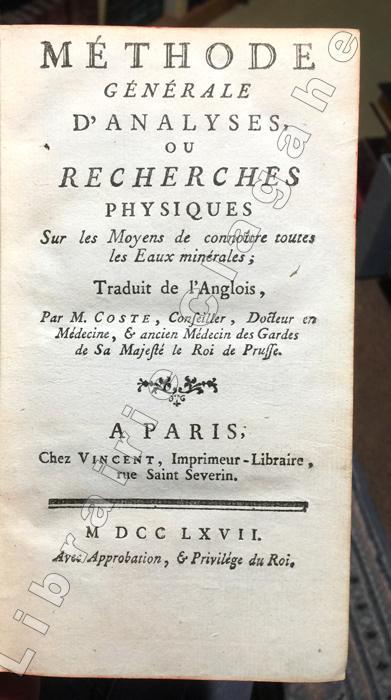
176721811Paris, Vincent, 1767 ; in-12, veau marbré, dos à nerfs décoré et doré, pièce de titre grenat, tranches rouges (reliure de l'époque) ; XV, 392 pp.