(Bible, English)Biblio.com

306 résultats
1763306680Birmingham: John Baskerville Printer to the University 1763. The third variant of the Subscriber's list with the most names ending with that of the Hon. Charles York Esq Attorney General. 1146 pp. 1 vols. Folio. Bound in full dark blue straight-grained morocco covers tooled in gilt with wide Greek key and drawer handle border with floral cornerpieces narrow gilt filet-bordered rectangles tooled all over with drawer handle and sunburst tools and semé off small dots with central gilt-stamped L with crown spine with six double raised bands titled in one compartment stamped with owner's name "Frederic Powys" in another and the rest richly gilt a.e.g. pink endsheets by Staggemeier and Welcher with their circular pink paper label on front pastedown. Front joint and headcap with conservation repairs of the highest quality light foxing to text. The third variant of the Subscriber's list with the most names ending with that of the Hon. Charles York Esq Attorney General. 1146 pp. 1 vols. Folio. The 1763 edition of Baskerville's Bible has always been recognised as his masterpiece and is one of the high-points in the history of printing in Britain. This beautiful and monumental binding can be closely dated because Thomas Powys formerly MP for Northamptonshire was created Baron Lilford in 1797 and Staggemeier & Welcher are recorded in partnership on Villiers Street as of 1799. By 1810 Welcher was in business alone at that address. The Hon and Rev. Frederic Powys whose name appears on the spine was the third son of the first Lord Lilford; he married in 1807. Whether the binding was commissioned for his taking holy orders or on the occasion of his marriage can only be conjectured. A landmark of printing in a splendid binding. Nixon p. 184; Gaskell Bibliography of John Baskerville 26; Ramsden p. 135. Provenance: Frederic Powys his name tooled in gilt to spine Lilford Library booklabel John Baskerville, Printer to the University unknown
17631230541763. Cambridge: Printed by John Baskerville Printer to the University 1763. <br /> <br /> Royal folio 573 unnumbered leaves. A2 1 B-13D2 a-e2 f1. English binding of contemporary full blue-green morocco covers with elaborate gilt border backstrip richly gilt with red morocco lettering pieces stamped in gilt "HOLY BIBLE" and at the foot "BASKERVILLE" gilt edges marbled endpapers. Inevitable slight signs of wear on such a huge book but in all a very good unrestored copy internally flawless.<br /> <br /> § First edition of Baskerville's masterwork in a magnificent contemporary English binding. Third issue of the subscribers' list as usual. "John Baskerville was a monumental figure in the history of English bookbinding and printing with contemporary accounts of his work ethic revealing a man deeply engaged in virtually every aspect of book production. Yet for most of his life and indeed for many decades afterwards he was decried as a mere amateur. Still other sources show an individual with highly idiosyncratic and paradoxical habits -- he lived with Sarah Eaves for nearly two decades out of wedlock; a devout atheist who was buried in his own backyard without Christian ceremony; a man who 'had wit but always against religion and decency'" F.E. Pardoe in John Baskerville of Birmingham: Letter-Founder and Printer 1975. <br /> <br /> Paradoxically after taking the position of Printer to the University of Cambridge on 1 December 1758 Baskerville produced one of the few great Bibles. It is a true masterwork expertly printed with impeccable attention to ink type spacing paper quality and ease of use. Published on 4 July 1763 "the adjective that inevitably comes to mind is 'noble' and the volume warrants the word. It was conceived and executed on a grand scale. to show that he had now learnt his craft and was able to practice it in a masterly fashion. and the result shows again that Baskerville must be placed in the very top rank of book designers" Pardoe 87. Morison and Day The Typographic Book 1963 write that "Baskerville's folio English Bible printed for the University of Cambridge is the finest presentation of Holy Writ since Richelieu's Latin Vulgate printed at the Imprimerie Royal" 48. Gaskell 26. Herbert 1146. Morison & Day The Typographic Book 48. Huntington Library Great Books in Great Editions 7. Rothschild 2640. Rumball Petre 145. unknown
1763306680Birmingham: John Baskerville Printer to the University 1763. The third variant of the Subscriber's list with the most names ending with that of the Hon. Charles York Esq Attorney General. 1146 pp. 1 vols. Folio. Bound in full dark blue straight-grained morocco covers tooled in gilt with wide Greek key and drawer handle border with floral cornerpieces narrow gilt filet-bordered rectangles tooled all over with drawer handle and sunburst tools and semé off small dots with central gilt-stamped L with crown spine with six double raised bands titled in one compartment stamped with owner's name "Frederic Powys" in another and the rest richly gilt a.e.g. pink endsheets by Staggemeier and Welcher with their circular pink paper label on front pastedown. Front joint and headcap with conservation repairs of the highest quality light foxing to text. The third variant of the Subscriber's list with the most names ending with that of the Hon. Charles York Esq Attorney General. 1146 pp. 1 vols. Folio. Baskerville's Masterpiece in Staggemeier & Welcher Binding. The 1763 edition of Baskerville's Bible has always been recognised as his masterpiece and is one of the high-points in the history of printing in Britain. This beautiful and monumental binding can be closely dated because Thomas Powys formerly MP for Northamptonshire was created Baron Lilford in 1797 and Staggemeier & Welcher are recorded in partnership on Villiers Street as of 1799. By 1810 Welcher was in business alone at that address. The Hon and Rev. Frederic Powys whose name appears on the spine was the third son of the first Lord Lilford; he married in 1807. Whether the binding was commissioned for his taking holy orders or on the occasion of his marriage can only be conjectured. A landmark of printing in a splendid binding. Nixon p. 184; Gaskell Bibliography of John Baskerville 26; Ramsden p. 135. Provenance: Frederic Powys his name tooled in gilt to spine Lilford Library booklabel John Baskerville, Printer to the University unknown books
174236184London 1742. 6 works in one volume folio. 12 1/2 x 8 inches. Manuscript index. Contemporary English mottled calf expertly rebacked to style spine gilt with raised bands red morocco lettering piece.<br/> <br/>Provenance: Samuel Sandys 1st Baron Sandys 1695-1770<br/> <br/>An extraordinary sammelband of early 18th century Parliamentary reports and colonial laws relating principally to the English colonies in America including the first collected printing of colonial charters and an important early work on Georgia.<br/> <br/>1 Report from the Commissioners for Trade and Plantations . a Scheme for the Registering the Wool of Great Britain and Ireland. London: 1741 but 1742. 11 1pp. This Parliamentary report dated Feb. 12 1741-2 and issued under Walpole's administration details a fifty-point process for the licensing of wool from the moment of shearing in an attempt to reduce the smuggling of wool and the avoidance of export tariffs. ESTC T150068. 2 An Abridgement of Several Acts and Clauses of Acts of Parliament Relating to the Trade and Navigation of Great Britain to and from and in the British Plantations in America. London: John Baskett. 1739. Text in two columns. 44pp. Includes text from the Molasses Act of 1733 as well as other British Acts of Parliament relating to colonial trade the fisheries piracy and more from as early as 1660 to 1735. Sabin 80; ESTC T111534 recording only four copies in North America. 3 MARTYN Benjamin 1699-1763. An Account shewing the Progress of the Colony of Georgia in America from its First Establishment. London: 1741. 2 71 1pp. Ordered to be published by the Trustees for Establishing the Colony of Georgia this work -- the first history of the Colony of Georgia -- was issued as a Parliamentary paper ordered to be printed 26 February 1741. "While Martyn's two earlier pieces of 1732 his Some Account and New and Accurate Account were in the nature of prospectuses for the proposed colony of Georgia the Account shewing the Progress is a year by year record of happenings there preceded by a discussion of the charter and especially its reasons for the prohibition against Negroes. There is also much on the relations between Georgia and South Carolina. This is the first year by year account of the colony of Georgia." Streeter. A very few examples are extant with a map of Georgia inserted not present here and not present in either the Streeter or Siebert copies. Rare. Clark I:121; De Renne I pp. 90--91; European Americana 174/147; Howes M353; Sabin 45000; Siebert sale 573; Streeter sale 2:1145; Vail 411; ESTC T103222. 4 A List of Copies of Charters from the Commissioners for Trade and Plantations . Viz. Maryland . Connecticut . Rhode-Island . Pensylvania sic . Massachusets Bay . Georgia . London: 1741. 2; 12; 10; 14; 12; 21 1; 18pp. Text of the Maryland Charter in Latin. The first collected edition of American colonial charters issued as a Parliamentary paper and ordered to be printed 11 February 1741. ESTC notes two issues: the present with "John Clarke" on the last line of the first page of the Connecticut charter. Rare with only a single example in the auction records for the past half century. Rich I:15; Sabin 41430; Tower 8; ESTC T80993. 5 Acts of Assembly Made and Enacted in the Bermuda or Summer-Islands From 1690 to 1713-14. London: John Baskett 1719. 2 v 1 79 1pp. With separate title pages to each of the various sessions i.e. at pages 28 41 and 55. The first collected laws of Bermuda. Very rare with no examples in the auction records for the past half century. Sabin 4906; Tower 4; ESTC T145163. 6 Acts of Assembly Passed in the Island of Barbadoes; From 1717-18 to 1738 inclusive. Part II. London: John Baskett 1739. x 2 blank 315-484pp. Preceded by pp. 315-318 i.e. a supplement to Part I. The first part was separately published in 1721 and reissued in 1732 comprising the laws from 1648 to 1718. This second part recording the laws from 1717 to 138 also includes an abridgment of the previous Acts of Assembly in the rear. Sabin 3260; ESTC T19070. unknown books
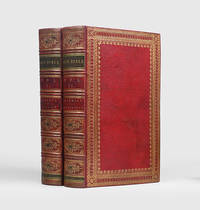
1763184488Cambridge: printed by John Baskerville 1763. An outstanding synthesis of fine printing illustration and binding First Baskerville edition: a spectacular copy of one of the greatest English Bibles and a crowning achievement of English printing in a magnificent Staggemeier and Welcher binding and abundantly extra-illustrated with 287 Old Master engravings. The copy adorned two of the greatest book collections of the last two centuries: the library of the Dukes of Marlborough at Blenheim Palace and of Estelle Doheny in California. Friedrich Leberecht Staggemeier 1759-1827 was esteemed for his elaborately decorated neoclassical bindings. He partnered with Samuel Welcher from 1799 to 1810 and the pair catered to the highest echelons of the market. Extra-illustration was a distinguishing feature of this market: here 171 of the illustrations are from Bernard Picart and Gerard Hoet's Figures de la Bible The Hague 1728 and 58 are from Pierre Mortier's Bible Amsterdam and Antwerp 1700 while others are from Jan Luyken's Icones Biblica Veteris et N. Testamenti Amsterdam 1729 and other sources. The extravagant binding and extra-illustration were commissioned by the first owner the collector and scholar Jacob Bryant. In 1804 he bequeathed the Bible to his patron George Spencer 4th Duke of Marlborough. It remained in the duke's collection at Blenheim Palace until 1881 when it passed to Fanny Octavia Louisa daughter of the 7th duke. Her descendants sold the book and it passed via Dawson's Book Shop to Estelle Doheny one of the greatest collectors of the 20th century where it joined her Gutenberg Bible and other landmarks of printing history. She bequeathed it to St. John's Seminary which sold it and the rest of Doheny's collection in 1988 where it realized $11000. Bound in 2 vols large folio 518 x 343 mm pp. 1146. Extra-illustrated with 287 Old Master engravings of which 198 are single page and 84 double each mounted mostly within a black ink and pale yellow wash frame. Late 18th- or early 19th-century red straight-grain morocco by L. Staggemeier & Welcher of London binder's ticket green morocco labels richly gilt in compartments wide gilt borders to covers gilt Greek-key turn-ins green watered-silk linings with gilt grapevine borders all edges gilt. Joints and extremities restored scattered light offsetting from plates and foxing else contents fresh very minor worming to front endpapers of first volume: a beautiful copy. ESTC T93106; Gaskell 26; Herbert 1146. unknown
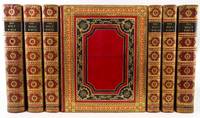
1800ST20221aLondon: T. Bensley for T. Macklin final volume Bensley for T. Cadell & W. Davies 1800 for the six volumes of the Bible 1816 for the Apocrypha. First Printing of this Edition. 480 x 385 mm. 19 x 15 1/8". One leaf in the Apocrypha 3P2 comprising two prologues of Ecclesiasticus invisibly inserted from another copy. Seven volumes comprising the regular Bible in six volumes and the Apocrypha usually not included as a seventh volume. <br/> ABSOLUTELY MAGNIFICENT CONTEMPORARY RED NEOCLASSICAL-STYLE STRAIGHT-GRAIN MOROCCO SUMPTUOUSLY GILT AND ONLAID WITH BLUE BY GEORG FRIEDRICH KRAUSS done for Prince Albert Casimir Duke of Saxe-Teschen with repeated "AST" monogram covers with very elaborate frames incorporating 11 plain and decorative gilt rules four onlaid borders of blue morocco and very elegant swirling foliate ornamentation around the central scalloped panel six pairs of raised bands each pair flanking a recessed gilt and blue metope and pentaglyph rule very handsome spine compartments with blue fan-shaped cornerpieces and central gilt-decorated blue medallions within sunburst gilt collars turn-ins with Greek key pattern in gilt striking endleaves of turquoise and green watered silk the Apochrypha endleaves slightly different. With more than 100 allegorical headpieces and tailpieces and some 70 SPLENDID LARGE-FOLIO-SIZE COPPER PLATES after Fuseli Reynolds West and others most plates printed before letters. Tissue guards perhaps later. Herbert 1442 and 1651. First volume with about 30 leaves noticeably foxed the majority of plates offset onto previous and following pages consistent inoffensive offsetting of text on facing pages other trivial imperfections but still a very impressive copy internally with the luxurious paper used for the text both fresh and clean and the engravings richly impressed and with very little foxing. Some unimportant scuffing and rubbing to the leather but all defects minor THE MAGNIFICENT BINDINGS REMARKABLY WELL PRESERVED the heavy volumes completely solid with only insignificant signs of use and THE MOROCCO AND LAVISHLY GILT DECORATION EXTREMELY BRIGHT. AN ALTOGETHER MEMORABLE COPY.<br/> <br/> The most prodigious form of Scripture in English ever published the Macklin Bible was often put into ornate bindings especially by London binders like Staggemeier and his contemporaries. But however much other sets may glisten the present magnificent example surely stands at or near the front of the line as one of the most lavishly decorated and arresting copies in existence. Its decorative extravagance also testifies to the fact that Macklin's publication was sufficiently admired outside of England to warrant the finest workmanship and the expenditure of great sums of money on artistic resources. The very large and bold type the fine Whatman paper and the series of engravings by some of the most celebrated artists of the period make this an item that is already very desirable. Like the Boydell "Shakespeare Gallery" also printed by Bensley our Macklin Bible is a vast picture book with illustrations that are grand both in size and emotional impact. But it is of course the bindings here that matter the most. Francesco Piranesi is generally given credit for inventing the Neoclassical style when he designed volumes presented to Gustavus III of Sweden during this monarch's visit to Rome in 1783-84. Quickly popular the Neoclassical style was imitated and developed by Staggemeier & Welcher in London by F. W. Standlander in Stockholm and by Georg Friedrich Krauss in Vienna. Krauss was the most prominent Continental binder working in this style of the day and Saxe-Teschen was perhaps his most important client. Products of the Krauss bindery have passed through some of the most distinguished collections over the years particularly those of Fürstenberg and Schäfer; and his bindings have consistently brought remarkable sums of money at auction. It is sufficient to say that the present group of bindings represents the most impressive collection of decorative volumes we have ever offered for sale. The collector for whom these bindings were originally executed Duke Albert of Saxe-Teschen 1738-1822 was the son of Friedrich August II of Saxony and the son-in-law of the empress Maria Theresa. After providing important military and civil service to the Habsburg empire he retired to Vienna in 1795 and afterward devoted himself to the fine arts. He founded the Albertina which now houses the greatest collection of prints in the world and he put together a great library distinguished by the highest taste and most exacting standards. The present copy has the additional distinction of containing what amounts to an extra volume: the Macklin Bible however it is bound most often appears in the marketplace without the Apocrypha appearing here as Volume VII which was not issued until 16 years after the others. It is also of some interest that the bindings of our seven volumes were decorated in an entirely uniform fashion as a close inspection shows something not typical of a set with volumes published so many years apart. The non-uniform endleaves in the final volume here may have resulted from the fact that given the physical size of the books the binder simply ran out of the cloth he had used for lining the first six volumes. The present set was offered though unsold at Sotheby's in 2003 with an estimate of £40-50000 approximately $64000-80000 and in 2005 for £30-40000 approximately $54000-72000. T. Bensley for T. Macklin [final volume Bensley for T. Cadell & W. Davies] unknown