James, PhilipLivre Rare Book
42 315 résultats
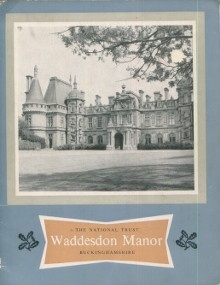
3995Pitkin Pictorials Limited, London, 1959. In-8, plaquette agrafée sous couverture illustrée en noir et blanc,36 pp. Waddesdon Manor, a short guide by Philip James. - Foreword : Waddesdon Manor and the Rothschild Family - The National Trust : Waddesdon Manor Buckinghamshire : the description of the rooms follows the order in which they are viewed by ...
243089 May 1899; 112 Manor Road Stoke Newington N London. See his entry in the Oxford DNB. 1p 12mo. In good condition lightly aged. Folded once. The recipient whose name Jacobs gives as ‘D. H. Denselow Esq’ was the commercial artist and autograph hunter Douglas Harold Hellier-Denselow whose studio was in Gunnersbury West London. The note reads: ‘Dear Mr. Denselow / I am much obliged for your letter & its accompanying illustration. I shall not follow your example & affix my eye to my autograph / Yours very truly / W. W. Jacobs’. 9 May 1899; 112 Manor Road, Stoke Newington, N [London]. unknown
2555024 March 1931. Letterhead: ‘From / W. L. Wyllie / Tower House Portsmouth / Tel. 2598.’. See his entry and that of Swan in the Oxford DNB. From the Swan papers. On both sides of an 11.5 x 9 cm card. In good condition lightly aged and with faint ink line at foot. Signed ‘W L Wyllie’. Begins: ‘Dear Miss Swan / Very many thanks for sending me the copy of Cape St Vincent. It is quite fine I will try if I cannot steal a bit for my big picture.’ He turns to a ‘roll’ which is ‘not long enough to make a panorama’ but which he hopes to be able to ‘drive round and look at’ when the weather is warmer. ‘We might make it into pictures.’ He ends in the hope that ‘the fireback is going strong’ and with regards to her mother. 24 March 1931. Letterhead: ‘From / W. L. Wyllie, / Tower House, Portsmouth / Tel. 2598.’ unknown
2419430 December 1947; on letterhead of Poplar Cottage Beltinge Cliffs Herne Bay. 6 March 1948; from Poplar Cottage. Berry was hugely popular during the Edwardian period and into the First World War. His greatest success was as ‘Mr Meebles’ in ‘The Boy’ 1917. See the recipient’s entry in the Oxford DNB. Both letters signed ‘W. H. Berry’ and the second with long postscript on separate 12mo leaf signed ‘W. H. B’. In fair condition aged and worn. ONE: 30 December 1947. 4pp 4to. ‘This letter will be quite a “rat-tat from the past†as Geo. Graves used to say & its many a long year since I last saw you - & much has happened since “those were the days†& carriages were at 11. I have been thinking a lot lately of those days & evenings when I used to see you entering my tube train at Finsbury Park both bound for Theatreland & our work therein - which we both loved.’ He praises MP’s ‘recent writing on my favourite topic & my one & only period - the theatre in my time say from 1890 onwards!’ He is fulsome in praise of MP’s work adding ‘My friend Wyatt shares these joys with me & he tells me visited you recently . Strange isnt it that Wyatt is the nephew of my old dresser Bartlett. Who was with me for years until he died’ He discusses his past ill health adding ‘I’m really in pretty good form considering I’m 77 - in fact only 3 months short of 78.’’ After the death of his beloved wife he has been fortunate enough to marry ‘an old friend of ours of over 40 years & has lived here for the past 10 years . My wife passed away last January & my dear & I were married at Canterbury on July 17’. He ends with enquiries after ‘Jack Macqueen’. TWO: 6 March 1948. 2pp 4to and postscript of 2pp 12mo. He is sorry that he has not been ‘up to’ responding to MP’s two recent letters and now thanks him ‘for the Copy of that nice little mag “The Playgoer†which was naturally made more interesting by our article on “Gaiety Gals†- including pictures of Sylvia Storey & Jean Alwyn both in “Havanaâ€! Also my old publicity “guvoner†sic H. C. G Inky Stevens has an article on “Show folk†which I enjoyed - as you may imagine. Of course I could not refrain from a little longing when I thought of Gaiety “Havana†& “Show folkâ€! Ah me.’ He has sent him a photograph of the Lowther Arcade as he ‘thought the sight of the dear old place might have revived a few delightful memories’. ‘I was much amused about your story of Alphours & Tauber & I hope that when you refer to my book for anything you want you won’t miss my anecdotes about 1 Geo Edwardes & Willie Ward at a “Cuts†rehearsal “I must save time†& 2 Geo Edwardes greeting Alfred Lester who had called to protest about me having all the numbers to sing in “Havanaâ€'. In a postscript he writes: ‘I like you am so fond of & wrapped up in the Theatre that I love to write about it - if I write any-thing & I thought I’d struck a good idea & a good title when I wrote a book recently: - / “The Private life of a Theatre†/ The first chapter was an account of a visit to a typical musical comedy with everything that happens from the entry of the orchestra to the final curtain & then I say: - “now those few hours are all the general public know of the life of a theatre: but what about all those other 20 hours Does nothing happen†etc etc / But Hutchinson’s didn’t like it so its put away in Lavender with other mementos.’ 30 December 1947; on letterhead of Poplar Cottage, Beltinge Cliffs, Herne Bay. 6 March 1948; from Poplar Cottage. unknown
24077TO GRINLING: No date postmark of 6 September 1921; “The Meadows†Saham Toney Watton Norfolk. TO WHITAKER: No date postmark of 16 September 1929; 245 Southlands Rd Bickley Kent. Note to be confused with the Kew curator William Watson 1858-1925. Both cards are plain: the first with a self-printed stamp and the second with stamp affixed. Both in fair condition lightly aged. ONE to Grinling: He identifies the fungi he sent adding a comment on bacteoles of mallow. Ends in the hope of attending ‘the Epping Forest foray this year’. TWO to Whitaker. The previous Saturday he noted ‘Pyrus torminalis in the old rough lane between fences nearly opposite the Bull Inn on Shooters Hill Jack Wood Lane’. He notes that ‘everything’ is ‘extremely dry’ and that he has ‘pretty well given up toadstools for the time being’. TO GRINLING: No date (postmark of 6 September 1921); “The Meadowsâ€, Saham Toney, Watton, Norfolk. TO WHITAKER: No date (post unknown
19651006268London, Macmillan, 1965. 9, 503, (1) S., 8 Abb. auf Taf. (Papermac 106). OKart.
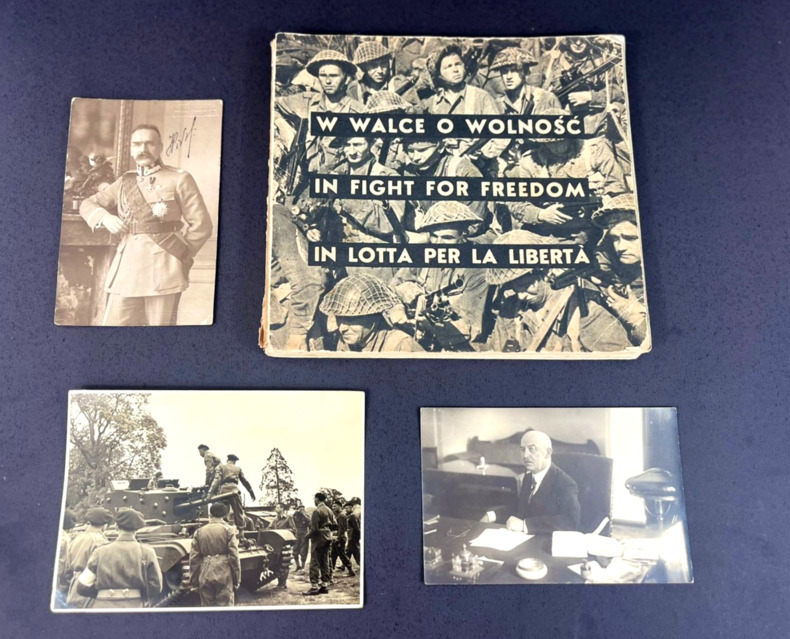
1945517This is a set which belonged to Janusz Gluchowski, a high-ranking Polish military officer at the time of the WW2. The set contains three original B&W pictures. First one: undated postcard showing Marshal Jozef Pilsudski, signed by himself in black ink, 8.5 x 13.5 cm, with two embossed mentions above and below. Second picture: undated postcard showing Poland President Gabriel Narutowicz, with a written mention on the back. Third picture: 11 x 15.5 cm photograph. General Tadeusz Bór-Komorowski inspecting a British Cromwell tank, accompanied by Polish officers of the 3rd Armored Regiment (3 puk pancerny). The image was captured during an official ceremony in the city of Kelso, Scotland, in the immediate post-war period, on June 15, 1945. The scene shows the General in an observation position, climbing onto the tank while surrounded by Polish soldiers. The tank corresponds to a British model widely used by Polish forces in exile during the Western European campaign. On the reverse, the following handwritten inscriptions appear: VI 1945, Kelso. N. Wódz gen. Bór-Komorowski dokonuje inspekcji 3 p. panc. N. Wódz w towarzystwie bryg. puku na czogu." / June 15, 1945, Kelso The book is an illustrated three-languages (Polish, English and Italian) set commemorating the struggles of the Polish II Corps. Edited by Wyda Rererat [Referat] Kultury i Prasy Kresowej Dywizji Piechoty in Rome, 1945. Oblong book of 21 x 19 cm, unpaginated (144 pp.). Cover detached. Endpapers and first page show Janusz Gluchowski's stamp. In publisher's photographically illustrated wrappers. Each page contains a photographic image or a photomontage accompanied with a short text in three languages. Front cover shows some wear and tear, the binding is a bit loose - we would advise having this book bound. The Polish II Corps was a major tactical and operational unit recruited from Polish deportees in the Soviet Gulags in 1943. First they fought in the Middle East, and in 1944 February they were transferred to Italy and as independent part of the British Army to fight in the Italian campaign, in the battles of Monte Cassino and Ancona and also the Battle of Bologna during the final offensive in Italy in 1945. The book goes through the story of Poland and the later established Polish II Corps, starting with the German and Soviet occupation in 1939. It shows the deportation of Poles to forced labour to the Gulag and, after the Polish-Russian Military Agreement in 1941, the establishment of the Polish Army on Soviet soil, also their military training and their fights in various battles. Janusz Julian Gluchowski was a Major General in the Polish Army during the Second Polish Republic. He was born on August 6, 1888, in Bukowa. He fought in the Polish Legions in World War I, the Polish-Ukrainian War, the Polish-Soviet War, and the invasion of Poland by Nazi Germany, Slovakia, and the Soviet Union in 1939, which culminated in the start of World War II. In his adolescence, he attended high school in Czstochowa. In 1905, he became a member of the Combat Organization of the Polish Socialist Party and was wounded in the hand during an attack near Czstochowa. To avoid arrest by the Russian authorities, he left for Belgium, where he studied at the University of Liège. He returned to divided Poland around 1910 and settled in Austrian Galicia. In 1912 he graduated from the Officers' School of the Riflemen's Association in Stroza, near Krakow. In the early hours of August 1914, he commanded a platoon in Oleandria and was Wadysaw Belina-Pramowski's representative during the legendary attack of the so-called Seven Lancers of Belina (Uaska siódemka). On August 6th, together with the First Cadre Company, he left Krakow and marched to Miechów. In October 1914 he was promoted to Lieutenant (Poruchik) and, in November 1916, to Rittmeister (Cavalry Master). Until 1917 he served in the First Uhlan Regiment of the Polish Legions. After the Oath Crisis (Kryzys przysigowy) he was interned first in Fort Beniaminów and later in Werl. Released in October 1918, he went to Lublin, where, in early November, he formed the Third Ulan Regiment (later renamed the Seventh Ulan Regiment of Lublin). Along with his unit, he fought in the Polish-Soviet War. On May 29, 1920, he was promoted to Polkovnik. He was transferred in July 1920 to Eastern Galicia, taking command of the First Cavalry Brigade, fighting against the Soviets in Galicia and Volhynia. After the war, he remained in this position until 1925, when he was transferred to the Fourth Cavalry Brigade. Promoted to Brigadier General on March 16, 1927. Appointed commander of the Center for Higher Military Studies on June 4, 1930, and three years later, after the death of General Stanislaw Tessaro, he was appointed commander of Military District X in Przemyl. In October 1935, he became Deputy Minister of Military Affairs. In the early days of the 1939 invasion of Poland, Gluchowski ordered General Walerian Czuma to prepare the defense of Warsaw. In mid-September 1939, he fled to Romania. After his escape, he managed to travel to the Middle East and, in January 1941, received orders to go to London. In October 1941, he was appointed Commander of the Training Brigade stationed in Scotland. On September 23, 1943, he was appointed commander of all Polish Army units stationed in Great Britain, except the First Independent Parachute Brigade, which remained under the authority of the Commander-in-Chief. He was promoted to Major General on June 1, 1945. He decided not to return to Soviet-occupied Poland and remained in Great Britain. He frequently criticized the Soviet regime and the Soviet occupation authorities in postwar Poland. Furthermore, he was one of the founders and president of the Jozef Pilsudski Institute in London. He was, therefore, an active member of the Polish community in Great Britain. He was president and honorary member of several Polish veterans' organizations. He died on June 11, 1964, in London, England.
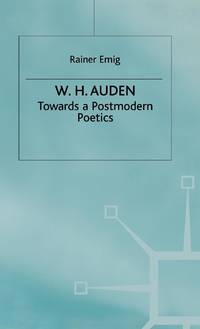
ria9780333745571_inpHardcover. New. New Book; Fast Shipping from UK; Not signed; Not First Edition; This study reads Auden's poetry and plays through the shifts from modernism to postmodernism. It analyses the experiments in Auden's writings for their engagement with crucial contemporary problems: that of the individual in relation to hardcover
6357373057MacMillan pp. 248 . Hardback. New. MacMillan hardcover
1955RO40019809Ferenczi. 1955. In-8. Broché. Etat d'usage, Couv. défraîchie, Dos abîmé, Rousseurs. 127 pages, manque dernier plat de couverture.. . . . Classification Dewey : 810-Littérature américaine
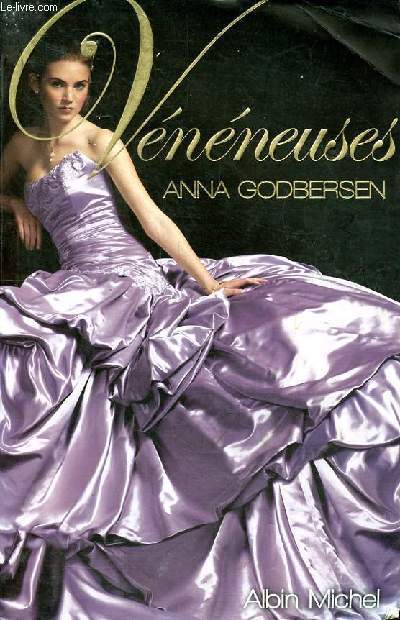
2011R260255460Albin michel. Octobre 2011. In-8. Broché. Bon état, Coins frottés, Dos satisfaisant, Intérieur frais. 429 pages.. . . . Classification Dewey : 810-Littérature américaine
1978RO80009955STOCK. 1978. In-12. Broché. Bon état, Couv. convenable, Dos satisfaisant, Intérieur frais. 302 pages.. . . . Classification Dewey : 810-Littérature américaine
1985R240134426NOUVELLES EDITIONS OSWALD. 1985. In-8. Broché. Bon état, Couv. convenable, Dos satisfaisant, Intérieur frais. 177 pages.. . . . Classification Dewey : 810-Littérature américaine
157850Heaton Mersey, The Cloister Press Ltd.,, 1959 in-4, VI-65-IX pp., 6 pl., frontispice, bradel lilas, premier plat orné d'une ill. dorée, jaquette illustrée (reliure de l'éditeur).
1985100371985 New York abrams 1985 in4, pleine toile sous jaquette illustrée, 126 pp illustraons couleurs, tres bon état
R150108346GALLIMARD .. 1966.. In-12. Broché. Bon état, Couv. légèrement passée, Dos satisfaisant, Intérieur acceptable. 186 pages.. . . . Classification Dewey : 810-Littérature américaine
2001ROD0124186DAPPER. 2001. In-12. Broché. Bon état, Couv. convenable, Dos satisfaisant, Intérieur frais. 203 pages.. . . . Classification Dewey : 810-Littérature américaine
1988RO20235994F1rst. 1988. In-8. Broché. Bon état, Couv. convenable, Dos satisfaisant, Intérieur frais. 218 pages. Quelques illustrations miniatures en noir et blanc dans le texte.. . . . Classification Dewey : 810-Littérature américaine
R150108748GALLIMARD .. 1971.. In-12. Broché. Bon état, Couv. convenable, Dos satisfaisant, Intérieur acceptable. 186 pages.. . . . Classification Dewey : 810-Littérature américaine
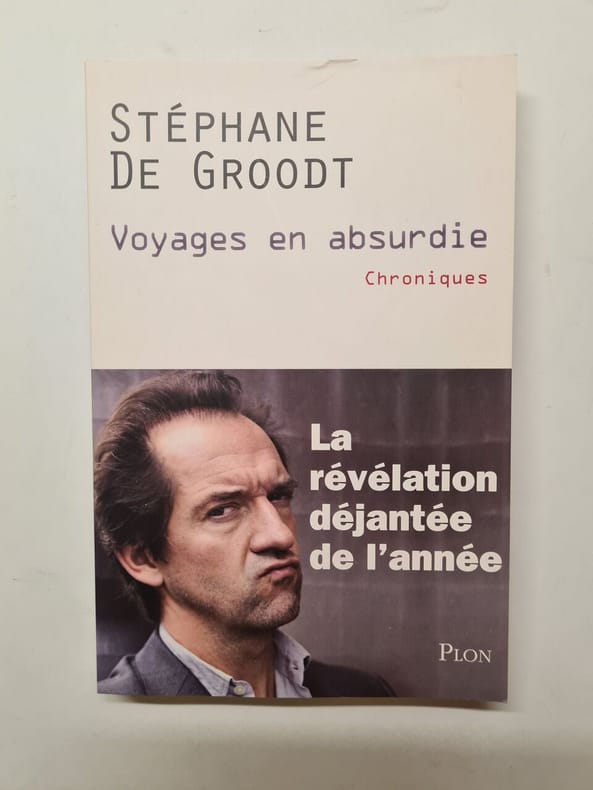
2014500084154Plon P 2014 201 pages 13 2x2x20cm. 2014. Broché. 201 pages.
2014500182577Plon P 2014 201 pages 13 2x2x20cm. 2014. Broché. 201 pages.
2014500208901Plon P 2014 201 pages 13 2x2x20cm. 2014. Broché. 201 pages.
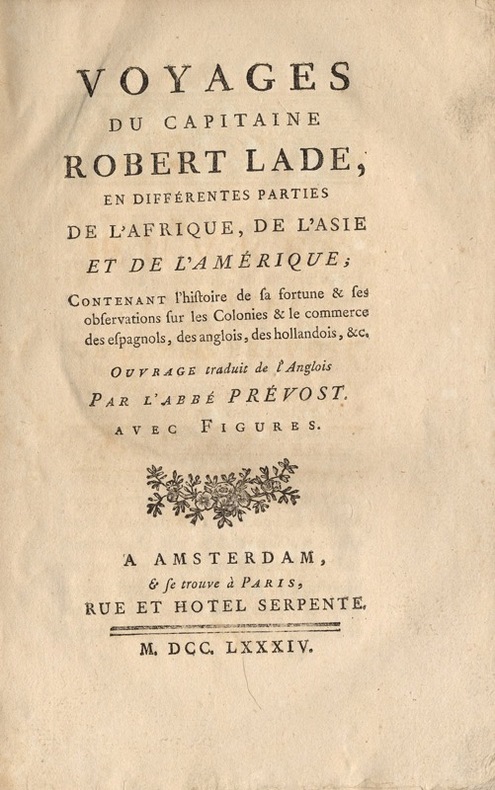
17846495Amsterdam et Paris, 1784 ; in-8 ; cartonnage rigide de papier bleu de l'époque, non rogné ; XVI, 591 pp., 2 gravures hors-texte d'après Marillier.
B324754Paris, Jean-Baptiste-Guillaume Musier, 1772. 2 Bde. 12mo (165 x 100 mm). Mit 4 Kupferatafeln und 2 Druckerzeichen auf dem Titel (der erste davon in Kupfer, der zweite in Holzschnitt). [4], XXVIII, 275 S., 1 Bl. [4], 314 S., 1 Bl. Kalbslederband d. Z., mit Rückenvergoldung und je zwei Rückenschildchen (Rücken an Kopf und Fuss etwas beschädigt).
1955105799Club des Libraires de France, coll. « Livres de toujours », n° 15 1955 2 volumes. In-8 cartonnage éditeur pleine toile violette aux plats décorés. 19,8 cm sur 13,8. LXIX-279 pages. Très bon état d’occasion.