41 résultats
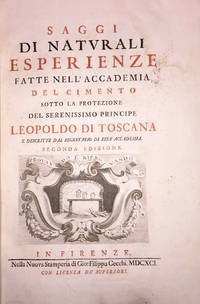
1691S13100Florence:: Gio: Filippo Cecchi 1691. 1691. Large 4to. xv CCLXIX 20 pp. Half-title title printed in red & black title vignette 75 copper engraved plates numerous woodcut initials and head & tailpieces index; prominent waterstains to corners lacks the portrait of Cosimo some copies have the portrait others do not. Later quarter vellum marbled boards black leather gilt-stamped spine label vellum tips. Very good. Second edition first printed in 1666/7. This marvelous work contains descriptions of experiments on air-pressure freezing of water an early account of Torricelli's invention of the barometer thermometer electrical and magnetic experiments measurements of the velocity of sound and light and experiments on heat and cold. It contains many large full-page engravings of experimental apparatus used to conduct these early experiments in natural physics. The engravings on pages iii vi viii and xiii show Torricelli's thermometer with a column of liquid and capsules of various density liquids that will either float of sink depending upon the surrounding temperature. Also known as a "termometro lento" slow thermometer this clever instrument is still marketed as a functioning curiosity today. / As the mechanism of the atmosphere exerting continuous pressure on the surface of the earth was unknown at that time the experiments using a barometer and bell jar pp. xxiv-xxxi seem rather naïve to us today. The members of the Academy couldn't determine why the mercury in the column didn't fall once the barometer was 'shielded' from the surrounding atmosphere. What they failed to realize is that the air pressure inside the bell jar remained the same as the outside since it had not been evacuated. Page lxxxxix depicts a curious experiment in which an organ pipe and a bellows to blow air through a pipe are encased in a vacuum chamber. The experiment demonstrated that when the chamber was evacuated the pipe no longer made sound even though the bellows were still forcing 'air' through the apparatus therefore showing that air at normal pressure was a necessary component to produce sound. / The Academy of Experiments was founded in Florence in 1657 and flourished for only ten years 1657-1667 and presents the first group effort at scientific investigation on the part of scientists including such original minds as Viviani Borelli Steno Redi Cassini and Torricelli. Its moving spirits were two of Galileo's most distinguished disciples Viviani and Torricelli. The necessary financial support came from the two Medicis the Grand Duke Ferdinand II of Tuscany and his brother Leopold; both of them had studied under Galilei. More than a decade before the formal institution of the Academy the two Medici brothers had started a laboratory well equipped with such scientific apparatus as was then obtainable. :: Wolf. / "This collection contains papers describing experiments on light sound and electricity. Amber rubbed in vacuo . . . magnetic attraction across a vacuum . . . magnetic screening . . . rubbed amber and gems . . . discharging action of flames . . . electrical attraction is mutual. . ." :: Wheeler. / Barchas-Stanford 1345 1666/7 ed.; Boffito 'Gli strumenti della scienza' pp. 133-134; Brunet V-29; Catalogo Bibl. Mediceo-Lorenese 569; Cinti 163; Dibner Heralds of Science 82; DSB IX p.3 Magalotti; Gamba 853; Krivatsy/NLM p.25 1666/7; Maylender Michele "Storia delle Accademie d'Italia" 1926-30 II pp. 7-16; Michel V-76; Riccardi II 407; Wellcome III p. 23; Wheeler 196 1684 ed.; Wolf The History of Science Technology and Philosophy I p. 55. This edition not in Bakken but has the 1684 translation. Gio: Filippo Cecchi, 1691. hardcover books
161367034Ad insigne pinus [ C. Daberholtzer for Marcus Welser] | Augustae Vindelicorum [Augsbourg] 1613 | 15.8 x 20.4 cm | relié
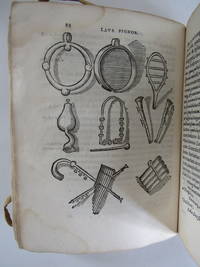
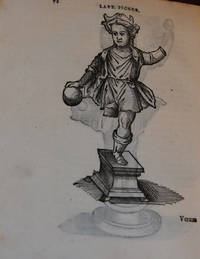
161367034Augustae Vindelicorum Augsburg Augsbourg Augsburg: Ad insigne pinus C. Daberholtzer for Marcus Welser 1613. Fine. Ad insigne pinus C. Daberholtzer for Marcus Welser Augustae Vindelicorum Augsburg Augsbourg Augsburg 1613 15.8 x 20.4 cm relié Rare first edition illustrated with 6 full-page figures and 21 vignettes. Printer's device on title page with pine tree. The plates depict musical instruments jewelry kitchen utensils Modern full vellum binding with ties. Smooth unlettered spine. Label on last endpaper: Restored by Serge Valeri Ville-Sous-Anjou 2018. From p. 10 trace of pale dampstain to upper corner of pages and sometimes at bottom these stains fading then reappearing on paper that is overall very fresh. Good copy. Important study of slavery and domestic family life in Antiquity. The work contains the duties charges and legal status of slaves and servants in daily life notably gladiators musicians actors tax collectors and artisans. Pignoria's work constitutes an interesting insight into laborious existence within families during Antiquity. A short essay by Doctor Fabricius on food and addressed to Marcus Walser closes the work. This is one of the best ancient treatises on the subject. Ad insigne pinus[ C. Daberholtzer for Marcus Welser] hardcover
167664886Finaro ma Firenze Nella Stamperia di Gio. Tommaso Rossi 1676. In 12° legatura artigianale novecentesca in piena pelle con cornice ai piatti a doppio largo filetto nervi fregi e titolo al dorso dentelle con fregio. Pagine 16 n.n. con Lettera scritta dall'A. alla Sereniss. Arciduchessa Claudia di Ispruch . Vita dell'A. . Giovanni Cinelli a chi legge. Seguono poi pp. 300 ma 240 per errata numerazione sempre riscontrabile in quest'opera pp. 32 non numerate con la dicitura: Giovanni Cinelli al Cortese Lettore. VERA ED INTEGRA edizione originale contenente queste ultime 32 pagine che portano l'epistola detta e due sonetti di Antonio Malatesta. Queste ultime pagine non numerate e senza indicazione di segnatura caddero sotto la censura furono proibite e quindi tolte dal testo; solo un numero molto limitato le bibliografie parlano di sole 50 copie contengono questo finale. Si veda il Parenti Luoghi di stampa falsi a pag. 86. Il Malmantile risultò una burlesca parodia della Gerusalemme Liberata che in dodici canti in ottava rima racconta la fantastica contesa di Celidora e Bertinella per il reame di Malmantile castello diroccato presso Signa. Gli argomenti di ogni canto furono redatti da A. Malatesti. Rarissime come detto sono le copie rimaste di quest'opera così complete. Si veda oltre al Parenti il Gamba e lo Choix di Olschki dove viene definito "molto raro" Finaro (ma Firenze), Nella Stamperia di Gio. Tommaso Rossi unknown
1669ABC_50527Amsterdam: Andreas Frisius 1669. Contemporary vellum with the gold-stamped coat of arms of Arnhem on both boards faded manuscript title on the spine remnants of green ties. 4to. With an engraved frontispiece with Egyptian and other antiquities a general title page with a small engraved scene 3 divisional title pages the first two with the same larger engraving a small scene similar to that on the general title page but flanked by figures of Minerva/Athena and Mercury/Hermes the frontispiece large engraving and probably the unsigned small engraving by A. Blotelingh. The first work with 11 folding engraved plates with hieroglyphics 1 full-page engraved plate outside of collation 5 full-page engraved plates in the text and 16 smaller engravings in the text. The second work in two parts with 3 full-page engraved plates and several smaller engravings in the text. Further with woodcut decorated initials throughout and several woodcut head- and tailpieces. 2 works published and bound as 1 the second in 3 parts. Including: IDEM. Magnae deum matris idaeae & attidis initia.And: TOMASINUS Jacobus Philippus. Manus aeneae cecropii votum referentis dilucidatio. First issue of the third and best edition of two important works on Egyptian archaeology the first edition with this title and form originally published together written by Lorenzo Pignorius. The first work a famous study of the Egyptian artefact known as the Mensa Isiaca or Bembine Tablet devoted to the Egyptian goddess Isis is the first notable work on Egyptology first published at Venice in 1605 titled Vetustissimae tabulae Aeneae sacris Egyptiorum simulacris . The Mensa Isiaca was a bronze table top discovered in the ruins of the temple of Isis in Rome at around 1525 and now believed to have been executed in Rome in the first century CE. Pignorius studied this very famous artefact when it was in the possession of Cardinal Bembo. Pignorius believed that it depicted the sacrificial ceremonies according to the Egyptian rites. The bronze is now in the collection of the Torino Museum.The text of the second work consists of two parts with two separate title pages on O3r and e1r plus a divisional title without imprint i3r. The first part is an essay on the deity Great Mother of Gods by Pignorius first published in 1623. The second part titled ''Manus Aenae cecropii votum referentis dilucidatio'' by Jacobus Philippus Tomasinus contains a description of a small votive statue of a hand. At the end pp. 63-96 it includes a biography of Lorenzo Pignorius and a description of his museum and library and its contents including ancient coins and portrait busts of classical figures by Tomasini.The boards are somewhat scuffed and browned remnants of ties the gold-stamped centrepiece remains very clear. The sewing supports have broken and the pastedowns have separated from the inside of the boards meaning that the bookblock is only connected to the binding through the headband at the top of the spine. Occasional minor browning a occasionally large tear in the gutter margin of the folding plates the edges of the folding plates are somewhat frayed two folding plates are loose but still present. Leaf with pp. 7-8 in the second work with a large tear slightly affecting the text.l Blackmer 1312; Gay 1567; Ibrahim-Hilmy II 119; STCN 097598674 9 copies; USTC 1806033 same as STCN; cf. STCN 097598186 4 copies 1670 issue; USTC 180743 1670 issue same as STCN. Andreas Frisius, hardcover
168521967Appresso Nicolo Pezzanna Venetia 1685. First Italian Edition. Hardback. Full contemporary vellum-backed boards good. Half inch sq tear with loss to the half-title inch sq cut from the bottom of the title page. Remains an exceptional example overall; scans &c on request. ; 312 pages; Printer's device to the title. Double columned type - minor foxing and worming. Appresso Nicolo Pezzanna, Venetia hardcover
1647IMAGINI1647<p>4to approx. 23 cm later quarter calf over marbled boards gilt-tooled spine rubbed with small losses at head and foot corners worn. 16 ff. text complete with both large folding plates and numerous in-text woodcut illustrations of the pagan gods and related emblems. Title printed in red and black with large woodcut device; early ink ownership inscription "… Ruggero" at head of title.</p><p>Occasional light damp-staining notably to title and a few prelims scattered foxing and minor soiling but text and images generally crisp and well-inked; folds of plates with a few small handling creases and short closed tears no major losses.</p><p>Classic 17th-century Venetian edition of Cartari's influential illustrated handbook of classical mythology and iconography enlarged with Lorenzo Pignoria's antiquarian notes and Cesare Malfatti's allegories. A complete solid working copy with both folding plates present.</p> Presso il Tomasini
16751398897n.p.: n.p c. 1675. Hardcover. Octavo 324 pages. In Good condition. Bound in full contemporary vellum "boards" composed of multiple sheets of 17th-century sheets. Vellum is beginning to separate from composite-sheet boards along fore-edges. Boards have moderate plus staining overall with moderate plus chipping and wear to vellum along edges. Textblock shows moderate age toning and light wear to untrimmed edges with occasional light staining to pages not impacting legibility. Undated ink manuscript in an unidentified 17th-century Italian hand. Shelved Room A.<br> <br> An early handwritten manuscript of Lippi's Il Malmantile Racquistato which appears to predate the second printed edition in 1688 and possibly the first printed edition in 1676. The present manuscript differs from one or both of the 17th-century editions in multiple points please see notes for further analysis of contrast with the published manuscript tradition of the text. Title page includes a dedication to Cardinal Leopoldo de Medici lacking in the first printed edition and attributes the work to Lippi's pseudonym Perlone Zipoli - unlike both 17th-century editions. The title page is followed by the prefatory Disfatto here attributed to the anagrammatic pseudonym Amostante Latoni Antonio Malatesti. The work is then prefaced by an index revealing the "true identities" of all the figures appearing pseudonymously in the work. Contrary to both printed editions each book is here referred to as canto rather than cantare and each stanza is numbered similarly to the 1688 edition and unlike the 1676 edition. Shelved Room A. The mock-heroic epic Malmantile Racquistato was written by Florentine painter Lorenzo Lippi 1606–1665 during the 1640s. Writing under the anagrammatic pseudonym Perlone Zipoli Lippi composed the poem while serving Cardinal Leopoldo de’ Medici and his wife at Innsbruck. Il Malmantile is often read as a parodic response to contemporary literary conventions particularly the epic stylings of Tasso’s Gerusalemme Liberata. Yet beyond its burlesque tone the work serves as a celebration of the Tuscan—specifically Florentine—dialect and is still studied today as a rich repository of regional idioms and turns of phrase.<br /> <br> <br> While the core of the poem was composed in Innsbruck between 1643 and 1644 reports from Lippi’s contemporaries many of whom were members of the informal literary academy degli Apatisti suggest that substantial additions and refinements were made after his return to Florence in 1648. Lippi wary of scandal or public backlash resisted calls to publish the poem during his lifetime. Nonetheless it circulated widely among members of the Apatisti the Accademia degli Svogliati and even the Accademia della Crusca. <br /> <br /> <br> <br> It was not published until 1676 eleven years after Lippi’s death in a flawed and limited edition only 50 copies issued by Giovanni Rossi. That edition was viewed by Lippi’s admirers as a distorted presentation of the poem—possibly even an act of literary revenge. A more authoritative version was published in 1688 under the editorial guidance of Paolo Minucci and the posthumous patronage of Leopoldo de’ Medici.<br> <br> <br /> The present manuscript appears to have been produced prior to the 1688 edition but after the completion of the poem before Lippi’s death in 1665. Based on textual evidence it is unlikely to have been copied from either printed edition. Instead it likely reflects a version circulating independently—perhaps within Lippi’s literary circle or among manuscript readers close to the Medici court. Several features underscore the manuscript’s significance as a witness to the early textual transmission of Malmantile Racquistato. Please note that this list is not comprehensive or exhaustive.<br> <br> <br /> <br /> Dedication to Cardinal Leopoldo de’ Medici 1617-1675<br> The manuscript bears a dedication “al Serenissimo Princeps Cardinal Leopoldo de’ Mediciâ€â€”a form appropriate only during Leopoldo’s lifetime.<br /> The 1676 edition includes no dedication.<br /> The 1688 edition dedicates the work “alla gloriosa memoria†of the deceased cardinal.<br /> This places the present manuscript’s source text prior to Leopoldo’s death in 1675 supporting an early dating.<br /> <br /> <br /> Attribution of the “Malmantile Disfatto Enigmaâ€<br> The manuscript attributes the poem’s enigma to Latoni a fictional character in the narrative and anagram of Antonio Maltesti author of the argomentos.  The enigma in the present manuscript follows the 1688 edition’s title: “Malmantile Disfatto Enigma†as opposed to the 1676 edition which title it simply the “Malmantile Disfattoâ€.<br /> Unlike the present manuscript both printed editions attribute the Disfatto to Malatesti friend of Lippi and author of the the argomentos prefacing each canto/cantare.<br /> <br /> <br /> Lexical Variant in the Enigma’s First Line<br /> The manuscript and the 1676 edition share the rare form inospite inhospitable whereas the 1688 edition substitutes the more conventional indomite untamed.<br /> The retention of inospite aligns the manuscript with the earlier textual variants prior to normalization.<br /> <br /> <br /> Dialectal Verb Form: “dalli†vs. “dagliâ€<br /> The manuscript occasionally makes use of the form dalli a dialectal or colloquial variant of dagli.<br /> This reflects non-standard or pre-Cruscan orthography and suggests a version of the poem less filtered by formal editorial revision.<br /> <br /> <br />  “Canto†vs. “Cantareâ€<br> The manuscript titles the poem’s sections as “Cantos†contrasting with the “Cantare†found in both printed editions.<br /> While “Cantare†evokes the popular cantari tradition the manuscript’s use of “Canto†suggests either scribal normalization or an attempt to frame the work more in line with classical epic conventions.<br /> <br /> <br /> Book Seven Stanza 73<br /> The present manuscript lacks the seventy-third stanza of the seventh canto/cantare which appears in both the 1676 and 1688 editions.<br /> <br /> <br /> Various Textual Differences including:<br /> The Argomento of the eighth canto/cantare: Lines 2-5 of the present manuscript have elements that appear to be either hybrids of the two printed editions or are unique to the manuscript.<br /> Line 2 matches the second edition of 1688<br /> Line 3 matches the first edition of 1676<br /> Line 4 is a unique rendering more closely aligned with the 1676 edition<br /> Line 5 matches the first edition of 1676<br /> <br /> <br /> Book 7 Stanza 104 105 of the printed editions has in distinction to both print editions burlando for brillando.<br /> <br /> <br /> . 1398897. Special Collections. [n.p] hardcover
166964891669 Amstelodami, sumptibus Andreae Frisii, [Amsterdam, Andrea Frisi], 1669. 3 parties en 1 vol. in-4: 18.5 x 24.5 cm [5] ff., [4] pl. grav. dép, 96 pp., [6] ff. d'index, [4] ff., 96 pp. Troisième et meilleure édition de ce curieux ouvrage, d'après Brunet, avec les gravures de la Table Isiaque d'après Enea Vico, absentes de précédentes éditions. Notre exemplaire comporte 43 gravures en taille-douce. Un frontispice gravés par Blooteling, 8 planches à pleine page, 26 figures dans le texte et 8 des 11 sections de la Table Isiaque réalisées par Giacomo Franco d'après les gravures de Vico parues en 1559, ces 8 sections sont regroupées en 4 grandes pl. dép. Il manque les 3 sections de la bande centrale de la table. Reliure de l'époque en parchemin. Dos lisse avec titre manuscrit à l'encre noir. Bel exemplaire
161352482Augsburg: C. Daberholtzer for Marcus Welser At the sign of the Pine 1613. First Edition. 4to pp. xii 280 10 2 blanks. Illustrated with six full page and 21 text woodcuts with a woodcut title device. Bound in contemporary vellum over thin soft boards ms spine title. A fine copy spot on two leaves early ownership signature of D. Attanzio Arcelli. Krivatsy 8979; RISM B VI2 654; UCBA I:1603; Cicognara 1759;. This is the first edition of this illustrated encyclopaedia of the duties of rural and urban servants in the ancient world. This covers the family life and legal status of a wide range of tradesmen and blue collar workers: gladiators scribes bookkeepers musicians physicians and surgeons comedians artisans tutors gardeners cooks midwives teachers and fishermen. There are plates of musical instruments ball players ships jewelry and a wine cellar. The text draws on ancient medieval and contemporary sources. The distinguished doctor Fabricus ab Aquapendente contributed a short essay on food addressed to the Augusburg merchant and historian Marcus Welser. A learned antiquary born in Padua in 1591 Pignoria was educated by the Jesuits and a canonry of Treviso was conferred upon him by cardinal Fr. Barberini. This present work is called "a valuable work" although criticised as being diffuse. This offers an interesting glimpse into the working of the classical household. [C. Daberholtzer for Marcus Welser] At the sign of the Pine unknown books
1681000434Barcelona Spain: Joseph Forcada. Very Good with no dust jacket. 1681. Original Vellum. AN EXCEEDING RARE SPIRITUAL TREATISE VIRTUALLY UNKNOWN IN SUCH AN EARLY SPANISH EDITION AND THE BOOK USED AS AN EARLY CONVERSION MANUAL IN THE NEW WORLD. Printed 1681 in Fine Original Vellum with gilt! COMBATTING OF THE DEVIL! The Book: Scupoli Lorenzo 1530-1610; Juan de Castaniza d. 1598 COMBATE ESPIRITUAL ESCRITO POR EL VENERALE SCUPOLIU. Barcelona Joseph Forcada 1681 64mo. Fine contemporary limp vellum with gilt blindstamping usual woodcut illustrated title of the devil firing an arrow into the breastplate of a Christian soldier. 452 pgs and tabla complete. A precious Spanish edition of this classic treatise on evangelical perfection through spiritual exercises including several chapters in partcular to the promotion of Christian faith and the combatting of the devil as evidenced particularly in the title and frontispiece illustration. This manual was among the often used in the New World for conversion of the native from their "vices and the snares of the devil." There are no traces of the first Spanish edition. The present volume is among the earliest surviving Spanish copies all of which are extremely rare and the next readily traceable one being from 1722. Scupoli Lorenzo 1530-1610; Juan de Castaniza d. 159. Combate espiritual o Tratado de la perfeccion Christiana. Traduxolo en la lengua Espanola de la Italiana y de la Latina; y lo consagra a la Emperatriz y Reina nuestra Senora Don Damian Gonzalez del Cueto doctor en ambos derechos. Vienna Johann Baptist Schilgen 1722. A precious illustrated Spanish edition of this classic treatise on evangelical perfection through spiritual exercises Combattimento spirituale The spiritual combat with engravings by Martin Engelbrecht. This work is commonly attributed to Juan de Castaniza who is here identified in the preface. Castaniza a Benedictine monk of Ona active in Italy was known for his chronicles of the life of P. Rivadeneyra and St. Romuald. The work was written by the Italian father Lorenzo Scupoli however and translated shortly after its appearance by Castaniza into Spanish. Combate espiritual in this pocket-sized and compact duodecimo format is a handbook of devotional exercises presented in sixty-six chapters modeled after Loyola's famous text. It aims at perfecting the soul through prayer meditation and examination of the conscience. It is thus a guide for the conquest of the spirit over unruly passions the senses and conscious acts offering a method for self-regulation leading to virtue and salvation. Indeed it prescribes the imitation of Christ's life through empathic contemplation on the Passion assisted by the text and images. The stirring devotional image of the Crucifixion engraved by Engelbrecht 1684-1756 depicts the cross as the fountain of life "apud me est fons vitae"; Christ's blood pours into the cups of his disciples who stand at his feet. The engraving is appropriate for the work a visual experience provoking empathy for Christ through inward meditation and complete sensitization through reflection on the image. The frontispiece also by Engelbrecht depicts Christ as the exemplar of complete virtue. An unsigned engraving of St. Francis de Sales 1567-1622 accompanies a short elegy by this great ascetic bishop of Geneva who endorsed in his spiritual teachings the mortification of the senses will and mind for the sake of perfection. The more simple depiction of St. Francis de Sales is likely produced by a different engraver as Engelbrecht's compositions are here characterized by fully-modeled figures and atmospheric effects through the use of fine linework. Engelbrecht was the brother of Christian Engelbrecht 1672-1735. These well-known printsellers and engravers were dominant figures in Augsburg at this time and are remembered for their portrait studies and their landscape religious and allegorical illustrations. Martin is also noted for his engravings used in perspective boxes or peepshows. Scupoli's work makes its first appearance in the Italian in Venice in 1589. By the mid- seventeenth century this very popular devotional work was frequently republished in German and Latin. There are no traces of the first Spanish edition which must have appeared shortly after the Italian edition. This present illustrated edition a late Spanish translation of this important work reproduces the text as it originally appeared in Castaniza's translation. All Spanish translations of this text remain very rare. This popular meditative manual produced in this small format for a large and pious public instructively suggests the ways in which its readers responded to the text and images. It is an early publication from the press of Schilgen printer to the university of Vienna. A nice copy of this very important and scarce devotional work in Spanish. Duodecimo: 12 26 A-R12 R1112 blank; xxxvi 396 12 pp. Engraved frontispiece and full-page engraving signed Martin Engelbrecht full-page engraved portrait of St. Francis de Sales signed I.A.P. woodcut historiated initial typographic and woodcut head- and tailpieces. Occasional text browning. Contemporary sprinkled calf backstrip divided into five compartments with naturalistic tool at center and corners in blind remains of morocco label title stamped in blind raised bands outer edges hatched in blind contemporary combed marbled endpapers all edges gilt worn at extremities. Very good. Not in OCLC or RLIN; not in German or Spanish union catalogues including Gesamtkatalog GBV and the Osterreicher Bibliothekverbund. For Engelbrecht see NDB 4.512; Thieme-Becker 10.534; F. Schott Der Augsburger Kupferstechner und Kunstverlager Martin Engelbrecht und sein Nachfolger Walluf 1972.; Spanish; 48mo - over 3" - 4" tall; OCCULT NECROMANCY SORCERY EXORCISM SATANISM ASTROLOGY DIVINATION RELIGION MAGIC SATAN DEVIL WORSHIP PENTACLE WICCA WICCAN . Joseph Forcada hardcover
16993149<p>Full vellum with titles inked to spines. 6 raised bands. Red speckled edges. Fissure in vellum at front hinges but quite firm. Wine colored stain to front cover of vol. II near spine. Many foldout plates. Late 17th century compilation of medical specialties. A nice clean copy without previous owners' names or other markings. ; Folio 13" - 23" tall; 1072; 1223 pages; All shipments through USPS insured Priority Mail.</p> Johan. Anthon. Chouet & Davidis Ritter hardcover
16993149Full vellum with titles inked to spines. 6 raised bands. Red speckled edges. Fissure in vellum at front hinges but quite firm. Wine colored stain to front cover of vol. II near spine. Many foldout plates. Late 17th century compilation of medical specialties. A nice clean copy without previous owners' names or other markings. ; Folio 13" - 23" tall; 1072; 1223 pages; All shipments through USPS insured Priority Mail. Johan. Anthon. Chouet & Davidis Ritter hardcover books
16660000696Bononiae Bologna: Sumptibus haeredum Euangelistae de Duccijs 1666. First Edition. Vellum. Very good . Folio 31.4 x 21cm. Contemporary vellum. Collation: 16 576 70 p. engraved frontispiece and 36 woodblock prints in text or singly. The frontispiece has allegorical figures in a garden with arms of the University of Bologna. Bottom of spine repaired with new vellum. The internal condition is very good. This is a very scarce title from an Italian botanist and brother of naturalist Batolomeo Ambrosini. He succeeded his brother to the chair of botany at the University of Bolognia and also assumed direction of the botanical garden. His first work was Hortus Bononia studiosirum consistus which was followed posthumously with the Phytologiae offered here. The Phytologiae was intended to be the first of a two-volume dictionary of plants with the second to be on trees. The second volume was never completed. The woodcuts in this work on herbaceous plants were done by Tinti and provide a good working illustration for the plant described in the text. This very scarce work comes from a period of great botanical study and characterization in Italy. The genus Ambrosinia is named after the two brothers. Hunt 303; Pritzel 132. <br/><br/>This very scarce work comes from a period of great botanical study and characterization in Italy. The genus Ambrosinia is named after the two brothers. Hunt 303; Pritzel 132. Sumptibus haeredum Euangelistae de Duccijs hardcover books
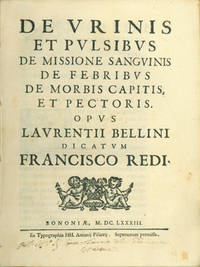
168340699Bologna: ex typographia HH. Antonij Pisarrii 1683. First edition. <p> Inscribed by Bellini</p> <p>Bellini Lorenzo 1643-1704. De urinis et pulsibus de missione sanguinis de febribus de morbis capitis et pectoris. 4to. 20 606 i.e. 608pp. Woodcut ornaments. Bologna: ex typographia HH. Antonij Pisarrii 1683. 216 x 161 mm. Vellum c. 1683 title hand-inked on spine. Leaf Aaaa2 torn and repaired at an early date without loss of text otherwise a fine copy. Presentation copy from the author inscribed at the foot of the title: "All' Illmo Conte Tommaso della Gherardesca. l'Autore." </p> <p>First Edition inscribed by the author. This is the first inscribed copy of a major seventeenth century medical classic that has been on the market in more than a decade. Bellini professor of anatomy and medical theory at Pisa was one of the Italian founders of iatromechanics a system that framed physiologic events such as the circulation of the blood in terms of mathematical and physical principles. Bellini's De urinis et pulsibus represents the first important attempt by an Italian scientist to systematically apply iatromechanics to medical theory. "William Harvey's theory of the circulation was of fundamental importance to Bellini and other proponents of iatromechanism. Bellini asserted that good health depended on optimal function of the circulation of the blood and that disease was a manifestation of an inefficient circulation. Rejecting ancient humoral pathology he viewed blood as a physical fluid with specific properties that could be interpreted in terms of mathematical and physical principles. . . . Bellini emphasized that disease was often due to alterations in the elasticity or 'tone' of the solids or in the density of the fluids which hindered their motion. This in turn could cause local congestion or stagnation. Bellini's enthusiastic support of therapeutic bleeding reflected this pathophysiologic concept. He tried to prove that this phlebotomy increased the velocity of the circulation thereby washing away 'morbid matter' and restoring health" Fye pp. 181-82. </p> <p>In the book's section on diseases of the chest Bellini reported "several forms of heart disease especially of the syncopal type . . . in his book De urinis et pulsibus Bellini discusses the state of the coronary arteries and admits that the condition which he calls 'pressio' is dangerous and may cause the contraction of the heart to be abolished p. 541. He also has in mind external pressure by tumors fat and so on. However an intra-arterial coronary impediment of blood-flow by calcification was clearly described by this author. Bellini reported of a patient who died of a condition similar to the clinical picture of coronary disease as we now understand it in whose coronary arteries he found a 'stone.' It seems quite reasonable to deduce that Bellini saw in the post-mortem a coronary occlusion" Leibowitz History of Coronary Heart Disease p. 71. </p> <p>Bellini's work is also important in the history of urology as it marks the first important contribution to the chemical analysis of urine. Recognizing the value of urine as a diagnostic aid Bellini insisted on its chemical analysis in pathologic conditions. </p> <p>Bellini presented this copy of De urinis et pulsibus to Tommaso della Gherardesca 1654-1721 a distinguished member of an important Tuscan aristocratic family and as such a likely patron. Gherardesca was appointed bishop of Fiesole in 1702 and archbishop of Florence in 1703; he also founded the Seminario Maggiori di Firenze in 1712. The rarity of this inscription by Bellini cannot be overestimated. This is the first inscribed book by Bellini we have seen on the market in more than 40 years and it is also the first inscribed copy of a major seventeenth century classic on any aspect of medicine that we have seen on the market in more than a decade possibly longer. In addition this copy is clearly in the original binding in which it was presented and with the exception of one leaf which was inexplicably torn through and repaired the copy is in fine even very fine condition for a work of this period</p> . <p>Garrison-Morton 762.1 4162. Fye "Lorenzo Bellini" Clinical Cardiology 20 1997: 181-82. Dictionary of Scientific Biography. Willius & Dry History of the Heart and the Circulation p. 64. Murphy History of Urology pp. 147-48.</p> . ex typographia HH. Antonij Pisarrii unknown books
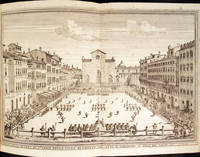
168829719Firenze: Stamperia di S.A.S. alia Condotta 1688. Rare First Edition of this very early work on football. Engraved armorial title-vignette featuring a figure with a football by Francesco Nacci two folding engraved plates one with players lined up for play in the Piazza Sante Croce by Alexander Cecchini and one a diagram of player's positions. 4to in nineteenth-century marbled boards backed in black morocco the spine gilt lettered and with multi-line gilt ruled flat bands additional gilt tooling at the foot bookplate of Franco Niccoli to front paste-down. xii 118 2 manuscript entries pp. A very handsome and proper copy of this rare book with a couple of contemporary marginal annotations and one contemporary manuscript leaf bound at the end a little scattered foxing throughout but not obtrusive. RARE FIRST EDITION OF PIETRO BINI'S ANTHOLOGY ON FLORENTINE FOOTBALL a forerunner to the modern games of soccer rugby and American football. THIS IS ONE OF THE EARLIEST TREATISES ON THAT PREDECESSOR TO OUR MODERN GAMES.<br> In the game of calcio two teams each consisting usually of 27 men are engaged on an enclosed ground of 172 x 82 braccie fiorentine just little smaller than a modern football field. The action consists of carrying and kicking a pumped ball of medium size with fists and feet hence the name calcio in order to make it pass beyond the terminal barriers of the adversaries' half. One such successful action is called caccia. The team making the most caccie is the winner. Games typically last one hour and are played 'for honour's sake'.<br> The wonderfully detailed description of the game is largely by Giovanni de' Bardi and though it was first published anonymously nearly a century earlier the text included here is greatly expanded and illustrated. It fully explains the rules and manners of the game and describes a number of games that had recently been played in and near Florence. The double-page plate depicts a match in the Piazza Santa Croce is very impressive and provides us with a lasting 17th century "instant replay" of the event. Stamperia di S.A.S., alia Condotta hardcover