4 876 résultats
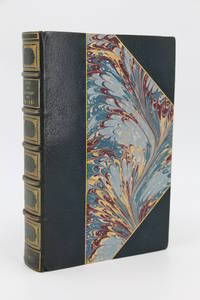
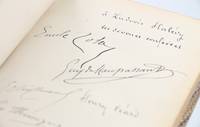
188087614Paris: Charpentier 1880. Fine. The Manifesto of Naturalism Charpentier Paris 1880 12 x 19 cm relié First edition. Half blue morocco shagreen smooth spine gilt date at foot of spine marbled paper boards contemporary binding. Exceptionally inscribed by Emile Zola to the playwright and opera librettist Ludovic Halévy with the autograph signatures of Guy de Maupassant Joris-Karl Huysmans Léon Hennique Paul Alexis and Henri Céard on the first flyleaf. Provenances: from the libraries of Ludovic Halévy and Marcel Lecomte with their bookplates on front pastedown. Our copy also includes on a flyleaf an autograph note by Ludovic Halévy: ""See a letter by Guy de Maupassant at the end of the volume. L.H. Inscribed by the six authors of the volume. Ludovic Halévy."" Voir une lettre de Guy de Maupassant à la fin du volume. L.H. Envoi autographe des six auteurs du volume. Ludovic Halévy. The reproduction of the famous letter sent by Guy de Maupassant to Halévy in 1880 is pasted onto six additional leaves at the end of the volume. It bears Halévy's penned note at the beginning and end of the letter: ""Cette lettre est de 1880 / 1880."" Cette lettre est de 1880 / 1880. A fine and rare uncut copy of this manifesto of Naturalism signed and inscribed by Emile Zola with the signatures of the other five authors to their librettist colleague. Halévy notably co-wrote the libretto of Georges Bizet's Carmen. Charpentier hardcover
189152249Sous étui bordé. Reliure plein maroquin janséniste de diverses couleurs (bleu, orange, rouge, vert, havane, etc.). Dos à nerfs avec date dorée au talon. Plats décorés de fleurs dorées et mosaïquées aux angles, dentelle intérieure. Tranches dorées sur témoins. Couvertures conservée. Reliure signée NOULHAC. Quelques dos sont très légèrement éclaircis.
188585867Paris: Victor-Havard 1885. Fine. Victor-Havard Paris 1885 13 x 19.50 cm relié First edition one of 200 numbered copies on Hollande paper the only large paper copies. 3/4 blue morocco Bradel binding spine with five raised bands highlighted with gilt dots and decorated with triple gilt compartments gilt date at tail gilt fillets on marbled paper boards marbled paper flyleaves and pastedowns original wrappers and spine preserved top edge gilt others uncut binding signed Canape. Rare copy of Guy de Maupassant's masterpiece beautifully bound in an elegant signed binding. Victor-Havard hardcover
188087614Charpentier | Paris 1880 | 12 x 19 cm | relié
188053303Paris: Charpentier 1880. Fine. Charpentier Paris 1880 12 x 19 cm relié First edition an ordinary paper copy. Contemporary green half shagreen marbled paper boards spine with five raised bands and gilt flowers speckled edges. With the autograph signatures of every author of the ""Médan group"" involved in the writing of this famous collection of short stories: Guy de Maupassant Emile Zola Joris-Karl Huysmans Léon Hennique Paul Alexis and Henri Céard on the first endpaper. A very good and rare copy in a strictly contemporary binding. This true manifesto of Naturalism that constitutes Les Soirées de Médan is composed of six short stories: ""L'Attaque du moulin"" by Émile Zola ""Sac au dos"" by J.-K. Huysmans ""La Saignée"" by Henry Céard ""L'Affaire du grand 7"" by Léon Hennique ""Après la bataille"" by Paul Alexis and of course ""Boule de Suif"" by Guy de Maupassant qualified as a masterpiece by Gustave Flaubert. Charpentier hardcover
188585867Victor-Havard | Paris 1885 | 13 x 19.50 cm | relié
188053303Charpentier | Paris 1880 | 12 x 19 cm | relié
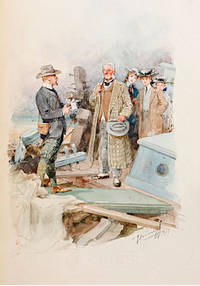
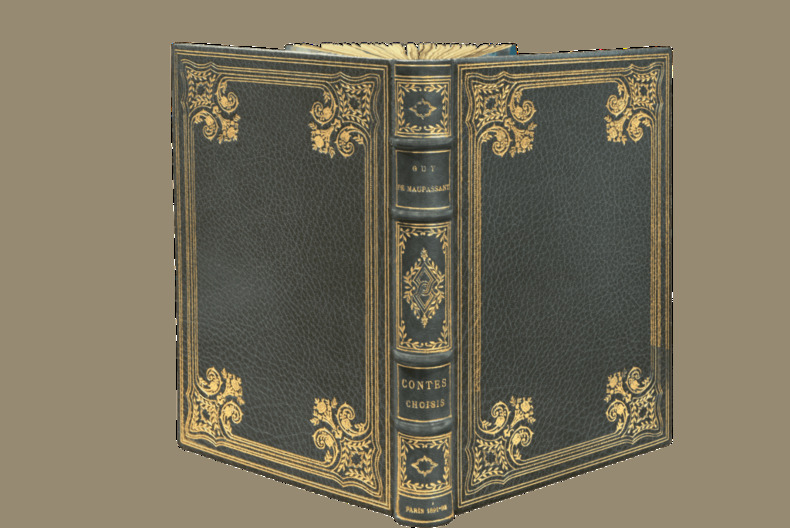
1891LCS-1864048<p><strong>Superb complete collection of the 10 tales by Maupassant published in 188 copies </strong></p><p><strong>by the Society of contemporary Bibliophiles and printed for their members only </strong></p><p><strong>richly illustrated with black and color figures by the best artists of the time.</strong></p><p>10 works combined in a large 8vo volume.</p><p>Blue-gray morocco framing of gilt fillets and floral designs around the covers richly decorated ribbed spine wide gilt inner border gilt over untrimmed edges wrappers and spine bound in case. <em>Ch. de Samblanx.</em></p><p>265 x 175.</p><p>Superb complete collection of the 10 tales by Maupassant published by the Society of Bibliophiles of the Academy of Fine Books.</p><p>" <em>The complete work consists of ten booklets with pagination and a particular cover for each of them. All these stories were printed on paper made exclusively for the Society with watermark framing each page bearing at the top: Guy de Maupassant; and at the bottom Selected stories.</em></p><p><em>Some associates have had their copy bound by retaining all the covers either by leaving them in their place or relegating them to the back of the volume; others have retained the booklets as they are by enclosing them in a case</em>". Administrative Annals of contemporary Bibliophiles p. 89.</p><p>It consists of a cover a half-title and a title accompanied by a colored frontispiece by <em>Paul Avril</em> after <em>Félicien Rops</em> followed by the following 10 titles each with its particular cover:</p><p>- <em>Le Loup. Histoire de chasse</em>. November 1891. 2 ff. 12 pp.</p><p>Edition entirely engraved illustrated with 15 aquatint-enhanced etchings by Everet Louis Von Muyden 1853-1922 including one on the title 12 headers an initial and a cul-de-lamp. The text was engraved with a burin by <em>A. Leclère</em>.</p><p>- <em>Hautot père & fils</em>. 1892. 2 ff. 20 pp. 3 plates.</p><p>Edition illustrated with 12 compositions by <em>Georges Jeanniot</em> including 3 off-text mostly in color retouched with etching and burin by <em>Henry Manesse</em> and printed in polychrome intaglio by the firm <em>Wittmann</em>. Pages 5 to 8 wrongly bound after the title.</p><p>- <em>Allouma</em>. 1892. 2 ff. 30 pp. 1 ff.</p><p>Edition illustrated with 2 color chapter heads and 2 monochrome tailpieces engraved by <em>Paul Avril.</em></p><p>- <em>Mouche. Souvenir d'un Canotier</em>. 1892. 2 ff. 20 pp.</p><p>Edition entirely engraved illustrated on each page with a composition by <em>Ferdinand Gueldry</em> engraved on copper by <em>Fillon</em>. The text was engraved with a burin by <em>A. Leclère</em>.</p><p>- <em>La Maison Tellier</em>. 1892. 2 ff. 44 pp. 2 last white ff.</p><p>Edition illustrated with 25 watercolors by <em>Pierre Vidal</em> in the text engraved by <em>Hellé</em> et <em>Ruckert</em> and colored by <em>Grenengaire</em></p><p>- <em>Un Soir</em>. 1892. 2 ff. 27 pp.</p><p>Edition illustrated with 28 compositions by <em>Georges Scott</em> engraved on wood by <em>D. Quesnel</em> et <em>Duplessis</em>.</p><p>- <em>Le Champ d'oliviers</em>. 1892. 2 ff. 34 pp. 1 ff. 3 plates.</p><p>Edition illustrated with 9 compositions by <em>Paul Gervais</em> including 3 chapter heads 3 tailpieces and 3 off-texts heliogravure and printed in intaglio by <em>Boussod</em> et <em>Valadon</em>.</p><p>- <em>Mademoiselle Fifi</em>. 1892. Frontispiece 2 ff. 22 pp. 1 ff. 3 plates.</p><p>Edition illustrated with 22 compositions by<em>A. Gérardin </em>et <em>Charles Morel</em> including 18 in the text engraved on wood by <em>Jules Tinayre</em> and 4 off-text engraved on copper by <em>Hellé</em> including one in color. Copy enriched with the color plate that was given to the associates after the publication.</p><p>- <em>L'Épave</em>. 1892. 2 ff. 17 pp. 1 ff.</p><p>Edition not illustrated. Copy enriched with 2 very beautiful original watercolors signed signature difficult to decipher and dated 1917 as well as a very beautiful original unsigned pencil sketch.</p><p>- <em>Une partie de campagne</em>. 1892. 2 ff. 18 pp. 1 blank ff.</p><p>Edition not illustrated. Copy enriched with a color etching by <em>Henri Boutet</em> which was given to the associates after the publication and with 3 superb original watercolors signed by Alcide Robaudi 1850-1928 on the half-title and on pages 1 and 18.</p><p>" <em>Collection des 10 contes de Maupassant publiés par la Société des Bibliophiles contemporains et tiré pour les seuls membres de la Société. Chaque conte porte une pagination distincte a une couverture de couleur et d'ornementation différentes et offre un type particulier d'impression d'illustration et de gravure. Pour pouvoir donner à l'ouvrage complet une apparence homogène il a été fait un titre général portant le nom imprimé du sociétaire une couverture d'ensemble et un beau frontispice gravé par Paul Avril d'après Félicien Rops tiré en couleur. Les artistes qui ont contribué à l'illustration de ces contes sont : Evert Van Muyden G. Jeanniot P. Avril F. Guledry P. Vidal G. Scott P. Gervais A. Gérardin et C. Morel</em>. " Catalogue de la Bibliothèque d'Alfred Piat 1446</p><p>The print run was according to Vicaire 188 copies on vellum watermark in the name of the author and the collection not put on the market.</p><p>This copy bears number 71; it was specially printed for <em>Mr. Léon Guillon</em>. It has been enriched with the prospectus printed on blue paper sent to the associates.</p><p>" <em>Ces 10 fascicules sont illustrés de figures en noir et en couleurs par Pierre Vidal P. Avril Lunois Paul Gervais F. Gueltry Van Muyden etc.</em></p><p><em>Frontispiece engraved in color by P. Avril after F. Rops.</em></p><p>This edition was printed in a very small number of copies for the members of the Society only ". Bulletin of the Librairie Damascène Morgand VI 26287</p><p>Superb copy with all the original wrappers of different colors and ornamentations bound in a very beautiful binding by Charles de Samblanx.</p><p>FRANCAIS</p><p><strong>Superbe collection complète des 10 contes de Maupassant publiés à 188 exemplaires </strong></p><p><strong>par la Société des Bibliophiles contemporains et tirés pour leurs membres seulement abondamment illustrée de figures en noir et en couleurs par les meilleurs artistes du temps.</strong></p><p>10 ouvrages réunis en un volume grand in-8.</p><p>Maroquin gris bleu encadrement de filets et de fleurons dorés sur les plats dos à nerfs richement orné double filet or sur les coupes large roulette dorée intérieure tranches dorées sur témoins couvertures et dos conservés étui. Ch. de Samblanx.</p><p>265 x 175.</p><p>Superbe recueil complet des 10 contes de Maupassant publiés par la Société des Bibliophiles de l'Académie des beaux-livres.</p><p>" <em>L'ouvrage complet se compose de dix fascicules avec pagination et couverture particulière pour chacun d'eux. Tous ces contes ont été imprimés sur papier fabriqué exclusivement pour la Société avec filigrane encadrant chaque page et portant dans la pâte en haut : Guy de Maupassant ; et en bas Contes choisis.</em></p><p><em>Quelques sociétaires ont fait relier leur exemplaire en conservant toutes les couvertures soit en les laissant à leur place soit en les reléguant à la fin du volume ; d'autres ont conservé les fascicules tels quels en les renfermant dans un étui </em>". Annales administratives des Bibliophiles contemporains p. 89.</p><p>Il se compose d'une couverture d'un faux titre et d'un titre accompagnés d'un frontispice en couleurs de <em>Paul Avril</em> d'après <em>Félicien Rops</em> suivis des 10 titres suivants chacun avec sa couverture particulière :</p><p>- <em>Le Loup. Histoire de chasse</em>. Novembre 1891. 2 ff. 12 pp.</p><p>Édition entièrement gravée illustrée de 15 eaux-fortes relevées d'aquatinte par Everet Louis Von Muyden 1853-1922 dont une sur le titre 12 bandeaux une lettrine et un cul-de-lampe. Le texte a été gravé au burin par <em>A. Leclère</em>.</p><p>- <em>Hautot père & fils</em>. 1892. 2 ff. 20 pp. 3 planches.</p><p>Édition illustrée de 12 compositions de <em>Georges Jeanniot</em> dont 3 hors texte la plupart en couleurs retouchées à l'eau-forte et au burin par <em>Henry Manesse</em> et tirées en taille-douce polychrome par la maison <em>Wittmann</em>. Pages 5 à 8 reliées par erreur après le titre.</p><p>- <em>Allouma</em>. 1892. 2 ff. 30 pp. 1 f.</p><p>Édition illustrée de 2 têtes de chapitre en couleurs et de 2 culs-de-lampe en camaïeu gravés par <em>Paul Avril.</em></p><p>- <em>Mouche. Souvenir d'un Canotier</em>. 1892. 2 ff. 20 pp.</p><p>Édition entièrement gravée illustrée à chaque page d'une composition de <em>Ferdinand Gueldry</em> gravée sur cuivre par <em>Fillon</em>. Le texte a été gravé au burin par <em>A. Leclère</em>.</p><p>- <em>La Maison Tellier</em>. 1892. 2 ff. 44 pp. 2 ff. dernier blanc.</p><p>Édition illustrée de 25 aquarelles de <em>Pierre Vidal</em> dans le texte gravées par <em>Hellé</em> et <em>Ruckert</em> et coloriées par <em>Grenengaire</em></p><p>- <em>Un Soir</em>. 1892. 2 ff. 27 pp.</p><p>Édition illustrée de 28 compositions de <em>Georges Scott</em> gravées sur bois par <em>D. Quesnel</em> et <em>Duplessis</em>.</p><p>- <em>Le Champ d'oliviers</em>. 1892. 2 ff. 34 pp. 1 f. 3 planches.</p><p>Édition illustrée de 9 compositions de <em>Paul Gervais</em> dont 3 têtes de chapitre 3 culs-de-lampe et 3 hors-textes héliogravées et tirées en taille-douce par <em>Boussod</em> et <em>Valadon</em>.</p><p>- <em>Mademoiselle Fifi</em>. 1892. Frontispice 2 ff. 22 pp. 1 f. 3 planches.</p><p>Édition illustrée de 22 compositions d'<em>A. Gérardin </em>et <em>Charles Morel</em> dont 18 dans le texte gravées sur bois par <em>Jules Tinayre</em> et 4 hors texte gravées sur cuivre par <em>Hellé</em> dont une en couleurs. Exemplaire enrichi de la planche en couleurs qui était remise aux sociétaires après la publication.</p><p>- <em>L'Épave</em>. 1892. 2 ff. 17 pp. 1 f.</p><p>Édition non illustrée. Exemplaire enrichi de 2 très belles aquarelles originales signées signature difficile à déchiffrer et datées de 1917 ainsi que d'un très beau croquis original au crayon non signé.</p><p>- <em>Une partie de campagne</em>. 1892. 2 ff. 18 pp. 1 f. blanc.</p><p>Édition non illustrée. Exemplaire enrichi d'une eau-forte en couleurs d'<em>Henri Boutet</em> qui était remise aux sociétaires après la publication et de 3 superbes aquarelles originales signées d'Alcide Robaudi 1850-1928 sur le faux titre ainsi que sur les pages 1 et 18.</p><p>" <em>Collection des 10 contes de Maupassant publiés par la Société des Bibliophiles contemporains et tiré pour les seuls membres de la Société. Chaque conte porte une pagination distincte a une couverture de couleur et d'ornementation différentes et offre un type particulier d'impression d'illustration et de gravure. Pour pouvoir donner à l'ouvrage complet une apparence homogène il a été fait un titre général portant le nom imprimé du sociétaire une couverture d'ensemble et un beau frontispice gravé par Paul Avril d'après Félicien Rops tiré en couleur. Les artistes qui ont contribué à l'illustration de ces contes sont : Evert Van Muyden G. Jeanniot P. Avril F. Guledry P. Vidal G. Scott P. Gervais A. Gérardin et C. Morel</em>. " Catalogue de la Bibliothèque d'Alfred Piat 1446</p><p>Le tirage était selon Vicaire de 188 exemplaires sur vélin filigrané au nom de l'auteur et de la collection non mis dans le commerce.</p><p>Cet exemplaire porte le numéro 71 ; il fut spécialement imprimé pour <em>M. Léon Guillon</em>. Il a été enrichi du prospectus imprimé sur papier bleu envoyé aux sociétaires.</p><p>" <em>Ces 10 fascicules sont illustrés de figures en noir et en couleurs par Pierre Vidal P. Avril Lunois Paul Gervais F. Gueltry Van Muyden etc.</em></p><p><em>Frontispice gravé en couleurs par P. Avril d'après F. Rops.</em></p><p>Cette édition a été tirée à un très petit nombre d'exemplaires pour les membres de la Société seulement ". Bulletin de la Librairie Damascène Morgand VI 26287</p><p>Superbe exemplaire dont toutes les couvertures d'origine de couleurs et d'ornementations différentes ont été conservées dans une très belle reliure de Charles de Samblanx.</p> Aux frais et pour les sociétaires des Bibliophiles de l?Académie des Beaux-livres.
LCS-1864048Superbe recueil complet des 10 contes de Maupassant publiés par la Société des Bibliophiles de l’Académie des beaux-livres. Paris, aux frais et pour les sociétaires des Bibliophiles de l’Académie des Beaux-livres, 1891-1892. 10 ouvrages réunis en un volume grand in-8. Maroquin gris bleu, encadrement de filets et de fleurons dorés sur les plats, dos à nerfs richement orné, double filet or sur les coupes, large roulette dorée intérieure, tranches dorées sur témoins, couvertures et dos conservés, étui. Ch. de Samblanx. 265 x 175.
188060635Paris 1880. Fine. Paris s. d. 16 janvier 1884 10.10 x 13 cm 2 pages sur un feuillet rempliée Signed autograph letter of Guy de Maupassant to Countess Potocka 26 lines in black ink on a sheet of laid paper headed ""GM 83 Dulong Street"". Maupassant evokes the episode that marks his entry into familiarity with the countess: the famous story of dolls. Following a lost bet the Countess Potocka sent Maupassant rag dolls representing the ladies invited to a future dinner. By play Maupassant took six of them and stuffed them with the belly of cloth before autograph dedication of the author them back to the countess. In a word that accompanied the mail Maupassant boasted of having them all engrossed in one night. To get out of an evening that he would prefer to spend with the countess he had to "". make diplomacy employ the ruses and machinations of the most skilful. In spite of everything he will only be able to: "". save around eleven o'clock or eleven thirty. In order to know the guests who will be at the party he asks Potocka: "" I'll have to give six dolls back to me "". A little joke that reflects their level of intimacy. He regrets to have committed for this evening which prevents him from going to the countess's house: "" Do you see where I am The evening for which I had engaged should not begin to be pleasant until midnight all guests left. At last he proposes to: "". scream like the brother-in-law of your friend:"" To me camphor and water lily ""! Both substances were used as anaphrodisiac or to calm nervousness. Despite his lack of desire he will have to go to this dinner but he plans to offer: "". to God and to you this sacrifice which will seem delicious to me. I will come with feelings of contrition and sacred exaltation. To conclude the most humorous of Maupassant's letters to Countess Potocka the author signs: "" Maupassant free priest ."" hardcover
189175163Sous étui bordé. Reliure plein maroquin grenat, dos à nerfs janséniste, doublures de peau de vélin illustré de deux aquarelles signées de Pierre VIDAL et datées, 1912, dans un encadrement de roulettes et filets dorés, gardes de soie tissée lie de vin, doubles gardes de papier marbré. Toutes tranches dorées sur témoins. Couvertures et dos conservés. Reliure signée par NOULHAC. Quelques légitimes décharges en regard des aquarelles mises à part.
29048Paris, Pour les Cent Bibliophiles, 1905. In-4. Plein maroquin havane, dos à 5 nerfs, auteur, titre et dates dorés, plats et dos ornés de compartiments décorés d'un motif floral mosaïqué de maroquin vert, rouge, brun et violet et de pointillés dorés dans un cadre, plats décorés d'un encadrement de filets dorés, d'un listel de maroquin brun clair et d'un filet noir avec 4 beaux fleurons d'angle composés d'un décor identique à celui du dos, double filet doré sur les coupes et les coiffes, contreplats doublés de maroquin brun clair dans un cadre de maroquin brun foncé, gardes en soie et en papier marbré, tranches dorées sur témoins, chemise et étui en demi-maroquin à bandes, dos à 5 nerfs, auteur, titre et date dorés, étui gaîné et bordé de même, couvertures et dos conservés, étiquette de la librairie Simonson et ex-libris de Jean Jacobs (SUPERBE RELIURE SIGNEE TCHEKEROUL).
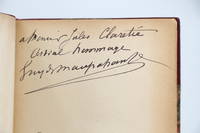
188787433Paris: Paul Ollendorff 1887. Fine. Paul Ollendorff Paris 1887 11.50 x 18.50 cm relié First edition on ordinary paper. Contemporary binding in half red morocco with corners spine with five raised bands framed with black fillets gilt date on tail marbled paper boards bouquet-patterned endpapers and pastedowns original wrappers and spine preserved small angular restoration to the foot of the first board gilt head. Binding signed by Léon Gruel one of the most renowned bookbinders of the late 19th century. Le Horla consists of thirteen short stories: Le Horla Amour Le Trou Sauvée Clochette Le Marquis de Fumerol Le Signe Le Diable Les Rois Au bois Une famille Joseph L'Auberge and Le Vagabond. Precious signed and inscribed copy by Guy de Maupassant: « À monsieur Jules Claretie cordial hommage. Guy de Maupassant ». To Mr Jules Claretie with my warmest regards. Guy de Maupassant' Autograph inscriptions on the first edition of Le Horla are particularly rare especially in signed contemporary half-marocco bindings. Only fourteen copies have been recorded by Thierry Selva Maupassant par les textes. A great admirer of Maupassant's work the critic novelist and playwright Jules Claretie sponsored his admission to the Société des Gens de Lettres on March 3 1884. Le Horla was published during the height of public interest in theories of hysteria and personality disorders. Both Maupassant and Claretie attended the lessons and hypnosis sessions of Doctor Charcot at the Salpêtrière hospital whose influence can be found in Le Horla and many of Maupassant's fantastic short stories. Claretie himself explored similar themes in his 1885 novel Jean Mornas depicting a crime committed under hypnotic suggestion and later in L'Obsession: Moi et l'Autre 1908 which tells the story of a painter suffering from a split personality. In 1892 as Maupassant succumbed to syphilitic madness under the care of Dr. Blanche Claretie immediately thought of Le Horla. He reopened his copy and examined the eerie connection between the writer and his work in an article for the North American Review: And while I am reading over this 'Horla"" to seek there for the trace to find there the premonitions of the misfortune that has overwhelmed M. de Maupassant I cannot keep from seeing him again revolver in hand in the room at Cannet trying to escape by suicide from that other Horla whose sinister approach he felt ; the mania of persecution. The Shudder in Literature' August 1892 English-speaking readers discovered Le Horla in 1890 Harpers & Brothers trans. Jonathan Stuges which would be H.P. Lovecaft's main inspiration for his famous Call of Cthulhu. On the writer's death Claretie once again dedicated some superb lines to him in his Parisian columns. One can easily imagine Claretie rereading the pages of this copy offered by the author contemplating the tragic fate of a genius whose illness eerily mirrored the hallucinations of Le Horla's narrator: ""I know of nothing more heartrending than this end at the height of his powers this sorrowful death in the prime of youth. One could have foreseen it perhaps guessed it this obsession with madness in such a poignant study as Le Horla - in such tales where the shudder of the unknown and the vertigo of fear run throughout. What a study of physiological literature for Arvède Barine who was already studying disease in Poe and Gérard de Nerval! Was it overwork or heredity that doomed the poor admirable Maupassant Was he the victim of his artificial life as a socialite or of his solitary reveries n this contrast of existences which part became the morbid one"" La Vie à Paris 1897. This masterpiece through its precious autograph dedication brings together two leading literary figures of the 19th centuryboth fascinated by the fantastic and the limits of human perception: ""I admired this man of robust clear prose. Others knew him better but no one admired him more. He was a classic."" Paul Ollendorff hardcover
188960645Triel Triel-sur-Seine 1889. Fine. Triel Triel-sur-Seine s. d. 8 juillet 1889 9.90 x 15.20 cm 3 pages sur un feuillet rempliée Autograph letter signed by Guy de Maupassant to Countess Potocka 38 lines in black ink on a double sheet. Published in Marlo Johnston ""Lettres inédites de Maupassant à la comtesse Potocka"" Histoires littéraires no. 40 October-November-December 2009. Darker than usual Maupassant seems troubled by some incident he does not mention but for which he apologizes to the Countess: ""Je vous demande encore pardon ce qui du reste n'atténue pas mon remords ; et je vous assure qu'il est cuisant car j'ai cette arrière-pensée que cous m'en voudrez un peu pendant longtemps."" ""I ask your pardon once again which moreover does not diminish my remorse; and I assure you that it is stinging for I have this nagging thought that you will hold it against me for a long time."" Maupassant had earned a reputation as a prankster as well as a man of very free speech; he had no doubt crossed a line in word or deed. A few years earlier he had distinguished himself with the famous doll prank. Countess Potocka had given Maupassant rag dolls representing the guests at a dinner she was hosting at her home. As a joke he stuffed the bellies of said dolls and sent them back to the Countess the next day thus claiming to have impregnated them overnight. The prank became known and provoked many outraged reactions but the Countess had eventually assured him of her forgiveness. Whatever the unfortunate event may have been the letters seem to have crossed in the mail: ""Votre lettre m'a été renvoyée à Triel car le facteur ne me savait pas à Paris."" ""Your letter was forwarded to me at Triel because the postman did not know I was in Paris."" Thinking he would again face reproaches he admits to having: "". été en la lisant pénétré de confusion."" ""been upon reading it filled with confusion."" Anxious to please the Countess he expresses his concern: ""Pourquoi suis-je ainsi nerveux par moments comme une femme sans motifs réels et sans avoir ressenti vraiment aucun froissement. Je n'en sais rien. Je ne peux que le constater."" ""Why am I thus nervous at times like a woman without real motives and without having truly felt any offense. I know nothing of it. I can only observe it."" Whether they were the early signs of the madness in which he would end his days or the consequences of his feelings for the Countess whom he feared to anger these fits of nervousness would never cease for the rest of the author's life. To ensure the Countess's visit to Triel Maupassant asks for confirmation: ""Je compte sur vous demain n'est-ce pas."" ""I count on you tomorrow do I not."" To this end he advises her to take the train: ""Si vous venez par le chemin de fer comme vous y paraissez décidée j'irai vous attendre à Meulan . Si vous veniez par le bateau de Georges je vous prie de vouloir bien m'en informer par une dépêche."" ""If you come by railway as you seem decided to do I will go wait for you at Meulan. If you were to come by Georges's boat I beg you to kindly inform me by telegram."" The Georges in question is Georges Legrand journalist one of the Countess's ""Macchabées"" whom she introduced to Maupassant and according to painter Jacques-Émile Blanche the only one who enjoyed her favors. Provenance: Jean Bonna collection. unknown
188460657Paris 1884. Fine. Paris s. d. début janvier 1884 10.20 x 13 cm 4 pages sur un feuillet double Signed autograph letter from Guy de Maupassant to the Countess Potocka 67 lines in black ink on a letterhead ""GM 83 rue Dulong"" envelope attached. This long letter begins with a commission that was made to Maupassant: "" I immediately pay for a commission for which I am charged although I seem to find a little irony in it. The Princess Ourosow who has just written to me to ask to see her this evening begs me in postscript to remind her of your memory when I see you. Princess Ourosov was the wife of the Russian ambassador to Paris. With the Countess she was part of that worldly gotha that surrounded authors and artists. The irony he mentions is this: "" As reputed perceptive people asserted that all the thought of a woman's letter is in the postscript . I wanted to fulfill my role immediately 'intermediate. Because of this addition he deduced: "". that the letter of the Princess despite what it contains of amiable for me was addressed to you ."" This amazing letter then addresses a little-known leaning of Maupassant: his taste for fetishes. He informs his correspondent that: "" The hand since she came home seems to me in an extraordinary agitation. This is the famous hand that Maupassant had bought from George Powell. It was through the poet Charles Swinburne whom Maupassant almost saved from drowning that the two men met at Etretat in 1868. Powell and Swinburne shared a house there filled with Powell's collection of curiosities. The hand in question was mummified and it inspired Maupassant twice. A first in 1875 with La Main de l'écorché then in 1885 with La Main . This nervousness of the lucky charm makes Maupassant wonder: "" Perhaps you were wrong not to keep it as a fetish He adds: ""But I have other singular fetishes. Do you want one Indeed he possesses a collection: "" I own the shoe of a little Chinese woman who has died of love for a Frenchman. He comments on the potential effects of these objects: "" This talisman brings happiness to the desires of the heart. I still have a large copper cross very ugly which worked miracles in the village where I found it. But these talismans do not all work as they should: "" Since she is at home she does not. Maybe it's the environment that's bothering her. But it is not the most astonishing: ""But what I possess most singular are the two ends of a man deceived by his wife and died of shagreen. The guilty wife kept the husband's foot and horn . and made them weld together. I do not know what the effect of this object may be. Despite the seriousness of the affair Maupassant did not abandon his humor: "" Say madam do you want a fetish"" I add that my friends pretend that I bring happiness myself! I place at your feet this last vegetarian who asks for the preference . "" To echo his statement regarding female postscript he adds two to his letter. The first asked the Countess Potocka to recall Maupassant to the memory of Madame Lambert. This lady was the wife of Eugene Lambert a painter known for his cats and who frequented the same milieu as Maupassant and the Countess. The second is much more flavourful: "" Men should not be attached to the postscript of the same importance as to women. "" unknown
188589271885 ÉDITION ORIGINALE dun des chefs duvres de Maupassant. À Paris, Victor-Havard Éditeur, 1885. Un volume, in-12° (12 x 18.5 cm), [2] + 441 pages. Reliure en demi-maroquin violet foncé à grands coins, beau papier marbré violacé sur les contre-plats, deuxième et troisième de couverture, dos à 5 nerfs avec titre, auteur et date en lettres dorées, tranche supérieure dorée. La couverture cartonnée dorigine est conservée à lintérieur. Exemplaire de première impression sur papier ordinaire, après 200 exemplaires sur papier Hollande numérotés. Quelques rares taches de rousseurs, petites manque sur la couverture cartonnée originale, autrement ouvrage en très bon état.
188060635Paris s. d. [16 janvier 1884] | 10.10 x 13 cm | 2 pages sur un feuillet rempliée
188787433Paul Ollendorff | Paris 1887 | 11.50 x 18.50 cm | relié
188960645Triel s. d. [8 juillet 1889] | 9.90 x 15.20 cm | 3 pages sur un feuillet rempliée
188460657Paris s. d. [début janvier 1884] | 10.20 x 13 cm | 4 pages sur un feuillet double
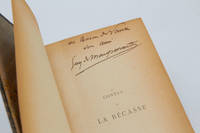
188387740Paris: ED. Rouveyre et G. Blond 1883. Fine. Guy to his Bel-Ami ED. Rouveyre et G. Blond Paris 1883 12 x 19 cm relié First edition no grands papiers deluxe copies printed. Half brown sheepskin spine with four raised bands framed in blind and decorated with gilt floral motifs some rubbing to the spine marbled paper boards marbled paper endpapers and flyleaves modest contemporary binding. Rare signed and inscribed copy by Guy de Maupassant to the Baron de Vaux who inspired the character of Bel-Ami: To Baron de Vaux / his friend / Guy de Maupassant. Maupassant and De Vaux knew each other from their time working at the newspaper Gil Blas where more than half of the short stories in Contes de la bécasse were published. The baron occupied the first office on the left as you entered. The main piece of furniture was the divan. When pretty visitors came to see him he would ostentatiously bolt the door Armand Lanoux Maupassant le Bel-Ami. This scandalous character and former cavalry officer wrote sports articles and front-page reports for Gil Blas which he signed Le Diable boiteux after Lesage's famous character. In the same year he gifted him this copy of Contes de la bécasse Maupassant dedicated to De Vaux the short story Un Sage published in a December issue of Gil Blas. The Baron de Vaux was one of the main inspirations for Georges Duroy the famous character from Bel-Ami: de Vaux had invented his title and had become an important man on the Boulevard. A specialist in horse riding shooting and hunting regular of the Café des Variétés he was the baron of blackmail' he knew all the scandals in Paris. He published a short study on weapons which Guy de Maupassant also prefaced. The baron described Maupassant himself as 'first-rate at cane and boxing tireless in this exercise for which his Herculean muscles are wonderfully suited' Armand Lanoux. A fine token of friendship from Maupassant to the baron of blackmail a member of the colorful and boastful crowd of Gil Blas and model for Bel-Ami. ED. Rouveyre et G. Blond hardcover
1905312910London and New York: M. Walter Dunne Publisher 1905. Edition Suprème Letter R of 26 copies printed on Japan Vellum. Illustrated from Original Drawings by Eminent French and American Artists. 17 vols. 8vo. Bound in full blue morocco with full citron morocco doublures and waters silk endpapers t.e.g. Edition Suprème Letter R of 26 copies printed on Japan Vellum. Illustrated from Original Drawings by Eminent French and American Artists. 17 vols. 8vo. Provenance: Duke of York sold 1926; Aspery 1985 M. Walter Dunne, Publisher unknown
1905312910London and New York: M. Walter Dunne Publisher 1905. Edition Suprème Letter R of 26 copies printed on Japan Vellum. Illustrated from Original Drawings by Eminent French and American Artists. 17 vols. 8vo. Bound in full blue morocco with full citron morocco doublures and waters silk endpapers t.e.g. Edition Suprème Letter R of 26 copies printed on Japan Vellum. Illustrated from Original Drawings by Eminent French and American Artists. 17 vols. 8vo. M. Walter Dunne, Publisher unknown books
191347208(Paris) Socit des Amis des 1913 In-8, maroquin havane, plats orns d'un large encadrement de filets pleins et en pointill, pousss or et froid, et entrelacs aux angles; rappel du dcor sur le dos nerfs, filets or sur les coupes; larges encadrements intrieurs orns de filets dors pleins et en pointill; doublures de maroquin blanc bordes de jeux de listels de maroquin havane et de filets or, et ornes en tte d'un bouquet de fleurs enrubann mosaqu en maroquin orange, crme, vert, rose, jaune et bleu; gardes de soie grenat, doubles gardes de papier marbr, tranches dores sur brochure, couverture imprime (G. Mercier, succ. de son pre, 1922).Un portrait-frontispice et 22 compositions hors texte d'Henri Royer, gravs l'eau-forte et au burin par Antoine Dzarrois. Tirage limit 100 exemplaires numrots sur papier vlin du Marais. Exemplaire n1 imprim au nom de M. Paul VillebSuf qui a dirig la publication de l'ouvrage, enrichi de 5 dessins originaux au crayon non signs de Royer (ayant servi aux illustrations des pages 43, 77, 99, 113 et 123, avec une petite esquisse supplmentaire dessine au crayon au verso), de 2 tats du portrait-frontispice (l'eau-forte en preuve unique signe par le graveur et le bon tirer), de plusieurs tats des 22 eaux-fortes dont le bon tirer (souvent avec des annotations autographes de l'artiste) et de 7 de ces eaux-fortes en preuve unique signes par le graveur.L'exemplaire est de plus accompagn de 80 preuves d'artiste correspondant diffrents tats (dont l'eau-forte pure) du portrait-frontispice et des 22 eaux-fortes, souvent signes par le graveur, avec des annotations au crayon de l'artiste ou sous la forme d'preuve raye. Ces gravures, en partie montes sur onglets, ont t relies en 1924, galement par Georges Mercier la demande de M. Paul VillebSuf, en un volume in-4, demi-maroquin havane coins, plats de papier marbr, dos nerfs orn de filets et petits fers dors; doublures et gardes de papier marbr, tte dore, non rogn.Peintre et graveur, Henri Royer (1869-1938) eut pour matres Franois Flameng et Jules Lefebvre auprs desquels il a dvelopp cette parfaite matrise du dessin, et particulirement celle du portrait, qui le rendra rapidement clbre.Trs bel exemplaire dans une reliure double de Georges Mercier, successeur de son pre, ayant travaill Paris de 1910 1939.De la bibliothque Paul VillebSuf (Paris, Gurin, 30-31 octobre 1963, n333, ex-libris et chiffre pouss or au bas du premier plat).
188387740ED. Rouveyre et G. Blond | Paris 1883 | 12 x 19 cm | relié