FENELON, FrancoisBiblio.com

1 066 résultats
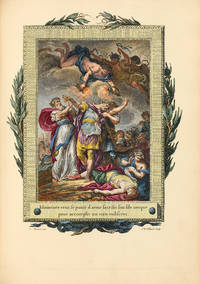
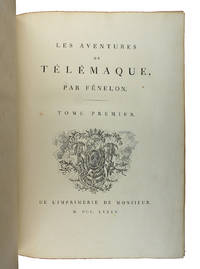
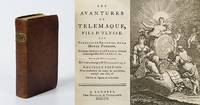
1785ABC_49452Paris: l'imprimerie de Monsieur" colophon below advertisement: Pierre François Didot le jeune printer to the future King Louis XVIII who used the title Monsieur from 1774 to 1789 1785. Contemporary gold-tooled dark greenish-brown morocco sewn on 5 supports with the corresponding raised bands on the spine a red morocco title and volume label on the spine lettered in gold a triple fillet frame on both boards with fleurons in the corners gold-tooled board edges and turn-ins gilt edges marbled endpapers. Super royal 4to. With 98 hand-coloured plates namely two engraved title pages in volume 1 resp. by Augustin de St. Aubin and Montulay 72 illustration plates engraved by Jean-Baptiste Tilliard after drawings by Charles Monnet and 24 engraved plates with summaries of the "books" in decorative frames. Further with an elaborate armorial device incorporating the French royal coat of arms on the title page of each volume. 2 volumes. Deluxe hand-coloured edition of Fénelons popular didactic novel printed with newly designed type by Didot. This is also the first edition to include the 72 beautifully engraved plates drawn by the French painter Charles Monnet or Monet 1732-1808 or later and engraved by Jean-Baptiste Tilliard 1740-1813. The present copy has been luxuriously bound in a neoclassical style by Nicolas-Denis Derome 1731-1790 a renowned bookbinder who was known for the beauty and finesse of his work.Les aventures the Telemaque was originally published anonymously in 1699 because its denunciation of luxury war and selfishness as a matter of principal clearly bore an implied critique of the autocratic rule of King Louis XIV. The author did not remain anonymous for long; François de Salignac de la Mothe-Fénelon mostly known as François Fénelon 1651-1715 was a French Catholic archbishop theologian poet and writer. He was a regular visitor of the royal court at Versailles and for eight years tutor to Louis Duke of Burgundy known as the Petit Dauphin King Louis XIVs grandson. In 1697 however Fénelon was banished to his diocese initially because of a religious dispute and later for writing the present work. Growing dissatisfaction with Louis XVI leading up to the French Revolution made it once again both popular and dangerous though ironically the present edition and others were produced with patronage from members of the royal family.The story of Telemachus and Minerva was meant as a small addition to fill a gap in the chronology of Homer's great epic the Odyssey. While Telemachus the son of Ulysses/Odysseus is in theory the main character the principal focus is actually on "Mentor" or Minerva who teaches him how to rule and how to live life in general with both wisdom and morality. Fénelon's work proved incredibly popular going through numerous editions and translations throughout the 18th and well into the 19th century. The author's ideals of simplicity equality and world peace found their way through Telemachus and Minerva/Athena to French revolutionaries and German romantics thus indirectly shaping 18th- and 19th-century European cultural and political thought. It also found its way to North America - becoming one of Thomas Jefferson's favourites - and the Ottoman Empire. With the publication of an edition in Ottoman Turkish in 1859 it became the first European novel to be translated into Turkish.The present luxurious edition - which stands in stark contrast to the author's original message of simplicity and relative equality - was produced under the direction of Pierre François Didot with the patronage of the future King Louis XVIII. It is the first edition to unite the text with the detailed illustrations by Monnet and Tilliard. The first 6 plates belonging to the first 2 books in volume 1 are numbered signed and captioned all other plates are "avant la lettre" without the textual information and are very rare. The main text is set in the new Gros Romain gras roman type that Didot commissioned for this book from the punchcutter Jean-Baptiste Gérard and printed on high quality wove paper made by Pierre II and Étienne Montgolfier in Annonay.With the bookbinder's label of Nicolas-Denis Derome mounted on the verso of the second flyleaf "Rélié par Derome le jeune". The boards have been slightly rubbed the spines are somewhat faded due to exposure to sunlight in the past. The work is slightly browned and very lightly foxed throughout the tissue paper guards have browned some of the plates are stained. Otherwise in very good condition.l Cohen & De Ricci cols. 384-385; André Jammes Les Didot 1998 p. 27; Jeanne Veyrin-Forrer Les caracteres de Pierre-François Didot 1783-1790 in: Gutenberg-Jahrbuch 1962 pp. 57-67 at pp. 60-64 & figs. 1-7 also in Veyrin-Forrer La lettre et le texte 1987 pp. 139-157; Quérard III p. 92; for the plates by Tilliard after Monnet: Portalis 1877 pp. 399-413. l'imprimerie de Monsieur" [colophon below advertisement: Pierre François Didot le jeune, printer to the future King Louis XVIII hardcover
TR12<p>Paris De l'imprimerie de Monsieur 1785.</p><p>2 larges volumes 4to 325 x 234 mm on vellum paper with : I/ 3 ll 309 pp 36 plates 12 engraved titles; II/ 2 ll 297 pp. 29 plates 12 engraved titles 3 ll. In all 1 title-frontispiece engraved by <i>Montulay </i>and dated 1773 65 engravings out of 72 after <i>Monnet</i> engraved by <i>Tilliard</i> and 24 plates decorated with culs-de-lampe containing the summaries On the titles are the arms of Monsieur wood-engraved after <i>Choffard</i>. </p><p>Full red morocco gilt fillet and roulette on the covers spine ribbed with Maltese crosses in the panels of the spine green morocco title and greef double gilt fillet on the edges gilt edges gilt inner roulette. <i>Contemporary binding</i>.</p><p><b>Luxurious typographical edition on velvet paper printed under the direction of Pierre-François Didot with the new characters of his foundry.</b></p><p>Cohen 384-385.</p><p>This is one of the first French works printed on vellum paper.</p><p>"Beautiful edition made to contain the suite of drawings by Charles Monnet exhibited at the Salon of 1771 under the title of Sujets tirés de Télémaque and engraved two years later by Jean-Baptiste Tilliard.</p><p>"It was as early as 1771 that Monnet made for the engraver Tilliard his beautiful illustration of Télémaque the drawings of which were exhibited in part at the exhibition of the Academy of that same year and the series of engravings of which were sold separately.</p><p>Here are a few extracts from the announcement made in January 1773 in the Mercure de France about these figures: "Aventures de Télémaque. 72 estampes in-4. The sieurs Monnet painter to the king and Tilliard engraver thought it necessary to combine their talents to present the most interesting features to the public; they propose to make a series of prints executed in a new manner and suitable for decorating the cabinets or for joining to the various editions that have been made of this work.</p><p>The booksellers took advantage of the opportunity as the following passage proves to launch a new deluxe edition of Télémaque in which these prints could be easily inserted: "As printing and engraving are two arts that are closely related and as amateurs may wish to join the prints to the text of Télémaque itself the associated booksellers who have the privilege announce that they are preparing to make an in-quarto edition in the same format which they hope will be as well executed as the engraving so that there will be nothing left to be desired in such an undertaking. </p><p><b>The first suite which is now being published is of the greatest beauty; the drawings are perfectly composed and the engravings are made with great art care and taste</b>. Baron Roger Portalis Les dessinateurs d'illustrations au XVIIIe siècle.</p><p><b>The adventures of Telemachus is a work of circumstance in the full sense of the term</b>. Indeed in 1689 Fénelon became the tutor of the three sons of the Grand Dauphin. He had to deal especially with the Duke of Burgundy the most difficult of them who was at the same time the heir to the crown.</p><p><b>The present edition is added with a title-frontispiece</b>engraved by <i>Montulay</i> dated 1773 the arms of Monsieur woodcut on the title after <i>Choffard</i> 65 out of 72 <b>hors-text plates engraved in intaglio by</b><i><b>Tilliard </b></i><b>after </b><i><b>Monnet</b></i><b> and 24 engraved plates containing summaries of songs ornamed with encrement and culs-de-lampe.</b></p><p><b>An exceptional copy of which all 90 engravings by monnet and tilliard have been admirably enhanced with gouache at the time and protected by serpents.</b></p><p><b>it is also preserved in its elegant red morocco bindings of the period.</b></p><p>Cohen does not mention any copies of Telemachus with the suite of Monnet and Tilliard in large colours.</p><u>FRENCH</u><br /><u><br /></u><p>Paris De l'imprimerie de Monsieur 1785.</p><p>2 volumes grand in-4 sur papier vélin de : I/ 3 ff. 309 pp. 36 planches 12 titres gravés ; II/ 2 ff. 297 pp. 29 planches 12 titres gravés 3 ff. En tout 1 titre-frontispice gravé par <i>Montulay </i>et daté de 1773 65 gravures sur 72 d'après <i>Monnet</i>gravées par <i>Tilliard</i> et 24 planches ornées de culs-de-lampe contenant les sommaires. Sur les titres sont les armes de Monsieur gravées sur bois d'après <i>Choffard</i>.</p><p>Plein maroquin rouge filet et roulette dorés en encadrement sur les plats dos à nerfs ornés dans les entrenerfs de croix de Malte pièces de titre et de tomaison de maroquin vert double filet or sur les coupes tranches dorées roulette intérieure dorée. <i>Reliure de l'époque</i>.</p><p>325 x 234 mm.</p><p><b>Luxueuse édition typographique sur papier vélin</b><b> imprimée sous la direction de Pierre-François Didot avec les nouveaux caractères de sa fonderie</b>.</p><p>Cohen 384-385.</p><p>C'est l'un des premiers ouvrages français imprimés sur papier vélin.</p><p>" <i>Belle édition faite pour contenir la suite des dessins de Charles Monnet exposée au Salon de 1771 sous le titre de Sujets tirés de Télémaque et gravée deux ans plus tard par Jean-Baptiste Tilliard</i>. "</p><p><i>" C'est dès 1771 que Monnet fit pour le graveur Tilliard sa belle illustration de Télémaque dont les dessins furent exposés en partie à l'exposition de l'Académie de cette même année et dont la série de gravures se vendait séparément.</i></p><p><i>Voici du reste quelques extraits de l'annonce qui fut faite en janvier 1773 dans le </i>Mercure de France<i> au sujet de ces figures : " </i>Aventures de Télémaque<i>. 72 estampes in-4. Les sieurs Monnet peintre du roi et Tilliard graveur ont cru devoir réunir leurs talents pour en présenter au public les traits les plus intéressants ils se proposent d'en former une suite d'estampes exécutées d'une manière nouvelle et propre à orner les cabinets ou à joindre aux différentes éditions qui ont été faites de cet ouvrage. "</i></p><p><i><b>Les libraires profitèrent de l'occasion</b></i><i><b></b> comme le prouve le passage suivant pour lancer une nouvelle édition de luxe du </i>Télémaque<i> dans laquelle on pût insérer facilement ces estampes : " Comme l'imprimerie et la gravure sont deux arts qui se tiennent et que les amateurs pourront souhaiter de joindre aux estampes le texte même de </i>Télémaque<i> les libraires associés qui en ont le privilège annoncent qu'ils se disposent d'en faire une édition in-quarto dans le même format dont ils se flattent que l'exécution pour le papier et la partie typographique répondra aux soins des artistes pour la gravure ainsi il ne restera rien à désirer dans une pareille entreprise. </i></p><p><b>La première suite qui se publie actuellement est de la plus grande beauté ; les dessins sont parfaitement composés et les gravures sont faites avec beaucoup d'art de soin et de goût. </b>" Baron Roger Portalis <i>Les dessinateurs d'illustrations au XVIIIe siècle</i>.</p><p><b>Les Aventures de Télémaque sont une œuvre de circonstance dans toute l'acception du terme.</b> En effet en 1689 Fénelon devint le précepteur des trois fils du grand dauphin. Il dut s'occuper surtout du Duc de Bourgogne le plus difficile d'entre eux qui se trouvait être en même temps l'héritier de la couronne.</p><p><b>La présente édition est ornée d'un titre-frontispice</b> gravé par <i>Montulay</i> daté de 1773 des armes de Monsieur gravées sur bois sur le titre d'après Choffard de 65 sur 72 <b>planches hors-texte gravées en taille-douce</b> par <i>Tilliard</i>d'après <i>Monnet</i> et de <b>24 planches gravées contenant les sommaires de chants ornés d'encadrement et de culs-de-lampe.</b></p><p><b>Exemplaire</b><b>exceptionnel dont l'ensemble des 90 gravures de Monnet et Tilliard ont été admirablement rehaussées à la gouache à l'époque et protégées par des serpentes.</b><b> Il est en outre conservé dans ses élégantes reliures en maroquin rouge de l'époque.</b></p><p>Cohen ne cite pas d'exemplaires du Télémaque avec la suite de Monnet et Tilliard en grand coloris.</p> hardcover
178512113Paris: Imprim. de Mosieur Didot et al. 1785. Paris Imprim. de Mosieur Didot et al. 1785. 2 volúmenes. En folio. -I: Portadilla frontis grabado portada 2 h. 309 pp. 12 36 láminas. -II: Portadilla portada 297 pp. 12 36 láminas. Magnífica encuadernación francesa en pleno marroquén rojo de época planos enmarcados por dos ruedas doradas de elegante composición lomera con hilos dorados a modo de nervios y grecas doradas en las calles doble hilo dorado en los cantos y rueda dorada en los contracantos cabeza y cortes también dorados. Magnífico ejemplar encuadernado en marroquén de época con rica decoración que contiene en total 72 láminas grabadas por Tilliard sobre dibujos de Monnet 24 sumarios grabados enmarcados por finas viñetas y un frontispicio. Obra clásica de la literatura francesa del siglo XVIII. La primera edición de las Aventuras de Telémaco hijo de Ulyses escrita por Fenelón 1651-1715 fue publicada en 1699 y desde entonces han sido numerosas las ediciones que han aparecido siendo las más apreciadas las impresas en folio en París por Didot. Típico trabajo francés del siglo XVIII realizado con el mayor esmero: el papel los grabados la disposición tipográfica la soberbia encuadernación. todo es excelente. Buen ejemplar amplio de márgenes y generalmente limpio ligeras manchas ocasionales que afectan generalmente a los márgenes de alguna lámina dos o tres láminas algo oscurecidas por lo demás magnífico ejemplar digno de las más importantes bibliotecas. Imprim. de Mosieur [Didot et al.] unknown
1734ST12855Amsterdam: Wetstein & G. Smith; Rotterdam: Jean Hofhout 1734. First Printing of this Edition. ONE OF 150 COPIES IN FOLIO FORMAT. 375 x 265 mm. 14 3/4 x 10 1/2". 4 p.l. including portrait and frontispiece x xxvi i.e. xvi 395 1 pp. Like most copies ours lacks the suppressed material designed to follow page 395. <br/> FINE CONTEMPORARY RED STRAIGHT-GRAIN MOROCCO covers with palmette roll border central panel with gilt-ruled frame and lozenge accented with bead and lozenge roll spine gilt and inlaid with olive morocco bands tooled with gilt chalice and leaves between the double raised bands spine compartments with central urn ornament surrounded by small tools calligraphic flourishes at corners gilt titling turn-ins with elaborate gilt roll featuring leaves and moths blue watered silk endleaves all edges gilt lower board with three older repaired patches. In a modern marbled paper slipcase. Ornamental headpieces and tailpieces title page decorated with vignette author portrait by Drevet after Vivien and 25 more plates illustrating the tale engraved by Folkéma and others predominantly in classical style three including the frontispiece designed by Picart 16 by Dubourg and six by Debrie with original tissue guards; 45 vignettes serving as headpieces 24 and tailpieces 21 designed by Dubourg and Shenk one engraved folding map and extra-illustrated with a portrait of Fenelon by Jean Coraboeuf dated 1920. Text with ornamental border throughout. Front pastedown with the bookplate of Arthur Meyer. Cohen-de Ricci 381-82; Ray 1; Brunet II 1214; Graesse II 564. ◆A few darkened patches on boards small chip to olive band at tail of spine corners gently bumped occasional minor foxing or light browning otherwise QUITE AN EXCELLENT COPY the binding altogether pleasing with only insignificant wear the text clean and fresh with rich impressions of the plates.<br/> <br/> This is a very well-preserved copy of the luxury version of one of the most impressive French illustrated books of the 18th century offered in a Neoclassical binding appropriate for its contents. Ray says that in our volume "all the formal elements of the mid-18th century French masterpieces are present." He describes the 25 plates as "stately and elaborate" and singles out Picart's frontispiece which he reproduces in one of the rare full-page illustrations in his book as being "developed with exceptional spirit and inventiveness." Not only the handsome plates but also the leafy frames of each text page the large type and the many charming headpieces and tailpieces make it an elegant object that provides for a visually memorable experience. Fénelon 1651-1715 wrote this utopian work for Louis XIV's grandson whom he was employed to tutor. The book was designed to give the future ruler more farsighted political social and economic ideas than he might otherwise have met with. Unfortunately the boy died before he could come to power and Fénelon fell into disgrace partly because "Telemaque" reflected badly on the government of Louis. According to Graesse our "beautiful" edition supervised by the marquis de Fénelon is much more correct than previous printings as a great many errors have been corrected and lacunae have been filled in. While the unsigned binding is not quite up to the level of émigré binders Kalthoeber and Staggemeier & Welcher it is in their style and is certainly impressive enough to look handsome on the shelf. Former owner Arthur Meyer 1844-1924 was a French press baron whose collection focused on fine bindings and beautiful illustrations. Wetstein & G. Smith; Rotterdam: Jean Hofhout unknown
182519729<p>New edition published in small numbers by Antoine-Augustin Renouard and printed by Paul Renouard rue de l'Hirondelle.<br />This work was the pretext for the first separate publication of the Lettre à Louis XIV whose original manuscript had recently been purchased at public auction by Antoine-Augustin Renouard February 26 1825. This acquisition removed all doubt as to the authenticity of this famous letter.<br />The illustration consists of three portraits of Fénelon Louis XIV and Madame de Maintenon and a facsimile of the manuscript.</p><p><strong>Copy printed on straw paper with a handwritten note from a Renouard: <em>"this volume is printed entirely on straw paper. R.".</em></strong><br /><strong>The catalog of Antoine-Augustin Renouard's library Potier 1854 indicates that for this work "f<em>ew copies have been printed both on this paper vellum and on another kind also white vellum paper although made of straw."</em></strong><br />As for the portraits they were printed on vergé straw paper and the facsimile of the letter on the same paper as the text on papier vélin de paille.<br />There are few examples of other works printed on straw paper in Renouard's library catalog.</p><p><strong>A very rare specimen of straw wove paper chosen by Antoine-Augustin Renouard as bibliophilic paper.</strong></p><p><em>Catalogue d'une précieuse collection de livres manuscrits autographes dessins et gravures composant la bibliothèque de feu M. Antoine-Augustin Renouard. Paris Potier 1854. n°82 and 83 both stitched<br />Librairie Paul Jammes. Catalogue n°308. Antoine-Augustin Renouard bibliophile. n°11.</em></p> Antoine-Augustin Renouard
1796232357Paris: Didot l'aîné 1796. First edition with these illustrations one of 200 printed on GRAND PAPIER VELIN. Engraved portrait after Vivian engraved by Gaucher and 24 plates after drawings by Lefebvre engraved by Delvaux Godefroy Simonet Thomas and Trière. 4 vols. 18mo. Full early 20th-century dark brown morocco richly gilt marbled endpapers. Spines very slightly faded otherwise a beautiful set complete with all half-titles immaculate text and plates with the original tissue guards. First edition with these illustrations one of 200 printed on GRAND PAPIER VELIN. Engraved portrait after Vivian engraved by Gaucher and 24 plates after drawings by Lefebvre engraved by Delvaux Godefroy Simonet Thomas and Trière. 4 vols. 18mo. Cohen: 388-89 "charmantes figures par Lefebvre" Didot l'aîné unknown
1790ST20479Paris: De l'imprimerie de Monsieur i.e. P. Didot jeune 1790. 243 x 154 mm. 9 1/2 x 6 1/4". Two volumes. <br/> LOVELY DARK BLUE STRAIGHT GRAIN MOROCCO BY BOZERIAN JEUNE stamp-signed at foot of Tome I spine covers with pretty gilt frame enclosed by double gilt rule raised bands spine gilt in panels with large millepoint ornament with floral tools emanating from a central circle gilt lettering turn-ins with Greek key roll marbled endpapers all edges gilt. With frontispiece and six engravings by Cochin and Moreau as called for all before letters and EXTRA-ILLUSTRATED with 24 engravings by Marillier here in proofs before the letter and with three versions of the portrait of Fénélon by Vivien engraved by Hubert Figuet and Savart. Cohen-de Ricci col. 386-87 noting the addition of the Marillier plates to some copies; Graesse II 565; Brunet II 1215-16. Spine evenly a little sunned Marillier plates with minor marginal foxing isolated small smudges to the very generous margins one quire a little yellowed a couple of leaves with small holes to a margin due to paper flaws but AN ESPECIALLY FINE COPY--clean fresh and bright in a most appealing binding with almost no signs of wear.<br/> <br/> Our copy of Fénélon's political allegory featuring the son of Odysseus is a very fine example of French Rococo book production with printing illustration and binding by leading practitioners of those arts. Scion of a printing dynasty Pierre-François Didot jeune 1732-95 sought to improve the family's productions by founding a factory to product the luxurious papers that characterize Didot editions as well as by making improvements in type-founding to refine their always-admired font. Ray considers illustrators Cochin and Moreau le jeune part of the Rococo pantheon of greats headed by Boucher Gravelot and Eisen. He praises Cochin’s "mastery of outline and firmness of composition" as well as his "acute observation and unpretentious humor." Ray was also impressed with Moreau's keen eye for detail and agreed with the Goncourt brothers that "the grace and charm of his drawing . . . brought about 'a renaissance in the rococo style.'" Forced by financial necessity to take up book illustration Pierre-Clémént Marillier 1740-1808 soon earned what Ray called "a position in the front rank of book artists" with his skill and energy. Ray deems Marillier "among the most accomplished" illustrators of the century and he says that "nearly all of his designs are characterized by grace liveliness and firmness of drawingâ€â€”a fitting description for the plates in our volumes. François Bozerian generally called Bozerian jeune was active in Paris from just after the turn of the century until 1818 and for much of that time he worked with his elder brother Jean-Claude 1762-1840. The Bozerian workshop produced many fine bindings for clients that included the emperor Napoleon I as well as leading bibliophiles of the day. Their works are valued today especially for their technical achievement and refinement of design. Our two volumes are especially elaborate--even for Bozerian work--and the precision of the faultless finishing here leaves a very strong impression of rigorous order. De l'imprimerie de Monsieur [i.e., P. Didot jeune] unknown
1717TS368Rotterdam: Jean Hofhout 1717. Nouvell Edition: Augmentee & Corrigee . Hardback. Fine. 12mo. Composees par feu Messire Francois de Salignac De la Motte Fenelon.THE RARE RE-ISSUE BY THE AUTHOR'S FAMILY. 2 volumes bound in one with two titles-pages printed in red and black. French text. lxvii xv folding map finely engraved showing Telemaques voyage around the Mediterranean. 525pp xxiii Odes and table i errata. 10 engraved plates all fine. MAINLY ENGRAVED BY D. COSTER. The 2 pp advertment is SIGNED at the foot by the publisher Jean Hofhout. Later nineteenth century full polished calf binding with gilt. dec. single borders to the boards and a fine spine with raised bands and gitl title and decoration. PLEASE EMAIL FOR PHOTOGRAPHS OF THE BINDING AND SIGNATURE.The title was first published in 1699. This rare edition is the corrected and increased post-humous edition was the second edition correctly published after several 'pirated' editions were sold after the first edition of 1699. The author's family led by his nephew published this edition in French at Rotterdam and Amsterdam in 1717. PLEASE EMAIL FOR PHOTOS. 165x95 mm <br/> <br/> Jean Hofhout hardcover
1764ST15125Augustae Vindelicorum Augsburg: Conradum Henricum Stage 1764. Second Edition in Latin. 208 x 160 mm. 8 1/8 x 6 1/4". 9 p.l. 262 pp.Translated from French into Latin by Joseph Claude Destouches. <br/> VERY ATTRACTIVE LATE 18TH CENTURY ETRUSCAN CALF IN THE STYLE OF EDWARDS OF HALIFAX covers with gilt border central panel framed by stencilled palmettes within double gilt rules an Etruscan-style vase at center within a stencilled sunburst raised bands spine panels with blind-stamped Etruscan vase black morocco label gilt-rolled turn-ins all edges gilt. With printer's elaborate engraved device on title page engraved portrait of Elector Maximilian-Joseph of Bavaria at the head of the dedication to him engraved allegorical headpiece at the opening of Book I wood-engraved tailpieces at end of each section. Small wormhole near head of front joint two corners a bit bumped minor foxing to title and final page other trivial imperfections but QUITE A FINE WIDE-MARGINED COPY clean fresh and bright internally and in a binding with only minor defects.<br/> <br/> This beautifully preserved and attractive Neoclassical binding is a fitting cover for a Latin edition of Fénelon's Homeric coming-of-age tale. Edwards of Halifax is credited with developing the process of acid staining calf by using stencils a method known most notably to produce as here their so-called Etruscan calf bindings after the Etruscan vase decoration they resembled. The process was also adopted by binders on the Continent and became a fashionable choice for bindings in the late 19th century when the present binding was surely produced. It is difficult to say whether this binding was done by the Edwards firm or by an imitator but in any case the quality of execution is very high. The popularity of Fénelon's account of the adventures of the son of Odysseus also spread in this case beyond his native France and it became a favorite of schoolboys far removed from the young Dauphin for whom it was originally composed. First printed in 1759 our Latin translation offered an opportunity for young men to practice reading that classical language. The engravings here were newly designed and executed for this edition by German painter and engraver Georg Sigmund Rösch d. 1766. Conradum Henricum Stage unknown
169930837Bruxelles Fr. Foppens 1699. Small 8vo 12mo. Bound in a beautiful later full calf ca. 1800 w. five raised bands on back. Gilt back and blindstamped ornamental borders on boards. All edges of boards gilt and gilt borders on inside of boards. Hinges cracked and boards loosening inner hinges crudely repaired. A bit of brownspotting but internally a very nice copy. <br/><br/><em>The very rare Bruxelles-edition published same year as the first edition Paris Barbin. Fénelon's main work written when he was a tutor to the Duke of Burgundy in order to hold up Ulysses as an example for the young prince. Fénelon was a leader of the Quetism heresy and in 1699 the year Télemaque appeared Pope Innocent XII condemned his writings. The true first edition of Fénélon's Télemaque appeared in one volume in 1699 under the title "Suite du quatrième livre de l'Odyssée d'Homère ou les Aventures de Télémaque fils d'Ulysse" and containing only half of what we consider Télémaque today. According to Brunet the first edition was suppressed and Moetjens printed a pirate-edition called the second edition in Haag with the same year and date June and a bit later the same year the second part appeared. Several editions appeared the same year and Brunet mentions one without printer or Place but Paris and the Liége- and Bruxelles-editions. "Dans les différentes éditions que nous venons de décrire dans lesquelles il le soit sont celles de LIÉGE 1699 et de BRUXELLES FR. FOPPENS même date l'une et l'autre impr. en France en 2 vol. in-12 et en dix livres." Brunet II:1212. Foppens also printed an edition in Bruxelles 1700 but that is divided into 16 books. All early editions of this work are scarce and the first edition is almost impossible to get a hold of. This main work of French literature has been printed numerous times after the author's death 1715 and editions printed before his death are a great rarity. The later editions were corrected and divided into numerous books not intended in the original manuscript."Une autre circonstance allait aggrever la situation de l'archevêque de Cambray. Peu de temps après sa condemnation parut le livre qui l'a rendu le plus populaire et qui après la "Bible" et l'"Imitation de Jésus-Christ" est un de ceux qui ont eu plus d'éditions: "Les Aventures de Télémaque". N.B.G. 17:328. The controversial but highly popular work was among other things accused of satirically portraying Louis XIV and thereby publicly humiliating him -this was probably not the intention but there is no doubt that the work was critical towards the reigning regime and put forth many ideas not previously heard of. In true utopian political manner Fénélon warns against overgrowth of the metropolis and preaches groundbreaking doctrines like free trade international arbitration etc. He actually foresees the French Revolution as a result of the flourishing despotism so visible in France at the time. Lamartine in his "Life of Fénélon" describes the saintly poet as the first Radical and the first communist of his century though not to his own knowledge and he directly traces the Utopias which produced the revolutions of 1793 and 1848 to his groundbreaking work "The Adventures of Telemachus". Especially the part "Voyage en Salente" is considered very important for the study of utopian literature but the entire work is characterized by the attempt to represent people as they might have behaved and might still be were they governed by sages and saints and according to the laws of God. The work represents a religious ideal where God is always higher than man; it is greatly political greatly influenced by the appreciation of ancient Greek life and is designed to evoke the feeling of honour responsibility and religion in the young prince. See Brunet II: 1210-1212. Graesse 2:563-64 Paris- and La Haye-editions. </em> hardcover
182384888Chez Aime Payen Libraire. As New. 1823. Hardcover. FREE UPGRADE to Courier/Priority Shipping Upon Request - IN STOCK AND IMMEDIATELY AVAILABLE FOR SHIPMENT - AS NEW THE TEXT BLOCK IS PRISTINE CLEAN UNMARKED AND IN EXCELLENT CONDITION - - Text in French 283 pages; on the lives of the most illustrious philosophers of antiquity concise / abridged edition .Includes 26 illustrations. -- with a bonus offer-- . Chez Aime Payen, Libraire hardcover
199574616Le Cateau-Cambresis Nord France: Musee Matisse. New. 1995. Paperback. 2907545175 . FREE UPGRADE to Courier/Priority Shipping Upon Request - IN STOCK AND IMMEDIATELY AVAILABLE FOR SHIPMENT - FLAWLESS COPY PRISTINE NEVER OPENED -- with a bonus offer-- . Musee Matisse paperback
173422235Amsterdam & Rotterdam: J. Wetstein & G. Smith & Zacharie Chatelain; Jean Hofhout 1734. Nouvelle Edition. leather_bound. Contemporary full mottled calf. Aeg. Very good/Near fine. 2 X XVII 424 pages. 28.5 x 23 cm. Folding map 24 plates engraved by Balthasar Bernaerts Philipp Van Gunst Louis Surugue and Jacob Folkema after Louis Fabricius Dubourg Bernard Picart and Guillaume-François-Laurent Debrie with 22 engraved tail pieces. There was also a 1734 folio edition of this work limited to 150 copies. The engravings of the two editions are similar. Our copy contains the suppressed "Ode" last six pages of the text. First edition published 1699: it was also considered an attack on the divine right of absolute monarchy and the the most popular book of its time. BRUNET. p.1214 calls it a "belle edition." GORDON N. RAY. p.8: depicts frontispiece herein. Bookplate of Armand-Jules de Rohan Archbishop of Reims. Raised bands spine panels in gilt floral arabesques triple gilt border panels marbled endpapers spine ends conserved. J. Wetstein & G. Smith, & Zacharie Chatelain; Jean Hofhout unknown
1809ST14310fLondon: J. Hatchard 1809. 210 x 133 mm. 8 1/4 x 5 1/4". xvi 291 pp.Translated by Louisa A. Marshall. <br/> Contemporary dark blue straight-grain morocco covers bordered with gilt rule flat spine with simple gilt rules and titling gilt-ruled turn-ins all edges gilt and WITH A FINE FORE-EDGE PAINTING OF A SCENIC RIVER VIEW FEATURING CHRIST CHURCH PRIORY in Hampshire. Front free endpaper with owner signature of E. A. Fetherston. Slight variation in color of boards half title with one inch trimmed away at head probably removing owner inscription leaves a shade less than bright occasional minor foxing or offsetting in the text bed but still an excellent copy the text clean and fresh the pleasant binding entirely sound and the lovely fore-edge painting very well preserved.<br/> <br/> The typically bucolic fore-edge scene here--boat in tranquil water stately building occupying center stage trees all around puffy clouds--stands out for the level of achievement in execution by the artist. The clouds are painted in a delicately applied range of shades so that they are very convincing; there is considerable architectural detail visible on the side of the church; and it seems as if one can almost see individual leaves in the trees. These features are all hallmarks of the work of the so-called "Dover Painter" the name given by Jeff Weber to the artist who produced very high quality painted fore edges in the 1920s and 1930s. He did work for the famous London bookseller Marks & Company for Dawson's Bookshop in Los Angeles and for J. W. Robinson Company the Los Angeles department store. Estelle Doheny 1875-1958 whose library comprised one of the great collections of the 20th century bought actively from Dawson's and Weber estimates that approximately half of the very considerable number of especially fine fore-edge paintings in the Doheny collection in Camarillo California were done by the Dover Painter. As the fore-edge painting here evokes a feeling of serenity so too does the content religious meditations by François Fénélon 1651-1715 priest writer and tutor to King Louis XIV's grandson for whom he composed his best-known work "The Adventures of Telemachus.". J. Hatchard unknown
182887901Paris: Froment et Lequien 1828. Fine. Froment et Lequien Paris 1828 12.50 x 21 cm 2 volumes reliés New edition preceded by the Discourse on Epic Poetry and on the Excellence of the Telemachus poem by Ramsay. One portrait frontispiece and 11 neoclassical figures hors-texte under tissue guards in volume 1 and 13 in volume 2 totaling 25 figures. Contemporary full glazed navy calf binding signed Thouvenin at the foot of volume 1. Raised band spine decorated with 3 richly ornamented compartments series of fillets on the bands and roulettes at head and foot. Boards stamped in blind with a large central Restoration rosette and large Rococo corner ornaments blind decorative border and gilt fillet frame. Interior decorative border. Gilt edges. Light rubbing. Some scattered foxing. Very handsome copy rare in this condition. Froment et Lequien hardcover
9677774Short description: In Russian. Fenelon Francois de Salignac de la Mothe. Nature's Spectacle about the Being of God. printed at Imperial Moscow University. The image is provided for reference only. It may reflect condition of one of the available copies or only help in identifying the edition. Please feel free to contact us for a detailed description of the copies available. SKU9677774 unknown
168712094<p>A Paris: Chez Pierre Aubouin Pierre Emery et Charles Clousier… 1687 First edition mixed issue of Fénelon's 1651-1715 most important book. This copy has no errata as is the case with first issue copies according to Tchermerzine. It follows Tchermerzine's description of the second issue with p. 167 line 20 having the reading "sans vivre de son esprit" . However it has the errors on p. 275 "manifiques" and "simplieté" as does the first issue. Both O4 pp. 167-8 and pp. 275-6 Z3 are on stubs. . Contemporary calf gilt-decorated spine. . Twelvemo. Spine ends corners lightly worn. Some light browning but generally a very good copy. Instructions for the Education of a Daughter was "…the first systematic attempt ever made to deal with that subject as a whole. Hence it was probably the most influential of all Fénelon's books and guided French ideas on the question all through the 18th century. It holds a most judicious balance between the two opposing parties of the time. On the one side were the précieuses enthusiasts for the 'higher' education of their sex; on the other were the heavy Philistines so often portrayed by Molière who thought that the less girls knew the better they were likely to be. Fénelon sums up in favour of the cultivated house-wife; his first object was to persuade the mothers to take charge of their girls themselves and fit them to become wives and mothers in their turn" Encyclopedia Britannica 13th edition. "Il faut considérer outre le bien que font les femmes quand elles sont bien élevées le mal qu'elles causent dans e monde quand elles manquent d'une education qui leur inspire la vertu. Il est constant que la mauvaise éducation des femmes fait plus de mal que celle des hommes puisque les désordres des hommes viennent souvent & de la mauvaise éducation qu'ils ont receüe de leurs mères & des passions que d'autres femmes leur ont inspirées dans un âge plus avancé. Quelles intrigues se presentent à nous dans les Histoires quel renversement des lois & des moeurs quelles guerres sanglantes quelles nouveautez contre la religion quelles révolutions d'Etat causées par le déreglement des femmes! Voilà ce qui prouve l'importance de bien élever les filles" pp. 7-8.</p> Chez Pierre Aubouin, Pierre Emery et Charles Clousier…
30944Paris Didot l'AineÌ An IV 1796. 4 vol. 90 x 145 mm de 240 292 248 et 260 p. avec 1 f. front. au tome I et 2 f. catalogue au tome IV. Maroquin rouge dos aÌ€ nerfs orneÌs de compartiments doreÌs pieÌ€ces de titre et pastilles de tomaison vertes filets et roulettes doreÌs encadrant les plats contreplats et gardes papier à décor floral tranches doreÌes reliure de l'époque. . Un des 200 exemplaires sur vélin avec les figures avant la lettre signées à la pointe-sèche. Portrait de FeÌnelon d'apreÌ€s Vivien graveÌ par Gaucher et 24 figures de Quéverdo graveÌes par Dambrun Delignon Delaunay Gaucher et Villerey. . On joint reliée à part la rare suite des eaux-fortes pures à toutes marges de Quéverdo reliée en demi-percaline aÌ€ coins. Roman didactique de Fénelon probablement écrit dans les années 1694 et suivantes Les Aventures de Télémaque sont publiées pour la première fois - à l'insu de l'auteur - en 1699. Il fut interprété comme une satire du règne de Louis XIV où l'arrogant prince Idoménée transparaît comme une image particulièrement évocatrice du Roi Soleil. Cette critique implicite de l'absolutisme du monarque apparut immédiatement comme un manifeste transparent en faveur du droit naturel contre le droit divin. Le roman rencontra un vif succès et fut pendant deux siècles de 1699 à 1914 un des livres les plus réédités et les plus lus de toute la littérature française « tellement traduit en Europe que le décompte exact de ses traductions reste encore à faire ». Sa diffusion fut telle qu'il servit de support d'apprentissage de la langue française avec de nombreuses éditions bilingues y compris étrangères : « ainsi dans l'espace allemand on publie de nombreuses versions traduites en italien ou en anglais du roman de Fénelon avec une évidente visée d'apprentissage linguistique . Télémaque est historiquement en 1726 le premier livre publié en anglais sur le sol allemand et c'était aussi le premier roman à être traduit en turc publié en 1862 » Nathalie Ferrand Les circulations européennes du roman français Presses universitaires de Rennes 2010. Une édition identique sera imprimée en 1797 dans le même format avec la même collation et toujours chez Pierre Didot mais avec des gravures de Lefebvre nettement moins séduisantes et recherchées. Des bibliothèques A. Gransire puis Paul Eudel ex-libris. Paul Eudel était collectionneur critique d'art et auteur dramatique ; ex-libris armorieÌ aÌ€ la devise In Procellis impavidae Calmes dans la tempeÌ‚te. Sa bibliotheÌ€que fut dispersée en vente publique en 1898 et 1913. Cohen 388-389 ; voir le blog du Dr J.P. Fontaine le 17 mai 2019 : « Le Tite-Live de l'Hotel des Ventes ». Paris, Didot l'AineÌ, An IV, 1796. 4 vol. (90 x 145 mm) de 240, 292, 248 et 260 p. avec [1] f. (front.) au tome I et [2] f. (ca unknown
175632426AB1756. A Londres London Chez Nourse & Vaillant 1756. Octavo 10.8 cm wide x 18 cm high. Pagination: Frontispiece XXXII 386 pages plus 22 unnumbered pages of a Dictionary for Mythology and Geography to the rear of the volume. With ten engravings plus one folded map throughout the Volume resulting in 11 engravings including Frontispiece plus Map. Hardcover / Original full leather with gilt lettering on spine-label. Edges of bookblock and binding slightly rubbed. Overall in very good and firm condition with only minor signs of wear. Few dogears. Front free endpaper partially torn name of pre-owner Reverend Richard Meade verso the frontispiece. From the library of Richard Meade Ballymartle with his Exlibris / Bookplate loosely inserted. "Les Aventures de Télémaque fils d'Ulysse" English: The Adventures of Telemachus son of Ulysses is a didactic novel by François Fénelon Archbishop of Cambrai who in 1689 became tutor to the seven-year-old Duc de Bourgogne grandson of Louis XIV and second in line to the French throne. It was published anonymously in 1699 and reissued in 1717 by his family. The slender plot fills out a gap in Homer's Odyssey recounting the educational travels of Telemachus son of Ulysses accompanied by his tutor Mentor who is revealed early on in the story to be Minerva goddess of wisdom in disguise. The tutor Mentor is arguably the true hero of the book much of which is given over to his speeches and advice on how to rule. Over and over Mentor denounces war luxury and selfishness and proclaims the brotherhood of man and the necessity of altruism though that term would only be coined in the 19th century by Auguste Comte. He recommends a complete overhaul of government and the abolition of the mercantile system and taxes on the peasantry and suggests a system of parliamentary government and a Federation of Nations to settle disputes between nations peacefully. As against luxury and imperialism represented by ancient Rome Fénelon holds up the ideal of the simplicity and relative equality of ancient Greece an ideal that would be taken up by in the Romantic era of the 19th century. The form of government he looks to is an aristocratic republic in the form of a constitutional monarchy in which the ruler-prince is advised by a council of patricians. Although set in a far off place and ancient time Télémaque was immediately recognized by contemporaries as a scathing rebuke to the autocratic reign of Louis XIV of France whose wars and taxes on the peasantry had reduced the country to famine. Louis XIV who had previously banished Fénelon from Versailles and confined him to his diocese because of a religious controversy was so angered by the book that he maintained those restrictions on Fénelon's movements even when the religious dispute was resolved. Yet a few years later royal panegyrists were hailing the young king Louis XV as a new Telemachus and flattering his tutors as new "Mentors". Later in the century royal tutors gave the book to their charges and King Louis XVI 175493 was strongly marked by it. The French literary historian Jean-Claude Bonnet calls Télémaque "the true key to the museum of the eighteenth-century imagination".2 One of the most popular works of the century it was an immediate best-seller both in France and abroad going through many editions and translated into every European language and even Latin verse first in Berlin in 1743 then in Paris by Étienne Viel 173787. It inspired numerous imitations such as the Abbé Jean Terrasson's novel Life of Sethos 1731; it also supplied the plot for Mozart's opera Idomeneo 1781. With its message of world peace simplicity and the brotherhood of man Télémaque was a favorite of Montesquieu and of Jean-Jacques Rousseau and through him of the French revolutionaries and of German Romantics such as Johann Gottfried Herder 17441803 who approvingly quotes Fénelon's remark "I love my family more than myself; more than my family my fatherland; more than my fatherland humankind". It was also a favorite of Thomas Jefferson who re-read it frequently. It was also widely read in the Ottoman Empire and in Iran. One critic explains the popularity of Télémaque this way: Fénelon's story stood as a powerful rebuke to the aristocratic court culture that dominated European societies with its perceived artificiality hypocrisy and monumental selfishness. The book did not simply express these feelings; it helped shape and popularize them. From its wellspring of sentimentality a river of tenderly shed tears would flow straight through the eighteenth century fed by Richardson Greuze and Rousseau among others finally to pour out into the broad sea of Romanticism. Influence on Rousseau In Rousseau's Émile 1762 a treatise on education the eponymous pupil is specifically given only two novels although as a young man he also reads poetry and other literature: as a child he is given Daniel Defoe's Robinson Crusoe to inculcate him in resourcefulness and self-reliance; and when he becomes a young man the political treatise Télémaque which is put into his hands by his intended Sophie who has read it and fallen in love with the fictional hero. The education of Émile is completed by a journey during which the institutions of various nations are to be studied. His tutor inculcates principles into him which sum up the essentials of the Social Contract. But it is with a Telemachus in hand that teacher and pupil establish a "scale of measurement" for judging various existing societies. Fénelon's story presents models and counter models of monarchs. The princes and governments of the real world will be compared with them. In Rousseau's novel Émile and his tutor travel to Salento which formerly included much of what is now Calabria and Apulia Italy to seek the "good Idomeneo" whom Fénelon's novel had relocated from his former kingdom in Crete to the kingship of a new and reformed government. Contrary to Louis XIV whom he resembles in many traits of character Idomeneus renounces conquest and is able to make peace with his neighbors. The prosperous fields and laborious capital are schools of virtue where law rules over the monarch himself. Everything here is brought down to a "noble and frugal simplicity" and in the harmony of a strictly hierarchical society everything combines in a common utility. Wikipedia _____________________________________________________ Telemachus Romanized: Telemakhos lit. 'far-fighter' is the son of Odysseus and Penelope in Greek mythology and a central character in Homer's Odyssey. When Telemachus reached manhood he visited Pylos and Sparta in search of his wandering father. On his return to Ithaca he found that Odysseus had reached home before him. Then father and son slayed the suitors who had gathered around to woo Penelope. According to later tradition Telemachus married Circe after Odysseus's death. The first four books of the Odyssey focus on Telemachus's journeys in search of news about his father who has yet to return home from the Trojan War and are traditionally given the title Telemachy. Telemachus's name in Greek means "far from battle" or perhaps "fighting from afar" as a bowman does. In Homer's Odyssey Telemachus under the instructions of Athena who accompanies him during the quest spends the first four books trying to gain knowledge of his father Odysseus who left for Troy when Telemachus was still an infant. At the outset of Telemachus's journey Odysseus had been absent from his home at Ithaca for twenty years due to the Trojan War and the intervention of Poseidon. During his absence Odysseus's house has been occupied by hordes of suitors seeking the hand of Penelope. Telemachus first visits Nestor and is well received by the old man who regales him with stories of his father's glory. Telemachus then departs with Nestor's son Peisistratus who accompanies him to the halls of Menelaus and his wife Helen. While there Telemachus is again treated as an honored guest as Menelaus and Helen tell complementary yet contradictory stories of his father's exploits at Troy. Telemachus also learns from Menelaus that his father was last seen stranded on Ogygia. Telemachus focuses on his father's return to Ithaca in Book XV. He visits Eumaeus the swineherd who happens to be hosting a disguised Odysseus. After Odysseus reveals himself to Telemachus due to Athena's advice the two men plan the downfall of the suitors. Telemachus then returns to the palace to keep an eye on the suitors and to await his father as the beggar. When Penelope challenges the suitors to string Odysseus's bow and shoot an arrow through the handle-holes of twelve axe heads Telemachus is the first to attempt the task. He would have completed the task nearly stringing the bow on his fourth attempt; however Odysseus subtly stops him before he can finish his attempt. Following the suitors' failure at this task Odysseus reveals himself and he and Telemachus bring swift and bloody death to the suitors. The Telegony was a short two-book epic poem recounting the life and death of Odysseus after the events of the Odyssey. In this mythological postscript Odysseus is accidentally killed by Telegonus his unknown son by the goddess Circe. After Odysseus's death Telemachus returns to Aeaea with Telegonus and Penelope and there marries Circe. Seemingly later tradition included the character of Cassiphonethe daughter of Odysseus and Circe and therefore half-sister of Telemachusin the narrative. In this account Telemachus still marries Circe but Odysseus is resurrected by Circe at some point. From the Dictionary of Greek and Roman Biography and Mythology: In the post-Homeric traditions we read that Palamedes when endeavouring to persuade Odysseus to join the Greeks against Troy and the latter feigned idiocy placed the infant Telemachus before the plough with which Odysseus was ploughing. In Contest of Homer and Hesiod it is alleged that the Roman Emperor Hadrian asked the Delphic Oracle about Homer's birthplace and parentage. The Oracle replied that Homer came from Ithaca and that Telemachus was his father by Epicasta daughter of Nestor. According to Aristotle and Dictys of Crete Telemachus married Nausicaa King Alcinous's daughter and fathered a son named Perseptolis or Ptoliporthus. Eustathius says that the mother was Polycaste the daughter of Nestor. Others relate that he became the father of Latinus by Circe. He is also said to have had a daughter called Roma who married Aeneas. Servius makes Telemachus the founder of the town of Clusium in Etruria. Wikipedia hardcover
79583 p.l. iv 39 pp. 18mo 142 x 96 mm. cont. brown sheep-backed boards extremities a trifle worn uncut. London: Ballintine & Byworth 1811.<br/> <br/> One of 100 copies privately printed; this is a bibliophilic re-publication of Fénelon’s elegant dialogues on the importance of a ruler engaging with and actively promoting the fine arts. Initially meant for private distribution only this edition was printed in three issues: 50 copies in 18mo 40 on grand papier and 10 on colored paper.<br/> <br/> Fénelon 1651-1715 archbishop of Cambrai and an esteemed writer and theologian originally composed these two imagined dialogues at the end of the 17th century. He gave the manuscript to the painter Pierre Mignard 1612-95 but never published the work in his lifetime. These dialogues finally appeared in print for the first time as an appendix to Monville’s scarce La vie de Pierre Mignard… 1730.<br/> <br/> The first of Fénelon’s dialogues takes place between Poussin and the Greek painter Parrhasius. They discuss the former’s Funeral of Phocion Louvre. The second dialogue is between Poussin and da Vinci and touches upon Poussin’s Landscape with a Man Killed by a Snake National Gallery London.<br/> <br/> The present edition was undertaken by Samuel Weller Singer 1783-1858 a literary scholar and great bibliophile whose initials are found at the end of the Avertissement. He started working with his mother in the feather and flower business but his interest in literature led him to become a bookseller opening on St. James’s Street. He counted legendary collectors like Heber Grenville and Douce as his clients. This work which he also edited was his first privately circulated publication.<br/> <br/> In near fine condition. With a catalogue entry clipping pasted on the front endpaper. WorldCat records just one example in the United States at the Yale Center for British Art on grand papier. The Royal Academy’s copy is printed on pink paper. <br/> <br/> ⧠ODNB. unknown
1705284756A La Haye: Chez Adrien Motjens 1705. Full Leather. Good binding. An early copy of the Avantures de Telemaque Fils d’Ulysse or the “Adventures of Telemachus son of Ulysses†published six years after the First. Written by Francois Fenelon while he was tutor of Louis Duke of Burgundy. The work served as a didactic tool for the future ruler the young ‘Fils de France’ as well as a not-so-subtle critique of absolute monarchy and King Louis XIV. Literary historian Jean-Claude Bonnet is quoted as stating that the Avantures is “the true key to the museum of the eighteenth century imagination;†an instant bestseller Telemaque went through numerous editions. Text in French. Two volumes in one; additional title page for Tome II; pagination and collation reset. Title pages in black and red; with seventeen engraved plates throughout. Some offsetting to the type of signature Bb suggesting the leaves were sewn in before they were dry; previous owners’ names in ink on the rear flyleaves and first title page; lacking endpapers. 26 272 2 328 pp. Full leather with raised bands leather label and tooling in gilt in compartments. Jean-Claude Bonnet La Naissance du Pantheon: Essai sur le culte des grands hommes. Good binding. Chez Adrien Motjens unknown
#[67585]Amsterdam Jan Morterre 1770 two parts in one binding each with seperate titlepage 8vo. half leather binding with wooden boards and marbled paper and faded handwritten title on spine 6036035020 pp. in good condition solid construction with only some waterstains with an engraved frontispiece a fold out map to follow the travels of Telemachus Keyser fecit eight more engravings Broen fecit and some lovely decorative initials and head- and tailpieces. l Two parts in one binding. Dutch translation of the French "Les avantures de Télemaque" after the classical stories about Telemachus. hardcover
171850930à Amsterdam: Chez J. Frédéric Bernard 1718. Fine. Chez J. Frédéric Bernard à Amsterdam 1718 9 x 15.50 cm relié First edition. Another edition appeared on the same date from Florentin Delaulne in Paris. Title page in red and black. Full old red morocco binding ca 1860 unsigned. Raised bands spine in Jansenist style decorated with blind compartments. Gilt title and ""Edition originale"" at foot. Double blind fillet frame on boards. Rich interior border. Edges gilt. Foxing angular lack at head of leaf 45-46 not touching text light rubbing at foot of spine a very small marginal dampstain affecting some leaves at head otherwise handsome copy in an unsigned master binding. Dialogue between A B and C on the nature of eloquence A having the role of Socrates and employing maieutics B and C responding to A's questions. The characters discuss a sermon they have just heard and from there define the qualities of true eloquence by drawing these from examples of the Ancients. Fénelon criticizes both Ancients and Moderns giving preference to the eloquence of Holy Scripture. Du Cerceau's essay attempts to characterize French poetry and what makes verse specific in relation to prose. Both works are supported by quite subtle and pertinent grammatical analyses adjectives figures genitive and ablative. Chez J. Frédéric Bernard hardcover
17953982London: G. and G. Kearsley 1795. Hardcover. Very Good. 12 engraved plates after Thomas Stothard hand-colored. xi 1 xxxv 1 439 12 pages. 4to contemporary tree calf rebacked; plates variously foxed front free endpaper lacking. A surprisingly uncommon edition even more seldom with the plates hand-colored as they are here. <br/><br/> G. and G. Kearsley hardcover
1742861F3Londres London: J. Gray 1742 . Leather. Very Good Indeed. 7" by 4.5". Not Stated . A wonderful copy of this scarce illustrated edition of Francois Fenelon's 'Adventures of Telamachus'. In the original French.Illustrated with a frontispiece folding map and eleven plates. Collated complete.First published in 1699 Fenelon's work recounts the travels of Telemachus the son of Ulysses as he is accompanied by his mentor who is revealed to be Minerva goddess of wisdom.The folding map depicts the route taken by Telemachus.ESTC Citation No. T223001 Revised by Pierre Desmaizeaux.Two volumes in one with separate pagination but only a general title page to the start of the work.With the stamp of the Ipsley Bindery to the rear pastedown.An exceptionally lovely copy of this richly illustrated edition of Fenelon's work. Rebound in half calf with cloth covered boards and endpapers renewed. Externally excellent. Binder's stamp to rear pastedown. Ink marks to fore edge of text block. Internally firmly bound. Pages lightly age toned but generally clean and bright. The odd contemporary ink blot throughout. Very Good Indeed J. Gray hardcover