FENELON, François de Salignac de la Mothe.Livre Rare Book

2 307 résultats
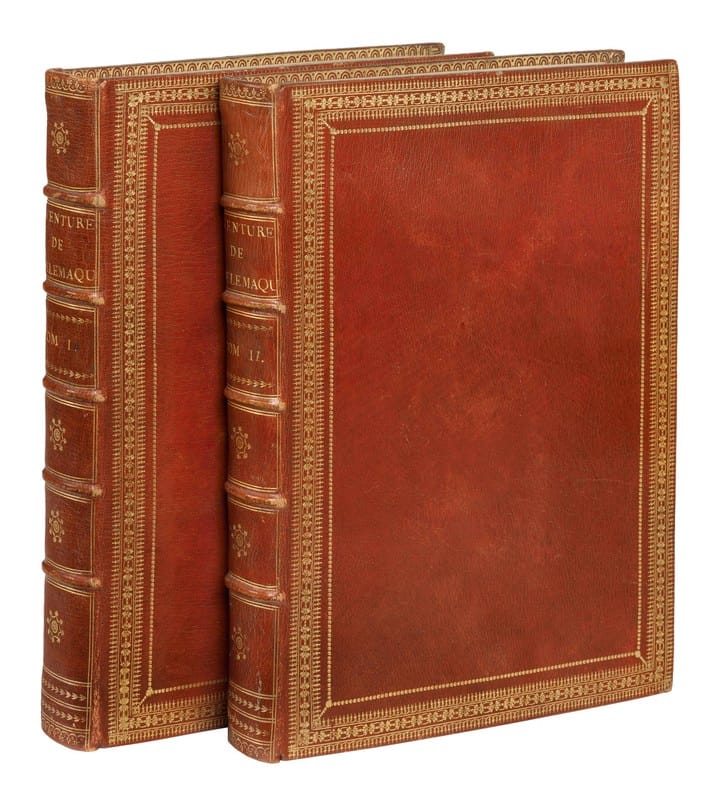
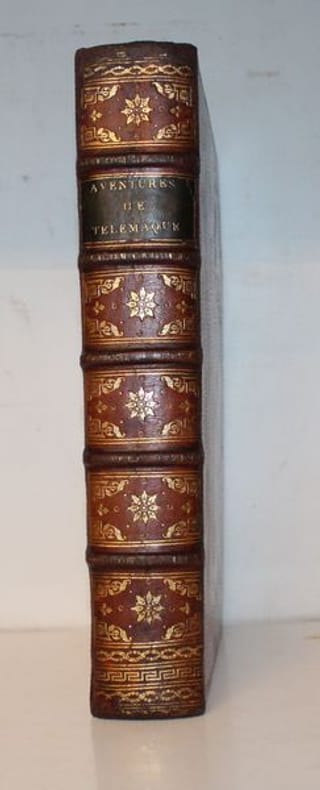
LCS-18121L’un des rarissimes exemplaires somptueusement gouachés à l’époque. Paris, De l’imprimerie de Monsieur, 1785. 2 tomes en deux volumes in-4 de : I/ (2) ff., 309 pp., 13 planches à pleine page hors texte ; II/ (2) ff., 297 pp., (7) pp., 12 planches hors texte à pleine page. Demi-maroquin rouge à long grain à coins de maroquin rouge, filets dorés, dos à nerfs orné de filets dorés et de motifs dotés et mosaïqués. Reliure postérieure. 328 x 245 mm.
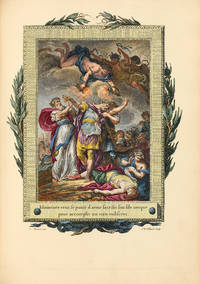
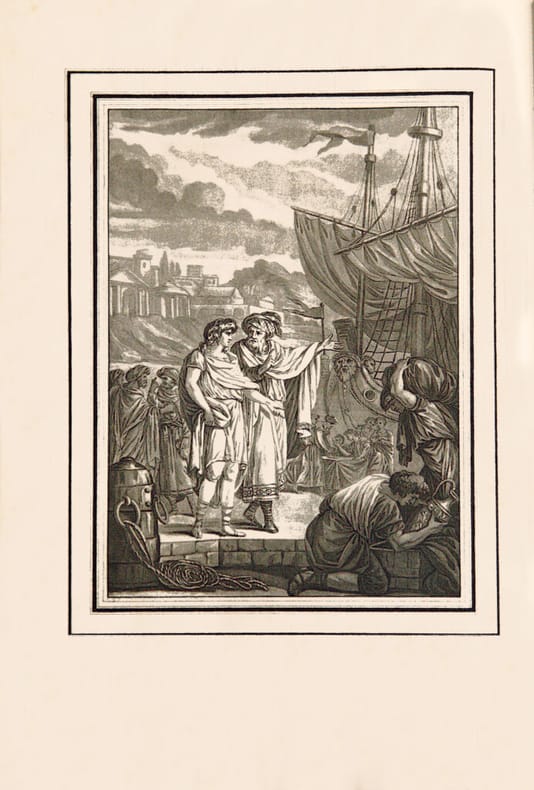
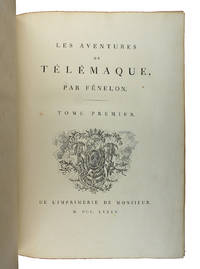
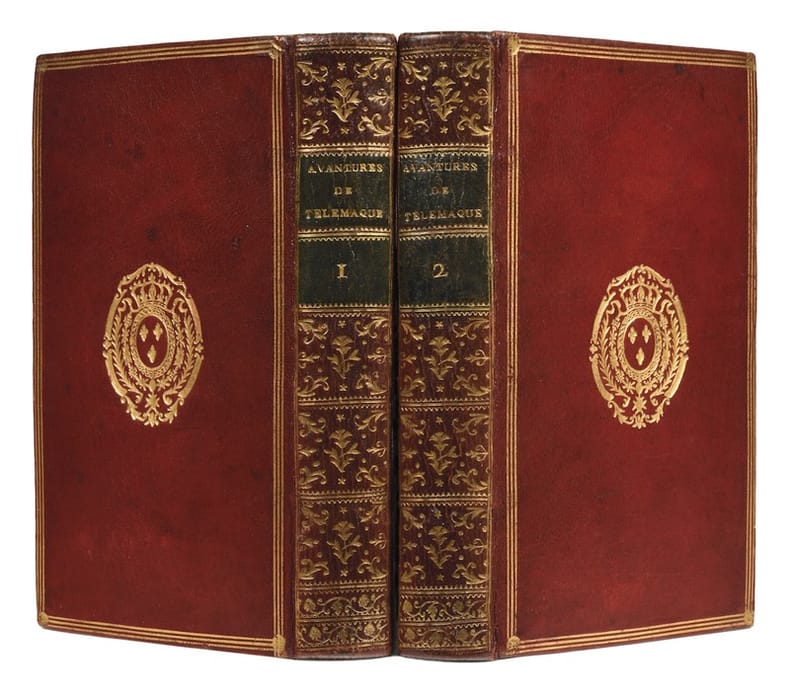
1785ABC_49452Paris: l'imprimerie de Monsieur" colophon below advertisement: Pierre François Didot le jeune printer to the future King Louis XVIII who used the title Monsieur from 1774 to 1789 1785. Contemporary gold-tooled dark greenish-brown morocco sewn on 5 supports with the corresponding raised bands on the spine a red morocco title and volume label on the spine lettered in gold a triple fillet frame on both boards with fleurons in the corners gold-tooled board edges and turn-ins gilt edges marbled endpapers. Super royal 4to. With 98 hand-coloured plates namely two engraved title pages in volume 1 resp. by Augustin de St. Aubin and Montulay 72 illustration plates engraved by Jean-Baptiste Tilliard after drawings by Charles Monnet and 24 engraved plates with summaries of the "books" in decorative frames. Further with an elaborate armorial device incorporating the French royal coat of arms on the title page of each volume. 2 volumes. Deluxe hand-coloured edition of Fénelons popular didactic novel printed with newly designed type by Didot. This is also the first edition to include the 72 beautifully engraved plates drawn by the French painter Charles Monnet or Monet 1732-1808 or later and engraved by Jean-Baptiste Tilliard 1740-1813. The present copy has been luxuriously bound in a neoclassical style by Nicolas-Denis Derome 1731-1790 a renowned bookbinder who was known for the beauty and finesse of his work.Les aventures the Telemaque was originally published anonymously in 1699 because its denunciation of luxury war and selfishness as a matter of principal clearly bore an implied critique of the autocratic rule of King Louis XIV. The author did not remain anonymous for long; François de Salignac de la Mothe-Fénelon mostly known as François Fénelon 1651-1715 was a French Catholic archbishop theologian poet and writer. He was a regular visitor of the royal court at Versailles and for eight years tutor to Louis Duke of Burgundy known as the Petit Dauphin King Louis XIVs grandson. In 1697 however Fénelon was banished to his diocese initially because of a religious dispute and later for writing the present work. Growing dissatisfaction with Louis XVI leading up to the French Revolution made it once again both popular and dangerous though ironically the present edition and others were produced with patronage from members of the royal family.The story of Telemachus and Minerva was meant as a small addition to fill a gap in the chronology of Homer's great epic the Odyssey. While Telemachus the son of Ulysses/Odysseus is in theory the main character the principal focus is actually on "Mentor" or Minerva who teaches him how to rule and how to live life in general with both wisdom and morality. Fénelon's work proved incredibly popular going through numerous editions and translations throughout the 18th and well into the 19th century. The author's ideals of simplicity equality and world peace found their way through Telemachus and Minerva/Athena to French revolutionaries and German romantics thus indirectly shaping 18th- and 19th-century European cultural and political thought. It also found its way to North America - becoming one of Thomas Jefferson's favourites - and the Ottoman Empire. With the publication of an edition in Ottoman Turkish in 1859 it became the first European novel to be translated into Turkish.The present luxurious edition - which stands in stark contrast to the author's original message of simplicity and relative equality - was produced under the direction of Pierre François Didot with the patronage of the future King Louis XVIII. It is the first edition to unite the text with the detailed illustrations by Monnet and Tilliard. The first 6 plates belonging to the first 2 books in volume 1 are numbered signed and captioned all other plates are "avant la lettre" without the textual information and are very rare. The main text is set in the new Gros Romain gras roman type that Didot commissioned for this book from the punchcutter Jean-Baptiste Gérard and printed on high quality wove paper made by Pierre II and Étienne Montgolfier in Annonay.With the bookbinder's label of Nicolas-Denis Derome mounted on the verso of the second flyleaf "Rélié par Derome le jeune". The boards have been slightly rubbed the spines are somewhat faded due to exposure to sunlight in the past. The work is slightly browned and very lightly foxed throughout the tissue paper guards have browned some of the plates are stained. Otherwise in very good condition.l Cohen & De Ricci cols. 384-385; André Jammes Les Didot 1998 p. 27; Jeanne Veyrin-Forrer Les caracteres de Pierre-François Didot 1783-1790 in: Gutenberg-Jahrbuch 1962 pp. 57-67 at pp. 60-64 & figs. 1-7 also in Veyrin-Forrer La lettre et le texte 1987 pp. 139-157; Quérard III p. 92; for the plates by Tilliard after Monnet: Portalis 1877 pp. 399-413. l'imprimerie de Monsieur" [colophon below advertisement: Pierre François Didot le jeune, printer to the future King Louis XVIII hardcover
LCS-186438
TR12<p>Paris De l'imprimerie de Monsieur 1785.</p><p>2 larges volumes 4to 325 x 234 mm on vellum paper with : I/ 3 ll 309 pp 36 plates 12 engraved titles; II/ 2 ll 297 pp. 29 plates 12 engraved titles 3 ll. In all 1 title-frontispiece engraved by <i>Montulay </i>and dated 1773 65 engravings out of 72 after <i>Monnet</i> engraved by <i>Tilliard</i> and 24 plates decorated with culs-de-lampe containing the summaries On the titles are the arms of Monsieur wood-engraved after <i>Choffard</i>. </p><p>Full red morocco gilt fillet and roulette on the covers spine ribbed with Maltese crosses in the panels of the spine green morocco title and greef double gilt fillet on the edges gilt edges gilt inner roulette. <i>Contemporary binding</i>.</p><p><b>Luxurious typographical edition on velvet paper printed under the direction of Pierre-François Didot with the new characters of his foundry.</b></p><p>Cohen 384-385.</p><p>This is one of the first French works printed on vellum paper.</p><p>"Beautiful edition made to contain the suite of drawings by Charles Monnet exhibited at the Salon of 1771 under the title of Sujets tirés de Télémaque and engraved two years later by Jean-Baptiste Tilliard.</p><p>"It was as early as 1771 that Monnet made for the engraver Tilliard his beautiful illustration of Télémaque the drawings of which were exhibited in part at the exhibition of the Academy of that same year and the series of engravings of which were sold separately.</p><p>Here are a few extracts from the announcement made in January 1773 in the Mercure de France about these figures: "Aventures de Télémaque. 72 estampes in-4. The sieurs Monnet painter to the king and Tilliard engraver thought it necessary to combine their talents to present the most interesting features to the public; they propose to make a series of prints executed in a new manner and suitable for decorating the cabinets or for joining to the various editions that have been made of this work.</p><p>The booksellers took advantage of the opportunity as the following passage proves to launch a new deluxe edition of Télémaque in which these prints could be easily inserted: "As printing and engraving are two arts that are closely related and as amateurs may wish to join the prints to the text of Télémaque itself the associated booksellers who have the privilege announce that they are preparing to make an in-quarto edition in the same format which they hope will be as well executed as the engraving so that there will be nothing left to be desired in such an undertaking. </p><p><b>The first suite which is now being published is of the greatest beauty; the drawings are perfectly composed and the engravings are made with great art care and taste</b>. Baron Roger Portalis Les dessinateurs d'illustrations au XVIIIe siècle.</p><p><b>The adventures of Telemachus is a work of circumstance in the full sense of the term</b>. Indeed in 1689 Fénelon became the tutor of the three sons of the Grand Dauphin. He had to deal especially with the Duke of Burgundy the most difficult of them who was at the same time the heir to the crown.</p><p><b>The present edition is added with a title-frontispiece</b>engraved by <i>Montulay</i> dated 1773 the arms of Monsieur woodcut on the title after <i>Choffard</i> 65 out of 72 <b>hors-text plates engraved in intaglio by</b><i><b>Tilliard </b></i><b>after </b><i><b>Monnet</b></i><b> and 24 engraved plates containing summaries of songs ornamed with encrement and culs-de-lampe.</b></p><p><b>An exceptional copy of which all 90 engravings by monnet and tilliard have been admirably enhanced with gouache at the time and protected by serpents.</b></p><p><b>it is also preserved in its elegant red morocco bindings of the period.</b></p><p>Cohen does not mention any copies of Telemachus with the suite of Monnet and Tilliard in large colours.</p><u>FRENCH</u><br /><u><br /></u><p>Paris De l'imprimerie de Monsieur 1785.</p><p>2 volumes grand in-4 sur papier vélin de : I/ 3 ff. 309 pp. 36 planches 12 titres gravés ; II/ 2 ff. 297 pp. 29 planches 12 titres gravés 3 ff. En tout 1 titre-frontispice gravé par <i>Montulay </i>et daté de 1773 65 gravures sur 72 d'après <i>Monnet</i>gravées par <i>Tilliard</i> et 24 planches ornées de culs-de-lampe contenant les sommaires. Sur les titres sont les armes de Monsieur gravées sur bois d'après <i>Choffard</i>.</p><p>Plein maroquin rouge filet et roulette dorés en encadrement sur les plats dos à nerfs ornés dans les entrenerfs de croix de Malte pièces de titre et de tomaison de maroquin vert double filet or sur les coupes tranches dorées roulette intérieure dorée. <i>Reliure de l'époque</i>.</p><p>325 x 234 mm.</p><p><b>Luxueuse édition typographique sur papier vélin</b><b> imprimée sous la direction de Pierre-François Didot avec les nouveaux caractères de sa fonderie</b>.</p><p>Cohen 384-385.</p><p>C'est l'un des premiers ouvrages français imprimés sur papier vélin.</p><p>" <i>Belle édition faite pour contenir la suite des dessins de Charles Monnet exposée au Salon de 1771 sous le titre de Sujets tirés de Télémaque et gravée deux ans plus tard par Jean-Baptiste Tilliard</i>. "</p><p><i>" C'est dès 1771 que Monnet fit pour le graveur Tilliard sa belle illustration de Télémaque dont les dessins furent exposés en partie à l'exposition de l'Académie de cette même année et dont la série de gravures se vendait séparément.</i></p><p><i>Voici du reste quelques extraits de l'annonce qui fut faite en janvier 1773 dans le </i>Mercure de France<i> au sujet de ces figures : " </i>Aventures de Télémaque<i>. 72 estampes in-4. Les sieurs Monnet peintre du roi et Tilliard graveur ont cru devoir réunir leurs talents pour en présenter au public les traits les plus intéressants ils se proposent d'en former une suite d'estampes exécutées d'une manière nouvelle et propre à orner les cabinets ou à joindre aux différentes éditions qui ont été faites de cet ouvrage. "</i></p><p><i><b>Les libraires profitèrent de l'occasion</b></i><i><b></b> comme le prouve le passage suivant pour lancer une nouvelle édition de luxe du </i>Télémaque<i> dans laquelle on pût insérer facilement ces estampes : " Comme l'imprimerie et la gravure sont deux arts qui se tiennent et que les amateurs pourront souhaiter de joindre aux estampes le texte même de </i>Télémaque<i> les libraires associés qui en ont le privilège annoncent qu'ils se disposent d'en faire une édition in-quarto dans le même format dont ils se flattent que l'exécution pour le papier et la partie typographique répondra aux soins des artistes pour la gravure ainsi il ne restera rien à désirer dans une pareille entreprise. </i></p><p><b>La première suite qui se publie actuellement est de la plus grande beauté ; les dessins sont parfaitement composés et les gravures sont faites avec beaucoup d'art de soin et de goût. </b>" Baron Roger Portalis <i>Les dessinateurs d'illustrations au XVIIIe siècle</i>.</p><p><b>Les Aventures de Télémaque sont une œuvre de circonstance dans toute l'acception du terme.</b> En effet en 1689 Fénelon devint le précepteur des trois fils du grand dauphin. Il dut s'occuper surtout du Duc de Bourgogne le plus difficile d'entre eux qui se trouvait être en même temps l'héritier de la couronne.</p><p><b>La présente édition est ornée d'un titre-frontispice</b> gravé par <i>Montulay</i> daté de 1773 des armes de Monsieur gravées sur bois sur le titre d'après Choffard de 65 sur 72 <b>planches hors-texte gravées en taille-douce</b> par <i>Tilliard</i>d'après <i>Monnet</i> et de <b>24 planches gravées contenant les sommaires de chants ornés d'encadrement et de culs-de-lampe.</b></p><p><b>Exemplaire</b><b>exceptionnel dont l'ensemble des 90 gravures de Monnet et Tilliard ont été admirablement rehaussées à la gouache à l'époque et protégées par des serpentes.</b><b> Il est en outre conservé dans ses élégantes reliures en maroquin rouge de l'époque.</b></p><p>Cohen ne cite pas d'exemplaires du Télémaque avec la suite de Monnet et Tilliard en grand coloris.</p> hardcover
LCS-18514Luxueuse édition typographique sur papier vélin, imprimée sous la direction de Pierre-François Didot, avec les nouveaux caractères de sa fonderie. Paris, De l’imprimerie de Monsieur, 1785. 2 volumes grand in-4 sur papier vélin de: I/ (5) ff., 309 pp., 49 planches et 12 titres gravés; II/ (2) ff., 1 frontispice, 297 pp., (1) f., 48 planches et 12 titres gravés. En tout 1 titre-frontispice gravé par Montulay, 72 gravures d'après Monnet gravées par Tilliard et 24 planches ornées de culs-de-lampe contenant les sommaires. Sur les titres sont les armes de Monsieur, gravées sur bois d'après Choffard. Sont en outre reliées les 24 superbes gravures de Moitte gravées au lavis par Parisot. Plein maroquin rouge à grain long, triple filet et roulette dorés en encadrement sur les plats, dos lisses richement ornés, roulette sur les coupes, tranches dorées, roulette intérieure dorée. Reliure de l’époque. 324 x 237 mm.
[700 Figurato di pregio - Legatura] (cm. 34) 2 voll. Magnifica legatura originale in tutta pelle verde, nervi, doppio tassello, ricchi fregi floreali al dorso e larga bordura ai piatti. Sguardie in seta, labbri e dentelle anch'essi decorati. Tagli dorati. -cc.5 nn., + ritratto a colori, pp. 309; -cc. 3 nn., pp. 297 + 1 carta con il privilegio del re. Con 72 tavole da Monnet e 24 tavole con sommari. Opera magnifica su carta speciale è uno dei massimi capolavori della tipografia francese del '700, considerato uno dei 100 migliori libri francesi illustrati. Esemplare eccezionale completo del ritratto del Fenelon, all'inizio del primo volume, finemente colorato di vivien e alix. Molti degli esemplari passati in vendita in atiquariato ed in aste sono privi di questo ritratto. Alcune carte lievemente ombreggiate ma bellissimo esemplare con legatura in perfetto stato e tavole incise protette da veline. Provenienza: Asta Sotheby's Milano 13 Novembre 1996, lotto n° 915. Per particolarità e varianti vedi: * Cohen-Ricci 384; * Ray 37; * Sander 664; * Ramsden 80; * Boissais 76. [F. 81] Libro
178512113Paris: Imprim. de Mosieur Didot et al. 1785. Paris Imprim. de Mosieur Didot et al. 1785. 2 volúmenes. En folio. -I: Portadilla frontis grabado portada 2 h. 309 pp. 12 36 láminas. -II: Portadilla portada 297 pp. 12 36 láminas. Magnífica encuadernación francesa en pleno marroquén rojo de época planos enmarcados por dos ruedas doradas de elegante composición lomera con hilos dorados a modo de nervios y grecas doradas en las calles doble hilo dorado en los cantos y rueda dorada en los contracantos cabeza y cortes también dorados. Magnífico ejemplar encuadernado en marroquén de época con rica decoración que contiene en total 72 láminas grabadas por Tilliard sobre dibujos de Monnet 24 sumarios grabados enmarcados por finas viñetas y un frontispicio. Obra clásica de la literatura francesa del siglo XVIII. La primera edición de las Aventuras de Telémaco hijo de Ulyses escrita por Fenelón 1651-1715 fue publicada en 1699 y desde entonces han sido numerosas las ediciones que han aparecido siendo las más apreciadas las impresas en folio en París por Didot. Típico trabajo francés del siglo XVIII realizado con el mayor esmero: el papel los grabados la disposición tipográfica la soberbia encuadernación. todo es excelente. Buen ejemplar amplio de márgenes y generalmente limpio ligeras manchas ocasionales que afectan generalmente a los márgenes de alguna lámina dos o tres láminas algo oscurecidas por lo demás magnífico ejemplar digno de las más importantes bibliotecas. Imprim. de Mosieur [Didot et al.] unknown
1734ST12855Amsterdam: Wetstein & G. Smith; Rotterdam: Jean Hofhout 1734. First Printing of this Edition. ONE OF 150 COPIES IN FOLIO FORMAT. 375 x 265 mm. 14 3/4 x 10 1/2". 4 p.l. including portrait and frontispiece x xxvi i.e. xvi 395 1 pp. Like most copies ours lacks the suppressed material designed to follow page 395. <br/> FINE CONTEMPORARY RED STRAIGHT-GRAIN MOROCCO covers with palmette roll border central panel with gilt-ruled frame and lozenge accented with bead and lozenge roll spine gilt and inlaid with olive morocco bands tooled with gilt chalice and leaves between the double raised bands spine compartments with central urn ornament surrounded by small tools calligraphic flourishes at corners gilt titling turn-ins with elaborate gilt roll featuring leaves and moths blue watered silk endleaves all edges gilt lower board with three older repaired patches. In a modern marbled paper slipcase. Ornamental headpieces and tailpieces title page decorated with vignette author portrait by Drevet after Vivien and 25 more plates illustrating the tale engraved by Folkéma and others predominantly in classical style three including the frontispiece designed by Picart 16 by Dubourg and six by Debrie with original tissue guards; 45 vignettes serving as headpieces 24 and tailpieces 21 designed by Dubourg and Shenk one engraved folding map and extra-illustrated with a portrait of Fenelon by Jean Coraboeuf dated 1920. Text with ornamental border throughout. Front pastedown with the bookplate of Arthur Meyer. Cohen-de Ricci 381-82; Ray 1; Brunet II 1214; Graesse II 564. ◆A few darkened patches on boards small chip to olive band at tail of spine corners gently bumped occasional minor foxing or light browning otherwise QUITE AN EXCELLENT COPY the binding altogether pleasing with only insignificant wear the text clean and fresh with rich impressions of the plates.<br/> <br/> This is a very well-preserved copy of the luxury version of one of the most impressive French illustrated books of the 18th century offered in a Neoclassical binding appropriate for its contents. Ray says that in our volume "all the formal elements of the mid-18th century French masterpieces are present." He describes the 25 plates as "stately and elaborate" and singles out Picart's frontispiece which he reproduces in one of the rare full-page illustrations in his book as being "developed with exceptional spirit and inventiveness." Not only the handsome plates but also the leafy frames of each text page the large type and the many charming headpieces and tailpieces make it an elegant object that provides for a visually memorable experience. Fénelon 1651-1715 wrote this utopian work for Louis XIV's grandson whom he was employed to tutor. The book was designed to give the future ruler more farsighted political social and economic ideas than he might otherwise have met with. Unfortunately the boy died before he could come to power and Fénelon fell into disgrace partly because "Telemaque" reflected badly on the government of Louis. According to Graesse our "beautiful" edition supervised by the marquis de Fénelon is much more correct than previous printings as a great many errors have been corrected and lacunae have been filled in. While the unsigned binding is not quite up to the level of émigré binders Kalthoeber and Staggemeier & Welcher it is in their style and is certainly impressive enough to look handsome on the shelf. Former owner Arthur Meyer 1844-1924 was a French press baron whose collection focused on fine bindings and beautiful illustrations. Wetstein & G. Smith; Rotterdam: Jean Hofhout unknown
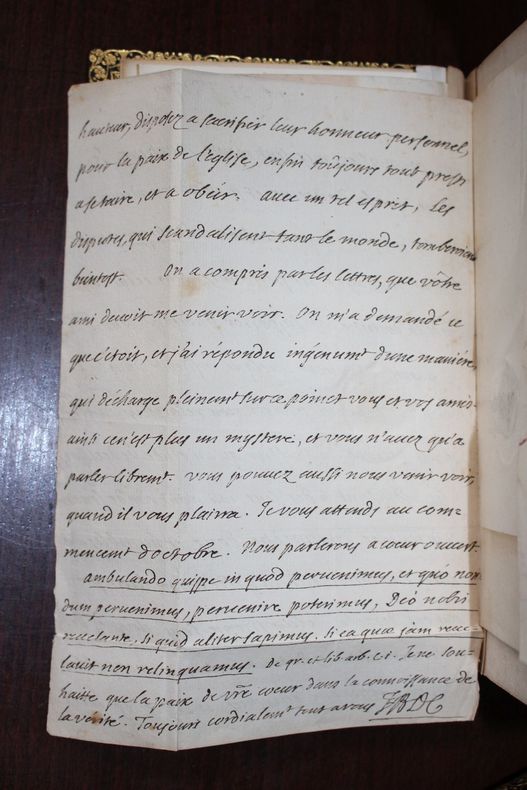
009206François de Salignac de la Mothe-Fénelon, dit Fénelon, Les aventures de Télémaque. Londres, White, Cochrane & Co, 1812. 2 volumes in-8, LXXI-289p & [2]-434p. Nouvelle édition illustrée d'un frontispice d'après Vivien et de 24 planches par Manceau. L'exemplaire est enrichi de 39 gravures supplémentaires, dont 1 frontispice et 25 planches gravées par Robert de Launay d'après les dessins de Charles Monnet (une deux états, avant et après la lettre - T.II, 269 -, planches contrecollées sur vergé fort), 12 planches par Clément-Pierre Marillier et un portrait en médaillon par E Desrochers. Exemplaire imprimé sur beau papier vélin. Exemplaire enrichi de deux rares L.A.S. de Fénelon offertes par Jules Van Praet à Ferdinand Baeyens en 1880 (l'exemplaire contient la lettre de Van Praet jointe aux lettres de Fénelon et une lettre explicative de Baeyens) : .21 septembre 1703 : 2p in-4 avec adresse et cachet de cire aux armes au dos du 2e feuillet. Adressée au chanoine Philippe-Charles Robert, chanoine de Leuze à Mons (Belgique), ami de Port-Royal. Intéressante lettre dont une partie concerne la conduite des supérieurs envers les inférieurs et des inférieurs envers les supérieurs. « Je n'aime que la douceur et je voudrais n'employer que les moyens de persuasion ». La seconde partie mentionne, sans le nommer, le père Quesnel. « On a compris par les lettres que votre ami devait me venir voir ». En effet, ce projet de rencontre, qui s'était su, avait provoqué une enquête à laquelle Fénelon avait aussitôt réussi à mettre fin, peut-être grâce à son sermon du 31 juillet 1703. « On m'a demandé ce que c'était, et j'ai répondu ingénument d'une manière qui décharge pleinement sur ce point vous et vos amis ainsi ce n'est plus un mystère ». Il invite donc à nouveau Robert à Cambrai, en octobre. Cette lettre est fameuse et est éditée depuis longtemps dans les ouvres et correspondances de Fénelon (mal datée toutefois - 2 septembre au lieu de 21 septembre). On la retrouve ainsi dès 1787 (Ouvres, Tome I, p.566), en 1827 (Correspondance, T.II, p.454, lettre n°90), en 1837 (La vraie et solide vertu sacerdotales recueillie des ouvres de Fénelon par Dupanloup, p.629). Elle porte aujourd'hui le n°935 de la correspondance. Provenances : M. Dubois (vente Charavay, 1866, n°59) ; Laurent Veydt (1800-1877) (vente Charavay, 1878, n°420) ; Jules Van Praet (1806-1887) ; Ferdinand Baeyens (1837-1914). .10 décembre 1711 : 1p in-4. Adressée au prieur des Augustins d'Enghien, vraisemblablement Jacques Ignace van Bossuyt (1669-1727). La teneur de la lettre pourrait laisser supposer que le prieur ne l'est que depuis peu et on sait jusque que Bossuyt devient prieur avant 1715. Elle ne porte pas de numéro dans la correspondance, marquée uniquement « p.m. » (entre n°1510 & 1511). A propos d'un jugement que Fénelon ne peut empêcher. Il va écrire au doyen de Chevres (?) afin que son correspondant puisse s'accommoder avec le doyen d'Enghien pour un « salut [du Saint Sacrement] avec l'exposition du S. Sacrement ». Provenances : Laurent Veydt (1800-1877) (vente Charavay, 1878, n°424) ; Jules Van Praet (1806-1887) ; Ferdinand Baeyens (1837-1914). Reliure signée Paul-Joseph Claessens (1861-1909), relié selon toute logique pour Baeyens, plein maroquin vert bouteille, dos à nerfs très décoré, triple filet sur les plats, double filet sur les coupes, dentelle en bordure des contreplats, tranches dorées, étui papier. Rousseurs claires, mors supérieur du tome 1 craquelé sur 1 cm. Magnifique exemplaire enrichi de deux très rares lettres.
8032Paris, Antoine-Augustin Renouard, 1795. 2 volumes in-4 (293 x 212 mm), de 2 ff. n. ch., 366 pp. ; 4 ff. n. ch., 348 pp. Maroquin rouge, jeu de roulettes dorées encadrant les plats, dos à nerfs orné, roulette sur les coupes et les chasses, tranches dorées, la tomaison de la reliure a été inversée et rectifiée postérieurement (reliure de l'époque).
9385Paris, de l’imprimerie de Didot l’aîné, 1784. Deux volumes petit in-8 (182 x 110 mm), 6 ff. n. ch., 453 pp.; 2 ff. n. ch., 438 pp., 1 f n. ch. Maroquin vieux rouge, triple filet doré en encadrement sur les plats, armes au centre, dos lisse orné de caissons de fleurons dorés, pièces de titre et de tomaison vert foncé, coupes filetées, roulette intérieure, tranches dorées, quelques feuillets légèrement brunis dans le second volume (reliure de l’époque).
178576211785 A Paris: De lImprimerie de Monsieur, Chez Didot, Barrois, Onfroy, Th. Barrois, Delalain, 1785. Deux vol. grand in-4: 25.5 x 33 cm. I/ 1 f. de faux.titre, 1 front., 1 f. de titre, 1 f. de titre au livre premier, 309 pp. de texte des livres I à XII + 12 pl. grav.; II/ 2 ff. De faux-titre et titre, 297 pp. de texte des livres XIII à XXIV + 12 pl. grav., 1 f. de privilège. Rare et précieux exemplaire de cette édition des Aventures de Télémaque enrichi dun frontispice et de 24 figures de Moitte gravées au lavis par Parisot. Habituellement, cette édition de lImprimerie de Monsieur est illustrée des 72 gravures de Tillard daprès Monnet, mais les éditeurs décidèrent de commander une autre suite de figures à Moitte, car le papier de la suite de Tillard sharmonisait mal avec lédition. (Cohen, 384-385). Élégantes reliures en veau blond de lépoque. Dos à cin nerfs avec pièces de titre en maroquin rouge, pièces de tomaison en maroquin vert, caissons ornés aux petits fers et roulettes aux coiffes. Gardes recouvertes de papier marbré. Tranches rouges. Mors de queue du vol. 1 légèrement fondu. Quelques taches aux plats, Mors de tête du vol. 2 fendu sur quelques centimètre. Papier et aquatintes propres et fraîches. Bel exemplaire à très grandes marge.
182519729<p>New edition published in small numbers by Antoine-Augustin Renouard and printed by Paul Renouard rue de l'Hirondelle.<br />This work was the pretext for the first separate publication of the Lettre à Louis XIV whose original manuscript had recently been purchased at public auction by Antoine-Augustin Renouard February 26 1825. This acquisition removed all doubt as to the authenticity of this famous letter.<br />The illustration consists of three portraits of Fénelon Louis XIV and Madame de Maintenon and a facsimile of the manuscript.</p><p><strong>Copy printed on straw paper with a handwritten note from a Renouard: <em>"this volume is printed entirely on straw paper. R.".</em></strong><br /><strong>The catalog of Antoine-Augustin Renouard's library Potier 1854 indicates that for this work "f<em>ew copies have been printed both on this paper vellum and on another kind also white vellum paper although made of straw."</em></strong><br />As for the portraits they were printed on vergé straw paper and the facsimile of the letter on the same paper as the text on papier vélin de paille.<br />There are few examples of other works printed on straw paper in Renouard's library catalog.</p><p><strong>A very rare specimen of straw wove paper chosen by Antoine-Augustin Renouard as bibliophilic paper.</strong></p><p><em>Catalogue d'une précieuse collection de livres manuscrits autographes dessins et gravures composant la bibliothèque de feu M. Antoine-Augustin Renouard. Paris Potier 1854. n°82 and 83 both stitched<br />Librairie Paul Jammes. Catalogue n°308. Antoine-Augustin Renouard bibliophile. n°11.</em></p> Antoine-Augustin Renouard
22947Paris De l'imprimerie de François-Ambroise Didot; puis de l'imprimerie de Pierre Didot l'aîné, 1787-1792 1787 in 4 (31x23) 9 volumes reliures plein veau porphyre de l'époque, dos à nerfs très ornés, caissons dorés, pièces de titre de maroquin rouge, pièces de tomaison de maroquin vert, triple filet doré d'encadrement sur les plats, roulette dorée sur les coupes, roulette dorée intérieure, tranches teintées bleu. Avec un portrait de Fénelon, et de Louis de France, duc de Bourgognebon gravés par A. de Saint-Aubin d'après J. Vivien. Des feuillets sont uniformément jaunis, et quelques rares rousseurs éparses. Tchemerzine, III, pages 240. Première édition des Oeuvres, publiée par l'abbé Gallard et le P. de Querbeuf, auteur de la Vie de Fénélon, l'adresse porte le nom de Pierre Didot l'aîné., 1792, à partir du tome 6. Approbation datée du 17 janvier 1787. François de Salignac de La Mothe Fénelon, 1651-1715, Précepteur des Enfants de France, Archevêque-Duc de Cambrai. Première édition des Oeuvres, celui-ci un des rares exemplaires tirés en grand papier. Superbe exemplaire, reliures très fraiches ( Photographies sur demande / We can send pictures of this book on simple request )
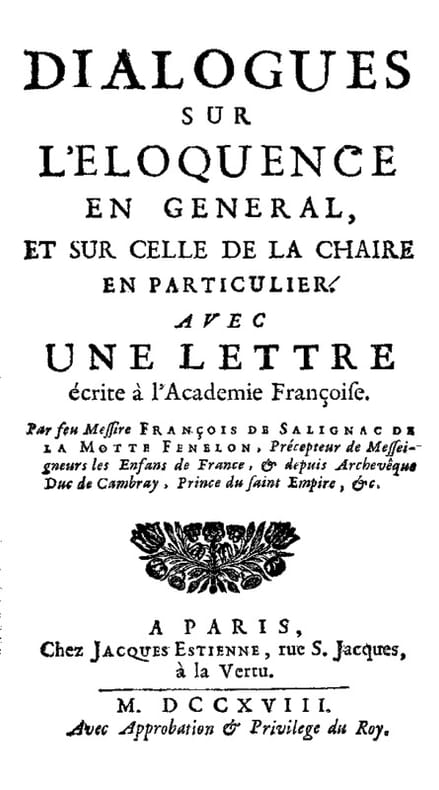
6370Paris, Jacques Estienne, 1718. In-12 (91 x 163 mm), 4 ff. n. ch., 419 pp. chiffrées 409, 1 f. n. ch., 1 f. bl. Maroquin rouge, filet d'encadrement à froid sur les plats, dos à nerfs, caissons à froid, titre doré, roulette intérieure et sur les ocupes, tranches dorées sur marbrure (reliure de l'époque).
1796232357Paris: Didot l'aîné 1796. First edition with these illustrations one of 200 printed on GRAND PAPIER VELIN. Engraved portrait after Vivian engraved by Gaucher and 24 plates after drawings by Lefebvre engraved by Delvaux Godefroy Simonet Thomas and Trière. 4 vols. 18mo. Full early 20th-century dark brown morocco richly gilt marbled endpapers. Spines very slightly faded otherwise a beautiful set complete with all half-titles immaculate text and plates with the original tissue guards. First edition with these illustrations one of 200 printed on GRAND PAPIER VELIN. Engraved portrait after Vivian engraved by Gaucher and 24 plates after drawings by Lefebvre engraved by Delvaux Godefroy Simonet Thomas and Trière. 4 vols. 18mo. Cohen: 388-89 "charmantes figures par Lefebvre" Didot l'aîné unknown
1790ST20479Paris: De l'imprimerie de Monsieur i.e. P. Didot jeune 1790. 243 x 154 mm. 9 1/2 x 6 1/4". Two volumes. <br/> LOVELY DARK BLUE STRAIGHT GRAIN MOROCCO BY BOZERIAN JEUNE stamp-signed at foot of Tome I spine covers with pretty gilt frame enclosed by double gilt rule raised bands spine gilt in panels with large millepoint ornament with floral tools emanating from a central circle gilt lettering turn-ins with Greek key roll marbled endpapers all edges gilt. With frontispiece and six engravings by Cochin and Moreau as called for all before letters and EXTRA-ILLUSTRATED with 24 engravings by Marillier here in proofs before the letter and with three versions of the portrait of Fénélon by Vivien engraved by Hubert Figuet and Savart. Cohen-de Ricci col. 386-87 noting the addition of the Marillier plates to some copies; Graesse II 565; Brunet II 1215-16. Spine evenly a little sunned Marillier plates with minor marginal foxing isolated small smudges to the very generous margins one quire a little yellowed a couple of leaves with small holes to a margin due to paper flaws but AN ESPECIALLY FINE COPY--clean fresh and bright in a most appealing binding with almost no signs of wear.<br/> <br/> Our copy of Fénélon's political allegory featuring the son of Odysseus is a very fine example of French Rococo book production with printing illustration and binding by leading practitioners of those arts. Scion of a printing dynasty Pierre-François Didot jeune 1732-95 sought to improve the family's productions by founding a factory to product the luxurious papers that characterize Didot editions as well as by making improvements in type-founding to refine their always-admired font. Ray considers illustrators Cochin and Moreau le jeune part of the Rococo pantheon of greats headed by Boucher Gravelot and Eisen. He praises Cochin’s "mastery of outline and firmness of composition" as well as his "acute observation and unpretentious humor." Ray was also impressed with Moreau's keen eye for detail and agreed with the Goncourt brothers that "the grace and charm of his drawing . . . brought about 'a renaissance in the rococo style.'" Forced by financial necessity to take up book illustration Pierre-Clémént Marillier 1740-1808 soon earned what Ray called "a position in the front rank of book artists" with his skill and energy. Ray deems Marillier "among the most accomplished" illustrators of the century and he says that "nearly all of his designs are characterized by grace liveliness and firmness of drawingâ€â€”a fitting description for the plates in our volumes. François Bozerian generally called Bozerian jeune was active in Paris from just after the turn of the century until 1818 and for much of that time he worked with his elder brother Jean-Claude 1762-1840. The Bozerian workshop produced many fine bindings for clients that included the emperor Napoleon I as well as leading bibliophiles of the day. Their works are valued today especially for their technical achievement and refinement of design. Our two volumes are especially elaborate--even for Bozerian work--and the precision of the faultless finishing here leaves a very strong impression of rigorous order. De l'imprimerie de Monsieur [i.e., P. Didot jeune] unknown
179678565Reliure d'époque plein veau blond. Dos lisse avec galons dorés et décorés en lace des nerfs, joli fer doré représentant Éros et son arc près d'un char antique, frappé entre les faux-nerfs, pièces de maroquin rouge dont une écussonnée de maroquin vert sur fond or pour la tomaison. Filets au pointillé et petite dentelle. Coupes décorées. Toutes tranches dorées. Avec 24 figures (Avant-lettre) par MARILLIER, gravées par Baquoy, Dambrun, Dupréel, Delvaux, de Ghendt, Langlois jeune, Masquelier, Patas, Pauquet et Ponce, plus un portrait par Vivien, gravé par Hubert.
1717TS368Rotterdam: Jean Hofhout 1717. Nouvell Edition: Augmentee & Corrigee . Hardback. Fine. 12mo. Composees par feu Messire Francois de Salignac De la Motte Fenelon.THE RARE RE-ISSUE BY THE AUTHOR'S FAMILY. 2 volumes bound in one with two titles-pages printed in red and black. French text. lxvii xv folding map finely engraved showing Telemaques voyage around the Mediterranean. 525pp xxiii Odes and table i errata. 10 engraved plates all fine. MAINLY ENGRAVED BY D. COSTER. The 2 pp advertment is SIGNED at the foot by the publisher Jean Hofhout. Later nineteenth century full polished calf binding with gilt. dec. single borders to the boards and a fine spine with raised bands and gitl title and decoration. PLEASE EMAIL FOR PHOTOGRAPHS OF THE BINDING AND SIGNATURE.The title was first published in 1699. This rare edition is the corrected and increased post-humous edition was the second edition correctly published after several 'pirated' editions were sold after the first edition of 1699. The author's family led by his nephew published this edition in French at Rotterdam and Amsterdam in 1717. PLEASE EMAIL FOR PHOTOS. 165x95 mm <br/> <br/> Jean Hofhout hardcover
1764ST15125Augustae Vindelicorum Augsburg: Conradum Henricum Stage 1764. Second Edition in Latin. 208 x 160 mm. 8 1/8 x 6 1/4". 9 p.l. 262 pp.Translated from French into Latin by Joseph Claude Destouches. <br/> VERY ATTRACTIVE LATE 18TH CENTURY ETRUSCAN CALF IN THE STYLE OF EDWARDS OF HALIFAX covers with gilt border central panel framed by stencilled palmettes within double gilt rules an Etruscan-style vase at center within a stencilled sunburst raised bands spine panels with blind-stamped Etruscan vase black morocco label gilt-rolled turn-ins all edges gilt. With printer's elaborate engraved device on title page engraved portrait of Elector Maximilian-Joseph of Bavaria at the head of the dedication to him engraved allegorical headpiece at the opening of Book I wood-engraved tailpieces at end of each section. Small wormhole near head of front joint two corners a bit bumped minor foxing to title and final page other trivial imperfections but QUITE A FINE WIDE-MARGINED COPY clean fresh and bright internally and in a binding with only minor defects.<br/> <br/> This beautifully preserved and attractive Neoclassical binding is a fitting cover for a Latin edition of Fénelon's Homeric coming-of-age tale. Edwards of Halifax is credited with developing the process of acid staining calf by using stencils a method known most notably to produce as here their so-called Etruscan calf bindings after the Etruscan vase decoration they resembled. The process was also adopted by binders on the Continent and became a fashionable choice for bindings in the late 19th century when the present binding was surely produced. It is difficult to say whether this binding was done by the Edwards firm or by an imitator but in any case the quality of execution is very high. The popularity of Fénelon's account of the adventures of the son of Odysseus also spread in this case beyond his native France and it became a favorite of schoolboys far removed from the young Dauphin for whom it was originally composed. First printed in 1759 our Latin translation offered an opportunity for young men to practice reading that classical language. The engravings here were newly designed and executed for this edition by German painter and engraver Georg Sigmund Rösch d. 1766. Conradum Henricum Stage unknown
179675221796 A Paris: De l'imprimerie de Crapelet, An IV (1796). Complet en 2 vol. in-8: 15 x 22.5 cm. I/ 2 ff. de faux-titre et titre, 1 portr., lxxix pp. d'éloge et de tables (tables rel. avant l'éloge), 320 pp. de texte (Livres I à X) et notes + 10 pl. grav.; II/ 2 ff. de faux-titre et titre, 441 pp. de texte (livres XI à XXIV) + 14 pl. grav. Édition illustrée d'un portrait de Fénelon par Vivien gravé par Hubert en frontispice et de 24 figures par Marillier, ici avant la lettre, gravées par Baquoy, Dambrun, Dupréel, Delvaux, de Ghendt, Langlois, Masquelier, Patas, Pauquet et Ponce. Un des précieux 200 exemplaires sur grand papier vélin renfermant lees avant-lettre. (Cohen, 387-388). Précédé de l'Éloge de Fénelon par Jean-François de La Harpe. Reliure strictement de l'époque en veau. Dos lisses avec pièces de titre de maroquin rouge et pièces de tomaison de maroquin vert mine, caissons aux petits fers ornés d'urnes. Roulettes géométriques en encadrement des plats, filet aux coupes et roulettes aux chasses. Toutes tranches dorées. Gardes recouvertes de papier moucheté bleu. Quelques piqûres. Un mors légèrement frondu.
22136S.l., Imprimerie de Monsieur, 1785. Deux tomes en un volume grand in-4, illustrés d'un titre-frontispice gravé par Montulay, daté de 1773 (Paris, chez l'auteur), des armes de Monsieur gravées sur bois d'après Choffard sur le titre, de 72 tailles-douces d'après Charles Monnet gravées par Jean-Baptiste Tilliard, et 24 planches ornées pour les Sommaires. Intérieur frais malgré quelques rousseurs éparses. Plein maroquin rouge, dos à nerfs orné, pièces de titre de maroquin vert, roulette dorée sur les plats, roulette intérieure, tranches dorées . Habiles restaurations (coiffes, coins). Reliure étrangère de l'époque.
169930837Bruxelles Fr. Foppens 1699. Small 8vo 12mo. Bound in a beautiful later full calf ca. 1800 w. five raised bands on back. Gilt back and blindstamped ornamental borders on boards. All edges of boards gilt and gilt borders on inside of boards. Hinges cracked and boards loosening inner hinges crudely repaired. A bit of brownspotting but internally a very nice copy. <br/><br/><em>The very rare Bruxelles-edition published same year as the first edition Paris Barbin. Fénelon's main work written when he was a tutor to the Duke of Burgundy in order to hold up Ulysses as an example for the young prince. Fénelon was a leader of the Quetism heresy and in 1699 the year Télemaque appeared Pope Innocent XII condemned his writings. The true first edition of Fénélon's Télemaque appeared in one volume in 1699 under the title "Suite du quatrième livre de l'Odyssée d'Homère ou les Aventures de Télémaque fils d'Ulysse" and containing only half of what we consider Télémaque today. According to Brunet the first edition was suppressed and Moetjens printed a pirate-edition called the second edition in Haag with the same year and date June and a bit later the same year the second part appeared. Several editions appeared the same year and Brunet mentions one without printer or Place but Paris and the Liége- and Bruxelles-editions. "Dans les différentes éditions que nous venons de décrire dans lesquelles il le soit sont celles de LIÉGE 1699 et de BRUXELLES FR. FOPPENS même date l'une et l'autre impr. en France en 2 vol. in-12 et en dix livres." Brunet II:1212. Foppens also printed an edition in Bruxelles 1700 but that is divided into 16 books. All early editions of this work are scarce and the first edition is almost impossible to get a hold of. This main work of French literature has been printed numerous times after the author's death 1715 and editions printed before his death are a great rarity. The later editions were corrected and divided into numerous books not intended in the original manuscript."Une autre circonstance allait aggrever la situation de l'archevêque de Cambray. Peu de temps après sa condemnation parut le livre qui l'a rendu le plus populaire et qui après la "Bible" et l'"Imitation de Jésus-Christ" est un de ceux qui ont eu plus d'éditions: "Les Aventures de Télémaque". N.B.G. 17:328. The controversial but highly popular work was among other things accused of satirically portraying Louis XIV and thereby publicly humiliating him -this was probably not the intention but there is no doubt that the work was critical towards the reigning regime and put forth many ideas not previously heard of. In true utopian political manner Fénélon warns against overgrowth of the metropolis and preaches groundbreaking doctrines like free trade international arbitration etc. He actually foresees the French Revolution as a result of the flourishing despotism so visible in France at the time. Lamartine in his "Life of Fénélon" describes the saintly poet as the first Radical and the first communist of his century though not to his own knowledge and he directly traces the Utopias which produced the revolutions of 1793 and 1848 to his groundbreaking work "The Adventures of Telemachus". Especially the part "Voyage en Salente" is considered very important for the study of utopian literature but the entire work is characterized by the attempt to represent people as they might have behaved and might still be were they governed by sages and saints and according to the laws of God. The work represents a religious ideal where God is always higher than man; it is greatly political greatly influenced by the appreciation of ancient Greek life and is designed to evoke the feeling of honour responsibility and religion in the young prince. See Brunet II: 1210-1212. Graesse 2:563-64 Paris- and La Haye-editions. </em> hardcover
182384888Chez Aime Payen Libraire. As New. 1823. Hardcover. FREE UPGRADE to Courier/Priority Shipping Upon Request - IN STOCK AND IMMEDIATELY AVAILABLE FOR SHIPMENT - AS NEW THE TEXT BLOCK IS PRISTINE CLEAN UNMARKED AND IN EXCELLENT CONDITION - - Text in French 283 pages; on the lives of the most illustrious philosophers of antiquity concise / abridged edition .Includes 26 illustrations. -- with a bonus offer-- . Chez Aime Payen, Libraire hardcover
199574616Le Cateau-Cambresis Nord France: Musee Matisse. New. 1995. Paperback. 2907545175 . FREE UPGRADE to Courier/Priority Shipping Upon Request - IN STOCK AND IMMEDIATELY AVAILABLE FOR SHIPMENT - FLAWLESS COPY PRISTINE NEVER OPENED -- with a bonus offer-- . Musee Matisse paperback