Fontenelle - Bernard Le Bouyer de.Livre Rare Book
146 résultats
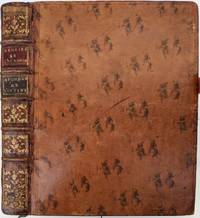
1796YRG-436TRÈS GRANDES MARGES pour cet in-4 (36cm x 27.5) reliure d'époque plein veau blond, dos lisse, orné d'entrelacs dorés, pièce de titre en maroquin rouge et titre doré. Liserets et fleurons dorés sur les plats et gardes avants et arrières. Toutes tranches dorées. Frontispice peint par VOIRIOT, dessiné par FORTY et gravé par LANGLOIS l'an 5 (1796). Une gravure à pleine page. Manque de cuir au bas des plats avant & arrière, coiffe de pieds absente page 31 jaunie dans les marges, traces de tâches ancienne sur les plats. Cependant bel et luxueux ouvrage.
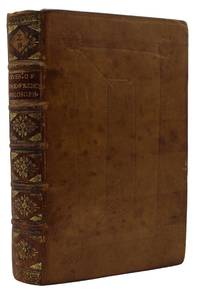
1727171224to. Cont. full calf. 5 raised bands and richly gilt compartments. Faint scratches on covers. Corners and edges a little rubbed. 2 small holes in leather at sides of upper compartment. (26),548 pp. and 1 folded engraved plate. Engraved vignette. On good paper.
1727171224to. Cont. full calf. 5 raised bands and richly gilt compartments. Faint scratches on covers. Corners and edges a little rubbed. 2 small holes in leather at sides of upper compartment. 26548 pp. and 1 folded engraved plate. Engraved vignette. On good paper. <br/><br/><em>First edition of the well-known French philosopher and mathematician's main mathematical work. Fontenelle author of "The Plurality of Worlds" claims here that Geometry is entirely intellectual and independent of the actual decription and existence of figures following more the conceptions of Descartes than those of Newton. </em> hardcover
17972105270019Paris Impr. de Hautbout l'aine an v 1797. First French edition. Hardcover. Good. The French and Indian War: Cherokee Indians 3 works bound as one. 12mo 15 cm. Bound in contemporary 1/4 calf. 2 viii 187 1 pages. Lacking frontispiece. Early ink doodle on verso of title page lion but clean besides. French translation by Billecocq of the 1765 London edition of "The memoirs of Lieut. Henry Timberlake." Timberlake was a Virginian from Hanover county who fought for the English against the Cherokees in the French and Indian War. Tensions had been raised by the execution of 22 Cherokee in South Carolina in 1760 at Fort Prince George. As a result Overhill Cherokee attempted to expel British settlers. Timberlake was part of Colonel William Byrd / Adam Stephen's forces sent to suppress the Americas Indians in the Virginia / Tennessee region. Timberlake served as a lieutenant and a hostage to the Cherokees in 1761-1762 and visited many of their settlements. Later he was accompanied by three Cherokee leaders including the Chief Ostenaco on a diplomatic mission to England. The mission met with King George III and attempted to halt westward expansion by British colonists. One a second mission to England in 1765 Timberlake was imprisoned for debts owed for the lodging in London. He presumably wrote this journal while in debtor's jail and died in prison in 1765. His journal was published posthumously. His accounts of the Cherokee provide an early and fairly accurate depiction of the people before their displacement. Sabin 95837. <br> Also includes two other works bound with this one: M. de Fontenelle "Histoire des Oracles" "Poesies Pastorales." 2 212 142 pages. London 1785; "Confessions de Clement Marot." 6 197 pages. Paris 1798. Paris, Impr. de Hautbout l'aine, an v hardcover
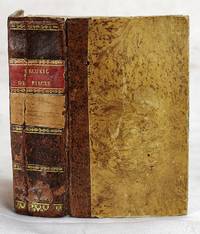
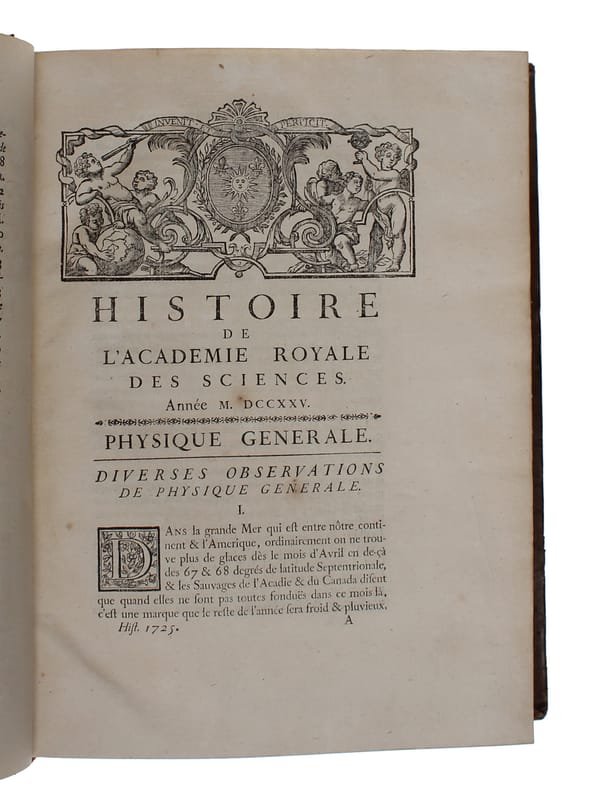
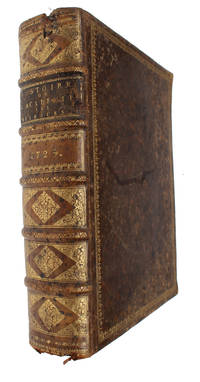
172759036Paris, L'Imprimerie Royale, 1727. 4to. Fine contemp. full calf. Raised bands. Richly gilt spine. Tome- and titlelabels with gilt lettering. Gilt borders on covers. A small nick in leather at upper compartmen. Light wear to foot of spine. (26),548, pp., 1 folded engraved plate. Clean and fine. The offered item includes the entire volume of ""Histoire de L'Academie Royale des Sciences. Années MDCCXXV. Paris, L'Imprimerie Royale, 1727"", of which the memoir of Fontenelle is printed as a ""suite"". With the engraved frontispiece. (6),154,354,(2) pp., 14 partly folded engraved plates. (Original papers by: Maraldi, Petit, Nicole, Winslow, du Fay, Pitot, Delisle d'Aine, Geoffroy le Cadet, Reaumur, Nicole, Cassini, de Mairan, Saurin, de Lagny, Fizes).
172759036Paris L'Imprimerie Royale 1727. 4to. Fine contemp. full calf. Raised bands. Richly gilt spine. Tome- and titlelabels with gilt lettering. Gilt borders on covers. A small nick in leather at upper compartmen. Light wear to foot of spine. 26548 pp. 1 folded engraved plate. Clean and fine. The offered item includes the entire volume of "Histoire de L'Academie Royale des Sciences. Années MDCCXXV. Paris L'Imprimerie Royale 1727" of which the memoir of Fontenelle is printed as a "suite". With the engraved frontispiece. 61543542 pp. 14 partly folded engraved plates. Original papers by: Maraldi Petit Nicole Winslow du Fay Pitot Delisle d'Aine Geoffroy le Cadet Reaumur Nicole Cassini de Mairan Saurin de Lagny Fizes. <br/><br/><em>First edition. "In 1727 as a "Suite des mémoires de l’Académie royale des sciences" he published the Élémens de la géométrie de l’infini. Some doubted whether it was really the work of a mathematician but the author believed it was and attached great value to it. He had worked on it for a long time probably since the period of his preface to the Analyse des infiniment petits. The term élémens is to be understood in the sense of "first principles." According to Fontenelle none of the geometers who had invented or employed the calculus of infinity had given a general theory of it; that is what he proposed to do. The work is divided into a preface relating the history of this branch of calculus and into two main parts: "Système général de l’infini" and "Différentes applications ou remarques." The author discusses "the infinite in series or in progressions of numbers" and then examines "the infinite in straight and curved lines" in the words of the Abbé Terrasson who reviewed the work in the Journal des sçavans July-October 1728." There was a great deal of discussion in the scientific community about this work in which mathematicians found numerous paradoxes. Johann I Bernoulli for example in his correspondence with Fontenelle allowed his criticisms to show through his praise: he did not understand what was meant by finis indéterminables. Fontenelle attempted to defend his theory and above all his distinction between metaphysical infinity and geometric infinity: one must ignore the metaphysical difficulties in order to further geometry and the finis indéterminables ought to be considered "as a type of hypothesis necessary until now in order to explain several phenomena of the calculus" letter to Johann I Bernoulli 29 June 1729. "The orders of infinite and indeterminable quantities like the magnitudes that they represent are only purely relative entities hypothetical and auxiliary. The subject matter of mathematics is only ideal" according to the terms of a "Projet de rapport" of Dortous de Mairan to the Academy on this work." DSB. </em> hardcover
1727RW1716Paris:: L'Imprimerie Royale 1727. 1727. 4to. xxvi 548 pp. Title-page vignette tailpieces headpieces 1 engraved chapter vignette 1 engraved initial 1 engraved folding plate occasional light foxing or browning. Full contemporary mottled calf blind-ruled covers raised bands red and brown leather spine labels gilt decorated spine all edges red marbled end papers leather separation at top of spine all edges red marbled end-papers; leather separation at top of spine hint of worming but strong lightly rubbed. A very clean and tight copy. Fine. FIRST EDITION of an extensive treatise on the principles of calculus by Bernard Fontenelle the distinguished French philosopher and scientist who is famous for his book on the plurality of worlds. Through his friend Varignon Fontenelle made the acquaintance of the Parisian scientific circle and became friends with Nicolas de Malezieu and l'Hopital. Fontenelle wrote the preface to l'Hopital's Analyse des infiniment petits pour l'intelligence des lignes courbes 11690. "In it he displayed his interest in the notion of infinity and his talent as a historian; in a few pages he retraces the history of the mathematical study of curved lines from Archimedes to Newton and Leibniz . . . In 1727 he published his Elements de la geometrie de l'infini which he had worked on for a long time probably since the period of his preface to the Analyse des infiniment petits . . . According to Fontenelle none of the geometers who had invented or employed the calculus of infinity had given a general theory to it; that is what he proposed to do. The work is divided into a preface relating to the history of this branch of calculus and into two main part . . . 'the infinite series or in progression of numbers' and then examines 'the infinite in straight and curved lines . . . " DSB. / Bernard Fontenelle was born at Rouen and pursued a literary career. Fontenelle dabbled in poetry and writing for the stage but it is better known for his work as secretary to the Academy of Sciences. Among his published works are Entretiens sur la pluralite des mondes 1686 the Histoire du renouvellement de l'Academie des Sciences 1708-1722 and a number of eloges of the members. REFERENCES: DSB V pp. 57-63; Poggendorf 1 col. 770 Zeitlinger 1360. L'Imprimerie Royale, 1727. hardcover
1727SW1717Paris:: L'Imprimerie Royale 1727. 1727. 4to. xxvi 548 pp. Title-page vignette tailpieces headpieces 1 engraved chapter vignette 1 engraved initial 1 engraved folding plate; occasional light foxing or browning. Full contemporary mottled calf blind-ruled covers raised bands red and brown leather spine labels gilt decorated spine all edges red marbled end-papers; leather separation at top of spine all edges red marbled end-papers; leather separation at top of spine hint of worming but strong lightly rubbed. A very clean and tight copy. Fine. FIRST EDITION of an extensive treatise on the principles of calculus by Bernard Fontenelle the distinguished French philosopher and scientist who is famous for his book on the plurality of worlds. Through his friend Varignon Fontenelle made the acquaintance of the Parisian scientific circle and became friends with Nicolas de Malezieu and l'Hopital. Fontenelle wrote the preface to l'Hopital's Analyse des infiniment petits pour l'intelligence des lignes courbes 11690. "In it he displayed his interest in the notion of infinity and his talent as a historian; in a few pages he retraces the history of the mathematical study of curved lines from Archimedes to Newton and Leibniz. . . In 1727 he published his Elements de la geometrie de l'infini which he had worked on for a long time probably since the period of his preface to the Analyse des infiniment petits. . . . According to Fontenelle none of the geometers who had invented or employed the calculus of infinity had given a general theory to it; that is what he proposed to do. The work is divided into a preface relating to the history of this branch of calculus and into two main part. . . 'the infinite series or in progression of numbers' and then examines 'the infinite in straight and curved lines. . . .'" DSB. / Bernard Fontenelle was born at Rouen and pursued a literary career. Fontenelle dabbled in poetry and writing for the stage but it is better known for his work as secretary to the Academy of Sciences. Among his published works are Entretiens sur la pluralite des mondes 1686 the Histoire du renouvellement de l'Academie des Sciences 1708-1722 and a number of eloges of the members. DSB V pp. 57-63; Poggendorf I col. 770; Zeitlinger 1360. L'Imprimerie Royale, 1727. hardcover books
173638571736 La Haye: Antoine van Dole, 1736. Complet en 5 vol. in-12: 10 x 17cm. I/ 342-156pp. + 138-180pp. + 332pp. + 346pp. + 355pp. Reliure en pleine basane havane. Dos à 5 nerfs, richement orné de motifs dorés. Pièce de titre foncée, tomaison en lettres dorées. Plats encadrés d'un filet doré, orné d'un fer à chaque coin. Roulette pressée à froid sur les coupes. Tranches rouges. Illustré de deux frontispices et d'une gravure dépliante. Quelques défauts, pièce de tomaison frottées (voir photographies) sinon très bel exemplaire.
17903002018Paris: Jean-Francois Bastien 1790. One or two joints slightly weak. Eight volumes octavo engraved portrait frontispiece in volume 1 and a folding plate in vol. 2; a fine set in contemporary French polished marbled calf; flat spines ornately gilt with double red labels. <p><p>A very attractive set of Fontenelle's works including his enormously popular Entretiens sur la Pluralité des Mondes: this utopian analysis of the universe took Europe by storm and was precursor and inspiration to scores of imitations. It was first published in 1686 and first translated into English by Aphra Behn only two years later.</p> <p>Although the Entretiens clearly owes a tremendous debt to the astronomical traditions of Galileo and Brahe Fontenelle's sensational tale of the inhabitants in "other planets in other galaxies and even on comets could hardly fail to captivate" Nina Rattner Gelbart Introduction to the Conversations on the Plurality of Worlds. In the form of an elegant dialogue between a scientist and a Marquise it takes as its starting point that "Toute la philosophie n'est fondée sur deux choses: sur ce qu'on a l'esprit curieux et les yeux mauvais": that is that if we had a perfect understanding we would not need science because all would be spontaneously revealed. Meant as a quick summation of scientific discovery but also as pure speculation on the possibilities of the universe it suggests that as it has taken six millennia for Europeans to cross the Atlantic Ocean to America it may take a little longer for the inhabitants of other worlds to cross the far greater expanses of space.</p> <p>This set also includes "Dialogues des Morts anciens" and "Histoire des Oracles" works which exemplify Fontenelle's desire to propagate philosophical thinking. Voltaire described Fontenelle as having the most universal mind produced by the era of Louis XIV.</p> </p> . Jean-Francois Bastien unknown
17151008F35London: A. Bettesworth; E. Curll 1715 . First edition. Leather. Good. 6.5" by 4.5". Not Stated. The very scarce first William Gardiner English language translation of Fontenelle's important early work of astronomy which speculates on the possibility of extra-terrestrial life. First published in French in 1686 this is the very scarce first English language translation of this work from William Gardiner.Illustrated with a frontispiece.ESTC T137582A6 B-I12. Collated complete.Bernard le Bovier de Fontenelle expresses support for cosmic pluralism and discusses the topic of astrobiology in this work while also speculating on the existence of Venusians as a species of extra-terrestrial life.It helped popularise the theories of Rene Descartes and Nicolas Copernicus taught through constructive conversations between a philosopher and a Marquise. In a full calf binding. Loss to back strip tail. Joints starting rear board firmly held and front board just a touch tender. Internally firmly bound. Pages lightly age toned due to paper type but generally clean and bright with the odd handling mark and light tide marks to perimeters of six leaves towards the rear. Good A. Bettesworth; E. Curll hardcover
17528548Chez Hippolyte-Louis Guérin 10 x 16,5 Paris 1752 In-12, reliure plein veau raciné de l'époque, dos à cinq nerfs orné de cinq grenades dorées encadrées de filets dorés, pièce de titre de maroquin lavallière, titre doré, tranches rouges, roulette dorée sur les coupes, XXXI-[1]-215-[5] pp. Edition originale sans nom d'auteur. Fontenelle a 95 ans lorsqu'il commet sa "Théorie des tourbillons cartésiens." Il apparait en 1752 comme un des derniers défenseurs de la thèse que Descartes avait exposée près d'un siècle plus tôt dans "Les principes de la philosophie", parus en 1644-1647, à savoir que "la matière du ciel est liquide" et que "Les planètes tournent sans cesse en rond ainsi qu'un tourbillon qui aurait le soleil en son centre". Fontenelle avait participé dès 1686 à la diffusion du cartésianisme. Le frontispice de ses "Entretiens sur la pluralité des mondes" présentait un système solaire environné de multiples tourbillons. Or au même moment (1687) paraissaient à Londres les "Principia" de Newton (1643-1727) qui démontraient de manière rigoureuse l'attractivité universelle des corps et l'incompatibilité de la théorie des tourbillons avec les lois de Kepler. Dans les années 1720-1740, le cartésianisme fait toujours la loi en France, malgré la lente diffusion des théories de Newton, à laquelle participa Voltaire par ses "Eléments de la philosophie de Neuton" parus en 1738. Pour mémoire la première traduction française à partir du texte latin des "Principia" par Emilie du Chatelet date de 1759. Fontenelle en 1752, sous couverture de l'anonymat, descend à nouveau dans l'arène, qui oppose à l'époque "cartésiens" et "newtoniens", "impulsionnistes" et "attractionnistes." Le petit volume se présente comme une synthèse. Son angle d'attaque, en s'appuyant sur Kepler et la force centrifuge de Huguens [Huygens], est contenu en fait dans la deuxième partie du titre "avec des réflexions sur l'attractivité", qui occupent le dernier chapitre (p. 185). Newton a expliqué les phénomènes célestes par la force de la gravitation, mais il est accusé (cf. la préface de l'éditeur écrite par un des proches de Fontenelle, Camille Falconet) de revenir aux "qualités occultes" de la scholastique pour expliquer la cause de cette gravitation. Coiffe supérieure abimée, coins légèrement émoussés, dos agréable, intérieur frais, bon exemplaire. Peu fréquent.(Bbis6) PHOTOS NUMERIQUES DISPONIBLES PAR EMAIL SUR SIMPLE DEMANDE-DIGITAL PHOTOGRAPS MAY BE AVAILABLE ON REQUEST
17528548Chez Hippolyte-Louis Guérin 10 x 16,5 Paris 1752 In-12, reliure plein veau raciné de l'époque, dos à cinq nerfs orné de cinq grenades dorées encadrées de filets dorés, pièce de titre de maroquin lavallière, titre doré, tranches rouges, roulette dorée sur les coupes, XXXI-[1]-215-[5] pp. Edition originale sans nom d'auteur. Fontenelle a 95 ans lorsqu'il commet sa "Théorie des tourbillons cartésiens." Il apparait en 1752 comme un des derniers défenseurs de la thèse que Descartes avait exposée près d'un siècle plus tôt dans "Les principes de la philosophie", parus en 1644-1647, à savoir que "la matière du ciel est liquide" et que "Les planètes tournent sans cesse en rond ainsi qu'un tourbillon qui aurait le soleil en son centre". Fontenelle avait participé dès 1686 à la diffusion du cartésianisme. Le frontispice de ses "Entretiens sur la pluralité des mondes" présentait un système solaire environné de multiples tourbillons. Or au même moment (1687) paraissaient à Londres les "Principia" de Newton (1643-1727) qui démontraient de manière rigoureuse l'attractivité universelle des corps et l'incompatibilité de la théorie des tourbillons avec les lois de Kepler. Dans les années 1720-1740, le cartésianisme fait toujours la loi en France, malgré la lente diffusion des théories de Newton, à laquelle participa Voltaire par ses "Eléments de la philosophie de Neuton" parus en 1738. Pour mémoire la première traduction française à partir du texte latin des "Principia" par Emilie du Chatelet date de 1759. Fontenelle en 1752, sous couverture de l'anonymat, descend à nouveau dans l'arène, qui oppose à l'époque "cartésiens" et "newtoniens", "impulsionnistes" et "attractionnistes." Le petit volume se présente comme une synthèse. Son angle d'attaque, en s'appuyant sur Kepler et la force centrifuge de Huguens [Huygens], est contenu en fait dans la deuxième partie du titre "avec des réflexions sur l'attractivité", qui occupent le dernier chapitre (p. 185). Newton a expliqué les phénomènes célestes par la force de la gravitation, mais il est accusé (cf. la préface de l'éditeur écrite par un des proches de Fontenelle, Camille Falconet) de revenir aux "qualités occultes" de la scholastique pour expliquer la cause de cette gravitation. Coiffe supérieure abimée, coins légèrement émoussés, dos agréable, intérieur frais, bon exemplaire. Peu fréquent.(Bbis6) PHOTOS NUMERIQUES DISPONIBLES PAR EMAIL SUR SIMPLE DEMANDE-DIGITAL PHOTOGRAPS MAY BE AVAILABLE ON REQUEST
172911174La Haye France: Chez Gosse & Neaulme 1729. New Edition. Full Calf. Very Good. New Edition. Full Calf. Translation to English: Complete Works of M. de Fontenelle of the Francoise Academy. New Edition Enhanced and Enriched with figures engraved by BERNARD PICART the ROMAIN. First Second Third Volume Bernard Le Bovier de Fontenelle 11 February 1657 - 9 January 1757 also called Bernard Le Bouyer de Fontenelle was a French author and an influential member of three of the academies of the Institut de France noted especially for his accessible treatment of scientific topics during the unfolding of the Age of Enlightenment. He is noted for the accessibility of his work - particularly its novelistic style. This allowed non-scientists to appreciate scientific development in a time where this was unusual and scientists to benefit from the thoughts of the greater society. Minimal head and tail wear discolored spine/tabs rubbing/chipping to boards minor foxing else tight bright and unmarred. Three tomes in folio 22 x 28 cm full mottled calf binding titles and friezes in gold on the spine initial P and on edging marbled endpapers pp 8 376 for the first volume; pp 8 440 for the second; pp 3 434 for the third which bears the date "1729" on the title page illus engravings. Six full-page copper engravings by Picart including one with the portrait of Fontenelle by Picart and Rigaud. Ex libris label on endpapers M.Piller. Chez Gosse & Neaulme unknown
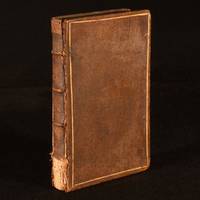
1715160304London: Printed for A. Bettesworth 1715. 12mo pp. 1-12 1-192; collates A 6 B-I 12 frontispiece eighteenth-century brown leather front and rear panels ruled and tooled in blind four raised bands on spine panel no title label. The first printing of the Gardiner edition. Fontenelle's ENTRETIENS SUR LA PLURALITE DES MONDES his most famous and frequently reprinted and translated book was first published in 1686. It is "the first example in French of a learned work placed within the reach of an educated but non specialized public." - DSB V 59. A popular account of the systems of Ptolemy Copernicus and Tycho Brahe in dialogue form the treatise "awakened general interest in astronomy and popularized the scientific system of inquiry; it also emphasized the small space occupied by man and this planet relatively to the rest of the universe. The work was ridiculed by Voltaire though it suggested his MICROMEGAS." - The Oxford Companion to French Literature 1959 p. 278. The first of the three seventeenth-century English translations was A DISCOURSE OF THE PLURALITY OF WORLDS . Translated into English by Sir W. D. Knight. Dublin: Printed by Andr. Crook and Sam. Helsham for William Norman 1687. The first edition of the Glanvill translation containing five dialogues was published in 1688 the same year Aphra Behn's translation of Fontenelle's book A DISCOVERY OF NEW WORLDS was published in London by William Canning. This Gardiner translation first published in 1715 is the first edition to include a translation of Fontenelle's sixth dialogue. "In all the literature of the cosmic voyage there was no book more popular than Fontenelle's CONVERSATIONS OF THE PLURALITY OF WORLDS. Translated again and again it seemed to the British peculiarly their own book read for at least a century both by men and by those 'ladies' of whom we have many a description one of whom would read it aloud to others who were busily engaged in making strawberry jam. This was a book indeed that warranted a subtitle I once discovered in an eighteenth-century popularization of astronomy: 'Science made clear to the Meanest Capacities even those of Women and Children.'" - Nicolson Voyages to the Moon pp. 58-9. Fontenelle's book "became a seminal influence on proto science fiction . This is one of the earliest works ever written popularizing science notably astronomy for the layman which it does by wittily presenting its speculations -- many about the possibility of life on other worlds -- in the form of conversations after dinner between the author and a marquise." - Clute and Nicholls eds The Encyclopedia of Science Fiction 1993 p. 437. "A great stimulant to utopian speculations and science fiction." - Gibson and Patrick "Utopias and Dystopias 1500-1750" in Gibson St. Thomas More: A Preliminary Bibliography 1961 683. See Ley Rockets Missiles and Space Travel 1951 pp. 22-4 and Ley Rockets Missiles and Men in Space 1968 pp. 21-2 for a good summary of the book. Bleiler Science-Fiction: The Early Years p. 853. Howgego Encyclopedia of Exploration: Invented and Apocryphal Narratives of Travel F16. Negley Utopian Literature: A Bibliography 371. Versins Encyclopédie de l'Utopie des Voyages Extraordinaires et de la Science Fiction pp. 341-42. NCBEL II 1513. An early important and scarce edition of this classic work. A lovely copy. Enclosed in a custom quarter leather rounded back clamshell box. #160304 Printed for A. Bettesworth unknown books
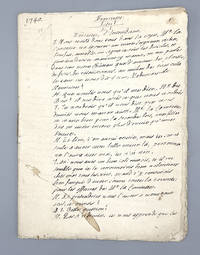
1740cmd20<p><strong> XVIIIth c. THEATRE – FEMINISM</strong></p><p><strong> AN <em>AVANT-GARDE</em> PLAY ON <em>"WOMEN'S CONSENT" </em></strong></p><p><strong> EXTREMELY RARE MANUSCRIPT BY FONTENELLE WITH CORRECTIONS </strong></p><p><strong> MANUSCRIPT</strong></p><p><strong> FONTENELLE Bernard le Bovier de</strong></p><p><strong> <em>Henriette</em> Paris 1740 </strong>32 pp.</p><p><strong> A precious autograph manuscript with corrections and variants of this innovative comedy written by Fontenelle in his eighties. It is the penultimate play he ever wrote. </strong></p><p>This comedy belongs to the theatre of the 18th century: a world of gallantry and sentiment centered on amorous sparring. <strong>But Fontenelle takes it further—although rooted in 18th-century conventions <em>Henriette</em> proves avant-garde in its critical perspective on women's roles in society and marriages of convenience</strong>. Far from being a mere comedy of manners it anticipates some Enlightenment ideas especially regarding female emancipation.</p><p><strong>It even contains an unusually forward-thinking development on women's consent Act I Scene 1: <em>"All that's missing is a trifle a word of consent."</em></strong></p><p>Our manuscript—which ends at Act IV Scene 4— shows traces of edits and revisions by Fontenelle ; some phrases have been crossed out or rewritten.</p><p><strong>A rare and invaluable glimpse into the making of an 18th-century play. </strong></p>
179650081796 Paris, Magimel, 1796 (an 3 de la République), 13x20cm. Ouvrage complet en trois volumes. Reliures en pleine basane. Dos lisses, pièce de titre sur maroquin rouge, tomaison en chiffres dorés. Illustré de 59 planches dépliantes, placées à la fin de chaque volume. Quérard dit de cet ouvrage "On ne peut même donner qu'une idée imparfaite du travail de l'éditeur, en signalant les rectifications, additions, développements, notes et tables de matières, dont il a enrichi cette édition" (Quérard, X, 70). Édition peu courante, très rarement complète en reliures d'époque assorties. Quelques rousseurs et frottements, une planche débrochée mais présente. Envoi de photographies sur demande.
1717AQ19580London: Printed for W. Innys 1717. 16 xxxv 1 123 122-441 552 455- 464pp 4. With two terminal advertisement leaves. Contemporary gilt-tooled blind-panelled polished calf contrasting red morocco lettering-piece small shelf-label to head of spine. A trifle rubbed slightly chipped at head else a fine copy. The Macclesfield copy with the armorial 'North Library' bookplate shelf-mark 45.C.29 and typical armorial blind- stamps to title page and first two leaves of text pencilled shelf-marks to front endpapers. A choice copy of John Chamberlayne's significant translation of short biographies or 'Elogy as Mons. Fontenelle calls it' of eminent European scientists and mathematicians members of the French Academy of Sciences with excellent provenance: from the library of the dedicatee Thomas Parker 1st Earl of Macclesfield 1666-1732. Whilst the biographies within are translations of the work of Bernard le Bovier de Fontenelle 1657-1757 celebrated French author and secretary for forty-two years of the Academy of Sciences in the second half of the work English writer John Chamberlayne c.1668-1772 has added brief English abstracts of 'some of the Choicest Pieces Memoirs Dissertations &c' taken from the Academy's Transactions including work on flora fauna entomology 'Upon Bees' geological and meteorological phenomena. Chamberlayne's gushing dedication of this work to Lord Parker - then Lord Chief Justice - references the latter's patronage of the sciences was apparently presented 'without.consent or knowledge' and indeed is referenced in his later works also dedicated with similar gusto to the Earl of Macclesfield. This taken with the presence in the Macclesfield library of several copies of works presented to Chamberlayne including Miscellanea Berolinensia ad incrementum scientiarum Berlin 1710 inscribed by Dr. Daniel Ernst Jablonski likely acquired by Parker after the 1724 sale of the library of Chamberlayne pere et fils further suggests a close connection between the two. A printed postscript to the dedication of this work also directed by Chamberlayne at 'My Lord' Parker discusses the disagreement over 'the Differential Calculation as the Invention thereof which I think is every where ascribed to the late Mons. Liebnitz' and 'no where attributed as it ought to our own Countryman Sir Isaac Newton the First Mathematician in the World' and shares with his readership that 'Dr. Keill.has done our British Philosopher justice; and fully proved that which Mr. L did in some manner acknowledge to me when I attempted to reconcile these two Great Men that Sir I.N. might be the first inventor'. Although not a presentation copy per se given the connection between the translator and early owner this is surely one of the most interesting copies available of this significant work documenting the work of the French academicians. . First edition. 8vo. Printed for W. Innys unknown
172878401728 La Haye : Grosse & Neaulme, 1728-1729. Complet en 3 vol. in-fol. : 25 x 37.5 cm. I/ 1 bl., 5 ff. n. chiff. de pièces lim., 1 front. grav., 376 pp. + 3 pl. grav. ; II/ 4ff. n. chiff. de pièces lim., 1 pl. grav., 440 pp. ; III/ 3 ff. n. chiff. de pièces lim. 1 front. grav., 434 pp. Luxueuse édition originale collective des uvres de Fontenelle illustrée de six belles figures hors-texte, deux fleurons répétés et 174 vignettes et culs-de-lampes par Picart. (Tchemerzine, V, p. 332). Notre exemplaire est un des précieux ensemble en grand papier, au format in-folio, avec le texte entirèement encadré ! (Cohen, col. 407-408). Reliures de lépoque en veau blond. Dos à six nerfs avec pièces de titre en maroquin rouge, pièces de tomaison en maroquin vert et caissons ornés aux petits fers. Trois filets en encadrement des plats. Deux filets aux coupes et roulette aux chasses. Gardes recouvertes de papier marbré. Toutes tranches dorées. Quelques griffures aux plats. Coiffes et gouttière restaurées. Rares rousseurs. Contenu. I/ Dialogues des morts. Jugement de Pluton. Entretiens sur la pluralité des mondes. Histoire des oracles. Oeuvres mêlées ; II/ Poésies pastorales et diverses. Discours sur la nature de léglogue. Digression sur les anciens et les modernes. Thétis et Pélée. Énée et Lavinie. Lettres galantes ; III/ Histoire du renouvellement de lAcadémie des sciences. Éloges.
1727D11894Paris: De LImprimerie Royale 1727. First Edition. Hardcover. Good. 4to 249 x 187mm. 26 548 pages. Title with woodcut royal printers device fleur-de-lis three under crown. Folding engraved plate of figures of planes. Contemporary mottled calf gilt marbled endpapers spine gilt in compartments with morocco lettering label ELEMENTS DE LA GEOMETRIE; occasional toning light soiling and minor stains on title light marginal dampstaining mostly in middle of volume wormtrail and dampstaining in blank upper margins toward end few stains in upper margin of plate nothing severe a good book in contemporary binding. Near contemporary ink inscription French surname Baudoin on end-leaf another instance cancelled and No. 17 on title. 1727 first edition of Fontenelles published theories on inifinitesimal calculus plenty in philosophical dialogue. <br/><br/>While Éléments de la Géometrie de lInfini was praised by Alexis Fontaine des Bertins as an inspiration Fontenelles contemporary mathematicians did not consider his book to be a mathematical work. Fontenelles main desire in line with early-Enlightenment ideals was to make science accessible to the layman. His work laid the foundations for such discussion by taking a philosophical approach to the calculus of infinity writing in a novelistic style. For infinity Fontenelle studied the curvatures of the plane curves using the sines of angles of contingence although in practice Fontenelles theories contained many paradoxes. The result was that Fontenelles work was increased and expanded on by his supporters famously by the Jesuit mathematician Louis-Betrand Castel. In addition Fontenelles work was the basis on Fontaines 1731 work on the curvature of plane curves which presented new formulas on infinity and was a highly praised work in the Paris Academy. OCLC locates several institutional copies in the US additionally held in microform. Fontenelles is a classic and fundamental textbook work on geometry from the French Enlightenment-era still containing valuable points. De LImprimerie Royale hardcover
1727D11894Paris: De LImprimerie Royale 1727. First Edition. Hardcover. Good. 4to 249 x 187mm. 26 548 pages. Title with woodcut royal printers device fleur-de-lis three under crown. Folding engraved plate of figures of planes. Contemporary mottled calf gilt marbled endpapers spine gilt in compartments with morocco lettering label ELEMENTS DE LA GEOMETRIE; occasional toning light soiling and minor stains on title light marginal dampstaining mostly in middle of volume wormtrail and dampstaining in blank upper margins toward end few stains in upper margin of plate nothing severe a good book in contemporary binding. Near contemporary ink inscription French surname Baudoin on end-leaf another instance cancelled and No. 17 on title. 1727 first edition of Fontenelles published theories on inifinitesimal calculus plenty in philosophical dialogue. <br/><br/>While Éléments de la Géometrie de lInfini was praised by Alexis Fontaine des Bertins as an inspiration Fontenelles contemporary mathematicians did not consider his book to be a mathematical work. Fontenelles main desire in line with early-Enlightenment ideals was to make science accessible to the layman. His work laid the foundations for such discussion by taking a philosophical approach to the calculus of infinity writing in a novelistic style. For infinity Fontenelle studied the curvatures of the plane curves using the sines of angles of contingence although in practice Fontenelles theories contained many paradoxes. The result was that Fontenelles work was increased and expanded on by his supporters famously by the Jesuit mathematician Louis-Betrand Castel. In addition Fontenelles work was the basis on Fontaines 1731 work on the curvature of plane curves which presented new formulas on infinity and was a highly praised work in the Paris Academy. OCLC locates several institutional copies in the US additionally held in microform. Fontenelles is a classic and fundamental textbook work on geometry from the French Enlightenment-era still containing valuable points. De LImprimerie Royale hardcover books