587 résultats
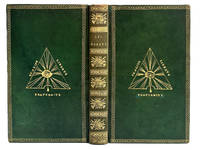
352623<p>Entretiens sur la pluralité des mondes. 8vo 165 x 10 cm 2 ff.-291 12 pp. engraved portrait by Saint-Aubin after the bust by Le Moyne. Contemporary green morocco gilt roll border masonic centrepiece spine richly gilt turn-ins gilt edges gilt wide margins. restoration to a cap some light foxing. Dijon de l'imprimerie de P. Causse An 2 1794.</p><p>Nice copy of this later edition of Fontenelle's main works. The "Conversations on the Plurality of Worlds marks the debut of "Extraterrestrials" in European literature. First published in 1686 it fullfilled its main object to popularize the astronomical theories of Copernicus. No work was more influential in popularizing the facts and the philosophy empowered by the microscope and telescope. Few minor foxing else in fresh condition.</p><p>Pleasant 18th Masonic binding featuring the radiant Eye of Providence in a triangle with the moto 'Egalité Liberté Fraternité"</p> Dijon, de l'imprimerie de P. Causse, An 2 [1794].
1727D11894Paris: De LImprimerie Royale 1727. First Edition. Hardcover. Good. 4to 249 x 187mm. 26 548 pages. Title with woodcut royal printers device fleur-de-lis three under crown. Folding engraved plate of figures of planes. Contemporary mottled calf gilt marbled endpapers spine gilt in compartments with morocco lettering label ELEMENTS DE LA GEOMETRIE; occasional toning light soiling and minor stains on title light marginal dampstaining mostly in middle of volume wormtrail and dampstaining in blank upper margins toward end few stains in upper margin of plate nothing severe a good book in contemporary binding. Near contemporary ink inscription French surname Baudoin on end-leaf another instance cancelled and No. 17 on title. 1727 first edition of Fontenelles published theories on inifinitesimal calculus plenty in philosophical dialogue. <br/><br/>While Éléments de la Géometrie de lInfini was praised by Alexis Fontaine des Bertins as an inspiration Fontenelles contemporary mathematicians did not consider his book to be a mathematical work. Fontenelles main desire in line with early-Enlightenment ideals was to make science accessible to the layman. His work laid the foundations for such discussion by taking a philosophical approach to the calculus of infinity writing in a novelistic style. For infinity Fontenelle studied the curvatures of the plane curves using the sines of angles of contingence although in practice Fontenelles theories contained many paradoxes. The result was that Fontenelles work was increased and expanded on by his supporters famously by the Jesuit mathematician Louis-Betrand Castel. In addition Fontenelles work was the basis on Fontaines 1731 work on the curvature of plane curves which presented new formulas on infinity and was a highly praised work in the Paris Academy. OCLC locates several institutional copies in the US additionally held in microform. Fontenelles is a classic and fundamental textbook work on geometry from the French Enlightenment-era still containing valuable points. De LImprimerie Royale hardcover
1717AQ19580London: Printed for W. Innys 1717. 16 xxxv 1 123 122-441 552 455- 464pp 4. With two terminal advertisement leaves. Contemporary gilt-tooled blind-panelled polished calf contrasting red morocco lettering-piece small shelf-label to head of spine. A trifle rubbed slightly chipped at head else a fine copy. The Macclesfield copy with the armorial 'North Library' bookplate shelf-mark 45.C.29 and typical armorial blind- stamps to title page and first two leaves of text pencilled shelf-marks to front endpapers. A choice copy of John Chamberlayne's significant translation of short biographies or 'Elogy as Mons. Fontenelle calls it' of eminent European scientists and mathematicians members of the French Academy of Sciences with excellent provenance: from the library of the dedicatee Thomas Parker 1st Earl of Macclesfield 1666-1732. Whilst the biographies within are translations of the work of Bernard le Bovier de Fontenelle 1657-1757 celebrated French author and secretary for forty-two years of the Academy of Sciences in the second half of the work English writer John Chamberlayne c.1668-1772 has added brief English abstracts of 'some of the Choicest Pieces Memoirs Dissertations &c' taken from the Academy's Transactions including work on flora fauna entomology 'Upon Bees' geological and meteorological phenomena. Chamberlayne's gushing dedication of this work to Lord Parker - then Lord Chief Justice - references the latter's patronage of the sciences was apparently presented 'without.consent or knowledge' and indeed is referenced in his later works also dedicated with similar gusto to the Earl of Macclesfield. This taken with the presence in the Macclesfield library of several copies of works presented to Chamberlayne including Miscellanea Berolinensia ad incrementum scientiarum Berlin 1710 inscribed by Dr. Daniel Ernst Jablonski likely acquired by Parker after the 1724 sale of the library of Chamberlayne pere et fils further suggests a close connection between the two. A printed postscript to the dedication of this work also directed by Chamberlayne at 'My Lord' Parker discusses the disagreement over 'the Differential Calculation as the Invention thereof which I think is every where ascribed to the late Mons. Liebnitz' and 'no where attributed as it ought to our own Countryman Sir Isaac Newton the First Mathematician in the World' and shares with his readership that 'Dr. Keill.has done our British Philosopher justice; and fully proved that which Mr. L did in some manner acknowledge to me when I attempted to reconcile these two Great Men that Sir I.N. might be the first inventor'. Although not a presentation copy per se given the connection between the translator and early owner this is surely one of the most interesting copies available of this significant work documenting the work of the French academicians. . First edition. 8vo. Printed for W. Innys unknown
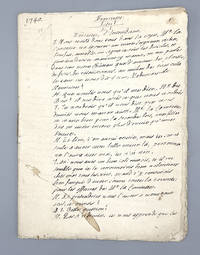
1740cmd20<p><strong> XVIIIth c. THEATRE – FEMINISM</strong></p><p><strong> AN <em>AVANT-GARDE</em> PLAY ON <em>"WOMEN'S CONSENT" </em></strong></p><p><strong> EXTREMELY RARE MANUSCRIPT BY FONTENELLE WITH CORRECTIONS </strong></p><p><strong> MANUSCRIPT</strong></p><p><strong> FONTENELLE Bernard le Bovier de</strong></p><p><strong> <em>Henriette</em> Paris 1740 </strong>32 pp.</p><p><strong> A precious autograph manuscript with corrections and variants of this innovative comedy written by Fontenelle in his eighties. It is the penultimate play he ever wrote. </strong></p><p>This comedy belongs to the theatre of the 18th century: a world of gallantry and sentiment centered on amorous sparring. <strong>But Fontenelle takes it further—although rooted in 18th-century conventions <em>Henriette</em> proves avant-garde in its critical perspective on women's roles in society and marriages of convenience</strong>. Far from being a mere comedy of manners it anticipates some Enlightenment ideas especially regarding female emancipation.</p><p><strong>It even contains an unusually forward-thinking development on women's consent Act I Scene 1: <em>"All that's missing is a trifle a word of consent."</em></strong></p><p>Our manuscript—which ends at Act IV Scene 4— shows traces of edits and revisions by Fontenelle ; some phrases have been crossed out or rewritten.</p><p><strong>A rare and invaluable glimpse into the making of an 18th-century play. </strong></p>
172911174La Haye France: Chez Gosse & Neaulme 1729. New Edition. Full Calf. Very Good. New Edition. Full Calf. Translation to English: Complete Works of M. de Fontenelle of the Francoise Academy. New Edition Enhanced and Enriched with figures engraved by BERNARD PICART the ROMAIN. First Second Third Volume Bernard Le Bovier de Fontenelle 11 February 1657 - 9 January 1757 also called Bernard Le Bouyer de Fontenelle was a French author and an influential member of three of the academies of the Institut de France noted especially for his accessible treatment of scientific topics during the unfolding of the Age of Enlightenment. He is noted for the accessibility of his work - particularly its novelistic style. This allowed non-scientists to appreciate scientific development in a time where this was unusual and scientists to benefit from the thoughts of the greater society. Minimal head and tail wear discolored spine/tabs rubbing/chipping to boards minor foxing else tight bright and unmarred. Three tomes in folio 22 x 28 cm full mottled calf binding titles and friezes in gold on the spine initial P and on edging marbled endpapers pp 8 376 for the first volume; pp 8 440 for the second; pp 3 434 for the third which bears the date "1729" on the title page illus engravings. Six full-page copper engravings by Picart including one with the portrait of Fontenelle by Picart and Rigaud. Ex libris label on endpapers M.Piller. Chez Gosse & Neaulme unknown
2716London: printed for A. Bettesworth and E. Curll 1715. Hardcover. Good. Duodecimo. xii 192pp. Contemporary calf rebacked. With a frontispiece. ESTC T137582. With the ownership inscription of James Hardy . <br/> <br/> London: printed for A. Bettesworth, and E. Curll, 1715. hardcover
18361727Boston: March Capen & Lyon 1836. First American edition. In publisher’s half cloth with printed panels. Binding rubbed stained. Pages discolored except for the first and last quires. Otherwise in fine condition. First American edition. In publisher’s half cloth with printed panels. 2 151 1 p. and 1 large folding plates. <p><br /> First American edition of this uncommon book about beet sugar manufacturing. <br /> <p><p><br /> A translation of L.-J. Blachette and Frédéric Salvator Zoéga’s Manuel du fabricant de sucre et du raffineur Paris 1826. The large folding engraved frontispiece contains 12 views of the technical apparatus used in beet sugar manufacture.<br /> <p><p><br /> Scarce on the market Rarebookhub shows only two records Charles Wood: 1969; 1982 WorldCat locates 3 copies worldwide. <br /> <p>. March, Capen & Lyon unknown
192981907Nonesuch Press. As New. 1929. Paperback. FREE UPGRADE to Courier/Priority Shipping Upon Request - IN STOCK AND IMMEDIATELY AVAILABLE FOR SHIPMENT - AS NEW THE TEXT BLOCK IS PRISTINE CLEAN UNMARKED AND IN EXCELLENT CONDITION - - x 138 pages. -- with a bonus offer-- . Nonesuch Press paperback
17151008F35London: A. Bettesworth; E. Curll 1715 . First edition. Leather. Good. 6.5" by 4.5". Not Stated. The very scarce first William Gardiner English language translation of Fontenelle's important early work of astronomy which speculates on the possibility of extra-terrestrial life. First published in French in 1686 this is the very scarce first English language translation of this work from William Gardiner.Illustrated with a frontispiece.ESTC T137582A6 B-I12. Collated complete.Bernard le Bovier de Fontenelle expresses support for cosmic pluralism and discusses the topic of astrobiology in this work while also speculating on the existence of Venusians as a species of extra-terrestrial life.It helped popularise the theories of Rene Descartes and Nicolas Copernicus taught through constructive conversations between a philosopher and a Marquise. In a full calf binding. Loss to back strip tail. Joints starting rear board firmly held and front board just a touch tender. Internally firmly bound. Pages lightly age toned due to paper type but generally clean and bright with the odd handling mark and light tide marks to perimeters of six leaves towards the rear. Good A. Bettesworth; E. Curll hardcover
110169The Hague chez Gosse & Neaulme 1728-29. Folio. Engr. front 10 376 pp. 3 engr. plates; 8 440 pp. engr. plate; 6 434 pp. engr. plate. Titles printed in red and black with 174 engr. vignettes in text of which one pasted and all pages printed within typographical borders. Stain in inner margin on the last four leaves in part one and last two in part two a small spot pp 263-264 in part one. Worn contemporary full calf richly gilt spines with raised bands and red labels boards with gilt frames red edges. Three volumes joints cracked. Bookplate of Chataud de Chemilly â€Ancient conseiller de la cour des Aides de Parisâ€. Cohen-DeRicci col. 407-08 â€Superbes illustrationsâ€. Lewine p. 191. First complete edition of Fontenelle’s work in the more rare folio format with borders around the text and with the fine engraved plates by Bernhard Picart one with the portrait of Fontenelle after Rigaud and with engraved head- and tail-pieces by Picart throughout. Bernard Le Bouvier de Fontenelle 1657-1757 was both author of dramas and of scientific treaties and he is considered one of the most important members of the early enlightenment.Contains in part 1:Dialogue des morts Entretiens sur la pluralité des mondes Histoire des oracles De l’origine des fables De l’existence de Dieu. Part 2: Poesie pastoral Discours sur la nature de la l’egloue Digression sur les anciens & les modernes Thetis et Pelée Enée et Lavinie tragedie en musique Recueil de poësis diverses Lettres galantes de Mr le chevalier d’Her Oeuvre melées. Part 3: Histoire du renouvellement de l’Academie Royale des Sciences. Eloges des academiciens de l’Academie Royale des Science morts depuis l’an 1699. hardcover
17903002018Paris: Jean-Francois Bastien 1790. One or two joints slightly weak. Eight volumes octavo engraved portrait frontispiece in volume 1 and a folding plate in vol. 2; a fine set in contemporary French polished marbled calf; flat spines ornately gilt with double red labels. <p><p>A very attractive set of Fontenelle's works including his enormously popular Entretiens sur la Pluralité des Mondes: this utopian analysis of the universe took Europe by storm and was precursor and inspiration to scores of imitations. It was first published in 1686 and first translated into English by Aphra Behn only two years later.</p> <p>Although the Entretiens clearly owes a tremendous debt to the astronomical traditions of Galileo and Brahe Fontenelle's sensational tale of the inhabitants in "other planets in other galaxies and even on comets could hardly fail to captivate" Nina Rattner Gelbart Introduction to the Conversations on the Plurality of Worlds. In the form of an elegant dialogue between a scientist and a Marquise it takes as its starting point that "Toute la philosophie n'est fondée sur deux choses: sur ce qu'on a l'esprit curieux et les yeux mauvais": that is that if we had a perfect understanding we would not need science because all would be spontaneously revealed. Meant as a quick summation of scientific discovery but also as pure speculation on the possibilities of the universe it suggests that as it has taken six millennia for Europeans to cross the Atlantic Ocean to America it may take a little longer for the inhabitants of other worlds to cross the far greater expanses of space.</p> <p>This set also includes "Dialogues des Morts anciens" and "Histoire des Oracles" works which exemplify Fontenelle's desire to propagate philosophical thinking. Voltaire described Fontenelle as having the most universal mind produced by the era of Louis XIV.</p> </p> . Jean-Francois Bastien unknown
1727RW1716Paris:: L'Imprimerie Royale 1727. 1727. 4to. xxvi 548 pp. Title-page vignette tailpieces headpieces 1 engraved chapter vignette 1 engraved initial 1 engraved folding plate occasional light foxing or browning. Full contemporary mottled calf blind-ruled covers raised bands red and brown leather spine labels gilt decorated spine all edges red marbled end papers leather separation at top of spine all edges red marbled end-papers; leather separation at top of spine hint of worming but strong lightly rubbed. A very clean and tight copy. Fine. FIRST EDITION of an extensive treatise on the principles of calculus by Bernard Fontenelle the distinguished French philosopher and scientist who is famous for his book on the plurality of worlds. Through his friend Varignon Fontenelle made the acquaintance of the Parisian scientific circle and became friends with Nicolas de Malezieu and l'Hopital. Fontenelle wrote the preface to l'Hopital's Analyse des infiniment petits pour l'intelligence des lignes courbes 11690. "In it he displayed his interest in the notion of infinity and his talent as a historian; in a few pages he retraces the history of the mathematical study of curved lines from Archimedes to Newton and Leibniz . . . In 1727 he published his Elements de la geometrie de l'infini which he had worked on for a long time probably since the period of his preface to the Analyse des infiniment petits . . . According to Fontenelle none of the geometers who had invented or employed the calculus of infinity had given a general theory to it; that is what he proposed to do. The work is divided into a preface relating to the history of this branch of calculus and into two main part . . . 'the infinite series or in progression of numbers' and then examines 'the infinite in straight and curved lines . . . " DSB. / Bernard Fontenelle was born at Rouen and pursued a literary career. Fontenelle dabbled in poetry and writing for the stage but it is better known for his work as secretary to the Academy of Sciences. Among his published works are Entretiens sur la pluralite des mondes 1686 the Histoire du renouvellement de l'Academie des Sciences 1708-1722 and a number of eloges of the members. REFERENCES: DSB V pp. 57-63; Poggendorf 1 col. 770 Zeitlinger 1360. L'Imprimerie Royale, 1727. hardcover
172759036Paris L'Imprimerie Royale 1727. 4to. Fine contemp. full calf. Raised bands. Richly gilt spine. Tome- and titlelabels with gilt lettering. Gilt borders on covers. A small nick in leather at upper compartmen. Light wear to foot of spine. 26548 pp. 1 folded engraved plate. Clean and fine. The offered item includes the entire volume of "Histoire de L'Academie Royale des Sciences. Années MDCCXXV. Paris L'Imprimerie Royale 1727" of which the memoir of Fontenelle is printed as a "suite". With the engraved frontispiece. 61543542 pp. 14 partly folded engraved plates. Original papers by: Maraldi Petit Nicole Winslow du Fay Pitot Delisle d'Aine Geoffroy le Cadet Reaumur Nicole Cassini de Mairan Saurin de Lagny Fizes. <br/><br/><em>First edition. "In 1727 as a "Suite des mémoires de l’Académie royale des sciences" he published the Élémens de la géométrie de l’infini. Some doubted whether it was really the work of a mathematician but the author believed it was and attached great value to it. He had worked on it for a long time probably since the period of his preface to the Analyse des infiniment petits. The term élémens is to be understood in the sense of "first principles." According to Fontenelle none of the geometers who had invented or employed the calculus of infinity had given a general theory of it; that is what he proposed to do. The work is divided into a preface relating the history of this branch of calculus and into two main parts: "Système général de l’infini" and "Différentes applications ou remarques." The author discusses "the infinite in series or in progressions of numbers" and then examines "the infinite in straight and curved lines" in the words of the Abbé Terrasson who reviewed the work in the Journal des sçavans July-October 1728." There was a great deal of discussion in the scientific community about this work in which mathematicians found numerous paradoxes. Johann I Bernoulli for example in his correspondence with Fontenelle allowed his criticisms to show through his praise: he did not understand what was meant by finis indéterminables. Fontenelle attempted to defend his theory and above all his distinction between metaphysical infinity and geometric infinity: one must ignore the metaphysical difficulties in order to further geometry and the finis indéterminables ought to be considered "as a type of hypothesis necessary until now in order to explain several phenomena of the calculus" letter to Johann I Bernoulli 29 June 1729. "The orders of infinite and indeterminable quantities like the magnitudes that they represent are only purely relative entities hypothetical and auxiliary. The subject matter of mathematics is only ideal" according to the terms of a "Projet de rapport" of Dortous de Mairan to the Academy on this work." DSB. </em> hardcover
17972105270019Paris Impr. de Hautbout l'aine an v 1797. First French edition. Hardcover. Good. The French and Indian War: Cherokee Indians 3 works bound as one. 12mo 15 cm. Bound in contemporary 1/4 calf. 2 viii 187 1 pages. Lacking frontispiece. Early ink doodle on verso of title page lion but clean besides. French translation by Billecocq of the 1765 London edition of "The memoirs of Lieut. Henry Timberlake." Timberlake was a Virginian from Hanover county who fought for the English against the Cherokees in the French and Indian War. Tensions had been raised by the execution of 22 Cherokee in South Carolina in 1760 at Fort Prince George. As a result Overhill Cherokee attempted to expel British settlers. Timberlake was part of Colonel William Byrd / Adam Stephen's forces sent to suppress the Americas Indians in the Virginia / Tennessee region. Timberlake served as a lieutenant and a hostage to the Cherokees in 1761-1762 and visited many of their settlements. Later he was accompanied by three Cherokee leaders including the Chief Ostenaco on a diplomatic mission to England. The mission met with King George III and attempted to halt westward expansion by British colonists. One a second mission to England in 1765 Timberlake was imprisoned for debts owed for the lodging in London. He presumably wrote this journal while in debtor's jail and died in prison in 1765. His journal was published posthumously. His accounts of the Cherokee provide an early and fairly accurate depiction of the people before their displacement. Sabin 95837. <br> Also includes two other works bound with this one: M. de Fontenelle "Histoire des Oracles" "Poesies Pastorales." 2 212 142 pages. London 1785; "Confessions de Clement Marot." 6 197 pages. Paris 1798. Paris, Impr. de Hautbout l'aine, an v hardcover
1727171224to. Cont. full calf. 5 raised bands and richly gilt compartments. Faint scratches on covers. Corners and edges a little rubbed. 2 small holes in leather at sides of upper compartment. 26548 pp. and 1 folded engraved plate. Engraved vignette. On good paper. <br/><br/><em>First edition of the well-known French philosopher and mathematician's main mathematical work. Fontenelle author of "The Plurality of Worlds" claims here that Geometry is entirely intellectual and independent of the actual decription and existence of figures following more the conceptions of Descartes than those of Newton. </em> hardcover
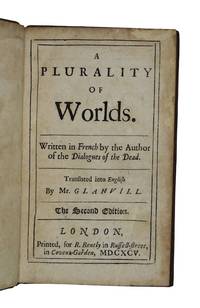
1695AQ26436London: Printed for R. Bently 1695. 12 152pp. Without initial two blank leaves. Contemporary blind-tooled mottled calf. Lightly rubbed and marked some loss to head of spine. Without pastedowns later armorial bookplate of John Jones of Llanarth Court Monmouthshire to verso of upper board small worm-track to foot of text-block touching text in places. The second English edition translated by poet John Glanvill 1663/4-1735 of Fontenelle's popular cosmographical discourse; an early and significant Enlightenment work and the first example in French of a learned work directed at an educated but non-specialised public. First published in 1686 the book was promptly translated to numerous languages with the first edition in English appearing in 1687. ESTC R212866 Wing F1417. Second edition. 12mo. Printed, for R. Bently unknown
57794EB. Very Good. Hardcover. Leather. 12mo. Chez les Libraires Associés Paris. 1766. 11 volumes. Illustrated with 8 frontispieces including a portrait by H. Rigaud after Dolsier. Seven other frontispieces are found in the remaining volumes those by Clavaro A. Coipel Gravelot and Pilart. Four of the five engravings throughout the set are by B. Pilart and Clavaro after Duflos. Bound in calf leather with gilt titled spine labels present to the spine and gilt decoration present to the boards. Leather lightly rubbed and worn along the extremities. No ownership marks present. Text is clean and free of marks binding tight and solid. A beautiful and complete eleven-volume set of the works of the brilliant French polymath Bernard de Fontenelle 1657 - 1757. Many of the characteristic ideas of the French Enlightenment are found in their earliest form in Fontenelles works. His writings are valuable to scholars to this day Raman Variety in Religion and Science 122. Fontenelle is remembered by historians as an erudite scholar brilliant wit and an effective exponent of science. He fostered enlightened thinking using enjoyable language. Fontenelle warned that people would reject science as useless if they didnt understand it. He was so impressed with the power of mathematics that he said even a work of morality politics criticism will be more elegant other things being equal if it is shaped by the hand of geometry. He felt the joy that mathematics can give saying: Nothing probes more clearly that the mind seeks truth and nothing reflects more glory upon it than the delight it takes sometimes in spite of itself in the driest and thorniest researches of algebra Raman Variety in Religion and Science 122. It is particularly interesting to note that Fontenelle foresaw that science would rise to great heights but he also feared humanity was too weak to look at truth straight in the eye Fontenelle was one of the spirits that inspired the French Encyclopedie and the associated Enlightenment which were to significantly affect the course of human history ibid. Voltaire described Fontenelle as having the most universal mind produced by the era of Louis XIV. This set includes Fontenelles enormously popular Entretiens sur la Pluralité des Mondes a utopian analysis of the universe that took Europe by storm and was precursor and inspiration to scores of imitations. It was first published in 1686 and first translated into English by Aphra Behn only two years later. Although the Entretiens clearly owes a tremendous debt to the astronomical traditions of Galileo and Brahe Fontenelle's sensational tale of the inhabitants in 'other planets in other galaxies and even on comets could hardly fail to captivate' Nina Rattner Gelbart Introduction to the Conversations on the Plurality of Worlds . In the form of an elegant dialogue between a scientist and a Marquise Entretiens sur la Pluralité des Mondes takes as its starting point that 'Toute la philosophie n'est fondée sur deux choses: sur ce qu'on a l'esprit curieux et les yeux mauvais': that is that if we had a perfect understanding we would not need science because all would be spontaneously revealed. Meant as a quick summation of scientific discovery but also as pure speculation on the possibilities of the universe Entretiens sur la Pluralité des Mondes suggests that as it has taken six millennia for Europeans to cross the Atlantic Ocean to America it may take a little longer for the inhabitants of other worlds to cross the far greater expanses of space. Fontenelle also explains his theories on astronomical systems the moon other planets and coments. This set also includes other writings on science and mathematics as well as Dialogues des Morts anciens and Histoire des Oracles' works which exemplify Fontenelle's desire to propagate philosophical thinking. EB; 8vo 8" - 9" tall . hardcover
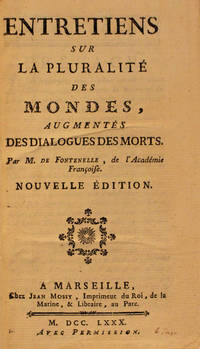
1911PG019<p>AUGMENTÉS DES DIALOGUES DES MORTS. Par M. de Fontenelle de l'Académie Françoise. NOUVELLE ÉDITION. A MARSEILLE Chez Jean Mossy Imprimeur du Roi de la Marine & Libraire au Parc. M. DCC. LXXX. 1780. Avec Permission.</p>_x000d_<p>In 8º de 168x105 cm. Com x ii 434 págs. Encadernação de inícios do século XIX com ferros a ouro e rótulo na lombada. Cortes das folhas carminados.</p>_x000d_<p>Ilustrado em extratexto com uma gravura desdobrável que representa o sistema solar com o Sol Mercúrio Vénus Terra Marte Júpiter e Saturno.</p>_x000d_<p>A obra diálogo dos mortos começa na página 165 e tem folha de rosto própria com pé de imprensa igual ao da obra principal e com os seguintes títulos: Dialogues des morts anciens. Par M. de Fontenelle des Académies Françoise des Sciences des Belles-Lettres de Londres de Nancy de Berlin & de Rome. Nouvelle édition.</p>_x000d_<p>A 1ª edição dos Entretiens foi publicada em 1686 e conheceu nova edição em 1724.</p>_x000d_<p>Obra sobre astronomia dividida em seis lições que expõem de forma clara e simples as descobertas de Copérnico e de Descartes. Nos diálogos dos mortos o autor apresenta diálogos entre personagens da história da literatura e da filosofia antigos e modernos como por exemplo Sócrates e Montaigne.</p>_x000d_<p>Bernard Le Bouyer de Fontenelle Rouen 1657 - Paris 1757 cientista filósofo escritor e dramaturgo francês integrado no pensamento do iluminismo que se distinguiu como divulgador das ideias de outros cientistas e filósofos.</p>_x000d_<p>Sobrinho dos acadêmicos e dramaturgos franceses Pierre e Thomas Corneille frequentou o Colégio dos Jesuítas onde estudou Direito. Aos vinte anos foi contratado por seu tio Thomas como colaborador de sua revista Le Mercure Galant e escreveu libretos de ópera tragédias e poemas mas como em 1680 a sua tragédia Aspar foi um fracasso. voltou a Rouen onde publicou entre 1682 e 1687 textos que o tornaram mais conhecido como filósofo e cientista. do que como poeta. Entre suas numerosas obras as mais conhecidas são: <em>La République des philosophes</em> A República dos Filósofos romance utópico que exalta uma democracia radical materialista e ateia; <em>Les Dialogues des Morts</em> Diálogos dos Mortos nos quais reproduz diálogos fictícios entre Sêneca e Scarron Sócrates e Montaigne; um artigo irônico sobre a rivalidade entre as religiões judaica católica e calvinista; <em>De l´origine des fables</em> Da origem das fábulas escreveu também sobre a história do teatro e reflexões sobre poesia. Em 1687 publicou uma de suas grandes obras <em>Histoire des Oracles</em> um ensaio no qual denuncia a crença em superstições semeia dúvidas sobre aspectos sobrenaturais examina alguns comportamentos irracionais baseados em crenças e suscita reflexões pungentes a respeito do assunto promovendo um ataque directo ao cristianismo.</p> I-7-H-10 unknown
88264Amsterdam Pierre Mortier 1716. 8vo. Engr. front. 14 159 pp. Title printed in ed and black. Foxing. Bound together with: Le politique du temps. Ou discours necessaire dans la conjoncture presente pour avoir une juste idée de la puissance de l’autorité & du devoir des princes; de la diversité des gouvernemens & jusqu’où l’on doit supporter la tyrannie. No place 1704. 8vo. 8 150 2 pp. Somewhat worn contemporary full calf gilt spine with raised bands and beige label defective at head of spine. From the library of Biby mansion in Södermanland Sweden. â€Histoire des Oracles†by Fontenelle was originally published in 1687 and re-issued in several editions. Together with van Dale in â€De oraculis veterum ethnicorum dissertationes†1683 Fontanelle claimed that the ancient oracle answers were given neither by the supernatural agency of demons nor the Devil and also that they did not cease with the birth of Jesus. A view that stirred up oppositon in the church. The â€Le politique du temps†is a new edition of â€Le politique du temps; ouvrage qui traite de la puissance authorité et du pouvoir des princes†published in Paris 1650 which is a reprint of a pamphlet published in 1574. It is sometimes attributed François Davesne. hardcover
4241126 189 pag. geheel leer. Geillustreerd met frontispice en twee uitslaande gravures van het heelal en van de maan door J. van Solingen. Drempelgedichten van A. de Zoete en Joh. v.d. Brouke. unknown
1695022392London: R. Bently. Full leather rebacked with new endpapers. Second Edition so stated. This work explained the heliocentric model of the universe. It is Fontenelles most famous work and one of the first major works of the Age of Enlightenment. From the library of Sydney Ross with only the adhesive remnant of his bookplate. Very Good. . Very Good. Hardcover. 2nd Edition. 1695. R. Bently hardcover
173269103à Paris: Chez Jean-Baptiste Coignard 1732. Fine. Chez Jean-Baptiste Coignard à Paris 1732 26 x 40 cm 2 volumes reliés New edition corrected and expanded by Fontenelle. Volume I extends from A to L volume II from M to Z. 2 title vignettes and engraved initials by Mariette. Title pages in red and black. Printed in 2 columns. Armorial copy with arms completely scraped away. One can still distinguish an anchor in the shield and a shell at the upper right of the anchor. Contemporary full brown calf binding. Spine with raised bands richly decorated with central fleuron and scattered stars. Title and volume labels in garnet morocco. Split headcaps. Joints cracked at head and foot. Corners very bumped and worn. Lacks to edges along the raised bands. This dictionary of terms used in the sciences and arts originally appeared in 1684. Fontenelle corrected numerous errors and approximations in it notably due to a certain lack of knowledge of the origin of words particularly Greek ones. Fontenelle further extended the dictionary to other fields natural sciences with birds fish but also religious and military orders certain words from old French. His work ranks him among the first encyclopedists of the 18th century. Chez Jean-Baptiste Coignard hardcover
178420937<p><b>1784 </b><b>Astronomy Plurality of Worlds Fontenelle Isaac Newton Planet ZODIAC Science</b></p><p>"<i>And seeing the Earth makes her circle in a year I see the Sun likewise in the space of a year answer successively to the whole circle of the fixed stars which circle is called…the zodiac</i>." </p><p>– Fontenelle Plurality of Worlds</p><p>A rare new and enhanced edition of the "<i>Conversations on the Plurality of Worlds</i>" including "<i>Dialogues of the Dead</i>" by Bernard de Fontenelle. This work was originally in French which was quite rare at the time considering most scientific works were written in Latin. The book is presented as hypothetical conversations between philosophers while gazing at stars. The books discusses the prospects of extraterrestrial life.</p><p>'<i>Plurality of Worlds'</i> is considered Fontenelle's most famous work and is also one of the first major works of the Age of Enlightenment. The work offers explanations of various models of the universe space the heavens and the zodiac through a philosophical lens and entertains the possibilities of extraterrestrial life. The contents were lackluster enough that it drew negative attention from neither the Catholic nor Protestant churches.</p><p>Item number: #20937</p><p>Price: $750</p><p>Fontenelle</p><p><b><i>Entretiens sur la pluraliteÌ des mondes</i></b></p><p>Paris A Londres: 1784.</p><p><br /></p><p><u>Details</u>: </p><p>· Collation: Complete with all pages; 4 volumes</p><p>o Vol. 1 – 4 292</p><p>o Vol. 2 – 4 303 1</p><p>o Vol. 3 – 4 314</p><p>o Vol. 4 – 4 360</p><p>· Language: French</p><p>· Binding: Leather; tight and secure</p><p>· Size: ~5in X 3in 12.5cm x 7.5cm</p><p>Our Guarantee:</p><p>Very Fast. Very Safe. Free Shipping Worldwide.</p><p>Customer satisfaction is our priority! Notify us with 7 days of receiving and we will offer a full refund without reservation!</p><p>20937</p><p>Photos available upon request. </p> hardcover
1698266792Paris: Michel Brunet 1698. Fourth edition. xx 297 3 pp. 1 vols. 12mo. Polished contemporary calf spine in six compartments with raised bands. Wear to spine ends and corners contemporary manuscript notes to title-page. Fourth edition. xx 297 3 pp. 1 vols. 12mo. A defence of the heliocentric model of the solar system one of the major early works of the Enlightenment. Michel Brunet unknown
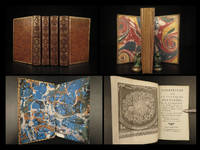
178065727Paris France 1780. Hardcover. Very Good. CONS EW. A beautiful volume bound in sheepskin published in 1780. Gilt title and decoration on spine is still bright with moderate scuffing/damage. Moderate damage to top and bottom spine ends. Front cover has a single inch wide spot of damage possibly from a removed label. Text block is dark with age no signs of soiling or foxing. Binding is tight and holds. All pages intact along with inlaid map of the solar system. Additional photos provided upon request. hardcover