(MANN, Horace)Biblio.com

15 056 résultats
18463983351846. Unbound. Near Fine. A remarkable group of 10 portraits of Horace Mann and his family featuring a unique and previously undiscovered cased sixth plate daguerreotype of Mann the great architect of the American system of popular education. The photos were preserved by the Mann family and all are housed in a circa 1950s cardboard box with the typed ownership label of Horace Mann III Mann’s grandson of Southwest Harbor Maine. The box has some internal repair and chipping. The photos are overall very good with general wear and light spotting to two; the daguerreotype has a few scratches at neck level and a couple of mild abrasions but else near fine. unknown
mon0000162278WORD PUBLISHING. Hardcover. Good. in x in x in. WORD PUBLISHING hardcover
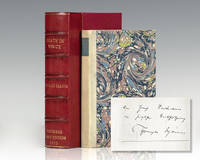
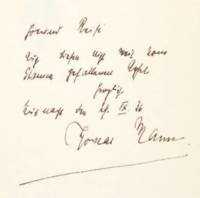
191398970Berlin: S. Fischer Verlag 1913. First trade edition of one of the greatest novellas of the twentieth century. Octavo original publisher's quarter vellum over marbled boards. Association copy inscribed by the author on the front free endpaper "An Ernst Bertram in herzlicher Wertschatzung Thomas Mann" To Ernst Bertram in heartfelt appreciation Thomas Mann. One of the best possible association copies as Bertram was Mann's closest friend from the late 1900s through the 1930s when their politics separated them. Bertram was deeply influential on Mann's thinking and literary direction during the time when he was somewhat artistically lost and suffered his own writer's block. It was also in nearly daily conversation with Bertram that the long political confessional Betrachtungen eines Unpolitischen Reflections of an Unpolitical Man was born. Bertram was a constant visitor at the Mann's and it is evident that there was some quotient of homoerotic attraction to the relationship. It is well-known that Mann's early adulthood prior to his marriage to Katia in 1905 were spent in more or less explicitly gay attractions and relations but recent scholarship has begun to trace the residues of Mann's homosexuality in his later life and work and the relationship with Bertram who was openly homosexual somehow epitomizes the special significance that the company of men still bore. In addition to being Mann's closest confidant Bertram was an important man of letters in his own right. He was a poet professor at the University of Colon and author of many books including Nietzsche - An Attempt of a Mythology. Housed in a custom half morocco clamshell box. Inscribed first editions of Mann's major works are rare; an association copy to this fellow Nietzschean scholar and close confidant makes this a magnificent piece of history. "Thomas Mann is one of the greatest and most widely read authors of the 20th century… An innovative stylist and synthesizer of the intellectual trends of his time Mann exerted much influence on modern fiction not only in Germany but in Europe and in both Americas as well. His perceptiveness as an interpreter of Western cultural heritage and his skill as a cosmopolitan teacher of democratic and humanistic values earned him recognition as a 'mirror of his age' and a 'citizen of the world'… Among Mann's many well-written works of short fiction "Death in Venice" 1928 a novella based on Mann's impressions during his stay in Venice is the most famous… Typically for Mann the novella deals with the problem of the unhappy sick artist Gustav von Aschenbach who envies the healthy and 'normal' people of the bourgeois society" Pribic 262-3. S. Fischer, Verlag hardcover
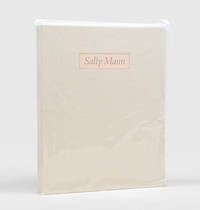
2005126395South Dennis Massachusetts: 21st Editions 2005. First and only edition. One of 100 numbered and 10 lettered copies signed by Mann on the colophon each of the 10 bound prints initialled and the free-standing print signed. This is a stunning and provocative collection of photographs each accompanied by a poem by controversial photographer Sally Mann who was named "America's Best Photographer" by Time magazine in 2001. 21st Editions received the 3rd Annual Lucie Award for Photographic Book Publisher of the Year for this publication. Folio. Illustrated throughout with 10 full-page black-and-white platinum prints each initialled by Mann lower right. Together with one free-standing platinum print signed by Mann lower right. Image sizes: 25.2 x 18.7 cm. Sheet sizes: 35.3 x 30.2 cm. Original buff paper covered boards front cover lettered in silver fore and bottom edges untrimmed printed on handmade cotton rag paper patterned endpapers. With the original buff raw silk clamshell box. All in excellent condition hardcover
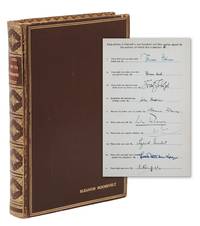
1944140949367New York: Simon and Schuster 1944. Limited Edition. Very Good. Limited edition. Eleanor Roosevelt's copy #6 of 150 copies signed by each of the ten authors on the limitation page tipped in at front: Thomas Mann Rebecca West Sigrid Undset Andre Maurois and six others. xiii 1 488 pp. Custom bound in chestnut polished calf stamped in gilt on spine boards and turn-ins; Roosevelt's name stamped on front board. Not signed or inscribed by her though. All edges gilt maroon morocco title label to spine printed endpapers maroon ribbon marker. Very Good with light rubbing to extremities and heavy chipping to title label; front joint starting at upper end. Light scattered stains to fly-leaves; contents overall clean binding firm. Buergin 568.<br /> <br /> <p>In the summer of 1942 the Austrian refugee and music publisher Armin L. Robinson invited ten prestigious writers to work on a new project: an anti-fascist propaganda film that would demonstrate that Nazi ideology violated each of the Ten Commandments. The deal with Metro-Goldwyn-Meyer fell through so Robinson decided to continue the project as a collection of ten novellas. Each writer took one amendment with Thomas Mann leading the charge:<br /> <br /> <p>1. Thou shalt have no other gods before me. Thomas Mann.<br /> <br> 2. Thou shalt not make unto thee any graven image. Rebecca West.<br /> <br> 3. Thou shalt not take the name of the Lord thy God in vain. Franz Werfel.<br /> <br> 4. Remember to keep the sabbath day to keep it holy. John Erskine.<br /> <br> 5. Honour thy father and thy mother. Bruno Frank.<br /> <br> 6. Thou shalt not kill. Jules Romains.<br /> <br> 7. Thou shalt not commit adultery. Andre Maurois.<br /> <br> 8. Thou shalt not steal. Sigrid Undset.<br /> <br> 9. Thou shalt not bear false witness against thy neighbor. Hendrik Willem Van Loon.<br /> <br> 10. Thou shalt not covet. Louis Bromfeld.<br /> <br /> <p>The book was published in December 1943. Reviewers felt that the collection was uneven and overly long but still found much to praise particularly in Mann's contribution. They all felt the moral imperative of anti-Nazi writing: "Here the world's pen is raised against the sword of the super-race" wrote the New York Times. Four years into the war it had become clear that Hitler's conquest of Europe went well beyond territorial expansion and was an assault on civilization itself. <br /> <br /> <p>It is no surprise that Eleanor Roosevelt should own a copy of this limited edition the text of which is taken from the third trade printing. Apart from being married to Hitler's chief opponent Eleanor was an activist whose positive newspaper review of Mann's 1938 book The Coming Victory of Democracy had aided its success with the American public. The Roosevelts received Thomas Mann and his wife at the White House in 1941 and Mann who admired the President's values and speechmaking gave a speech on behalf of his reelection campaign in 1944. This copy of The Ten Commandments bound for the First Lady's personal library is a tribute to the shared principles of those towering figures. Simon and Schuster unknown
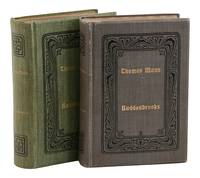
1901140948424Berlin: S. Fischer 1901. First Edition. Near Fine. First edition first printing. Two volumes. 566; 539 9 pp. with 8 advertising pages at rear of second volume. Text in German in Fraktur type. Bound in publisher's green or gray linen over beveled boards stamped in black and gilt top edge gilt patterned endpapers ribbon bookmarks. Near Fine with light rubbing to cover extremities light soiling and light toning and occasional thumbing to contents. Hinges on Volume I are a little tender binding exposed at p. 385 bookseller ticket to back free endpaper verso. Inner hinges exposed and tender on Volume II rubber ownership stamp to third page subtle repair to cloth at tail. A very pretty set in Jugendstil binding. Jacob 2.<br /> <br /> <p>The first edition of Thomas Mann's family saga his most famous novel and the primary reason for his 1929 Nobel Prize win. The ownership stamp is that of Paula and Victor Asriel in Vienna. Paula Asriel who was predeceased by her husband killed herself to avoid deportation in the Holocaust though she managed to get her son out of the country on a Turkish passport. Thomas Mann targeted by the Nazis for his politics rather than his religion was deprived of his German citizenship in 1936 and never lived in his home country again. S. Fischer unknown
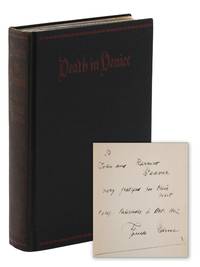
1925140949042New York: Alfred A. Knopf 1925. First American Edition. Near Fine. First American edition first printing. Association copy signed by Thomas Mann on the fly-leaf and inscribed to John and Harriet Weaver "very grateful for their visit. Pacific Palisades 6. October 1942." 284 pp. plus 2 advertising pages at rear. Bound in publisher's black cloth stamped in dark red black topstain patterned endpapers; lacking the dust jacket. Near Fine with sunned spine and light rubbing to extremities and topstain. Bookseller ticket to front free endpaper light toning to contents. A beautiful signed copy of the Nobel laureate's novel about an older man's self-destructive obsession with an adolescent boy.<br /> <br /> <p>The journalists John Downing Weaver and Harriet Sherwood Weaver moved to Los Angeles from Kansas City in 1940. John wrote articles fiction and history famously clearing the names of 167 Black soldiers falsely accused in 1906 of complicity in the death of a White man while Harriet crusaded for better management of the hills sounding the city. Thomas Mann settled in Los Angeles in 1941 and built his "Seven Palms" house in the Pacific Palisades the following year. Here he wrote his anti-Nazi broadcasts for the BBC and here he inscribed this book to two fellow members of the Los Angeles literary scene. Alfred A. Knopf unknown
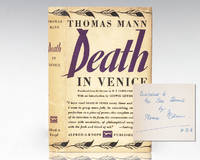
1930140382New York: Alfred A. Knopf 1930. First edition of this translation of Mann's classic novel. Octavo original cloth. Presentation copy inscribed by the author on the front free endpaper "Dedicated to Mr. Carl Lammle by Thomas Mann 15.VII.36." Translated from the German by H.T. Lowe-Porter. Introduction by Ludwig Lewisohn. Near fine in the rare original dust jacket with some expert restoration to the extremities. Rare and desirable signed and inscribed this is the first example of this edition we have encountered. "Thomas Mann is one of the greatest and most widely read authors of the 20th century… An innovative stylist and synthesizer of the intellectual trends of his time Mann exerted much influence on modern fiction not only in Germany but in Europe and in both Americas as well. His perceptiveness as an interpreter of Western cultural heritage and his skill as a cosmopolitan teacher of democratic and humanistic values earned him recognition as a 'mirror of his age' and a 'citizen of the world'… Among Mann's many well-written works of short fiction "Death in Venice" 1928 a novella based on Mann's impressions during his stay in Venice is the most famous… Typically for Mann the novella deals with the problem of the unhappy sick artist Gustav von Aschenbach who envies the healthy and 'normal' people of the bourgeois society" Pribic 262-3. Alfred A. Knopf hardcover
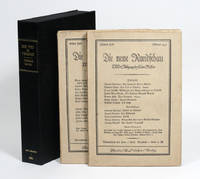
19122495Berlin: S. Fischer Verlag 1912. First edition. Original wrappers. Very Good. FIRST PRINTING IN EXCEEDINGLY SCARCE ORIGINAL WRAPPERS of arguably Thomas Mann's most celebrated work. "At the beginning of 1911 Mann's health was poor and his development sluggish. Nothing he had published since Buddenbrooks had been received with such universal acclaim. He had planned but abandoned several long works and had published chiefly short stories. Convinced that he needed to make a mark with a new piece that would appeal to current tastes he poured all his mastery into Death in Venice . The story was written between July 1911 and July 1912 . Mann had intended it for S. Fischer's magazine by that time merely called Die Neue Rundschau but was uncharacteristically hesitant about submitting it once it was done-it was too innovative and personal. His wife convinced him to send it in. It was first published in the October and November 1912 issues" S. Appelbaum. <br /> <br /> The publication in the October and November issues of Die Neue Rundschau preceded the rare limited edition printed by Hans von Weber. <br /> <br /> In: Die neue Rundschau October and November issues 1912; pp. 1368-1398; 1499-1526. Berlin: S. Fischer Verlag 1912. Octavo original publisher's printed wrappers; custom box. Minor foxing to text block edges very light edgewear to wrappers. SCARCE IN THE ORIGINAL WRAPPERS. S. Fischer Verlag unknown
191255732Berlin, S. Fischer Verlag, 1912. Royal 8vo. Volumes 1 and 2 (i.e. the entire year) of ""Die neue Rundschau, 1912"" present, in the original half vellum bindings with gilt title to spines. A few pencil annotations on flyleaf. An exceedingly nice and clean set.
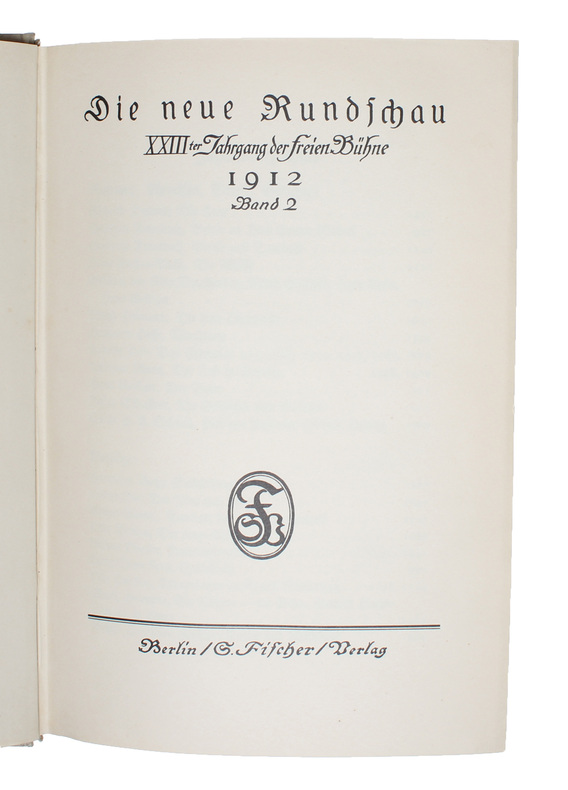
191255732Berlin S. Fischer Verlag 1912. Royal 8vo. Volumes 1 and 2 i.e. the entire year of "Die neue Rundschau 1912" present in the original half vellum bindings with gilt title to spines. A few pencil annotations on flyleaf. An exceedingly nice and clean set. <br/><br/><em>The true first printing of Thomas Mann's masterpiece "The Death in Venice". Contrary to what is generally believed the actual first appearance of "The Death in Venice" was not the extremely scarce de luxe-edition that appeared in 100 numbered copies in 1912. In fact the work originally appeared and in its entirety in the October and November issues i.e. in the second volume on pp. 1368-1398 1499-1526 of "Die Neue Rundschau" 1912.Simultaneusly with this first appearance Poeschel und Trepte in Leipzig were preparing the luxury edition of the work for Hans von Weber's Hyperionverlag in Munich as one of his "Hundertdrucke". Probably due to the controversial theme of the work Thomas Mann was hesitant to immediately handing over the manuscript to his regular publisher S. Fisher for him to publish it directly and had settled on the bibliophile edition already before finishing the work. He did give Fischer the work to publish though and thus it came to appear both in Fischer's "Neue Rundschau" over two months and with Weber's Hyperionverlag. While the first part of the work was being published in "Die neue Rundschau" the luxury edition was being prepared and in the end the luxury edition was only issued shortly after the second and final part had appeared in "Die neue Rundschau" in November 1912. Shortly after the famous luxury edition in 1913 Fischer published the first trade edition in book form. By 1924 50.000 copies of the work had appeared in this form. Thomas Mann's disturbing masterpiece probably the most famous story of obsession ever written is considered one of the most important literary productions of the 20th century. </em> hardcover
19362776Wien: Fischer Verlag 1936. First edition. In original wrappers housed in a red chagrin spine folder and Boichot case. In fine condition. First edition. In original wrappers housed in a red chagrin spine folder and Boichot case. 42 p. <p><br /> Inscribed to Hans Reisiger.<br /> <p><p><br /> The text of Thomas Mann’a speech delivered on May 8 1936 in Vienna on the occasion of Sigmund Freud's 80th birthday.<br /> <p><p><br /> Inscribed to Hans Reisiger a close friend of Thomas Mann who served as the model for Rüdiger Schildknapp’s in Mann’s 1947 novel the Doctor Faustus.<br /> <p>. Fischer Verlag unknown
191244435Berlin, S. Fischer Verlag, 1912. Royal 8vo. Volumes 1 and 2 (i.e. the entire year) of ""Die neue Rundschau, 1912"" present, in the original half vellum bindings with gilt title to spines, top edge gilt. In remarkably fine condition, with just a bit of soiling to spines and a small crack to upper hinges of volume 1 (""Der Tod in Venedig"" is in vol. 2). Small stamp in Hebrew to front boards and to title-pages. Large engraved book plates (""E. Schwabach-Märzdorff"") to inside of front boards and to front free end-papers. A very nice and clean set.
191244435Berlin S. Fischer Verlag 1912. Royal 8vo. Volumes 1 and 2 i.e. the entire year of "Die neue Rundschau 1912" present in the original half vellum bindings with gilt title to spines top edge gilt. In remarkably fine condition with just a bit of soiling to spines and a small crack to upper hinges of volume 1 "Der Tod in Venedig" is in vol. 2. Small stamp in Hebrew to front boards and to title-pages. Large engraved book plates "E. Schwabach-Märzdorff" to inside of front boards and to front free end-papers. A very nice and clean set. <br/><br/><em>The true first printing of Thomas Mann's masterpiece "The Death in Venice". Contrary to what is generally believed the actual first appearance of "The Death in Venice" was not the extremely scarce de luxe-edition that appeared in 100 numbered copies in 1912. In fact the work originally appeared and in its entirety in the October and November issues i.e. in the second volume on pp. 1368-1398 1499-1526 of "Die Neue Rundschau" 1912. Simultaneusly with this first appearance Poeschel und Trepte in Leipzig were preparing the luxury edition of the work for Hans von Weber's Hyperionverlag in Munich as one of his "Hundertdrucke". Probably due to the controversial theme of the work Thomas Mann was hesitant to immediately handing over the manuscript to his regular publisher S. Fisher for him to publish it directly and had settled on the bibliophile edition already before finishing the work. He did give Fischer the work to publish though and thus it came to appear both in Fischer's "Neue Rundschau" over two months and with Weber's Hyperionverlag. While the first part of the work was being published in "Die neue Rundschau" the luxury edition was being prepared and in the end the luxury edition was only issued shortly after the second and final part had appeared in "Die neue Rundschau" in November 1912. Shortly after the famous luxury edition in 1913 Fischer published the first trade edition in book form. By 1924 50.000 copies of the work had appeared in this form. Thomas Mann's disturbing masterpiece probably the most famous story of obsession ever written is considered one of the most important literary productions of the 20th century. </em> hardcover
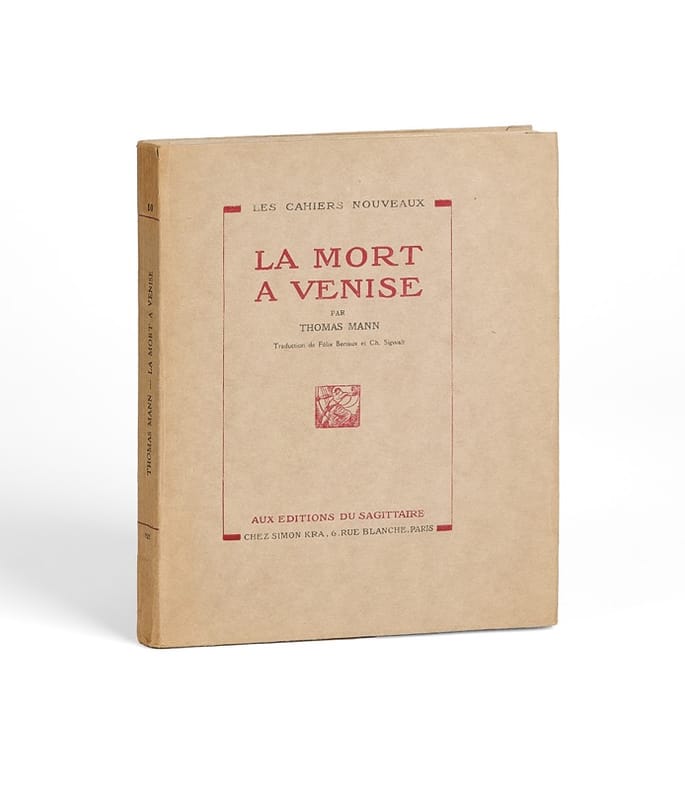
29495Paris Aux éditions du Sagittaire 1925. 1 vol. 160 x 124 mm de 212 p. Broché. . Édition originale de la traduction française donnée par Félix Bertaux Ch. Sigwalt. Elle comprend en frontispice un fac-similé d’une page du manuscrit. Un des 50 premiers exemplaires sur japon n° 26. . La fascination mortelle que peut exercer la beauté : tel est le sujet de La Mort à Venise ce chef-d'oeuvre d'inspiration très romantique où l'on retrouve l'essentiel de la pensée de Thomas Mann. Gustav Aschenbach romancier célèbre et taciturne voit sa vie bouleversée par la beauté divine et la grâce d'un adolescent. Sous le regard interrogateur du jeune Tadzio la descente aux abîmes de ce veuf respectable dans une Venise au charme maléfique rongée par le choléra est un des récits les plus troublants de Mann qui hésita à le livrer à Fisher son éditeur habituel. Il confia d'abord le texte pour une discrète édition de bibliophilie limitée à 100 exemplaires pour les éditions Hyperion de Hans von Weber à Munich qui fut préparée en novembre 1912 quelques semaines après la parution du texte intégral dans les numéros d'octobre et de novembre de Die Neue Rundschau. N'en déplaise à Nabokov - qui parle de la « niaise Mort à Venise » - ce texte est entouré d'une aura certaine que ses diverses transpositions n'ont fait qu'accroître : La Mort à Venise opéra en deux actes créé à Maltings par Benjamin Britten et la célébrissime Mort à Venise de Luchino Visconti pour ne parler que d'elles. Magnifique exemplaire en tirage sur japon avec ses grandes marges conservées. Paris, Aux éditions du Sagittaire, 1925. 1 vol. (160 x 124 mm) de 212 p. Broché. unknown
192529495Un des 50 premiers exemplaires sur japon Paris, Aux éditions du Sagittaire, 1925. 1 vol. (160 x 124 mm) de 212 p. Broché. Édition originale de la traduction française, donnée par Félix Bertaux Ch. Sigwalt. Elle comprend en frontispice un fac-similé d’une page du manuscrit. Un des 50 premiers exemplaires sur japon (n° 26).
2013__9004268758Brill Academic Pub 2013. Hardcover. New. multilingual edition. German language. 12.75x9.75x23.00 inches. Brill Academic Pub hardcover
20018266821st -- The Journal of Contemporary Photography 2001-01-01. Hardcover. Like New. The signed and numbered Deluxe Edition includes 10 exquisite hand-pulled photogravures 4 full-color planographs on fine tissue and 46 additional tritone and color plates. It is hand-bound in Moroccan goatskin and fine fabric and is encased in a matching portfolio case. Edition is limited to 165 copies in original corrugated box. oversized and overweight. Please email for photos. 21st -- The Journal of Contemporary Photography hardcover
1836007789London: Ackermann and Co. Printed by Hillmandel 1836. Half Calf. Very Good. Truly scarce set of hand-colored plates with not a single copy reflected on OCLC First Search nor in bibliographic bibles for color plate and sporting books Tooley and Schwerdt respectively. Oblong 28.5 by 38cm. Six hand-colored lithographic plates Original wraps bound in. Ackermann and Co. Printed by Hillmandel unknown
397987Unbound. Near Fine. A single octavo leaf approximately 6" x 7.75" written on both sides from the Diary of George Combe Mann. One margin a little irregularly cut affecting a few letters but not affecting the readability of the leaf old folds near fine.<br /> <br /> Both Horace Jr. and George were the sons of Horace Mann died 1859 the Father of American Education and Mary Peabody Mann one of the illustrious Peabody Sisters a reformer teacher and founder of a successful school for young children her sister Elizabeth Putnam Peabody was a reformer and pioneer in the creation of kindergartens and her other sister Sophia Peabody was a painter and the wife of Nathaniel Hawthorne.<br /> <br /> Horace and Mary Mann had three sons: Horace Mann Jr. George Combe Mann and Benjamin Pickman Mann. The eldest Horace Mann Jr. was an accomplished botanist who studied and traveled with Henry David Thoreau. Mann also studied zoology with Louis Agassiz and was responsible for discovering over 100 plants species in Hawaii. Mann was named to head the botanical gardens at Harvard but died of tuberculosis at age twenty-four before he could fill the position. His personal herbarium of approximately 12500 sheets was purchased in 1869 by Andrew Dickson White as the first accession into the Cornell University Herbarium.<br /> <br /> The diary leaf in the 22-year-old George Mann's hand covers two sides of one leaf begins on November 11 1868 the day of his brother's death and continues on the other side with entries through November 18th the entry for the 18th may be incomplete.<br /> <br /> Mann's entry for November 11th in a clear and readable hand is exceedingly poignant:<br /> <br /> "At a few minutes before 2 p.m. Horace coughed a little harder than usual and mother spoke to him. He answered 'I was trying to stop a hiccough' adding immediately 'in the eastern provinces they say that is death.' She went out a minute and returned to find him with his eyes fixed gasping for breath. She called me who tried to raise him a little but he gasped five or six times at intervals of a few seconds and ceased to breathe.<br /> <br /> He had been comfortable all day. After his drain was driven out this morning he said he almost wished he had it to drive out again it felt so deliciously. He wanted mother to be with him all the time kept repeating how comfortable he was and wanted to continue just as he was. He enjoyed the day it seemed as much as any one in his life so perfectly calm and tranquil was he.<br /> <br /> But it was the calm which he now enjoys in full. His temperament made living hard even in health - an invalid intolerable. But he lived better than we realized and in his death I find an untold loss!"<br /> <br /> On the 13th he notes:<br /> <br /> "We had service here at 4 o'clock. Dr. Peabody officiated and Mrs. Gould and Dr. & Mrs. Vaughan sang. Brigham staid here last night."<br /> <br /> On the 14th: "We went to Providence at 11 o'clock - mother Aunt Lizzie Mary Peabody Dr. Gould Ben and I - where we found Aunt Lydia the Messers and Arthur Knapp. It was a beautiful day and the short service at the grave was very satisfactory. We dined at Aunt Lydia's and returned at 4 getting home at 7 p.m. Everything was calm and quiet. It is all over!"<br /> <br /> On the 16th: "Mother's 62nd birthday. Went in to Mr. Brigham's office again."<br /> <br /> On the 17th: "Attended to Horace's accounts in the evening."<br /> <br /> The entry on the 18th is truncated: "Snow in the night and rain all day - Read 150pp. of Greenleaf on Evidence."<br /> <br /> Unique primary source material on the death of a promising young botanist.<br /> <br /> From the estate of Horace Mann III died 1978 the son of George Combe Mann. unknown
1905129391New York: Town Topics Publishing Company 1905. First edition of this lavishly published work regarding New York's wealthy society at the time including names such as John Jacob Astor J. Pierpont Morgan and Henry Huntington. Folio original full green morocco elaborate tooling to the spine front and back panels green silk doublures and endleaves all edges gilt. Illustrated hundreds of photogravures all edges gilt. Signed by William Mann the publisher of Town Topics. Includes sketches of Astor Pell Yerkes Stanford White Flagler Schwab Depew C.P. Huntington H.E. Huntington Chanler Cleveland Roosevelt J.P. Morgan Foxhall Keene and many others. In fine condition. Housed in rare original felt-lined wooden box with latches. An exceptional production. William d'Alton Mann was a businessman and newspaper and magazine publisher during the civil war. He developed the Mann Boudoir Car a railroad sleeping car and published the Mobile Register The Smart Set and Town Topics. Mann came to be known for his dubious practices. For example he created the "blind item" a gossipy news story in which the details of a private happening are reported while the identities of the people involved are not revealed. Mann used this as blackmail to publicly threaten an individual into doing his will lest Mann chooses to expose him. Town Topics Publishing Company unknown
60060Berlin Alf Häger 1924. Gr.8° Orig. -Radierung 64 S 1 Bl. Geglättetes blaues Saffianleder Deckel- Rücken- und Innenkantenvergoldung Rundumgoldschnitt Spiegel und fliegende Vorsätze m. goldgemasertem Buntpapier bezogen. Tadelloses Exemplar Erstausgabe Potempa G 186.1 Haack S. 104. Einmalige Auflage in 300 Exemplaren die ersten 90 mit einer Porträtradierung Thomas Manns von Karl Dannemann. Davon kamen 75 in den Handel. Einband und Vergoldung aus der Werkstatt Holzey & Sohn Leipzig. Die ganzseitige Porträt-Radierung von Karl Dannemann und Thomas Mann signiert unter dem Impressum auf der letzten Seite von Thomas Mann ebenfalls signiert. Exemplar LVIII von 90 römisch nummerierten Exemplaren. Gedruckt in Grasset-Antiqua auf Zanders-Hadern. 010 Berlin, Alf Häger, [1924] unknown
1825B4754London: Hurst and Robinson Pall Mall and J. Dickinson c.1825. A fine example. Plates and text are clean and crisp. . Binding: Quarter recent calf with contemporary marbled paper boards. Spine in six compartments of raised bands with gilt ruling and gilt ornaments. Title on two. Notes: Plate book showing views of several planned improvements of River Thames suggested by Lieutenant-Colonel Sir Frederick Trench. <br>Thomas Baynes 1794-1876 was a London born English artist known for his drawings and watercolours of landscapes buildings and outdoor events. Many of his subjects were engraved and published generally in London and these include a notable panorama of the River Thames which was drawn from nature and engraved on stone. He was the son of James Baynes a noted watercolour artist. <br> Size: Oblong folio 280x685mm. Pages: P. Title Page Blank Prospectus 1-2 1-10. Illustrated with ten finely water coloured large lithographic views of London over Thames. Category: Book Europe United Kingdom; Hurst and Robinson, Pall Mall and J. Dickinson hardcover
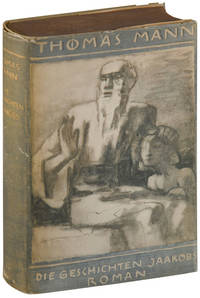
19435676Berlin Vienna & Stockholm: S. Fischer Verlag / Bermann-Fischer Verlag 1943. First Editions. Well-preserved set of the Nobel Prize-winner's great tetralogy telling the story of the Biblical Joseph's dealings with his brothers his rise as a statesman in Egypt his conduct during the epic famine and his restoration to his father Jacob. First Impressions. Four octavo volumes 19-19.5cm; beige and brown cloth-covered boards with titling and decorative elements stamped in black and gilt on spines and front covers; brown topstains; dustjackets; lxiv4026; 910-3377; 910-7524; 89-6444pp. Inscribed by the author in the first volume in Leipzig dated 5.I.37. A few faint scuffs to topstains; gentle sunning to board edges on Vol.2; scattered foxing to covers on Vol.3 though clean internally; some faint foxing to covers and text edges on Vol.4; Very Good to Near Fine. Dustjackets on Vols.1-3 are gently spine-sunned lightly edgeworn with several tiny nicks tears and attendant creases and some shallow losses to crown on Vol.3; Very Good. Dustjacket on Vol.4 is gently spine-sunned with a few tiny tears and a faint stain to rear panel; Near Fine. S. Fischer Verlag / Bermann-Fischer Verlag unknown
16041818816/04/1936. <blockquote><p>An incredibly rare and unpublished letter relating to his perhaps most famous work</p></blockquote><p>1936 was a momentous year for Mann. That year his escalated attacks on the Nazi government led to his German citizenship being revoked. He traveled to Argentina his maternal homeland for a PEN International Conference which was organized to bring peace and understanding between cultures using literature.</p><p>In 1900 at the age of 25 Thomas Mann wrote and in 1901 published Buddenbrooks chronicling the decline of a wealthy north German merchant family over the course of four generations. Mann drew deeply from the history of his own family the Mann family of Lübeck and their times. It was Mann's first novel and it made him a major literary figure. The work led to a Nobel Prize in Literature for Mann in 1929; although the Nobel award generally recognizes an author's body of work the Swedish Academy's citation for Mann identified ""his great novel Buddenbrooks"" as the principal reason for his prize. Mann began writing the book in October 1897 when he was twenty-two years old. The novel was completed three years later in July 1900 and published in October 1901.</p><p>Henry Hart was an American publisher who worked mainly for Scribner's in New York. He was working with Mann on the publication of English-language versions of his works including Nocturns.</p><p><strong>Typed letter signed</strong> in German to Hart April 16 1936.</p><p><em>""I am hurrying to acknowledge receipt of your check from August 25th and am happy that sales of the “Nocturnes†are gradually progressing.</em></p><p><em>""You have added some very personal notes to your letter hat I would like to address with a few words. The trip to Moscow I will definitely make but will have to postpone it for now since I have travel plans to Vienna and Budapest in the immediate future. For the summer I have agreed to travel to Bueno Aires for the PEN Club Congress. I had committed to this trip a while ago and therefore have to travel there first. This trip is especially enticing to me since it will take me to Rio de Janeiro. It is the home of my mother who often told me about the beauty of the coast when I was a child.</em></p><p><em>""I was very touched about what you told me regarding your repeated studies of the novel of my youth. I finished it when I was 25 years old. The young man who wrote that book in his solitude could not have dreamed that it would be his calling in life to influence the intellectual life of people in a foreign continent in a educating and encouraging way. From the bottom of my heart I wish you have happy and beautiful ideas for your work and am repeating my request to please send me a copy your book once it is printed.""</em></p> unknown