Mann ThomasABAA
5 993 résultats
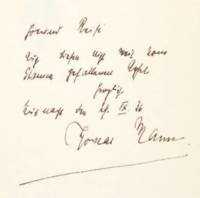
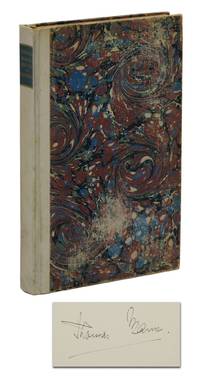
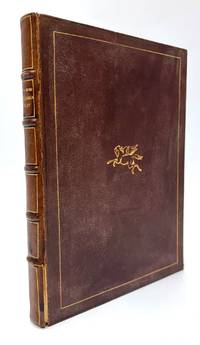
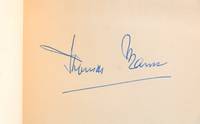
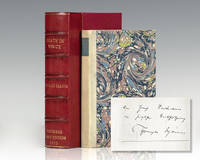
191398970Berlin: S. Fischer Verlag 1913. First trade edition of one of the greatest novellas of the twentieth century. Octavo original publisher's quarter vellum over marbled boards. Association copy inscribed by the author on the front free endpaper "An Ernst Bertram in herzlicher Wertschatzung Thomas Mann" To Ernst Bertram in heartfelt appreciation Thomas Mann. One of the best possible association copies as Bertram was Mann's closest friend from the late 1900s through the 1930s when their politics separated them. Bertram was deeply influential on Mann's thinking and literary direction during the time when he was somewhat artistically lost and suffered his own writer's block. It was also in nearly daily conversation with Bertram that the long political confessional Betrachtungen eines Unpolitischen Reflections of an Unpolitical Man was born. Bertram was a constant visitor at the Mann's and it is evident that there was some quotient of homoerotic attraction to the relationship. It is well-known that Mann's early adulthood prior to his marriage to Katia in 1905 were spent in more or less explicitly gay attractions and relations but recent scholarship has begun to trace the residues of Mann's homosexuality in his later life and work and the relationship with Bertram who was openly homosexual somehow epitomizes the special significance that the company of men still bore. In addition to being Mann's closest confidant Bertram was an important man of letters in his own right. He was a poet professor at the University of Colon and author of many books including Nietzsche - An Attempt of a Mythology. Housed in a custom half morocco clamshell box. Inscribed first editions of Mann's major works are rare; an association copy to this fellow Nietzschean scholar and close confidant makes this a magnificent piece of history. "Thomas Mann is one of the greatest and most widely read authors of the 20th century. An innovative stylist and synthesizer of the intellectual trends of his time Mann exerted much influence on modern fiction not only in Germany but in Europe and in both Americas as well. His perceptiveness as an interpreter of Western cultural heritage and his skill as a cosmopolitan teacher of democratic and humanistic values earned him recognition as a 'mirror of his age' and a 'citizen of the world'. Among Mann's many well-written works of short fiction "Death in Venice" 1928 a novella based on Mann's impressions during his stay in Venice is the most famous. Typically for Mann the novella deals with the problem of the unhappy sick artist Gustav von Aschenbach who envies the healthy and 'normal' people of the bourgeois society" Pribic 262-3. S. Fischer, Verlag hardcover books
191398970Berlin: S. Fischer Verlag 1913. First trade edition of one of the greatest novellas of the twentieth century. Octavo original publisher's quarter vellum over marbled boards. Association copy inscribed by the author on the front free endpaper "An Ernst Bertram in herzlicher Wertschatzung Thomas Mann" To Ernst Bertram in heartfelt appreciation Thomas Mann. One of the best possible association copies as Bertram was Mann's closest friend from the late 1900s through the 1930s when their politics separated them. Bertram was deeply influential on Mann's thinking and literary direction during the time when he was somewhat artistically lost and suffered his own writer's block. It was also in nearly daily conversation with Bertram that the long political confessional Betrachtungen eines Unpolitischen Reflections of an Unpolitical Man was born. Bertram was a constant visitor at the Mann's and it is evident that there was some quotient of homoerotic attraction to the relationship. It is well-known that Mann's early adulthood prior to his marriage to Katia in 1905 were spent in more or less explicitly gay attractions and relations but recent scholarship has begun to trace the residues of Mann's homosexuality in his later life and work and the relationship with Bertram who was openly homosexual somehow epitomizes the special significance that the company of men still bore. In addition to being Mann's closest confidant Bertram was an important man of letters in his own right. He was a poet professor at the University of Colon and author of many books including Nietzsche - An Attempt of a Mythology. Housed in a custom half morocco clamshell box. Inscribed first editions of Mann's major works are rare; an association copy to this fellow Nietzschean scholar and close confidant makes this a magnificent piece of history. "Thomas Mann is one of the greatest and most widely read authors of the 20th century… An innovative stylist and synthesizer of the intellectual trends of his time Mann exerted much influence on modern fiction not only in Germany but in Europe and in both Americas as well. His perceptiveness as an interpreter of Western cultural heritage and his skill as a cosmopolitan teacher of democratic and humanistic values earned him recognition as a 'mirror of his age' and a 'citizen of the world'… Among Mann's many well-written works of short fiction "Death in Venice" 1928 a novella based on Mann's impressions during his stay in Venice is the most famous… Typically for Mann the novella deals with the problem of the unhappy sick artist Gustav von Aschenbach who envies the healthy and 'normal' people of the bourgeois society" Pribic 262-3. S. Fischer, Verlag hardcover
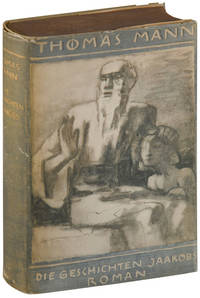
194432318Berlin / Vienna / Stockholm: Fischer 1944. First editions. Four volumes original cloth very good copies in lightly worn dust jackets. "Die Geschichten Jaakobs" is inscribed by Mann "Herrn Gottschalk mit den besten Wuenschen New York 23.v.37". "Die junge Joseph" and "Joseph in Ägypten" are signed. <br/><br/> Fischer hardcover books
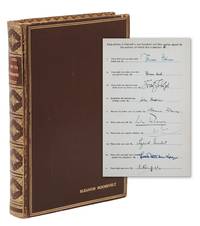
1944140949367New York: Simon and Schuster 1944. Limited Edition. Very Good. Limited edition. Eleanor Roosevelt's copy #6 of 150 copies signed by each of the ten authors on the limitation page tipped in at front: Thomas Mann Rebecca West Sigrid Undset Andre Maurois and six others. xiii 1 488 pp. Custom bound in chestnut polished calf stamped in gilt on spine boards and turn-ins; Roosevelt's name stamped on front board. Not signed or inscribed by her though. All edges gilt maroon morocco title label to spine printed endpapers maroon ribbon marker. Very Good with light rubbing to extremities and heavy chipping to title label; front joint starting at upper end. Light scattered stains to fly-leaves; contents overall clean binding firm. Buergin 568.<br /> <br /> <p>In the summer of 1942 the Austrian refugee and music publisher Armin L. Robinson invited ten prestigious writers to work on a new project: an anti-fascist propaganda film that would demonstrate that Nazi ideology violated each of the Ten Commandments. The deal with Metro-Goldwyn-Meyer fell through so Robinson decided to continue the project as a collection of ten novellas. Each writer took one amendment with Thomas Mann leading the charge:<br /> <br /> <p>1. Thou shalt have no other gods before me. Thomas Mann.<br /> <br> 2. Thou shalt not make unto thee any graven image. Rebecca West.<br /> <br> 3. Thou shalt not take the name of the Lord thy God in vain. Franz Werfel.<br /> <br> 4. Remember to keep the sabbath day to keep it holy. John Erskine.<br /> <br> 5. Honour thy father and thy mother. Bruno Frank.<br /> <br> 6. Thou shalt not kill. Jules Romains.<br /> <br> 7. Thou shalt not commit adultery. Andre Maurois.<br /> <br> 8. Thou shalt not steal. Sigrid Undset.<br /> <br> 9. Thou shalt not bear false witness against thy neighbor. Hendrik Willem Van Loon.<br /> <br> 10. Thou shalt not covet. Louis Bromfeld.<br /> <br /> <p>The book was published in December 1943. Reviewers felt that the collection was uneven and overly long but still found much to praise particularly in Mann's contribution. They all felt the moral imperative of anti-Nazi writing: "Here the world's pen is raised against the sword of the super-race" wrote the New York Times. Four years into the war it had become clear that Hitler's conquest of Europe went well beyond territorial expansion and was an assault on civilization itself. <br /> <br /> <p>It is no surprise that Eleanor Roosevelt should own a copy of this limited edition the text of which is taken from the third trade printing. Apart from being married to Hitler's chief opponent Eleanor was an activist whose positive newspaper review of Mann's 1938 book The Coming Victory of Democracy had aided its success with the American public. The Roosevelts received Thomas Mann and his wife at the White House in 1941 and Mann who admired the President's values and speechmaking gave a speech on behalf of his reelection campaign in 1944. This copy of The Ten Commandments bound for the First Lady's personal library is a tribute to the shared principles of those towering figures. Simon and Schuster unknown
1901140948424Berlin: S. Fischer 1901. First Edition. Near Fine. First edition first printing. Two volumes. 566; 539 9 pp. with 8 advertising pages at rear of second volume. Text in German in Fraktur type. Bound in publisher's green or gray linen over beveled boards stamped in black and gilt top edge gilt patterned endpapers ribbon bookmarks. Near Fine with light rubbing to cover extremities light soiling and light toning and occasional thumbing to contents. Hinges on Volume I are a little tender binding exposed at p. 385 bookseller ticket to back free endpaper verso. Inner hinges exposed and tender on Volume II rubber ownership stamp to third page subtle repair to cloth at tail. A very pretty set in Jugendstil binding. Jacob 2.<br /> <br /> <p>The first edition of Thomas Mann's family saga his most famous novel and the primary reason for his 1929 Nobel Prize win. The ownership stamp is that of Paula and Victor Asriel in Vienna. Paula Asriel who was predeceased by her husband killed herself to avoid deportation in the Holocaust though she managed to get her son out of the country on a Turkish passport. Thomas Mann targeted by the Nazis for his politics rather than his religion was deprived of his German citizenship in 1936 and never lived in his home country again. S. Fischer unknown
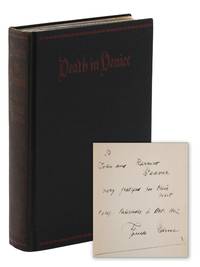
1925140949042New York: Alfred A. Knopf 1925. First American Edition. Near Fine. First American edition first printing. Association copy signed by Thomas Mann on the fly-leaf and inscribed to John and Harriet Weaver "very grateful for their visit. Pacific Palisades 6. October 1942." 284 pp. plus 2 advertising pages at rear. Bound in publisher's black cloth stamped in dark red black topstain patterned endpapers; lacking the dust jacket. Near Fine with sunned spine and light rubbing to extremities and topstain. Bookseller ticket to front free endpaper light toning to contents. A beautiful signed copy of the Nobel laureate's novel about an older man's self-destructive obsession with an adolescent boy.<br /> <br /> <p>The journalists John Downing Weaver and Harriet Sherwood Weaver moved to Los Angeles from Kansas City in 1940. John wrote articles fiction and history famously clearing the names of 167 Black soldiers falsely accused in 1906 of complicity in the death of a White man while Harriet crusaded for better management of the hills sounding the city. Thomas Mann settled in Los Angeles in 1941 and built his "Seven Palms" house in the Pacific Palisades the following year. Here he wrote his anti-Nazi broadcasts for the BBC and here he inscribed this book to two fellow members of the Los Angeles literary scene. Alfred A. Knopf unknown
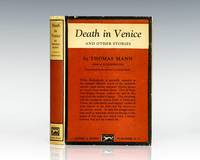
192567022New York: Alfred A. Knopf 1925. First edition in English preceding the British edition by three years of Mann's classic novel. Octavo original cloth patterned endpapers. Signed by Thomas Mann on the half-title page. Translated from the German by Kenneth Burke. Near fine in the rare original dust jacket with some chipping to the head of the spine and rear panel. Housed in a custom half morocco clamshell box. First editions are rare especially so signed. "Thomas Mann is one of the greatest and most widely read authors of the 20th century. An innovative stylist and synthesizer of the intellectual trends of his time Mann exerted much influence on modern fiction not only in Germany but in Europe and in both Americas as well. His perceptiveness as an interpreter of Western cultural heritage and his skill as a cosmopolitan teacher of democratic and humanistic values earned him recognition as a 'mirror of his age' and a 'citizen of the world'. Among Mann's many well-written works of short fiction "Death in Venice" 1928 a novella based on Mann's impressions during his stay in Venice is the most famous. Typically for Mann the novella deals with the problem of the unhappy sick artist Gustav von Aschenbach who envies the healthy and 'normal' people of the bourgeois society" Pribic 262-3. Alfred A. Knopf hardcover books
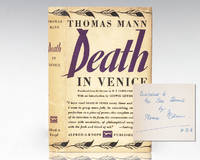
1930140382New York: Alfred A. Knopf 1930. First edition of this translation of Mann's classic novel. Octavo original cloth. Presentation copy inscribed by the author on the front free endpaper "Dedicated to Mr. Carl Lammle by Thomas Mann 15.VII.36." Translated from the German by H.T. Lowe-Porter. Introduction by Ludwig Lewisohn. Near fine in the rare original dust jacket with some expert restoration to the extremities. Rare and desirable signed and inscribed this is the first example of this edition we have encountered. "Thomas Mann is one of the greatest and most widely read authors of the 20th century… An innovative stylist and synthesizer of the intellectual trends of his time Mann exerted much influence on modern fiction not only in Germany but in Europe and in both Americas as well. His perceptiveness as an interpreter of Western cultural heritage and his skill as a cosmopolitan teacher of democratic and humanistic values earned him recognition as a 'mirror of his age' and a 'citizen of the world'… Among Mann's many well-written works of short fiction "Death in Venice" 1928 a novella based on Mann's impressions during his stay in Venice is the most famous… Typically for Mann the novella deals with the problem of the unhappy sick artist Gustav von Aschenbach who envies the healthy and 'normal' people of the bourgeois society" Pribic 262-3. Alfred A. Knopf hardcover
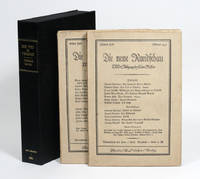
19122495Berlin: S. Fischer Verlag 1912. First edition. Original wrappers. Very Good. FIRST PRINTING IN EXCEEDINGLY SCARCE ORIGINAL WRAPPERS of arguably Thomas Mann's most celebrated work. "At the beginning of 1911 Mann's health was poor and his development sluggish. Nothing he had published since Buddenbrooks had been received with such universal acclaim. He had planned but abandoned several long works and had published chiefly short stories. Convinced that he needed to make a mark with a new piece that would appeal to current tastes he poured all his mastery into Death in Venice . The story was written between July 1911 and July 1912 . Mann had intended it for S. Fischer's magazine by that time merely called Die Neue Rundschau but was uncharacteristically hesitant about submitting it once it was done-it was too innovative and personal. His wife convinced him to send it in. It was first published in the October and November 1912 issues" S. Appelbaum. <br /> <br /> The publication in the October and November issues of Die Neue Rundschau preceded the rare limited edition printed by Hans von Weber. <br /> <br /> In: Die neue Rundschau October and November issues 1912; pp. 1368-1398; 1499-1526. Berlin: S. Fischer Verlag 1912. Octavo original publisher's printed wrappers; custom box. Minor foxing to text block edges very light edgewear to wrappers. SCARCE IN THE ORIGINAL WRAPPERS. S. Fischer Verlag unknown
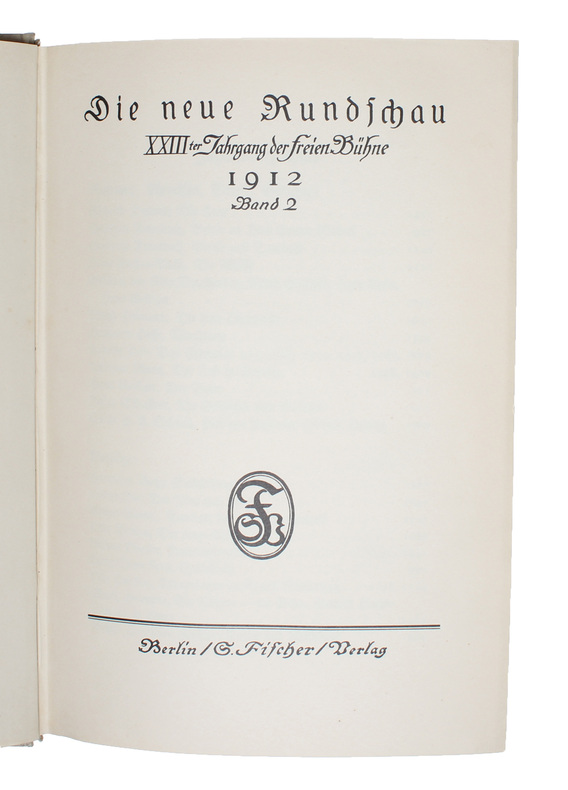
191255732Berlin, S. Fischer Verlag, 1912. Royal 8vo. Volumes 1 and 2 (i.e. the entire year) of ""Die neue Rundschau, 1912"" present, in the original half vellum bindings with gilt title to spines. A few pencil annotations on flyleaf. An exceedingly nice and clean set.
191255732Berlin S. Fischer Verlag 1912. Royal 8vo. Volumes 1 and 2 i.e. the entire year of "Die neue Rundschau 1912" present in the original half vellum bindings with gilt title to spines. A few pencil annotations on flyleaf. An exceedingly nice and clean set. <br/><br/><em>The true first printing of Thomas Mann's masterpiece "The Death in Venice". Contrary to what is generally believed the actual first appearance of "The Death in Venice" was not the extremely scarce de luxe-edition that appeared in 100 numbered copies in 1912. In fact the work originally appeared and in its entirety in the October and November issues i.e. in the second volume on pp. 1368-1398 1499-1526 of "Die Neue Rundschau" 1912.Simultaneusly with this first appearance Poeschel und Trepte in Leipzig were preparing the luxury edition of the work for Hans von Weber's Hyperionverlag in Munich as one of his "Hundertdrucke". Probably due to the controversial theme of the work Thomas Mann was hesitant to immediately handing over the manuscript to his regular publisher S. Fisher for him to publish it directly and had settled on the bibliophile edition already before finishing the work. He did give Fischer the work to publish though and thus it came to appear both in Fischer's "Neue Rundschau" over two months and with Weber's Hyperionverlag. While the first part of the work was being published in "Die neue Rundschau" the luxury edition was being prepared and in the end the luxury edition was only issued shortly after the second and final part had appeared in "Die neue Rundschau" in November 1912. Shortly after the famous luxury edition in 1913 Fischer published the first trade edition in book form. By 1924 50.000 copies of the work had appeared in this form. Thomas Mann's disturbing masterpiece probably the most famous story of obsession ever written is considered one of the most important literary productions of the 20th century. </em> hardcover
19362776Wien: Fischer Verlag 1936. First edition. In original wrappers housed in a red chagrin spine folder and Boichot case. In fine condition. First edition. In original wrappers housed in a red chagrin spine folder and Boichot case. 42 p. <p><br /> Inscribed to Hans Reisiger.<br /> <p><p><br /> The text of Thomas Mann’a speech delivered on May 8 1936 in Vienna on the occasion of Sigmund Freud's 80th birthday.<br /> <p><p><br /> Inscribed to Hans Reisiger a close friend of Thomas Mann who served as the model for Rüdiger Schildknapp’s in Mann’s 1947 novel the Doctor Faustus.<br /> <p>. Fischer Verlag unknown
1913140941253Berlin: S. Fischer Verlag 1913. Very Good. Signed by Thomas Mann on the title page. First trade edition eighteenth printing. 145 3 pp. Publisher's quarter vellum over marbled paper-covered boards spine label blocked in turquoise with gilt lettering. In the original German. Very Good with rubbing to marbled paper light wear small stain to fore edge. An uncommon signed copy of one of the author's best-known works with strong homoerotic themes. S. Fischer, Verlag unknown books
191244435Berlin, S. Fischer Verlag, 1912. Royal 8vo. Volumes 1 and 2 (i.e. the entire year) of ""Die neue Rundschau, 1912"" present, in the original half vellum bindings with gilt title to spines, top edge gilt. In remarkably fine condition, with just a bit of soiling to spines and a small crack to upper hinges of volume 1 (""Der Tod in Venedig"" is in vol. 2). Small stamp in Hebrew to front boards and to title-pages. Large engraved book plates (""E. Schwabach-Märzdorff"") to inside of front boards and to front free end-papers. A very nice and clean set.
191244435Berlin S. Fischer Verlag 1912. Royal 8vo. Volumes 1 and 2 i.e. the entire year of "Die neue Rundschau 1912" present in the original half vellum bindings with gilt title to spines top edge gilt. In remarkably fine condition with just a bit of soiling to spines and a small crack to upper hinges of volume 1 "Der Tod in Venedig" is in vol. 2. Small stamp in Hebrew to front boards and to title-pages. Large engraved book plates "E. Schwabach-Märzdorff" to inside of front boards and to front free end-papers. A very nice and clean set. <br/><br/><em>The true first printing of Thomas Mann's masterpiece "The Death in Venice". Contrary to what is generally believed the actual first appearance of "The Death in Venice" was not the extremely scarce de luxe-edition that appeared in 100 numbered copies in 1912. In fact the work originally appeared and in its entirety in the October and November issues i.e. in the second volume on pp. 1368-1398 1499-1526 of "Die Neue Rundschau" 1912. Simultaneusly with this first appearance Poeschel und Trepte in Leipzig were preparing the luxury edition of the work for Hans von Weber's Hyperionverlag in Munich as one of his "Hundertdrucke". Probably due to the controversial theme of the work Thomas Mann was hesitant to immediately handing over the manuscript to his regular publisher S. Fisher for him to publish it directly and had settled on the bibliophile edition already before finishing the work. He did give Fischer the work to publish though and thus it came to appear both in Fischer's "Neue Rundschau" over two months and with Weber's Hyperionverlag. While the first part of the work was being published in "Die neue Rundschau" the luxury edition was being prepared and in the end the luxury edition was only issued shortly after the second and final part had appeared in "Die neue Rundschau" in November 1912. Shortly after the famous luxury edition in 1913 Fischer published the first trade edition in book form. By 1924 50.000 copies of the work had appeared in this form. Thomas Mann's disturbing masterpiece probably the most famous story of obsession ever written is considered one of the most important literary productions of the 20th century. </em> hardcover
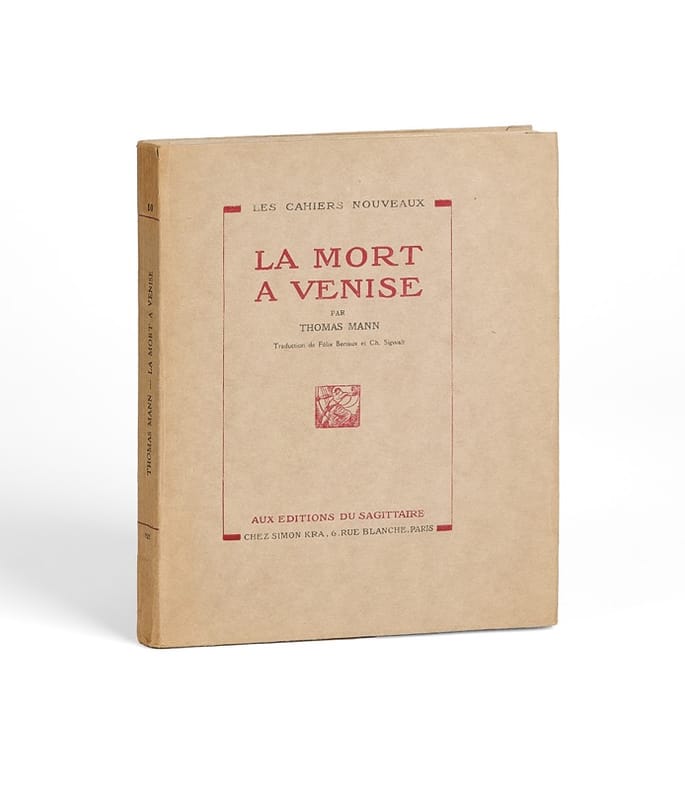
192529495Un des 50 premiers exemplaires sur japon Paris, Aux éditions du Sagittaire, 1925. 1 vol. (160 x 124 mm) de 212 p. Broché. Édition originale de la traduction française, donnée par Félix Bertaux Ch. Sigwalt. Elle comprend en frontispice un fac-similé d’une page du manuscrit. Un des 50 premiers exemplaires sur japon (n° 26).
1905129391New York: Town Topics Publishing Company 1905. First edition of this lavishly published work regarding New York's wealthy society at the time including names such as John Jacob Astor J. Pierpont Morgan and Henry Huntington. Folio original full green morocco elaborate tooling to the spine front and back panels green silk doublures and endleaves all edges gilt. Illustrated hundreds of photogravures all edges gilt. Signed by William Mann the publisher of Town Topics. Includes sketches of Astor Pell Yerkes Stanford White Flagler Schwab Depew C.P. Huntington H.E. Huntington Chanler Cleveland Roosevelt J.P. Morgan Foxhall Keene and many others. In fine condition. Housed in rare original felt-lined wooden box with latches. An exceptional production. William d'Alton Mann was a businessman and newspaper and magazine publisher during the civil war. He developed the Mann Boudoir Car a railroad sleeping car and published the Mobile Register The Smart Set and Town Topics. Mann came to be known for his dubious practices. For example he created the "blind item" a gossipy news story in which the details of a private happening are reported while the identities of the people involved are not revealed. Mann used this as blackmail to publicly threaten an individual into doing his will lest Mann chooses to expose him. Town Topics Publishing Company unknown
192568098New York: Alfred A. Knopf 1925. First edition in English preceding the British edition by three years of Mann's classic novel. Octavo original cloth patterned endpapers. Translated from the German by Kenneth Burke. Near fine in the rare original dust jacket with some light expert restoration to the crown of the spine. First editions are rare especially in the original dust jacket. "Thomas Mann is one of the greatest and most widely read authors of the 20th century. An innovative stylist and synthesizer of the intellectual trends of his time Mann exerted much influence on modern fiction not only in Germany but in Europe and in both Americas as well. His perceptiveness as an interpreter of Western cultural heritage and his skill as a cosmopolitan teacher of democratic and humanistic values earned him recognition as a 'mirror of his age' and a 'citizen of the world'. Among Mann's many well-written works of short fiction "Death in Venice" 1928 a novella based on Mann's impressions during his stay in Venice is the most famous. Typically for Mann the novella deals with the problem of the unhappy sick artist Gustav von Aschenbach who envies the healthy and 'normal' people of the bourgeois society" Pribic 262-3. Alfred A. Knopf hardcover books
19435676Berlin Vienna & Stockholm: S. Fischer Verlag / Bermann-Fischer Verlag 1943. First Editions. Well-preserved set of the Nobel Prize-winner's great tetralogy telling the story of the Biblical Joseph's dealings with his brothers his rise as a statesman in Egypt his conduct during the epic famine and his restoration to his father Jacob. First Impressions. Four octavo volumes 19-19.5cm; beige and brown cloth-covered boards with titling and decorative elements stamped in black and gilt on spines and front covers; brown topstains; dustjackets; lxiv4026; 910-3377; 910-7524; 89-6444pp. Inscribed by the author in the first volume in Leipzig dated 5.I.37. A few faint scuffs to topstains; gentle sunning to board edges on Vol.2; scattered foxing to covers on Vol.3 though clean internally; some faint foxing to covers and text edges on Vol.4; Very Good to Near Fine. Dustjackets on Vols.1-3 are gently spine-sunned lightly edgeworn with several tiny nicks tears and attendant creases and some shallow losses to crown on Vol.3; Very Good. Dustjacket on Vol.4 is gently spine-sunned with a few tiny tears and a faint stain to rear panel; Near Fine. S. Fischer Verlag / Bermann-Fischer Verlag unknown
1930117697London: Jarrolds 1930. First UK Edition and first printing in English. Issued under the publisher's Jay Library series at a price of 7/6. <br/><br/>Basis for the classic 1930 film by Josef von Sternberg starring Emil Jannings and a very young Marlene Dietrich filmed simultaneously in both German and English. <br/><br/>Very Good in a extremely bright and colorful Very Good plus dust jacket. Boards slightly bowed with evidence of exposure to moisture at the fore-edges. Jacket has no loss only a bit of shallow creasing at the spine ends. Jarrolds unknown books
192114202München: Phantasus-Verlag 1921. Limited Edition. Hardcover. Good. First edition of this controversial novella. The present copy is number 25 of 30 numbered copies bound in Saffiano calfskin and SIGNED by Mann and illustrator Thomas Theodor Heine. Of a total edition of 530 copies issued in several bindings this is an example from the smallest limitation and it is a handsome binding indeed. The bottom spine compartment is flapping partly detached but holding precariously. The first and last few leaves are considerably foxed including the limitation page. Two ownership signatures to the first two leaves Ooherwise clean and sound internally. Altogether in good condition. Wälsungenblut The Blood of the Wälsungs was written in 1915 but withheld from publication owing to the similarities between the characters in the story and Mann's new in-laws. In 1905 Mann married Katja Pringsheim and it is believed based his story in part on Katja and her twin brother Klaus Pringsheim reinvented as Siegmund and Sieglinde Wagner's incestuous twins from Die Wälkure 1870 with echoes of the Volsunga Saga. <br /> <br /> The story was set for publication in the January 1906 issue of Die Neue Rundschau but after discovering the incestuous nature of the story Alfred Pringsheim Mann's father-in-law demanded that publication be withheld. Suppressed for fifteen years Wälsungenblut was finally published in 1921. It remains one of Mann's most controversial stories owing to its depiction of anti-Semitism and incest. The novella was adapted for the award-winning German film Wälsungenblut directed by Rolf Thiele in 1964. <br /> <br /> Though not in fine condition the book is genuinely rare in this deluxe binding and desirable thus. Phantasus-Verlag hardcover
195091161Paris: Arthème Fayard 1950. Fine. Arthème Fayard Paris 1950 14 x 22.7 cm 2 volumes brochés New edition of the French translation.Spines slightly sunned with minor tears at the foot.Signed in manuscript by Thomas Mann on the endpapers of both volumes. Arthème Fayard unknown
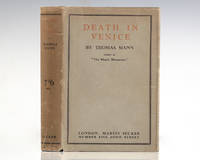
1928142045London: Martin Secker 1928. First British edition of Mann's classic novel. Octavo original cloth. Translated from the German by H.T. Lowe-Porter. Near fine in the rare original dust jacket with some light shelfwear and small repairs to the verso. First editions are rare especially in the original dust jacket and in this condition. "Thomas Mann is one of the greatest and most widely read authors of the 20th century… An innovative stylist and synthesizer of the intellectual trends of his time Mann exerted much influence on modern fiction not only in Germany but in Europe and in both Americas as well. His perceptiveness as an interpreter of Western cultural heritage and his skill as a cosmopolitan teacher of democratic and humanistic values earned him recognition as a 'mirror of his age' and a 'citizen of the world'… Among Mann's many well-written works of short fiction "Death in Venice" 1928 a novella based on Mann's impressions during his stay in Venice is the most famous… Typically for Mann the novella deals with the problem of the unhappy sick artist Gustav von Aschenbach who envies the healthy and 'normal' people of the bourgeois society" Pribic 262-3. Martin Secker hardcover
195434Frankfurt am Main: S. Fischer 1954. True first edition. In original orange paper. Spine somewhat worn author and title written in ink. True first edition. In original orange paper. 441 1 6 p. Thomas Mann’s last unfinished picaresque novel that he “wrote†throughout almost his entire life about Felix Krull the confidence man. A parody of Goethe’s autobiography “Dichtung und Wahrheit†Poetry and Truth embellished with Mann’s ironic autobiographical allusions. <br /> Mann started to plan the book in 1905 and finished the first chapters already in 1911 than he ceased writing it for about four decades to continue it in the early 50s between 1950 and 1954. The first part published first in the collection of short stories in 1920 titled “Das Wunderkind†The Infant Prodigy the first separate edition was published in 1922. <br /> This one is the very first edition of the entire but still unfinished work. “Leseexemplars†were printed in limited number not for the market handed to booksellers and journalist weeks before the date of the proper publication.<br /> We could not trace any copies in libraries found only one copy in Hans-Peter Haack’s collection.<br /> Haack Hans-Peter: Erstausgaben Thomas Mann; 91.3. S. Fischer unknown
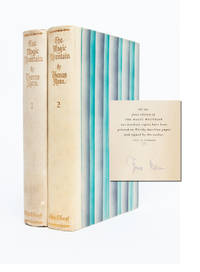
19274284New York: Alfred A. Knopf 1927. First American edition. Near Fine. A lovely copy of the first American edition of Mann's justifiably famous The Magic Mountain in very nearly Fine condition. Slight discoloration to vellum of both spines. Internally unopened throughout resulting in bright fresh pages. One of just 200 copies signed by the author. <br/><br/>Originally published as Der Zauberberg Mann's opus was worked and reworked over a period of 12 years starting in 1912 and finally seeing publication in 1924. It is a complex work on man European society and culture and the seemingly eternal questions; swirled together in an intoxicating blend of realism allegory and the ironic. Near Fine. Alfred A. Knopf unknown books