2 704 résultats
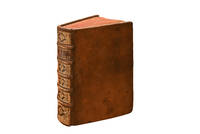
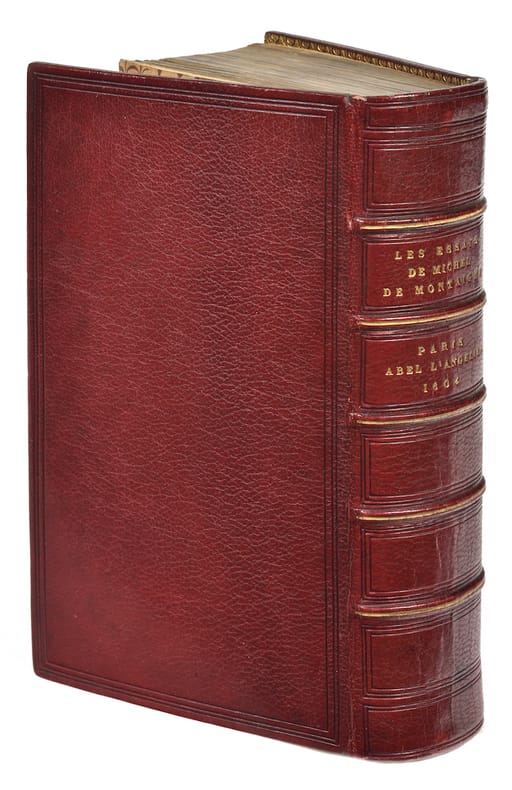
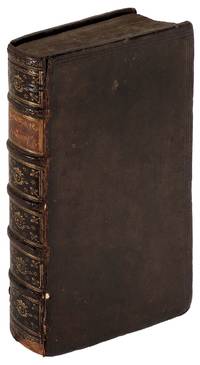
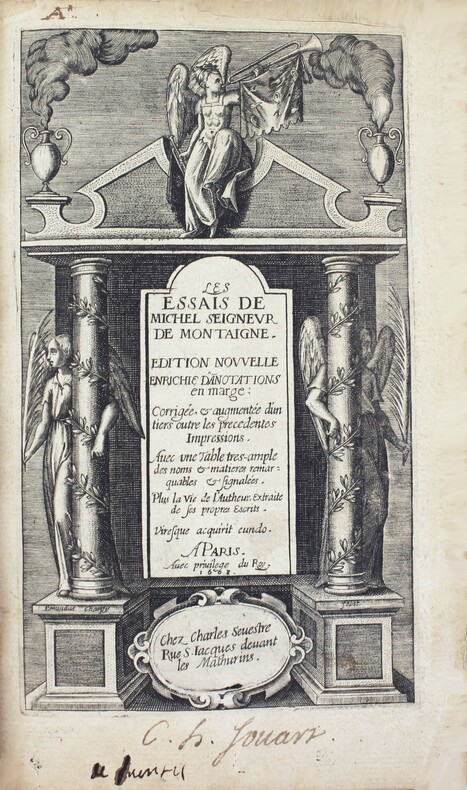
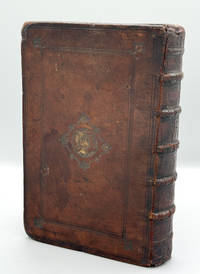
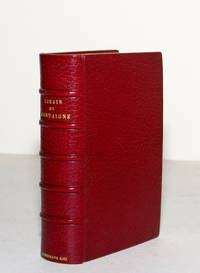
15824822Bordeaux: Simon Millanges 1582. Hardcover. Very Good. 8vo - over 7¾ - 9¾" tall. 4 ff 806 pp 1 ff. Bound in luxurious 19th century red morocco by Chambolle-Duru. Very good. Rare second edition carefully corrected by Montaigne himself of his chef d'oeuvre and a masterpiece of world literature. Montaigne continuously corrected his Essais throughout his lifetime and modern commentators have often been able to trace the development of his thought through these changes in addition to the reflections they provide of Montaigne's life experiences. The first of these corrected editions is the present work published shortly after Montaigne's return from a voyage to Italy. The work is of particular American interest for one of the earliest and most astute accounts of Brazilian Indians published in the 16th century "Des Cannibales" pp. 174-191 and certainly the most widely read account of Brazilian Indians known to Renaissance readers. More meticulously and beautifully printed than the first edition the present work incorporates some 34 additions and 16 new citations relative to the 1580 text. Many of the new citations reference Italian sources - an indication of the profound effect Montaigne's travels in Italy 1580-1 had on the author. Other corrections - in text style orthography punctuation and the addition or suppression of words - have also been recorded by Marcel Françon. The edition of 1582 "permits first of all the correction of a somewhat corrupted text. but also represents a commercial endeavour by Millanges who had a great interest in associating himself with a new political power ie Montaigne who had been elected Mayor of Bordeaux in 1581." Desan In his thought-provoking discussion of civilized behaviour famously titled 'Des Cannibales' Montaigne draws on printed sources-Léry Thevet and Osorio-as well as a personal encounter with ethnic Brazilians. Montaigne had been in Rouen in 1562 when a group of Indians were presented to Charles IX. In "Des Cannibales" he reports with remarkable accuracy on Brazilian morals music housing and other ethnographic details. Following a detailed description of cannibalism the essayist draws a deft parallel with the torture methods employed by the Inquisition. Like the first edition the present work contains the first two books of the Essais. A third would appear only in 1588. OCLC shows Chicago Virginia the NYPL Yale Princeton and Harvard. Desan 12; Sayce 2; Tchemerzine-Scheler IV 871; M. Françon Les Essais de 1582 Harvard 1969. <br/> <br/> Simon Millanges hardcover books
15824822Bordeaux: Simon Millanges 1582. Hardcover. Very Good. 8vo - over 7¾ - 9¾" tall. 4 ff 806 pp 1 ff. Bound in luxurious 19th century red morocco by Chambolle-Duru. Very good. Rare second edition carefully corrected by Montaigne himself of his chef d'oeuvre and a masterpiece of world literature. Montaigne continuously corrected his Essais throughout his lifetime and modern commentators have often been able to trace the development of his thought through these changes in addition to the reflections they provide of Montaigne's life experiences. The first of these corrected editions is the present work published shortly after Montaigne's return from a voyage to Italy. The work is of particular American interest for one of the earliest and most astute accounts of Brazilian Indians published in the 16th century "Des Cannibales" pp. 174-191 and certainly the most widely read account of Brazilian Indians known to Renaissance readers. More meticulously and beautifully printed than the first edition the present work incorporates some 34 additions and 16 new citations relative to the 1580 text. Many of the new citations reference Italian sources - an indication of the profound effect Montaigne's travels in Italy 1580-1 had on the author. Other corrections - in text style orthography punctuation and the addition or suppression of words - have also been recorded by Marcel Françon. The edition of 1582 "permits first of all the correction of a somewhat corrupted text. but also represents a commercial endeavour by Millanges who had a great interest in associating himself with a new political power ie Montaigne who had been elected Mayor of Bordeaux in 1581." Desan In his thought-provoking discussion of civilized behaviour famously titled 'Des Cannibales' Montaigne draws on printed sources-Léry Thevet and Osorio-as well as a personal encounter with ethnic Brazilians. Montaigne had been in Rouen in 1562 when a group of Indians were presented to Charles IX. In "Des Cannibales" he reports with remarkable accuracy on Brazilian morals music housing and other ethnographic details. Following a detailed description of cannibalism the essayist draws a deft parallel with the torture methods employed by the Inquisition. Like the first edition the present work contains the first two books of the Essais. A third would appear only in 1588. OCLC shows Chicago Virginia the NYPL Yale Princeton and Harvard. Desan 12; Sayce 2; Tchemerzine-Scheler IV 871; M. Françon Les Essais de 1582 Harvard 1969. <br/> <br/> Simon Millanges hardcover
1582LCS-A100<p><strong>" Montaigne's Essays are hailed as one of the most important works of Western literature not only for their literary value but also for their contribution to philosophical thought. They continue to be studied and appreciated today for their humanism their skepticism and their commitment to intellectual freedom. "</strong></p><p><strong>" The Essays have become a universal book the only book of its kind in the world a unique book that shows the reader not simply a man describing himself<br />but a life in the process of being lived. "</strong></p><p><strong>Original edition of Montaigne's Essays in superb antique binding the second<br />printed in " Bourdeaus in 1582 " with 34 additions and 16 citations.</strong></p><p><strong>Provenance: Le Roy year 1750 and Doctor Lucien Graux ex-libris.</strong></p><p><strong>Copy with wide margins height: 157 mm.</strong></p><p><strong>The Pottiée-Sperry copy height 158 mm disfigured by a large worm gallery affecting the text sold for 50000 by Sotheby's on November 27 2003<br />22 years ago was resold for 145000.</strong></p><p><strong>Bourdeaux 1582.</strong></p><p>In-8 of 4 unnumbered ll. 806 pp. and 1 leaf of excerpt from the privilege collation: 4 A Z8 Aa-Zz8 Aaa Ddd8 Eee4. Full Havana calf spine with raised bands richly decorated with small gilded tools including the radiant sun decorated boards red edges case. <em>Parisian binding of the 17th century.</em></p><p>157 x 98 mm.</p><p>Original edition of the essays the second revised corrected and augmented by Michel de Montaigne printed " A Bourdeaux in 1582 ".</p><p>"<em> It is more beautiful than the first and is an uncommon volume</em> " notes Brunet <em>Manuel du Libraire III 1835</em>.</p><p>" <em>It is printed in finer and clearer type than that of the first " </em>adds Le Petit <em>Bibliographie d'éditions originales françaises</em> page 100.</p><p>It must have been printed in 1500 copies 443 years ago and the corrections notably record the requirements of censorship.</p><p>In June 1580 tired of his years of retreat spent writing and publishing the Essays Montaigne left his château and went to Paris to present his book to the king. He left in September and embarked on a long journey through Germany Switzerland and finally Italy. He traveled for a year and while at the Baths of Lucca in September 1581 he received a letter informing him of his election as mayor of Bordeaux. In no hurry to assume his new office he returned to Rome. He was made a citizen of the city and it was only on October 15 that he finally decided to return to France.<br />Upon his return he decided to publish a new edition of the <em>Essays</em> to which he would add some additions. Two years after the publication of the first edition which contained the first two books Montaigne revised his text and added 34 additions and 16 new citations including 9 in Italian several passages concerning his recent trip to Italy. In addition he made several hundred correctionstext style spelling punctuation addition or deletion of wordsall noted by Marcel Françon. Published at the time Montaigne had just been elected mayor of Bordeauxthe title page even lists all the author's public officesthe edition " <em>first allows the correction of a fairly corrupted text this was necessary for Montaigne who was well aware of the rushed work of the 1580 edition but it also represents a commercial operation for Millanges who had every interest in associating himself with the city's new political power from which he could hope to receive printing contracts notably for the Collège de Guyenne. Through this reissue of the 1580 Essays Millanges gave Montaigne increased visibility and a prominent place on the local political stage and in Bordeaux's intellectual circles</em> " Philippe Desan. The volume was very carefully printed with chosen and finely crafted type.</p><p>This second edition is extremely rare.</p><p><em>The Essays</em> are one of the most important books of the pre-modern period. Following Erasmus but in the vernacular Montaigne provides an inventory of humanism. He also learns to observe himself and the observer who observes himself. In doing so he lays the groundwork for classicism: all the notions that would later be central to classical doctrine are already present in him; he shaped the honest man. Descartes Pascal Molière La Fontaine La Rochefoucauld La Bruyère owe him a debt. In the 18th century Bayle Fontenelle Montesquieu and Voltaire drew from him even if sometimes distorting him: Montaigne was already a " philosopher. " Rousseau borrowed some anecdotes which he claimed as his own! and took more than one paradox from him. Later Sainte-Beuve searching for Pascal at Port-Royal would find himself in Montaigne and take him as a model. Abroad Montaigne's influence was considerable. The first Italian translation of the Essays appeared during Montaigne's lifetime Girolamo Naselli 1590 44 chapters of the first two books. In England John Florio translated the first titling it <em>The Essayes or Morall Politike and Militarie Discourses</em> 1603 immediately making it a classic of English letters. Shakespeare owes him certain passages in <em>The Tempest</em>; Locke was inspired by his ideas on child education. The essay was naturalized across the Channel becoming the English's favorite minor genre. In the United States Montaigne found in Emerson the " sufficient reader " and in Jacob Zeitlin and Donald M. Frame the translators he had dreamed of. In Germany a complete translation of the Essays did not appear until the 18th century ed. Johann Daniel Titius <em>Michaels Herrn von Montaigne Versuche</em> 1753-4. A 17th-century Spanish translation Diego de Cisnero 1634 was never published and it was only at the end of the 19th century that the Essays became truly accessible edition Constantino Roman Salamero 1898. In Japan Hideo Sekine translated the Essays 1935.</p><p>The value of the two original editions of 1580 and 1582 has increased considerably over time: according to Brunet Supplément 1095-1096 the value hierarchy between the 1580 edition and that of 1582 for copies in identical bindings and conditions was as follows: " In 1877 at Morgand and Fatout 1500 F. But for a 1580 copy bound by Duru at the same date at the same bookseller the Lebeuf de Montgermond 1582 copy bound by Duru was sold for 1000 F. Or. "</p><p>As the cult of the original edition grew the value difference today stands at 3 to 1 for copies. Thus in the catalog of a Parisian bookstore published in December 2019 we see a 1580 Essays copy bound in the 19th century sold for 250000 no. 1 and a 1582 Essays copy bound by Chambolle Duru around 1870 sold for 85000 no. 2. Of medium size height: 151 mm this copy had been sold for 20000 on May 13 1987 38 years ago by Maître Tajan.</p><p>On June 25 2009 16 years ago Christie's Paris sold the Pontière copy in restored old vellum of the 1580 edition for 715000.</p><p>The Escoffier copy of the 1582 edition measured 152 mm in height as did the Rochebilière copy.<br />The Pottiée-Sperry copy height 158 mm disfigured by a large worm gallery affecting the text sold for 50000 by Sotheby's on November 27 2003 22 years ago and was recently resold for 145000.</p><p>Magnificent copy preserved in its beautiful antique binding with very wide margins height: 157 mm one of the finest recorded on the market in the last half-century.</p><p>Provenances: <em>Le Roy</em> 1750 and <em>Doctor Lucien Graux</em> ex-libris.</p><p>FRANCAIS</p><p><strong>" <em>Les </em></strong><strong><em>Essais de Montaigne sont salués comme l'une des uvres les plus importantes de la littérature occidentale non seulement pour leur valeur littéraire mais aussi pour leur contribution à la pensée philosophique. Ils continuent à être étudiés et appréciés aujourd'hui pour leur humanisme leur scepticisme et leur engagement en faveur de la liberté intellectuelle</em></strong><strong>. "</strong></p><p><strong>" <em>Les </em></strong><strong><em>Essais sont devenus un livre universel le seul livre au monde de son espèce un livre unique qui met sous les yeux du lecteur non pas simplement un homme en train de se décrire</em></strong></p><p><strong><em>mais une vie en train de se faire.</em></strong><strong> "</strong></p><p><strong>Edition originale des </strong><strong><em>Essais</em></strong><strong> de Montaigne en superbe reliure ancienne la seconde</strong></p><p><strong>imprimée à " Bourdeaus en 1582 " augmentée de 34 additions et 16 citations.</strong></p><p><strong>Provenance : <em>Le Roy</em> année 1750 et <em>Docteur Lucien Graux</em> ex-libris.</strong></p><p><strong>Exemplaire à grandes marges hauteur : 157 mm</strong><strong>.</strong></p><p><strong>L'exemplaire <em>Pottiée-Sperry</em> hauteur 158 mm défiguré par une importante galerie de vers atteignant le texte adjugé 50 000 par Sotheby's le 27 novembre 2003 </strong></p><p><strong>il y a 22 ans fut revendu 145 000 .</strong></p><p><strong>Bourdeaux 1582.</strong></p><p>In-8 de 4 ff. non chiffrés 806 pp. et 1 feuillet d'extrait du privilège collation : 4 A Z8 Aa-Zz8 Aaa Ddd8 Eee4. Plein veau havane dos à nerfs richement orné aux petits fers dorés incluant le soleil rayonnant coupes décorées tranches rouges étui. <em>Reliure parisienne du XVIIè siècle. </em></p><p>157 x 98 mm.</p><p>Edition originale des Essais la seconde revue corrigée et augmentée par Michel de Montaigne imprimée " <em>A Bourdeaux en 1582</em> ".</p><p>" <em>Elle est plus belle que la première et c'est un volume peu commun</em> " mentionne Brunet <em>Manuel du Libraire</em> III 1835.</p><p>" <em>Elle est imprimée en jolis caractères plus fins et plus nets que ceux de la première</em> " ajoute Le Petit <em>Bibliographie d'éditions originales françaises</em> page 100.</p><p>Elle dut être imprimée à 1 500 exemplaires il y a 443 ans et les corrections enregistrent notamment les exigences de la censure.</p><p>En juin 1580 las de ses années de retraite occupées à la rédaction et à la publication des <em>Essais</em> Montaigne quitte son château et gagne Paris pour aller présenter son livre au roi. Il en repart en septembre et engage un long voyage passant par l'Allemagne la Suisse et enfin l'Italie. Il voyage pendant un an et alors qu'il se trouve aux Bains de Lucca en septembre 1581 il reçoit une lettre lui apprenant son élection en qualité de maire de Bordeaux. Peu pressé d'entrer dans ses nouvelles fonctions il retourne à Rome. Il y est nommé citoyen de la ville et ce n'est que le 15 octobre qu'il décide enfin de rentrer en France.</p><p>À son retour il décide de publier une nouvelle édition des <em>Essais</em> à laquelle il va faire quelques ajouts. Deux ans après la parution de la première édition qui renfermait les deux premiers livres Montaigne reprend son texte et y ajoute 34 additions et 16 citations nouvelles dont 9 en italien plusieurs passages concernant son récent voyage en Italie. En outre il y apporte plusieurs centaines de corrections - texte style orthographe ponctuation addition ou suppression de mots - toutes relevées par Marcel Françon. Publiée alors que Montaigne vient d'être élu maire de Bordeaux - la page de titre fait d'ailleurs état de toutes les charges publiques de l'auteur - l'édition " <em>permet d'abord la correction d'un texte passablement corrompu c'est une nécessité pour Montaigne qui est bien conscient du travail bâclé de l'édition de 1580 mais elle représente également une opération commerciale pour Millanges qui a tout intérêt à s'associer au nouveau pouvoir politique de la ville dont il peut espérer recevoir des contrats d'impression notamment pour le Collège de Guyenne. Par cette réédition des Essais de 1580 Millanges donne à Montaigne une visibilité accrue et une place de choix sur la scène politique locale et dans le milieu intellectuel bordelais</em> " Philippe Desan. Le volume fut très soigneusement imprimé avec des caractères choisis et d'une grande finesse.</p><p>Cette deuxième édition est d'une grande rareté.</p><p><em>Les Essais</em> sont un des livres les plus importants de la période pré-moderne. À la suite d'Érasme mais en langue vulgaire Montaigne y dresse un inventaire de l'humanisme. Il y apprend aussi à s'observer et à observer l'observateur qui s'observe. Par là il prépare le classicisme : toutes les notions qui seront par la suite au centre de la doctrine classique sont déjà présentes chez lui ; il a façonné l'honnête homme. Descartes Pascal Molière La Fontaine La Rochefoucauld La Bruyère lui sont redevables. Au XVIIIe siècle Bayle Fontenelle Montesquieu Voltaire s'en nourrissent même si c'est pour le déformer : Montaigne est déjà " philosophe ". Rousseau lui emprunte quelques anecdotes qu'il s'attribue à lui-même ! et lui reprend plus d'un paradoxe. Plus tard Sainte-Beuve parti à la recherche de Pascal à Port-Royal se retrouvera en Montaigne et le prendra pour modèle. À l'étranger l'influence de Montaigne sera considérable. La première traduction italienne des <em>Essais</em> paraît du vivant de Montaigne Girolamo Naselli 1590 44 chapitres des deux premiers livres. En Angleterre John Florio traduit le premier qu'il intitule <em>The Essayes or Morall</em> <em>Politike and Militarie Discourses</em> 1603 et en fait immédiatement un classique des lettres anglaises. Shakespeare lui doit certains passages de <em>La Tempête</em> ; Locke s'inspire de ses idées sur l'<em>Institution des enfants</em>. L'essai se naturalise Outre-Manche pour devenir le petit genre favori des Anglais. Aux États-Unis Montaigne trouvera en Emerson le " suffisant lecteur " et en Jacob Zeitlin et Donald M. Frame les traducteurs dont il avait rêvé. En Allemagne il faut attendre le XVIIIe siècle pour avoir une traduction complète des <em>Essais</em> éd. Johann Daniel Titius <em>Michaels Herrn von Montaigne Versuche</em> 1753-4. Une traduction espagnole du XVIIe siècle Diego de Cisnero 1634 ne sera jamais publiée et c'est à la fin du XIXe siècle que l'on aura vraiment accès aux <em>Essais</em> édition Constantino Roman Salamero 1898. Au Japon Hideo Sekine traduira les <em>Essais</em> 1935.</p><p>La valeur des deux premières originales de 1580 et 1582 s'est considérablement accrue au fil du temps : selon Brunet Supplément 1095-1096 la hiérarchie de valeur entre l'édition des 1580 et celle de 1582 pour des exemplaires en reliure et conditions identiques s'établissait ainsi : " En 1877 chez Morgand et Fatout 1500 F. Or pour un exemplaire de 1580 relié par Duru à la même date chez le même libraire l'exemplaire Lebeuf de Montgermond de 1582 relié par Duru était vendu 1 000 F. Or. ".</p><p>Le culte de l'édition originale s'amplifiant la différence de valeur s'établit aujourd'hui de 3 à 1 pour des exemplaires. Ainsi voyons nous sur le catalogue d'une librairie parisienne publié en décembre 2019 un exemplaire des <em>Essais</em> de 1580 relié au XIXe siècle vendu 250 000 n° 1 et un exemplaire des <em>Essais</em> de 1582 relié par <em>ChambolleDuru</em> vers 1870 vendu 85 000 n° 2. De taille moyenne hauteur : 151 mm cet exemplaire avait été adjugé 20 000 le 13 mai 1987 il y a 38 ans par Maître Tajan.</p><p>Le 25 juin 2009 il y a 16 ans Christie's Paris adjugeait 715 000 l'exemplaire <em>Pontière</em> en vélin ancien restauré de l'édition de 1580.</p><p>L'exemplaire <em>Escoffier</em> de l'édition de 1582 mesurait 152 mm de hauteur ainsi que l'exemplaire Rochebilière.</p><p>L'exemplaire <em>Pottiée-Sperry</em> hauteur 158 mm défiguré par une importante galerie de vers atteignant le texte adjugé 50 000 par Sotheby's le 27 novembre 2003 il y a 22 ans fut revendu 145 000 il y a peu.</p><p>Magnifique exemplaire conservé dans sa belle reliure ancienne à très belles marges hauteur : 157 mm l'un des plus beaux répertoriés sur le marché depuis un demi-siècle.</p><p>Provenances : <em>Le Roy</em> 1750 et <em>Docteur Lucien Graux</em> ex-libris.</p> Par S, Millanges, Imprimeur ordinaire du Roy.
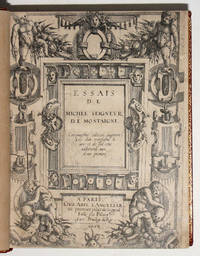
15884823Paris: chez Abel L'Angelier au premier pillier de la grand Salle du Pallais 1588. Hardcover. Very Good. 4to 24.3 x 18.8 cm. 4 ff. 496 ff. first leaf is an etched title woodcut headpieces and initials. Bound in nineteenth-century red morocco spine gold stamped in six compartments gilt turn-ins marbled endpapers ribbon bookmark all edges gilt. Minor rubbing and edge wear to spine and boards book labels inside upper cover and on front flyleaf title engraving trimmed at or just inside platemark as is usual faint inscription of verso of f. 4 some edge wear to f. 2 small loss at corner of f. 247 SSS iii a few minor paper flaws very occasional minor staining very minor browning to a few quires. The first complete edition of Michel de Montaigne's 1533-92 Essais one of the most influential and profound works of world literature. This is the last edition printed during the author's lifetime and the definitive text on which all later editions are based. The volume the so-called 'cinquièsme edition' is in fact the fourth edition and contains the first appearance of the third book printed from Montaigne's manuscript copy. Sayce offers an interesting hypothesis for the odd numbering of this edition: "The substitution of fifth for fourth edition may have been prompted by the desire to suggest that the book was selling better than it was a trick unknown today." Montaigne's association with Abel L'Angelier among the great printer-editors of the time was as much a coup for the author as it was for the publisher and the present volume's format "larger than the normal L'Angelier quarto gives Montaigne's book a certain prestige" Desan p. 42. The etched title page of putti masks and garlands in a quasi-architectural framework is here in its second state with the date added and the 'g' of 'grand' corrected; the copperplate seems to have been a bit large for the book as it is "often trimmed in almost all examples even those with the fullest margins" Desan p. 42. The present copy is typical of surviving 1588 editions almost all of which have been rebound in nineteenth-century red morocco Desan p. 42. The volume carries the bookplates of Horace de Landau 1824-1803 and the Swiss poet Albert Natural as well as a label indicating that it was exhibited in 1949 at the Lucerne exhibition "Dix Siècles de livres français" cat. no. 130 bis. OCLC locates U.S. copies at the Morgan Library Yale Princeton Harvard Chicago Williams Virginia NYPL and Clark Art. P. Desan Biblioteca Desaniana: Catalogue Montaigne pp. 41-2 no. 14; Tchemerzine-Scheler IV 843; Sayce & Maskell A Descriptive Bibliography of Montaigne's Essais 1580-1700 no. 4; PPM note 95. <br/> <br/> chez Abel L'Angelier au premier pillier de la grand Salle du Pallais hardcover books
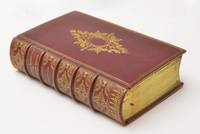
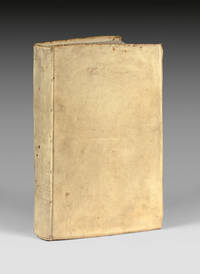
15811251Paris: chez Michel Sonnius demeurant à l’Escu de Basle ruë Sainct Iaques 1581. Bound in red maroquin the panels ruled and decorated with a large gilt floral design in the center their fore and inner edges are gilt. Spine with five raised bands gilt decoration and title. Marbled pastedown. All edges gilt. Printed bookplate of P. F. Arminjon on front end pastedown. Ten leaves slightly over trimmed that has a minor effect on the initial or final letters of the printed marginal notes but no effect on their legibility. Overall a very well preserved and beautiful copy of this scarce volume. Bound in red maroquin the panels ruled and decorated with a large gilt floral design in the center their fore and inner edges are gilt. Spine with five raised bands gilt decoration and title. Marbled pastedown. All edges gilt. 2 ff. 469 ie 496 pp. 30 ff. <p><br /> Extremely scarce second revised edition. Just as rare as the first 1569 of Montaigne's first book the French translation of Theologia Naturalis the important source of natural theology written by Raymond Sebond the 15th-century Catalan theologian.<br /> <p><p><br /> Sebond’s text was composed around 1435 in Latin and it was first published in 1487. It declares that not merely the Bible but also Nature is a Divine revelation and holding a position against the scholastic antithesis the concept that reason and faith philosophy and theology are antithetical and irreconcilable.<br /> <p><p> <br /> Montaigne made his translation of Sebon’s text on his father’s request however his personal interest in the book and his affiliation to its content is conspicuous not only through this corrected and revised second edition but also the corresponding ideas exposed in his 1580 Essais and particularly by the Essais' long and most recognised chapter “L'Apologie de Raymond Sebond†Book II chapter XII. an eloquent expression of Christian scepticism wherein Montaigne poses the famous question “What do I know†Que sçay-je / Que sais-je which is the intrinsic motif of the entire work and also served as Montaigne personal motto.<br /> <p><p><br /> Albeit this edition is sometimes referred as a reprint of the editio princeps Alain Brieux a Parisian bookseller reported in 1958 the discovery of Montaigne’s own copy with 229 inserted corrections in Montaigne’s hand which were incorporated into this 1581 edition. <br /> <p><p><br /> Ref.: USTC 1693; FB 47582; Adams no. S 40 Gourbin imprint<br /> <p><p><br /> Bibl.: Brieux Alain: Autres Souvenirs de Montaigne. In: Bibliothèque d'Humanisme et Renaissance Vol. 20. Geneva: E. Droz 1958. pp. 370–376.; Brush Craig B.: The Apologie de Raimond Sebond. In: Montaigne and Bayle: Variations on the Theme of Skepticism. The Hague: Martinus Nijhoff 1966. pp. 62–120. Desan Philippe: Montaigne. A Life. Princeton: Princeton University Press 2017. 285–299.; Ramachandran Ayesha: The Worldmakers. Global Imagining in Early Modern Europe. Chicago: The University of Chicago Press 2016. pp. 86–94.<br /> <p>. chez Michel Sonnius, demeurant à l’Escu de Basle, ruë Sainct Iaques unknown
159055265Ferrara Benedetto Mamarello 1590. Small 8vo. Later half vellum with gilt title-label to spine. Marbbled paper over boards. A faint damp stain to the last few leaves otherwise a nice and clean copy. Old ownership-signature to last leaf. Bookplate to inside of front board. Large woodcut device to title-page. Woodcut initials and headpieces at beginning. 8 170 5 pp. <br/><br/><em>The very scarce first edition of the first translation into any language of any part of Montaigne's Essays namely Naselli's monumental first Italian translation which came to pave the way for later translations of the work among them Florio's first English from 1603. Montaigne's magnum opus was published in 1580 and in 1588 the final edition appeared constituting the definitive text of the work and that on which all later editions were based. With his seminal work Montaigne not only created a novel genre of writing he also founded modern scepticism and the revival of ancient scepticism and he paved the way for the modern philosophy and thought presented by Bacon Decartes and Newton. "Unlike anti-intellectuals like Erasmus Montaigne developed his doubts through reasoning. Unlike his skeptical predecessors who presented mainly a series of reports on the variety of human opinions Montaigne worked out his complete Pyrrhonism through a sequence of levels of doubt culminating in some crucial philosophical difficulties. The occurrence of Montaigne's revitalization of the Pyrrhonism of Sextus Empiricus coming at a time when the intellectual world of the 16th century was collapsing made the "nouveau Pyrrhonisme" of Montaigne not the blind alley that historians like Copleston and Weber have portrayed but one of the crucial forces in the formation of modern thought. It was also to be the womb of modern thought in that it led to the attempt either to refute the new Pyrrhonism or to find a way of living with it." Popkin vol. II 1960 pp. 54-55. There are many important aspects of Montaigne's groundbreaking work which has been subject of an uncountable number of scholars throughout centuries. But one aspect which seems to have been forgotten in recent times is one that is emphasized by Naselli's extremely important first ever translation of the work. As the Italian title will reveal the work was also widely viewed - and intended - as a political council book. Naselli bases his translation on Montaigne's own final edition from 1588 and publishes it merely two years later including 42 of 94 chapters of the first two books. His translation is the one closest in time to the original appearance of the work and is the only one published in Montaigne's own life-time. It is thus in a unique position to tell us about contemporary views on the work and its use. "One enormously important prose genre upon which Montaigne draws most heavily consists of political advice books for courtiers and princes that proliferated in great number and with great social and political impact in the late Renaissance. Montaigne's appropriation of the political counsel genre has gone largely unnoticed by contemporary scholars and bringing it into focus has significant implications for our understanding of the "Essais". bringing it to the foreground allows us to challenge more robustly the common conclusion that Montaigne's unique project "is not a political work."Many in the first generation of Montaigne's reception appear to have seen the "Essais" principally as a contribution to the political contribution to the political counsel literature. For example Girolamo Naselli's 1590 Italian translation of the "Essais is titled "Discorsi morali politici e military" while John Florio follows Naselli's lead in the title of his 1603 English translation "The Essayes or Morall politike and militaire discourses". And when Francis Bacon enthusiastically adopts Montaigne's novel "Essai"-form for his own ends he does so as a useful means of giving "Councels Civill and Morall" not simply musings personal and poetic." Thompson Montaigne and the Tolerance of Politics p. 21. As is mentioned on the title-page this first translation also contains another long "questione". "In this deliberative discourse very different in kind from anything a modern reader would associate with "Essais" and apparently composed soon after the winter 1576-7 Estates General of Blois the author argues methodically and resolutely against those at the assembly who in a public "ragionamento" demonstrated the employment of foreigners in a republic to be universally undesirable and who nearly succeeded in having this position passed into law." Boutcher: The Scool of Montaigne in Early Modern Europe vol. 2 p. 136. </em> hardcover
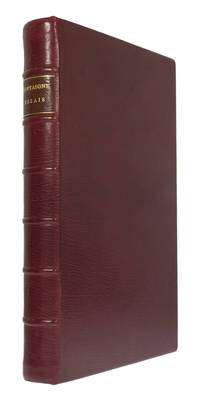
159566552The Definitive Edition and First Folio Edition MONTAIGNE Michel de. Les Essais.Edition nouvelle trouvee apres le deceds de l'Autheur reveue & augmentee par luy d'un tiers plus qu'aux precedentes Impressions. Paris: chez Michel Sonnius 1595. The Definitive edition and the first folio edition. Folio. 24 523 1 blank 231 1 errata pp. Modern maroon morocco. Morocco spine label raised bands old gilt edges. Contents skillfully washed and sized a few marginal tears not affecting text some scattered pencil marginalia. A very good copy. This edition edited by the French bluestocking Marie de Jars Demoiselle de Gournay 1566-1645 has some claim to be the definitive edition of Montaigne's Essais. Mlle de Gournay who as a very young girl had travelled to Paris to meet her intellectual hero was Montaigne's adopted daughter. After Montaigne's death his widow presented Mlle de Gournay with the philosopher's copiously annotated copy of the 1588 edition of his Essais the last issued during his lifetime and the first to include the third book. Having inserted Montaigne's additions marked the alterations and translated all the quotations Mlle de Gournay sent the proofs to Bordeaux where the poet Pierre de Brach collated them against another copy with Montaigne's annotations deposited in the convent of the Feuillants in Bordeaux. "The edition thus produced in 1595 has with justice passed as the standard even in preference to those which appeared in the author's lifetime" Ency. Brit. Copies were also issued with the imprint of Abel l'Angelier. STC French Books p. 317; Adams M-1622 both l'Angelier imprint; Graesse IV 579 "aujourd'hui la principale edition de Montaigne pour l'authenticite du texte". HBS 66552. $25000 Chez Michel Sonnius hardcover books
159566552Paris: Chez Michel Sonnius 1595. Paris: chez Michel Sonnius 1595.<br> <br> The Definitive edition and the first folio edition. Folio. 24 523 1 blank 231 1 errata pp.<br> <br> Modern maroon morocco. Morocco spine label raised bands old gilt edges. Contents skillfully washed and sized a few marginal tears not affecting text some scattered pencil marginalia. A very good copy.<br> <br> This edition edited by the French bluestocking Marie de Jars Demoiselle de Gournay 1566-1645 has some claim to be the definitive edition of Montaigne's Essais. Mlle de Gournay who as a very young girl had travelled to Paris to meet her intellectual hero was Montaigne's adopted daughter. After Montaigne's death his widow presented Mlle de Gournay with the philosopher's copiously annotated copy of the 1588 edition of his Essais the last issued during his lifetime and the first to include the third book. Having inserted Montaigne's additions marked the alterations and translated all the quotations Mlle de Gournay sent the proofs to Bordeaux where the poet Pierre de Brach collated them against another copy with Montaigne's annotations deposited in the convent of the Feuillants in Bordeaux. "The edition thus produced in 1595 has with justice passed as the standard even in preference to those which appeared in the author's lifetime" Ency. Brit. Copies were also issued with the imprint of Abel l'Angelier.<br> <br> STC French Books p. 317; Adams M-1622 both l'Angelier imprint; Graesse IV 579 "aujourd'hui la principale edition de Montaigne pour l'authenticite du texte".<br> <br> HBS 66552.<br> <br> $25000. Chez Michel Sonnius unknown
7248Paris, Jean Camusat, 1635. In-folio (368 x 236 mm), 20 ff. n. ch., 871 pp., 1 p. n. ch., 11 ff. n. ch. Maroquin noir, dos à nerfs orné à la grotesque au pointillé, titre et tranches dorés, feuillet de titre réenmargé, fines restaurations, étui moderne (reliure de l'époque).
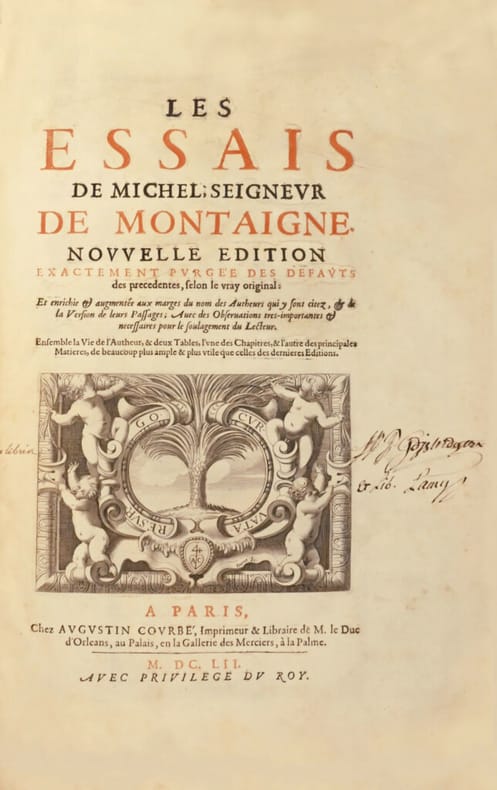
LCS-186411Année 1652. Paris, chez Augustin Courbé, 1652. In-folio de (16) ff. y compris un frontispice, 834 pp. (mal ch. 840), (21) ff., pt. manque de papier au coin de la p. 523 sans atteinte au texte. Plein veau moucheté de l’époque orné à la Du Seuil, dos richement orné, tranches marbrées. Reliure de l’époque. 383 x 260 mm.
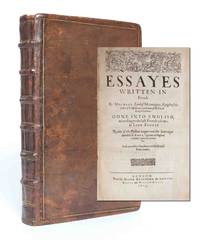
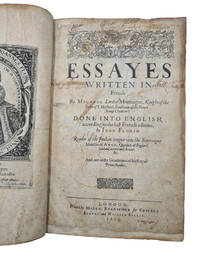
16131790London: Melch. Bradwood for Edward Blount and William Barret 1613. Second edition. Second edition of Florio's great translation which was first published in 1603. Small folio 11 3/8 x 7 1/4 inches; 290 x 185 mm collating: 12 630 2 blank pp. With engraved portrait of Florio on leaf A6v which was not included in the first English edition. With historiated initials and engraved head-and-tail pieces. The second and third books have separate dated title pages but pagination is continuous. This second edition replaces the original dedications of the three books to various Court ladies with a dedication and a new sonnet in Italian to the Queen Anne of Denmark who had appointed Florio as her reader in Italian and private secretary. Also for the first time in this edition is the anonymous sonnet Concerning the Honor of Bookes which was once attributed to Shakespeare but is more probably by Samuel Daniel. <br/><br/>Full contemporary polished calf. Boards and spine ruled in gilt. Board edges tooled in gilt. All edges speckled red. Remnants of green silk ties. Outer hinges professionally repaired. No front or rear pastedowns. Previous owner's bookplates. Contemporary ink notes on front free endpaper. Some minor toning to title-page and some occasional light dampstaining. Small hole to leaf Xx3 and light scrape to Ddd3 both with minor loss of text. Overall a very good copy. <br/><br/>This is considered the most important Elizabethan translation of any contemporary text. Its influence on English writers and philosophers of the time including Shakespeare Bacon Milton Hobbes and Locke can hardly be overestimated. "Montaigne startles the common reader at each fresh encounter if only because he is unlike any preconception we bring him. He can be interpreted as skeptic humanist Catholic Stoic even Epicurean" Bloom The Western Canon 147-151 <br/><br/>"Montaigne devised the essay form in which to express his personal convictions and private meditations a form in which he can hardly be said to have been anticipated.He finds a place in the present canon however chiefly for his consummate representation of the enlightened scepticism of the sixteenth century to which Bacon Descartes and Newton were to provide the answers in the next" Printing and the Mind of Man 95.<br/><br/> "The unfolding of a mind of genius in dialogue with itself and with the world a Renaissance humanist speaking to all humanity" Hollier A New History of French Literature 250. <br/><br/>Grolier Langland to Wither 102. Pforzheimer 378 Florio 1st edition. STC 18042. ESTC S111840. Melch. Bradwood for Edward Blount and William Barret unknown books
1774YQV-35In-4 (285 × 213 mm) de 1 portrait et [8]-liv-416 pp. ; veau fauve glacé, dos à nerfs, compartiments ornés de fleurons et fers d’angle, pièces d’armes dans les angles des plats (macle et chabot alternés), roulette intérieure, deux filets sur les coupes, tranches rouges (reliure de l’époque).
16135000740London: Melch. Bradwood for Edward Blount and William Barret 1613. Edges of the title-page ragged and 1/4 inch of lower margin made good with blank paper the following three leaves with some marginal wear well clear of text; portrait leaf normally at end of prelims placed here as frontispiece and slightly worn at outer margin; spine of the binding rubbed but good. Folio xii 630 pp. A-3I6 3K3 missing final blank leaf 3K4; leaf A6 pp.7/8 with portrait on verso bound as frontispiece; three parts published as one volume individual title-pages with woodcut decorations to second and third parts; old half calf and marbled boards. <p><p>Second edition in English of Montaigne's masterpiece in the important translation by John Florio one of the great prose works of the Elizabethan period used by Shakespeare as a source for several late works most importantly The Tempest. First published in French in 1580 Montaigne's Essays first appeared in English in Florio's translation in 1603. William Hole's portrait bound as frontispiece here celebrates the translator rather than the author of the Essays showing Florio as a handsome neatly bearded courtier.</p> <p>"Montaigne devised the essay form in which to express his personal convictions and private meditations a form in which he can hardly be said to have been anticipated. He finds a place in the present canon however chiefly for his consummate representation of the enlightened skepticism of the 16th century to which Bacon Descartes and Newton were to provide the answers in the next" Printing and the Mind of Man. </p> <p>The second edition contains the preliminary sonnet "Concerning the honor of bookes" which was at one time attributed to Shakespeare though is more likely to have been by Samuel Daniel who signs the poem before it in honour of Florio "Sam. Daniel". Oddly early ink annotations on this page claim "There are Six manuscripts and two Old Copys have it Sappy instead of Sam; which makes a great alteration in the Text" and "Sappy Daniel One of the greatest Poets in those Days: he writes in the Pindarick Stile: he read Homer in 5 days & translated Horace into Verse in 15 and became perfect Master of all ye Greek & Latin Classicks in 25. A Beautiful Progress".</p> </p> . Provenance: Early signatures on the title-page of Betty Gregson Yorkshire -1763 married Henry Chaytor in 1760 and Matthew Chaytor; later there seems to have been a family connection Sir Henry Heathcote Admiral 1777-1851 with his armorial bookplate as baronet. Melch. Bradwood for Edward Blount and William Barret unknown
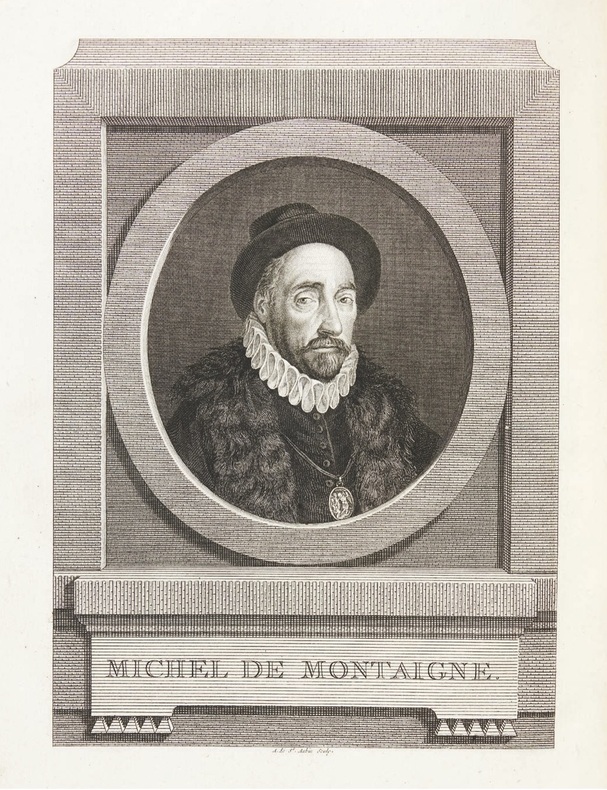
ABAA25-17<p>Paris chez Simon Piget 1652.</p><p>Folio of 16 ll. including a frontispiece 834 pp. incorrectly numbered 840 21 ll pte. waterstain in the lower corner of the last ll. Full overlapping vellum flat spine. <em>Contemporary binding</em>.</p><p>358 x 225 mm.</p><p><em>"Good edition made on the edition of 1635; the translations are placed there for the first time opposite the text.</em></p><p><em>It was shared between Augustin Courbé Pierre Rocolet Et. </em><em>Loyson Edme Couterot Pierre Le Petit Th. </em><em>Jolly Sébastien Huré etc."</em> Tchermerzine IV 902.</p><p>This is the third folio edition.</p><p>It includes the "<em>Epistre de Mademoiselle de Gournay</em>" and its preface.</p><p>"<em>Although many liberties have been taken with it the text is essentially that of the last edition of Mademoiselle de Gournay published in 1635 which reappears . for the first time</em>". In <em>Les Essais de Montaigne</em> Exposition Bibliothèque Municipale de Bordeaux 1980-1981.</p><p>It is illustrated with the famous portrait-frontispiece of Montaigne engraved in intaglio.</p><p>An attractive copy preserved in its contemporary overlapping vellum binding.</p><p><strong>FR</strong></p><p>Paris chez Simon Piget 1652.</p><p>In-folio de 16 ff. y compris un frontispice 834 pp. mal ch. 840 21 ff. Plein vélin à recouvrement de l'époque dos lisse. <em>Reliure de l'époque.</em></p><p>358 x 225 mm.</p><p>" <em>Bonne édition faite sur l'édition de 1635 ; les traductions y sont placées pour la première fois en regard du texte.</em></p><p><em>Elle a été partagée entre Augustin Courbé Pierre Rocolet Et. Loyson Edme Couterot Pierre Le Petit Th. Jolly Sébastien Huré etc.</em> " Tchermerzine IV 902.</p><p>Il s'agit de la troisième édition in-folio.</p><p>Elle comprend bien l'"<em>Epistre de Mademoiselle de Gournay</em>" et sa préface.</p><p>" <em>Quoiqu'on ait pris beaucoup de libertés avec lui le texte est pour l'essentiel celui de la dernière édition de Mademoiselle de Gournay publiée en 1635 qui reparaît . pour la première fois</em>. " In <em>Les Essais de Montaigne</em> Exposition Bibliothèque Municipale de Bordeaux 1980-1981.</p><p>Elle est ornée du célèbre portrait-frontispice de Montaigne gravé en taille-douce.</p><p><strong>Séduisant exemplaire conservé dans son vélin à recouvrement de l'époque.</strong></p> hardcover
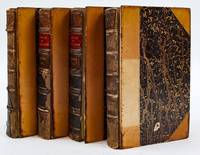
1409062Paris: G. Charpentier n.p. Early Printing. Hardcover. Octavo four volumes. In Good minus condition. Half-bound in brown leather with marbled paper boards. Volumes 1 and 4 have a significant loss of leather to spine and are lacking the raised bands and labels. Volumes 2 and 3 have paneled spines with chipping to leather but maroon and brown labels are intact with gilt titling and ornamentation. Boards have soiling and chipping to edges. Volume 1 has discoloration to leather and rubbing wear along the front board. Volume 1 and 4 boards are detached from the textblock. Volume 2 has a detached front board and loose rear board. Volume 3 front board is loose and rear board is detached. Textblock has age toning and foxing throughout and stains to some pages throughout. Volume 1 is signed by Henry James 1843-1916 on the front free end page. Text in French. Pieces of the spines and a label preserved in an envelope. Shelved in Room A. <br /> <br> <br /> <br> <br /> CONTENTS: VOL I: 4 xlii 2 441 pages-- VOL II: 4 552 pages-- VOL III: 4 518 pages-- VOL IV: 4 506 pages. Michel de Montaigne 1533-1592 was a Renaissance era French philosopher. His "Essais" originally published in 1580 popularized essay as a literary genre in France and England influencing both thought and style.<br /> <br> <br /> Henry James 1843-1916 was an American-British author. James best known for his novels helped mark the transition between literary realism and literary modernism. He also authored essays criticism memoirs and plays. While James seldom explicitly referenced Montaigne it is known that the 1877 edition of Montaigne's Essais translated by Charles Cotton and edited by William Carew Hazlitt was in James' library at Lamb House. As James' was fluent in french it is unsurprising that he possessed the Essais in both english translation and the original french. Moreover James shared with Montaigne a similar 'conservative skepticism' about one's relationship to the world truth and self - a common commitment which informs the structure and subjects of Montaigne's essays as well as the rich recursive textures of James' later prose style. As Mrs. Prest says in The Aspern Papers echoing Montaigne's famous question Que sais-Je "The truth is God's it isn't man's; we had better leave it alone. Who can judge it-who can say". 1409062. Special Collections - Upstairs. G. Charpentier hardcover
1613032513London : Printed by Melch. Bradwood for Edward Blount and Wliiam Barret 1613. Book. Very Good. Full Leather. 2nd Edition. 4to - over 9¾ - 12" tall. Second Edition in English. Full Leather. Quarto in 6's signatures A1 to Kkk3v 10 1/2 x 7 1/2 inches; 27 cm x 19 cm. Engraved frontis portrait of John Florio William Hole engraver. Pp. x 630 the second R1 and third books Rr5 have separate title pages: "The Essayes or Moral Politike and Militarie Discourses of Lo. Michael de Montaigne Knight of the noble Order of St. Michael and one of the Gentlemen in Ordinarie of the French King Henry the Third his Chamber. The Second Booke. 1613. The Third Booke. 1613" continuous pagination and register. Title pages have head-piece and decoration. Woodcut head and tail-pieces and initials; includes bibliographical references in Printed side-notes. Contemporary full calf 5 raised bands gilt stamped maroon spine label. Rebacked and re-cornered most likely a couple of hundred years ago. Covers rubbed and scuffed frontis portrait laminated to wide-margined stub; contemporary ink note to title page and signed "John Legard/Aug 79" possibly one of the Legard Baronets. Title page dust soiled and mildly browned paper repair to A5 done sometime ago margins appear trimmed but without loss; toning to pages with infrequent smudge or stain. Otherwise a good copy. Florio is one the individuals proposed as the real author of Shakespeare's works. His translation of the Essays was first published in 1603. Printed by Melch. Bradwood for Edward Blount and Wliiam Barret Hardcover
1613LLV2626London:: Printed by Melch. Bradwood for Edward Blount and William Barret 1613. 1613. Folio. 7 ¼ x 11 inches. x 630 pp. Frontispiece engraved portrait of Florio by William Hole bound facing the first text leaf containing general title page Main title with headpiece and vignette separate title-pages for the second and third books elaborate ornamental woodcut-engraved initials headpieces throughout occasional mispagination; title edges browned portrait the repaired tear strengthened with later backing. Antique-style full brown calf blind- and gilt-stamped sprinkled calf raised bands maroon label. Small manuscript notation at foot of title. Very good copy. Second edition in English of Montaigne’s seminal masterpiece with the key Elizabethan translation of John Florio used by Shakespeare as a source for The Tempest circa 1611 a splendid folio volume in contemporary calf boards. "Montaigne devised the essay form in which to express his personal convictions and private meditations a form in which he can hardly be said to have been anticipated. He finds a place in the present canon however chiefly for his consummate representation of the enlightened skepticism of the 16th century to which Bacon Descartes and Newton were to provide the answers in the next" - Printing and the Mind of Man 95. "Walt Whitman and Norman Mailer are indirect descendants of Montaigne even as Emerson and Nietzsche are his direct progeny" - Bloom Western Canon pp.147–151. "It is generally accepted that Shakespeare used Florio’s translation when writing the passage on the natural commonwealth in his Tempest" - Pforzheimer 378. Initially published in French in 1580 Montaigne’s Essayes were first published in English in 1603 with this translation. REFERENCES: STC 18042. Lowndes 1588. ESTC S111840. Printed by Melch. Bradwood for Edward Blount and William Barret, 1613. hardcover books
9470Paris, Abel l'Angelier, 1604. In-12 (173 x 100 mm), 36 ff. n. ch., 1031 pp., 1 p. n. ch. Maroquin rouge bordeaux, triple filet à froid encadrant les plats, dos à nerfs, filets d'encadrement à froid en caisson, roulette dorée sur les nerfs, titre, auteur, lieu, éditeur et date dorés, double filet doré sur les coupes, dentelle sur les chasses, tranches dorées sur marbrure, manque de papier en pied dans la marge p. 597 (Trautz-Bauzonnet).
15726Paris, Lefèvre, 1818.
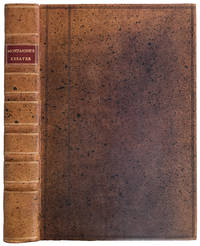
163238184London: Printed by M. Flesher for Rich: Royston in Ivie-lane next the exchequer Office London 1632. Hardcover. Very Good. Hardcover. This is the third edition of Montaigne's influential and famous essays and on the title page it says that whereunto this edition is now more newly added an index of the principal matters and personages mentioned in the book. The celebrated architectural illustration that is engraved on the title page is by Martin Droeshout responsible for the iconic portrait of Shakespeare in the First Folio also appeared in this edition for the first time Montaigne is credited with pioneering the modern essay form. His Essays are a collection of personal reflections exploring a wide range of topics from human nature to philosophy literature and personal experiences. Published in three books they were written and revised over several decades with the first edition appearing in 1580. The remarkable modernity of thought apparent in Montaigne's essays coupled with their sustained popularity made them arguably the most prominent work in French philosophy until the Enlightenment. Their influence over French education and culture is still strong. Wikipedia They were originally written in Middle French and published in the Kingdom of France. Montaigne's stated design in writing publishing and revising the Essays over the period from approximately 1570 to 1592 was to record "some traits of my character and of my humours." Montaigne's Essays went through several stages of publication evolving from a two-book work in 1580 to a final posthumous edition in 1595. The first English translation of Montaigne's Essays was published in 1603 by John Florio. This translation titled The Essayes or Morall politike and millitarie discourses was a significant event in English literature introducing the French philosopher's work to an English-speaking audience. <br /> <br /> Bound in full brown leather; the spine has raised bands with titling and ornaments in gilt. There are small chips on the right side of each band. A small piece of leather at the bottom of spine edge is torn away and their is a slight crack to the top of spine along the front cover. The covers have some bumping and rubbing and a few small spots. It appears that the formal endpapers are missing and there is just rough paper covering the inside covers. It is torn and revels glue remnants <br /> <br /> The front inside cover has a bookplate with a coronet and the Latin motto "Vernon Semper Viret" meaning in English "Vernon Always Flourishes". This appears to belong to George John Warren Venables-Vernon 5th Baron Vernon 1803-1866 who was a British politician and member of parliament. He was also a devotee of Dante and The Inferno.<br /> <br /> The text pages have bright white margins but the printed text sections are somewhat browned. There small brown spots along the margins of pages 55-60 with one having become a hole. There are three books of essays with the second and third books having title pages dated 1631. The first book: pages 1 - 177; the second book: pages 183-440; the third book: pages 443-631. It is followed by the "Index or Table of subjects that is unpaginated. Despite the noted condition issue this is still a very good copy of this important book. LIT/073125. Printed by M. Flesher, for Rich: Royston, in Ivie-lane next the exchequer Office, London hardcover
1652D8765Paris: Chez Augustin Courbé Estienne 1652. Hardcover. Very Good. Large folio 390 x 265mm. 840pp. Copper plate engraved printer’s device of Courbé a single palm tree surrounded by putti some trumpeting in frame with motto in allusion to his name Curvata Resurgo curved I straighten up signed by Daret. Title printed in red and black. Full-page copper engraved half title with author portrait of Michel de Montaigne the same as the 1635 edition. Near contemporary calf the spine tooled and lettered in gilt with raised bands; worming and small dampstain to margin of last 100 pages not affecting text other spotting and small stains binding slightly rubbed with losses to spine tips otherwise internally bright with clean wide margins. <br/><br/>Large Paris folio edition of Montaigne’s moralist and political ‘Essais.’ This 1652 edition contains beside the Essays the long preface and dedication of de Gournay the preface of Montaigne a summary of his life references to the authors in the margin and translations of the passages quoted. These citations often very lengthy make the Essays not only one of the great philosophical investigations in the Western tradition but a storehouse of the most beautiful and profound passages of classical literature. His citations from classical authors including Lucretius are especially remarkable. The whole is preceded by a notice of Estienne in which he details the improvements he has made in this edition most notably by placing the translations opposite the text – the first time this arrangement was introduced. Estienne also allowed Courbé the privilege to use his name and device on the title for this edition only although the work was printed on Estienne’s press. This same year Cousterout prints the work but uses the Estienne device. “I do not teach I tell” – Montaigne Montaigne’s Essays are central to the development of the early modern consciousness of the self; his skepticism and proto-empiricism were highly influential upon early modern scientific enquiry especially upon the works of Bacon. In the Essays Montaigne transcends his skepticism and transforms his stoicism to offer a positive and urgent message to his contemporaries. This message constitutes a new ethics one of goodness fellowship and trust all countering the model of heroic virtue which dominated his culture and his class by honor-bound aristocrats and religious zealots alike. Directed principally to the nobility of a nation torn apart by civil and religious conflict which forms the backdrop of the Essays Montaigne’s message shuns violence and urges for a new civilizing process. His moral argument depicts extreme humanist aspirations toward radical and divisive individualism in the name of a shared humanity. Canonical work in large format attractive and good with Courbé’s device found less often. Chez Augustin Courbé [Estienne] hardcover books
18669Paris, Charles Sevestre, 1608.
22713Volume in-8° (174x108 mm), reliure moderne en velin ivoire à recouvrements, faux nerfs triple filet doré, fleurons et titres dorés en caractères majuscules, roulette d'encadrement des plats, fleur de lys au centre. [8 ff.] y compris titre par Edme Charpy et portrait gravé par Thomas de Leu, 1130 (i.e. 1088, la dernière blanche) pp., [18] ff. de Table et Privilège. (Coll : ã8, a-z Aa-Zz, AAa-YYy8, AAaa-BBbb8, CCcc2). Ex-libris manuscrit "J La Court 1689".
1652D8765Paris: Chez Augustin Courbé Estienne 1652. Hardcover. Very Good. Large folio 390 x 265mm. 840pp. Copper plate engraved printers device of Courbé a single palm tree surrounded by putti some trumpeting in frame with motto in allusion to his name Curvata Resurgo curved I straighten up signed by Daret. Title printed in red and black. Full-page copper engraved half title with author portrait of Michel de Montaigne the same as the 1635 edition. Near contemporary calf the spine tooled and lettered in gilt with raised bands; worming and small dampstain to margin of last 100 pages not affecting text other spotting and small stains binding slightly rubbed with losses to spine tips otherwise internally bright with clean wide margins. <br/><br/>Large Paris folio edition of Montaignes moralist and political Essais. This 1652 edition contains beside the Essays the long preface and dedication of de Gournay the preface of Montaigne a summary of his life references to the authors in the margin and translations of the passages quoted. These citations often very lengthy make the Essays not only one of the great philosophical investigations in the Western tradition but a storehouse of the most beautiful and profound passages of classical literature. His citations from classical authors including Lucretius are especially remarkable. The whole is preceded by a notice of Estienne in which he details the improvements he has made in this edition most notably by placing the translations opposite the text the first time this arrangement was introduced. Estienne also allowed Courbé the privilege to use his name and device on the title for this edition only although the work was printed on Estiennes press. This same year Cousterout prints the work but uses the Estienne device. I do not teach I tell Montaigne Montaignes Essays are central to the development of the early modern consciousness of the self; his skepticism and proto-empiricism were highly influential upon early modern scientific enquiry especially upon the works of Bacon. In the Essays Montaigne transcends his skepticism and transforms his stoicism to offer a positive and urgent message to his contemporaries. This message constitutes a new ethics one of goodness fellowship and trust all countering the model of heroic virtue which dominated his culture and his class by honor-bound aristocrats and religious zealots alike. Directed principally to the nobility of a nation torn apart by civil and religious conflict which forms the backdrop of the Essays Montaignes message shuns violence and urges for a new civilizing process. His moral argument depicts extreme humanist aspirations toward radical and divisive individualism in the name of a shared humanity. Canonical work in large format attractive and good with Courbés device found less often. Chez Augustin Courbé [Estienne] hardcover
1544new1<p><strong>NOTA : The last 2 photos are not from our book but from Montaigne's copy with the identical medallion for comparison </strong></p><p><strong> A MEDALLION SIMILAR TO ONE FOUND ON A BIBLE OWNED BY MONTAIGNE </strong></p><p><strong> BINDING FROM THE REIGN OF FRANCIS I OF FRANCE</strong></p><p><strong>HESIOD</strong></p><p><strong><em>Opera quæ quidem extant omnia Græcè cum interpretatione Latina .</em></strong></p><p><strong>Basel J. Oporin 1544.</strong></p><p>8vo 4 ff. 373 p. 1 p. 16 ff. Contemporary brown calf double cold-stamped fillet frame fleur-de-lis at the corners cold-stamped and gilt medallion bearing the effigy of Dido in the center of the covers surrounded by a diamond-shaped garland ribbed spine decorated with lilies gilt edges. Restoration upper cap trimmed defects on the spine corners dull small angular damp stain affecting the last 20 ff. printer's name and date added in ink at the bottom of the title page by an amateur. Dimensions: 16.7 x 10.1 cm.</p><p>References: USTC 662387. VD 16 H 2681.</p><p><strong>Provenance:</strong></p><p><strong>1. Pierre de Lavergne Lord of Guilleragues mid-16th century: handwritten note of ownership inscribed on the first </strong>flyleaf: "Advisor to the King and President of Inquiries at the Court of Parliament in Bordeaux Lord of Les Plantis De Guilleragues."</p><p>2. Jean de Lapine early 18th century handwritten bookplate.</p><p><strong>Languages of the annotation: Greek and Latin.</strong></p><p><strong>A beautiful edition of the works of Hesiod bringing together Works and Days and The Shield of Heracles - now removed from Hesiod corpus </strong>- and the Theogony with a Latin translation opposite the Greek text. The publisher was keen to include Niccolò Valla's elegant translation of Works and Days into Latin verse and a Latin translation-adaptation of the Theogony by Pylades Brixianus.</p><p><strong>Copy belonging to Pierre de Lavergne died in 1554 a powerful figure in Bordeaux and member of the Bordeaux </strong>Parliament; he was a contemporary of Montaigne's father. Lord of Guilleragues and former regent at the University of Angers he was also lieutenant general of Bazadais before becoming a lay advisor to the Bordeaux Parliament and then president of the Chamber of Inquiries. He is an ancestor of Gabriel de Guilleragues 1628-1685 diplomat and writer author of the mysterious Lettres portugaises see Gabriel-Joseph Lavergne-Guilleragues Lettres portugaises ed. F. Deloffre and J. Rougeot Droz 1972.</p><p><strong>A copy bearing 70 notes in Greek and Latin. </strong>In the 16th century Hesiod was one of the classics used in colleges to teach Greek. See J.-E. Girot Pindare avant Ronsard from the emergence of Greek to the publication of the 'First Four Books of the Odes' Geneva Droz 2002. Here Les Travaux and Les jours have been extensively annotated up to page 20. Approximately 70 notes in Greek and Latin have been added in the margins. In line 45 p. 7 the term eiarinos "herald of spring" is accurately glossed with its etymology and dialectal variant: eiarinos vernus ab eiar ros to. Ver pro earinos. This verse celebrates the Hours with beautiful hair who bring spring: they are depicted for example in Botticelli's Birth of Venus. The last ode of Pindar's Olympic Odes is also referenced. On p. 9 to illustrate the image of old age destroying beauty he quotes two lines from Ovid's Tristia III 7 in the margin: Senectutem tacito passu irrepere ait Ovid. Injicietque manum formae damnosa senectus. Quae strepitum passu non faciens venit. 3° de Trist. El. 7 Let us highlight on p. 20 a verse that reads like a maxim: "Bad advice is a great evil for those who take advice" with reference to Book IV of Aulus Gellius' Attic Nights "Gellii liber 4 capitulo 5" which indeed quotes this verse from Hesiod in a chapter on the perfidy of haruspices. Sometimes some of his etymologies seem risky: the annotator seems to think that phos light comes from a Greek verb close to the Latin verb fari "to say": phos photos o tou a phô quod est dico . p. 15.</p><p><strong>A binding reminiscent of François I but also of Montaigne :</strong></p><p>The copy is bound in a medallion binding featuring the image of Dido a popular ornament in bindings from the 1530s and 1540s. Miriam Foot Henry Davies Gift III no. 29 and Howard Nixon Sixteenth c. Gold-tooled bookbindings in the Pierpont Morgan Library no. 9 list examples of this type of binding.</p><p><strong>Our "Didon" medallion is identical or nearly so to the one appearing on each of the plates of a Greek Bible from </strong><strong>Basel 1545 bound in brown calfskin that belonged to Montaigne Bordeaux BM G.F. 277. </strong>This medallion was reproduced in Trésors de la bibliothèque de Bordeaux. Abécédaire Le festin 2017 p. 66. note by Alain Legros. This work is one of the books that belonged to La Boétie and was bequeathed to Montaigne. It should be noted that La Boétie was from 1554 a member of the Parliament of Bordeaux like Lavergne before him; the poet married the daughter of the president of the Parliament that same year.</p><p>This medallion depicting Dido adorning a period binding from the reign of Francis I also refers to the myth of Dido and Aeneas which was so beloved by the victor of Marignan. François I had indeed "evoked the myth of the Trojan origin of the French monarch and his nation" comparing himself to Aeneas. This parallel appears notably in a letter addressed to his sister Marguerite. See Jean-Max Colard "Le courage. 'La veine royale' de François Ier poète" in Devenir roi. Essais sur la littérature adressée au Prince edited by Isabelle Cogitore and Francis Goyet Grenoble: Ellug 2001 pp. 119-146. Our binding can also be compared to another this time preserved at the BNF which adorns a copy of Bartholomaeus Westheimer Phrases seu modi loquendi divinæ scripturæ Paris Jean Ruelle 1544 in-8 Rare Books Reserve RÉS-P-X-446 whose first medallion "offers a schematic profile" of Francis I associated on the second plate with a medallion featuring a fanciful profile of Dido.</p><p><strong>Remarkable copy whose binding and provenance echo Montaigne</strong></p> Oporin