1 380 résultats
198309Paris, Champion, s.d. (1904) in-8, 26 pp., broché.
487914P., Librairie Hachette, 1905. In-16 rel. demi-toile postérieure, dos lisse, pièce de titre basane noire, titre et filets dorés, couv. sup. conservée, XXVIII-342-12 pp. (catalogue).
199426657Ethnies 16-17, 1994, in-8°, 315 pp, avec la collaboration de Martine Dauzier, Mario Humberto Ruz, cartes, glossaire, biblio, broché, couv. illustrée
553716P., Fischbacher, 1902. In-8, broché, IX-401 pp., table analytique. Mention de 3e mille.
553715P., L.R. Delay, succ. de Risler, 1844. In-8, rel. de l’époque demi-veau vert, dos lisse orné, [2]ff.-423 pp.
1857AUB-8984Librairie de Ch. Meyrueis 1857 (2e éd.). Bon exemplaire relié, in-8, II avec 468 pages + table.
55203Le livre de poche 2002, format poche n° 15215 - très bon état
81992Denoël 1978, cartonnage éditeur, 80pp avec des photographies de Joël Jaffre et Jean-Marc Durou - très bon état
72501Actes Sud, éditeur 1997, broché, 1424pp; collection Thesaurus - très bon état
49988Editions Seghers-L'Inter 11 mars 1960, broché, couverture illustrée, 252pp avec des photographies hors texte extraites du film de Jean Dreville - très bon état
54205Seuil 1971, broché, 214pp - bon état
49529Masson 1990, broché, 226pp avec 98 figures in-texte; mention deuxième édition; collection les abrégés - très bon état
26680Editions Gilbert & Cie 1974, in-8 broché, 82pp avec dessins et légendes - bon état
49442Actes Sud.1994.In-8,couv.souple avec photo.1421 p.TBE.
64706VPRT
BZD15RT
1911034036Paris: C. Delagrave 1911. 119 1p. 40 b/w plates original stiff wrappers bound in blue buckram quarto format ex libris. C. Delagrave unknown books
007671Paris: La Documentation Francaise 1974. Limited Edition. Quarto. 203 pp. French text. Extensive maps includes plastic overlay of cities in 1968 and projected populations in 2000.Fading and moderate rubbing on covers. Paris: La Documentation Francaise, 1974 unknown books
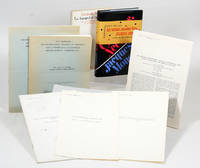
19582205various: various 1958. First edition offprints. Original wrappers. Very Good. FIRST EDITIONS OFFPRINT ISSUES OF FOUR CLASSIC PAPERS REPORTING THE WORK OF FRENCH BIOCHEMIST JACQUES MONOD AND HIS COLLABORATORS ON THE MECHANISMS BY WHICH GENETIC INFORMATION IS EXPRESSED AND BY WHICH SUCH EXPRESSION IS REGULATED OFFERED WITH INSCRIBED COPIES OF THE FIRST EDITION AND FIRST EDITION IN ENGLISH OF MONOD'S SEMINAL WORK IN THE PHILOSOPHY OF SCIENCE "LE HASARD ET LA NÉCESSITÉ.". The discovery that genetic information is stored in DNA - and the work of Watson Crick Franklin and others which provided basic insights into the structural basis of genetic information storage - opened the doors in the 1950s and 1960s to wide-ranging research on the mechanisms by which genetic information is expressed - in other words the path by which the genetic information stored in DNA "genotype" determines the physical characteristics of a cell or organism its "phenotype" and how such expression is regulated. The question of the regulation of gene expression was a particularly vexing one since cells within an organism that have apparently identical genotypes - for example liver cells and muscle cells - have widely varying phenotypes. Key insights into these issues were provided by the work of the biochemist hero of the French Resistance anti-Stalinist leftist and philosopher of science Jacques Monod. The important and highly dangerous work that Monod and his close friend Albert Camus carried out for the French Resistance during World War II is described in the book by Sean B. Carroll quoted above which also shows how Camus made common cause with Monod in opposing the Lamarckian genetic theories of Trofim Lysenko which were being promoted by Stalin and by the Stalinist Left in France. The four offprints offered here document the classic experimental work carried out by Monod and his colleagues to test their hypotheses on the mechanisms of gene expression and gene regulation. These scientists demonstrated that the products of certain bacterial genes known as "repressors" act as molecular switches suppressing the expression of other genes. For example activity of the enzyme β-galactosidase which participates in the metabolism of lactose is observed in the bacterium E. coli only when lactose is present in the nutrient solution in which it is being grown. In other words enzyme activity is observed only when it is needed. Prior to Monod's work a number of hypotheses were put forward to explain this observation; one theory for example proposed that β-galactosidase was continuously synthesized by the cell but that the presence of lactose was somehow required to "activate" the enzyme. However according to the model that was developed by Monod and his colleagues and that was supported by them in a brilliant series of experiments a repressor protein produced by a separate gene normally attaches to a site the "operator" on the DNA molecule upstream from the β-galactosidase gene and thereby prevents it from being expressed. Lactose when present interferes with the attachment of the repressor to DNA and thus has the effect of "un-repressing" the normally repressed β-galactosidase gene thus ensuring that the enzyme will be synthesized in exactly the circumstances in which it is needed i.e. what lactose is present. Aside from providing fruitful insights into the problem of gene regulation this work led to the discovery that there is an intermediate - now known as messenger RNA mRNA for short - that carries information from DNA to structures in the cell known as ribosomes where the proteins encoded by particular genes are synthesized. The proof of the mRNA hypothesis established the nature of ribosomes as generic "protein synthesis machines" whose instructions are provided by mRNA. It thus undermined the competing theory that different types of ribosomes are created for each type of protein that the cell synthesizes. In short ribosomes are all-purpose hardware while the mRNA "downloaded" from an organism's DNA provides the specific software or "app" for synthesizing a particular protein. Offprints of the following papers are offered here: a Pardee Arthur B. François Jacob & Jacques Monod "Sur l'expression et le róle des allèles 'inductible' et 'constitutif' dans la synthèse de la β-galactosidase chez des zygotes d'Escherichia coli" in Comptes Rendus des Seances de l'Academie des Sciences 1st ed. offprint issue 1958. This is the first report of the classic "PaJaMo" experiment a whimsical designation derived from the first letters of the authors' names and meant to suggest "pajama" which demonstrated the role of repressors in bacterial gene regulation and stimulated the development of the hypothesis that a short-lived messenger later identified as mRNA acted as an intermediate information carrier between DNA and the site of protein synthesis. The instability of mRNA is important because it enables more precise control of when a protein will and will not be synthesized - such precision would be impossible if mRNA lingered after it had done its job. Two copies of the offprint are offered printed on paper of distinctly different sizes. We have not established any priority between what appears to be two separate printings of the offprint edition. Original wrappers. Both issues with center mailing fold and some toning around wrapper edges. b Pardee Arthur B. François Jacob & Jacques Monod "The Genetic Control and Cytoplasmic Expression of 'Inducibility' in the Synthesis of β-Galactosidase by E. coli" in Journal of Molecular Biology 1st ed. offprint issue 1959. This paper provides a more detailed discussion of the results that were presented in preliminary form in the Comptes Rendus paper. "In consequences the PaJaMo experiment ranks - where To say one can place it not far behind Oswald Avery's evidence that the transforming principle must be DNA ahead of Alfred Hersey and Martha Chase's demonstration that DNA not protein was the genetic material of bacteriophage about on a level with Paul Zamecniks' proof that the ribosome was the site of protein synthesis would be accurate but inadequate. A demonstration a model a theory has its first importance in the peculiar quality of its relation to work around it. In this relation the PaJaMo experiment was unexpectedly powerful. It forced the solution of two problems. First it turned upside down the logic of regulation of enzyme synthesis that Monod had been investigating and led to a general theory of the repressor and of groups of genes controlled together to be termed the 'operon.' "Operon" was Monod's terminology for the complex consisting of an upstream regulatory site and the genes that it regulated. Second when accepted the PaJaMo experiment. led to the theory of the messenger and the solution of the coding problem" Judson H.F. The Eighth Day of Creation: Makers of the Revolution in Biology. "The PaJaMo paper itself proposing a mechanism for genetic regulation with broad explanatory power was a flash of clarity in the murky sea of vaguely outlined theories that had been proposed up to this time. The concreteness and simplicity of the repressor model and the mode of analysis suddenly turned the intractable problem of gene regulation into one that could be readily studied by the classical genetic approach of dominance-recessiveness analysis" Joklik Wolgang K. et al. eds. Microbiology: A Centenary Perspective. Thick paper wraps possibly added around original self-wrappers. Owner signature on likely extra wrapper. Fine condition. c Riley Monica Arthur B. Pardee François Jacob & Jacques Monod "On the Expression of a Structural Gene" in Journal of Molecular Biology 1st ed. offprint issue 1960. Riley's paper was based on experiments she had conducted with Arthur Pardee at Berkeley. That work "new technically amusing and persuasive amounted to removal of the gene for βgalactosidase from the cell after it had begun to function." "Inactivation of the gene . abolished protein synthesis without delay. Stable intermediates between the gene and its protein such as ribosomes specialized to synthesize particular proteins were ruled out. Continual action of the gene was necessary either directly or by way of an intermediate that was unstable and so had to be steadily renewed" - a key finding leading to the recognition of the role of mRNA in protein synthesis. Judson op. cit. Original self-wrappers. Fine condition. d Jacob François & Jacques Monod "Genetic Regulatory Mechanisms in the Synthesis of Proteins" in Journal of Molecular Biology 1st ed. offprint issue 1961; copy of the geneticist Guido Pontecorvo with his signature and with penciled notes on the cover that may be his. This is a review article building on the PaJaMo experiment and related work by Jacob and Monod. "In this seminal paper in 1961 Jacob and Monod proposed a general model for bacterial gene regulation. Mainly on the basis of genetic information they predicted the existence of repressors encoded by a new class of non-structural i.e. regulatory genes. They were regulated by metabolites or other environmental factors which could promote or antagonize their function. Repressors acted through operators that functioned in cis with i.e. close to the regulated genes.; however the precise nature of the repressors and how they interacted with operators was unclear. This visionary paper stimulated a quest for the isolation of repressors which culminated in the isolation of the lac and lambda repressors in 1966 and 1967 respectively" "Nature Milestones in Gene Expression:. The Repressor Model" in Nature December 1 2005. "This paper's impact was immense and was hardly lessened by the fact that several of its elements - notably the repressor and the messenger - were already published and well discussed. The paper is one of the most famous in the science" Judson op. cit. Guido Pontecorvo the geneticist who was the original owner of the offered copy of this paper "was elected a Fellow of The Royal Society in 1955 for his contributions to the genetics of Drosophila and the fungus Aspergillus nidulans. Pontecorvo was a leading British geneticist prominent in the decade preceding the discovery of DNA who enriched our understanding of genes and whose pioneering work on the parasexual cycle in fungi found application in human somatic cell genetics" Biographical Memoirs of the Fellows of the Royal Society; see also "Guido Pontecorvo 'Ponte': A Centennial Memoir" in Genetics 177:1439-44 2007. He was the brother of Bruno Pontecorvo a nuclear physicist who was also a Soviet spy and who defected to the Soviet Union in 1950. Original self-wrappers. Pontecorvo's signature on front wrapper along with some scholarly notes in pencil and ink markings. Light wear but generally fine. d Brenner S. François Jacob & Matthew Meselson "An Unstable Intermediate Carrying Information From Genes to Ribosomes for Protein Synthesis" in Nature 1st ed. offprint issue 1961. This paper reported the classic experiment supporting the Jacob/Monod hypothesis that "ribosomes are non-specialized structures which receive genetic information from the gene in the form of an unstable intermediate or 'messenger'" this paper page 576. Stimulated by the PaJaMo experiments and other recent research Francis Crick Sydney Brenner and François Jacob met in Cambridge in 1960 to discuss the messenger hypothesis. "During this gathering Jacob and Brenner developed an experimental strategy for proving the existence of this new type of RNA and for distinguishing it from ribosomal RNA. These experiments were performed in the summer of 1960 in Matthew Meselson's laboratory in California." Using isotope labeling techniques the authors showed that RNA synthesized by a bacterium after infection by a bacteriophage a virus infecting bacterial cells bound to ribosomes that were present before the infection. "The ribosomes thus merely played a passive role in the synthesis of phage proteins: they were the material support upon which the short-lived messenger RNA molecules were bound in order to be translated into proteins" Michel Morange A History of Molecular Biology. Original self-wrappers. Fine condition. These four papers are offered here with inscribed copies of the first edition and the first edition in English of Monod's book Le Hasard et la Nécessité Chance and Necessity in the English translation. "Chance and Necessity was a slim book laden with technical details of oligomeric proteins telomeric structures and microscope perturbations. Despite the technical jargon the book sold over 200000 copies in its first year and became a best seller in Germany and Japan. It was bested in France only by Erich Segal's Love Story" Oren Harman "'Chance and Necessity' Revisited" in Los Angeles Review of Books. Strongly influenced by Camus' existentialism Chance and Necessity used recent discoveries in molecular biology as a starting point for presenting a materialist non-teleological philosophy of science. The approach taken in the book is well-summarized by its two epigraphs. The first which gave Monod his title is a quotation attributed to Democritus: "Everything existing in the Universe is the fruit of chance and necessity." On the meaning of this quotation see Daniel W. Graham trans. and ed. The Texts of Early Greek Philosophy: The Complete Fragments and Selected Testimonies of the Major Presocratics. "Democritus. insists that every event happens from necessity in the sense of having sufficient antecedent conditions to bring about the event; that that event can still be from another perspective a chance event in that it does not happen for a purpose. Thus he believes that natural events are causally necessary but happen by chance from a teleological perspective." But Monod immediately makes it clear that Democritus' rejection of teleology is not necessarily a cause for despair with his second epigraph - a famous quotation from Camus's The Myth of Sisyphus: "Sisyphus teaches the higher fidelity that negates the gods and raises rocks. This universe henceforth without a master seems to him neither sterile nor futile. Each atom of that stone each mineral flake of that night-filled mountain in itself forms a world. The struggle itself towards the heights is enough to fill a man's heart. One must imagine Sisyphus happy." AN OUTSTANDING AND EXTREMELY RARE COLLECTION DOCUMENTING ONE OF THE CENTURY'S MOST IMPORTANT BIOLOGICAL DISCOVERIES. various unknown books
5606Saigon: Édition Photo Nadal n.d. . Soft cover. Good/All but the first 4 pages with full-page gravure illustrations from photographs by Nadal presenting a detailed photographic study of the architecture and ruins of the Buddhist temples at Angkor. Though published in Saigon the work was printed by Braun & Cie in Dornach France. . 24 x 32 cm; 4 5-207 pages primarily full-page photogravure images with captions in French and English. Original pictorial wraps. Scattered light foxing mostly toward first 15 leaves. Old saucer marks on front wrap. Yet fresh and clean. Édition Photo Nadal paperback books
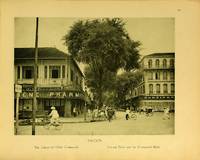
193043483Saigon: Édition Photo Nadal 1930. First edition oblong 4to pp. 113 1; profusely illustrated throughout with sepia toned and black & white photographic illustrations of various people places and way of life in Saigon & Cholon; parallel text in French and English; marbled endpapers front hinge cracked corners bumped and chipped else very good in quarter brown calf over marbled boards with gilt lettering and decoration on spine with raised bands. <br/><br/> Édition Photo Nadal hardcover books
191247565Neuchatel: Sttinger Freres 1912. Large 8vo pp. 124. Bibliography index. In German. Frontis portrait. Marbled paper over boards cloth spine. Paper somewhat yellowed cover little worn at edges o/w a VG tight copy. Sttinger Freres unknown books