1 484 résultats
167822856A Cologne, chez Claude Emmanuel, 1678 ; in-12, vélin ivoire rigide, titre manuscrit au dos (reliure de l'époque ; [2] titre, [12] préface, [4] Table des Chapitres, 531, [29] Table, [2] Fautes, blanc, 30 pp. Remarques qui sont les annotations manuscrites de Spinoza sur son exemplaire en latin paru en 1670.
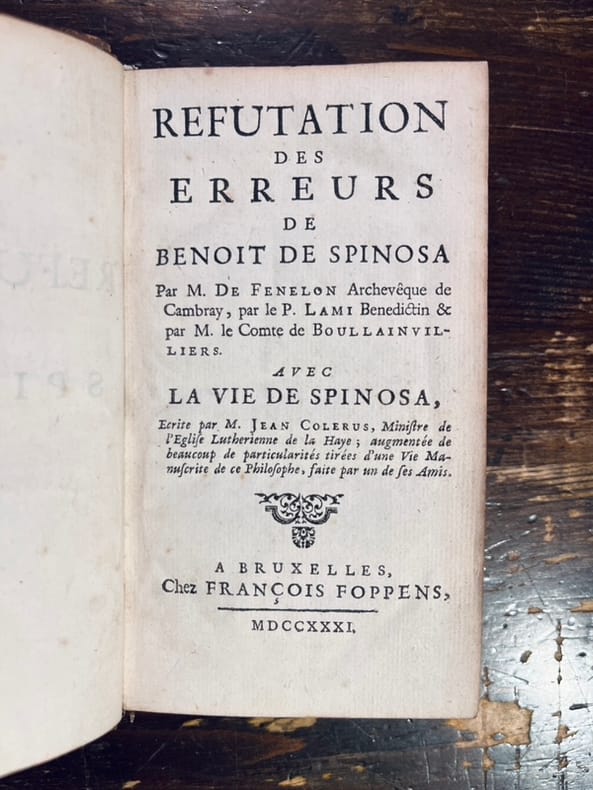
173122018A Bruxelles, chez François Foppens, 1731. In-16 de [10]-158-483-[3] pages, plein veau brun, doa à nerfs, pièce de titre en maroquin rouge.
193389611933 Paris, Excelsior, 1933, in 8° broché, 85 pages ; 32 planches hors-texte ; couverture illustrée.
1982189241982 P., PUF (Collection "Philosophie d'Aujourd'hui"), 1982, in 8° broché, 772 pages.
42268P., LAmitié par le livre, 1941, petit in 8° broché, 231 pages.
Ensemble relié en 2 volumes in-12 (140 x 78 mm), plein maroquin vert sapin, dos à 5 nerfs guillochés or, garnis de compartiments entièrement dorés à la fanfare, large roulette d'encadrement sur les plats garnie de fleurons aux coins, roulette sur les coupes, titre doré, dorés sur tranche, gardes de tabis rose (reliure de l'époque). Exceptionnel exemplaire relié en maroquin de l'époque, réunion en deux volumes de l'ensemble de la production contemporaine française de / et autour de Spinoza 1- Première édition française du "Tractatus Theologico-Politicus", augmentée des additions apportées par Spinoza à son texte ("Remarques curieuses") publiées ici pour la première fois. Le traducteur, Gabriel de Saint-Glain, calviniste français réfugié en Hollande, devint un fervent spinoziste après sa rencontre avec un élève du philosophe. Rigoureusement interdite et poursuivie en France, cette édition fut présentée sous pages de titre et adresses différentes afin de détourner la censure. La traduction de Saint-Glain, "avec des éclaircissements et un commentaire inestimable", contribua directement à la diffusion du spinozisme en Europe (cf. Vernière, I, p. 25 sq., qui signale que Saint-Glain effectua sa traduction sur un exemplaire annoté de la main de Spinoza). (Kingma & Offenberg, n° 13, 14 et 15. "Catalogue du tricentenaire, Institut hollandais", p. 59. Van der Linde, n° 10, 11 et 12. Sauvy, 'Livres saisis à Paris', n°204 et 568). 2 et 3- Edition originale de ce recueil collectif consacré à Spinoza et à sa doctrine, édité par Nicolas Lenglet du Fresnoy. Il contient la "Vie de Spinoza" (p. 1 à 150) par Jean Colerus (Johann Koehler), pasteur luthérien à La Haye -- La préface et la "Réfutation" de Spinoza par le comte de Boulainvilliers ainsi que celle de Fénelon (p. 151 à 320) – "Extrait du nouvel athéisme renversé" oeuvre du cartésien François Lamy (p. 321 à 386) sous page de titre particulière à la date de 1696 – "Certamen Philosophicum" (...) d’Isaac Orobion médecin et personnalité de la communauté juive d’Amsterdam (p. 387 à 483), également sous page de titre particulière, à la date de 1703. "Sous prétexte de rendre plus facile la réfutation de Spinoza en mettant ses opinions à la portée de tout le monde, Boulainvilliers a eu réellement pour but de propager le système de ce philosophe (...) en substituant au langage austère du métaphysicien hollandais une forme simple et pleine d’attraits" (Franck, p. 202). Sur l’importance décisive de ce recueil dans la propagation du spinozisme en France, cf. P. Vernière, ‘Spinoza et la pensée française’, p. 373 sq. (Brunet, II, 1209. Fürst, III, p. 54. Cat. Expo. Spinoza, Herzog August Bibliothek, n° 64. Tchemerzine-Scheler, III, 232. Van der Linde, 107 et 108). Ex-libris amorié du Dr Armand Ripault à sa devise "D'espérer servir". Très bel exemplaire, exceptionnelle réunion en reliure de maroquin de l'époque orné à la fanfare.
1678ABC_50006Amsterdam: Jacob Smith = Israel de Paull for Jan Rieuwertsz. Sr. 1678. Contemporary mottled calf gold-tooled spine with a red morocco title-label lettered in gold gold-tooled board edges marbled endpapers. 12mo. With a woodcut vignette on title page ornament E in the description of Van de Ven. First French edition of Spinoza's famous Tractatus Theologico-Politicus 1670 printed by Israel de Paull for Jan Riewertsz. Sr. in Amsterdam but appearing with the false imprint of "Hamburg Henricus Künrath". The original Latin edition is one of two works by Spinoza that originally appeared during his lifetime the other work is his Principia philosophiae cartesianae 1663. The present French translation was published only a year after Spinoza's death in 1677 and was still so controversial that it was published without mentioning the author's name and with false imprints. Three issues of the first French edition are known all three dated 1678 but with different titles and false imprints: 1: Reflexions curieuses d'un esprit des-interressé sur les matieres les plus importantes au salut Leiden Pierre Warnaer 1678; 2: La clef du santuaire Cologne Claude Emanuel 1678; and 3: the present work Traitté des ceremonies superstitieuses des juifs. In chapter 5 pp. 200-255 of Van de Vens bibliography of Spinoza's works the complicated printing history of the French translation is covered in detail; our issue has the number X3. The translation presumably launched by Spinozas Amsterdam publisher Jan Rieuwertsz Sr. is commonly attributed to a French Hugenot Gabriel Lord of Saint Glain 1620-1684 who had been a zealous Protestant before he came to know Spinoza. He grew into one of his disciples and one of his greatest admirers. He settled in The Hague about the same time when Spinoza moved to that same city where they could have met each other.What makes this edition of the French translation extra important also for the general Spinoza bibliography is that it contains at the end the 31 "Adnotationes ad Tractatum theologico-politicus" here called "Remarques curieuses et necessaires pour lIntelligence de ce livre" pp. 1-30: notes clarifying obscurities in Spinozas book. The majority of these Adnotationes were composed by Spinoza himself some were arguably made by others. The precise sources for these notes which were unpublished until this French translation are unknown. In the autumn of 1675 Spinoza was planning - as he wrote to his correspondent H. Oldenburg in London - a new edition of his Tractatus together with his Adnotationes marginal notes to explain passages easily to be misinterpreted by critical readers written in the margins of his copy of the first edition now lost. But there are more copies known and lost with a varying number of notes 31-39. If Saint Glain was indeed the translator of the Tractatus this would indicate that he must have gotten hold of either Spinozas holograph or an apograph of the notes whether or not written in de margins of a copy of the first Latin edition probably through Jan Rieuwertsz who was after the death of Spinoza in the possession of his written legacy. It may even be speculated that Rieuwertsz himself did ask and commission Saint Glain to translate the Tractatus into French and to append the still unpublished Adnotationes in French.With a manuscript inscription initials on the verso of the first flyleaf a crossed out manuscript owner's inscription of Abraham Couet du Vivier 1646-1719 Hugenot pastor and author in The Hague at the head of the title page with the manuscript additions of the Latin title and "par Benedict. Spinosa" around the printed title in the same hand. The binding shows clear signs of wear the front hinge is weakened the corners of the boards are slightly damaged the marbled endpapers are slightly rubbed and frayed slight browning throughout. Otherwise in good condition.l Akkerman F. Introduction to his translation into Dutch 1997; Kingma/Offenberg p. 15; STCN 840787480; USTC 1561976; Van der Linde p. 12; Ven J.M.M. van de Printing Spinoza Leiden Brill 2022 Chapter 5 pp. 200-255 nr. X3; cf. STCN 843272147 other issues of this ed. Jacob Smith [= (Israel de Paull for) Jan Rieuwertsz. Sr.], unknown
187126848Nieuwkoop, B. de Graaf, 1961 (Nachdruck der Ausgabe ?s-Gravenhage, 1871). Gr.-8°. 1 Bl., 113 S., OLwd.
195814668Oxford: Clarendon Press 1958. Very Good. Oxford: Clarendon Press 1958. Reprint. Octavo; publisher's blue cloth gilt-lettered spine; xvi231pp. Moderate shelf wear brief spotting to front cover cloth sizing spine a bit cocked and toned contemporary ownership signature to front free endpaper and fairly extensive pencil annotations to first third of text; overall a Very Good reading copy. Clarendon Press unknown
in-12, 205 pages, front., broche, couv. Tres bel exemplaire, tres frais [MI-5]
cm. 17 x 24, xii-284 pp. Lessico intellettuale europeo Vengono affrontati, da angolature diverse, alcuni dei nodi problematici intorno ai quali si ? articolata la critica spinoziana negli ultimi decenni: necessit? di disporre di edizioni critiche attendibili, problemi terminologici, analisi delle fonti e individuazione di analogie lessicali con autori antichi e moderni, aspetti particolari del dizionario filosofico del ?Tractatus de intellectus emendatione? e dell??Ethica? Some of the problems around which the criticism of Spinoza has been articulated in the last few decades are discussed from several points of view: the need to avail oneself of reliable critical editions, problems of terminology, source analysis and the identification of lexical analogies with ancient and modern authors, particular aspects of the philosophical dictionary of ?Tractatus de intellectus emendatione? and of ?Ethica? 545 gr. xii-280 p.
GUIDA 2004 242 PP. FONDO DI MAGAZZINO: PERFETTO E INTONSO. Parole e frasi comuni alcun assoluto Auschwitz banalità del male Baum Carl Schmitt compito comunità concezione coscienza costituisce costruire Cracovia crisi Cristo dell'Olocausto dell'uomo dice diritto domanda ebraica ebraismo ebrei Eckardt Eichmann Elie Wiesel esiste esso etica f1glio fascismo fede filosofia funzione Germania Gerusalemme Gesù ghetto Giobbe guerra Gumplovicz Hannah Arendt headship Hegel Heidegger Hitler Ibid ideologica Ihid interpretazioni interrogativi Israele Judenrat Judenriite Kafka l'ebreo L'Olocausto l'uomo lager Lévinas liberalismo Lissa lotta male naturale mente Metz mistico mondo morte Movimenti giovanili nazista nemico notte nulla nuovo parlare parola passato Paul Celan pensare poema poesia politica anti - ebraica possibile potere problema processo proprio questione radicale Raul Hilberg razze realtà Reich religiosa responsabilità resurrezione Ruether ruolo sembra senso Shoah signif1cato silenzio situazione sociale sofferenza Sombart storia storico sviluppi tedesco Tel Aviv teodicea teologia cristiana termini Terzo Reich totalitario totalmente tradizione tratta trova umano vuol dire XX secolo
A. BOUGANIM Le testament de Spinoza. Francia, Nadir 2000 finnish, 387 CH44Brossura editoriale volume in buone condizioni, lievi segni di usura causati dal fattore tempo sulla copertina, interno in ottimo stato, legatura salda, testo in francese387pagine circa Copertina come da foto
Mm 170x240 Collana "La psicoanalisi che viene". Volume nella sua brossura originale, 229 pagine. Opera in buone condizioni, presenta sottolineature a matita. Spedizione in 24 ore dalla conferma dell'ordine.
TRADUZIONE DI Maurizio Bruno, David Mezzacapa BOLLATI BORINGHIERI 1995 LIEVI SEGNI DEL TEMPO, VOLUME PERFETTO. Un libro che si rivolge a quanti, più che all'opera dello scienziato, sono interessati alla figura di Einstein uomo, a capire chi fosse in realtà, al di là del mito. Il risultato è un ritratto per certi versi imprevedibile, molto più sfaccettato e complesso di quanto una certa agiografia lascerebbe supporre. Oltre a particolari inediti della vita familiare, il libro illustra il credo filosofico di Einstein e le sue prese di posizione sui grandi temi della politica, della pace e della guerra, e analizza le ragioni del mito di Einstein, soffermandosi sul ruolo avuto dai grandi mezzi di informazione e fornendo esempi che testimoniano il clima di isteria collettiva che si creò intorno allo scienziato dopo il trionfo delle sue teorie.
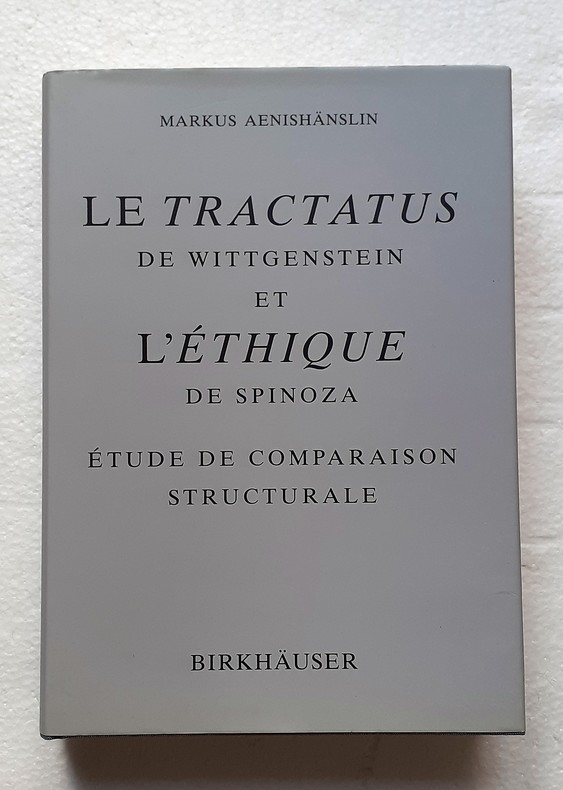
1993ZNC-474Bâle, Birkhaüser Verlag, 1993, grand et fort in-8°, 421 pages, pleine toile grise de l'éditeur, jaquette.
0791423808.Gpaperback. Good. Access codes and supplements are not guaranteed with used items. May be an ex-library book. paperback
Alain Billecoq Les combats de Spinoza. Parigi, Ellipses 1997 french, 127 Opera con copertina morbida in brossura, annotazioni a matina sull'ultima pagina. st1029
192316482ABMünchen, Reinhardt, 1923. 178 S. Priv. Pappband mit eingeb. Orig.-Umschlag.
19236594ABMünchen, E.Reinhardt, 1923. 8° (21 x 14 cm). 178 (1)S., 4 Blatt mit 1 Titelbild Spinozas. Typographisch gestalteter Original-Karton. (=Geschichte der Philosophie in Einzeldarstellungen Abt. 4. Die Philosophie der neueren Zeit; 1, Band 18).
1992HVD-63491-OS-0New York NY: Metropolitan Museum of Art/Abrams. Very Good- in Very Good dust jacket. 1992. Exhibition Edition. Hardcover. 289 pages; B&W and color illustrations throughout the book. Minor foxing on the top exterior edge of textblock and on a prelim page. Minor erased pencil markings on a prelim page. Very Good condition otherwise. No other noteworthy defects. No markings. ; Your satisfaction is our priority. We offer free returns and respond promptly to all inquiries. Your item will be carefully cushioned in bubble wrap and securely boxed. All orders ship on the same or next business day. Buy with confidence. . Metropolitan Museum of Art/Abrams hardcover
1992103207New York: Metropolitan Museum of Art / Abrams. Qto. 304 pages 167 illustrations 106 being in colour. A Very Good copy in a Very Good dust jacket. . Very Good. Hardcover. 1st Edition. 1992. Metropolitan Museum of Art / Abrams hardcover
199227718<p>new oversize pb</p> Metropolitan Museum of Art/Abrams paperback
1992Q-0810964163Metropolitan Museum of Art/Abrams 1992-01-01. Hardcover. New. In shrink wrap. Looks like an interesting title! Metropolitan Museum of Art/Abrams hardcover
INTERVENTI DI ANTONELLA DEL PRETE, G. AQUILECCHIA, T. DRAGON, R LéCU, A. PERFETTI, J. SEIDENGART, A. INGEGNO, M. BRACALI, N. PANICHI, G. CENGIAROTTI, LA CITTà DEL SOLE 2006 315 PP. FONDO DI MAGAZZINO: LIEVI SEGNI DEL TEMPO, VOLUME INTONSO, MAI SFOGLIATO, PERFETTO. Atti, in occasione del 4° cent. della morte di G. Bruno (1548-1600). Proceedings, on the occasion of the 4th cent. of the death of G. Bruno (1548-1600). Filippo Bruno, noto con il nome di Giordano Bruno (Nola, 1548 – Roma, 17 febbraio 1600), è stato un filosofo, scrittore e monaco cristiano italiano appartenente all'ordine domenicano vissuto nel XVI secolo. Il suo pensiero, inquadrabile nel naturalismo rinascimentale, fondeva le più diverse tradizioni filosofiche — materialismo antico, averroismo, copernicanesimo, lullismo, scotismo, neoplatonismo, ermetismo, mnemotecnica, influssi ebraici e cabalistici — ma ruotava intorno a un'unica idea: l'infinito, inteso come l'universo infinito, effetto di un Dio infinito, fatto di infiniti mondi, da amare infinitamente. Parole e frasi comuni Aristotele astrologia astronomia atomi atomos Boétie BOeuC bruniana Campanella causa causalità celeste Christian Rosenkreuz Comenio comètes concetto Copernico cosmo cosmologia critica universo Democrito Deus dialectique Dialoghi d'amore Dieu divina doctrine Epicuro Erasmo ermetica Eroici furori Ficino filosofia fisica forma Frances Yates Giordano Bruno Granada immenso espace essence être l'infini unità Leone Ebreo limite Lucrezio magia magica matematica materia metafisica minimo mondo Montaigne movimento natura naturale nihil Nolano omnia opere panteismo pensiero perfezione philosophie physique Pico platonicienne politica Praga predestinazionista principio problema Providentia puissance questione ragione rerum riferimento Riforma Rosacroce Servitude volontaire Suarez teologia teoria thèse Tycho Brahé umana vincolo vinculis virtus Wittenberg Yates Zwingli Curione Soggetti: Filosofia Medievale e rinascimentale, Umanesimo, Rinascimento, Cultura, Studi culturali, Metafisica, Cosmologia, Scienze, Esoterismo, Riforma, Scolastica, Razionalismo, Principia rerum, Democrito, Teorie delle comete, Atomi, Tommaso Campanella, Riforma, Magia, Boétie, Cabala, Furori, Giovanni Aquilecchia, Erudizione, Santa Inquisizione, Ermetismo, Neoplatonismo, Rogo, Rivoluzione astronomica, Mnemotecnica, Clavis Magna, Sigillo, Candelaio, Dialoghi filosofici, De la causa, principio et uno, Sigillus sigillorum, De monade, De gli eroici furori, Scienza, Conoscenza, Spaccio de la bestia trionfante, Creazione, Niccolò Copernico, Nicola Cusano, Medieval and Renaissance Philosophy, Humanism, Renaissance, Culture, Cultural Studies, Metaphysics, Cosmology, Science, Esotericism, Reform, Scholasticism, Rationalism, Democritus, Comet Theories, Atoms, Reformation, Magic, Kabbalah, Furore, Erudition, Holy Inquisition, Hermeticism, Neoplatonism, Astronomical Revolution, Mnemonic, Seals, Candle, Philosophical dialogues, De la causa, principle et uno, De the heroic fury, Science, Knowledge, beast triumphant, Creation, Aristotle, Nicolaus Copernicus