"ARISTOTELES [ARISTOTLE] - GIOVIO PACE [JULIUS PACIUS].Livre Rare Book
58 résultats
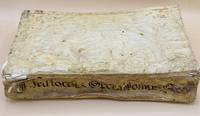
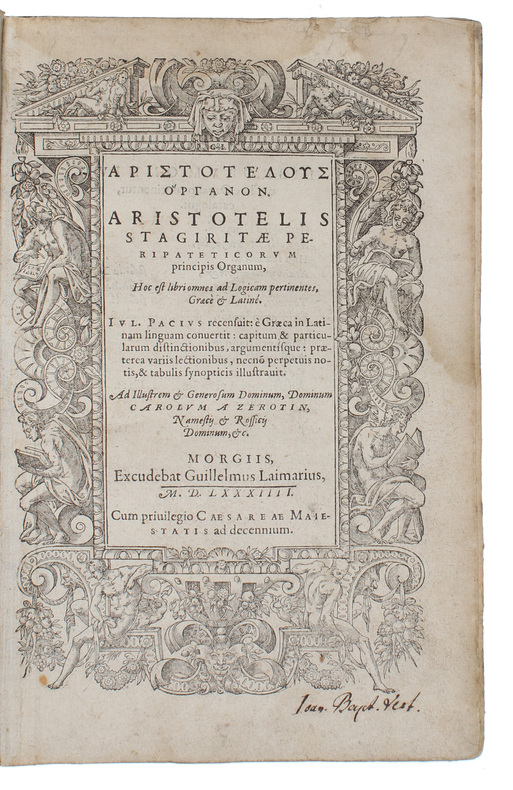
158450934Morgiis, Guillelmus Laimarius, 1584. Small folio. 18th century half vellum, somewhat soiled and worn. Corners and edges bumped and worn. Handwritten title to spine. Fore-edge with 2-line title in neat (contemporary?) hand and with the ""Societas Jesu"" (i.e. the Jesuit Society) symbol in white to the otherwise red fore-edge. Internally a very ni8ce copy, with the occasional browning and spotting. A faint damp stain to top marging of some leaves. A small hole to top of title-page, far from affecting print. Last leaves with neat strenthening of blank upper corners, far from affecting text. Old (presumably 18th century) owner's name to title page: ""Ioan. Bey A. Vest."" Front free end-papers heavily annotated (presumably by this same owner, in Latin, Greek, and German. The annotations include and elaborate handwritten index, information about the edition, and references to the Greek sentences. Verso of last leaf and back end-papers also with notes. A few underlinings here and there. Woodcut ornamental title-border, woodcut vignettes, woodcut initials, numerous woodcut illustrations and diagrams in the text. Greek-Latin parallel-text. (8), 831, (1) pp.
152014721Augsburg: Grimm & Wirsung 1520. Printed throughout in Roman letter of various sizes and mostly in double columns. First title page in red and black; heraldic woodcuts on second and third titles devices initials and text diagrams throughout. Final leaf with large woodcut of Saint Catherine on colophon is in facsimile on contemporary paper. Old vellum new endpapers; occasional stains and a few wormholes. This edition of Aristotle’s scientific works on the motion of heavenly bodies his physics meteorology on the process of birth and generation and on the soul of man was brought together by Johann Eck 1486-1543 and here first printed in Augsburg by Grimm and Wirsung. This is also the first time the beautiful heraldic woodcuts were used. Research suggests that the artist could be Hans Burgkmair who worked in Augsburg at the time the book was printed. Another source indicates the woodcuts could be by the “Petrarca-Master†or that Books 2 and 3 were done by Hans Weiditz.<br /> <br /> See F. Edward Cranz A Bibliography of Aristotle Editions 1501-1600: 107.846 p. 17; 107. 853 p. 18; 107.864 p. 19; Proctor 10873 10900 10914; VD16 A 3563 33793334; Metzler Eck 16 22 34. Grimm & Wirsung unknown
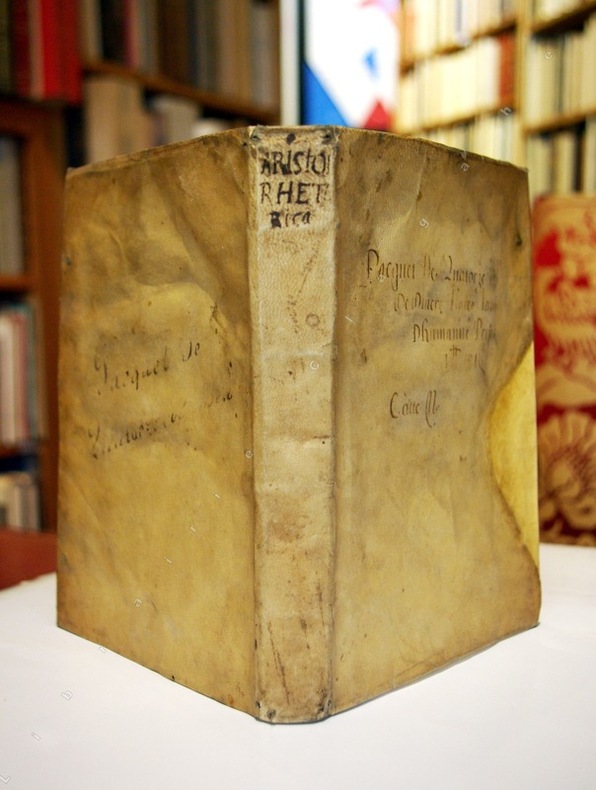
154866468Basileæ Basel: Ex Officina Joan. Oporini Joannes Oporinus 1548. Good. Second volume of a work in three volumes. 667pp. Quarto 33 cm Mid-17th-century vellum binding likely Spanish but possibly Italian. Bold manuscript title on the spine. Gauffered edges. With tanned skin sewing supports. Initial letters. Text block hanging on to wraps by a single leather cord. Missing title page and prefatory pages to Aristotle's work on auscultation. Text block cracked a couple of times at the rear. Light marginal tidemarks to the preliminary pages. Occasional manuscript notations. Pages exceptionally bright. Latin text.<br /> <br /> Contents:<br /> <br /> Aristotelis Stagiritae Physicae Auscultationis Io. Argyropylo Byzantio Interprete: Liber Primus; Liber Secundus; Liber Tertius; Liber IIII; Liber V; Liber VI; Liber VII; Liber VIII.<br /> <br /> Aristotelis Stagiritae De Coelo Io. Argyropylo Byzantio Interprete: Liber Primus; Liber Secundus; Liber Tertius; Liber Quartus.<br /> <br /> Epistola Nuncupatoria ad Leonem.<br /> <br /> Aristotelis Stagiritae Peripa Teticae Disciplinae Autoris: Liber De Generatione & Interitu Prior Latinus á Petro Alcyonio factus; Liber De Generatione et Interitu Posterior Latinus á Petro Alcyonio factus.<br /> <br /> Petrus Alcyonius Antonio Prato S. P. D.<br /> <br /> Aristotelis Stagiritae Meteoron Petro Alcyonio Interprete: Liber Primus; Liber Alter; Liber Tertius; Liber Quartus.<br /> <br /> Aristotelis Stagiritae De Anima Ioan Argyropylo Byzantio Interprete: Liber Primus; Liber Secundus; Liber Tertius.<br /> <br /> Petri Alcyonii In Libros Decem Aristotelis De Animalibus Se Autore Latinos Praefatio Ad Octavium Pregosium.<br /> <br /> Aristotelis Stagiritae De Sensu et Sensilibus Aut De Communibus Animae et Corporis Functionibus Liber Eodum Petro Alcyonio Interprete.<br /> <br /> Aristotelis Stagiritae De Memoria et Reminiscentia Liber Eodum Petro Alcyonio Interprete.<br /> <br /> Aristotelis Stagiritae De Somno Liber Eodum Petro Alcyonio Interprete.<br /> <br /> Aristotelis Stagiritae De Somniis et Imaginibus Liber Eodum Petro Alcyonio Interprete.<br /> <br /> Aristotelis Stagiritae De Communi Animalium Motione Liber Eodum Petro Alcyonio Interprete.<br /> <br /> Aristotelis Stagiritae De Communi Animalium Gressu Liber Eodum Petro Alcyonio Interprete.<br /> <br /> Aristotelis Stagiritae De Diuturnitate et Brevitate Vitae Liber Eodum Petro Alcyonio Interprete.<br /> <br /> Aristotelis Stagiritae De Spiratione Liber Eodum Petro Alcyonio Interprete.<br /> <br /> Theodori Gazae Thessalonicensis In Libros Aristotelis De Animalibus.<br /> <br /> Aristotelis Stagiritae De Historia Animalium Theodoro Gaza Interprete: Liber Primus; Liber Secundus; Liber Tertius; Liber Quartus; Liber Quintus; Liber Sextus; Liber Septimus; Liber Octavus; Liber Nonus.<br /> <br /> Aristotelis De Partibus Animalium et Earum Causis Theodoro Gaza Interprete: Liber Primus; Liber Secundus; Liber Tertius; Liber Quartus.<br /> <br /> Aristotelis Stagiritae De Generatione Animalium Theodoro Gaza Interprete: Liber Primus; Liber Secundus; Liber Tertius; Liber Quartus; Liber Quintus.<br /> <br /> Aristotelis Problematum Sectiones Duædequadraginta Theodoro Gaza Interprete. The second volume of Aristotle's works published by Joannes Oporinus containing the following works: On Auscultation; On the Heavens; On Coming-to Be and Passing Away; Meterology; On the Soul; On Sense and the Sensible; On Memory and Recollection; On Sleep; On Dreams and Images; On the Common Motion of Animals; On the Common Gait of Animals; On the Longness and Shortness of Life; On Breathing; On the History of Animals; On the Parts of Animals and Their Causes; On the Generation of Animals; Aristotle's Problems Section.<br /> <br /> Aristotle 384-322 B.C.E. was born in Stagira in northeastern Greece. He ranks among the greatest philosophers of all time. His works defined centuries of philosophy from Late Antiquity through the Renaissance and are still considered relevant today. A remarkable researcher and writer Aristotle produced nearly two-hundred treatises from which about thirty-one survive. His extant writings cover an extensive range of disciplines including logic metaphysics and philosophy of mind ethics political theory and aesthetics and rhetoric. In addition Aristotle's works explore non-philosophical realms as well such as empirical biology where he provided detailed animal and plant observation and description.<br /> <br /> A scholarly work in a striking vellum binding. Ex Officina Joan. Oporini (Joannes Oporinus) unknown
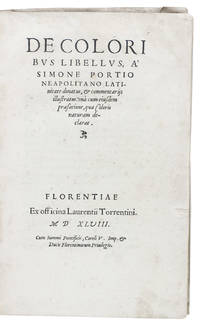
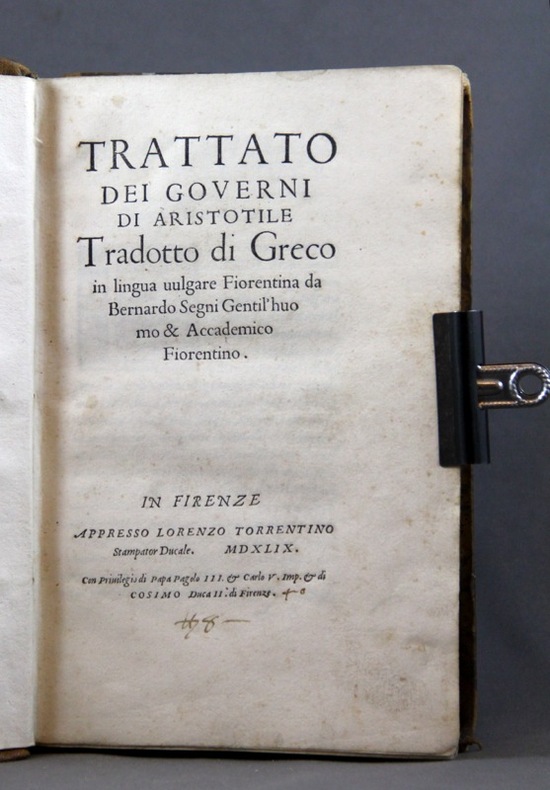
1548642CKI1RIA1QFlorence 1548. 4to. Lorenzo Torrentino Contemporary limp sheepskin parchment straight sewn on 3 wittawed thongs laced through the joints manuscript title down the spine with 4 fragments of a Latin manuscript in an upright humanistic hand on vellum used as spine lining. With 2 large woodcut historiated initials and a vine leaf ornament by Granjon Vervliet 178: 1st recorded in this year. Set in roman types with whole paragraphs in Greek 2 sizes and the dedication and some end matter in italic. 197 3 pp. First edition of one of the earliest printed books about colour translated from the Greek into Latin and with commentary by the Neapolitan physician and philosopher Simone Porzio 1497-1554. Usually attributed to Aristotle it is now thought to be the work of the peripatetic scholar and pupil of Aristotle Theophrastus.''As the author states at the end of the treatise it is intended rather to supply data for a detailed examination into the scientific theory of colour than to expound a complete thesis. He has realized that the development of colour in animals and plants depends to some extent on heat and he seems to suggest that heat and moisture are the controlling factors. It is of more value as a collection of observed facts than for any theory of the origin and development of colour in physical life'' Aristotle Minor Works Cambridge and London Loeb Classical Library 1936 p. 3.With some spotting on the title-page and some marginal tears not approaching the text but otherwise in very good condition and with large margins. Binding with the sewing supports broken a tear in the backstrip and some small stains. An important treatise on colour and one of the earliest.l Adams P1958; Caillet 8881; EDIT16 CNCE 16133; Hoffman I 289 "rare and very important"; Kemp The science of art p. 264; Schwab Bibliographie d'Aristotle 3503; USTC 803281. hardcover
1517260577Venice: Luce Antony de Giunta 1517. hardcover. very good. Illustrated with a fine woodcut headpiece showing St. Thomas teaching; many decorative initials and in-text diagrams throughout and printer's device at end. 6 147 leaves with black letter Latin text printed in double columns. Folio later vellum-backed boards. Venitijs Impensis domini Luce Antonij de Giunta Florentini 1517. A tear in the title page has been carefully mended still a very good tight copy with some contemporary ink marginalia.<br/><br/> Scarce. OCLC lists only 5 copies including those at Cambridge NYU and University of Pennsylvania. An early edition of Saint Thomas Aquinas' 1225-1274 "great commentary on Aristotle's physics - the most important scholastic commentary on this seminal text of ancient science. Aquinas the philosopher is forever entwined with Aristotle as the former came onto the scene just as the Aristotelian corpus arrived in Latin translation and questions of the relation between faith and reason challenged the modus vivendi that had been in effect for centuries." USTC 859417<br/><br/> Luce Antony de Giunta unknown books
1517260577Venice: Luce Antony de Giunta 1517. hardcover. very good. Illustrated with a fine woodcut headpiece showing St. Thomas teaching; many decorative initials and in-text diagrams throughout and printer's device at end. 6 147 leaves with black letter Latin text printed in double columns. Folio later vellum-backed boards. Venitijs Impensis domini Luce Antonij de Giunta Florentini 1517. A tear in the title page has been carefully mended still a very good tight copy with some contemporary ink marginalia.<br/> <br/> Scarce. OCLC lists only 5 copies including those at Cambridge NYU and University of Pennsylvania. An early edition of Saint Thomas Aquinas' 1225-1274 "great commentary on Aristotle's physics - the most important scholastic commentary on this seminal text of ancient science. Aquinas the philosopher is forever entwined with Aristotle as the former came onto the scene just as the Aristotelian corpus arrived in Latin translation and questions of the relation between faith and reason challenged the modus vivendi that had been in effect for centuries." USTC 859417<br/> <br/> Luce Antony de Giunta unknown
158414506Francfort, Héritiers de André Wechel, 1584 ; in-4 ; plein vélin ivoire de l'époque, titre manuscrit au dos ; 341 pp., (1) p. corrigenda, (1) f. blanc. Texte grec jusqu'à la page 258 puis Annotations en latin sur deux colonnes et Index.
156643521566 Ethique à Nicomaque d'Aristote suivie des Fragments de Pythagore. Edition bilingue Grec et Latin. Ioannem Oporinum, Eusebium Episco, Basileae (Bâle, Basel), 1566. In-4 reliure du XIXe siècle, demi veau glacé olive, quatre faux nerfs, filets dorés et à froid, titre et date, dentelles en tête et en queue, tranches jaspées, page de titre, [3ff.], 487 pages chiffrées mais manquent les pages 1 à 8, dont 4 pp. intercalées entre p.8 et p.9 [erreur numérotation], inversion de l'imprimeur entre les pages 217 et 224, [13ff.] d'index, manque la fin de l'index, léger travail de vers sur les 4 premières pages (sans atteinte au texte), mors fendus en queue.
1547PH156Lugduni, Theobaldus Paganum, 1547 (Lyon, Thibaud Payen) in-8o, 1bl., 270, 1 f. imprimeur), sign. A-K8. Rel. plein velin contemp. avec petits manques et 2 lacets, dos lisse avec l'auteur manuscrit, marque d'editeur et initiales gravees, brunissure legere aux dernieres pages. Johannes Argyropoulos (1415 Constantinople - Rome 1487) fut traducteur et professeur -de Const. Lascaris entre autres et lui-meme eleve de B. Bessarion- a Padua et a Rome. Inconnu de Brunet, Baudrier IV, 235.
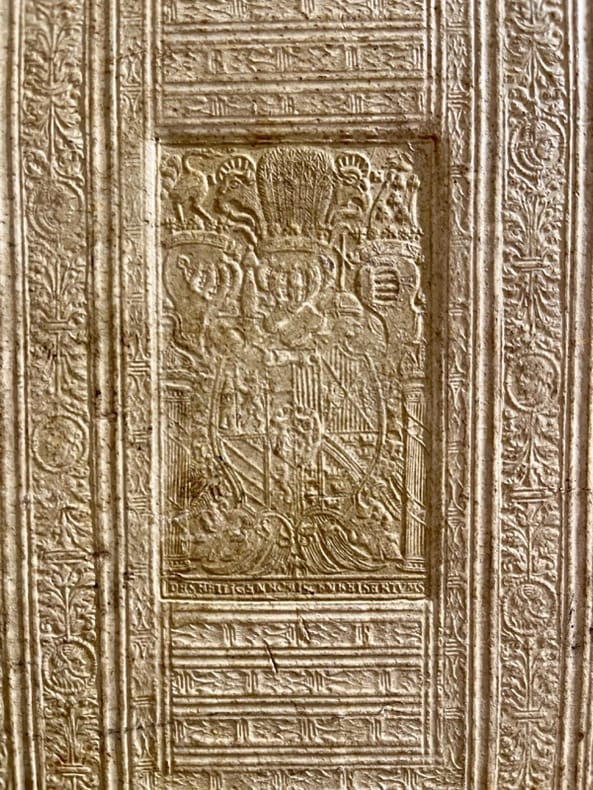
159020050Lugduni (pour Genève), Apud Iacobum Bubonium [et] Apud Guillelmun Leamarium, 1590. Deux tomes en un volume in-folio de [20]-751 (chiffrées 1-430; 435-755) -[1] et [4]-595-[65] pages, plein vélin sur ai de bois, dos muet à 5 nerfs, plats bordés de plusieurs roulettes dont une large aux entrelacs végétaux, et deux autres aux portraits de figures historiques, motif central du plat supérieur aux armes du Saint Empire romain germanique et au plat inférieur celles du grand électeur de Saxe, fermoirs en laiton.
154632121546 Lugduni apud Seb. Gryphium, 1545-1546. 6 textes d'Artistote, tous éd. à Lyon par Sebastien Gryphius, reliés en 1 vol. in-8: 11 x 18 cm. Physicorum (trad. Byzantio), 1546, 214 pp.; De Coelo (trad. Byzantio) 1545, 115 pp.; De Generatione (trad. Vatablo), 1546, 67 pp.; Meteorologicorum (trad. Vatablo), 1546, 136 pp.; De Anima (trad. Byzantio), 1546, 90 pp.; Stagiritae (trad. Vatablo), 1546, 108 pp. Avec plusieurs vignettes de l'imprimeur représentant un gryphon; nombreuses lettrines initiales sur bois; quelques scolies manuscrites en marge du texte. Reliure moderne en parchemin. Dos à troix nerfs avec titre et date manuscits à l'encre noir. Bibli.: Baudrier, Biblio. lyonaise, VIII / Gültlingen, Biblio. imprimé à Lyon, V.
15583048Lyon, Theobald Pagan (Thibaud Payen), 1558 ; in-12 ; plein vélin ivoire, titre manuscrit (reliure ancienne) ; 359 pp., (10) pp. d’index, la dernière blanche.
15496034Firenze, Lorenzo Torrentino, 1549. Petit in-4 de 420-[20]p. pour la table, demi-basane brune, dos lisse orné de filets et fleurons dorés, pièce de titre rouge (coins émoussés, quelques très rares rousseurs). Reliure XIXe ème.
159439275Coloniae 1594. ad varias quaestiones et Philosophiam naturalem cognescendas in primis utilia Einband unter Verwendung einer mittalterlichen Handschrift.Lederbändel als Schliessen.Rara Officina Birckmann Arnold Mylij 16°. Ldr. d. Zt. Philosophie unknown
1532120984Venetia Sebastiani Vincentinum impresse 1532 die XXVII Iunij. In 8° piena pergamena coeva rimontata risguardi sostituiti. Cc. XCIIII. Manca la cc 8 dell'indice e le ultime due carte bianche bel frontespizio con larga cornice figurata con angioletti putti e animali anche fantastici non recente leggero sottile capace rinforzo ai bordi. La numerazione della carte è tutta a cifre romane tranne le carte 9 11 13 e 15 che sono numerate in arabo variante B giusta la collazione. Volume con carta tutta un poco ingiallita ma volume ben sistemato e ben godibile riferibile come buono. Sebastiani fu tipografo attivo a Venezia forse un antenato di Giacomo Vincenzi ma Vincentinus potrebbe essere invece che un cognome un'indicazione di provenienza da Vicenza. Venetia, Sebastiani Vincentinum impresse unknown
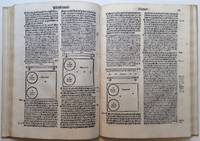
158450934Morgiis Guillelmus Laimarius 1584. Small folio. 18th century half vellum somewhat soiled and worn. Corners and edges bumped and worn. Handwritten title to spine. Fore-edge with 2-line title in neat contemporary hand and with the "Societas Jesu" i.e. the Jesuit Society symbol in white to the otherwise red fore-edge. Internally a very ni8ce copy with the occasional browning and spotting. A faint damp stain to top marging of some leaves. A small hole to top of title-page far from affecting print. Last leaves with neat strenthening of blank upper corners far from affecting text. Old presumably 18th century owner's name to title page: "Ioan. Bey A. Vest." Front free end-papers heavily annotated presumably by this same owner in Latin Greek and German. The annotations include and elaborate handwritten index information about the edition and references to the Greek sentences. Verso of last leaf and back end-papers also with notes. A few underlinings here and there. Woodcut ornamental title-border woodcut vignettes woodcut initials numerous woodcut illustrations and diagrams in the text. Greek-Latin parallel-text. 8 831 1 pp. <br/><br/><em>The very rare first edition of Julius Pace's seminal "Organon"-edition which was the standard-edition of the logical texts of Aristotle throughout more than a century running through at least 11 editions before 1624. Pace's version of the text in Greek-Latin parallels and with Pace's inspired commentaries and interpretations profoundly influenced Renaissance thought determining the course of the Organon-interpretation throughout this period and inspiring much original philosophical thought. Pace's interpretation of Aristotle's logical works - arguably the most influential collection of works in the history of Western thought - not only changed the face of Renaissance thought it has remained the authoritative reading of Aristotle's "Organon" to this day and is still considered the most important and authoritative reading of the texts. As Ross puts it in the Preface to his translation of the logical works the standard Oxford-edition: "My chief authority in matters of interpretation has been Pacius". "The Works of Aristotle Translated into English Under the Editorship of W.D. Ross. Volume I". Oxford University Press. To this day a proper study of Aristotle's "Organon" - and Porphyrios' "Isagoge" - is still unthinkable without references to Pace his rendering of the text and his interpretations of it. The famous "Porphyrian Tree" or "arbor porphyriana" which has gone down in history as a standard presentation of the basis of Aristotle's thought was presented by Porphyrios in his "Isagoge" which since Antiquity has accompanied Aristotle's "Ornanon" as an introduction thereof. The standard presentation of this tree is that of Pace in the present edition on p. 9. It is that rendering of it with occasional slight alterations which has remained standard ever since 1584. That which we ever since Antiquity have called the "Organon" comprises the logical works of Aristotle: 1. Categories 2. On Interpretation 3. Prior Analytics 4. Posterior Analytics 5. Topics 6. On Sophistical Refutations - which ever since late Antiquity/early Middle Ages have been accompanied by Porphyrios' 233/34-ca.310 "Isagoge" his introduction to Aristotle's "Categories". During the Renaissance all editions of Aristotle's "Organon" also comprised Porphyrios' "Isagoge" which was seen as necessary for the understanding of Aristotle's logic. Aristotle's logic has played a seminal role in the history of Western thought. No other collection of writings has had an impact on the history of philosophy that comes close to the "Organon" an impact that remains pivotal to this day. "Aristotle's logic especially his theory of the syllogism has had an unparalleled influence on the history of Western thought." SEP.From Antiquity the earlier middle ages had inherited Boethius' translation of the two first treatises of Aristotle's "Organon" along with Porphyrios' "Isagoge". These works formed the basis for logical study and teaching until the end of the 11th century. Only during the 12th and 13th centuries were Aristotle's writings - along with those of the Arabic and some of the Greek commentators - translated into Latin. When the medieval universities reached their full development during the thirteenth century Aristotle's works were adapted as the standard textbooks for all philosophical disciplines - thus modern terms for many philosophical and scientific disciplines correspond to the titles of Aristotle's works e.g. Ethics Physics Metaphysics. Through Aristotle's works the West thus acquired not only the specific problems and ideas that were being dealt with at the universities but also the terminology used to describe and discuss them and the systematic framework within which all relevant problems should and could be treated. But come the Renaissance we see a clear change in the use of Aristotle's works. We here witness something other than a mere continuation of the late medieval Aristotelianism. The Humanists began supplying new translations of Aristotle's works and translated all the Greek commentators of Aristotle many of them for the first time. And thus a tendency to emphasize the original Greek Aristotle developed a tendency that became pivotal for the development of modern thought - the development of modern science and modern philosophy is inextricably linked with the Renaissance Humanist editions of Aristotle's works in Greek with Latin parallel-text. The "Organon" Aristotle's seminal logical writings occupies a central position within the Aristotelian body of writing and thus within the development of Western thought. Certain Humanist versions of the Greek text and the Latin translations as well as the interpretations of them thus came to play a seminal role in the trajectory of Renaissance and modern though Pace's "Organon"-edition presumably being THE most important and influential edition ever to have appeared. "The medieval traditions of logical writing survived well into the sixteenth century particularly at Paris and at the Spanish universities though with considerable internal changes. Treatises on sophisms and on proofs of terms ceased to be written; whereas there was a sudden flurry of activity concerned with the various divisions of terms and with the opposition of propositions i.e. the logical relations between different kinds of categorical proposition. These internal changes were not however sufficient to keep the tradition alive and after about 1530 not only did new writing on the specifically medieval contributions to logic cease but the publication of medieval logicians virtually ceased. The main exceptions were the logical commentaries by or attributed to such authors as Thomas Aquinas and John Duns Scotus which found a place in their "Opera Omnia" and which benefited from a revived interest in the great medieval metaphysicians.The main changes in the teaching and writing of logic during the sixteenth century were due to the impact of humanism. First commentaries on Aristotle came to display a totally new style of writing. One reason for this was the influence of new translations of Aristotle and new attitudes to the Greek text. Another reason was the publication of the Greek commentators on Aristotle's logic Alexander Themistius Ammonius Philoponus and Simplicius. A third reason was the new emphasis on Averroes which expressed itself in the great Aristotle-Averroes edition of 1550-1552. The effects of these new factors can be seen in the commentaries on individual works of the "Organon" by such Italians as Agostino Nifo 1473-1546 and Jacopo Zabarella 1533-1589 the latter of whom offered a particularly influential account of scientific method. They can also be seen in the "Organon" edition of Giulio Pace 1550-1635 which was first published in 1584 and contained the Greek text side-by-side with a new translation which was designed not only to read well but also to capture the philosophical significance of Aristotle's words." Raul Corazzon "History of Renaissance and Modern Logic from 1400 to Stuart Mill"."No editor better understood the nature of this Treatise of Aristotle than Julius Pacius who was the preceptor of Casaubon and profoundedly skilled in all the arcane of the Peripatetic philosophy in both the Greek and Latin tongues." Dibdin I: 318Giulio Pace of Beriga or Julius Pace/Pacius 1550 - 1635 was a famous Italian Aristotelian scholar and jurist. He was born in Vicenza and studied law and philosophy in Padua. He was inspired by the Reformation and put on trial by the Inquisition. Therefore he had to flee Italy and escaped first to Geneva thereafter to Germany. While in Heidelberg he converted to Protestantism. He was highly respected as an academic and was widely known for his deep knowledge and understanding of Aristotle whom he became famous for translating. He was elected public professor in Geneva where he taught for ten years 1575-1585. The next ten years he spent teaching law at the University of Heidelberg where he got into different conflicts especially with the philosophical faculty for giving private tuition in the controversial Ramist logic. After Heidelberg he taught at different universities throughout Europe where he was especially well known for his 1584-edition of Aristotle's "Organon" which played a definitive role in Aristotle-scholarship and philosophy in general throughout all of Europe.Dibdin I:318; Adams A:1866. </em> hardcover
1501300661501. Problemata Alexandri Aphrodisei. Problemata Plutarchi cum gratia. - Venetiis Per Bonetum Locatellum 1501 Folio 304 x 210 mm 22 296 fl. double colum gothic letters woodcut initials printer device fine full leather binding. A broad marginated clean and well preserved copy of this beautifully volume printed on strong paper. The greatest scientific name after Hippocrates is that of Aristotle 384-322 B.C. who gave the medicine the beginnings of botany zoology comparative anatomy embryology teratology and physiology and use of formal logic as an instrument of precision. Aristotle a pupil of Plato and at one time tutor to Alexander the Great had a profound influence in determining the direction of medical and biological thought; perhaps no other man has so dominated and advanced science as a whole.The Aristotelian Problemata enjoyed considerable popularity in the Middle Ages especially its book IV dealing with sexual intercourse and generation which adapted in such manner that it became a kind of pornographic publication. Petrus de Abano 1250-1315 was one of the most illustrious and influential men of his time and probably the most influential medical writer of the later middle age. A native of Apano near Padua from which he takes his name he took his degree in Paris and his cures were so remarkable that he was able to obtain the highest fees of any physicians of his time. He was called the Consiliator because of his remarkable book published during his residence in the Paris University. He was consulted by such man as Pope Honorius IV and was in great demand for lectures consultation and teaching. Dante was among his pupils. Abano believed that air has weight that brain is the source of the nervous system and the heart the source of the blood vessels- novel ideas that were not validated for centuries. He was the first to acquaint the West with the Problemata from Aritotle`s school to which he wrote the present commentary. For his heretical and outspoken views he was several times accused of heresy. Later he was suspected of magic and persecuted on that account during the Inquisition. Dying before his trial his body was taken out and burned in the public square. The medical science of the scholastic was a part of the universitas litterarum the scholastic physicians were philosophers. The methods of thought had been prescribed by Aristotle and the learned man of Arab. "Petrus spent some time in Constantinople probably before 1293; during his stay found a copy of the Problems of Aristotle.he translated them into Latin for the first time. He began a commentary on these problems while in Paris and completed it at Padua in 1310.His experience and activity represents a landmark in the history of scientific humanism." -Sarton III 439 "Prefatory note by Domenico Massaria. The translatio antiqua of Aristotle is that by Bartholomaeus de Messina which usually accompanies the commentary by Pietro d'Abano; not the ancient Latin version beginning Omnes hominess.- The Problemata of Alexander of Aphrodisias is in the translation of Giorgio Valla; the Problemata Quaestiones convivales of Plutarch in that by Giovanni Petri edited by Giovanni Calfurnio." -Durling NLM no. 286 p. 36; Thorndike II 874-947 921; Sarton III/1 pp.439-446; Sigerist Great doctors 75-79; Gordon Medial & Renaissance Medicine pp. 333-337; Brit. Museum Ital. Books Aristotle p.55. This edition not in Osler Wellcome Cushing Waller Adams etc. RILEY Aristotle texts and commentaries in the Univ. of Pennsylvania Library 1961 has only an edition of 1505 no. 209 hardcover
1557952227Paris: Hieronymus de Marnef 1557 und 1559. leather_bound. Gut. 141 3 weiße Blätter. - Lagenkollation: A-S8; 219 recte 221 2 1 weiße Seiten. A-O8. Halblederband des frühen 19. Jahrhunderts. Sedecimo. 111 x 67 mm. Vordergelenk angeplatzt leicht berieben innen nur wenig fleckig im Ganzen recht frisch. Halblederband des frühen 19. Jahrhunderts mit glattem Rücken aus hellbraunem Kalbleder vier durch blindprägung angezeichnete versetzte Bünde die von goldgeprägten Linien umschlossen sind auf zweitem Feld der Titel auf drittem ein ornamentaler Mittelstempel darunter die Bände unten und oben Filetenvergoldung. Deckel mit grün-schwarzem Marmorpapier bezogen handgestochene Kapitale Vorsätze aus Marmorpapier Schnitt marmoriert. Schöner Druck in zierlicher Kursiv. Marcus Antonius Zimara ein Philosoph und Arzt des frühen 16. Jh. aus Apulien lehrte zu Padua die Logik und zu Rom und Padua die Philosophie; cf. Jöcher IV1206. - Alexander Aphrodisiensis war ein peripatetischer Philosoph des 2.-3. nachchristlichen Jahrhunderts der Kommentare und kleinere Exegesen zu Aristoteles verfaßte; seine Interpretation ist antiplatonisch. Nineteenth-century calf backed boards spine gilt. Upper joint cracked but sound. A small stain to lower margin of some quires ruled in red. - Provenienz: Exlibris auf vorderem Spiegel: "Bibliothèque de Mr. le Vicomte de Vaufreland"; Exlibris auf vorderem fliegenden Vorsatz recto: "Ex libris Regis Bayle Consulde de S.M. la Roi des Belges" signiert R. Crozet. Vordergelenk geplatzt doch stabil Kanten stellenweise leicht berieben. Innen ein schwacher brauner Fleck im unteren weißen Rand einiger Lagen sonst recht frisch; durchgehend regliert. - I: Durling 287sqq. mit anderen Ausgg. I & II: nicht bei Adams BM STC. - RFM. Schriften zur aristotelischen Philosophie. - Weitere Bilder auf Anfrage oder auf unserer Homepage. Wegen Urlaub kann Ihre Bestellung / Anfrage erst nach dem 21.06.2026 bearbeitet werden. - Because of holidays your order / question can be handled only after 06/21/2026. Hieronymus de Marnef hardcover
157627614Venezia 1576. Rhetoricorum Artisque Poeticae libri atque etiam Problematum Sectiones omnes Quibus Alexandri Aphrodisaei Omnia Problemata adiuncta suere. Pars sexta Einband beschädigt Gasparis Bindoni 16°. Pgt. Philosophie unknown
15265283(Am Ende): Venedig, de Sabio, 1526. 4 nn. Bll., 107 num. Bll. mit wdh. Druckermarke in Holzschnitt. Gr.-4°. HPgmt des 17. Jahrhunderts mit hs. Rückentitel (etw. bestoßen und fleckig).
156122490Lugduni Lyon: Jacobi Juntae Jacobus Junta. Good with No dust jacket as issued. 1561. Hardcover. Early previous owner's name clipped from title leaf on each volume with unfortunate loss to some text on title leaf and to the printer's emblems on the title pages. One volume also with loss of text to corresponding portion of leaf following title leaf. Boards rubbed. Spines faded and rubbed. Corners of boards rubbed and worn. A couple of leather corners missing. Most other corners rubbed with abrasions to leather. Tomus quartus with some creasing to corners of leaves pages 705-760. ; 6 volumes of an 8 volume set. Volumes 1-4 6 Index volume. Printed date of 1561 in the Index volume only. Other volumes undated 1561. 19th century red half leather binding small leather corners with marbled papered boards. Page dimensions: 114 x 74mm 4 ½" x 2 7/8". Text in Latin. The titles of the six volumes are: 108.430 "Index Rerum Omnium Quae In Aristotelis Operibus Continentur Absolutissimus. In quem tota illius varia ac admirabilis doctrina quae sparsim ac diffuse suis in voluminibus tractatur contracta fuit ac ordine Alphabetico per locos communes digesta." Index volume to the first six volumes Tomus primus - Tomus sextus. 860 pages. Large piece cut from the title leaf and replaced with blank paper not recent with loss of the entire printer's emblem. This index volume contains page references to Volumes 1 - 6 but none to the eighth volume 108.430G.108.430A "Aristotelis Stagiritae Organum quod logicam appellant. Tomus Primus." 637 1 pages. Early owner's name cut away from title leaf with slight cropping to the top of the printer's emblem. Missing paper replaced not recent.108.430B "Aristotelis Stagiritae Physicorum Libri VIII. Quibus adiecimus omnia illius Opera quae ad Naturalem Philosophiam spectare videbantur. Quorum seriem versa pagella indicabit. Tomus secundus." 796 1 1 blank pages. Early owner's name cut away from title page with loss to "Tomus Secundus" and the upper part of the printer's emblem and also loss to 2 lines of the Contents on the verso of this leaf. Missing paper replaced with blank paper not recent.108.430C "Arisotelis Stagiritae Metaphysicorum Libri XIIII. Theophrasti Metaphysicorum Liber. Quorum omnium recognitionem et additamentum versa pagina ostendit. Tomus Tertius." 583 1 blank pages. Early owner's name cut away from title page with loss to "Tomus Tertius" and the upper part and left side of the printer's emblem and also loss to 2 lines of the Contents on the verso of this leaf. Missing paper replaced with blank paper not recent. 108.430D "Aristotelis Stagiritae Libri Omnes quibus Historia Partes Incessus Motus Generatioque Animalium atque etiam Plantarum naturae brevis description pertractantur. Quoniam seriem nominaque Interpretum versa pagina indicabit. Tomus Quartus." 842 1 1 blank pages. Owner's name cut away from title leaf with loss of "Tomus Quartus" and substantial part of printer's emblem and loss of 2 lines of the Contents on verso of this leaf. Also through carelessness there is loss of 3 lines of text on both recto and verso of the following leaf pages 3-4 In removing a piece from the title leaf the corresponding piece was also cut away from the following leaf. Missing paper on title leaf only replaced with blank paper not recent. This volume also with some creasing to corners of leaves pages 705-760. 108.430F "Aristotelis Stagiritae Rhetoricorum Artisque Poeticae libri atque etiam Problematum Sectiones omnes quibus Alexandri Aphrodisaei Omnia Problemaata adiuncta fuere. Quorum omnium seriem versa pagina commostrabit. Tomus sextus." 751 1 pages. Early owner's name cut away from title page with loss to left side of the printer's emblem and also loss to 6 lines of the Contents on the verso of this leaf. 15mm chip to lower blank corner of title leaf.Provenance: early-mid 20th century bookseller's ticket on front pastedown of each volume Newbold's Bookshop Dunedin New Zealand. Acquired from Scribes Bookshop Dunedin 2021.Lacking these two volumes:108.430E "Aristotelis libri omnes quibus tota moralis philosophis . . . Tomus quintus"; 104.430G "Aritotelis Stagiritae rhetoricorum artisque poeticae libri omnes". Reference: Cranz F. Edward "A Bibliography of Aristotle Editions 1501-1600" Second Edition with addenda and revisions by Charle B. Schmitt 1984: 108.430 p. 76 "Index rerum omnium"; 108.430A Addenda p. 146 "Tomus primus" - "This edition which includes 108.430B-104.430G accompanies the index volume 108.430 which is dated 1561"; 108.430B Addenda p. 146 "Tomus secundus"; 108.430C Addenda p. 146 "Tomus tertius"; 108.430D Addenda p. 146 Tomus quartus"; 108.430F Addenda p. 146 "Tomus sextus". . Jacobi Juntae [Jacobus Junta] hardcover
1525133419Venetiis: Octaviani Scoticiuis 1525. Rare early 16th century Venetian printing of Aristotle's pioneering work on zoology which had a powerful influence on zoology for over two thousand years. Folio bound in full vellum illustrated with woodcut initials. In very good condition. Deaccessioned from the Harvard College Library with their stamps and bookplate. Written in the fourth century B.C.E. Aristotle's History of Animals had a powerful influence on zoology for some two thousand years. Generally seen as a pioneering work of zoology Aristotle frames his text by explaining that he is investigating the what the existing facts about animals prior to establishing the why the causes of these characteristics. The book is thus an attempt to apply philosophy to part of the natural world. Throughout the work Aristotle seeks to identify differences both between individuals and between groups. The work contains many accurate eye-witness observations in particular of the marine biology around the island of Lesbos such as that the octopus had color-changing abilities and a sperm-transferring tentacle that the young of a dogfish grow inside their mother's body and that the male river catfish guards the eggs after the female has left. Some of these were long considered fanciful before being rediscovered in the nineteenth century. It continued to be a primary source of knowledge until in the sixteenth century zoologists including Conrad Gessner all influenced by Aristotle wrote their own studies of the subject. Octaviani Scoticiuis hardcover
15608656Lyon: Haeredes Jacobi Juntae 1560. Later printing. Vellum. Very good. 16mo. 8426pp. With the leaf of colophon following p. 842 and the 2 final blank leaves. Printer's device on title. Bound in 19th century vellum marbled paper on both covers. Spine label abraded. Aristotle's text on natural history. A separate issue of Vol. 4 of the works of Aristotle published by the same press in the same year. Translation from the Greek by T. Gaza J. B. Felicianus N. Leonicus Thomaeus and Georgius Valla. Haeredes Jacobi Juntae hardcover books
1531133411Parisiis: Petri Vidouei 1531. Rare 16th century French printing of Aristotle's third book of logic. Folio bound in full vellum elaborate woodcut vignette-border title-page illustrated with numerous in-text woodcut diagrams and woodcut initials. Ownership inscriptions including that of American philosopher Allan Gotthelf. Gotthelf received many honors for his work on Aristotle including in 2004 an international conference on "Aristotle on Being Nature and Life" held "in celebration of his contributions to the study of classical philosophy and science." In very good condition with some dampstaining and period marginalia throughout. Being one of the six extant Aristotelian writings on logic and scientific method The Prior Analytics was first composed around 350 BCE. The work represents the first formal study of logic where logic is understood as the study of arguments. In the Prior Analytics Aristotle identifies valid and invalid forms of arguments called syllogisms. A syllogism is an argument that consists of at least three sentences: at least two premises and a conclusion. Although Aristotle does not call them "categorical sentences" tradition does; he deals with them briefly in the Analytics and more extensively in On Interpretation. In the sixth century Boethius composed the first known Latin translation of the Prior Analytics. No Westerner between Boethius and Bernard of Utrecht is known to have read it. Petri Vidouei hardcover
1598138658London: Adam Islip 1598. Rare first edition in English of one of the world’s most important and influential political texts “the most valuable work on that branch of philosophy that has descended to us from antiquity.†Small folio bound in full leather gilt titles and tooling to the spine front and rear panels. In near fine condition bookplate small name to the title page small paper repair to the first few pages. First editions are exceptionally rare. Aristotle’s Politics written circa 350 B.C. “is the most valuable work on that branch of philosophy that has descended to us from antiquity†McCulloch 356. It marks “a genuine attempt at political science. Aristotle shows the ways in which oligarchies fall and the variety of situations that may follow. He goes through the likely causes of revolution. He is conscious of classes and their interests†Levi 403. The work embodies “theories of perennial value and refutations of fallacies which are always re-emerging†Hazlitt 36. Aristotle’s history of mature Athenian democracy and the development of that city-state’s constitution greatly influenced modern political philosophy. Politics had a particularly profound effect on the formation of the United States government: Jefferson had a copy of LeRoy’s French translation in his library Sowerby 2347 and many of the basic tenets of the U.S. Constitution derive directly from Aristotle making him in some sense “the father of modern democracy†PMM 94. Title page with woodcut-engraved device woodcut-engraved initials head- and tailpieces. STC 760. Pforzheimer 10. Brueggemann 184-85. CBEL I:800. Cox I:59. Harris 14 Lowndes 68. Palmer 12. Smith 31. See PMM 38 94. Adam Islip hardcover