Kiefer, Thomas; AristotleBiblio.com

453 résultats
200791625Continuum. New. 2007. Hardcover. 0826494854 . FREE UPGRADE to Courier/Priority Shipping Upon Request - IN STOCK AND IMMEDIATELY AVAILABLE FOR SHIPMENT - Flawless copy brand new pristine never opened -- 256 pages. Description: "The work of Aristotle 384-322 bc is considered to be one of the great achievements of the ancient world and is a foundation of both Western and Middle Eastern philosophy and science. Although Aristotle left significant material on almost all branches of learning what has survived is a somewhat disorganized collection of notes and lectures. Moreover the centuries of interpretation across various epochs and cultures tend to cloud our understanding of him. Thomas Kiefer breaks through this cloud of interpretation and provides an organized account of one key part of Aristotle's philosophy namely his theory of knowledge. This theory concerns what is knowledge what we can know and how we can do so. Kiefer's book is the first work that takes this theory as its sole focus and reconstructs it systematically. Kiefer's work throughout provides many new interpretations of key parts of Aristotle's philosophy including an unnoticed -but crucial- distinction between knowledge in general and knowledge for us the differences between his semantic and psychological requirements for knowledge and 'nous' which is perhaps the most obscure notion in Aristotle's work. He also concludes with a summary of Aristotle's theory in the terms and style of contemporary epistemology. Kiefer's work should be of interest to anyone involved in the history of philosophy or contemporary epistemology." -- with a bonus offer-- . Continuum hardcover
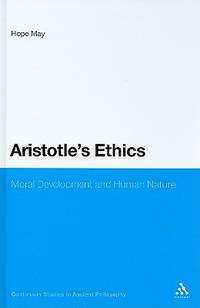
201091615Continuum. New. 2010. Hardcover. 0826491103 . FREE UPGRADE to Courier/Priority Shipping Upon Request - IN STOCK AND IMMEDIATELY AVAILABLE FOR SHIPMENT - Flawless copy brand new pristine never opened -- 204 pages. Description: "Aristotle's 'Nicomachean Ethics' is devoted to the topic of human happiness. Yet although Aristotle's conception of happiness is central to his whole philosophical project there is much controversy surrounding it. Hope May offers a new interpretation of Aristotle's account of happiness - one which incorporates Aristotle's views about the biological development of human beings. May argues that the relationship amongst the moral virtues the intellectual virtues and happiness is best understood through the lens of developmentalism. On this view happiness emerges from the cultivation of a number of virtues that are developmentally related. May goes on to show how contemporary scholarship in psychology ethical theory and legal philosophy signals a return to Aristotelian ethics. Specifically May shows how a theory of motivation known as Self-Determination Theory and recent research on goal attainment have deep affinities to Aristotles ethical theory. May argues that this recent work can ground a contemporary virtue theory that acknowledges the centrality of autonomy in a way that captures the fundamental tenets of Aristotles ethics." -- with a bonus offer-- . Continuum hardcover
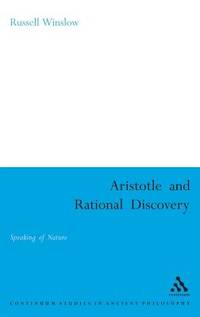
200791624Continuum. New. 2007. Hardcover. 0826496873 . FREE UPGRADE to Courier/Priority Shipping Upon Request - IN STOCK AND IMMEDIATELY AVAILABLE FOR SHIPMENT - Flawless copy brand new pristine never opened -- 160 pages. Description: "In this lively and original book Russell Winslow pursues a new interpretation of logos in Aristotle. Rather than a reading of rationality that cleaves human beings from nature this new interpretation suggests that for Aristotle consistent and dependable rational arguments reveal a deep dependency upon nature. To this end the author shows that a rational account of a being is in fact subject to the very same principle that governs the physical motion and generation of a being under inquiry. Among the many consequences of this argument is a rejection of both of the prevailing oppositional claims that Aristotle's methodological procedure of discovery is one resting on either empirical or conceptual grounds: discovery reveals a more complex structure than can be grasped by either of these modern modes. Further Winslow argues that this interpretation of rational discovery also contributes to the ethical debates surrounding Aristotle's work insofar as an ethical claim is achieved through reason but is not thereby conceived as objective. Again the demand for agreement in ethical/political decision will be disclosed as superseding in its complexity both those accounts of ethical decision as subjective for example 'emotivist' accounts and those as objective 'realist' accounts." -- with a bonus offer-- . Continuum hardcover