ARISTOTLEBiblio.com

59 résultats
1705428651London: Dan. Brown and Will. Turner 1705. Hardcover. Very Good. First edition. Octavo. 511pp. Later quarter goatskin with four raised banks stamped in gilt over blue cloth-covered boards. Pages evenly browned with some light wear soiling and tiny tears; very good and binding near fine. Dan. Brown and Will. Turner hardcover
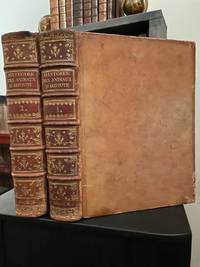
1783204<b>FIRST EDITION IN FRENCH. Including half-titles. Two leather bound volumes 8x10.5 are rubbed on the edges spines show some wear on raised bands and head/tail. Nice bookplate of C. Gulbranson on inside covers endpapers of handmade French marbled paper some tanning and light foxing. The first French translation of Aristotle's descriptive zoology. Text in Greek and French on facing pages. History of Animals is a natural history text by the Ancient Greek philosopher Aristotle who had studied at Plato's Academy in Athens. It was written in the fourth century BC; Aristotle died in 322 BC. Generally seen as a pioneering work of zoology Aristotle frames his text by explaining that he is investigating the what the existing facts about animals prior to establishing the why their causes. The book is thus an attempt to apply philosophy to part of the natural world. His method is to identify differences both between individuals and between groups. A group is established when it is seen that all members have the same set of distinguishing features; for example the birds all have feathers wings and beaks. This relationship between the birds and their features is identified as a universal. The History of Animals had a powerful influence on zoology for some two thousand years. It continued to be a primary source of knowledge until in the sixteenth century zoologists including Conrad Gessner all influenced by Aristotle wrote their own studies of the subject. </b> Published by Veuve Desaint hardcover
178310489Paris: Chez la Veuve DeSaint 1783. FIRST EDITION IN FRENCH. Including half-titles approbation and privilege du Roi. Volume I with the Greek and French translations on facing pages. Contemporary tree calf some wear to joints and corners; marbled edges some light waterstains in first volume. From the library of George Milton Smith with his bookplate.`. First edition. Camus' translation of Aristotle's descriptive zoology from Greek into French is a masterpiece of scholarship. This highly esteemed translation is much sought after for its extensive erudite commentaries and profound enlightenment of comparative anatomy. Divided into two books the first volume contains Aristotle's original Greek with Camus' French translation facing. Here he documents all the various manuscripts editions and translators cited in the work. The second volume a detailed study of natural history up to the modern time contains Camus' careful observations on the commentaries of other translators. This work is of particular importance for Camus' nomenclature of those living creatures originally described in Aristotle's account. He lists all of the animals found in Aristotle works including those "fanciful and primitive" and then details the differences in terms of the modern knowledge of natural history. <br /> <br /> So great was the influence of Aristotle that his teachings and thought were accepted and enlarged upon for nearly two millennia. He was acquainted with more than five hundred species of animals and had dissected and investigated in detail at least fifty kinds ranging over the entire animal kingdom. Many of his conclusions have stood the test of time. Among them may be mentioned his descriptions of the mechanisms of locomotion of the process of digestion in ruminants of the habits of bees of the mechanism of animal reproduction; his exposition of analogous structures in living bodies; and his methods of biological classification Eimas Heirs of Hippocrates 14.<br /> <br /> Camus 1740-1804 French revolutionist was a successful advocate before the Revolution. In 1789 he was elected by the third estate of Paris to the states general and attracted attention by his speeches against social inequalities. He was named archivist to the Constituent Assembly and in that capacity he organized the national archives and classified the papers of the different assemblies of the Revolution. He was restored to the office in 1796 and became absorbed in literary work. He remained an austere republican refusing to take part in the Napoleonic regime.<br /> <br /> This scarce work was included in Thomas Jefferson's library. Chez la Veuve DeSaint unknown
1799830021799. ARISTOTLE. ALBERTUS Magnus. Kurzgefasste Weiber-Buchlein. Enthalt Aristotels and Alberti Magni Hebammen-Kunst mit den darzu gehorigen Recepten. Harrisburg PA: Benjamin Mayer 1799. 10th ed. 24mo. 64 pp. In contemporary calf-backed boards. Close trimming to the fore-edge touches some text. Wear to the board edges nevertheless a remarkably well-preserved and attractive copy. Very good or better. Arndt 1173. Bristol B10844. Austin 1109. Brendle and Unger G19. While Bristol Austin and Brendle and Unger place this in Ephrata and from the press of G. Baumann Arndt notes this is a Harrisburg imprint from the press of Benjamin Mayers based on "typographical evidence." In terms of content Arndt has compared this with the 1796 edition and finds three chapters added: "Culpepper XVI" "Culpepper XII" and "Der Kaiserliche Schnitt." Arndt hypothesizes that the chapters likely come from Nicholas Culpeper's Directory for Midwives. Despite having been issued in several editions this early Pennsylvania German book on midwifery is rare in commerce. Text in German. unknown
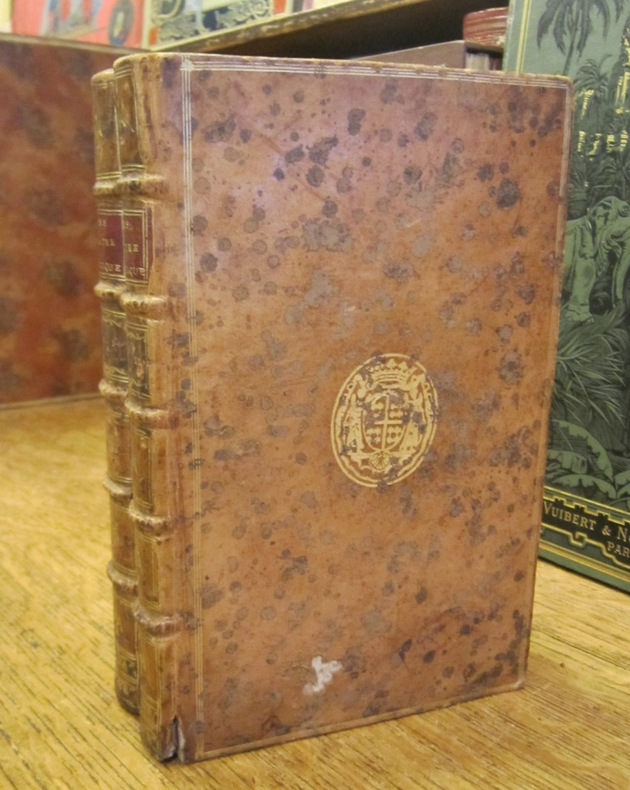
1771002357Paris Saillant & Nyon, Desaint 1771
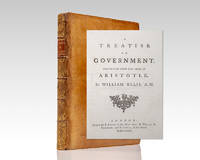
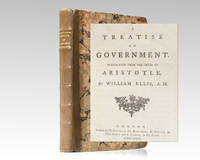
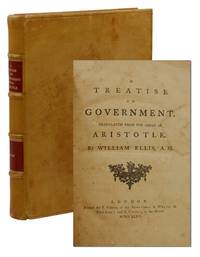
1776149288London: Printed for T. Payne at the Mew Gate; B. White in Fleet-street; and T. Cadell in the Strand 1776. First edition in English of Aristotle's' enormously influential work on government the only edition in the English language published during the 18th century. Quarto bound in full contemporary calf with elaborate gilt tooling to the spine in six compartments within raised gilt bands morocco spine label lettered in gilt gilt turn-ins. In good condition. A scarce and important work a copy of which was owned by Thomas Jefferson and influenced the drafting of the American Declaration of Independence. An important text in both the history of philosophy and in sparking the development of western political democracy. Ellis' translation was the first direct into English from the original Greek of Aristotle's "Politics." Loys Le Roy translated this work into French which was subsequently translated into English in 1597. Ellis' translation is considered more accurate and for many the most important translation in bringing Aristotle's treatise to enlightenment statesmen and philosophers. The bibliographer Lowdnes notes that Ellis' work appeared in this quarto edition 1776 priced at 15 shillings and was reprinted with little change in 1778. Lowndes praises Ellis' edition as "A faithful and perspicuous version." Aristotle's On Government via this English translation became a landmark text in the history of Western political thought a text which influenced late 18th and 19th century political thought in the English speaking world. Dr. B. E. Bryant notes that Thomas Jefferson owned a copy of the Ellis translation which influenced his drafting of the American Declaration of Independence: "Like most other well-educated individuals of his day Jefferson was thoroughly exposed to classical philosophy. We know for certain he owned a copy of the William Ellis 1776 translation of Aristotle's Politics and even cited Aristotle as one of the sources he used for the Declaration of Independence." Aristotle's "On Government" constitutes the first treatise of the conditions under which philosophy is possible within politics and thus the work that as much as any other founded political philosophy. The influence that this work has had on later political thinking is difficult to exaggerate and the fact that the work became available in a translation into English directly from the original Greek has been of the utmost importance to the development of political thought in England and America. Ellis' Aristotle is the only 18th century translation a an accurate and smoothly readable version that is still in print after more than 200 years. Printed for T. Payne, at the Mew Gate; B. White, in Fleet-street; and T. Cadell, in the Strand unknown
1776151205London: T. Payne 1776. First edition in English of this important work on government by Aristotle. Quarto bound in contemporary half calf over marbled boards full morocco spine label raised bands. In very good condition. Translated by William Ellis. An exceptional example of this cornerstone work. An important text in both the history of philosophy and in sparking the development of western political democracy. Ellis' translation was the first direct into English from the original Greek of Aristotle's "Politics." Loys Le Roy translated this work into French which was subsequently translated into English in 1597. Ellis' translation is considered more accurate and for many the most important translation in bringing Aristotle's treatise to enlightenment statesmen and philosophers. The bibliographer Lowdnes notes that Ellis' work appeared in this quarto edition 1776 priced at 15 shillings and was reprinted with little change in 1778. Lowndes praises Ellis' edition as "A faithful and perspicuous version." Aristotle's On Government via this English translation became a landmark text in the history of Western political thought a text which influenced late 18th and 19th century political thought in the English speaking world. Dr. B. E. Bryant notes that Thomas Jefferson owned a copy of the Ellis translation which influenced his drafting of the American Declaration of Independence: "Like most other well-educated individuals of his day Jefferson was thoroughly exposed to classical philosophy. We know for certain he owned a copy of the William Ellis 1776 translation of Aristotle's Politics and even cited Aristotle as one of the sources he used for the Declaration of Independence." Aristotle's "On Government" constitutes the first treatise of the conditions under which philosophy is possible within politics and thus the work that as much as any other founded political philosophy. The influence that this work has had on later political thinking is difficult to exaggerate and the fact that the work became available in a translation into English directly from the original Greek has been of the utmost importance to the development of political thought in England and America. Ellis' Aristotle is the only 18th century translation a an accurate and smoothly readable version that is still in print after more than 200 years. T. Payne hardcover
177681182London: T. Payne 1776. First edition in English of this important work on government by Aristotle. Quarto bound in three quarters leather over marbled boards gilt titles to the spine raised bands. In very good condition with light toning to the text and wear. Bookseller plate of George Gregory Bath Sept. 22 1936 on the front pastedown. Translated by William Ellis. An important text in both the history of philosophy and in sparking the development of western political democracy. Ellis' translation was the first direct into English from the original Greek of Aristotle's "Politics." Loys Le Roy translated this work into French which was subsequently translated into English in 1597. Ellis' translation is considered more accurate and for many the most important translation in bringing Aristotle's treatise to enlightenment statesmen and philosophers. The bibliographer Lowdnes notes that Ellis' work appeared in this quarto edition 1776 priced at 15 shillings and was reprinted with little change in 1778. Lowndes praises Ellis' edition as "A faithful and perspicuous version." Aristotle's On Government via this English translation became a landmark text in the history of Western political thought a text which influenced late 18th and 19th century political thought in the English speaking world. Dr. B. E. Bryant notes that Thomas Jefferson owned a copy of the Ellis translation which influenced his drafting of the American Declaration of Independence: "Like most other well-educated individuals of his day Jefferson was thoroughly exposed to classical philosophy. We know for certain he owned a copy of the William Ellis 1776 translation of Aristotle's Politics and even cited Aristotle as one of the sources he used for the Declaration of Independence." Aristotle's "On Government" constitutes the first treatise of the conditions under which philosophy is possible within politics and thus the work that as much as any other founded political philosophy. The influence that this work has had on later political thinking is difficult to exaggerate and the fact that the work became available in a translation into English directly from the original Greek has been of the utmost importance to the development of political thought in England and America. Ellis' Aristotle is the only 18th century translation a an accurate and smoothly readable version that is still in print after more than 200 years. T. Payne hardcover
1776140942627London: T. Payne B. White and T. Cadell 1776. First English Edition. Near Fine. First English edition and the first edition in the English language; translated by William Ellis directly from the Greek. Fireside poet James Russell Lowell's copy inscribed to him by his friend American transcendentalist writer and artist C.P. Cranch. <p>Quarto. 8.75 x 11 in. 428 12 index pp. Bound in somewhat recent full calf with four raised bands and red leather spine labels titled in gilt. Browning to title page first blank is reinforced at edges and title page is re-margined. A touch of soiling and staining to preliminary pages and page edges sporadic foxing and light toning throughout with several light pencil ticks in the margins. <p>This was the only English edition of Aristotle's Treatise on Government from the 18th-century. A copy of this very text was owned by Thomas Jefferson and was influential among the founding fathers of the United States of America. A lovely copy of a scarce and important book. T. Payne, B. White, and T. Cadell unknown