Aristoteles TegosBiblio.com

4 109 résultats
B9783036542546Hardback. New. hardcover
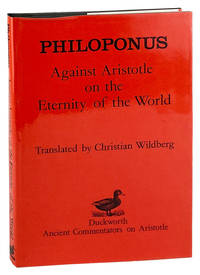
198727612London: Duckworth 1987. Near Fine/Very Good. London: Duckworth 1987. First Edition. Octavo; publisher's cloth in glossy red dust jacket; 6182pp. Minor shelf wear original price sticker to front jacket flap contemporary ownership signature to front free endpaper else Very Good or better. Duckworth unknown
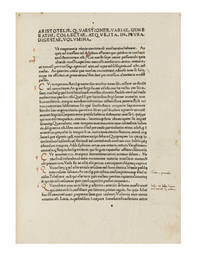
1472112<p>Very rare first edition mentioned by Goff of the<i> Introduction à la Philosophie de Platon</i> by Alcinous his disciple.</p><p>A superb and precious copy with huge margins ink rubricated initials and the first two letters illuminated the first one being enhanced in gilt.</p><p><b>Very rare first incunabula edition of the Introduction à la philosophie de Platon by Alcinous.</b></p><p>Given by Antoine Koburger.</p><p>It is the only one mentioned by Goff.</p><p>Goff A-365 ; Hain 620; Pellechet 419; Stillwell A-332 ; Proctor 1965 ; BMC II 412 ; Panzer p.9 ; Santander II n°58 ; A. A. Renouard <i>Catalogue de la bibliothèque d'un amateur</i> I p.174.</p><p>A superb and precious copy with rubricated initials in red ink and the first two letters illuminated the first one being enhanced in gilt. </p><p><i>"A rare piece."</i> Renouard</p><p>"<i>First very rare edition printed on long lines with no distinction of chapter or sections and without numbers signatures or catchwords. The totality of this volume is of 22 printed leaves: at the beginning there is a dedication epistle by the bishop of Tropea Petrus Balbus Pisanus author of this Latin version of Alcinous to the cardinal Nic. De Cusa ; then comes the text at the end of which we can read this subscription: Epitoma Alcinoi in disciplinaru Platonis definit. Anno salutis. M. CCCC. LXXII. Die vero XXIIII. Mensis Novebris."</i>Santander who lists this edition as being the first</p><p>Antoine Koburger 1443-1515 a German editor bookseller and one of the most distinguished and active printers of the 15th century was renowned for the "<i>Chroniques de Nuremberg</i>" he published in 1493.</p><p>Alcinous was popular in the 1st century CE.</p><p>A student of the school of Alexandria and faithful to its spirit he was one of the first to start blending into Plato's doctrine Aristotle's opinions and some oriental ideas. </p><p>There is sufficient proof of that in his <i>Introduction à la philosophie de Platon</i> a digest where he largely exposes this vast system while adding some foreign elements to it. For example when he speaks of spirits and demons he seems to know a lot more than Plato: to him some are visible and some invisible; he distributes them among all of the elements and tells us about their relationships their influence — before our eyes a complete demonology is born from which the only next step possible is towards magic." <i>Dictionnaire des Sciences philosophiques</i> pp.48-49 </p><p>We know of Plato and some of his texts; but there are only a few who have an accurate and precise idea of the whole philosophical system of the prince of philosophers. </p><p>Presenting to amateurs of philosophy a summarized tableau of what Platonism is was doing them a great favor. </p><p>This is what the Platonist philosopher Alcinous undertook and executed in this book that we can consider like a lost pearl in the dust of the centuries.</p><p><u>How intriguing it is to find gathered in a miniature frame a philosophical system that for so long sat at the highest level of the opinion especially nowadays when this kind of curiosity is hard to satisfy: for it is difficult to have in one's possession the complete works of Plato. </u></p><p><u>Plato's texts are numerous and quite diverse but there is no order that links the different treaties between them. This reduced map of Platonism must be considered very precious as it gives the mind the ability to grasp this vast ensemble at first glance. </u>J. J. Combes-Dounous</p><p>This translation of Alcinous' text is due to the talent of Pietro Balbus.</p><p><b>A superb and precious copy of this very rare incunabula edition with very wide margins height: 315 mm </b><b>rubricated initials in red ink with the first two letters illuminated the first one being enhanced in gilt.</b></p><p>The copy mentioned by BMC was only 303 mm high.</p><p>Provenance : Library of <i>Moreau</i> 10 December 1934 n° 18.</p> Antoine Koburger hardcover
19921718922Cornell University Press 1992. 1st Edition. hardcover. Used-Very Good. Cloth dj. Very little shelf-wear. Tight binding. Clean copy. Cornell University Press unknown
1996012408London: Duckworth and Co 1996. Cloth. Fine/Fine. 4to - over 9¾" - 12" tall. 182p. index English-Greek glossary. The series takes the writings of ancient writers living in the period 200-600 A.D. and reveals their interpretations of Greek thought and how much of this became interacted with the teachings of the Church. Duckworth and Co unknown
0332681947.Ghardcover. Good. Access codes and supplements are not guaranteed with used items. May be an ex-library book. hardcover
0332329275.Gpaperback. Good. Access codes and supplements are not guaranteed with used items. May be an ex-library book. paperback
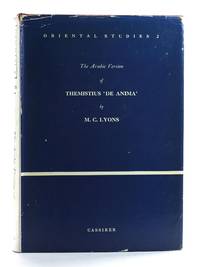
1973506046Bruno Cassirer 1973. Hardcover with Dust Jacket. NEAR FINE/Very Good. xviii 390pp. Smyth sewn binding in red hard covers gilt stamped spine. Light foxing to top edge exceedingly clean and sharp; DJ extremities a bit rubbed now wrapped in mylar. From the DJ: 'Aristotle's treatise on the Soul De anima was one of the most significant factors in the development of Islamic philosophy. In interpreting Aristotle's sometimes obscure thought however the Islamic philosophers were greatly influenced by the views of his most important commentators in anti-quity Alexander of Aphrodisias and Themistius. The latter's paraphrase of De anima was translated into Arabic and eagerly studied especially by Averroes who often refers to it in his own commentary on the book which in turn played an important role among the Latin Schoolmen. A Manuscript of this commentary by Themistius has recently been discovered in the Jarawiyyin mosque in Fez; it is edited here for the first time by Dr. M. C. Lyons. Its publication will make an important contribution to our interpretation of the psychological doctrines of the Islamic philosophers since it makes available Continued on back flap Continued from front flap one of the basic texts with which they worked. The elaborate Arabic-Greek and Greek-Arabic index facilitates the use of the text for studies on the history of these doctrines and of their Arabic terminology.'. Bruno Cassirer hardcover
1249066247.Gpaperback. Good. Access codes and supplements are not guaranteed with used items. May be an ex-library book. paperback
93244Hildesheim N.Y. Olms 1970. XVI464 p. Cloth. 21 cm Reprint of the edition London 1867 hardcover
0365240532.Ghardcover. Good. Access codes and supplements are not guaranteed with used items. May be an ex-library book. hardcover
1333805306.Gpaperback. Good. Access codes and supplements are not guaranteed with used items. May be an ex-library book. paperback
0331585995.Ghardcover. Good. Access codes and supplements are not guaranteed with used items. May be an ex-library book. hardcover
333710388X.Gpaperback. Good. Access codes and supplements are not guaranteed with used items. May be an ex-library book. paperback
0265527244.Ghardcover. Good. Access codes and supplements are not guaranteed with used items. May be an ex-library book. hardcover
0282664807.Gpaperback. Good. Access codes and supplements are not guaranteed with used items. May be an ex-library book. paperback
1332893554.Gpaperback. Good. Access codes and supplements are not guaranteed with used items. May be an ex-library book. paperback
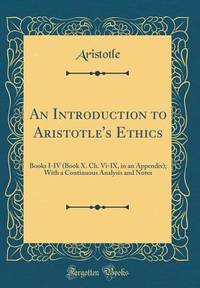
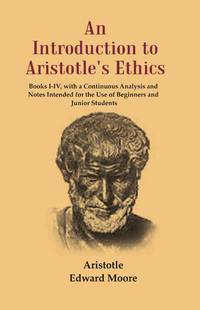
2023BIBHB0071404002023. Hardcover. New. About The Book: The same considerations must serve as an apology for language sometimes consciously loose and unphilosophical in the Analysis and Notes. The attempt to put such a treatise as that of Aristotle into such a �modern� light as may be intelligible to a reader ex hyp. Unacquainted with philosophical phraseology seems necessarily to involve the sacrifice of technical accuracy. This desire to appeal as far as possible to modern sympathies has occasioned a certain amount of diffuseness in parallel quotations from recent popular writers. The best thanks of the author are due to several friends who have kindly assisted him by their advice in various parts of the work: and he will feel grateful for any further criticisms or suggestions that may be offered to him. About The Author: Aristotle 384 B.C. - 322 B. C. Aristotle was born at Stagira in Macedonia in 384 B.C. At the age of 17 he went to Athens to study at Plato's Academy where he remained for about 20 years as a student and then as a teacher. When Plato died in 347 B.C. Aristotle moved to Assos a city in Asia Minor where a friend of his Hermias was ruler. After Hermias was captured and executed by the Persians in 345 B.C. Aristotle went to Pella the Macedonian capital where he became the tutor of the king's young son Alexander later known as Alexander the Great. In 335 when Alexander became king Aristotle returned to Athens and established his own school the Lyceum Aristotle's works were lost in the West after the decline of Rome but during the 9th Century A.D. Arab scholars introduced Aristotle in Arabic translation to the Islamic world. Edward Moore FBA 1835�1916 was an English scholar who specialized in Dante Alighieri. He was born at Cardiff educated at Bromsgrove Grammar School and at Pembroke College Oxford. For a time he was rector of Gatcombe Isle of Wight. From 1862 to 1864 he was fellow and tutor of Queen's College Oxford. In 1864 he became the principal of St. Edmund Hall and in early 1903 he was made canon of Canterbury Cathedral. He became an honorary fellow of Pembroke and Queen's colleges 1902 and received the honorary degree D.Litt. from the University of Dublin. The Title 'An Introduction to Aristotle's Ethics: Books I-IV with a Continuous Analysis and Notes Intended for the Use of Beginners and Junior Students written/authored/edited by Aristotle Edward Moore' published in the year 2023. The ISBN 9788121289849 is assigned to the Hardcover version of this title. This book has total of pp. 362 Pages. The publisher of this title is Gyan Publishing House. This Book is in English. The subject of this book is History. Size of the book is 14.34 x 22.59 cms Vol: hardcover
1355844983.Ghardcover. Good. Access codes and supplements are not guaranteed with used items. May be an ex-library book. hardcover
0198145624.Ghardcover. Good. Access codes and supplements are not guaranteed with used items. May be an ex-library book. hardcover
1981SONG0198145624Clarendon Press 1981-05-21. 1. hardcover. Used: Good. 0.67x7.56x5.00. Buy with confidence. Excellent Customer Service & Return policy. Clarendon Press hardcover
1981DADAX0198145624Clarendon Press 1981-05-21. 1. hardcover. New. 0.67x7.56x5.00. Buy with confidence. Excellent Customer Service & Return policy. Clarendon Press hardcover
1514104082Venice: Gregorium de Gregorijs 1514. Rare 16th century printing of Aristotle's Posterior Analytics; bound together with Spanish Franciscan theologian Antonius Andreas's best known work Quaestiones super XII libros Metaphysicae Aristotelis. Quarto bound in contemporary parchment over handmade paper-covered boards woodcut initials text in two columns. In very good condition. A rare and desirable collection. The Posterior Analytics is a text from Aristotle's Organon that examines demonstration definition and scientific knowledge. In the work Aristotle distinguishes 'demonstration' as a syllogism productive of scientific knowledge and 'definition' as the statement of a thing's nature: the meaning of its name or of an equivalent nominal formula. In the Prior Analytics syllogistic logic is considered in its formal aspect; in the Posterior it is considered in respect of its matter. The "form" of a syllogism lies in the necessary connection between the premises and the conclusion. Aristotle concludes the book with the way the human mind comes to know the basic truths or first principles which are not innate because people may be ignorant of them for much of their lives. Of all types of thinking scientific knowing and intuition are considered as only universally true where the latter is the originative source of scientific knowledge. Gregorium de Gregorijs hardcover
1993__3050017961Akademie-Verlag 1993. Hardcover. New. 1326 pages. German language. 9.44x6.69x2.83 inches. Akademie-Verlag hardcover
2023x-9355228341Classy Publishing 2023. Hardcover. New. 482 pages. 6.00x1.40x9.00 inches. Classy Publishing hardcover