ARISTOTE; SCALIGER Jules César; MAUSSAC Philippe-Jacques:Livre Rare Book
26 résultats
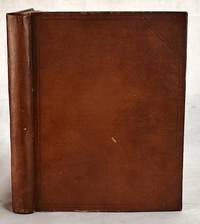
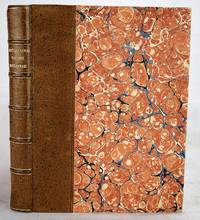
16199868Tolosae, Apud Dominicum & Petrum Bosc., 1619. In-folio de [32]-1248-[24] pages, plein veau fauve de l'époque, dos à 6 nerfs orné de fleurons, filets, roulettes et titre dorés, double filet doré encadrant les plats. Tampon de bibliothèque au titre.
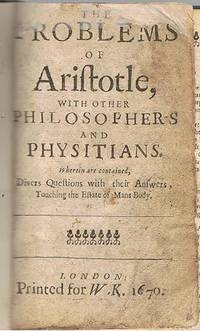
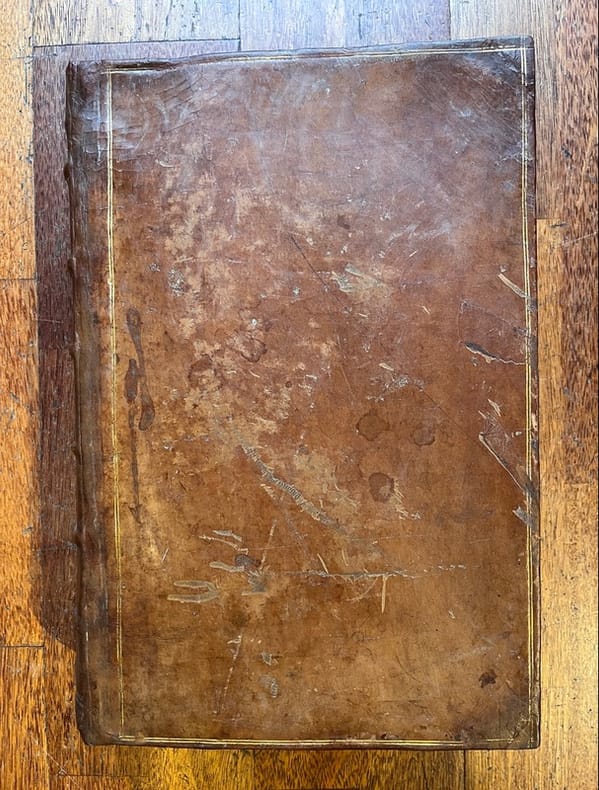
16705487London: printed for W.K. 1670. Book. Good. Full-Leather. 16mo - over 5¾" - 6¾" tall. 15.2cm x 9.4cm contemporary leather binding which shows wear new endpapers professional repairs to title page and last page book block is split between A2 and A3 but binding is otherwise firm. Falsely attributed to Aristotle. This is an early English printing. Covers questions of health physiology sexuality pregnancy etc. printed for W.K. Hardcover
160515243Aureliae Allobrogum:: Samuelem Crispinum 1605. 19 x 36.5cm. Single leaf. Title page volume 2. Red and black print. Trimmed. Large illustrated printers device. Mounted on larger plain leaf. Suitable for framing. Samuelem Crispinum, unknown
1606183871606 Aureliae Allobrogum (Genève), Petrus (Pierre) de La Rouiere, 1606-1607, 2 forts volumes in-8 de (14)-1546-(18)-(20) d'index des auteurs-(206) pp. d'index ; 1438 pp.-1 feuillet blanc-(172) pp. d'index, texte imprimé sur 2 colonnes, l'une étant l'impression en grec et l'autre l'impression latine, belle reliure germanique en peau de truie estampée sur les plats de différents encadrements et 2 plaques représentant sur un côté le blason du grand électeur de Saxe et sur l'autre le blason du Saint Empire germanique, quelques passages anciennement soulignés à la plume, anciens cachets ex-libris partiellement effacés sur les pages de titres, sinon bel exemplaire, sans mouillures, ni rousseurs, ni inscriptions manuscrites.
1671LI105Paris, Th. Moette, 1671, in-12o, 1f+156+1f. Ex-libris manuscrits et imprimes '1ERE TRAD. FRANCAISE...'(la 1e est par Cassandre, 1654 selon Hoffmann I, 352). Bayle la considere comme le meilleur ouvrage de philosophie de l'auteur en accord avec les notes enthousiastes de Rapin, Heinsius, Egger. Rare, non cite par Brunet dans une reliure contemporaine plein veau, dos decore, a nerfs, coiffes un peu usees.
1675146401675 Paris, Denys Thierry, 1675, in 12, 1 grand portrait-frontispice d'Aristote de profil gravé, (16)-476-(40) pp. (remarques et table des matières), rel. pastiche dans le style du XVIIe, demi-veau brun moucheté, dos à nerfs ornés de roulettes dorés, fers dorés, date en pied, papier brun moucheté ancien sur les plats, pièce de titre de chagrin bordeaux, bel ex.
170010975Paris, Josse, 1700. 6. Auflage 16° (10-15 cm). 218 S., 3 Bll. Ganzleder der Zeit über fünf Bünden mit vergoldeter Rückenverzierung
164678579BBUdine:, Nicolai Schiratti, 1646. 8°. (6) 389 (2), (8) 236 (4) S. 2 gestochene Taf. Einige Tabellen. Vignettenstempel auf Titelblatt. Schmuckleisten und Schmuckbuchstaben. Halbpergament mit umlaufendem Rotschnitt und neuem marmoriertem Einband 2 Bände. (ohne ein Vorsatzblatt [Band 1]; altersmässig, zum Teil stark gebräunt; Wasserflecken der Zeit; auf Vorsatz verso [Band 1] und auf Vorsatz [Band 2] Nummernbezeichnungen mit Rotstift)
160719838Venetiis i.e. Venice: Apud Sessas 1607. Hardcover. Good. 4 235 blank 8 56 fl. Signed: 4 A-Z8 Aa-Ff8 Gg4 a-b4 A-G8. E2 in first part mis-signed E4 Gg4 blank B1 in second part mis-signed E. Octavo old vellum over later boards later endpapers. Quite a bit of old restoration work including edges of many leaves guarded some wormholes repaired all very neatly and professionally done with no losses to text <br/><br/>Francisco Toledo 1532-1596 was born at Cordova Spain and studied philosophy and theology at Valencia under Domingo Soto and by the age of 23 he was teaching philosophy at Salamanca. He became a Jesuit in 1558 and in 1593 was the first Jesuit to be made a cardinal by Clement VIII. He was considered one of the most learned men of his time. A prolific author of popular philosophical theological and exegetical works this "Commentaria" originally published in Rome in 1572 was published in 17 editions. Text includes Ludovico Carbone's commentaries with separate title page same imprint as main text and pagination. The present edition is scarce only 1 copy on OCLC. Apud Sessas hardcover
162740095Excusa Typis Guolphgang Hofmanni, pro Bibliopolio Pal heniano hardcover
160418262CBFrankfurt, Ex Collegium Musarum Paltheniano, 1604. 8 Bll., 597 Seiten, 1nn Seite. Pergament der Zeit. Die Versandkosten für Kunstwerke und mehrbändige Werke können von den Standard-Versandkosten abweichen. Fliegender Vorsatz fehlt. Titelblatt mit gestochener Vignette und ergänztem Ausschnitt. Durchgehend vereinzelt alte Anstreichungen und Kommentare in Tinte.
1622a300106515Lugduni, Sumpt. Iacobi Cardon & Petri Cauellat. M. DC. XXII (Lyon, auf Kosten von Jakob Cardon und Petrus Cauellat [Cavellat], 1622). 2 Teile in einem Band (alles!): 6 Blätter (incl. zweifarbigem Titel); 288 Seiten; 1 Blatt (einfarbiger Zwischentitel); Seite 289 - 696; 15 Blätter (Indices). Späterer, lädierter Kalblederband über fünf Bünden, mit Goldprägung auf Rücken und Deckeln. (22,8 x 17,5 cm) Gr.8°. [10 Warenabbildungen]
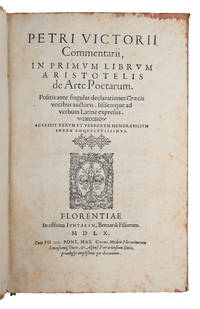
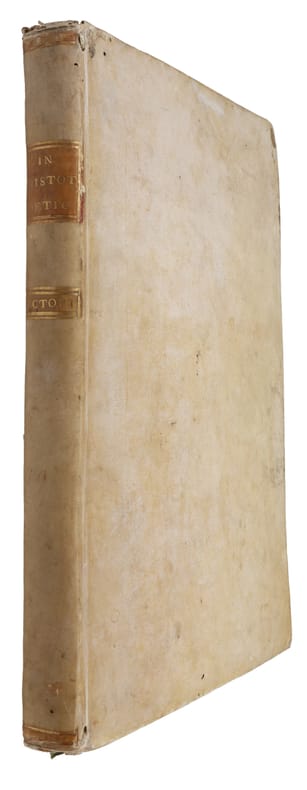
161062508Florence In officina Iuntaru Barnardi Filiorum 1560. Small folio. 18th century full vellum with gilt labels to spine. Wear to capitals and small worm tracts towrad opper hinges. Corners a bit bumped. A very nice and sturdy binding. Marbled edges. Some browspotting throughout. Small wormholes to blank margin of final leaf far from affecting imprint. Woodcut vignette to title-page and to verso of colophon-leaf. 10 308 12 ff. <br/><br/><em>The rare first edition of Vittore's main work his great edition translation and commentary on Aristotle's Poetics which is arguably the most important and influential commentary on the work ever published profoundly shaping our understanding and interpretation of Aristotelian literary theory. Petrus Victorius or Piero/ Pietro Vittore/Vettore 1499-1584 is not only the “first great editor of the Poetics†McMahon he is also considered "the greatest Greek scholar of Italy" Whibley “the leading Italian scholar of his time†Encycl. Britt. “the last great figure from that period in the domain of Greek studies†Willamowitz and “the foremost representative of classical scholarship in Italy during the sixteenth century which for Italy at least may well be called the “saeculum Victorianumâ€.†Sandys. His magnum opus and without doubt most influential work is his edition with commentary of Aristotle’s Poetics which is of seminal importance in several respects. It is crucial to our understanding of Aristotle’s great work shaping the way that all later scholars have read it. The understanding of Aristotle’s work on poetry came to define the way that we have understood literature and fiction ever since the Renaissance and Victorius is the leading interpreter. ““From the sixteenth century to Romanticism European literary theory used the term marvel or wonder It. meraviglia ammirabile Fr. merveille Sp. maravilla to designate everything that was on the conceptual margins of the poetics of probability and imitation. The discovery and complete reception of Aristotle’s Poetics between the fifteenth and sixteenth centuries resulted in the dissemination of an idea of poetry as the imitation of the actions of men whose main part was the plot or the structuring of actions ordered according to the laws of necessity credibility and probability. This formed the basis of Neo-Aristotelian poetics which determined the ways of thinking about literature and fiction for more than four centuries.†Vega p. 280. Especially the idea of “wonder†in Aristotle’s Poetics came to be one of the founding ideas of modern literary theory. And especially here Victurius’ reading is groundbreaking playing a central part in the reception and understanding of the work over the centuries to come. “A single editorial decision in just one passage and what is more in a complex fragmentary unfinished text like the Poetics affects the entire work…†Vega p. 284. “The text of the Poetics that can be read in the editions and translations of the sixteenth century and a large part of the seventeenth with one exception as we shall see NB. This exception is Victorius does not include the term alogon in the passage that deals with wonder. It does not appear in the first Greek edition the famous Aldine princeps of 1508 or in the Latin translations of the end of the fifteenth century; it is not in the edition and translation by Alexander Paccius or Pazzi the one most widely read in the sixteenth century neither does it appear in the edition with commentary by Francesco Robortello nor in Vincenzo Maggi’s Enarrationes nor in the vernacular commentaries of Ludovico Castelvetro and Alessandro Piccolomini. What is more a detailed revision of the history of the text reveals that no manuscript of the Poetics and no direct or indirect testimonies not even in the Arabic branch of its transmission have ever included the term alogon.†Vega p. 282. It is Victorius who is solely responsible for the reading that is generally accepted today as well. “The moment when the idea of irrationality alogon appears for the first time in Aristotle’s text can be identified without hesitation as 1560 which is the date when the edition translation and commentary on the Poetics by the philologist and Hellenist Pier Vettori or Victorius was printed on the presses of Giunti in Florence. Vettori is the one who first edits alogon even though no testimony provides him with this reading and he does so fully aware of his choice and its implications†Vega pp. 287-89. “The success of Victorius’ reading while not immediate was extraordinary.†Vega p. 287 Antonio Viperano accepts the reading “alogon†with all it involves De poetica libri tres Ricciboni adapts it in his edition of Aristotle’s Poetics Tasso embraces it Discorsi dell’arte poetica Discorsi del poema eroico and it is implicit in Alonso López Pinciano’s Philosophia Antigua Poetica. Vossius in 17th century Germany makes abundant glosses on alogon in his books on poetics and the commentators and translators of the “Poetics†in France preferred Victorius’ reading in every case. “Victorius’ conjecture seems to have convinced all editors and commentators who reproduce it without question in every case.†Vega p. 289. The influence of Victorius’ interpretation of Aristotelian literary theory that he presented in his magnum opus i.e. the present work was not limited to the use of specific words that changed the reception history of Aristotle’s Poetics. His entire view of poetry through an interpretation of Aristotle was highly original and came to define the way we understand literature in general. Victorius was one of the first to put forth the belief that heroic poetry should present a Platonic idea of perfect virtue contributing to the centuries long doctrine of the perfect hero as perfect exemplar and he was one of the first to revive Aristotle’s idea of purgation from tragedy still widespread today and to also understand the existence of a purgation from poetry. “He viewed poetry as a moderator of minds “By reading poetry men “become moderate in temper and their turbid motions are extinguished.†Poems “purge our minds of blemish and spotâ€. Vettori realized that Aristotle’s reference to catharsis should be applied to tragedy alone but he added that similar purgations could be achieved by other kinds of poetry effective however on other passions than pity and fear and with the aid of other instruments.†Hathaway pp. 292-93. Apart from his overall interpretation of Aristotle’s literary theory and his groundbreaking reading of the most central passages of the Poetics Victorius was also the first to determine that the Aristotelian text that has come down to us is not complete. “Victorius was the first to see that the treatise now known as the Poetics is only the surviving portion of a larger work.†Bywater p. XX. “during his lifetime five medals were struck in his i.e. Victorius’ honour and his portrait was painted by Titian… His fame was not limited to his own land or his own time. His scrupulous care and unwearied industry are lauded by Turnebus who declines to be compared with him even for a moment; the epiteths doctissiums optimus and fidelissimus are applied to him by the younger and the greater of the two Scaligers while Muretus calls him eruditorum coryphaeus; and similar eulogies might be quoted from Justus Lipsius. Dacius … and Graevius. He is described as having climbed the “hill of virtue†and taken his place on its summit between Cicero and Aristotle. In his funeral oration Salviati says of him in the personification of Italia: “Now no more shall distant peoples cross the snows of the Alps to see Victorius or men of mark arrive from every land to hear him; or princes hold converse with him. Now no more shall the works of scholars in all parts of the world be sent here for his approval; or youth learn wisdom from his lips.†Sandys pp. 139-40. “No one said a contemporary of his in a funerary laudatio ‘left Aristotle in a cleaner state purgatior’.†Baldi. _____________________________________________ Adams: 1905; Brunet V: 1179; Graesse I: 213 â€Ã©dition excellente quant à la critique†and noting that some copies bear the dates 1563 and 1564. Sandys: A History of Classical Scholarship Vol. II 2003 pp. 135-140. Hathaway Baxter: The Age of Criticism: The Late Renaissance in Italy. Cornell University Press 1962. A.Philip McMahon: On the Second Book of Aristotle's Poetics and the Source of Theophrastus' Definition of Tragedy Authors. In: Harvard Studies in Classical Philology 1917 Vol. 28 1917 pp. 1-46. Christopher Rowe: Petrus Victorius and Aristotle’s Eudemian Ethics Cambridge University Press online 2025. Vega Maria José: Wonder and the Irrational. The Invention of Aristotle’s Poetics in the Sixteenth Century. In: Nous Polis Nomos. Berlin Academia Verlag 2016. Baldi: Il greco a Firenze e Pier Vettori 1499–1585 Alessandria 2014 117. </em> hardcover
161062508Florence, In officina Iuntaru, Barnardi Filiorum, 1560. Small folio. 18th century full vellum with gilt labels to spine. Wear to capitals and small worm tracts towrad opper hinges. Corners a bit bumped. A very nice and sturdy binding. Marbled edges. Some browspotting throughout. Small wormholes to blank margin of final leaf, far from affecting imprint. Woodcut vignette to title-page and to verso of colophon-leaf. (10), 308, (12) ff.
165139491Leyden, Jean-Aimé Candy, 1651. Fol. Titel in Rot u. Schwarz m. Holzschn.-Vignette. Mit einigen Holzschn.-Vignetten u. -Initialen im Text. 4 Bll., 338 S. - Angeb. - Collegii Complutensis [...] disputationes in octo libros Physicorum Aristotelis [...]. Ebda., 1651. Mit Holzschn.-Titelvignette u. einigen Holzschn.-Vignetten u. -Initialen im Text. 4 Bll., 303 S. - Angeb. - Collegii Complutensis [...]. Disputationes in duos libros Phisicorum Aristotelis de generatione & corruptione, seu de ortu & interitu [...]. Ebda., 1651. Mit Holzschn.-Titelvignette u. einigen Holzschn.-Vignetten u. -Initialen im Text. 2 Bll., 118 (recte 188) S., Pgmt. d. Zt. m. handschriftl. Rückentitel u. dreiseitigem Farbschnitt.
1696018427London: Ben. Griffini Impensis Edvard Hall Bibliop. Catabr' 1696. Book. Very good condition. Hardcover. Early edition. Quarto 4to. iv 238 vi pages of text; complete. Title within double-rule border with ornament Latin; Greek and Latin in parallel columns. Measures 22 cm 4to. Rebound in cloth with a gilt-stamped leather spine label. Previous owner's engraved bookplate preserved and re-attached to the front pastedown. This bookplate is from circa 1820: G.W.F. Gregor the Gregor's of Trewarthenick House. Additional family name is written on the front endpaper"Franciscus Gregor 1706" which is accompanied by numerous notations. Another ownership name on the front endpaper is "Everett Lee Hunt Oxford 1926." Dr. Hunt was Dean emeritus at Swarthmore College joining their faculty in 1925 and had areas of academic concentration that included Aristotle. Signatures: A2 B-2H4 Ii2 Pages 54-55 83 185 188-189 192 223 incorrectly numbered 42-43 85 187 190-191 194 232 respectively. With side-glosses. Other titles: Aristotelis De rhetorica seu arte dicendi libri tres; De rhetorica seu arte dicendi libri tres; Arist. Rhetor. Ben. Griffini, Impensis Edvard Hall Bibliop. Catabr' Hardcover books
1696018427London: Ben. Griffini Impensis Edvard Hall Bibliop. Catabr' 1696. Book. Very good condition. Hardcover. Early edition. Quarto 4to. iv 238 vi pages of text; complete. Title within double-rule border with ornament Latin; Greek and Latin in parallel columns. Measures 22 cm 4to. Rebound in cloth with a gilt-stamped leather spine label. Previous owner's engraved bookplate preserved and re-attached to the front pastedown. This bookplate is from circa 1820: G.W.F. Gregor the Gregor's of Trewarthenick House. Additional family name is written on the front endpaper"Franciscus Gregor 1706" which is accompanied by numerous notations. Another ownership name on the front endpaper is "Everett Lee Hunt Oxford 1926." Dr. Hunt was Dean emeritus at Swarthmore College joining their faculty in 1925 and had areas of academic concentration that included Aristotle. Signatures: A2 B-2H4 Ii2 Pages 54-55 83 185 188-189 192 223 incorrectly numbered 42-43 85 187 190-191 194 232 respectively. With side-glosses. Other titles: Aristotelis De rhetorica seu arte dicendi libri tres; De rhetorica seu arte dicendi libri tres; Arist. Rhetor. Ben. Griffini, Impensis Edvard Hall Bibliop. Catabr' Hardcover
1619016801London: Edward Griffon 1619. Book. Good condition. Hardcover. First Edition. Octavo 8vo. vi pages 1-239 pages 1 blank page i tabulae page i blank iv pages. Original full calf binding very worn with front board detached. Several pages are dirty/soiled with a stain to the title page. Previous owner's names. Approximately 8.5 inches page height. Title within fine woodcut border and full page woodcut arms on verso of title. Enclosed and protected in an attractive clothbound clamshell box with a printed paper spine label. Edited by Theodore Goulston. Goulston is styled by Ant. a Wood "an excellent Latinist and a noted Grecian" and according to Dibdin his version of Aristotle's Rhetoric was the most popular of all 17th century vreions. This is the first printing of Aristotle's Rhetoric in Britain. Edward Griffon Hardcover books
16437081<p>Amsterdam: Jodocum Janssonium 1643 Contemporary stiff vellum with title in manuscript on spine. Twelvemo. Engraved title-page. A few pages a little browned. Generally a very good clean copy. Scarce: OCLC lists five copies two in North America.</p> Jodocum Janssonium, hardcover
16192011230008London: Typis Eduardi Griffini M.DC.XIX Edward Griffin 1619. First Edition. Hardcover. Good. First edition printed in England of Aristotle's Rhetoric. Quarto 22 x 17.5 cm. Bound in modern calf. 8 239 9 p. Large woodcut title engraving coat of arms verso of title. Printed in three columns with parallel Greek and Latin texts with commentary shoulder notes on third column. Early Oxford provenance: Charles Frayer sp 1717; Thomas Bland Exeter College Oxford. Signature on title and front blank. Refs: STC 766; Brunet I 476. <br> The translator Goulston 1572-1632 dedicated this volume to Prince Charles. After graduating from Oxford he worked as a physician in London and became a fellow of the College of Physicians. According to Dibdin Goulston's version of Aristotle's Rhetoric was the most popular 17th century version. Typis Eduardi Griffini, M.DC.XIX (Edward Griffin) hardcover
16191903070006Lutetiae Parisiorum: Typis Regiis 1619. First Edition. Hardcover. Good. 1st edition of Du Val's collected works of Aristotle. 2 volumes bound in 4. Folio 40 x 26 cm. Bound in contemporary Cambridge-style paneled calf. Rebacked and restored bindings. 6 raised bands. Title pages in red and black with engraved portrait of Aristotle. Text in Greek and Latin in parallel columns. Institutional blind stamps. Dampstaining along bottom scattered marginal staining. First title has its margins trimmed and conserved. Collated: Tome 1 part 1: 16 430 p.; T.1 p.2: 431-1251 p. 19; T.2 p.1: 3 469 p. 1; T. 2 p.2: 470-1104 p. 16. <br> According to John Lempriere's Classical Dictionary Aristotle's "treatises have been published separately; but the best edition of the works collectively is that of Duval." p. 96. Refs: Brunet I. 459. <br> Subtitle: "Veterum ac recentiorum interpretum ut Adriani Turnebi Isaaci Casauboni Julii Pacil studio emendatissima. Cum Kyriaci Strozae Patritii Florentini libris duobus Graecolatinis de Republica in supplementum politicorum Aristotelis. Sed nouissimae huic editioni omnium quae hactenus prodierunt ornatissimae accessit breuis ac perpetuus in omnes Aristotelis libros commentarius siue Synopsis Analytica Doctrinae Peripateticae non antehac visa; in qua ut in expeditiore tabella Aristotelis philosophia omnis provt ea suo ordine descripta est perspicue breuiterque indicatur & pro rerum dignitate exponitur. ; Authore Guillelmo Du-Val Pontesiano Philosophiae Graecae & Latinae in Parisiensi Acade" <br> This is an oversized or heavy book which requires additional postage for international delivery outside the US. Lutetiae Parisiorum: Typis Regiis hardcover
16191907170004London: Edward Gifffin; Thomas Snodham 1619. First Edition. Hardcover. Very Good. First British edition of two works of Aristotle Rhetoric and Poetics both edited by Theodore Goulston. Printed in 1619 and 1623 respectively. Fine modern 1/4 speckled calf over marbled boards. Gilt ruled raised bands with 6 spine compartments. Collated: Aristotle's Rhetoric: vi 239 vi 2 blank. Aristotle's Poetics: iv. 74 iv. Both works title pages printed within engraved woodcut border large woodcut royal coat of arms on title versos. Parallel Greek and Latin texts. STC 2nd ed. 759. <br> The translator Goulston 1572-1632 dedicated this volume to Prince Charles. After graduating from Oxford he worked as a physician in London and became a fellow of the College of Physicians. According to Dibdin Goulston's version of Aristotle's Rhetoric was the most popular 17th century version. ARISTOTELOUV TECNHV RHTORIKHV BIBLIA TRIA. London: Edward Gifffin; Thomas Snodham hardcover
1619016801London: Edward Griffon 1619. Book. Good condition. Hardcover. First Edition. Octavo 8vo. vi pages 1-239 pages 1 blank page i tabulae page i blank iv pages. Original full calf binding very worn with front board detached. Several pages are dirty/soiled with a stain to the title page. Previous owner's names. Approximately 8.5 inches page height. Title within fine woodcut border and full page woodcut arms on verso of title. Enclosed and protected in an attractive clothbound clamshell box with a printed paper spine label. Edited by Theodore Goulston. Goulston is styled by Ant. a Wood "an excellent Latinist and a noted Grecian" and according to Dibdin his version of Aristotle's Rhetoric was the most popular of all 17th century vreions. This is the first printing of Aristotle's Rhetoric in Britain. Edward Griffon Hardcover
1629110799Paris France: Societatem Graecarum Editionum 1629. Hardcover. Very Good. Elephant Folio 15 - 23'' tall. Hardcover. Book Condition: Very Good. Societatem Graecarum Editionum Paris France 1629. In parallel Latin and Greek. 676 pages. Published in 1619 this copy is 1629. 6-ribbed full brown leather gold decor on spine red page ends marbled endpapers similar to Placard title page in black and white. Nice Firm copy ! Light general wear. Leather worn at spine/boards and borders. All text pages very good no foxing no tape. Size: Elephant Folio 15 - 23'' tall. Tome II Contents: In quo libri ethicorum ad nicomachum decem ; maiorum moralium duo ; eudemiorum septem ; de virtutibus unus ; de republica octo ; kyriaci strozae duo politicorum ; oeconomicorum aristotelis duo ; rhetoricorum ad theodocten tres ; ad alexandrum unus ;poeticorum unus ; problematum sectiones triginta octo ; metaphysicorum libri quatuordecim ; de plantis duo ; de secretiore parte divinae sapientiea secundum aegyptios quatuordecim graece et latine continentur : quorum interpretes sequens pagina exhibebit. Classics/Collectors Series::Classics Latin/Greek Latin/Greek Shipbig Shipbig Societatem Graecarum Editionum hardcover
160635651606 deux tomes reliés en un volume, reliure janséniste d'époque en plein vélin ivoire parcheminé (jansenist's binding full vellum) in-octavo, dos long (spine without raised band), titre manuscrit et date à l'encre brune sur le dos (handwritten title on the spine), plats muets (cover without text) avec fermoirs à cordons (sans les cordons), tranches lisses (smooth edges), gouttière non rognée (no smooth fore-edge) , ex-libris (book-plate), sans illustration (no illustration) excepté la marque de l'imprimeur gravée sur bois (engraving wood) en noir sur chaque page de titre, très rares et légères rousseurs (rares and lights redness marks), trés légères cicatrices de mouillures marginales (scars of waterstains) en fin de volume, léger manque de papier sur 2 centimètres carrés en marge et affectant légèrement la compréhension du texte de la page 288 de la "Rhétorique" d'Aristote (lack of paper, light lake of text on page 288 of the first book), 1feuillet d'index + 288 pages pour la "Réthorique" d'Aristote , 356 pages pour la "Paraphrase" de Riccoboni, 1606 Hanoviae : apud heredes A. Wecheli, C. Marnium et J. Aubrium,