43 résultats
1775606571Wittenberg, Zimmermann, 1775. 178 S., 4 Bl., 250 S. Ldr. d. Zt. Einbd. leicht berieben. Rücken gering beschäd.
171744194Leipzig, Grosse & Gleditsch, 1717. 4to. In: ""Acta Eruditorum Anno MDCCXVII"". The entire volume offered in contemporary full vellum. Hand written title on spine. A yellow label pasted on to top of spine. A small stamp to title-page and free front end-paper. Library label to pasted down front free end-paper. As usual with various browning to leaves and plates. Pp. 317-322" Pp. 322-336 Pp. 353-360 Pp. 360-362. [Entire volume: (4), 553, (39) pp. + seven engraved plates.].
171244073Leipzig, Grosse & Gleditsch, 1712. 4to. In: ""Acta Eruditorum Anno MDCCXII"". The entire volume offered in contemporary full vellum. Hand written title on spine. A yellow label pasted on to top of spine. A small stamp to title-page and free front end-paper. Library label to pasted down front free end-paper. As usual with various browning to leaves and plates. Pp. 167-69. [Entire volume: (2), 555, (35) pp. + five engraved plates.].
175942999(Berlin, Haude et Spener, 1759). 4to. No wrappers as issued in ""Memoires de l'Academie Royale des Sciences et Belles Lettres"". tome XIII, 1757. Titlepage (Classe de Philosophie Spéculative) and pp. (451-)522.
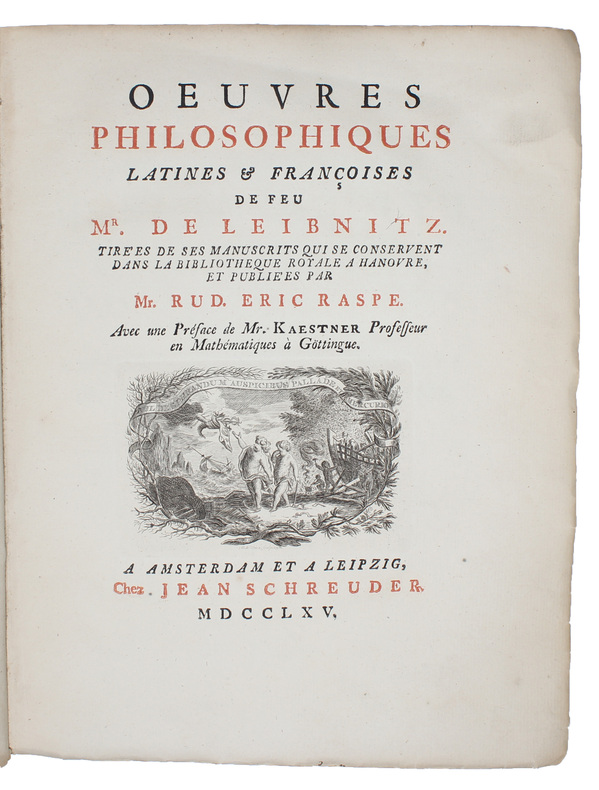
176538096Amsterdam et Leipzig, Chez Jean Schreuder, 1765. 4to. Uncut in the original marbled boards. Professionally rebacked preserving almost all of the original back. The fragile orginal binding is here preserved in its entirety, and it has quite a bit of overall wear. Apart from a small hole to two leaves in the index, affecting ab. one work on each of the four pages, it is internally nice and clean. Title-page printed in red and black. Beautiful eng. title-vignette and a few other woodcut vignettes and initials. (4), XVI, (2), 540, (18) pp.
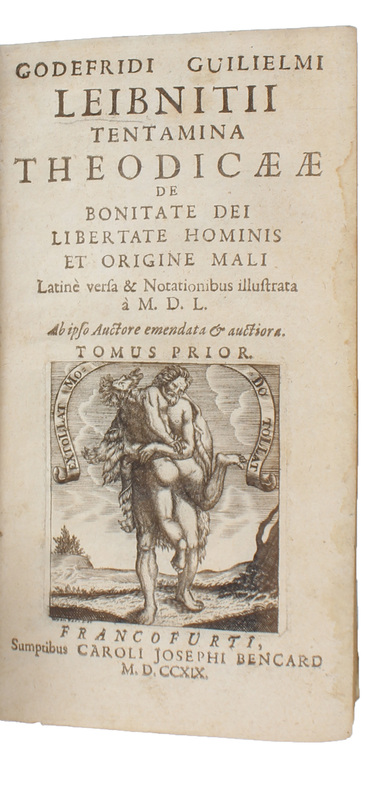
171949802Franckfurt, Bencard, 1719. 8vo. Contemp. full vellum. A few small brownspots to covers. Large engraved titlevignette. (48),(40),408,(12) pp. 1 folded table (between p.48/49). Clean and fine.
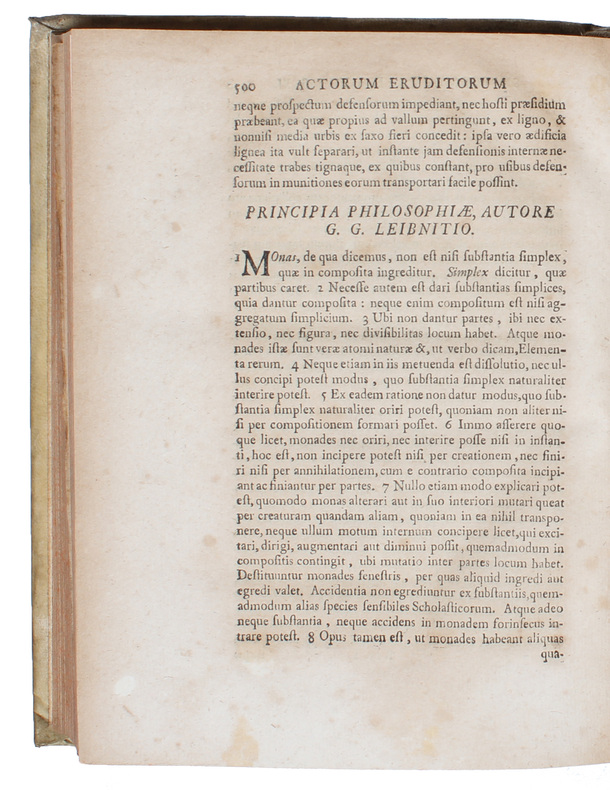
172149396Leipzig, 1721. 4to. Both entire volumes (Acta Eruditorum 1721 + Supplementa VII, 1721) present, in uniform contemporary full vellum bindings with handwriting to spines. A small later label to top of spines. Old handwritten ex libris-inscription to top of both title-pages as well as a small stamp. The supplement-volume with an additional stamp to title-page, and both volumes with library label (Archiv des k.k. militär.-geograf Institutes) to pasted down front free end-paper. As usual some brownspotting. A nice set. pp. 500-514 (Supplement-vol.) + pp. 94-95. [Entire volumes: (2), 537, (39) pp. + three plates (Suppl.-vol.) + (4), 547, (42) pp. + five plates].
174046487Amsterdam Francois Changuion 1740. Small 8vo. Bound in 2 fine contemp. full calf. Profusely gilt spines title-and tomelabels in leather with gilt lettering. Gilt border on covers. Titlepages in red/black with engraved vignettes. CII2429;6550 pp. and 2 engraved plates each with 3 portraits Leibniz Newton Clarke. Printed on good paper. Internally fine and clean. <br/><br/><em>Scarce collection which contains among other correspondences the correspondence of Leibnitz and A.S. Conti on the dispute on the invention of the calculus and also Newton's remarks and Leibnitz's letter to him.Babson 233 the 3rd edition - Ravier: 410. - Gray: 380. </em> hardcover
174046487Amsterdam, Francois Changuion, 1740. Small 8vo. Bound in 2 fine contemp. full calf. Profusely gilt spines, title-and tomelabels in leather with gilt lettering. Gilt border on covers. Titlepages in red/black with engraved vignettes. CII,(2),429(6),550 pp. and 2 engraved plates, each with 3 portraits (Leibniz, Newton, Clarke). Printed on good paper. Internally fine and clean.
171958539Leipzig: Johan. Grossii Haeredes Joh.Frid. Gleditsch & Fil. Thomam Fritschium / Typis Bernardi Christop. Breitkopfii 1719. Hardcover. Near Fine. Quarto. Contemporary vellum. 540 pp. Indices errata. Four engraved plates one folding. Old institutional bookplate a nice near fine copy. Text in Latin. A volume in an annual series of books published from 1682 to 1734 containing surveys of recent advances in science and literature. Contains contributions by Leibniz and others. An attractive copy. Johan. Grossii Haeredes, Joh.Frid. Gleditsch & Fil., Thomam Fritschium / Typis Bernardi Christop. Breitkopfii hardcover
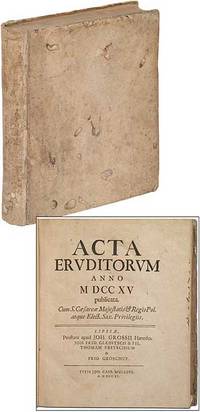
171556335Leipzig: J.OH. Grossii Haeredes Joh.Frid. Gleditsch & Fil. Thomam Fritschium & Frid. Groschuf 1715. Hardcover. Very Good. Quarto. 549 pp. Indices. Seven engraved plates three are folding. Contemporary stiff pastepaper boards. Some spotting to the boards still a sound very good copy. Text in Latin. A volume in an annual series of books published from 1682 to 1734 containing surveys of recent advances in science and literature. Includes Leibniz de Origine Francorum disquisitio. An attractive copy. J.OH. Grossii Haeredes, Joh.Frid. Gleditsch & Fil., Thomam Fritschium & Frid. Groschuf hardcover
171744194Leipzig Grosse & Gleditsch 1717. 4to. In: "Acta Eruditorum Anno MDCCXVII". The entire volume offered in contemporary full vellum. Hand written title on spine. A yellow label pasted on to top of spine. A small stamp to title-page and free front end-paper. Library label to pasted down front free end-paper. As usual with various browning to leaves and plates. Pp. 317-322; Pp. 322-336; Pp. 353-360; Pp. 360-362. Entire volume: 4 553 39 pp. seven engraved plates. <br/><br/><em>First printing of the famous Libnitz-issue of Acta Eruditorum published a year after the death of Leibnitz including the renowned obituary by the German philosopher Christian Wolff. In 1706 Leibniz recommended Wolff for the Professorship at Halle the post Wolff held for seventeen years until his dismissal and in 1711 Leibniz sponsored Wolff's membership to the Berlin Academy. It is also mentioned that during the year of Leibniz's death in 1716 Leibniz visited Wolff in Halle when returning to Hanover from Vienna. To honor Leibnitz memory Wolff undertook the project of writing ELOGIUM GODOFREDI GUILIEMI LEIBNITII a treatise of the life of Leibnitz. As early as 1679 George I acting as Leibnitz patron directed him to write the history of the house of Brunswick. Immediately after he began arranging material he had collected. The work was however only the preparatory steps when Leibnitz died in 1716 and the work was never published. The present paper NOTITIA DE HISTORIA BRUNSUICENSI is the only part of the work which could have become a opus magnum with historiography that has ever been published. The volume also contains:Goldbach Christian. Temperamentum Musicum Universale. Pp. 114-15.And many other papers by influential contemporary mathematicians philosophers and historians. </em> hardcover
171244073Leipzig Grosse & Gleditsch 1712. 4to. In: "Acta Eruditorum Anno MDCCXII". The entire volume offered in contemporary full vellum. Hand written title on spine. A yellow label pasted on to top of spine. A small stamp to title-page and free front end-paper. Library label to pasted down front free end-paper. As usual with various browning to leaves and plates. Pp. 167-69. Entire volume: 2 555 35 pp. five engraved plates. <br/><br/><em>First printing of one of Leibniz's latest publications in which he proposed an interpretation of infinitesimals by a comparison of bodies of different extensions. The paper is a response to to a problem raised by French philosopher and mathematician Antoine Arnauld who wrote an important philosophical work known as "The Logic of Port-Royal" from 1662 and "Geometry" 1667. In the book he includes an example of symbolic rules that he considers to be against our basic intuitions on magnitudes and proportions. His reasoning goes as follows "Suppose we have two numbers a larger and a smaller one. The proportion of the larger to the smaller one should evidently be larger than the proportion of the smaller to the larger one. But if we use 1 as the larger number and - 1 as the smaller one this would lead to 1/-1 > -1/1 which is against the rules of algebra". Heeffer The Methodological Relevance of the History of Mathematics for Mathematics Education 1992.Leibniz saw this as a genuine mathematical problem but argued that the division should be performed as a symbolic calculation. "Following Leibniz the infinite appeared in two forms as the i Contiuous infinite and ii the discrete infinite. The status of the differentials is closely related to the status of the infinite. . As a consequence there is no clear and consistence distinction between continua of different kind related to i geometry and to ii mechanics. . Leinbiz did neither consequently argue mathematically or arithmetically nor consequently geometrically phenomenologically and mechanically. But The correlation between mathematics and physics is as impressive as possible. Suisky Euler as physicist 2009 p. 89-90.The volume also contains:Bernoulli Johann. Angulorum arcuumque sectio indefinita per formulam universalem expressa. Pp. 274-277; 329-30.And many other papers by influential contemporary mathematicians philosophers and historians. </em> hardcover
178260306Toulouse, 1782 et 1788, , 2 ouvrages en 1 volume in-4 de 22 pages et 1 planche, puis de 40 pages, demi-veau moderne, dos lisse portant une pièce de titre, Deux mémoires en édition originale tirés des "Histoire et mémoires de l'Académie royale des sciences, inscriptions et belles lettres de Toulouse" (pages 43-64 du premier volume paru en 1782, et pages 29-72 du troisième volume publié en 1788). Roger Martin, appelé aussi Abbé Martin jusqu'à la Révolution, naquit en 1742 à Estadens dans la Haute-Garonne ; brillant élève de sciences, il fut nommé professeur de philosophie à 20 ans au Collège Royal de Toulouse. Passionné de physique et de mathématique, il parvint à faire instaurer dans ce même Collège un cabinet de physique expérimentale ; les leçons qu'il y professait eurent un grand succès. Dans les deux présents mémoires, lus à sept ans d'intervalle devant l'Académie de Toulouse, l'auteur pose le problèmes de l'infini mathématique à l'aune de la méthode du calcul différentiel initié par Newton et développé par Leibniz, tout en appréhendant ses méthodes nouvelles et modernes par le biais de "la méthode des Anciens, connue sous le nom de méthode d'exhaustion ou des limites". Traces de mouillures anciennes sur le premier mémoire. Couverture rigide
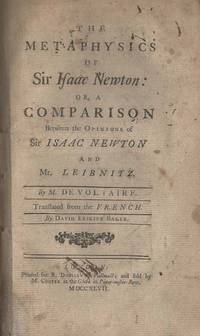
174731752AB1747. First English Edition. London Printed for R.Dodsley 1747. Octavo. 72 pages. Modern cloth. The bookblock with signs of stitching to the inner margin possibly used to be part of a Sammelband. Last three leaves with paper-restoration and manuscript inscription to last page looks like a 18th century gift-inscription. With numerous manuscript - annotations in the tracts of George Berkeley namely in "A Word to the Wise" "Farther Thoughts on Tar-Water" "The Querist". From the library of Daniel Conner Manch House County Cork. Bound with: "Berkeley George Bishop of Coyne - "A Miscellany Containing Several Tracts on Various Subjects. By the Bishop of Cloyne. London Printed for J. and R. Tonson and S.Draper 1752. VI 267 1 pages. Title-page witme minor paper-restoration. This wonderful collection by the eminent ANglo-Irish Philosopher includes the following Pamphlets / Tracts as called for: 1. Farther Thoughts on Tar-Water 2. An Essay towards preventing the Ruin of Great-Britain 3. A Discourse addressed to Magistrates and Men in Authority. Occasioned by the enormous Licence and Irreligion of the Times. 4. A Word to the Wise - Or an Exhortation to the Roman Catholic Clergy of Ireland This section "A Word to the Wise" includes several interesting annotations: a. an underlining of the sentence: "Seeing you are obnoxious of the Law" with a comment "Oh! infamous" b. annotation: "the catholic clergy cannot be accused even by there greatest enemies of having been influenced by interested motives therefore this hint of his lordship was not of much avail" 5. A Letter to the Roman Catholics of the Diocese of Cloyne 6. Maxims concerning Patriotism 7. The Querist - Containing several Queries proposed to the Consideration of the Public 8. Verses on the Prospect of Planting Arts and Learning in America 9. A Proposal for the better supplying of Churches in our Foreign Plantations and for converting the Savage Americans to Christianity by a College to be erected in the Summer Islands otherwise called The Isles of Bermuda 10. A Sermon preached before the Incorporated Society for the Propagation of the Gospel in Foreign Parts; at their Anniversary Meeting in the Parish-Church of St.Mary-le-Bow in 1731 11. De Motu ; sive de motus principio & natura & de causa communicationis motuum ______________________________________________________________________________ hardcover
1766301628-1Wien, J. L. Kaliwoda 1766. 2 Bll., 38, 39 S., 4 Bll. Neuer Interims-Kartonband.
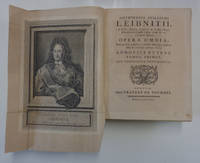
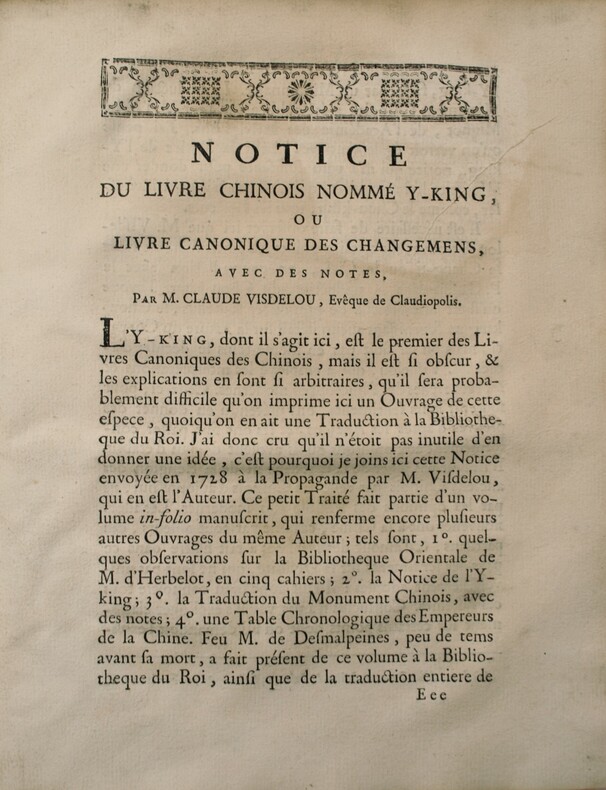
1768009245<p>Genevae: Apud Fratres De Tournes 1768. Alla pagina di occhiello: "Gothofredi Guillelmi Leibnitii Opera omnia. In sex tomos distributa". Sei tomi in sette volumi 25x20 cm legatura coeva in mezza pelle con dorso ornato e dorato piatti in cartone marmorizzato con usure; un paio di volumi risultano incurvati qualche spellatura alla cerniera e al dorso di due volumi. Gora vistosa al tomo 1 da pag. C a 70 che ha increspato le pagine che poi sfuma in angolo. Gora al margine delle prime pp del tomo 2 fino a p. 18 e poi all'angolo superiore di p. 219-307. Foretto di tarlo senza gravità all'angolo inferiore delle pp 9-30 del tomo 3. Fioriture e tracce di antica umidità alle risguardie dei primi due tomi. 40 tavole in b/n ripiegate fuori testo altre figure e tabelle anche a piena pagina nel testo. Il legatore settecentesco ha scelto di dividere il tomo IV in due volumi numerati 4 e 5 al dorso con la conseguenza di far "slittare" anche i numeri degli ultimi due tomi numero 6 per il tomo V e numero 7 per il tomo VI. L'opera è così articolata: Volume 1: Tomus primus quo theologica continentur. 2-IV-CCXLIV-790 pagine antiporta incisa ripiegata con ritratto di Leibnitz. Segnatura: a-gg4 hh2; A-Ggggg4 - Volume 2: Tomus secundus in duas partes distributus quarum 1. Continet Logicam & Metaphysicam; 2. Physicam generalem Chymiam Medicinam Botanicam Historiam Naturalem Artes &c. 2-VIII-400-291-1 pagine 12 tavole ripiegate in fine. Segnatura: 2ast.4 A-Ddd4 Tomo II parte I; A-Nn4 Oo2 Tomo II parte II - Volume 3: Tomus tertius continens opera mathematica. 2-VIII-LV-1-663-1 pagine XXV tavole ripiegate in fine. Segnatura: piè di mosca4 a-Oooo4 - Volumi 4 e 5: Tomus quartus in tres partes distributus quarum 1. continet Philosophiam in genere & opuscula Sinenses attingentia. 2. Historiam & Antiquitates. 3. Jurisprudentiam. Volume 4: VIII-216-285 pagine; segnatura: 2piè di mosca4 A-Dd4 Tomo IV parte I; A-Nn4 Tomo IV parte II. Volume 5: 2-647-1 pagine; segnatura: A-Mmmm4 Tomo IV parte III - Volume 6: Tomus quintus continens opera philologica. VIII-632 pagine; segnatura: croce latina4 A-Kkkk4. Tra le pagine 512 e 513 è stata inserita dal rilegatore una tavola pertinente al Tomo IV l'esatta posizione è stata tagliata dalla rifilatura - Volume 7: Tomus sextus in duas partes distributus quarum 1. continet philologicorum continuationem 2. collectanea etymologica. VI-2-334 2-344 pagine; segnatura: 2croce latina4 A-Tt4 parte I A-Vv4 Parte II. Tra le pagine 88 e 89 è stata inserita dal rilegatore una tavola pertinente al Tomo IV parte II pagina 88. In lingua latina prima edizione delle opere di Leibniz. Peso: 9500 gr.</p> Apud Fratres De Tournes
1770PHO-1193Paris: Chez N.M. Tilliard, 1770. in-4 , (24x20) , cxliv-474pp-1ff , illustré de 4 planches , relié demi cuir époque , pièce de titre (petit manque) , papier des plats refait , tranches rouges , vieille mouillure ,début de fente, coiffe de pied courte , 2 planches détachées.
172046329Amsterdam D. Mortier 1720. Bound in one contemporary full calf. Spine richly blindtooled. XLI3520 pp. 1 fold. table. A fine clean copy. <br/><br/><em>The scarce third edition of Leibnitz' importent treatise on the goodnes of God the free will of man and the causes of evil in the world The principal subject of the work being the problem of liberty and free will. It is the only larger philosophical work published by Leibnitz himself.Ravier No 67 the first ed. from 1710 - PMM: 177 1710-edition. </em> unknown
175942999Berlin Haude et Spener 1759. 4to. No wrappers as issued in "Memoires de l'Academie Royale des Sciences et Belles Lettres". tome XIII 1757. Titlepage Classe de Philosophie Spéculative and pp. 451-522. <br/><br/><em>First appearance of this remarkable mathematical correspondance comprising 29 letters mostly of mathematical content and after the death of Herman leading to some controveries in relation to priorities.Ravier "Bibliographie des Oeuvres de Leibniz" No. 465. </em> unknown
172046329Amsterdam, D. Mortier, 1720. Bound in one contemporary full calf. Spine richly blindtooled. XLI,(3),520 pp. + 1 fold. table. A fine clean copy.
176538096Amsterdam et Leipzig Chez Jean Schreuder 1765. 4to. Uncut in the original marbled boards. Professionally rebacked preserving almost all of the original back. The fragile orginal binding is here preserved in its entirety and it has quite a bit of overall wear. Apart from a small hole to two leaves in the index affecting ab. one work on each of the four pages it is internally nice and clean. Title-page printed in red and black. Beautiful eng. title-vignette and a few other woodcut vignettes and initials. 4 XVI 2 540 18 pp. <br/><br/><em>First edition thus being the first collected edition of Leibnitz' philosophical works in French and Latin and containing the FIRST PRINTING of one of Leibnitz' most important philosophical works his "Nouveaux essays sur l'entendement humain" New Essays on Human Understanding in which he attacks and refutes Locke and his "Essay on Human Understanding" and gives important testimony to his own philosophical ideas. With its 496 pages this extensive work takes up most of this collection of philosophical works and it also constitutes one of his largest and most important of his philosophical works. As explained by Raspe the editor in his preface to this publication "LES NOUVEAUX ESSAIS SUR L'ENTENDEMENT HUMAIN qui sont la partie principale de recueil sont connûs trés imparfaitement par l'histoire de la Philosophie de Leibnitz que Mr. Ludovici a publiée" p. X and the reason why the work was known even though it had not been published is because of a letter that Leibnitz had written in 1714 in which he explains why he did not wish to publish the work. Raspe quotes the letter p. X from which it becomes clear that Leibnitz had not wished to publish an attack on Locke and his work because Locke had died in 1704 the same year that Leibnitz had actually written the work and because Leibnitz was against publishing refutations of dead authors: "Mais je me suis degouté de publier des refutations des Auteurs morts quoiqu'elles dissent paroitre Durant leur vie & étre communiqués à eux memes". Raspe points to the nobleness of this decision but he also points to what could be other reasons for Leibnitz not wishing to publish his seminal work one of them being that towards the end of his life he died in 1716 he did not wish to enter into any more controversies with the British since he was already engaged in two very important ones that occuopied much of his time and energy: The first concerned the invention of the differential calculus the second was against Mr. Clarke on liberty and important metaphysical and theological questions. Another reason could also be that he did not want to begin controversies with the friends of Locke who at that time were many and important.Locke's "An Essay Concerning Human Understanding" which is the work here being refuted by Leibnitz became the crucial groundwork for the future empiricists with David Hume in the foreground and thus Leibnitz' work though published posthumously probably came to play a bigger role in the history of philosophy than it would have done had it been published just after he wrote it. Few philosophers of his time were susceptible to Leibnitz' ideas and his application of logic to the problems of metaphysics as most of them were far more receptive to Locke's empiricism. However when Leibnitz' "Nouveaux essays." was finally published here in his "Oeuvres philosophiques" in 1765 it became hugely influential and was also an important factor in the development of Kant's transcendental philosophy.The hugely famous work by Locke in which he stated his famous theory that the mind of the newborn is like a blank slate tabula rasa and concluded that all ideas come from experience and that there are no such things as innate principles was generally sharply criticized by the rationalists the most important of them being Leibnitz. Leibnitz' response his "Les nouveaux essays sur l'entendement humain" constitutes the most important of the rationalist responses and it is written in the form of a chapter-by-chapter refutation. He refutes the major premise of Locke's work that the senses are the source of all understanding primarily by adding to this "except the understanding itself" thus going on to distinguish between his three levels of understanding which are part of the centre of his philosophy.For Leibnitz as well as for Locke the great inspiration was Descartes but they chose two fundamentally different directions Locke the materialistic one and Leibnitz the idealistic one. The present work represents the greatest clash between the two giants of late 17th century philosophy. The effect of Leibnitz' work was enormous and among the Germans he invoked a great passion for philosophical studies. Leibnitz represents a striking contrast to both Locke with his empiricism and Spinoza. One earlier collection of some of Leibnitz' works had been printed before this one but it did not contain his "New Essays on Human Understanding" and only consisted of his "Smaller Philosophical Works". This is the German 1740-edition "Kleinere philosohische Schriften". The other writings contained in this publication are "Examen du sentiment du P. Malebranche que nous voyons tout en Dieu" ""Dialogus de connexione inter res & verba" "Difficultates quaedam Logicae" "Discours touchant la methode de la certitude & de l'art d'inventer" "Historia et commendatio charactericae universalis quae simul sit ars inveniendi".Graesse IV:152. </em> hardcover
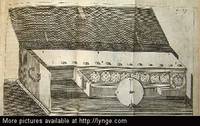
173528333Hannover Zu finden bey Nicolai Försters und Sohns sel. Erben 1735. 8vo. Contemporary full vellum w. author and title in old hand on back. Bdg. a bit soiled. Internally a bit of brownspotting. title-page w. professionally repaired tear. Inner front-hinge starting to crack but bdg. and bookblock tight. Overall a good and fairly well preserved copy. With engr. portrait woodcut vignettes and one folded engr. plate depicting an early calculating machine. 28 64 1030 pp. <br/><br/><em>Rare third German edition. Last Richter-edition. First published in French in 1710. It is the only larger philosophical work Leibnitz himself published and it is a work of immense importance to philosophy theology and mathematics. In this work Leibniz represents his excellent calculating machine which has served as the basis for what we now call a computer as he presents the binary arithmetic "Rechnen mit Null und Eins" "calculating with zero and one" in the Beylage p. 926 which forms the basis for the much later developed computer science see PMM 177. This work contains "Anmerkungen" by Richter and "Lebens=Beschreibung" by Fontenelle followed by "Beylage". In these "Beylage" we find the method of converting numbers into the binary system which here is said to be "etwas recht neues welches der Herr Leibnitz zu Hanover erfunden" "something brand new which Mr. Leibnitz von Hanover has discovered" as well as "Eine Schrift. In welcher klar gezeiget wird/ dass nicht Herr Neutonsondern der Herr von Leibnitz Erfinder des CALCULI DIFFERENTIALIS sey." A Treatise. In which it is clearly shown/ that Mr. Leibniz and not Mr. Newton is the inventor of the CALCULI DIFFERENTIALIS".All early editions of the Theodicee are rare. See D.S.B.: VIII pp. 161-166. </em> hardcover
173528333Hannover, Zu finden bey Nicolai Försters und Sohns sel. Erben, 1735. 8vo. Contemporary full vellum w. author and title in old hand on back. Bdg. a bit soiled. Internally a bit of brownspotting., title-page w. professionally repaired tear. Inner front-hinge starting to crack, but bdg. and bookblock tight. Overall a good and fairly well preserved copy. With engr. portrait, woodcut vignettes and one folded engr. plate depicting an early calculating machine. (28), 64, 1030 pp.
174712421Amsterdam Chez François Changuion 1747 Deux volumes in-12 plein veau granité, dos lisse orné, pièces de titre et de tomaison en maroquin vert, filet doré sur les coupes, [bl.], titre et vignette, avertissement, table, 332 et 166 pages, [bl.], puis [bl.], titre et vignette, 410 pages, [bl.], un tableau dépliant, [7] ff. de table, [bl.]. Bel exemplaire.