(LEIBNIZ, GW, and Others) G WBiblio.com
43 résultats
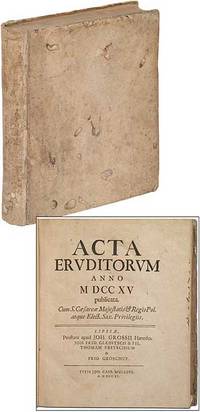
171958539Leipzig: Johan. Grossii Haeredes Joh.Frid. Gleditsch & Fil. Thomam Fritschium / Typis Bernardi Christop. Breitkopfii 1719. Hardcover. Near Fine. Quarto. Contemporary vellum. 540 pp. Indices errata. Four engraved plates one folding. Old institutional bookplate a nice near fine copy. Text in Latin. A volume in an annual series of books published from 1682 to 1734 containing surveys of recent advances in science and literature. Contains contributions by Leibniz and others. An attractive copy. Johan. Grossii Haeredes, Joh.Frid. Gleditsch & Fil., Thomam Fritschium / Typis Bernardi Christop. Breitkopfii hardcover
171556335Leipzig: J.OH. Grossii Haeredes Joh.Frid. Gleditsch & Fil. Thomam Fritschium & Frid. Groschuf 1715. Hardcover. Very Good. Quarto. 549 pp. Indices. Seven engraved plates three are folding. Contemporary stiff pastepaper boards. Some spotting to the boards still a sound very good copy. Text in Latin. A volume in an annual series of books published from 1682 to 1734 containing surveys of recent advances in science and literature. Includes Leibniz de Origine Francorum disquisitio. An attractive copy. J.OH. Grossii Haeredes, Joh.Frid. Gleditsch & Fil., Thomam Fritschium & Frid. Groschuf hardcover
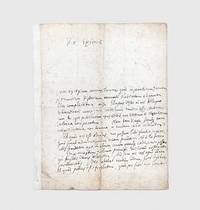
1702168455Hanover: 25 April 1702. A meeting of minds in the Age of Enlightenment The opening letter of Leibniz's correspondence with William Wotton marking the beginning of the long-standing relationship between the two great polymaths. The letter draws attention towards a relatively understudied side of Leibniz his engagement with historiography and presents his reflections on the role of history as a "mirror for princes". Wotton 1666-1727 was an English theologian who wrote chiefly on history and theology. Among his major works are Reflections upon Ancient and Modern Learning 1694 and The History of Rome from the Death of Antoninus Pius to the Death of Severus Alexander 1701 - the latter later used by Gibbon. These caught Leibniz's attention prompting him to open correspondence. Leibniz thanks Wotton for gifting him a copy of his Roman history praising the work as "accurately elaborate" and presented in "an elegant book". He then compliments the breadth of Wotton's knowledge admitting that: "I almost couldn't believe that the author of the History was the same as he who produced that famous work comparing the learning of the ancients and moderns Reflections. For such different forms of erudition are unlikely to coexist in the same person. I can't thank you without also expressing my admiration". Leibniz had read the Reflections a contribution to the ongoing controversy concerning the merits of ancient and modern learning and sided with the moderns as did Wotton. Leibniz first heard of Wotton's works a few years before from his friend Thomas Burnett who acted as a source of English intellectual news for him and had previously introduced him to Locke. In the first part of the letter Leibniz also mentions Wotton's "extraordinary envoy" who delivered the book; this was James Cresset English ambassador for several north-German states and a friend of Leibniz. Leibniz reveals that soon after receiving the book he immediately brought it to court and showed it to Georg Ludwig Elector of Hanover and the future King George I of England. The prince who Leibniz notes was "fond of English literature" was already reading a copy with pleasure; Leibniz regrets that the recently deceased William III could not do the same. This occasion prompts the philosopher to reflect on the educational role of history as a mirror for princes: "It is an old saying that History is the school of princes but hardly another history could be a better teacher than yours in which the Caesars. are depicted almost as if to be admired on a canvas". The letter also exemplifies Leibniz's fluid and creative Latin style: "with this taste you have wonderfully stimulated my appetite which you can satisfy if anyone can". Wotton replied in July and their correspondence continued until Leibniz's death the two typically exchanging cultural news. Leibniz's fascination with history began very early and was concentrated on Germany. Work on the critical edition of his historical contributions started in 2019 and is ongoing. Around the time of this letter he was publishing collections of Medieval documents: Mantissa Codicis Juris Gentium Diplomatici 1700 and Accessiones historicae 1700. These were part of a wider project to collect materials for the publication of a history of Germany which was never realized. The letter is a witness to Leibniz's curiosity towards the works of English historians at a time when he was actively reflecting on these topics; it also testifies to the popularity of Wotton whose achievements are often overlooked by modern scholarship. A transcription of the letter is published in Gottfried Wilhelm Leibniz Sämtliche Schrifte und BriefenReihe I Band 21 2012 no. 137. Single sheet of laid paper 199 x 158 mm legibly written on both sides in brown ink attached to a later blank of wove paper. Lightly toned and foxed creased from folding Leibniz's hand clear and the ink unfaded. Overall in very good condition. unknown
174753024Wolfenbüttel, Joh. Christoph Meisner, 1747. Fol. Mit zahlr. Holzschn.-Vignetten. 15 Bll., 24, 479 (recte 471) S.; 10 Bll., 180 S.; 6 Bll., 380 S., Blindgepr. Schweinsldr.-Bd. d. Zt. über Holzdeckeln a. 5 Bünden.
171744194Leipzig Grosse & Gleditsch 1717. 4to. In: "Acta Eruditorum Anno MDCCXVII". The entire volume offered in contemporary full vellum. Hand written title on spine. A yellow label pasted on to top of spine. A small stamp to title-page and free front end-paper. Library label to pasted down front free end-paper. As usual with various browning to leaves and plates. Pp. 317-322; Pp. 322-336; Pp. 353-360; Pp. 360-362. Entire volume: 4 553 39 pp. seven engraved plates. <br/><br/><em>First printing of the famous Libnitz-issue of Acta Eruditorum published a year after the death of Leibnitz including the renowned obituary by the German philosopher Christian Wolff. In 1706 Leibniz recommended Wolff for the Professorship at Halle the post Wolff held for seventeen years until his dismissal and in 1711 Leibniz sponsored Wolff's membership to the Berlin Academy. It is also mentioned that during the year of Leibniz's death in 1716 Leibniz visited Wolff in Halle when returning to Hanover from Vienna. To honor Leibnitz memory Wolff undertook the project of writing ELOGIUM GODOFREDI GUILIEMI LEIBNITII a treatise of the life of Leibnitz. As early as 1679 George I acting as Leibnitz patron directed him to write the history of the house of Brunswick. Immediately after he began arranging material he had collected. The work was however only the preparatory steps when Leibnitz died in 1716 and the work was never published. The present paper NOTITIA DE HISTORIA BRUNSUICENSI is the only part of the work which could have become a opus magnum with historiography that has ever been published. The volume also contains:Goldbach Christian. Temperamentum Musicum Universale. Pp. 114-15.And many other papers by influential contemporary mathematicians philosophers and historians. </em> hardcover
171744194Leipzig, Grosse & Gleditsch, 1717. 4to. In: ""Acta Eruditorum Anno MDCCXVII"". The entire volume offered in contemporary full vellum. Hand written title on spine. A yellow label pasted on to top of spine. A small stamp to title-page and free front end-paper. Library label to pasted down front free end-paper. As usual with various browning to leaves and plates. Pp. 317-322" Pp. 322-336 Pp. 353-360 Pp. 360-362. [Entire volume: (4), 553, (39) pp. + seven engraved plates.].
1766301628-1Wien, J. L. Kaliwoda 1766. 2 Bll., 38, 39 S., 4 Bll. Neuer Interims-Kartonband.
178260306Toulouse, 1782 et 1788, , 2 ouvrages en 1 volume in-4 de 22 pages et 1 planche, puis de 40 pages, demi-veau moderne, dos lisse portant une pièce de titre, Deux mémoires en édition originale tirés des "Histoire et mémoires de l'Académie royale des sciences, inscriptions et belles lettres de Toulouse" (pages 43-64 du premier volume paru en 1782, et pages 29-72 du troisième volume publié en 1788). Roger Martin, appelé aussi Abbé Martin jusqu'à la Révolution, naquit en 1742 à Estadens dans la Haute-Garonne ; brillant élève de sciences, il fut nommé professeur de philosophie à 20 ans au Collège Royal de Toulouse. Passionné de physique et de mathématique, il parvint à faire instaurer dans ce même Collège un cabinet de physique expérimentale ; les leçons qu'il y professait eurent un grand succès. Dans les deux présents mémoires, lus à sept ans d'intervalle devant l'Académie de Toulouse, l'auteur pose le problèmes de l'infini mathématique à l'aune de la méthode du calcul différentiel initié par Newton et développé par Leibniz, tout en appréhendant ses méthodes nouvelles et modernes par le biais de "la méthode des Anciens, connue sous le nom de méthode d'exhaustion ou des limites". Traces de mouillures anciennes sur le premier mémoire. Couverture rigide
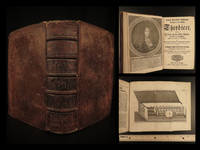
174212169Bern Ghent University: Bern. Christoph. Breitkopfii 1742. First Edition. Hardcover. Poor. First Edition. Hardcover. From the Library of Oliver Sacks. Lacking boards on one volume. Three and four volume present. This collection of letters between two great thinkers of the 17th century provides fascinating insights into their intellectual lives. Touching on a wide range of topics from theology to mathematics these letters offer a glimpse into the vibrant intellectual culture of their time.<br /> From the library of Dr. Oliver Sacks the renowned neurologist author and educator. He was in his life celebrated for his contributions to the understanding of the human brain and his ability to communicate complex scientific concepts to a broader audience. In doing so he highlighted the profound impact of neurological disorders on human identity and experience. His library is a reflection of this remarkable polymath's questing mind. Moderate soiling and foxing shaken and completely detached boards bumping evidence of wormholes chipp.ing rubbing etc. 8vo. illus b/w. Bound in full calf over marbled boards with raised bands and worn through title compartment red edging. Bern. Christoph. Breitkopfii hardcover
174712421Amsterdam Chez François Changuion 1747 Deux volumes in-12 plein veau granité, dos lisse orné, pièces de titre et de tomaison en maroquin vert, filet doré sur les coupes, [bl.], titre et vignette, avertissement, table, 332 et 166 pages, [bl.], puis [bl.], titre et vignette, 410 pages, [bl.], un tableau dépliant, [7] ff. de table, [bl.]. Bel exemplaire.
172046329Amsterdam D. Mortier 1720. Bound in one contemporary full calf. Spine richly blindtooled. XLI3520 pp. 1 fold. table. A fine clean copy. <br/><br/><em>The scarce third edition of Leibnitz' importent treatise on the goodnes of God the free will of man and the causes of evil in the world The principal subject of the work being the problem of liberty and free will. It is the only larger philosophical work published by Leibnitz himself.Ravier No 67 the first ed. from 1710 - PMM: 177 1710-edition. </em> unknown
1734VT - LA - HAY042541734 - seconde édition - . A Bruxelles chez François Foppens. reliés plein veau d'époque. Tome I dont le dos entièrement et bien refait ne présente aucune décoration des caissons mais avec des pièces de titre et de tomaison différentes du Tome II ; coiffe supérieure du deuxième tome légèrement accidentée épidermures au quatrième plat du tome I sinon ouvrage en bon état d'ensemble et intérieur. 2 volumes in-12. avec quelques bandeaux et lettrines dos à 5 nerfs avec pièce de titres et de tomaisons à lettres dorées caissons ornés de motifs floraux dorés pour le tome II ; toutes tranches rouges. unknown
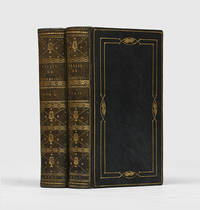
1747170287Amsterdam: Chez François Changuion 1747. The foundation text of theodicy Second edition of Jaucourt's critical edition the first to credit him as the author in a handsome 19th-century binding. Jaucourt's edition includes the Theodicy's four appendices his biography of Leibniz and a chronological catalogue of his works. The Theodicy was originally published in 1710. Jaucourt's edition first appeared in 1734. The Theodicy the only major philosophical treatise that Leibniz published during his lifetime vindicates the justice and goodness of God despite the existence of evil. Notably it includes the first statement of his famed argument that this world despite its manifest problems is nonetheless the best of all possible worlds. "Although the immediate reaction to the book was somewhat muted the Theodicy soon became commonly associated with Leibniz's name in European culture. Today Leibniz's name remains closely associated with the project that he developed most fully in the Theodicy. The neologism that Leibniz coined in the title from the Greek theos dike literally: "the justice of God" has entered the lexicon as a term describing any attempt to reconcile the goodness of God with the presence of evil in the world a project to which Leibniz had devoted a good portion of his life" Jorgensen & Newlands pp. 1-2. Louis de Jaucourt 1704-1779 a prolific Enlightenment scholar contributed over 25 per cent of the total articles for Diderot's Encyclopédie. 2 vols duodecimo 164 x 98 mm. Folding letterpress table Discours sur la conformité with divisional title and renewed collation. Title pages in red and black. Nineteenth-century green levant spines ruled lettered and with tooled fountain decoration in gilt covers with concentric borders and turn-ins in gilt pink watered silk doublures edges gilt pink silk bookmarkers. With 19th-century French ownership inscription to front free endpaper. Light bumping and rubbing faint sunning to spines and covers minor browning and foxing to endpapers slight damp staining and cockling to front doublure of vol. I: a very good copy. Ravier 431. Larry M. Jorgensen & Samuel Newlands eds New Essays on Leibniz's Theodicy 2014. unknown
1760206242Lausanne Bousquet 1760. Hardcover. G: The top and bottom of the leather spine are missing. Wear to the corners and edges of the boards. Staining to the outer margins of the pages. Remains easy to read. A leatherbound book with a decorative spine. Colorful marbled end pages. 592 pages; the textblocks are red. Text is in French. Lausanne Bousquet hardcover
17141396A AMSTERDAM. CHEZ ISAAC TROYEL, LIBRAIRE. 1714. 2 VOLUMES IN-12 (10 X 16,5 X 5,5 CENTIMETRES ENVIRON) DE (36) + 386 PAGES ET (2) + 216 + 132 PAGES, RELIURE D'EPOQUE PLEIN VEAU BRUN, DOS A 5 NERFS ORNE DE CAISSONS A FLEURONS DORES, TITRE DORE SUR ETIQUETTE MAROQUIN HAVANE, TRANCHES MOUCHETEES ROUGES. RARE SECONDE EDITION DONT ON CONNAIT PEU D’EXEMPLAIRES. PETIT MANQUE DE PAPIER SANS MANQUE DE TEXTE EN MARGE INFERIEURE BASSE DU PREMIER FEUILLET DE PREFACE DU TOME I, PETITE ROUSSEUR AYANT CAUSE UN PETIT TROU SANS GRAVITE PAGES 11/12 ET 161/162 DU TOME I, QUELQUES PETITS DEFAUTS EXTERIEURS, SINON BON EXEMPLAIRE.
172046329Amsterdam, D. Mortier, 1720. Bound in one contemporary full calf. Spine richly blindtooled. XLI,(3),520 pp. + 1 fold. table. A fine clean copy.
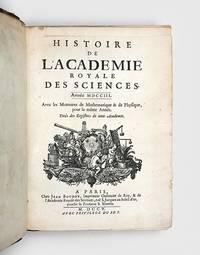
1705153285Paris: Jean Boudot 1705. The foundation of binary arithmetic First edition of this momentous volume of the journal of l'Académie Royale des Sciences containing Leibniz's invention of binary arithmetic the foundation of the electronic computer industry. Binary notation reduces all numbers to expressions involving only 0 and 1. It was a topic that had interested Leibniz for over two decades. "This explanation of binary arithmetic was the first publication on this topic to result in a significant impact on the scientific community" Glaser History of Binary and other Nondecimal Numeration p. 39. Although other mathematicians had experimented with binary previous to Leibniz including Pascal Leibniz's paper was the first to have a notable influence on scientific thought. After its publication the binary system became a popular subject of study. As modern computing is based on the binary system the paper can be seen as the basis of computational science both theoretical and in practice. Leibniz had conceived of a calculating machine based on the binary system as early as 1679 but this was never constructed. Binary arithmetic had broader implications for Leibniz beyond just its mathematical function. "In the domain of mathematics Leibniz regarded binary notation as intrinsically superior to decimal notation. Over and above this advantage however he believed that it contained the key to resolving both the problem of conceptual primitives and the problem of adequate characters. If it could be established as Leibniz speculated from about 1679 onwards that the only truly primitive concepts were those of God and Nothingness or Being and Privation then the symbols 1 and 0 would form the basis for an adequate characteristic whose simplest signs would stand in an immediate relation to the two conceptual primitives" The Cambridge Companion to Leibniz pp. 236-7. This was the second of Leibniz's great trilogy of works on mathematics and computation following Nova methodus pro maximis et minimis 1684 his independent invention of calculus and preceding Brevis descriptio machinae arithmeticae 1710 his decimal mechanical calculating machine. Also included in the volume is Bernard Le Boyer de Fontenelle's Nouvelle Arithmétique binaire pp. 58-63 written as secretary of the academy which offers an editorial comment on Leibniz's paper. 2 parts in 1 vol. quarto 245 x 173 mm. Engraved frontispiece 11 plates of 12 of which 9 folding. Recased in contemporary black morocco rebacked and recornered fragments of original spine laid down with new red morocco labels gilt border to covers enclosing gilt arms of Louis XIV marbled endpapers reinforced in hinges gilt edges. Contemporary armorial bookplate on title verso. Binding firm contents a little toned title page excised at head plate 12 the heart of the American tortoise lacking sporadic light foxing; a very good copy. Ravier 166. unknown
1775606571Wittenberg, Zimmermann, 1775. 178 S., 4 Bl., 250 S. Ldr. d. Zt. Einbd. leicht berieben. Rücken gering beschäd.
1777129592Wittenberg und Zerbst: bey Samuel Gottfried Zimmermann, 1775 - 1777. 178, [VI], 250, [VIII], 204, [X], 290, [1] S. ; 17,5 x 11 cm ; Halbleder.
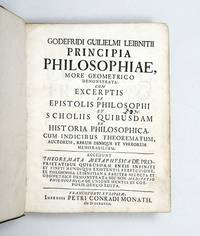
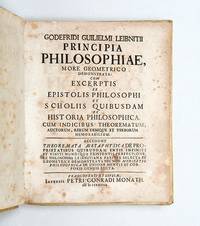
1728149005Frankfurt and Leipzig: Peter Conrad Monath 1728. Leibnizianism outlined by a contemporary First edition of this exposition on Leibniz's philosophy by a contemporary of the philosopher; including a Latin translation of Leibniz's Monadology. "Little is known of Michael Gottlieb Hansch. A theologian from Leipzig and adviser to the Emperor Charles VI he knew Leibniz personally from 1707 onwards. He was thus in an excellent position to acquaint himself with Leibnizian thought having been in correspondence with Leibiniz for five years prior to the writing of the Monadology 1707-13. The first 19 pages of the present work consisted of Hansch's Latin translation of Monadology. Then followed the geometrical demonstration of Leibniz's definitions 2 axioms and 114 theorems. Hansch's erudite commentary on the Monadology contains excerpts from Leibniz's letters and teems with references to the Leibniz-Clarke correspondence the Theodicy the Système nouveau Leibniz's reply to difficulties expressed by Bayle in his article Rosarius in tome II of the Receuil to the Oratio de Sinarum philosophica practica of Wolff. The book contributed to Condillac's understanding of Leibnizian thought" Hine pp. 94-95. Hansch is perhaps best known as the purchaser of and publisher of Kepler's letters a project in which Leibniz took great interest. Quarto 199 x 153 mm. Contemporary calf tooled in compartments blind borders to covers marbled edges. Front endpapers with various ownership inscriptions and notes from 1759 to 1800 in Latin; twentieth-century ink stamp on title page of Samuel Zocha of Modra Slovakia. Extremities worn spine dulled light ring mark to front cover binding firm contents crisp and clean; a very good copy. Ravier 381. Ellen McNiven Hine A Critical Study of Condillac's "Traite des Systemes" 1979. unknown
1728149331Frankfurt and Leipzig: Peter Conrad Monath 1728. An exposition of Leibnizianism First edition of this exposition on Leibniz's philosophy by a contemporary of the philosopher; including a Latin translation of Leibniz's Monadology. "Little is known of Michael Gottlieb Hansch. A theologian from Leipzig and adviser to the Emperor Charles VI he knew Leibniz personally from 1707 onwards. He was thus in an excellent position to acquaint himself with Leibnizian thought having been in correspondence with Leibiniz for five years prior to the writing of the Monadology 1707-13. The first 19 pages of the present work consisted of Hansch's Latin translation of Monadology. Then followed the geometrical demonstration of Leibniz's definitions 2 axioms and 114 theorems. Hansch's erudite commentary on the Monadology contains excerpts from Leibniz's letters and teems with references to the Leibniz-Clarke correspondence the Theodicy the Système nouveau Leibniz's reply to difficulties expressed by Bayle in his article Rosarius in tome II of the Receuil to the Oratio de Sinarum philosophica practica of Wolff. The book contributed to Condillac's understanding of Leibnizian thought" Hine pp. 94-95. Hansch is perhaps best known as the purchaser of and publisher of Kepler's letters a project in which Leibniz took great interest. Quarto 207 x 169 mm. Contemporary vellum manuscript title to spine orange speckled edges. Light discolouration to vellum else binding in nice shape contents browned; a very good wide-margined copy. Ravier 381. Ellen McNiven Hine A Critical Study of Condillac's "Traite des Systemes" 1979. hardcover
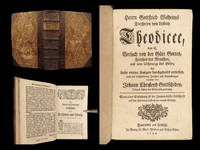
174422865<p><strong>1744 Leibniz THEODICY Essays Philosophy Humanism Free Will Good v Evil RARE</strong></p><p><em>"This is the best of all possible worlds." </em></p><p>― Gottfried Wilhelm Leibniz </p><p>Gottfried Wilhelm Leibniz was a 17th-century German philosopher whose ideas of 'best of all possible worlds' was a landmark attempt to solve all of the world's evils.</p><p>Originally published in 1710 '<em>Essays on Theodicy'</em> was one of Leibniz most well-known works and was the only book by Leibniz to be published during his lifetime. It was the first work to introduce the term 'theodicy.' Leibniz sought to provide a new optimistic approach to curing all of the world's evils. He claimed that human free will against God's true goodness was the root cause of the world's evil.</p><p>Item number: #22865</p><p>Price: $995</p><p>LEIBNIZ Gottfried Wilhelm von</p><p><strong><em>Herrn Gottfried Wilhelms Freyherrn von Leibnitz Theodicee das ist Versuch von der Güte Gottes Freyheit des Menschen und vom Ursprunge des Bösen bey dieser vierten Ausgabe durchgehends verbessert auch mit verschiedenen Zusätzen und Anmerkungen vermehrt von Johann Christoph Gottscheden</em></strong></p><p>Hannover ; Leipzig : In Verlag sel. Nicol. Försters und Sohns Erben 1744. </p><p><u>Details</u>: </p><p><!-- if !supportLists-->· <!--endif-->Collation: Complete with all pages</p><p><!-- if !supportLists-->o <!--endif-->24 64 843 53</p><p><!-- if !supportLists-->· <!--endif-->References: Ziegenfuss II 32</p><p><!-- if !supportLists-->· <!--endif-->Language: German</p><p><!-- if !supportLists-->· <!--endif-->Binding: Leather; tight and secure</p><p><!-- if !supportLists-->· <!--endif-->Size: ~7.25in X 4.75in 18.5cm x 12cm</p><p><!-- if !supportLists-->· <!--endif-->always rare and desirable </p><p>Our Guarantee:</p><p>Very Fast. Very Safe. Free Shipping Worldwide.</p><p>Customer satisfaction is our priority! Notify us with 7 days of receiving and we will offer a full refund without reservation!</p><p>22865</p><p>Photos available upon request. </p> Hannover, In Verlag sel. Nicol. Försters und Sohns Erben hardcover
174417207<p><b>1744 Leibniz Essays on THEODICY Philosophy Humanism Free Will Good v Evil RARE</b></p><p><i>"This is the best of all possible worlds." </i></p><p>― Gottfried Wilhelm Leibniz </p><p>Gottfried Wilhelm Leibniz was a 17th-century German philosopher whose ideas of 'best of all possible worlds' was a landmark attempt to solve all of the world's evils.</p><p>Originally published in 1710 '<i>Essays on Theodicy'</i> was one of Leibniz most well-known works and was the only book by Leibniz to be published during his lifetime. It was the first work to introduce the term 'theodicy.' Leibniz sought to provide a new optimistic approach to curing all of the world's evils. He claimed that human free will against God's true goodness was the root cause of the world's evil.</p><p>Item number: #17207</p><p>Price: $950</p><p>LEIBNIZ Gottfried Wilhelm von</p><p><b><i>Herrn Gottfried Wilhelms Freyherrn von Leibnitz Theodicee das ist Versuch von der Güte Gottes Freyheit des Menschen und vom Ursprunge des Bösen bey dieser vierten Ausgabe durchgehends verbessert auch mit verschiedenen Zusätzen und Anmerkungen vermehrt von Johann Christoph Gottscheden</i></b></p><p>Hannover ; Leipzig : In Verlag sel. Nicol. Försters und Sohns Erben 1744. </p><p><br /></p><p><u>Details</u>:</p><p>· Collation: Complete with all pages</p><p>o 24 64 843 53</p><p>o Signatures: 12 8 2 A-R12 S8 T-Y12.</p><p>· References: Ziegenfuss II 32</p><p>· Language: German</p><p>· Binding: Leather; secure</p><p>· Size: ~7.5in X 5.25in 19cm x 13.5cm</p><p>Our Guarantee:</p><p>Very Fast. Very Safe. Free Shipping Worldwide.</p><p>Customer satisfaction is our priority! Notify us with 7 days of receiving and we will offer a full refund without reservation!</p><p>17207</p><p>Photos available upon request. </p> Verlag sel. Nicol. Försters und Sohns Erben hardcover
1770PHO-1193Paris: Chez N.M. Tilliard, 1770. in-4 , (24x20) , cxliv-474pp-1ff , illustré de 4 planches , relié demi cuir époque , pièce de titre (petit manque) , papier des plats refait , tranches rouges , vieille mouillure ,début de fente, coiffe de pied courte , 2 planches détachées.
175942999Berlin Haude et Spener 1759. 4to. No wrappers as issued in "Memoires de l'Academie Royale des Sciences et Belles Lettres". tome XIII 1757. Titlepage Classe de Philosophie Spéculative and pp. 451-522. <br/><br/><em>First appearance of this remarkable mathematical correspondance comprising 29 letters mostly of mathematical content and after the death of Herman leading to some controveries in relation to priorities.Ravier "Bibliographie des Oeuvres de Leibniz" No. 465. </em> unknown