4 530 résultats
LEGATURA IN TUTTA PERGAMENA NON COEVA, CON TITOLI AL DORSO. VOLUME COMPLETO DEI SUOI 8 LIBRI numero pagine: (21) 642 (27) formato: 13.7X8.5 stato conservazione: ABBASTANZA BUONO, PRIMI TRE FOGLI CON MINIMO TAGLIO ACCANTO AL DORSO, SCRITTA DI POSSESSO E NUMERO D'INVENTARIO AL FRONTESPIZIO edizione: EDITIO NOVISSIMA
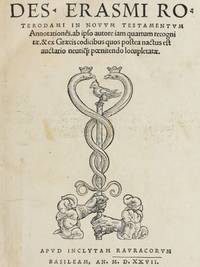
1527505487Froben 1527. Hardcover. VERY GOOD. 9 2-710 56 pp. original endpapers. Folio in sixes complete: a4 a-z6 A-Z6 Aa-Mm6 Nn8 Oo6 Qq8 Rr8. Contemporary blind-tooled alum-tawed pigskin over boards. Original clasps intact originally with corner furniture now lost. First title page with Froben device of crowned snakes and bird perching on hands enshrouded with clouds; second title page within Hans Holbein woodcut border. All edges stained Navy blue. 9 2-710 58 pp. <br /> <br /> Front hinge reattached with non-invasive Japanese paper repair; some staining and patina to the peccary bit of worming to the outer pages otherwise a few clean and fresh internal text. 17th century owner's inscription with hellenized name to FFEP. <br /> <br /> The fourth of six lifetime editions by Erasmus a great leap forward from the previous edition adding nearly 100 pages to the Third edition of 1522. <br /> <br /> First released in 1516 alongside his revised Greek Text and Latin translation of the New Testament the Annotationes are a philological tour de force examining in elaborate detail the differences between the ancient Greek text and the Vulgate in the process demonstrating the need for a new Latin translation namely his own. In the process Erasmus was dangerously frank in his discussion of Church abuses and departures from the teaching of Scripture showing himself 'An unprecedentedly formidable critic of contemporary theological and religious practice' McConicum Oxford Encyclopedia of the Reformation. <br /> <br /> The single greatest scholarly accomplishment of the renaissance was Erasmus's Annotations on the New Testament. Begun in 1516 and revised three times in his lifetime this second revision of 1527 was the greatest expansion of the work more than doubling its size from the first edition. Here the complete force of his philological powers is on full display boring away centuries of accreted dogma and ignorance that had obscured the text. "Without the notes Erasmus said the texts of the Scripture were 'naked and defenceless' open to criticism by uncomprehending readers and corruption by careless printers. The Annotations represent not only Erasmus' defence of the New Testament against such abuses but also a reflection of his own philosophy objectives and working methods. In establishing the text and defending it against his opponents Erasmus drew on manuscript sources classical literature patristic writings scholastic exegesis and the work of his immediate forerunners Valla and Lefevre. He did not hesitate to point out the errors of illustrious writers like Jerome and established medieval authorities like Peter Lombard. In general he was appreciative of the early church Fathers and contemptuous of medieval commentators. Rummel Erika. Erasmus' Annotations on the New Testament : From Philologist to Theologian. <br /> <br /> In many cases the Annotations serve to justify the most controversial renderings in his translation and defend himself against heresy charges. The most notable instance is his translation of the Greek metanoiete in Matt 3 note 1 and Acts 19 note 8. which Jerome had translated as "do penance" a rendering which shored up the Church's sacramental doctrine of a private secret confession made only to a priest. While Erasmus maintained that he himself practiced taught and supported the status quo penitential rite he did not find any grounding in Scripture where he insisted metanoiete referred to a change of mind not penitential confession and that anyway that instances of confession in Scripture were uniformly public and oral. See Rummel 152-156. Adams E-891. Froben hardcover
1774BBS-2021332Libraria Felseckeriana Norimbergae Nuremberg 1774. Hardcover. Good. 88 pages. 'In Praise of Folly' by Erasmus of Rotterdam c. 1466-1536. Black quarter-leather antique but not contemporary with gilt titles and ruling; marbled papered boards. Boards and leather spine rubbed moreso to edges; corners frayed. Decorative teal marbled endsheets. Binding sound; the early rebind which produced the endsheets and fly leaves just barely encroached on the text of the title page with loss of one letter in the extended subtitle the first 'i' from 'in lucem publican'. Foxed throughout else clean. Libraria Felseckeriana, Norimbergae [Nuremberg] hardcover
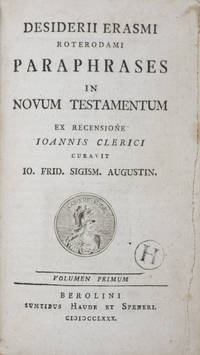
178043177Berolini Berlin: Haude et Speneri 1780. Later edition. Hardcover. vg. Octavo 8 1/2 x 5". xxxvi 546pp Vol. 1; xxii 398pp Vol. 2; xliv 399-995 1pp. Modern full black cloth with gold lettering to spines. Title vignettes. <br /> <br /> Originally published in 1548 "Paraphrases in Novum Testamentum" were composed between May 1517 and January1524. They consist of a series of commentaries on every book of the New Testament except "Apocalypse" a book for which Erasmus had no great regard. The Paraphrases were successful beyond expectation and were quickly translated into French German English and other languages.<br /> <br /> Modern endpapers and fly leaves. Small letter "H" stamped on title pages of first and third volumes. Text in Latin. Bindings and interior in overall very good condition. The publication history of the "Paraphrases" is complicated. Erasmus began with the Pauline Epistles. The paraphrase of Romans was published in quarto by Dirk Martens in Louvain in November 1517 and reprinted by Erasmus's friend Johann Froben in January of the following year; it sold well and was soon reprinted in octavo. Corinthians was published by Martens in February 1519 and reprinted in Basel by Froben in March; Galatians appeared later that year with editions from both publishers. The remaining Epistles followed in 1520 and 1521 the last to appear being Hebrews. In the autumn of 1521 Erasmus moved from Louvain to Basel and from that time Froben published the first editions of the remaining Paraphrases. Erasmus now turned to the Gospels Matthew appearing in March 1522 in both folio and octavo - from now on there are no more quartos John in February folio and March octavo 1523 Luke in August 1523 and Mark in early 1524 with a title page dated 1523. Acts followed quickly the dedication copy being dated February 13 1524. Froben published a complete edition in two volumes the first "a stout octavo volume of 400 leaves dated 1523 and called Tomus secundus" contained the Epistles and the Tomus primus containing the Gospels and Acts appeared the following year. "This was a considerable investment and the firm kept it in their list for ten years" resetting portions as needed without a change of date. The Paraphrases were reissued in various formats and combinations during the following decades; Roger Mynors writes: "When one is faced with one of these editions in folio one has to remember that a purchaser would see them as composed of separable parts out of which sets could be made up in any way that supply might dictate." For more information see: R.A.B. Mynors "The Publication of the Latin Paraphrases" in Robert Dick Sider ed. New Testament Scholarship: Paraphrases on Romans and Galatians Collected Works of Erasmus University of Toronto Press 1984 pp. xx-xxix. <br /> <br /> About the author: Desiderius Erasmus Roterodamus 1466-1536 known as Erasmus or Erasmus of Rotterdam was a Dutch Renaissance humanist Catholic priest social critic teacher and theologian. Erasmus was a classical scholar and wrote in a pure Latin style. Among humanists he enjoyed the sobriquet "Prince of the Humanists" and has been called "the crowning glory of the Christian humanists." Using humanist techniques for working on texts he prepared important new Latin and Greek editions of the New Testament which raised questions that would be influential in the Protestant Reformation and Catholic Counter-Reformation. He also wrote On Free Will The Praise of Folly Handbook of a Christian Knight On Civility in Children Copia: Foundations of the Abundant Style Julius Exclusus and many other works. From Wikipedia. Haude et Speneri hardcover
In-16°; pp. 524, (4), con l’index e l’epitaffio di Erasmo a Basilea frontespizio figurato inciso ad acquaforte, con Erasmo e tre dottori; con una autobiografia dell’autore. dedica a frobenius. legatura in mzza pelle con titolo e fregi in oro al dorso.
1528179633.Ghardcover. Good. Access codes and supplements are not guaranteed with used items. May be an ex-library book. hardcover
B9781498196345Paperback / softback. New. paperback
152770968X.Gpaperback. Good. Access codes and supplements are not guaranteed with used items. May be an ex-library book. paperback
0428626157.Ghardcover. Good. Access codes and supplements are not guaranteed with used items. May be an ex-library book. hardcover
46575London: In flete-strete: by me Robert Redman dwellynge at the sygne of the George next to Saynt Dunstones churche 1533 but later c. 1726. 18th-century edition hardback. 12mo 20cm by 12cm 178 folios. 19th-century binding of full brown calf title label to the spine. This copy lacks leaf A1 the title page a small number of leaves have been professionally repaired there is some damage to leaf A2 and there is some scattered foxing of the contents. Overall this copy is in good condition. The colophon on the final page reads "Imprinted at London in Flete-Strete by me Robert Redman dwellynge at the sygne of the George next to Saynt Dunstones churche" and the book is dated 1533 on leaf A2. However this is an 18th-century edition the type is not set in gothic script. COPAC lists four copies of this edition with estimated publication dates varying between 1720 and 1730. London: In flete-strete: by me Robert Redman, dwellynge at the sygne of the George, next to Saynt Dunstones churche, 1533 [but l hardcover
28910699-nnew. unknown
28910699like new. unknown
A9781442631397Paperback. New. paperback
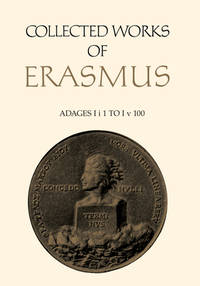
A9781487520755Paperback / softback. New. This sixth volume devoted to the Adages completes the translation and annotation of the more than 4000 proverbs Erasmus gathered and commented on. It is a fully annotated accurate and readable English version of Erasmus' commentaries on these Greek and Latin proverbs. paperback
A9781166492229New. unknown
A9781165950690New. unknown
A9781165947416New. unknown
A9781165952021New. unknown
B9781165952021New. unknown
B9781165950690New. unknown
B9781165947416New. unknown