ALBERE (Erasme).Livre Rare Book
194 résultats
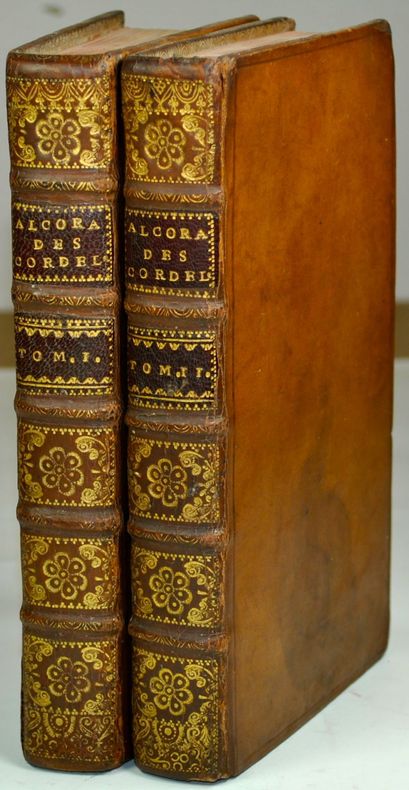
17348913A Amsterdam, aux dépens de la Compagnie, 1734. 2 vol. in-12 de (18)-396 pp. et (2)-419 pp., veau glacé, dos orné à nerfs, pièces de titre et de tomaison en maroquin rouge, tranches rouges (reliure de l'époque).
17773006455London and Paris: Barbou 1777. Joints chafed and head of spine slightly chipped. Duodecimo with a frontispiece to the first work; contemporary dark green morocco sides bordered and spine panelled in gilt all edges gilt. <p><p>The beautifully-printed Barbou edition of Utopia bound as often with the matching edition of Erasmus' Praise of Folly. </p> <p>The friendship between Sir Thomas More 1478-1535 and Erasmus 1469-1536 was one of the great scholarly alliances. More's Utopia 1516 was a revolutionary work of philosophy which inaugurated the entire tradition of the modern imaginary voyage but it was also a book to which a small coterie of his greatest friends contributed particularly including Erasmus. More also played an important part in turn in the writing of Erasmus' Moriae Enkomion - the 'praise of folly' but also a pun on the 'praise of More' - which is said to have been written whilst they were staying at More's London house. It was first published in 1511. </p> <p>This Barbou edition of both works is particularly attractive. The Barbou family was in business from the early sixteenth-century through to the beginning of the twentieth and was known in the later 1700s for their superb editions of the Latin and Greek classics not unlike a French Baskerville.</p> </p> . Barbou unknown
1781105911781 reliure plein veau havane marbré in-douze (binding full calfskin duodecimo), or estompé sur les 5 nerfs du dos (gilt blurred on the 5 raised bands of the spine) - entre-nerfs à fleuron aux fers spéciaux (between the raised bands specials blocking stamps) - pièce de titre sur fond grenat avec filet or (garnet label of title with gilt line), petites taches d'encre sur les plats (small ink marks on the covers), roulettes sur les coupes - manque de dorure (fillets on the cuts - blurred gilding), toutes tranches rouges (all red edges), marque-page en tissue vert (bookmark in tissue), pages de garde peignées à motif "modèle plume de paon" (painting flyleaf - model plucks peacock), illustrations de Hans Holbein : frontispice - 73 gravures in texte - 1 gravure hors-texte - 6 planches repliées hors texte + orné de bandeaux - lettrines et de culs-de-lampe (frontispiece - 73 engravings in text - 1 full page engraving and 6 folding plates - and illuminated of headpieces and dropped initials and of tailpieces), claires cicatrices de mouillures en marge de tête en fin d'ouvrage (light scars of waterstains on the top margin and the end of book), XXIV+320 pages, 1781 à Amsterdam Chez François L'Honoré,
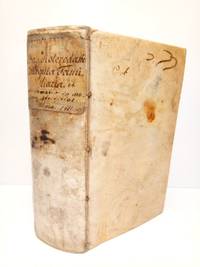
171248094Ulmae Ulm: Sumptibus Danielis Bartholomaei M DCC XII 1712.- 7 h. 869 p. 11 h. y 88 p. de la segunda obra con el mismo pie de imprenta y fecha: Grabado al cobre alegórico in frontis; 8º 173 x 115 cm; Portada a dos tintas; Sig. :7 A-Z8-Aa-Zz8-Aaa-Kkk8 / a-e8 f4; Texto en latín; Enc. de la época en Pergamino rígido a la romana lomo con título rotulado a mano cortes pintados y un ex-libris grabado al cobre de "Ex Bibliotheca Christiani Friederici Schnaussii" grabado por J. B. Gans al verso de la tapa anterior.- RARO. La encuadernación firme y fuerte aunque con diversas señales del tiempo. Al verso de la tapa anterior tienenunas notas manuscritas otra pequeña notita manuscrita en la portada. Por lo demás el interior del libro se encuentra limpio y sin ninguna mancha reseñable. El grabado del frontis tiene una pequeña reparación por detrás sin importancia. El título del libro va manuscrito sobre un tejuelo de pergamino en la cabecera del lomo. Dicho esto que es preceptivo se puede considerar el libro como en muy buen estado. Este libro contiene los Coloquios una especie de manual de cultura clásica para la vida renacentista así como el famoso Elogio de la Locura con un prefacio de Tomás Moro. LITERATURA Y ESTUDIOS LITERARIOS EXTRANJEROS DE LOS SIGLOS XVI-XXI Libro en latín Danielis Bartholomaei hardcover
17204459BB6 in 3 Bänden. Leyden, Pierres Vander Aa & Boudouin Jansson Vander Aa, 1720. 12°. (1) Bl., 272 S.; (4) 192 S., (1) Bl.; (1) Bl., (4) 358 S.; (4) 394 S., (1) Bl.; (1) Bl., (4) 224 S.; (4) 236 S., (1) Bl. Mit 1 gest. Frontispiz, 1 gest. Vignette sowie 55 gest. Textillustr. von Jacob Schijnvoet. Lederbde. d. Zt. auf 5 Bünden mit reicher Rücken- u. Stehkantenvergoldung (Ecken u. Kapitale restauriert, Leder etwas spröde).
17204459BB1720. 6 in 3 Bänden. Leyden Pierres Vander Aa & Boudouin Jansson Vander Aa 1720. 12°. 1 Bl. 272 S.; 4 192 S. 1 Bl.; 1 Bl. 4 358 S.; 4 394 S. 1 Bl.; 1 Bl. 4 224 S.; 4 236 S. 1 Bl. Mit 1 gest. Frontispiz 1 gest. Vignette sowie 55 gest. Textillustr. von Jacob Schijnvoet. Lederbde. d. Zt. auf 5 Bünden mit reicher Rücken- u. Stehkantenvergoldung Ecken u. Kapitale restauriert Leder etwas spröde. Erstmals in lateinischer Sprache erschienen 1518. Beilage: Kupferstich mit Portrait von Erasmus von Rotterdam von F. Bleuswyk. - Mit 6 Namenszügen dv. 3 von alter Hand auf den Titelseiten. Verbunden: Bd. III von S. 75 bis 94. die S. 267 bis 270 von Bd. I sind in Bd. V zwischen die S. 220 u. 221 eingebunden. Durchgehend stellenweise stärker gebräunt u. vereinzelt stockfleckig. unknown
1709019923London: Printed and Sold by J. Woodward in Threadneedle Street 1709. Book. Fair. Hardcover. 1st Edition. First Edition THUS. Pp. 22 xvi viii 12 171. Full red morocco five raised bands to spine gilt bordering gilt decoration to spine. front board detached. All text block edges gilt. Internally complete all plates and illustrations present. Verso of front board ex-libris of Robert Hoe and also famous book collector Cortlandt F. Bishop. Printed and Sold by J. Woodward, in Threadneedle Street Hardcover
173417931Aux dépens de la Compagnie | Amsterdam 1734 | 10.50 x 17 cm | deux tomes reliés en deux volumes
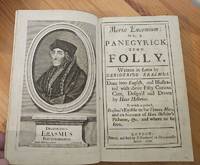
1780000010669Basileae = Basel: G. Haas ex Officina J.J. Thurneisen 1780. Later edition. Hardcover. Very Good. 8vo. 17 2-355 5 pp. Contemporary tree calf with a gold border on each board spine in six compartments with beautiful gold tooling and a red morocco label lettered in gold; all edges decoratively stained yellow. Marbled endpapers and pastedowns. Title page in Greek and Latin text in Latin. Illustrated with an engraved frontispiece portrait of Erasmus with seven full-page woodcuts and with numerous in-text woodcuts all done by Hans Holbein. With a commentary by Gerardus Listrius. A beautiful example of Erasmus' satiric essay a landmark publication in Renaissance Europe. In Praise of Folly is credited with helping to sow the future ideas of the Protestant Reformation as it parodies many superstitions of the Catholic Church. Erasmus' essay is a perfect example of dry and biting wit rich with metaphor and layered puns. Joints neatly touched up a small darkened spot on the front board. G. Haas, ex Officina J.J. Thurneisen hardcover
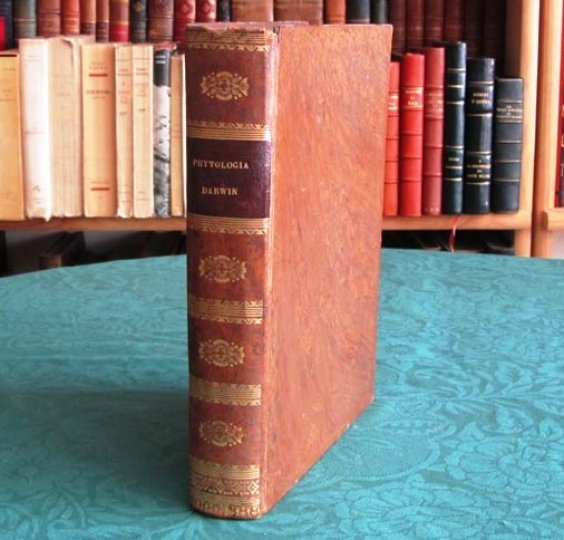
180014595With the theory of draining morasses and with an improved construction of the drill plough. By Erasmus Darwin, M.D.F.R.S. author of Zoonomia, and of the Botanic Garden.Contents.Introduction.Part the firt. Physiology of vegetation.sect.I. Individuality of the Buds of Vegetables. II. Their Absorbent Vessels. III. Their Umbilical Vessel. IV. Their Pulmonary Arteries and Veins. V. Their Aortal Arteries and Veins. VI. Their Glands and Secretion. VII. Their Organs of Reproductions. VIII. Their Muscles, Nerves, and Brain.Part the second. Economy of Vegetation.IX. The Growth of Seeds, Buds, and Bulbs. X. Manures, or the Food of Plants. XI. Of draining and Watering Lands. XII. Aeration and Pulverisation of the Soil. XIII. Of Light, Heat, Electricity. XIV. Diseases of Plants.Part the third. Agriculture and Horticulture.XV. Production of Fruits. XVI. Production of Seeds. XVII. Production of Roots and Barks. XVIII. Production of Leaves and Wood. XIX. Production of Flowers. XX. Plan for disposing a Part of the System of Linneus into more Natural Classes and Orders.Appendix. Improved Construction of the Drill Plough.Édition originale rare. London, Johnson 1800. 612 pp + index + 12 planches (dont 2 repliées). Ex-libris aux Armes de la bibliothèque de Bellotti S.Reliure pleine basane marbrée de l'époque. Dos lisse orné et doré avec pièce de titre. Roulette dorée sur les coupes. Quelques pâles rousseurs sans gravité. Petit accident à la coiffe supérieure. Exemplaire exceptionnel pour ces planches. Bon état. Format in-4° (27x22).
175810202AB1758 . Wien: Joh. Thomas Trattner 1758. Gr.-8°. 8 Bll. 245 S. 21 Tafeln Halb-Kunstleder mit umlaufendem Rotschnitt Bibliotheksexemplar; Stempel auf Vorsatz Vortitel und Titelblatt; Papier altersbedingt gebräunt; stockfleckig; sonst altersgemäss gut erhalten - Angebunden: Antonius Klobusiczki de Zetteny: Materia Tentaminispublici quod ex anni huius scholastici praelectionibus quovis cui libuerit periclitante . Wien: Joh. Th. Trattner 1758. 10 Blätter. unknown
1751115491S.l. [Paris] s.n. 1751 1 vol. relié in-4, veau miel, dos à nerfs, pièce de titre de cuir rouge, caissons ornés avec fleuron central doré, filet à froid en encadrement des plats, roulette dorée sur les coupes, coiffes guillochées, tranches marbrées, XXIV + 222 pp. + 1 f. (table). Première édition établie par Meusnier de Querlon, avec ses notes, reprenant la traduction française de Gueudeville (parue en 1713). Il s'agit de la première oeuvre illustrée d'importance entreprise par Charles Eisen (1720-1778), composée d'un frontispice, 13 figures et 2 vignettes in texte gravés par Aliamet, La Fosse, Flipart, Legrand, etc. (Cohen, 348). Excellent exemplaire sur grand papier réimposé au format in-4, bien complet des deux feuillets d'explication des figures et du feuillet de table, dans une agréable reliure de l'époque (coiffes légèrement frottées avec infime manque en pied).
1751115491S.l. [Paris] s.n. 1751 1 vol. relié in-4, veau miel, dos à nerfs, pièce de titre de cuir rouge, caissons ornés avec fleuron central doré, filet à froid en encadrement des plats, roulette dorée sur les coupes, coiffes guillochées, tranches marbrées, XXIV + 222 pp. + 1 f. (table). Première édition établie par Meusnier de Querlon, avec ses notes, reprenant la traduction française de Gueudeville (parue en 1713). Il s'agit de la première oeuvre illustrée d'importance entreprise par Charles Eisen (1720-1778), composée d'un frontispice, 13 figures et 2 vignettes in texte gravés par Aliamet, La Fosse, Flipart, Legrand, etc. (Cohen, 348). Excellent exemplaire sur grand papier réimposé au format in-4, bien complet des deux feuillets d'explication des figures et du feuillet de table, dans une agréable reliure de l'époque (coiffes légèrement frottées avec infime manque en pied).
172058442Chez Pierre Vander Boudoin Janisson Vander | à Leyde 1720 | 9.50 x 17 cm | 6 volumes reliés
1796023399New-York: T. and J. Swords. Volume 1 only of 2 volumes. First American Edition. Full leather expertly rebacked with new spine label and volume number. Very early bookplate of Pardon Bowen of Providence possibly the Dr. Pardon Bowen who was born in 1757. Also a hospital library bookplate from Providence. 434 pp. All 6 color plates called for on the final page are present. 1796 on title page and advertisement on final page dated October 1 1796.Occasional slight foxing Very Good. . Very Good. Hardcover. 1st Edition. 1796. T. and J. Swords hardcover
173417931Amsterdam: Aux dépens de la Compagnie 1734. Fine. Aux dépens de la Compagnie Amsterdam 1734 10.50 x 17 cm deux tomes reliés en deux volumes First illustrated edition of a work that was initially published in 1542 in Wittenberg. 2 frontispieces and 21 engravings by Bernard Picard representing hagiographical episodes from the life of Saint Francis. Cohen 5. Red and black title pages. The half-title in an engraved border by Picard bears the date 1733. Contemporary full navy morocco bindings. Smooth Jansenist spine. Series of hatchings on the leading edges. Edges gilt. Spines slightly faded. Handsome binding quite rare. Famous pamphlet particularly violent against the book by Barthelemy de Pise which highlighted the similarities between the life of Jesus Christ and the life of Saint Francis. The book begins with a preface by Conrad Badius and Martin Luther very insulting towards the Papists and Cordeliers. The work is in Latin and French it reprises the hagiographical account of Saint Francis while adding footnotes and extremely severe and virulent criticisms. More generally the book is a direct attack against Catholics by Protestants accusing them of heresies abominations satanism. « Car il ce livre est tel que quand hommes et diables dégorgeraient leurs poisons exécrables tous contre Dieu ils n'en sauraient plus dire qu'un moine seul en a osé écrire » For it this book is such that when men and devils would pour out all their execrable poisons against God they could not say more than what one monk alone has dared to write Conrad Badius. Aux dépens de la Compagnie unknown
1795019670London: Printed for J. Johnson St. Paul's Church-Yard 1795. Book. Very good condition. Hardcover. 3rd Edition. Quarto 4to. Part I: 3rd edition printed 1795; xx 200 pages of text. Part II: 4th edition printed 1794; viii 218 pages followed by Additional Notes with 124 pages. Leather spine and corners with marbled paper-covered boards; hinges professionally mended. The spine has two large raised sections and is gilt lettered and decorated. Part I and Part II each contains a frontispiece. The text contains 19 plates including one fold-out and an additional in-text engraving. Previous owner's bookplate and notation on the inside front cover. Two plates are by William Blake Fertilization of Egypt and Tornado with 4 plates of the Portland Vase attributed to Blake but are unsigned. Two plates by Fuseli. Except for a few spots of soiling in the margins the text is clean and unmarked. Height = 285mm 11 1/4. . Printed for J. Johnson, St. Paul's Church-Yard Hardcover books
179817365<p>Philadelphia: Printed by John Omrod 1798 First American edition of this educational classic that shows the influence of Rousseau on the work of Erasmus Darwin 1731 – 1802. First published in London the previous year. Included in this edition is an American printing of Mrs. M. Peddle's Rudiments of Taste a popular conduct book was first published in London in 1789 and in the United States in 1790. Contemporary tree sheep with red morocco spine label. Gilt-ruled spine. Twelvemo. Separate title-page for Mrs. M. Peddle's The Rudiments of Taste. Some wear to binding and a couple cracks to sheep on upper board. Quite a fresh copy despite some foxing to first few leaves and some slight toning throughout. A very good tight copy of a fragile book. Darwin wrote the present work after helping his daughters Susan and Mary Parker establish a boarding school for young women in 1794. Here he draws on the theories of Rousseau Locke and Genlis to advocate for the education of women in schools in topics like philosophy the natural sciences history art manufacturing and language. Darwin believed that women should be educated for the purpose of becoming better wives and companions to men but promoted progressive notions that women's education would take place in well-resourced schools rather than in the home and that women should be educated in the concepts of finance industry and manufacturing. In Peddle's The Rudiments of Taste "Classical influence blends with Christian…Peddle recommends reading ancient and modern history travels biography science and good poetry not novels which leave their readers incapable of 'relishing anything superior'" Blain Grundy and Clements eds. The Feminist Companion to Literature in English p. 841.</p> Printed by John Omrod,
1800D18575London: J. Johnson 1800. First Edition. Hardcover. Near Fine. 4to. 19th century diced gilt-ruled calf. With 12 finely engraved plates. This copy has a nice provenance with early ownership signature of James Law a Lichfield resident as was Erasmus Darwin. Later bookplate of Marshall Laird to front pastedown. The content of this marvelous book ranges from a poem on broccoli to a detailing of the struggle for existence xix.7; a struggle that his grandson Charles would elaborate on sixty years later. <br/><br/> J. Johnson hardcover
1795019670London: Printed for J. Johnson St. Paul's Church-Yard 1795. Book. Very good condition. Hardcover. 3rd Edition. Quarto 4to. Part I: 3rd edition printed 1795; xx 200 pages of text. Part II: 4th edition printed 1794; viii 218 pages followed by Additional Notes with 124 pages. Leather spine and corners with marbled paper-covered boards; hinges professionally mended. The spine has two large raised sections and is gilt lettered and decorated. Part I and Part II each contains a frontispiece. The text contains 19 plates including one fold-out and an additional in-text engraving. Previous owner's bookplate and notation on the inside front cover. Two plates are by William Blake Fertilization of Egypt and Tornado with 4 plates of the Portland Vase attributed to Blake but are unsigned. Two plates by Fuseli. Except for a few spots of soiling in the margins the text is clean and unmarked. Height = 285mm 11.25 inches. . Printed for J. Johnson, St. Paul's Church-Yard Hardcover
180036911London 1800. First Edition. 4to pp. Illustrated with 12 engraved plates including one folding and one double page. Bound in contemporary 3/4 calf piece nicked from the bottom of the spine some foxing couple of plates with water stain plates foxed. Generally a very clean copy. Author Kenneth Robert's copy with his bookplate. Henrey 615; Nissen 452; King-Hele Erasmus Darwin 58-62; Wheeler Gift 621; McDonald page 224. Erasmus Darwin 1731-1802 was an English physiologist and poet the grandfather of Charles Darwin. A physician in Litchfield UK Darwin kept an 8 acre botanical garden. Darwin's reputation rests on his long poem The Botanic Garden 1789 which anticipates the Linnaean system. It was crude poetry seemingly written in a carriage while Darwin was traveling between patients. He decribed the plants through a misplaced amusing personification . In the present work he described the plants as having sensation and volition. Roberts is best rememebred for his American historical romances ie Trending into Maine Northwest Passage Arundel etc. unknown books
172845761728 Amsterdam, François l'Honoré, 1728, 11.5x17. Reliure sobre en pleine basane d'époque. Dos à 4 nerfs. Page de titre en rouge et noir. Illustré d'un frontispice, d'un portrait et de 79 gravures dont 6 dépliantes. Privilège en flamand, avertissement, préface, texte et tables en français. Les gravures sont suberbes. Reliure simple mais solide. Envoi de photographies sur demande.
172058442à Leyde Leiden: Chez Pierre VanderBoudoin Janisson Vander 1720. Fine. Chez Pierre Vander Boudoin Janisson Vander à Leyde Leiden 1720 9.50 x 17 cm 6 volumes reliés First edition of Nicolas Gueudeville's translation particularly sought after for its illustration with the first printing of 55 half-page figures unsigned in the style of Romain de Hooge or Harrewyn Cohen 347. A frontispiece by Schinove and a large vignette with the arms of Frederick of Gloucester Prince of Hanover. Title pages in red and black. Contemporary full speckled brown calf bindings. Decorated smooth spines. Red morocco title labels and tan morocco volume labels. Triple fillet frame on boards. Head caps partially missing on volumes III and IV the others worn. Tail caps on volumes II III and VI worn. In volume VI from p. 95 to 115 a folded corner. Despite the noted flaws a handsome set well bound. Just like The Praise of Folly translated by Guedeville a little earlier which met with such success that this was the title retained in France for Erasmus's work although it was the translator's The Colloquies is a mixed work not merely an adaptation like most 18th-century translations but a recreation according to Guedeville's aims. The Colloquia Familiares or familiar conversations are a series of dialogues with very varied characters intended to represent the human comedy with a real didactic intention on the author's part: didacticism of language and morals. It is the entire society of the 16th century that parades through these dialogues with a watchword for the whole: the folly of men. Aubrey Rosenberg and most recently Paul Smith have examined Gueudeville's style as a translator and its main characteristics: amplification modernization oralization. As a general rule the translation is twice as long as the original the additions consisting essentially of humorous touches and jokes that accentuate the banter intended for a popular readership that does not necessarily read Latin. Allusions to current events are scattered here and there: the translator does not forget that he is also a journalist and there would undoubtedly remain discoveries to be made if one wanted to scrutinize more precisely the political scope of certain choices. The modernization furthermore consists in the use of fashionable vocabulary as well as the invention of pleasant neologisms. The insertion of oral turns of phrase such as interrogatives engaging the reader finally proceeds from Gueudeville's particular attention to the genre of texts he translates. He is thus sensitive to the theatricality implied by declamations. Similarly from the preface of his Colloquies he addresses his readers: ""Voulez vous bien que nous approfondissions un peu la Matière "" ""Would you like us to delve a little deeper into the Matter"". It nonetheless remains that the translator intends to be very respectful and faithful to Erasmus's work as evidenced by the numerous preliminary pieces on the author but he was above all concerned with amusing while instructing in keeping with the spirit of his century and the result seems to measure up as the philosophical and moralist matter of these dialogues is enhanced by a freshness of tone and banter for which Gueudeville is responsible. Chez Pierre VanderBoudoin Janisson Vander hardcover
1797310467Philadelphia: Printed by T. Dobson at The Stone House 1797. First American Edition. A New Edition. xxiv 486; 8 539pp. 2 vols. 8vo 8-1/4 x 5-3/4 inches. Original quarter sheep and red leather title labels on spine marbled boards uncut. First American Edition. A New Edition. xxiv 486; 8 539pp. 2 vols. 8vo 8-1/4 x 5-3/4 inches. UNCUT IN ORIGINAL BINDING. "As a physician Erasmus Darwin was widely recognized as England's finest medical doctor. He was asked several times to be personal physician to King George although his lack of respect for the monarchy in general and George in particular made this an easy offer to refuse. Much of the philosophy central to Erasmus Darwin's medical beliefs is laid out in his treatise on animal life Zoonomia. Although his views were loaded down with incorrect 18th-century ideas and assumptions. he was generally able to improve the lives of many of his patients using common-sense ideas such as a balanced diet the practice of basic hygiene and the cleaning and dressing of wounds. He was considered progressive in that he believed in a connection between his patient's state of mind and their general health and was one of the first physicians to espouse sympathetic treatment of mental patients who at the time were kept in deplorable conditions. Most of Zoonomia is made up of a Linneaus-inspired classification of all diseases and treatments known at that time. Erasmus tries to arrange them into distinct species genera families and ultimately into four broad classes: diseases of irritation from external sources sensation such as excess pain or pleasure volition caused by desire or aversion and association where diseases of one organ or system can cause other associated problems" Robert Day. This exercise led Darwin to advance the "first consistent all-embracing hypothesis of evolution" Garrison & Morton: "When we observe the essential unity of plan in all warmblooded animals we are led to conclude that they have been alike produced from a single living filament.". Evans 32017 Printed by T. Dobson, at The Stone House unknown books
1728R300113553CHEZ FRANCOIS L'HONORE. 1728. In-8. Relié plein cuir. Bon état, Couv. convenable, Dos à nerfs, Intérieur frais. 234 pages - 2 gravures en noir et blanc hors texte en début d'ouvrage (collationnées) - 6 gravures dépliantes en noir et blanc (collationnées) - 73 gravures en noir et blanc dans le texte (collationnées) - tranches rosées - contre plats jaspés - signet conservé - ornements dorés autour des contre plats - dos à 5 nerfs - auteur,titre, graveurs,année et filet doré sur le dos - 9 photos disponibles.. . . . Classification Dewey : 840.05-XVIII ème siècle