3 283 résultats
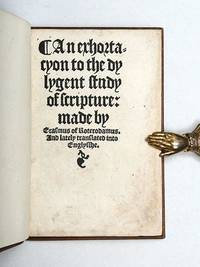
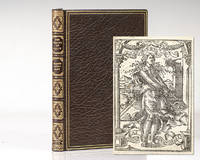
1549139476London: Thomas Berthelet 1549. First edition in English of one of the most notable and popular works of the Renaissance which played an important role in the beginnings of the Protestant Reformation and swiftly brought its author international fame. First printing with 'latine' and the printer's initials 'TB.' to the title page. Octavo bound in full crushed levant morocco by Sangorski and Sutcliffe gilt titles and elaborate gilt tooling to the spine in six compartments within raised gilt bands triple gilt ruling to the front and rear panels gilt turn-ins and inner dentelles all edges gilt wide woodcut border to the title page signed TB. woodcut printer's device to the final page. In near fine condition. Early ownership name to the title page and light marginalia. Small leather bookplate of Francis Kettaneh affixed to the verso of the front free endpaper. Exceptionally rare with only two other examples traced at auction in the last 100 years. This famous satire was first conceived on the road from Italy to England composed in the house of Erasmus's friend and the dedicatee Thomas More and then first printed under the Latin title Moriae encomium in Paris in 1511. Begun as a paradoxical joke between the two men who had been translating the ancient humorist Lucian together The Praise of Folly is a remarkable work by turns sharp and gentle—but always playful—in its learned treatment of the follies of the world and vision of a humanist life. “The Praise of Folly was written when Erasmus was staying in the house of Thomas More in the winter of 1509–10. Its title is a delicate and complimentary play on the name of his host: its subject matter is a brilliant biting satire on the folly to be found in all walks of life. The book stemmed from the decision which Erasmus had taken when he left Rome to come to England that no form of preferment could be obtained at the sacrifice of his freedom to read think and write what he liked … The work was first secretly printed in Paris and as in other cases its immediate success safeguarded him from the consequences of his audacity … Whenever tyranny or absolute power threatened The Praise of Folly was re-read and reprinted. It is a sign of what was in the air that Milton found it in every hand at Cambridge in 1628. His inherent scepticism has led people to call Erasmus the father of 18th century rationalism but his rationalist attitude is that of perfect common sense to which tyranny and fanaticism were alike abhorrent†PMM. Upon its initial publication in Paris in 1511 Moriae Encomium was hugely popular to Erasmus' astonishment and sometimes his dismay. Even Erasmus' close friends had been initially skeptical and warned him of possible dangers to himself from thus attacking the established religion. Even Pope Leo X and Cardinal Cisneros are said to have found it amusing. Before Erasmus' death it had already passed into numerous editions and had been translated into Czech French and German. An English edition soon followed translated by English poet and diplomat Sir Thomas Chaloner who was renowned among Elizabethans for his Latin verses and pastoral poems three volumes of which were printed during his lifetime by Thomas Berthelet the king’s printer who had published three translations of works by Erasmus in the 1520s. Thomas Berthelet hardcover
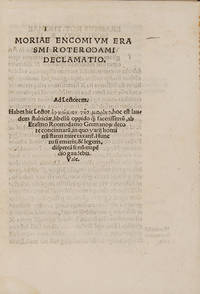
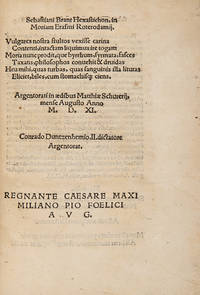
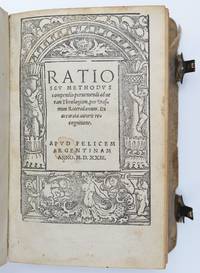
93719Argentorati Strassburg in aeidibus Matthiae Schurerii August 1511. . Second first dated edition; small 4to leaves measuring 19.4 x 13.8 cm; occasional minor coeval underlining and marginalia to earlier part of text very light stain to lower margin at gutter throughout not affecting text bibliographical clippings tipped onto front endpapers; bound in antique style calf; 96pp; A8 B4 C8 D4 E8 F4 G-H6 with the final blank leaf H6 present ff.<br /> The scarce first dated edition of Erasmus' Moriae Encomium an important work of humanist rhetoric which satirised the corruption and religious hypocrisy of Europe's elite.<br /><br />Printed two months after the undated Paris edition by Gilles de Gourmont of which only a handful of copies survive all of them in institutional libraries. The present edition almost as rare is not merely a reprint of the Paris edition but contains additional material including an address and laudatory letter to Erasmus by his fellow humanist Jakob Wimpfeling. All early editions are exceedingly scarce with only three appearing at auction in the last 100 years that we could trace. The first English translation was not published until 1549 although there had been Czech French and German editions prior to this.<br /><br />An excellent example of a classic work of paradoxical satire in which folly is personified and holds up a mirror to mankind. An extremely significant work both in its own right and for its influence on the Protestant Reformation in general. Sir Thomas More's own magnum opus Utopia was at least in part written as a response to Moriae Encomium.<br /><br />'The Praise of Folly was written when Erasmus was staying in the house of Thomas More in the winter of 150910. Its title is a delicate and complimentary play on the name of his host: its subject matter is a brilliant biting satire on the folly to be found in all walks of life. The book stemmed from the decision which Erasmus had taken when he left Rome to come to England that no form of preferment could be obtained at the sacrifice of his freedom to read think and write what he liked. The work was first secretly printed in Paris and as in other cases its immediate success safeguarded him from the consequences of his audacity. Whenever tyranny or absolute power threatened The Praise of Folly was re-read and reprinted. It is a sign of what was in the air that Milton found it in every hand at Cambridge in 1628. His inherent scepticism has led people to call Erasmus the father of eighteenth-century rationalism but his rationalist attitude is that of perfect common sense to which tyranny and fanaticism were alike abhorrent' PMM 43.<br /><br />Despite the risky nature of the work and its explicit and implicit attacks on established religion and authority figures of the time its rapid popularity ensured that the author and the work were left unmolested by church and state at least until Erasmus' death in 1536 after which his previously untainted reputation was diminished. By 1559 all of his works had been proscribed under the insidious Index Auctorum et Librorum Prohibitorum.<br /> Bezzel 1298; cf.PMM 43; Vander Haeghen 122. Argentorati (Strassburg), in aeidibus Matthiae Schurerii, August 1511. unknown
109061Argentorati Strassburg in aeidibus Matthiae Schurerii August 1511. . Second edition first dated edition; 4to 20.2 x 14.5 cm; dated ownership inscription in pen to title Roman and Greek type lower edge of G1 torn with loss not affecting text slight toning and soiling occasional underlining in ink; 19th-century vellum gilt spine gilt in compartments gilt lettering to second and fifth compartments on black morocco lettering-pieces edges stained red slight warping to upper board light soiling to boards; collation: A8 B4 C8 D4 E8 F4 G-H6 with final blank leaf H6 present ff.<br /> The scarce first dated edition of Erasmus' Moriae Encomium an important work of humanist rhetoric which satirised the corruption and religious hypocrisy of Europe's elite.<br /><br />Printed two months after the undated Paris edition by Gilles de Gourmont of which only a handful of copies survive all of them in institutional libraries. The present edition almost as rare is not merely a reprint of the Paris edition but contains additional material including an address and laudatory letter to Erasmus by his fellow humanist Jakob Wimpfeling. All early editions are exceedingly scarce with only three appearing at auction in the last 100 years that we could trace. The first English translation was not published until 1549 although there had been Czech French and German editions prior to this.<br /><br />'The Praise of Folly was written when Erasmus was staying in the house of Thomas More in the winter of 1509-1510. Its title is a delicate and complimentary play on the name of his host: its subject matter is a brilliant biting satire on the folly to be found in all walks of life. The book stemmed from the decision which Erasmus had taken when he left Rome to come to England that no form of preferment could be obtained at the sacrifice of his freedom to read think and write what he liked The work was first secretly printed in Paris and as in other cases its immediate success safeguarded him from the consequences of his audacity Whenever tyranny or absolute power threatened The Praise of Folly was re-read and reprinted. It is a sign of what was in the air that Milton found it in every hand at Cambridge in 1628. His inherent scepticism has led people to call Erasmus the father of 18th-century rationalism but his rationalist attitude is that of perfect common sense to which tyranny and fanaticism were alike abhorrent' PMM 43.<br /><br />Despite the risky nature of the work and its explicit and implicit attacks on established religion and authority figures of the time its rapid popularity ensured that the author and the work were left unmolested by church and state at least until Erasmus' death in 1536 after which his previously untainted reputation was diminished. By 1559 all of his works had been proscribed under the insidious Index Auctorum et Librorum Prohibitorum.<br /> Bezzel 1298; cf. PMM 43; Vander Haeghen 122. Argentorati (Strassburg), in aeidibus Matthiae Schurerii, August 1511. hardcover
1534150904London: Robert Wyer c.1534. Erasmus on reading the Bible in the vernacular Rare English translation of Erasmus's Paraclesis "a cogently argued text in support of the Bible in the vernacular and it is this particular thrust of the work that must have drawn the early English reformers to it since they too like Erasmus spoke eloquently and at length. in support of the Bible in English" Douglas H. Parker. Based on a translation variously attributed to either William Joy or George Joye which was first printed at Antwerp in 1529 this is one of two editions printed for the first time in England in 1534. While the 1529 Antwerp edition had included a translation of Martin Luther's commentary on 1 Corinthians 7 both 1534 editions replace Luther's text with another Erasmus text "An exhortacyon to the study of the Gospell". This is the only copy to have appeared in commerce in the past 45 years. Octavo 135 x 94 mm in two parts. Woodcut opening initials printer's devices McKerrow 67c and 68 69 "dieu et mon droit" woodcut on I8r. Twentieth-century brown pigskin spine lettered in gilt marbled endpapers. Fore-margins restored throughout affecting woodcuts on final leaf and occasional shoulder notes numerous short wormtracks filled some just into text some mostly marginal staining washed still a presentable copy carefully restored of a notably rare book. STC 10494 four copies only: British Library Oxford Huntington and the present copy. unknown
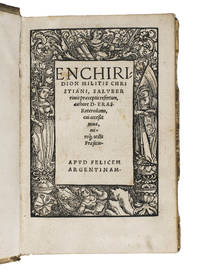
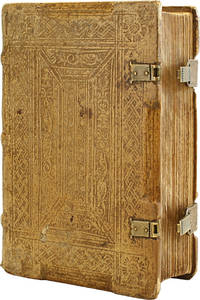
1523ABC_49639Strassburg 1523. 8vo. Colophon: Johann Knobloch Contemporary elaborately blind-tooled pigskin over wooden boards remnants of brass anchor plates. Ad 1 with a woodcut frame on the title page 1 woodcut decorated initial and Knoblochs large woodcut device on the verso of the last blank leaf. Ads 2 and 3 with 1 woodcut decorated initial each. Ad 4 with a woodcut architectural frame on the title page and 1 large woodcut decorated initial. 4 works in 1 volume. 106; 57 1 blank; 49 1 blank ll.;158 pp. Four significant early 16th-century works that illuminate the intellectual and theological tensions of the Reformation. Ad 1: The Enchiridion militis christiani Poinard of the Christian Knight one of Erasmus most influential writings serves as a practical manual for inner reform and devout living. Emphasising moral integrity over ritual this widely reprinted work became a cornerstone of Christian humanist thought.Ad 2: The two homilies in De immensa Dei misericordia include a sermon on divine mercy likely composed for the dedication of a chapel in Basel and a second comparing virginity and martyrdom written for the Benedictine nuns of Cologne. Both reflect Erasmuss pastoral sensibilities and rhetorical skill.Ad 3: In De libero arbitrio Erasmus directly challenges Luthers doctrine of predestination in a pivotal treatise on free will. This foundational text marking the definitive break between the two reformers is one of the periods most significant theological works.Ad 4: The volume concludes with an early -and apparently rare- edition of Henry VIIIs Assertio septem sacramentorum a fierce rebuttal of Luthers De captivitate Babylonica. This work earned the English king the title Fidei Defensor from Pope Leo X. A splendid collection that captures the core tensions of the Reformation and the humanist response to it.Ad 1 with some of the text underlined. Ad 2 with manuscript annotations in the margins. Ad 3 with some marginal annotations and some of the text underlined. Ad 4 with a manuscript inscription on the title page and a few annotations in the margins. The binding shows signs of wear some small pieces of leather missing on the back board revealing the wood below remnants of fastenings along the fore-edge ads 2 and 3 with some minor worm holes in the paper barely affecting the text some staining and browning in places. Otherwise in good condition.l Ad 1: USTC 650175 7 copies; Vander Haeghen I 80; VD 16 E 2772; Ad 2: Bezzel 1131; VD 16 E 3041 and VD 16 E 3659; not in the USTC; Ad 3: VD 16 E 3151; not in the USTC; Ad 4: VD 16 H 2166; this ed. not in USTC. hardcover
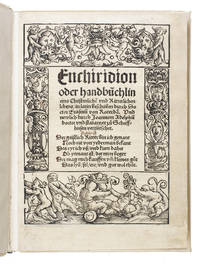
1520ABC_49900Colophon Basel 1520. 4to. Adam Petri Modern overlapping vellum grey endpapers. With an elaborate woodcut border by Hans Franck on the title page 5 half-page woodcut illustrations including 1 repeat in the text Petris device by Urs Graf below the colophon and several large decorated woodcut initials. The text is rubricated throughout. 10 CXIII ll. First German edition of Erasmuss Enchiridion militis christiani one of his most celebrated and influential works here translated by the Strasbourg humanist Johannes Adelphus ca. 1480s-ca. 1523. Erasmus began writing the Enchiridion around 1501 in Paris while fleeing from the plague and completed it some years later in Leuven. Originally conceived as a personal moral guide for the troubled nobleman the text promotes a life of inner devotion and ethical integrity urging Christians to cultivate sincere faith rather than rely on outward ritual. Though modest in origin the work became a cornerstone of Christian humanist thought and was widely reprinted and translated. The translator Joannes Adelphus Mülich or Müling was physician of the town of Schaffhausen; he made the translation at the request of Beatus Rhenanus.The present 1520 Basel edition handsomely produced by Adam Petri with rich woodcut ornamentation brought the Enchiridion to a broader German-speaking audience at a time of intense religious ferment. With a small manuscript annotation on the title page. The title page has been strengthened in the gutter margin and with elaborate restorations in the fore- and bottom edges. The tear in the bottom outer corner of leaf 73 has been restored barely affecting the text. Otherwise in good condition.l Bezzel 882; BM STC German p. 281; Erasmus Online 1708; USTC 650319; Vander Haeghen I 80; VD 16 E 2787; not in Adams. hardcover
16536648<p>Full yapped vellum; large gilt arabesque decor to boards; particulars debossed in blind to spine. Encased in 1566 edition of J.L. Vives 1493-1540 De Officio Mariti published in Frankfurt.</p><p>Text and plates from the original 1609 printing but now with the Frankfurt 1653 title page. Without additions or corrections but lacking two tables "amphitheatri aeternae" & "primordialiter constituunt mundum". Maintains same curious pagination as 1609 editon 61-42-63; 145-146-145-146-147; 190-192-193-193. No missing pages.</p><p>Eleven plates from the 1609 edition 9 of which are folding attached to rear and twelfth plate at 1653 title page.</p><p>Rear plates most wholly or partially rebacked include: original 1609 title page portrait of Khunrath Tablet of Jesus Tablet of Adam Table of Rebis Laboratorium Designation of the Pyramids or Designatio Porta Amphitheatri Adumbratio Gymnasii Hypotposis Arcis and Feinde Figure of the Panel of Enemies this last with creature-caused losses to top peripheral text see image. Minor loss to upper margin of center fold of plates 8 & 9. Peripheral dampstaining to upper margin of plates 3 4 & 7. Watermark of a crest with 3 towers in a shield over a moat to plate 5. This reissue bound without the elusive wise owl.</p><p>Peripheral worming throughout margins with two exceptions; one of which travels without side-tracking from a2 through z4 see images. Wear and moderate soiling to boards. No previous owners' names or other markings. 222 pp. 1. 8 1/4 x 12 1/4 inches; 20 x 31 cm.</p> Tobiam Gundermannum; Guilielmus Antonius hardcover
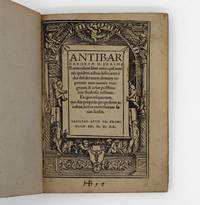
1520375736Basel: Froben 1520. First edition printed in May. Woodcut borders to title leaf and dedication by Hans Holbein printer's device on last page. 150 2 imprint pp. 4to. Eighteenth-century marbled boards ink label. Some toning to spine. Very good fresh copy. First edition printed in May. Woodcut borders to title leaf and dedication by Hans Holbein printer's device on last page. 150 2 imprint pp. 4to. Ignorantiam esse superbiae matrem. Eruditionem contra modestiam parere.<br /> Ignorance is the mother of pride; it is from learning on the contrary that modesty is born.<br /> <br /> First edition of Antibarbari Erasmus' manifesto "defending the arts against the scruples of the barbarians" Tracy. Erasmus argues for the primacy of poetry among the liberal arts for the importance of critical understanding of the writers of classical antiquity and for appropriating what is good in their work. He is also scornful of rote learning and blind repetition of earlier scholarship where "cuckoo calls to cuckoo".<br /> <br /> In Petro summus erat ardor fidei in Hieronymino summa doctrina: alterius animum alterius studia imitar. In Peter there was the ardour of faith at its highest; in Jeronme there was learning at its best. It is for you to imitate the spirit if the one and the scholarship of the other.<br /> <br /> This was a work of very long ripening. Erasmus began the earliest version circa 1490 when he was a newly ordained monk but that manuscript was left behind in his wanderings. Decades later when he came across his earlier work he was at the center of intellectual controversy following publication of of his edition of the New Testament. He revised his Antibarbari to assert the humanist position and Froben published it in May 1520. There were six editions of the work in the early 1520s Froben himself published another edition later the same year and ten editions in his lifetime.<br /> <br /> "it is ignorance rather than erudtion which makes men insolent"<br /> <br /> FIRST EDITION OF A KEY WORK BY ERASMUS. VD16 E1997; Valentina Sebastiani Johann Froben Printer of Basel 170; Bibliotheca Erasmiana p. 9; Adams E-463; Bezzel 157. The standard modern text iwith translation by Margaret Mann Phillips˜The Antibarbarians" is in the Toronto Collected Works vol. 23 1978 Froben unknown
1569ABC_49477Basel: Ambrosius & Aurelius Froben 1569. Contemporary half elaborately blind-tooled pigskin over wooden boards sewn on 5 supports volume 1 on 4 with two brass clasps on the fore edge leather anchor plate brass clasp and catch plate. With the manuscript titles on the spines and the contents of each volume in manuscript on the bottom edge of all but one volume. Probably bound by Michael Hermann in Stuttgart before 1580. See for the workshop einbanddatenbank no. 502297b the rolls used: nos. r004651 and r003964. Folio 38 x 25.5 cm. With the general title page in volume 1 set within an elaborate woodcut frame all other title pages show the large woodcut Froben printer's device repeated on all but one verso of the final page in each part. Further with woodcut decorated initials. 11 parts in 10 volumes. A complete and uniformly bound set of the monumental edition of the complete works of Saint Augustine of Hippo printed by the celebrated Froben press. This edition follows the editorial tradition established by Erasmus and Johann Froben in the early 16th century and reflects the enduring influence of Augustines thought on early modern theology. The present work includes a broad range of Augustines writings: his dogmatic treatises De Trinitate De civitate Dei polemical works notably against Pelagianism and Manichaeism exegetical texts Enarrationes in Psalmos Gospel homilies ascetic and moral discourses and the Epistolae. This edition represents an early attempt to consolidate Augustines vast corpus for academic and ecclesiastical use during period following the Council of Trent. It demonstrates the persistence of Augustinian authority in Reformation-era intellectual life as well as the role of the Swiss printing houses in disseminating patristic texts throughout Europe.Aurelius Augustine 354-430 CE commonly known as Augustine of Hippo was a North African bishop theologian and philosopher widely regarded as one of the most influential figures in Western Christianity and Latin patristic thought. Born in Thagaste modern-day Souk Ahras Algeria Augustine received a classical education in rhetoric and philosophy before embracing Manichaeism and later Neoplatonism.After a period of moral and spiritual searching chronicled in his Confessiones he converted to Christianity in 386 CE under the influence of Ambrose of Milan. He was baptised in 387 ordained a priest in 391 and became bishop of Hippo Regius in 395 a position he held until his death.Augustines vast body of work addresses themes such as original sin grace free will the nature of the Church and the interpretation of Scripture. His most notable writings include Confessiones De civitate Dei the City of God and De Trinitate. His thought shaped the theological foundations of both medieval Catholicism and later Protestant traditions particularly through his doctrines of grace and predestination. He died in 430 CE during the Vandal siege of Hippo. Augustine was later declared a Doctor of the Church and his intellectual legacy remains foundational to Western theology and philosophy.With a manuscript inscription on each of the title pages and a small printed book plate mounted on the front pastedown of volume 1. The bindings are slightly stained and are occasionally slightly bumped and rubbed. The front hinge of volume one is slightly weakened lacking the upper clasp and anchor plate of volume 7 and the front board of volume 9 is slightly damaged along the fore edge. Internally the volumes are variably slightly foxed and/or browned some volumes show very minor water staining most volumes contain some minor worm holes which affect small parts of the letters. A more detailed condition report including collations etc. per volume is available upon request. The 10 volumes are overall in very good condition. A handsome and important Renaissance printing of one of the most significant corpora of Christian antiquity. Rare complete in all ten volumes here uniformly bound.l USTC 686573; VD 16 A 4153; WorldCat 1828402 1406901978 1090145458 1002789099 35656998 222081178 1322263024 1114269923; cf. for the binder see Einbanddatenbank no. 502297b rolls nos. r004651 and r003964. Ambrosius & Aurelius Froben, hardcover
1520ABC_49643Colophon: Basel 1520. Small 8vo. Johann Froben Later blind-tooled pigskin over bevelled wooden boards each board in a panel design with a lozenge-shaped ornament and cornerpieces in the central panel surrounded by a decorative border 2 metal clasps and catches the manuscript title at the head edge a blank paper label on the spine and 4 pigskin tabs. With a decorative woodcut border on the title page of each work a woodcut printer's device at the end of the first 2 works 9 decorative woodcut borders in the text 16 decorative woodcut initials and 4 woodcut headpieces. 4 works in 1 volume. 141 3; 167 1; 91 1 blank; 14 2 blank pp. Compilation of first or early editions of four of the most important religious works by Desiderius Erasmus all printed during his lifetime. The texts which were incredibly popular in his own time were written to promote a more accurate understanding of the scriptures and make them more accessible to the public. Lifetime editions of these four works are quite rare on the market.In 1516 Erasmus published his revolutionary Latin edition of the Greek New Testament. It was not so much a translation but more a correction as Erasmus intended to free the text of the imperfections that had built up over time. When finished he began working on other parts of the scriptures with the same goal. The first two works in the present volume include his paraphrases of the letters of Paul. They were first issued separately in 4 parts starting in 1517. The present works are part of the first collected edition of the Pauline letters published by Froben in 1520 and 1521. This edition is praised for the fine title borders and initials some of them are known to have been cut by Johann Faber after drawings by the renowned artist Hans Holbein the Younger who often worked for Froben. The beautiful border on fol. 2A1 has been monogrammed by Ursus Graf "VG".The third work of this collection Modus orandi Deum is considered a centrepiece of Erasmus teachings on prayer. In it he explains the importance of prayer and provides a manual for how one should pray. He criticises monastic prayer long church services and practices that place the focus on the number of psalms said rather than their content. Instead he emphasises inner devotion and personal communication with God. The work was first published in October 1524 by Froben and in December 1524 by Knobloch. The present March 1525 edition is the second by Knobloch.The final work of the compilation was first published anonymously in 1520 as Consilium cujusdam . cupientis esse consultum & R. Pontificis dignitati & christianae religionis tranquillitati. Only two Latin editions and two German translations of it have been recorded by Vander Haeghen.With a contemporary ownership annotation at the head of the title page "Martini i iouilliami Vinter" a later annotation at the foot "Bernardhus Chymel alias Thalheuser" and a faded library stamp a few contemporary annotations and nota signs in the margins in 2 different hands. The pigskin has been washed with later clasps a few worm holes on the spine. The work is lightly browned throughout with water stains on some of the leaves mostly in the margins a brown stain on the title-page of ad 3. Otherwise in good condition.l Ad 1: Adams E 791; BM STC German p. 115; Erasmus Online 2919; USTC 682536 11 copies; Vander Haeghen I 144; VD16 E 3329; Ad 2: Adams E 792; BM STC German p. 115; Erasmus Online 2914; Vander Haeghen I 144; this ed. not in the USTC; VD 16; Ad 3: Adams E 697; Erasmus Online 2427; USTC 676364 10 copies; Vander Haeghen I 120; VD16 E 3176; not in BM STC German; Ad 4: Erasmus Online 5731; USTC 623273 3 copies; Vander Haeghen I 59; VD16 E 2542; not in Adams; BM STC German. hardcover
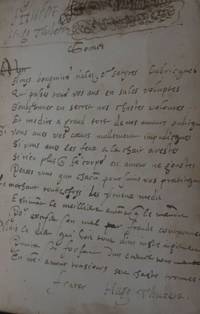
15233722Paris: apud Simon de Colines 1523. First edition. Contemporary French blind-stamped calf over wooden boards panelled with intersecting fillets and lozenge tools; remains of clasps present metal attachments preserved; spine with raised bands. Wide-margined and notably clean throughout. Early manuscript moral sonnet signed "Frater Hugo Thubert" on the front flyleaf and a biblical motto "Si quis vult post me venire." in a seemingly different sixteenth-century hand on the rear flyleaf. With a few early marginal annotations in a sixteenth-century hand on ff. 39 and 253 and f. 9 ruled with brown-ink frames. Leather somewhat worn including a damaged area on the front panel and some loss at the lower corners with surface abrasions and light cracking along the joints; spine rubbed at head and foot. A complete unsophisticated copy in its original binding retaining notable early reader's marks; overall in very good condition. First edition. Contemporary French blind-stamped calf over wooden boards panelled with intersecting fillets and lozenge tools; remains of clasps present metal attachments preserved; spine with raised bands. ff. 373 22. <p><br /> A rare example of early educational use of Erasmus's Adagia in its contemporary French leather binding and preserved with a handwritten French moral sonnet by its sixteenth-century owner Hugues Thubert.<br /> <p><p><br /> First edition of Jean Brouchier's pedagogical epitome of Erasmus's Adagia printed by Simon de Colines in the early years of his Paris press. Though derived entirely from Erasmus's celebrated Chiliades the structure and didactic programme are Brouchier's: an abridged sequence of selected adages arranged for the studiosa iuventus intended to make the moral historical and rhetorical substance of the Adagia usable in the Latin classroom at an elementary stage.<br /> <p><p><br /> Brouchier's dedicatory epistle explains the rationale behind the epitome: while the Adagia had become essential reading for humanist education their full scope far exceeded what younger students could manage. His selection extracts the most serviceable sententiae supplying a compact repertory suited to memorization written exercises and introductory rhetorical training. The epitome reflects early humanist classroom practice when teachers adopted shorter selections to provide beginners with a practical corpus for variation and elementary composition while still introducing Erasmus's ethical and stylistic programme.<br /> <p><p><br /> A dedicatory letter to the magistrates of Florence precedes the text outlining Brouchier's aims and directing readers to Erasmus for fuller commentary. The work aligns with Colines's broader programme of humanist educational printing which equipped collèges and monastic schools with clear reliable editions of classical and contemporary authors. Colines's architectural title border clean roman types and spacious mise-en-page underscore the book's intended function as a school text designed for legibility and daily use. As an adaptation of one of Erasmus's most influential works Brouchier's Epitome documents an early stage in the mediation condensation and classroom transmission of the Adagia illustrating the practical needs of humanist teaching in early sixteenth-century France.<br /> <p><p><br /> Brouchier's biography is largely undocumented; he is known only through a small group of humanist pedagogical editions issued in Paris between 1511 and 1534. Three of these-the present Epitome and the two editions of the Commentarii in Septem Sapientum Graeciae Apophthegmata-were printed by Simon de Colines placing Brouchier within the circle of authors associated with Colines's early humanist programme.<br /> <p><p><br /> This copy preserves an unpublished French moral sonnet in the hand of Hugues Thubert written on the front flyleaf and signed "Frater Hugo Thubert." The poem belongs to the broad and often fragmentary vernacular literary production of the sixteenth century when humanist education and the widespread use of printed and manuscript verse encouraged even non-professional writers to adopt classical forms for ethical reflection. Autograph poems of this type-especially those entered into the flyleaves of school and humanist books-are relatively uncommon and they offer intimate evidence of personal reading practices. Thubert's sonnet in fluent but regionally inflected French adapts the sonnet structure to a concise moral argument setting impurity and chastity in rhetorical opposition a mode familiar from contemporary humanist and devotional writing.<br /> <p><p><br /> An early owner of the present volume Hugues Hugo Thubert was a Benedictine of the Congregation of Chezal-Benoît listed in the 1529 matricule as a monk of Saint-Germain-des-Prés and later recorded as having left the order TELMA IRHT. He signs himself in this volume and appears again as owner of another book-Jean Grolier's former copy of Gaspar Bracellus's Ortus delitiarum Milan Minutianus 1515; Austin 357; Michon 24A-which he inscribed with his name and the date 1580 and which subsequently entered the abbey library of Saint-Germain-des-Prés. These traces collectively document a Paris-based sixteenth-century reader whose surviving books display consistent humanistic engagement.<br /> Rare; USTC lists 14 copies only six outside France and RBH records a single sale 2024.<br /> <p><p><br /> References: USTC 180884; IRHT-CNRS. n.d. Matricule de la Congrégation de Chezal-Benoît 1529. In TELMA - Traitement électronique des manuscrits.<br /> <p>. apud Simon de Colines unknown
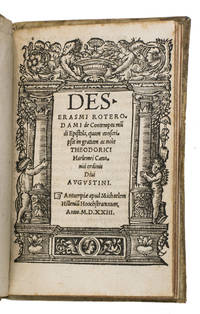
1523ABC_50124Antwerp: Michiel Hillen van Hoogstraten 1523. Later vellum with the manuscript title and year of publication on the spine red sprinkled edges. 8vo. With a decorative woodcut border on the title page and 2 decorated woodcut initials. Very rare early edition of Erasmus first written work a letter in praise of monastic life which was only published later in his career. Erasmus wrote it in 1488 or 1489 when he was 20 years old at the request of Theodoricus of Haarlem a fellow canon at the Augustine monastery at Steyn in order to persuade his nephew to join the order. It circulated in manuscript form for many years and was likely used to entice prospective candidates to enter the order of Canons Regular of St. Augustine.The work is divided into three parts: the first seven chapters focus on the evils of this world; chapter eight through eleven on the pleasures of the religious life; and chapter twelve on the ultimate choice between the material world or the religious state. This final chapter appears to counteract the rest of the work as it advises Theodoricus' nephew to carefully consider whether he truly wanted to enter a religious order since being a Christian is enough in itself. As such it has been suggested that Erasmus rewrote the text before its publication adding the 12th chapter but as he apologises for his adolescent writing style in the preface the work was likely mostly unedited.The first edition was published in Louvain in 1521 more than 30 years after it was written. The present edition is the first by Michiel Hillen van Hoogstraten and one of four printed in 1523. It is exceptionally rare on both the market and in institutions as only four copies have been recorded in libraries and we have not been able to find any others in sales records of the past century.The vellum is slightly soiled. The work is slightly browned throughout. Otherwise in good condition.l Adams E-569; Erasmus Online 1383; Nijhoff & Kronenberg 804; USTC 403708 4 copies; Vander Haeghen p. 64; WorldCat 71746606 2 copies; cf. De Molen R. "First fruits. The place of Antibarbarorum Liber and De contemptu mundi in the formulation of Erasmus Philosophia Christi" in: Colloque érasmien de Liège 1986 pp. 177-196; not in Bezzel; De Reuck; STCV. Michiel Hillen van Hoogstraten, hardcover
152116988Colophon: Mainz: Johannes Schoeffer 1521. German contemporary blind-tooled calf sewn on 3 double cords in a panel design each board with a 15 mm-wide border roll with fillets on either side containing 4 different heads in medaillions separated by quatrefoils. The central panel on each board is filled with dozens of impressions of 3 floral stamps 1 on the front board and 2 on the back. Titles in ink written on the spine partly upside down and the fore-edge; later paper spine label; 2 holes near the fore-edge of each board from fastenings now lost. 8vo. Ad 1: with the title in woodcut architectural border with 3 coats of arms the Isenburg bars and Mainz wagon wheel above left and right and Schoeffer's device here with 2 stars above and a rosette below rather than 3 stars at the foot under his IS-monogram; 6 large beautiful woodcut initials the largest 45 mm with 2 human figures. Both works set throughout in italic types still with upright capitals as always at this date. With 1 initial coloured by hand. Ad 2: with the title in an elaborate woodcut border dated "MDXX" at the head first page of the dedicatory letter by Erasmus to Petrus Aegidius dated Basle 5 October 1514 on back of the title page with a border made of woodcut strips Froben's large woodcut device on the last page and 2 decorative woodcut initials 2 series the 30 mm Q with a scorpion. 2 works in 1 volume. With: 2 ERASMUS Desiderius. Parabolae sive similia.Colophon: Basel Johannes Froben July 1521. Ad 1: Good scholarly edition of Erasmus's famous guide to writing and speaking style in Latin designed to provide the student of Latin with a wide range of words and expressions. Ad 2: A collection of similes or comparisons composed along the same lines and with the same intentions as those that had brought Erasmus much success in his Adagia. In a sense the Parabolae are an addition to and continuation of the Adagia. With some contemporary annotations. In very good condition with only a few minor marginal smudges or chips. Binding lacking fastenings and with damage to the spine and edges but still in good condition with most of the tooling very clear.l Ad 1: VD 16 E 2656; Allen I 260; II 305 311; Bezzel 748; Vander Haeghen Bibl. Erasm. p. 66; Reedijk 95 97; De Reuck Bibl. Erasm. Bruxel. 135 with illus. of the title; ad 2: VD 16 E 3246 2 copies; Bezzel 1371; Vander Haeghen Bibl. Erasm. p. 138; for the binding: cf. K. von Rabenau Deutsche Einbände der Renaissance von Jakob Krause Berlin 1994 7 & 8 similar bindings using stamps with the same motifs. Johannes Schoeffer, unknown
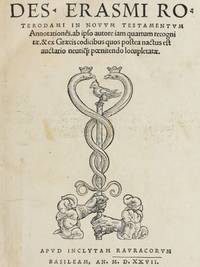
1527505487Froben 1527. Hardcover. VERY GOOD. 9 2-710 56 pp. original endpapers. Folio in sixes complete: a4 a-z6 A-Z6 Aa-Mm6 Nn8 Oo6 Qq8 Rr8. Contemporary blind-tooled alum-tawed pigskin over boards. Original clasps intact originally with corner furniture now lost. First title page with Froben device of crowned snakes and bird perching on hands enshrouded with clouds; second title page within Hans Holbein woodcut border. All edges stained Navy blue. 9 2-710 58 pp. <br /> <br /> Front hinge reattached with non-invasive Japanese paper repair; some staining and patina to the peccary bit of worming to the outer pages otherwise a few clean and fresh internal text. 17th century owner's inscription with hellenized name to FFEP. <br /> <br /> The fourth of six lifetime editions by Erasmus a great leap forward from the previous edition adding nearly 100 pages to the Third edition of 1522. <br /> <br /> First released in 1516 alongside his revised Greek Text and Latin translation of the New Testament the Annotationes are a philological tour de force examining in elaborate detail the differences between the ancient Greek text and the Vulgate in the process demonstrating the need for a new Latin translation namely his own. In the process Erasmus was dangerously frank in his discussion of Church abuses and departures from the teaching of Scripture showing himself 'An unprecedentedly formidable critic of contemporary theological and religious practice' McConicum Oxford Encyclopedia of the Reformation. <br /> <br /> The single greatest scholarly accomplishment of the renaissance was Erasmus's Annotations on the New Testament. Begun in 1516 and revised three times in his lifetime this second revision of 1527 was the greatest expansion of the work more than doubling its size from the first edition. Here the complete force of his philological powers is on full display boring away centuries of accreted dogma and ignorance that had obscured the text. "Without the notes Erasmus said the texts of the Scripture were 'naked and defenceless' open to criticism by uncomprehending readers and corruption by careless printers. The Annotations represent not only Erasmus' defence of the New Testament against such abuses but also a reflection of his own philosophy objectives and working methods. In establishing the text and defending it against his opponents Erasmus drew on manuscript sources classical literature patristic writings scholastic exegesis and the work of his immediate forerunners Valla and Lefevre. He did not hesitate to point out the errors of illustrious writers like Jerome and established medieval authorities like Peter Lombard. In general he was appreciative of the early church Fathers and contemptuous of medieval commentators. Rummel Erika. Erasmus' Annotations on the New Testament : From Philologist to Theologian. <br /> <br /> In many cases the Annotations serve to justify the most controversial renderings in his translation and defend himself against heresy charges. The most notable instance is his translation of the Greek metanoiete in Matt 3 note 1 and Acts 19 note 8. which Jerome had translated as "do penance" a rendering which shored up the Church's sacramental doctrine of a private secret confession made only to a priest. While Erasmus maintained that he himself practiced taught and supported the status quo penitential rite he did not find any grounding in Scripture where he insisted metanoiete referred to a change of mind not penitential confession and that anyway that instances of confession in Scripture were uniformly public and oral. See Rummel 152-156. Adams E-891. Froben hardcover
1525LCS-17326<p><strong>Erasmus and his master Laurent Valla: three founding works of the Renaissance </strong><strong>preserved in their contemporary blind-stamped binding.</strong></p><p><strong>Strasbourg 1523 1525. Cologne 1525.</strong></p><p><strong>From the <em>Campana</em> collection with this 16th century handwritten ex-libris </strong></p><p><strong><em>"Jacobi Campana et Amicorum 1530".</em></strong></p><p>In total three texts bound in one 8vo volume 148 x 100 mm of: I/ 184 ll. the last one blank; II/ 28 ll. ; III/ 1 title-page 148 pp. 10 pp. of index 1 bl.p. Numerous handwritten notes on the last 2 ll. of the 1st text. Bound in blind-stamped pigskin over wooden boards brass clasps. <em>Contemporary binding.</em></p><p>Collection in quite rare and very early editions of 3 important founding works of the Renaissance in philology and grammar by Erasmus and by his master Laurent Valla.</p><p><em>Laurent Valla "the greatest humanist of the first half of the 15th century" </em>was born in Rome around 1407. Guilio Vallese.</p><p><em>"Deeply convinced of the superiority of the antique culture renewed at the time in which he saw an incomparable ferment of regeneration Valla in order to defend it didn't hesitate to take the chance of being condemned in front of the Inquisition court. As other humanists of this time he claimed to be of the rationalist moral antique transmitted in the books of Wisdom when the Middle Ages had impoverished or lost the very meaning of it."</em></p><p>Valla's most famous treatise "<em>Des élégances de la langue latine</em>"that had most contributed to his reputation in six books was quickly given in every school and kept on being a teaching text for the greatest part of the 16th century.</p><p>Erasmus who professes many times in his letters a vivacious admiration for the author and for this particular work had made in his youth an extract for his personal use which was printed twice without his consent.</p><p><em>Valla's observations are about the value of certain forms of words about the value of several difficult terms and even more about the synonymy of the Latin language. This work proves a great sagacity of researches and a great judgment. "King Alphonse who really liked this kind of studies didn't get tired of hearing Valla and let him sometimes battling with Antoine de Parlerme "inde ivae". He gave him a diploma enriched with a golden speech bubble in which he declared him illustrious in almost every science as well as in poetics."</em></p><p>Are joined to this major work of Valla the two great founding texts it inspired to Erasmus:</p><p>-The first one <em>De Conscribendis epistolis</em> in the second edition from Strasbourg of 1525. It was such a success that it was after this one reprinted 77 times in the 16th century alone.</p><p>-The second one <em>De Constructione octo partium orationis libellus</em> printed for the first time in 1514 is here in the edition printed on August 11th 1523 at Sigismon Grim. It was followed by 61 editions in the 16th century alone.</p><p>A magnificent copy with wide margins preserved in its first blind-stamped binding; the clasps and ties are intact.</p><p>It comes from the collections <em>Jacob Campana</em> and <em>Gaspar Campana</em> and bears these two handwritten ex-libris "<em>Jacobi Campanae et Amicorum 1530</em>" and "<em>Gaspari Campanae et Amicorum</em>".</p><p>The<em> Campanas</em> illustrious Neapolitan family counted <em>César Campana</em> among their members a fine erudite from the 16th century.</p><p>FRANCAIS</p><p><strong>Erasme et son maître Laurent Valla : trois uvres fondatrices de la Renaissance</strong></p><p><strong>conservées dans leur première reliure estampée à froid.</strong></p><p><strong>Strasbourg 1523 1525. Cologne 1525.</strong></p><p><strong>De la bibliothèque <em>Campana</em> avec cet ex-libris manuscrit du XVIe siècle</strong></p><p><strong><em>" Jacobi Campana et Amicorum 1530 ".</em></strong></p><p>Soit trois textes reliés en un volume in-8 de I/ 184 ff. le dernier blanc ; II/ 28 ff. ; III/ 1 p. de titre 148 pp. 10 pp. d'index 1 p.bl. Nombreuses annotations manuscrites sur les 2 derniers ff. du 1er texte. Relié en peau de truie estampée à froid sur ais de bois dos à nerfs attaches et fermoirs de laiton. <em>Reliure de l'époque.</em></p><p>148 x 100 mm.</p><p>Réunion en éditions fort rares et très précoces de trois grands textes fondateurs de la Renaissance en philologie et grammaire d'Erasme et de son maître Laurent Valla.</p><p><em>Laurent Valla " le plus grand humaniste de la première moitié du XVe siècle "</em> naquit à Rome vers 1407. Guilio Vallese.</p><p><em>" Profondément convaincu de la supériorité de la culture antique alors renaissante dans laquelle il voyait un ferment incomparable de régénération Valla pour la défendre n'hésita pas à courir le risque d'une condamnation devant le tribunal de l'Inquisition. Comme d'autres humanistes de ce temps il se réclamait de l'antique morale rationaliste transmise dans les livres de la Sagesse dont le Moyen Age avait appauvri ou perdu la signification même. "</em></p><p>Le traité le plus célèbre de Valla qui avait le plus contribué à sa réputation<em>" Des élégances de la langue latine "</em> en six livres se répandit rapidement dans toutes les écoles et continua de faire texte d'enseignement pendant la plus grande partie du XVIe siècle.</p><p>Erasme qui professe en beaucoup d'endroits de ses lettres une vive admiration pour l'auteur et pour cet ouvrage en particulier en avait fait dans sa jeunesse un extrait pour son usage qui fut imprimé deux fois sans son consentement.</p><p><em>Les observations de Valla portent sur la valeur de certaines formes de mots sur celle de plusieurs termes difficiles et plus encore sur les synonymies de la langue latine. Ce travail atteste une grande sagacité de recherches et un rare discernement. " Le roi Alphonse auquel ce genre d'études plaisait singulièrement ne se lassait pas d'entendre Valla et le mettait quelquefois aux prises avec Antoine de Parlerme " inde ivae ". Il lui donna un diplôme enrichi d'une bulle d'or dans laquelle il le déclarait illustre en presque toutes les sciences ainsi qu'en la poétique. "</em></p><p>Sont joints à cette uvre phare de Valla les deux grands textes fondateurs qu'elle inspire à Erasme :</p><p>-Le premier <em>De Conscribendis epistolis</em> dans la seconde édition strasbourgeoise de 1525. Son succès fut tel qu'elle fut après celle-ci réimprimée 77 fois pour le seul XVIe siècle.</p><p>-Le second texte <em>De Constructione octo partium orationis libellus</em> imprimé pour la première fois en 1514 est ici dans l'édition achevée d'imprimer le 11 août 1523 chez Sigismon Grim. Elle fut suivie de 61 éditions pour le seul XVIe siècle.</p><p>Magnifique exemplaire à belles marges conservé dans sa première reliure estampée à froid dont les fermoirs et les attaches sont conservés intacts.</p><p>Il provient des bibliothèques <em>Jacob Campana</em> et <em>Gaspar Campana</em> et porte ces deux ex-libris manuscrits <em>" Jacobi Campanae et Amicorum 1530 "</em> et <em>" Gaspari Campanae et Amicorum "</em>.</p><p>Les<em> Campana</em> illustre famille napolitaine comptèrent parmi leurs membres <em>César</em> <em>Campana</em> fin lettré du XVIe siècle.</p> Iohannem Heruagium.
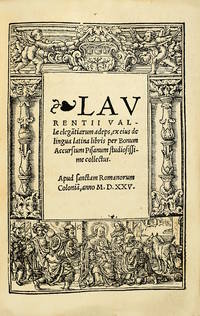
TBF4<p>Argentorati Iohannem Heruagium 1525.</p><p>Followed by: <b>Erasmus</b>.<i>De octo orationis partium constructione libellus tum elegans imprimis tum dilucida brevitate copiosissimus. Erasmo roterodamo autore.</i></p><p>At the end "<i>Augustae Vindelicorum in officina D. Sigismum Grim 11 Aout Anno 1523.</i>"</p><p>Followed by: <b>Valla</b>.<i>Laurentii vallae elegatiarum adeps exeius de lingua latina libris per Bonum Accursium Pisanum studiosissime collectus. </i><i>Les élégances de la langue latine.</i></p><p>Apud Sanctam Romanorum Colonia 1525.</p><p>In total three texts bound in one 8vo volume 148 x 100 mm of: I/ 184 ll. the last one blank; II/ 28 ll. ; III/ 1 title-page 148 pp. 10 pp. of index 1 bl.p. Numerous handwritten notes on the last 2 ll. of the 1st text. Bound in blind-stamped pigskin over wooden boards brass clasps. <i>Contemporary binding.</i></p><p><b>Collection in quite rare and very early editions of 3 important founding works of the Renaissance in philology and grammar by Erasmus and by his master Laurent Valla.</b></p><p><i>Laurent Valla "the greatest humanist of the first half of the 15th century" </i>was born in Rome around 1407. Guilio Vallese.</p><p><i>"Deeply convinced of the superiority of the antique culture renewed at the time in which he saw an incomparable ferment of regeneration Valla in order to defend it didn't hesitate to take the chance of being condemned in front of the Inquisition court. As other humanists of this time he claimed to be of the rationalist moral antique transmitted in the books of Wisdom when the Middle Ages had impoverished or lost the very meaning of it."</i></p><p><b>Valla's most famous treatise</b> "<i>Des élégances de la langue latine</i>"<b>that had most contributed to his reputation in six books was quickly given in every school and kept on being a teaching text for the greatest part of the 16th century.</b></p><p><b>Erasmus who professes many times in his letters a vivacious admiration for the author and for this particular work had made in his youth an extract for his personal use which was printed twice without his consent.</b></p><p><i>Valla's observations are about the value of certain forms of words about the value of several difficult terms and even more about the synonymy of the Latin language. This work proves a great sagacity of researches and a great judgment. "King Alphonse who really liked this kind of studies didn't get tired of hearing Valla and let him sometimes battling with Antoine de Parlerme "inde ivae". He gave him a diploma enriched with a golden speech bubble in which he declared him illustrious in almost every science as well as in poetics."</i></p><p><b>Are joined to this major work of Valla the two great founding texts it inspired to Erasmus:</b></p><p><b>-The first one</b><i>De Conscribendis epistolis</i> <b>in the second edition from Strasbourg of 1525.</b> It was such a success that it was after this one reprinted 77 times in the 16th century alone.</p><p><b>-The second one</b> <i>De Constructione octo partium orationis libellus</i> printed for the first time in 1514<b> is here in the edition</b> printed on August 11th 1523 at Sigismon Grim. It was followed by 61 editions in the 16th century alone.</p><p><b>A magnificent copy with wide margins preserved in its first blind-stamped binding; the clasps and ties are intact.</b></p><p>It comes from the collections <i>Jacob Campana</i> and<i>Gaspar Campana</i> and bears these two handwritten ex-libris "<i>Jacobi Campanae et Amicorum 1530</i>" and "<i>Gaspari Campanae et Amicorum</i>".</p><p>The<i> Campanas</i> illustrious Neapolitan family counted <i>César Campana</i> among their members a fine erudite from the 16th century.</p><br /><u><b>Français</b></u><br /><p>Argentorati Iohannem Heruagium 1525.</p><p>Suivi de : <b>Erasme</b>. <i>De octo orationis partium constructione libellus tum elegans imprimis tum dilucida brevitate copiosissimus. Erasmo roterodamo autore.</i></p><p>A la fin <i>" Augustae Vindelicorum in officina D. Sigismum Grim 11 Aout Anno 1523. "</i></p><p>Suivi de : <b>Valla</b>. <i>Laurentii vallae elegatiarum adeps exeius de lingua latina libris per Bonum Accursium Pisanum studiosissime collectus. Les élégances de la langue latine.</i></p><p>Apud Sanctam Romanorum Colonia 1525.</p><p>Soit trois textes reliés en un volume in-8 de I/ 184 ff. le dernier blanc ; II/ 28 ff. ; III/ 1 p. de titre 148 pp. 10 pp. d'index 1 p.bl. Nombreuses annotations manuscrites sur les 2 derniers ff. du 1er texte. Relié en peau de truie estampée à froid sur ais de bois dos à nerfs attaches et fermoirs de laiton. <i>Reliure de l'époque.</i></p><p>148 x 100 mm.</p><p><b>Réunion en éditions fort rares et très précoces de trois grands textes fondateurs de la Renaissance en philologie et grammaire d'Erasme et de son maître Laurent Valla.</b></p><p><i>Laurent Valla " le plus grand humaniste de la première moitié du XVe siècle "</i> naquit à Rome vers 1407. Guilio Vallese.</p><p><i>" Profondément convaincu de la supériorité de la culture antique alors renaissante dans laquelle il voyait un ferment incomparable de régénération Valla pour la défendre n'hésita pas à courir le risque d'une condamnation devant le tribunal de l'Inquisition. Comme d'autres humanistes de ce temps il se réclamait de l'antique morale rationaliste transmise dans les livres de la Sagesse dont le Moyen Age avait appauvri ou perdu la signification même. "</i></p><p><b>Le traité le plus célèbre de Valla qui avait le plus contribué à sa réputation</b><i>" Des élégances de la langue latine "</i> <b>en six livres se répandit rapidement dans toutes les écoles et continua de faire texte d'enseignement pendant la plus grande partie du XVIe siècle.</b></p><p><b>Erasme qui professe en beaucoup d'endroits de ses lettres une vive admiration pour l'auteur et pour cet ouvrage en particulier en avait fait dans sa jeunesse un extrait pour son usage qui fut imprimé deux fois sans son consentement.</b></p><p><i>Les observations de Valla portent sur la valeur de certaines formes de mots sur celle de plusieurs termes difficiles et plus encore sur les synonymies de la langue latine. Ce travail atteste une grande sagacité de recherches et un rare discernement. " Le roi Alphonse auquel ce genre d'études plaisait singulièrement ne se lassait pas d'entendre Valla et le mettait quelquefois aux prises avec Antoine de Parlerme " inde ivae ". Il lui donna un diplôme enrichi d'une bulle d'or dans laquelle il le déclarait illustre en presque toutes les sciences ainsi qu'en la poétique. "</i></p><p><b>Sont joints à cette œuvre phare de Valla les deux grands textes fondateurs qu'elle inspire à Erasme :</b></p><p><b>-Le premier</b><i>De Conscribendis epistolis</i> dans la seconde édition strasbourgeoise de 1525. Son succès fut tel qu'elle fut après celle-ci réimprimée 77 fois pour le seul XVIe siècle.</p><p><b>-Le second texte</b><i>De Constructione octo partium orationis libellus</i> imprimé pour la première fois en 1514 est ici dans l'édition achevée d'imprimer le 11 août 1523 chez Sigismon Grim. Elle fut suivie de 61 éditions pour le seul XVIe siècle.</p><p><b>Magnifique exemplaire à belles marges conservé dans sa première reliure estampée à froid dont les fermoirs et les attaches sont conservés intacts.</b></p><p>Il provient des bibliothèques <i>Jacob Campana</i>et <i>Gaspar Campana</i> et porte ces deux ex-libris manuscrits <i>" Jacobi Campanae et Amicorum 1530 "</i> et <i>" Gaspari Campanae et Amicorum "</i>.</p><p>Les<i> Campana</i> illustre famille napolitaine comptèrent parmi leurs membres <i>César</i> <i>Campana</i> fin lettré du XVIe siècle.</p> hardcover
1520253908Basel: Johann Froben 1520. First collected editions. Titles within ornamental woodcut border initials printer's device in colophon. 465 i.e. 495 1; 167 1; and 141 3 pp. 1 vols. 8vo. Contemporary blindstamped pigskin over wooden boards spine in four compartments with raised bands over doubled cords ruled in blind and crossed floral ornaments boards tooled with floral borders about a central field edges ochre. Covers somewhat soiled one brass clasp missing upper joint just starting but quite firm; internally a SUPERB near flawless copy. Bookplate and ownership signature of scholar and author Nathan Comfort Starr. First collected editions. Titles within ornamental woodcut border initials printer's device in colophon. 465 i.e. 495 1; 167 1; and 141 3 pp. 1 vols. 8vo. First collected editions of these "Paraphrases" of the letters of Paul which were undertaken shortly after Erasmus's revolutionary edition of the Greek New Testament of 1516. As part of that monumental reconstruction of the New Testament Erasmus' intention was to "retell" the books of the New Testament in one uninterrupted voice without the clutter of textual commentary or critical interruption. It was a bold undertaking and in 1517 Erasmus began with the letters of Paul. They were first issued separately starting with Romans in 1517; and editions appeared in Louvain Thierry Martens Leipzig Valentin Schumann and Basel Johann Froben. The collected issues - such as the three which are bound together in this exquisite volume - began to be issued in Basel by Froben in 1519; and finally in 1521 Froben issued a collected edition of all of the Pauline letters. All of the lifetime editions both separate and collected are rare on the market; this copy is in a well preserved contemporary pigskin binding first binding. Adams E790; E792; E791; VD16 E 3060; E 3324; E 3328 Johann Froben unknown
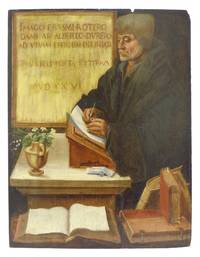
12140s.l. s.n. 16XX. 465 x 355 cm. Not dated not signed early XVII century. Painted on a thin wooden panel consisting of two parts with a small indentation at the top. The original engraving was made in 1526 in Rotterdam by the Germain painter Albrecht Dürer 1471-1528 and is now in The Metropolitan Museum of Art in New York. A Roman Catholic reformer and one the most important Netherlandish humanists Erasmus of Rotterdam held a deep admiration for Albrecht Dürer whom he praised in a eulogy as the greatest of graphic artists: ""And is it not more wonderful to accomplish without the blandishment of colors what Apelles accomplished with their aid"" In likening Dürer to Apellesindeed in asserting the German's superiority over the Greek artistErasmus echoed a tradition dating back to antiquity of judging artists and the visual character of their work by the standards set by their predecessors. Dürer would certainly have appreciated the praise for his graphic talents. The portrait amply demonstrates the virtuous effects Dürer was able to achieve without the benefit of color or a liquid medium. Convincingly aligned at an angle to the picture plane Erasmus stands writing in his study with the books that indicate his substantial intellect and scholarship arranged around him. The vase of lilies probably refers to the purity of his mind while the Latin and Greek inscription prominently framed like a picture on the wall underscores the scholar's humanistic interests: ""This image of Erasmus of Rotterdam was drawn from life by Albrecht Dürer."" Below is the date 1526 in Roman numerals. Dürer met Erasmus at least once in Brussels and twice in Rotterdam during a trip to the Netherlands in 1520 and 1521. Although he sketched Erasmus several times during his trip he did not execute the engraving until six years later and only then with the encouragement of his close friend Willibald Pirkheimer. For certain reasons Dürer had been disappointed by the well-known Protestant reformer. Dürer based the portrait on a medal of 1519 in Pirkheimer's collection by Quentin Massys and reproduced the Greek inscription found on the medal which states: ""A better portrait his writings show."" Presumably Erasmus agreed because he made known his disappointment with this portrait to at least two of his colleagues. And yet Dürer's Erasmus remains one of history's richest and most powerful depictions of scholarly preoccupation and the humanist ideal. 465 x 36 cm. Niet gedateerd niet gesigneerd begin XVII eeuw. Geschilderd op een op een dun houten paneel bestaande uit twee delen met aan de bovenzijde een kleine inkeping. De originele gravure werd in 1526 gemaakt in Rotterdam door de Duitse schilder Albrecht Dürer 1471-1528 en bevindt zich nu in The Metropolitan Museum of Art in New York. Erasmus van Rotterdam een rooms-katholiek hervormer en een van de belangrijkste Nederlandse humanisten had grote bewondering voor Albrecht Dürer die hij in een lofrede prees als de grootste van alle grafische kunstenaars: ""En is het niet wonderbaarlijker om zonder de verleiding van kleuren te volbrengen wat Apelles met hun hulp heeft volbracht"" Door Dürer met Apelles te vergelijken ja door de superioriteit van de Duitser over de Griekse kunstenaar te bevestigen herhaalde Erasmus een uit de oudheid stammende traditie om kunstenaars en het visuele karakter van hun werk te beoordelen naar de maatstaven van hun voorgangers. Dürer zou de lof voor zijn grafische talenten zeker op prijs hebben gesteld. Het portret laat goed zien welke fraaie effecten Dürer kon bereiken zonder het gebruik van kleur of een vloeibaar medium. Erasmus staat overtuigend in een hoek ten opzichte van het beeldvlak schrijvend in zijn studeerkamer met om hem heen de boeken die getuigen van zijn grote intellect en geleerdheid. De vaas met lelies verwijst waarschijnlijk naar de zuiverheid van zijn geest terwijl de Latijnse en Griekse inscriptie prominent ingekaderd als een afbeelding aan de muur de humanistische belangstelling van de geleerde onderstreept: ""Deze afbeelding van Erasmus van Rotterdam is naar het leven getekend door Albrecht Dürer."" Daaronder staat de datum 1526 in Romeinse cijfers. Dürer ontmoette Erasmus ten minste eenmaal in Brussel en tweemaal in Rotterdam tijdens een reis naar de Nederlanden in 1520 en 1521. Hoewel hij Erasmus tijdens zijn reis verschillende malen schetste voerde hij de gravure pas zes jaar later uit en dan nog alleen op aanmoediging van zijn goede vriend Willibald Pirkheimer; kennelijk was Dürer om bepaalde redenen teleurgesteld in de bekende protestantse hervormer. Dürer baseerde het portret op een penning uit 1519 in Pirkheimers verzameling van Quentin Massys en reproduceerde de Griekse inscriptie die op de penning te vinden was en die luidt: ""Een beter portret tonen zijn geschriften."" Vermoedelijk was Erasmus het daarmee eens want hij heeft zijn teleurstelling over dit portret aan tenminste twee van zijn collega's kenbaar gemaakt. En toch blijft Dürers Erasmus een van de rijkste en krachtigste afbeeldingen uit de geschiedenis van de wetenschappelijke preoccupatie en het humanistische ideaal. s.l., s.n. unknown
1675009581Various places: Various publishers 1675. Book. Very good condition. Hardcover. First Edition. Numerous works bound in one volume. Half vellum binding with marbled paper-covered boards; moderately soiled. Previous owner's bookplate Bilharz on front paste-down endpaper and circular private library sticker at bottom of spine. Works include: 1. Moller D. G. "Dissertatio De Technophysiotameis Von Kunst- und Naturalien- Kammern." Henrici Meyeri: Altdorfii 1704. Dissertaion/Thesis F. S. Wuffbain respondent. 68 pages. 2. Fermin Phillipe. "Memoire sur l'origine de la belemnite contenant la decouverte de l'animal analogue a ce fossile." 4 page manuscript with folding manuscript illustration. Apparently a fair copy of the above named article published in Ph. Renard's "Considerations d'histoire naturelle" pp.63-76 in 1775. 3. Camerarius R. J. "Dissertation inauguralis medica de lapidum figuratorum usu medico." Johannis Cunradi Reissi: Tubingae 1718. Dissertaion/Thesis J. J. Straskircher respondent. 32 pages. 4. Marbodus Bishop of Rennes; edited by F. E. Bruckmann. "Marbodei Galli Poetae Uetustissimi de Lapidibus Pretiosis Enchiridion Cum Scholiis Pictorii Villingensis." Bruckmanniana: Wolffenbuttleae 1740. 82 2 pages. 5. Stella Erasmus; edited by F. E. Bruckmann. "Interpretament Gemmarum Libellus Unicus Plinius Secundus de Gemmis." Carol. Frid. Jungnicolium: Erfurti et Lipsiae 1736. 68 pages. 6. Hebenstreit J. E. "De Ordinibus Gemmarum Verbis C. Plinii ex eius Naturalis Historiae Libr. XXXVII. Qui Totus de Gemmis Est Disserens Panegyrin Medicam." Lipsiae 1747. 16 pages. 7. Hueber G. L. "Disssertatio Inauguralis Physico-Chemico-Medica de Margaritis Earumque Virtute Medica." Joannis Jacobi Christophori Kleyer: Wirceburgi 1744. Dissertaion/Thesis J.G. Gross respondent. 71 xv pages. 8. Vogel R. A. "Terrarum Atque Lapidum Partitio Disputatio Medica Solemnis." Schulzianis Rosenbusch: Gottingae 1762. Dissertaion/Thesis A. F. C. Hempel respondent. 54 pages. 9. Roederer J. G. "Decanus Ordinis Medici in Academia Georgia Augusta Jo. Georg Roderer D. Dissertationem Inauguralem" Schulzianis Rosenbusch: Gottingae 1762. Dissertaion/Thesis with vita of A. F. C. Hempel. 12 pages. 10. Reiske Johannes. "M. Joh. Reiskii de Glossopetris Luneburgensibus ad Virum Nobilissimum Atque Esperientissimum Joh. Georg Hieronymi." Joh. Georg. Lipperi: Lipsiae 1684. 56 pages one folded leaf of illustrations. 11. Guettard Jean Etienne; Philippe Buache. Folding Map. "Carte Mineralogique de la Suisse par Philippe Buache." 1752. 12. Hottinger J. H. "Dissertatio de Crystallis." Bodmeriano: Tiguri 1698. iv 44 pages illustrated by one folding leaf of gems/crystals. 13. Hensing J. T. "Dissertatio Chemica de Germinatione Metallica Arificiali Ejusdemque Novo Invento." Joh. Reinh. Vulpii: Giessae-Hassorum 1718. Dissertaion/Thesis Joh. Georgio Beck respondent. 35 pages. 14. Muller P. L. S. "Dubia Coralliorum Origini Animali Opposita." Io. Diter. Mich. Camerarii: Erlangae 1770. 22 pages. Probably another dissertation: Suscipiet Philippus Ludovicus Statius Muller. 15. Frank Johann. "Disertatio Physica de Coralio Juxta Ductum Plinii Hist. Nat. Lib.32.c.2. adornata." Praelo Bauhoferiano: Jenae 1675. Dissertaion/Thesis Paulus Linsius respondent. 12 leaves. 16. Folding leaf with text and illustrations of tube worms. Measures 10 x 14 inches. "Kurtze Abbildung und Beschreibung der ungewohnten entsetzlichen Wuermen.in gank Nord-holland." Circa 1735. Various publishers Hardcover
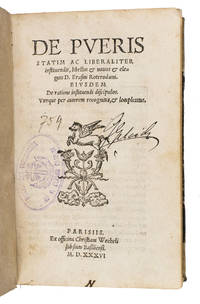
1536ABC_49637Paris: Chrétien Wechel 1536. Half vellum and brown sprinkled paper sides with the faded manuscript title on the spine red edges. 8vo. Ad 1 with Wechels woodcut device on the title page and 3 woodcut decorated initials. Ad 2 with Wechels woodcut device on the title page and the verso of the blank last leaf and 1 woodcut decorated initial. Ad 3 with a woodcut architectural frame on the title page and 2 woodcut decorated initials. Ad 4 with Frobens woodcut device on the title page and the verso of the last blank leaf. 4 works in 1 volume. With:2 IDEM. Responsio ad Petri Cursii defensionem nullo adversario bellacem.Paris Chrétien Wechel 1535.3 IDEM. Responsio ad epistolam paraeneticam clarissimi doctissimicque viri. Alberti Pii carporum principis. Paris Pierre Vidoux April 1529.4 IDEM. Purgatio adversus epistolam non sobriam Martini Luteri.Basel colophon: Hieronymus Froben and Nikolaus Episcopius April 1534. Together these four works capture the remarkable breadth of Erasmuss influence from his visionary humanist pedagogy to his forceful engagement in the theological controversies of the Reformation. Brought together in this volume they reflect both the moral urgency and intellectual sharpness that defined his contribution to early modern thought.Ad 1: First published in September 1529 De pueris statim ac liberaliter instituendis and De ratione instituendi discipulos represent Erasmus principal contribution to Renaissance pedagogy. He argues for the early and liberal education of children stressing mildness rather than severity moral formation alongside learning and the formative power of classical texts. Ad 2: An exceptionally rare edition of a polemic against the Louvain theologian Petrus Curtius in which Erasmus defends his humanist theology whilst ridiculing Curtius as a fighter without an adversary. First issued by Froben and Episcopius earlier that year with only that edition and the present Wechel edition extant; the text was not reprinted until the Opera omnia.Ad 3: A spirited reply to the accusations of Alberto Pio Prince of Carpi coupled with sharp extemporaneous notes against Edward Lee Beda. This double defence displays Erasmus wit and sharpness at the height of the Reformation debates. A very scarce edition; the editio princeps had appeared from Froben in March of the same year.Ad 4: An early witness to the high demand in 1534. Erasmus rejoinder to Luthers intemperate letter written in the wake of De servo arbitrio. Here Erasmus defends himself against charges of paganism whilst censuring Luthers furious and mendacious tone. After 1534 the text was no longer issued separately.With a manuscript owners inscription and a later purple stamp of the library of the Franciscan church and convent of Saint Clare in Kotor Montenegro on the title page of the ad 1. Further with a few manuscript annotations in the margins and some of the text underlined and crossed out throughout the work. The binding shows signs of wear the boards have been rubbed with some loss of material some occasional slight browning. Otherwise in good condition.l Ad 1: Adams 338; Inventaire chronologique des editions Parisiennes du XVIe siecle V no. 144; USTC 185690 1 copy; Vander Haeghen I 164; not in BM STC German; Ad 2: Inventaire chronologique des editions Parisiennes du XVIe siecle IV no. 1299; USTC 185562 1 copy lost; Vander Haeghen I 174; WorldCat 492052585 1 copy; cf. for the 1535 Froben edition see: Bezzel 1782; USTC 635442; VD16E3622; not in Adams; BM STC German; Ad 3: Adams 828; Inventaire chronologique des editions Parisiennes du XVIe siecle III no. 1758; USTC 181160; not in Vander Haeghen; BM ST C German; Ad 4: Vander Haeghen I 164; cf. Adams 809 later edition; USTC 635432 6 copies; VD 16 E 3481; not in BM STC German. Chrétien Wechel, hardcover
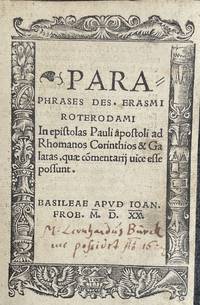
15202283Basileae Basel: Apud Ioan. Frob. Colophon: Per Hieronymvm Frob. Ioan Filium Johann and Hieronymus Froben 1520. First collected edition. . In 17th century vellum the author’s name lettered in ink to spine tinted edges. Leonhard Bürck’s possessor’s inscription in ink on the title page and p. 431. Woodcut borders to the four title pages. Woodcut initials and headpieces. Woodcut printer’s device at the end. Old underlines and marginal notes in ink to a few pages. Stains occasionally. Old restoration to O1–2 with no effect on the text. Overall in very good condition. First collected edition. . In 17th century vellum the author’s name lettered in ink to spine tinted edges. Leonhard Bürck’s possessor’s inscription in ink on the title page and p. 431. Woodcut borders to the four title pages. Woodcut initials and headpieces. Woodcut printer’s device at the end. 465=495 1 p. Some misnumberred omitted. Coll.: A–K8 L4 M–Z8 2A–2e8 2F4 2G–2I8. <p><br /> Scarce first edition of Erasmus’ paraphrases on the first four Pauline epistles with possessor’s inscription of the important 17th-century publisher in Frankfurt Leonhard Brück.<br /> <p><p><br /> <br /> The present volume of Paraphrases is the first collected edition of Erasmus’ monumental commentary on the Gospels which was composed and published between 1517 and 1523. <br /> Erasmus began the work on the commentary of the Gospels with the Pauline epistles. They were first issued separately starting with the paraphrase of Romans in 1517 Thierry Martens continued with both epistles of Corinthians 1519 Thierry Martens and the Galatians which was published in 1520 by Martens in Louvain and Froben in Basel. The remaining epistles appeared by 1521 when they were also published in a collected edition by Froben. Any of the lifetime editions of the Paraphrases both separate and collected are rare on the market.<br /> <p><p><br /> <br /> Provenance: inscription on title page and on p. 431 “M. Leonhardus Bürck me possidit Anno 162â€; Leonhard Bürck Burck Burkius Burcken was a printer and publisher in Frankfurt active between 1611 and 1628. Bürck is identified as the step-grandfather of Hans Jakob Christoffel von Grimmelshausen.<br /> <p><br /> USTC 682544 5 copies only in Germany; Bezzel 1163; VD 16 E 3060. Apud Ioan. Frob. [Colophon: Per Hieronymvm Frob. Ioan Filium] [Johann and Hieronymus Froben] unknown
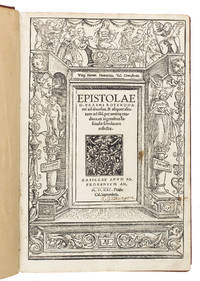
1521ABC_49922Basel 1521. Folio. Johann Froben Modern blind-tooled red morocco with the author title and year of publication lettered in gold on the spine a single fillet border on both boards red edges. With a decorative woodcut border on the title page by Urs Graf 2 decorative woodcut borders in the text by Ambrosius Holbein numerous decorated woodcut initials and a woodcut printer's device at the end of the work. 12 "668" =618 6 pp First complete edition of the letters of Desiderius Erasmus containing 171 letters which had never been published before with correspondence with many of the most prominent figures of the 16th century. The work has been beautifully illustrated with a splendid large woodcut title border by Urs Graf ca. 1485-1528 known as "The triumph of Humanitas" and two fine borders by Ambrosius Holbein ca. 1494-1519. The present copy has been annotated in several contemporary hands and was owned by Ralph Widdrinton d. 1688 the Regius professor of Greek at Cambridge University.The Epistolae ad diversos contains 617 letters in total and is far larger than any of the earlier collections of Erasmus' correspondence namely the Epistolae aliquot of January 1518 52 letters the Auctarium of October 1518 63 letters and the Farrago of November 1519 333 letters. The present letter collection is also the first with a preface by Erasmus. The majority of the letters date to 1519-1521 but some are earlier with the first dated to 11 July 1513. They reflect Erasmus' changing stance towards Luther and Protestantism but also continue his attacks on friars and the theologians of Louvain. Among the authors correspondents are prominent humanists and other important figures including Beatus Rhenanus Ulrich Zasius Johann Eck Guillaume Budé Jean Grolier Georg Spalatin Hermann von dem Busche Konrad Peutinger John Colet Thomas More John Fisher Thomas Linacre William Grocyn Luther Melanchton Pope Leo X and Henry VIII King of England. Erasmus later made many editorial changes to the letters making the present edition of particular importance.With a later ownership annotation "R. Widdrington" on the title page. The binding is very lightly soiled. The work is slightly browned throughout with contemporary and later manuscript annotations in the margins in three different hands a vertical tear in the upper part of the first errata leaf without loss of text. Otherwise a very good copy with ample margins.l Adams E 852; BM STC German p. 276; Erasmus Online 2069; USTC 651629 34 copies; Vander Haeghen I 99; VD 16 VD16 E 2925. hardcover
15281361Strasbourg Hagenau: Knobloch; Seltz 1528. Four works in one volume. In contemporary wooden panels with the traces of leather and a codex leaf on spine. Spine with three raised bands. The original copper clasps are presented. The title pages of the first three works by Erasmus with identical architectural borders. Signs on top edge in ink. Old collection stamp on verso of inner front pastedown. Sporadic manuscript marginal notes removed. Occasional underlines in the text throughout. Few stains throughout some leaves tanned. The title page of the fourth work Gebwiler with a tiny loss to the right edge with no effect on the text. Overall in fine condition. Four works in one volume. In contemporary wooden panels with the traces of leather and a codex leaf on spine. Spine with three raised bands. The original copper clasps are presented. The title pages of the first three works by Erasmus with identical architectural borders. <p><br /> Erasmus Desiderius<br /> Ratio seu methodus compendio perveniendi ad veram theologiam. Ratio verae theologiae.<br /> Argentorati Strasbourg: Ioannes Knoblochus Knobloch October 1523. 80 leaves.<br /> <p><p><br /> Bound with:<br /> Erasmus Desiderius<br /> Enchiridion militis Christiani saluberrimis praeceptis refertum ….<br /> Argentorati Strasbourg: Ioannes Knoblochus Knobloch November 1524. 100 leaves.<br /> <p><p><br /> Bound with:<br /> Erasmus Desiderius<br /> Modus orandi Deum. <br /> Argentorati Strasbourg: Ioannes Knoblochus J. Knobloch December 1524. 46 leaves.<br /> <p><p><br /> Bound with:<br /> Gebwiler Hieronymus<br /> Gravissimae sacrilegii ac contemptae theosebiae ultionis ethnicorum Hebraeorum et Christianorum verißimis comprobatae exemplis syngramma …. <br /> Haguenau Wilhelm Seltz 1528. 32 leaves last blank.<br /> <p><p><br /> Three sixteenth-century early Erasmus editions printed by Knobloch bound with Gebwiler’s first edition containing the earliest printed quotation from Hortus deliciarum.<br /> <p><p><br /> The third work in the volume Modus orandi Deum is generally regarded as the central text of Desiderius Erasmus’s teaching on prayer. The present edition dated December 1524 is the second following the first edition issued by Froben in October of the same year. The work circulated widely soon after publication: by the end of 1525 ten further impressions had appeared from presses across Europe. USTC records only eight surviving institutional copies of this December 1524 edition B. Er. I; Mynors 587; Bezzel 1285; Schmidt VII 284; VD16 E 3169; USTC 676366; EON 2424.<br /> <p><p><br /> The first work Ratio seu methodus October 1523 is likewise an early edition. Its editio princeps was published in Leuven by Thierry Martens in November 1518. This Knobloch edition is scarce: USTC records only four copies Augsburg Cambridge Edinburgh Neuchâtel and it is not listed in VD16 USTC 709423; Müller Knobloch 395; Benzing 544.<br /> <p><p><br /> The second work Enchiridion militis Christiani Handbook of the Christian Knight is among Erasmus’ earliest writings first printed in 1503. The preliminaries include all four Latin poems by Thomas More which first appeared together in the Mainz edition of 1520. This edition is also rare: USTC records only five institutional copies VD16 E 2774; USTC 650176.<br /> <p><p><br /> The final work in the sammelband is Gravissimae sacrilegii by Jérôme Gebwiler. Gebwiler is recognized as the earliest scholar to describe Hortus deliciarum Bischoff 1973 p. 13 the illuminated encyclopedic manuscript compiled by Herrad of Landsberg twelfth-century abbess of Hohenburg Abbey Mont Sainte-Odile destroyed in 1870 during the siege of Strasbourg. In this work Gebwiler quotes the dedicatory poem of Hortus deliciarum attributed either to Herrad herself or to Relinda of Hohenburg her predecessor as abbess Griffiths 2013 p. 231. This quotation represents the earliest appearance of the text in print VD16 G 597; USTC 660780.<br /> <p><p><br /> References: Bischoff C.: L’histoire. In: Green R. et al.: Herrad von Hohenburg Hortus deliciarum. London Leiden: The Warburg Institute University of Leiden E. J. Brill 1979. pp. 9–16.; Griffiths F.: Herrad of Hohenbourg and the Poetry of the Hortus deliciarum: Cantat tibi cantica. In: Churchill L. J. et al.: Women Writing Latin. … Volume 2. Medieval Modern Women Writing Latin. New York London: Routledge 2013. pp. 231– 264.<br /> <p>. Knobloch; Seltz unknown
152733077-1245Basel Joh. Froben Febr. 1527. Half-title with woodcut printer's device title-page within woodcut architectural border 2nd title-page fol. 1v. with different figured woodcut border different printer's device on last leaf verso and at the end numerous large and small figured woodcut initials in the text by Urs Graf Ambrosius Holbein and Hans Frank. 4 leaves 710 1 pp.; 28 leaves index. Folio. 17th century calf back gilt joints and foot of spine somewhat restored. Old ms. name on title. Basel Joh. Froben Febr. 1527. An important document of the humanistic spirit and remarkably beautifully printed with outstanding book decoration during Erasmus' lifetime. In the early years of the 16th century the demand for the original text of the New Testament began to mount and Erasmus 1467-1536 soon saw the necessity to translate the original Greek text into Latin. His first text-critical edition of the New Testament was one of the important foundations for Reformation theology. These present Erasmus commentaries were the first ferment of theological discussion at that time and are of great value. This is the 4th printing of the additional text notes contributed by Erasmus. They show mistakes that ancient theologians had made during their translation and revealed misunderstandings that had arisen due to the lack of knowledge of the text copyists. The first separate printing of this work was done by Froben at Basel in 1519 Bezzel 1212 as an indepent work. Through the years probably altogether a total of eight editions appeared as listed by most of the bibliographers. Numerous excerpts and vernacular versions circulated later.- Some little wormholes in the last 30 leaves some spots otherwise with wide margins and still a good copy. - VD 16 E 3096; Adams E-891; Vander Haeghen II 58; Bezzel 1215; Hieronymus Oberrhein. Buchillustration II 302 detailed; cf. Knaake II 302. BIBLES ; HELVETICA: ALLGEMEIN ; BIBELN RELIGION ; HUMANISM ; REFORMATION ; Basel, Joh. Froben unknown
1534372762Basel: Froben 1534. Third revised Erasmus edition first 1526; second 1528 of Irenaeus' treatise "Against Heresies. Printer's device on titlepage and last page; head-pieces; initials; printed marginalia. 1 vols. Folio. Near contemporary dark calf over wooden boards stamped in blind upper board dated 1545 brass clasps. Headcaps worn one clasp perished. Third revised Erasmus edition first 1526; second 1528 of Irenaeus' treatise "Against Heresies". Printer's device on titlepage and last page; head-pieces; initials; printed marginalia. 1 vols. Folio. Third Erasmus edition of Irenaeus' treatise Against Heresies consisting of five books which are preserved in their entirety only in their Latin version. It is Irenaeus' principal literary work which had a significant impact on the development of the church during the first three centuries.<br /> <br /> Colophon: Basileae in officina Frobeniana per Hieronymum Frobenium et Nicolaum Episcopium An. M D XXXIIII mense Martio.<br /> The work is bound with an extensive commentary on the Gospel of Matthew by Wolgang Musculus 1544. The nicely preserved binding is dated M.D.XLV. 1545 on upper board. VD16 I 318. Provenance: Provenance: title page of Musculus signed: Ludovicus Rabus . 1544 and Iohannes Longlinus . 1550; bookseller's label on front paste-down: G. & B. Westermann Bros. Deutsche Buchhandlung 290 Broadway New-York; Bookplate of Rev. Edwin A. Dalrymple; Maryland Diocesan Library; General Theologiccal Seminary bookplates and stamps Froben unknown