ERASMUS, DesideriusBiblio.com
3 283 résultats
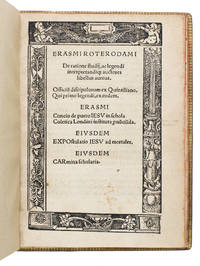
1516ABC_49694Colophon Strasbourg: Matthias Schürer 1516. Modern brown pigskin with a blind-tooled single fillet frame on both boards gold-tooled turn-ins red edges in a beige paperboard slipcase. 4to. With a woodcut decorated title frame and 3 woodcut decorated initials. Early edition of Erasmus seminal educational treatise De ratione studii here presented alongside several other influential pedagogical and devotional texts. It further includes: Officium discipulorum ex Quintiliano The duties of students according to Quintilian including a section on the first stages of learning to read also derived from Quintilian a sermon on the child Jesus by Erasmus intended for delivery at the Colet School in London a lament of Jesus addressed to mankind and a collection of school poems.The opening dedication addressed to Peter Viterius a professor of liberal arts sets the tone for this work: Erasmus praises his friends discernment and judgment in matters of education using vivid comparisons drawn from military strategy and classical mythology to underscore the importance of order and method in learning. Without it he argues even the most gifted minds may falter. Of particular note is Erasmus endorsement of an instructional technique that became central to Renaissance humanist pedagogy: the use of structured annotation. In De ratione studii he recommends that students classify selected passages under thematic headings a mnemonic device that aids both retention and retrieval. This principle would go on to shape the methods of early modern teaching and note-taking. It also reflects Erasmus' broader educational reforms where rhetoric and moral philosophy intersect. His engagement with progymnasmata preliminary rhetorical exercises especially those of Aphthonius favoured for their clear organisation into theory and examples demonstrates his commitment to practical and accessible instruction for young learners.With some contemporary and later underlining and annotations in red and brown ink mainly consisting of corrections additions to the text and markings of significant passages. Two minor worm holes througout barely affecting the text. The gutters between leaves V-VI; VII-VIII; XX-XXI; and after leaf XXIII have been reinforced in the gutter with linen tape slightly browned throughout. Otherwise in good condition.l Adams E 346; Bezzel 1709; USTC 653250 9 copies; Vander Haeghen I 169; VD16 E 3534; not in BM STC German; De Reuck; Kossmann. Matthias Schürer, hardcover
15238509Argentorati Strasburg: Iohannes Cnobloch execudebat Quinto Idus Iunias Anno. M.D.XXIII. 1523. 1523 20 130 i.e. 120; 107 1 leaves ; 16 cm. Collates Aa8 Bb4CC8 a-p8 A-N8 O4. D&M 6103a. Recently bound in calf to style with blind decoration to the boards. The spine has raised bands and is titled in gilt. Marginal annotations thoughout. Part title to Epistolae Apostolicae and Cnobloch's device printed at the end of both parts. The imprint and date are supplied from the colophon. The text of each book begins with a 14 line rubricated initial including one decorated with three parrots at the start of Evangelium Secundum Ioannem. PROVENANCE: The title page verso has the bookplate of the Nuremburg bookseller collector and bibliographer of alchemical literature Friedrich Roth-Scholtz 1687-1736. The title page and part title have a neat 19th century stamp of the Univerity of Erlangen now Erlangen-Nuremberg. an excellent early printing of Erasmus' important NT. Argentorati (Strasburg): Iohannes Cnobloch execudebat Quinto Idus Iunias Anno. M.D.XXIII. hardcover
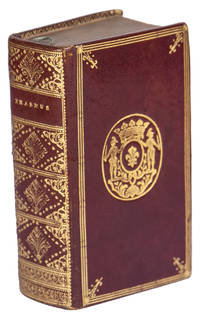
165818897Amsterdam: Joannes Janssonius 1658. 18th-century richly gold-tooled red morocco both boards show a triple fillet frame with small cornerpieces in the inside corners and an oval armorial centrepiece crowned fleur-de-lis flanked by two knights gold-tooled spine with "Erasmus" lettered in gold gold-tooled board edges and turn ins gilt edges marbled endpapers. 12mo. With an engraved title page a full-page engraving showing Erasmus woodcut decorated initials and several woodcut head- and tailpieces. Including: Coronis apologetica pro colloquiis Erasmi ex ipsius scriptis quantum per otium licuit fideliter collecta à P.S. accedit ejusdem De Collequiorum utilitate dissertatio. Montanus' edition of a renowned famous Latin schoolbook written by Erasmus one of the most used Latin schoolbooks for centuries as it discusses all basic scholarly and moral issues. With Erasmus' preface-letter to Froben at Basel dated 1524 and the Vita Erasmi preceding the Colloquia as well as two indices of authors and dialogues. Included at the end is a short essay explaining the usefulness of the book.With a few 17th-century annotations on the engraved and letterpress title pages resp. "1662" and "Besnier". The engraved title page is cut slightly short not affecting the engraving. Otherwise in very good condition.l Bibl. Belg. II E 572; Erasmus Coll. City Library Rotterdam p. 50; STCN 850071909 9 copies; Vander Haeghen p. 40. Joannes Janssonius, hardcover
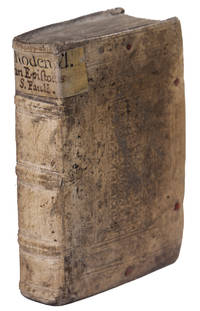
152212717Basel Johannes Froben 1522. Two parts in one 484 folio. Tall octavo H. 185 x W. 11.5 cm. contemporary binding in blindstamped brown leather over wooden boards. Title on the lower cover: ""In Epistola S. Pauli Can. RC."" The blind impression on the front cover faded but still visible is: ""ROTEROD"" as for ""Roterodami"" so from Rotterdam Erasmus' place of birth and ""WSKB"" possibly the initials of the owner. Second edition in an attractive binding the first in 8vo format. Two months before the first edition was edited in Folio. Each part has a woodcut title page. Lacking clasps some light waterstains wide margins with early manuscript annotations and thin strips of medieval manuscripts sewn inside the boards. A good copy. Literature: VD 16 E-3377; Bezzel I. Erasmusdrucke Nr. 1529. Van der Haeghen I 147 Basel, Johannes Froben hardcover
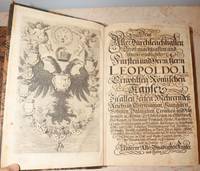
1668V70496Nurnberg: Johann Andreas Endter & heirs of Wolfgang 1668. Hardcover. Good. Fine full-page engraved plates 65 numbered 1-63 with 2 bis plates 45 & 47 1 text illustration full page elaborate copperplate coat of arms of Leopold I by C.N. Schurtz. Folio old vellum spine split repaired front cover nearly detached. Bookplate of Bibliotheca Prieseriana showing books on shelves and small library stamp on pastedown. Titlepage in red and black with printer's mark of 2 female supporters with sun shining on clasped book with monogram AEW. Titlepage 36pp including full page copperplate coat of arms of Leopold I by C.N.Schurtz 1762pp 34pp indices 2pp errata with a few part-lines of loss to lower outer corner & tatty edges. Double column Gothic type with shoulder notes throughout. Two marginal tears with loss hardly touching print & first page of dedication with cropping to outer edge some corner creases else clean and no worming/no foxing/no ink marks. Despite its huge bulk the book block is square and tight. A fascinating early German account of travels and curisoties and one of the most famous illustrated natural history books of the 17th century Nissen 648; Sabin 25463. Johann Andreas Endter & heirs of Wolfgang hardcover
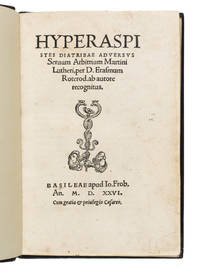
1526ABC_49737Basel: Johann Froben 1526. Modern calf with the author title and year of publication lettered in gold on the spine. Small 8vo. With a woodcut printer's device on the title page and final leaf and 2 decorated woodcut initials. First revised edition of Erasmus' response to Martin Luther which is part of their famous theological debate that took place in the 1520s. Erasmus received Luther's work in February 1526. The Hyperaspistes is his first reply to it which he composed within a few days in March 1526. The present edition revised by Erasmus himself and published in July of the same year supplies a more correct text of this famous refutation.The Hyperaspistes first published in March 1526 deals with the question of free will and was written in response to Luthers De servo arbitrio On enslaved willl 1525 which in turn was written in reply to Erasmuss De libero arbitrio On free will 1524. Luther argued that humans could not achieve salvation through good deeds as they could not choose between good and evil and so could only be redeemed through the will of God. Erasmus on the other hand believed that each individual had the freedom to accept Gods grace and turn towards a Christian life and salvation could be reached through good deeds. The confrontation between Erasmus and Luther was a duel of major importance for Europe in the first half of the 16th century as two visions of man history and faith clashed.The second part of the Hyperaspistes appeared in September 1527 continuing the exegetical controversy with Luther. The present edition however was published before the second part was written.With near- contemporary annotations in the margins of some of the leaves. The work is lightly browned and foxed throughout. Otherwise in good condition.l Adams E-675; Bezzel 1117; BM STC German p. 281; Erasmus Online 2230; USTC 664562; Vander Haeghen I 110; VD16 E 3029; cf. De Reuck 236 other issue. Johann Froben, unknown
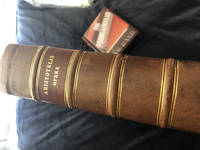
1550P8126The Works of Aristotle "per Des. Eras Roterordamvm" 1550. 2 volumes in one folio 323 x 192mm. Third Edition of The Works of Aristotle of the original text in 1831 prepared by Simon Grynaeus. This edition retains the original letter from Erasmus to Thomas More's son John. Woodcut initials a few woodcut illustrations old calf a few early annotations numerous notes in Latin Greek and English on front and rear flyleaves probably nineteenth-century and in text in ink pencil and red crayon neat annotations in Greek in second volume Greek quotation from Aristotle written on first title-page occasional light staining T5 torn in margin binding rubbed rebacked. Two of history's greatest minds converge. Book #P8126. $6500. We specialize in Rare Ayn rand erotica history and science. Johann Bebel and Michael Isengrin, 1550 hardcover
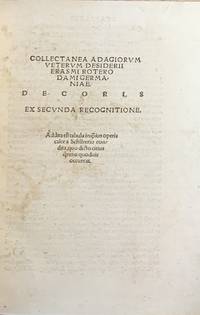
15106221Hardcover. Fine. 4to. Bound in 20th-century 1/4-vellum over marbled boards. Strasbourg: Matthias Schürer <b>Jul</b><b>y 1510. Second Strasbourg</b> edition of Erasmus heavily annotated collection of Greek and Latin proverbs. Printed in Roman and Greek types. <br /><br />This is the original version containing 818 adages which is considerably shorter than the later expanded versions published under the title Adagiorum chiliades. Adams E-420; Bezzel Erasmusdrucke 50; Van der Haeghen Bibliotheca Erasmiana p.25-6; Bibl. Belgica II 276: no. E.61; Muller Strasbourg II p. 179 no. 45. <br /><br />The Adagia could only have been possible in the new world of European education in which careful attention to a broader range of classical texts produced a much fuller picture of the literature of antiquity. Its impact has been long lasting. Such popular expressions such as <i>one step at a time</i> <i>between a rock and a hard place</i> <i>break the ice</i> <i>an iron in the fire</i> l<i>ooking a gift horse in the mouth</i> and many other sayings can trace their origin to the Adagia. <br /><br />The printer Matthias Schürer published 15 works by Erasmus in over 70 editions. It is interesting to note that his relationship with Erasmus began with a rather rough start. In 1509 the year Schürer completed his apprenticeship and opened his own print shop he struck an unauthorized edition of Erasmuss Adagia purloined from the first edition of 1500. In spite of this commercial indiscretion Erasmus favored Schürer with a warm supportive and lasting friendship. The dedicatee of this celebrated work William Blount 4th Baron Mountjoy of Barton Blount Derbyshire was a wealthy English courtier and scholar. A pupil of Erasmus he called him inter nobiles doctissimus The most learned amongst the nobles. Having served since 1512 as Chamberlain to Queen Catherine of Aragon it fell to him to announce to her the intention of Henry VIII to divorce her. Boards slightly rubbed; signatures D-K with a small wormhole to outer margin without loss of text; some slight browning and soiling to some pages; a few leaves with faded manuscript marginalia in a neat 16th-century hand; index leaves with light water staining to upper portion; o/w a very nice unrestored wide-margined example of this rare early edition. Matthias Schürer hardcover
1962146903London: Gregg Press 1962. Hardcover. Prof. Schoeck's tidy ownership information in each volume and very minor pencil markings light cover soil and wear corners lightly bumped and several have corner protectors V.1: crumpled and torn back flyleaf V.6: front cover board bent small tear to top of spine V.7: back hinge just beginning to crack but still sturdy V.8: front hinge just beginning to crack but still sturdy V.9: front and back hinges just beginning to crack but still sturdy V.10: pale splatters to bottom of front cover and fore-edge not affecting the interior all volumes in very good sound condition. From the library of Prof. Richard J. Schoeck. Size: 10.5"x15.5" 10 vols in 11 sturdy tan cloth bindings with red spine labels. Gregg Press hardcover
15291832Coloniae: Iohannem Gymnicum 1529. Rare edition a sound complete copy lacking only the final blank. Title within pictorial woodcut border. Octavo contemporary blind-tooled calf over wooden boards dated 1534 in blind brass clasps minor statins and soiling and some early penned marginalia. Also bound in are three additional works De Civilitate Morum Puerilium; Plutarch. De Liberis Educandis; and Horatius Flaccus. Iohannem Gymnicum hardcover
1613ABC_49605Utrecht 1613. 4to. Jan Amelisz Contemporary gold-tooled overlapping vellum sewn on 4 supports laced through the joints both boards show a double fillet frame with small ornamental cornerpieces in the inside corners and a large ornamental oval centrepiece on both boards and with small ornaments slightly faded and the manuscript title on the spine. With a woodcut printers device on the title page and the rare full-page engraved portrait of Erasmus which is lacking in at least 2 of the 4 copies known in an oval lettered: "Magnus ille Erasmus Roterodamus natus Roterdami Octobr. Ao 1467" with emblems in the corners ink pot trumpets hourglass and Bible and a Latin poem of 4 lines underneath "Post cineres vivo doctis tuta manet". This portrait of Erasmus on leaf p1r half to the left and seated his hands resting on an open book is apparently engraved after the portrait by Frans Huys of 1555 which he engraved after the painted portrait by Hans Holbein the Younger Hollstein Dutch & Flemish engr. and etches 132. On the verso of this portrait is a laudatory "Klanck-Ghedicht" sonnet for Erasmus between typographical borders; the same borders on leaf. p2r: the privilege by the States General verso blank. 18 141 3 ll. Very rare first and only edition of a collection of 27 colloquia dialogues by Erasmus and 13 by Lucian of Samosata ca. 125-after 180 CE. The colloquia were translated into Dutch by Andreas van Oosterbeeck fl. 1584-ca. 1620 a minister in Abcoude 1590 and Montfoort 1616. The 27 dialogues by Erasmus include Proci & Puella Virgo Misogamos Virgo poenitens Coniugium Adolescentis & Scorti Abbatis & Eruditae Puerpera Convivium Fabulorum Absurda Opulentia sordida Naufragium Charon Coniugium impar Inquisition de Fide Exorcismus sive Spectrum Peregrinatio Religionis ergo and others.The Colloquia familiaria is one of the main works by Desiderius Erasmus first published in 1518 as Latin dialogues for school exercises and expanded over the following decades with witty - albeit serious - and often controversial content including contemporary religious practises treated in a pervasively ironic tone. After Cornelis Crul's translations of a number of dialogues published between 1530 and 1545 these annotated translations by Andreas van Oosterbeeck are the first 17th-century edition followed in 1622 and 1634 by translation of the colloquia by Dirck Pietersz. Pers.After Erasmus' dialogues follow after a separate title page the 13 highly ironical dialogues originally written in Greek by Lucian: Gallus Toxaris Cnemon Zenophantes Tantalus Menippus Trophonius Charon Crates Nireus Mausolus Polystratus and Diogenes. These are all translated in Dutch by Andreas van Oosterbeeck after the Latin translations made by Erasmus from the original Greek. Lucian of Samosata - a town in Syria - was a Greek writer and satirist who lived in the 2nd century CE. He invented the genre of comic dialogue a parody of the traditional Socratic dialogues and wrote numerous satires about the Gods and public figures.With later annotations in pencil on the front pastedown and flyleave the fore-edge and the bottom outer corner of the back board are somewhat stained and soiled a water stain in the upper outer corner throughout. Otherwise in good condition.l Van der Aa 14 1867; Gheerebaert Lijst p. 57 LVI: Lucianus no. 1 First translation of a work by Lucianus in Dutch!; STCN 169198340 4 copies; USTC 1019209 4 copies same as STCN. hardcover
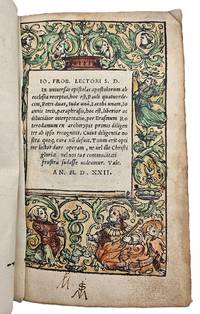
1522032982Coloniae: Heronem Alopeciu 1522 An extremely scarce early edition published in September 1522 - a month after the authorised Basel edition - by Hero Alopecius in Cologne. We have only been able to find one reference to it University of Toronto. Erasmus arranged publication of the Basel edition in August 1522 in response to the appearance of an unauthorised version in Cambridge in 1521. He had originally worked on the content in 1509-1511 and this work developed from his earlier writing and lectures became a popular and important text book on the writing of letters. It was much reprinted. This copy is newly rebound in full calf with panelled design to boards and gilt titles to spine. The page edges are red although this may not be contemporary. New endpapers. Contents with 2 initial blanks - the first with ink notation on the edition - this looks likely to be 1800's in date and the paper does not look contemporary. Title with elaborate design including 2 cherubs holding a shield with 3 crowns with contemporary latin note at the top; letter from Erasmus to Nicolao Beraldo pp 2-4; text with beautiful decorative initial capitals pp 5-414 Finis. No final blanks. There is some scholarly annotation in latin and gentle underlining - this could be contemporary. There are a number of mispaginations but the ties work in all cases: 47-74-75-50; 51-78-79-54; 55-82-83-58; 59-98-87-62-63-90-65; 170-117-172; 177-168-179; 192-191-192-193. There are a number of professional paper repairs: to the side of the title page and page 13/14; from p 357 onwards where the top corner tips had been burnt out - this begins with the just the tip but towards the end of the work includes some page numbers and just clips a couple of margin notes - the final 2 leaves have repair to sides. These corners do not have the red edges. Towards the end of the work there are a few pages with some grubbiness at the bottom corners. Otherwise the work is very clean with high quality paper. Please enquire if you would like to see additional images Heronem Alopeciu hardcover
152133059-66Mainz Johann Schöffer 1521. Full woodcut historiated title-border and typographic title. 3 ff. Sm.-4to. 19th century morocco Hans Asper Geneva. From the library of Gaspard Ernest Stroehlin 1844-1907 a Swiss minister and professor at the University of Geneva with his bookplate "Mente Libera" showing Calvin preaching with the St. Pierre Cathedral in Geneva in the background. Mainz Johann Schöffer 1521. First edition. In addition to the Greek and Latin writings of Erasmus' 1467-1536 we know a small number in German language. The humanist's paraphrases of the Evangelists were greeted with immediate popularity and received numerous reprintings. The seven woes to the Scribes and Pharisees in Matthew 23 are a list of critical words by Jesus against the religious leaders as hypocrisy and perjury. Because of Erasmus' critique of the Roman Catholic Church in the first edition of the Index Librorum Prohibitorum 1564 his writings were more severely condemned than the works of Luther or Calvin. - A nice copy of a rare booklet seldom found in a library outside Germany. - VD 16 E 3123; Vander Haegen I 149 assigns this edition as the first one and printed by Johann Schöffer in Mainz; Bezzel 1239; not in Pegg Swiss. REFORMATION ; HELVETICA ; HUMANISM ; BINDINGS ; (Mainz, Johann Schöffer) unknown
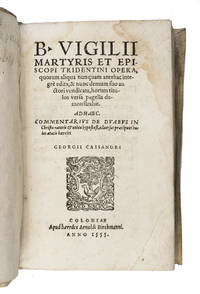
1535ABC_49895Cologne: printed by Jaspar von Gennep for Peter Quentel 1535. Limp overlapping vellum with ties. 8vo. With an elaborate woodcut border on the title page of ad 1 several decorated woodcut initials and Quentels woodcut device at the end. 2 works in 1 volume ad 2 in 2 parts. With bound before ad 1:2 VIGILIUS. Opera .Including: CASSANDER Georg. Commentarius de duabus in Christo naturis .Cologne Arnold Birckman 1555. A rare and significant edition of De veritate corporis et sanguinis Domini by Alger of Liège Algerus ca. 1060-ca. 1131 Benedictine monk of Cluny and one of the most influential medieval theologians on the Eucharist. This major treatise composed during the so-called second Eucharistic controversy defends the doctrine of the real presence of Christ in the Eucharist against the teachings of Berengarius of Tours. Admired by both medieval scholars and later by Erasmus Algers work remained central to Catholic theology well into the sixteenth century.This copy represents the Erasmian edition prepared under Erasmuss supervision with his corrections and editorial guidance. His involvement gave the text a new humanist form and authority making Algers theology newly relevant at a time when Eucharistic doctrine was again fiercely debated during the Reformation. Erasmuss careful attention to clarity and Latinity situates this edition within his broader humanist programme of restoring theological texts to philological precision and doctrinal coherence.Only a handful of copies of this edition are known and no record of it appears in recent sales databases underlining its rarity on the market. It is the second edition overall following the first printing in Freiburg im Breisgau 1530 and the first to be issued by Peter Quentel in Cologne.Bound together with the Opera of Vigilius 1555 and a Commentarius opposing the Christological views of Georg Cassander 1555 this important Sammelband reflects the continuing Catholic polemic against Reformation-era innovations in both Eucharistic theology and Christology.The vellum is slightly dampstained lacking part of the bottom closing tie on the front. Some stains and browning throughout. Otherwise in good condition.l Ad 1: BM STC German p. 20; USTC 626331; Vander Haeghen II 6; VD 16 A 1871; cf. Adams 173 1530 ed.; Ad 2: Adams V 748; BM STC German p. 893; USTC 615055; VD 16 V 1184. [printed by Jaspar von Gennep for] Peter Quentel, hardcover
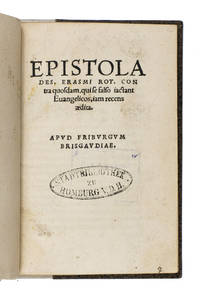
1529ABC_49734Colophon: Freiburg im Breisgau: Johannes Faber 1529. Modern half vellum and brown sprinkled paper sides. Small 8vo 9.5 x 13.9 cm. With a decorated woodcut initial and a small woodcut illustration incorporating Fabers device on the final page. First edition of a polemical work by Erasmus written at a pivotal moment in the escalation of tensions during the Reformation. Composed in Freiburg and dated 4 November 1529 this extensive letter to Gerardus Geldenhauer 1482-1542 is Erasmuss direct and indignant response to the unauthorised use of his Apologia ad monachos Hispanos in Geldenhauers own Epistolae aliquot de re evangelica et haereticorum poenis Strasbourg September 1529. By selectively quoting Erasmus Geldenhauer sought to align him with the Lutheran cause a move that Erasmus strongly rejected.Erasmus' Epistola is a vivid example of his determination to preserve his intellectual independence amid growing pressure from both sides of the Reformation divide. He denounces those who falsely claim the name evangelical asserting that true reform cannot be reduced to party slogans or doctrinal extremism. While Erasmus had long called for renewal within the Church through learning and moderation this work reveals a sharper tone as he distances himself from reformers who in his view distorted both scripture and his own writings.The tract was quickly circulated and remains a key document for understanding Erasmuss late theology his views on religious identity and his discomfort with the polarisation of the age.With a black oval stamp Stadtbibliothek zu Homburg V.D.H on the title page one small Veräusserte doublette and one larger blue/purple rectangular stamp Stadt-Bibliothek Homburg on the verso of the title page and a repeat of the oval and smaller rectangular stamps on the blank recto of the last leaf; all from the city library in Bad Homburg vor der Höhe in Germany. The binding is very slightly damaged along the fore-edge of the front board some occasional minor staining. Otherwise in very good condition.l Bezzel 953; Bomelius p. 20; Erasmus Online 2045; Prinsen p. 92; USTC 651263; Vander Haeghen I 97; not in Adams; BM STC German; De Reuck. Johannes Faber, hardcover
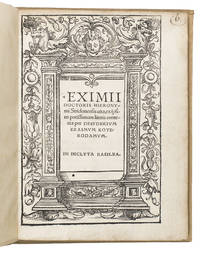
1519ABC_49873Basel 1519. 4to. Colophon Johann Froben Modern beige paper boards with a later paper label on the spine the author title and incorrect publication date in black. With a woodcut decorated frame on the title page and on page 3 a small woodcut illustration incorporating Frobens device on the verso of the last leaf and with 1 woodcut decorated initial. 70 2 pp. Second edition of Erasmus Vita The life of the excellent doctor Jerome of Stridon this work introduced the monumental edition of Saint Jeromes Opera omnia. It was Erasmus attempt to present Jerome as a relevant historical and intellectual figure instead of him remaining a remote saint cloaked in legend.Rather than relying on apocryphal sources or pious legend Erasmus built this work almost exclusively from Jeromes authentic correspondence. This method marked a clear break with traditional hagiography. He rejected fictitious episodes attributed to figures like Cyril of Jerusalem ca. 315-386 CE Eusebius of Cremona 5th century CE and pseudo-Augustine which had long coloured the popular image of Jerome. Instead Erasmus offered a critical and philologically grounded portrait both admiring and analytical aligning Jerome with the ideals of Christian humanism.Erasmus fascination with Jerome had deep roots. As a young man in the monastery at Steyn near Gouda in the Netherlands where he studied under the Hieronymite order he was seen copying Jeromes letters. His early reverence developed into critical engagement: at Cambridge Erasmus worked meticulously to identify and eliminate inauthentic letters attributed to Jerome and he was profoundly inspired by Jeromes linguistic rigour and exegetical method. It was during his time in England that Erasmus also undertook his pioneering revision of the New Testament. All of these efforts culminated in Basel in 1516 where Frobens press published not only the first edition of Erasmus Novum Instrumentum a new Latin translation of the New Testament alongside the Greek text but also his complete edition of Jeromes works prefaced by the Vita. With a small wormhole affecting all leaves though without significant impact on the text a small hole in the outer margin of pp. 45-46 not affecting the text light marginal water-staining and some browning throughout. Overall in good condition.l Béné Marulic et Erasme lecteurs de saint Jérôme Colloquia Maruliana Vol. 10 2001 pp. 29-45 see p. 31; Bezzel 1058; BM STC German p. 282; De Reuck 362; Julián Erasmo biógrafo de san Jerónimo: Hieronymi Stridonensis Vita 1516 Mirabilia: electronic journal of antiquity and middle ages 31 2020 pp. 411-443 see pp. 412-3; USTC: 655432; Vander Haeghen I 182; VD 16 E 2968; not in Adams. hardcover
1520ABC_49896Basel 1520. Small 8vo 10.1 x 15.3 cm. Hieronymus Froben Contemporary blind-tooled pigskin sewn on three supports with corresponding raised bands on the spine author and title lettered on a separated paper label at the head of the spine and with remnants of four pairs of red closing ties. With 5 woodcut frames on the title page and at the start of each text Corinthians in two parts 10 woodcut decorated initials 3 woodcut ornaments and a small woodcut illustration incorporating Frobens device above the colophon on the last page. "465" = 495 1 pp. First edition of Erasmus collected Paraphrases on the Pauline Epistles Romans 1 Corinthians 2 Corinthians and Galatians. Each paraphrase had appeared separately between 1517 and 1519 and this collected edition printed at Basel presented them together for the first time in a single work. Erasmus paraphrase on Romans was the earliest of the four. Completed during the summer of 1517 he initially intended it for publication by Froben in Basel. Concerned however that Frobens press was overburdened Erasmus entrusted the work instead to Dirk Martens in Louvain where he was then residing. Shortly thereafter Froben produced his own Basel edition in January 1518 and the work was an immediate success with further editions appearing in November 1518 and April 1519. The paraphrases on 1 and 2 Corinthians followed in early 1519. Once again Martens handled the first printing releasing it in February that year. However Froben was never far behind and brought out his own Basel edition the following month.The paraphrase on Galatians completed the present Pauline collection later that same year. The Louvain first edition appeared in May 1519 and was quickly followed by Frobens edition in August. Finally in January 1520 Froben gathered these works together into one volume.With a purple round stamp .bibliothek. on the title page and one blue round stamp from the same library on p. 97. With some contemporary underlinings and annotations primarily consisting of corrections textual additions and markings of notable passages. A difficult to read manuscript note on the last leaf a theological note on Paul's co-workers Epaphroditus and Tychicus written partly in Greek for the original terms and partly in Latin as explanatory glosses and on the back pastedown. Front pastedown detached from the boards revealing the printers waste likely a biblical commentary with references to Exodus and Genesis used in the binding. The binding is somewhat stained and rubbed affecting the clarity of some of the stamps on the front board. Some occasional water staining in the margins. Otherwise in good condition.l Adams E 790; Bezzel 1163; BM STC German p. 115; Sider Collected works of Erasmus volume 42 p. XXI; USTC 682544 6 copies; Vander Haeghen I 144; VD16 E 3060; not in De Reuck. hardcover
3376Paris: various publishers 1939-1948. AN UNPARALLELED COLLECTION OF ILLUSTRATED BOOKS BY ONE OF THE MOST ACCOMPLISHED BOOK ARTISTS OF THE 20TH CENTURY. ALL OF THESE BOOKS ARE ILLUSTRATED WITH ORIGINAL COPPER ENGRAVINGS / ETCHINGS /AQUATINTS / ROULETTES. Maurice Leroy like many other illustrators of his time specialized in lightly erotic depictions of feminine beauty. Unlike virtually all the other illustrators of his time however he infused tremendous imagination into his prints and demonstrated absolute mastery of all the major techniques of draftsmanship and copper engraving. The ten books in this collection all come from the height of his career and most of them are SPECIAL COPIES WITH ADDITIONAL SUITES OF THE PRINTS AND/OR ORIGINAL DRAWINGS. 1 Le Diable amoureux by Cazotte. One of only a few copies with the prints beautifully illuminated by hand; 2 Another copy of the same one of 127 copies with a remarque suite; 3 Le malheureux petit Voyage by Soulages. One of only 25 copies tete with an original drawing used for one of the illustrations signed a second suite in color a suite in black and a second suite of the wood-engraved decorations by Poilliot. Beautifully bound in full leather with original color drawings by Leroy on both covers; 4 La Belle sans chemise ou Eve ressuscitee. A unique artist's copy with a stunning original color drawing signed a remarque suite and four likely unique color separation proofs; 5 Le bon Plaisir by Henri de Regnier. One of 36 copies tete with an original color drawing used for one of the illustrations signed a remarque suite in color and a remarque suite in black; 6 L'Eloge de la folie by Erasmus. One of 75 copies with a remarque suite and the "planche refusee"; 7 Le roman de Tristan et Iseut. One of 24 copies with two suites of the etchings and an original watercolor; 8-10 Three other limited-edition books with original prints. 4tos. Except for the bound volume described above all loose as issued in board chemises and slipcases. One slipcase damaged else FINE AND BRIGHT INSIDE AND OUT. A monumental collection a testament to the artist's varied and profound talent. OVER 1000 PRINTS IN ALL. <br/><br/> Paris: various publishers, 1939-1948 hardcover
1668007387Nuremburg Nürnberg: J.A. Endters 1668. Half Leather sheep. Marbled paper pastedown on boards. Very Good. Three parts in two volumes. Folio 33 by 22 cm. 912 xxxxxx pp. J.A. Endters unknown
1520ABC_49926Basel 1520. Folio. Johann Froben Contemporary richly blind-tooled calf over wooden boards with brass clasps catch- and anchor plates along the fore-edge and brass edge guards around the corners and on the bottom board edge near the spine manuscript waste pastedowns re-backed. With an elaborate woodcut border on the title page and on the first page of the dedication. Further with a small woodcut illustration incorporating Frobens device on the verso of the last leaf numerous woodcut decorated initials by Ambrosius Holbein throughout and some ornamental woodcut headpieces. 24 515 1 blank 32 pp. First edition of the works of Thascius Caecilius Cyprianus Saint Cyprian ca. 210-258 CE edited by Erasmus. The present work is a landmark in the history of humanist scholarship and a cornerstone of Erasmuss lifelong effort to restore the authentic voice of the Early Church Fathers. Working in Basel Erasmus devoted himself to what he regarded as his highest calling: presenting these foundational Christian sources to a wider audience and revealing the truth of the Gospel in its original simplicity.In this edition Erasmus rescued Cyprians writings from centuries of textual corruption carefully correcting medieval errors and adding several minor treatises from ancient manuscripts that had never previously been printed. It includes Cyprians pastoral letters and doctrinal works arranged by theme and reflects the bishops deep concern with church unity moral discipline and the challenges of the early Christian community.This 1520 edition of Cyprians works marks the true beginning of Erasmus great Basel enterprise: a series of monumental editions that would soon include works by Arnobius 1522 Hilary 1523 Jerome 1524 Irenaeus 1526 Ambrose 1527 Augustine 1528-29 and Chrysostom 1530. This rapid succession of vast editorial projects reveals both Erasmuss astonishing intellectual energy and his conviction that the wisdom of these Church-Fathers could renew Christian life.More than a critical edition the present work embodies the spirit of Christian humanism itself: rigorous scholarship in the service of faith. It stands as one of Erasmus' most significant achievements and a defining moment in the recovery of patristic learning in the Renaissance.With manuscript waste pastedowns three stamps of the Roman Catholic Saint Maria-Magdalena church in Zaandam on the title page occasionally some near contemporary manuscript annotations in the margins and some of the text has been underlined. The work has been re-backed lacking the backstrip of the original binding the edges of the leather around both boards is slightly damaged revealing the wooden boards below the spine is somewhat rubbed. The edges of the first and last few leaves are slightly frayed some occasional water staining in the fore-edge margin not affecting the text some slight staining and dust soiling throughout. Otherwise in good condition.l Allen 1000; De Reuck 416; Huizinga VI p. 148; USTC 679667; Vander Haeghen II 23; VD 16 C 6508; not in Adams; Bezzel; BM STC German. hardcover
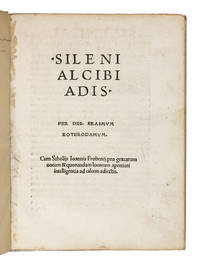
1517ABC_49731Colophon: Basel 1517. 4to. Johann Froben Late 19th-century or early 20th-century boards red edges. With 4 decorated woodcut initials and a woodcut printer's device at the end of each part. 2 parts in 1 volume. 42 ll. First separate edition of an influential work by Desiderius Erasmus which is a call for reform of the Catholic Church. It uses the Ancient Greek figure Alcibiades ca. 450-404 BC and the mythical characters known as the Sileni as an allegory for looking beyond appearances in order to perceive someone's or the Church's true nature. Erasmus wrote the text as part of his compilation of proverbs the Adagia in particular for the revised 1515 edition where it became one of the most popular entries. It was then published by Froben as a separate work in 1517 together with his scholia. The present copy also includes the Scarabeus a similar essay from the Adagia with scholia from Beatus Rhenanus. Although these two works are now rarely found together on the market the Scarabeus was clearly intended as the second part of the Sileni Alcibiades for the present edition as both the pagination and collation continue between the two works.The boards are slightly soiled. The work is slightly browned throughout with water stains in the margins of some of the leaves and numerous near contemporary academic annotations in the margins of the first part by at least 2 different hands. Otherwise in good condition.l Bibl. Belgica E 259; BM STC German p. 277; USTC 693955; ad 1: Adams E 833; Erasmus Online 3579; Vander Haeghen I 176; VD16 E 1990; Ad 2: Adams E 830; Erasmus Online 3574; Vander Haeghen I 175; VD 16 E 1986. hardcover
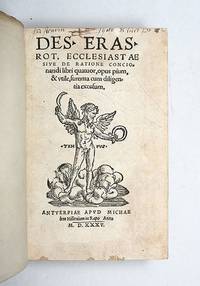
1535150907Antwerp: Michael Hillenius 1535. Rare 16th-century English blind stamped panels One of two pirated editions of Erasmus's Ecclesiastes published in Antwerp the same year as Froben's authorized original. The covers of this copy bear two handsome and rare blind stamped panels attributed to the Dutch binder Gerard or Garrett Pilgrim active in England at the beginning of the 16th century. Pilgrim was a native of Antwerp who worked as a bookseller and bookbinder in Oxford from at least 1524 until his death in 1536. The two panels of which only 13 examples are known to Oldham Oldham HM 17 and 18 p. 28 all dated 1523-35 are of characteristically English style and manufacturing. They feature an outer frame filled with blind stamped rolls of leaves garlands angels masks and dragons and a central design of heads in roundels accompanied by the binder's initials with a key and a pilgrim's staff crossed. On 12 July 1536 Erasmus died in Basel where he had returned to check on Froben's publication of the Ecclesiastes his last major composition. This work is an extensive manual in four books on the art of preaching containing a treatise on the role and importance of preachers in the church precise indications on how to structure and deliver sermons and a list of sermon topics. The Ecclesiastes was highly successful: in addition to the 2600 copies printed by Froben two pirated editions were produced in Antwerp in 1535 the present one and another by Martinus Caesar for an estimated total of 3500 copies sold - an uncommonly large publication for its time see Kleinhans p. 308. Octavo 160 x 103 mm. Woodcut printer's device to title page and verso of last leaf half-page portrait of Erasmus in a roundel historiated and floriated initials. Later calf preserving contemporary English blindstamped panels signed "GP" spine with raised bands decoration of parallel blind lines to first and last compartment intricate design of curls and tendrils to third and fourth gilt date at foot early 19th century endpapers one binder's blank with watermark "EB 1813". Partly erased contemporary ownership inscription of one "frater Henricus Thor." to title page occasional contemporary marginalia in Latin and maniculae early price indication of 2 shillings inked to verso of last leaf armorial bookplate to front pastedown of George Kenyon of Peel Esq 1666-1728 MP and a prominent figure in the Lancashire Tory political scene in the 1690s through to the 1710s. Raised bands and joints a little rubbed early repair to rear cover panel some marginal light stains and fingermarks to contents otherwise internally bright and exceptionally clean A2-3 missing as usual. An attractive well-margined copy. Adams E-626; USTC 400577; Erasmus Online 1678. J. B. Oldham Blind Panels of English Binders 2010. On the panels see also M. Foot The Henry Davis Gift Vol. II 1979 no. 27. R. G. Kleinhans "Erasmus Ecclesiastes and the Church of England" in Historical Magazine of the Protestant Episcopal Church 39/3 1970 pp. 307-14. hardcover
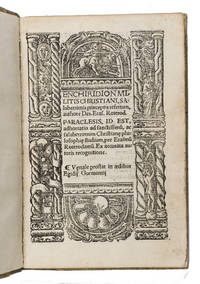
1522ABC_49728Paris 1522. 8vo 10.3x16.2. Gilles de Gourmont Modern half vellum and sprinkled paper sides sewn on 5 supports with the corresponding raised bands on the spine the manuscript author title and supposed year of publication 1522 on the spine. With both titles set within an identical woodcut architectural frame and several woodcut decorated initials. 106 10 ll. Very rare Paris edition of Erasmus Enchiridion militis Christiani including a short text urging readers to study Christian philosophy. Before Erasmus became a household name for his satire The Praise of Folly or for his Latin translation of the New Testament he authored a lesser-known yet deeply personal work: Enchiridion militis Christiani The handbook of the Christian soldier.Written in 1501 the Enchiridion is a passionate call to return to a pure Christ-centred faith one grounded not in ritual or church hierarchy but in inner devotion and practical piety. With urgency and sincerity Erasmus wrote not for scholars or clergy but for ordinary believers striving to live a holy life.Between its first publication and Erasmuss death in 1536 the Enchiridion was printed in over fifty Latin editions becoming one of his most widely read works across Europe. This relatively early French edition is rare with few known copies surviving. We have traced only two other copies in sales records of the past 100 years one sold in 1920 and the other in 1980.With occasional near- contemporary manuscript annotations in the margins and underlining of some text indicating text improvements and highlighting important passages and in the same hand a short note on the blank verso of the last leaf most likely a philosophical reflection or content-related note. Most pages contain a simple frame ruled in red after printing the edges of the last quarter of leaves are slightly frayed minor water staining in the fore-edge margin and somewhat browned throughout. Otherwise in good condition.l Renouard inventaire chronologique des editions Parisiennes III 318; Renouard & Moreau II 1812; USTC 183822 lost book; Vander Haeghen I 84; not in Adams; Bezzel; BM STC French; De Reuck; Kossmann; WorldCat; cf. . Bibliotheca Belgica E 1023 ca. 1522 ed. with different impressum. hardcover
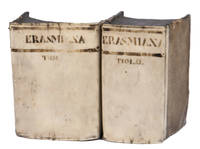
1642AB6GB5JMB8EQLeiden: Joannes Maire 1642. Contemporary half vellum paper sides with "Erasmiana tom. I or II" in manuscript on the spine blue edges. 12mo. Ad 1 with an engraved title page by C. van Dalen showing Erasmus standing in a church with a book in his left hand pointing to three other men. All title pages contain Maire's woodcut device see Breugelmans nr. 13 and a woodcut portrait of Erasmus in a roundel on leaf 8r in ad 1 and his device in a roundel in the text on leaf 25v in ad 1. Further with several woodcut decorated initials throughout. 14 works in 2 volumes. With:2 IDEM. Lingua sive de linguae usu atque abusu liber utilissimus.Leiden Joannes Maire 1649.3 IDEM. Moriae encomium cum Gerradi Listriis commentariis. Epistolae aliqut in fine additae. Leiden Joannes Maire 1648.4 IDEM. Dialogus Ciceronianus: sive de optimo genere dicendi. Leiden Joannes Maire 1643.5 IDEM. Dialogus de recta Latini Graecique sermonis pronuntiatione. Leiden Joannes Maire 1643.6 IDEM. De contemptu mundi liber. Leiden Joannes Maire 1641.7 IDEM. Querela pacis undique gentium ejectae profligataeque. Leiden Joannes Maire 1641.8 IDEM. De immensa Dei misericordia. Leiden Joannes Maire 1641.9 IDEM. Modus orandi Deum. Leiden Joannes Maire 1641.10 IDEM. Precationes quibus homines assuescant cum Deo loqui.Leiden Joannes. Maire 1641.11 IDEM. Enarratio in Psalmum I.Leiden Joannes Maire 1644.12 IDEM. Enarratio triplex in Psalmum XXII. Leiden Joannes Maire 1645.13 IDEM. Enarratio pia juxta ac docta in Psalmum XXXIV.Leiden Joannes Maire 1652.14 IDEM. Concionalis interpretatio plena pietatis in Psalmum LXXXVI.Leiden Joannes Maire 1652. These 14 important works by Erasmus - the edition of his most important letters after the Vita edited by Petrus Scriverius 1576-1660 his famous Laus stultitiae and 3 of his linguistic works in the first volume and 9 theological works in volume 2 - belong to a project of the Leiden publisher printer and bookseller Joannes Maire 1603-1657. This project that can be seen as a series of editions that together represent Erasmus' collected works ensured Maire's stellar reputation through the ages. 23 different works appeared between 1641 and 1652. It has long been thought that Petrus Scriverius was the editor but now there is proof that in fact Willem Henricus Vorstius a learned Remonstrant minister in the village of Warmond near Leiden did the job Breugelmans p. 24.11 works were published in 1641 5 of which in the present collection; 2 in 1642 1 present 3 in 1643 2 present 1 in 1644 also present 3 in 1645 1 present 1 in 1648 also present 1 in 1649 also present 1 in 1650 also present and 2 in 1652 both present. The whole collection brings together a representative selection of Erasmus' spiritual moral and exegetical writings - as it includes treatises on Christian prayer and devotion moral and ascetical reflections expositions of the Creed the Ten Commandments and the Lord's Prayer and commentaries on select psalms. It is presented together with Sriverius' edition of the Vita a biography of Erasmus.Printed in compact duodecimo format with Maires characteristic typographic elegance these Leiden editions form one of the most coherent 17th-century series of Erasmus spiritual writings.With a manuscript owner's inscription on the title pages of ads 1 and 6 a small manuscript inscription on the title page of ad 2 and a small manuscript inscription on the title pages of ads 3 5 and 6-14. Further with two library stamps of the Nordelbische Kirchenbibliothek in Hamburg incl. "Gelöscht" stamps on the versos of the title pages of ads 1 and 6. The bindings are dust soiled and slightly damaged along the extremities but the structural integrity of both bindings remains fine slight foxing and browning throughout. Otherwise in good condition.l Breugelmans Fac et spera. Joannes Maire 2003 1642:7 and other numbers; ads 2-6 and 10-14 in verzicht werken Erasmus Rotterdam 1936; all works in the STCN and USTC; Van der Haeghen I 182 and other numbers. A detailed list of references is available upon request. Joannes Maire, hardcover
1536953165Basel: Froben 1536. leather_bound. Gut. 940 Seiten 30 Blatt. Blindgeprägter Schweinsledereinband der Zeit mit zwei Schließen auf Holzdeckeln mit 3 Bünden. Klein-Oktav 173 cm. Gegenlager der unteren Schließe fehlt Einband leicht bestoßen und fleckig Schnitt fleckig handschriftliche Besitzvermerke innen meist dezenter Feuchtigkeitsrand im Ganzen aber gut erhalten. Ledereinband der Zeit auf 3 Bünden mit blindgeprägter Streicheisen- und Rollband-Ornamentik und handschriftlichem Rückentitel. Kleine metallene Griffe markieren den Beginn der Bücher 2 3 und 4. Die Paginierung ist teilweise irrig das Buch ist aber vollständig. Auf den Seiten 174 -181 finden sich dezente Unterstreichungen mit rotem Farbstift auf den Seiten 265 -268 Unterstreichungen mit brauner Tinte. Ganz vereinzelt kleine Ausrisse im weißen Rand. Ausgabebezeichnung: BASILEAE IN OFFICINA FRO / BENIA PER HIERONYMVM / FROBENIVM ET NICOLAVM / EPISCOPIVM MENSE / AVGVSTO ANNO / M D XXXVI "Desiderius Erasmus von Rotterdam geboren vermutlich am 28. Oktober 1466 / 1467 / 1469 wahrscheinlich in Rotterdam; gestorben 11./12. Juli 1536 in Basel war ein bedeutender niederländischer Gelehrter des Renaissance-Humanismus." Wikipedia. Die erste Ausgabe dieses Buches im Oktav-Format erschien 1535. - Eigentlich wollte Erasmus dieses Spätwerk John Fisher dem Bischof von Rochester widmen; kurz vor dem Druck erfuhr Erasmus jedoch von der Hinrichtung seiner Freunde Fisher und Thomas Morus. In seiner Vorrede geht er auf die Hinrichtungen ein was das Interesse der Öffentlichkeit erhöhte. Erasmus richtet seinen Blick auf die neuentdeckten Länder in Amerika. Er mißbilligt die Kriegführung der Conquistadoren appelliert an das Verantwortungsbewußtsein der christlichen Fürsten und lobt den Missionseifer. Ecclesiastes oder: Über die Art des Predigens "ist das Werk eines schließlich müde gewordenen Geistes der nicht mehr scharf auf die Nöte seiner Zeit reagiert. . Die Predigt hatte Erasmus immer als die würdigste Aufgabe des Theologen betrachtet. . Erasmus knüpft mit einer Reihe moraldogmatischer Abhandlungen wieder dort an wo er mit dem Enchiridion begonnen hatte: bei der Erörterung der einfachen allgemein christlichen Lebensführung einer ungezwungenen Ethik. Das ist seine erlösende Botschaft." Huizinga p.166 et pass. Mit 5 alten handschriftlichen Besitzvermerken von 1650 bis 1845 auf dem Titel. Auf dem letzten Blatt recto eine dreizeilige handschriftliche Notiz mit Erwähnung des Hl. Polykarp von Smyrna und dem Reformator Erhard Schnepf aber nicht aus der Hand von Schnepf vielleicht aber eines seiner Studenten. Vgl. Mentz: Handschriften der Reformationszeit 20 b. "Erhard Schnepf oder Schnepff geboren 1. November 1495 in Heilbronn; gestorben 1. November 1558 in Jena war ein lutherischer Theologe und bedeutender Reformator Generalsuperintendent des Herzogtums Württemberg Hochschullehrer an der Universität Jena Hochschullehrer der Philipps-Universität Marburg und Hochschullehrer an der Universität Tübingen 1544 - 1548." Wikipedia. "Wilhelmi Schimko 1845" "Emanuel Wilhelm Schimko 1791-1875 studierte in Ödenburg ung. Sopron und Jena Theologie. Ab 1835 bekleidete er das Doppelamt des Pfarrers und Seniors der Evangelischen Kirchengemeinde A. B. zu Preßburg sowie des Theologieprofessors am Preßburger Evangelischen Lyzeum." Wikipedia. VD16: E 2722; Adams I p.399 630; BMCGB p. 281; Bezzel p. 250 822; Vanderhaegen p. 78; Sebastiani verzeichnet Froben-Drucke nur bis zu dessen Tod 1527. - Weitere Bilder auf Anfrage oder auf unserer Homepage. Wegen Urlaub kann Ihre Bestellung / Anfrage erst nach dem 21.06.2026 bearbeitet werden. - Because of holidays your order / question can be handled only after 06/21/2026. Froben hardcover