133 résultats
1528CLL-143Lyon, Gryphe, 1528-1529 In-12 de 160 pp., (4) ff. - (16) ff. - (40) ff., veau blond, trois filets dorés en encadrement, dos à nerfs orné de filets et d'un décor à la grotesque doré, pièces de titre et de tomaison de maroquin havane et vert, coupes filetées or, bordures décorées, tranches dorées (Niédrée).
160015652Small 4to. Bound with orig. wrappers in a fine hmorocco. No 93 of 1600 ""sur velin teinte"". Fine wood-engravings by Pauw.
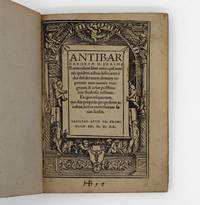
1520375736Basel: Froben 1520. First edition printed in May. Woodcut borders to title leaf and dedication by Hans Holbein printer's device on last page. 150 2 imprint pp. 4to. Eighteenth-century marbled boards ink label. Some toning to spine. Very good fresh copy. First edition printed in May. Woodcut borders to title leaf and dedication by Hans Holbein printer's device on last page. 150 2 imprint pp. 4to. Ignorantiam esse superbiae matrem. Eruditionem contra modestiam parere.<br /> Ignorance is the mother of pride; it is from learning on the contrary that modesty is born.<br /> <br /> First edition of Antibarbari Erasmus' manifesto "defending the arts against the scruples of the barbarians" Tracy. Erasmus argues for the primacy of poetry among the liberal arts for the importance of critical understanding of the writers of classical antiquity and for appropriating what is good in their work. He is also scornful of rote learning and blind repetition of earlier scholarship where "cuckoo calls to cuckoo".<br /> <br /> In Petro summus erat ardor fidei in Hieronymino summa doctrina: alterius animum alterius studia imitar. In Peter there was the ardour of faith at its highest; in Jeronme there was learning at its best. It is for you to imitate the spirit if the one and the scholarship of the other.<br /> <br /> This was a work of very long ripening. Erasmus began the earliest version circa 1490 when he was a newly ordained monk but that manuscript was left behind in his wanderings. Decades later when he came across his earlier work he was at the center of intellectual controversy following publication of of his edition of the New Testament. He revised his Antibarbari to assert the humanist position and Froben published it in May 1520. There were six editions of the work in the early 1520s Froben himself published another edition later the same year and ten editions in his lifetime.<br /> <br /> "it is ignorance rather than erudtion which makes men insolent"<br /> <br /> FIRST EDITION OF A KEY WORK BY ERASMUS. VD16 E1997; Valentina Sebastiani Johann Froben Printer of Basel 170; Bibliotheca Erasmiana p. 9; Adams E-463; Bezzel 157. The standard modern text iwith translation by Margaret Mann Phillips˜The Antibarbarians" is in the Toronto Collected Works vol. 23 1978 Froben unknown
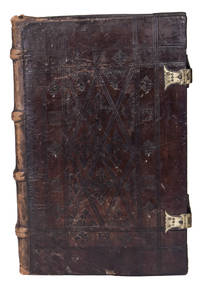
152253365Mainz: J. Schöffer 1522. First Mainz edition. Octavo. 562 2: colophon blankpp. Collation: A-Z8 Mm8 chi2 O4/O5 reversed complete. Title within historiated woodcut border. Woodcut initials throughout. Text in italics. Printed side-glosses. Errata at final text leaf. Contemporary beveled wooden boards backed in tooled pigskin; spine with raised bands. Brass catch and clasp with expert restoration of leather thong. Contemporary manuscript musical scores used as pastedowns at front and back. Seven leather stubbs affixed at front edge as indexes. Occasional faint smudging mostly at margins else text crisp and fresh. A very good copy in a well-preserved sixteenth-century binding with a notable provenance.<br /> <br /> Scarce very early collective edition of the Latin "Paraphrases" of the Pauline Epistles prepared by the celebrated humanist scholar theologian and educational writer Desiderius Erasmus of Rotterdam 1466-1536. Preceded by the Froben collective editions of 1520 and 1521 this first and only edition of the Pauline Epistle Paraphrases to be printed at Mainz was issued by Schöffer in two parts each with full title and separate register and pagination; our volume contains the first part only: the Epistles to the Romans; Corinthians 2; Galatians; Ephesians; Philippians; Colossians; and Thessalonians 2.<br /> <br /> "In the vast and sustained labour he devoted to the New Testament Erasmus saw the culmination of his commitment to scholarship. and nothing else he wrote not even the Moriae encomium was to have so great an influence on posterity. The first edition of the New Testament appeared in 1516 and was followed in his lifetime by four more 1518/10 1522 1527 1535 each newly revised. Each consisted of the Greek text Erasmus' translation thereof and a copious apparatus of notes Annotations published as a separate volume. Beginning in 1517 he also published a Paraphrase of all parts of the New Testament save Revelation. Written in smooth and comprehensible Latin it was usually fuller than the original text. If offered his own interpretatiton but often avoided the provocative statements found in the Annotations. From the outset the translation the Annotations and to a lesser degree the Paraphrases drew criticism originally from conservative theologians who found heresies in his humanist philology but soon also from Lutherans and Catholics who denounced him for departures from their respective doctrines" Bietenholz. The Paraphrases were composed between May 1517 and January 1524. "Erasmus began with the Pauline Epistles. The paraphrase of Romans was published in quarto by Dirk Martens in Louvain in November 1517 and reprinted by Erasmus's friend Johann Froben in January of the following year; it sold well and was soon reprinted in octavo. Corinthians was published by Martens in February 1519 and reprinted in Basel by Froben in March; Galatians appeared later that year with editions from both publishers. The remaining Epistles followed in 1520 and 1521 the last to appear being Hebrews. In the autumn of 1521 Erasmus moved from Louvain to Basel and from that time Froben published the first editions of the remaining Paraphrases" Mynors. <br /> <br /> Our edition was printed by Johann Schöffer the son of Peter Schöffer who was the principal workman of Johannes Gutenberg. Apart from those of the Pauline Epistles the only other complete Paraphrase of Erasmus to be published by Schöffer was that on the Gospel of Matthew also in 1522. He did in 1521 however issue a series of four brief excerpts from the Paraphrases in German translation which appear to highlight provocative exegesis by the great scholar of Rotterdam concerning for example the hypocracy of the Pharisees Matthew 23 or the exhortation to "Take My yoke upon you and learn from Me" Matthew 11.29.<br /> <br /> Provenance and annotations: Contemporary manuscript entry at the title-page of the Benedictine monastery library at Amorbach; contemporary 50-word manuscript note in Latin at the free endleaf facing the title which discusses the present work. Early manuscript note in German at the final blank endleaf. Early leaves with light rubrication in red ink; about twenty leaves with contemporary annotations throughout. Later stamps of the Leiningen Palace Library at the bottom margin of the title and very faintly at the pigskin covers. Bookplate of United Theological Seminary Dayton Ohio noting the gift of Dr. Walter N. Roberts with their vertical entry stamp Mar 28 1963 at the dedication leaf lightly over the left-hand edge of the text but not impairing legibility. Full title and imprint: Paraphrases Eras. Rot. In omnes epistolas Pauli apostoli germanas : et in eam quae est ad Hebraeos incerti autoris cum ijs quae Canonicae uocantur diligenter recognitae excusaeque & ita binos in tomos digestae ut cuique secare in formam enchiridij siuelit liberum sit.<br /> <br /> References: P.G. Bietenholz Encounters with a Radical Erasmus Univ. Toronto 2009 p.13; R.A.B. Mynors "The Publication of the Latin Paraphrases" in: R.D. Sider ed. New Testament Scholarship: Paraphrases on Romans and Galatians University of Toronto Press 1984 pp. xx-xxix; USTC 682534; Vander Haeghen p.145: Paraphrases in omnes epistolas Pauli. Moguntiae Io. Schoeffer m. augusto 1522 octavo; VD16 E-3379 Berlin; Halle; Leipzig; Wittenberg; Wolfenbüttel. This first part not in Adams but cf. E-795 the second part 378pp. J. Schöffer unknown
154749141Lyon: Sebastian Gryphius 1547. Hardcover. Very Good-. 16mo in 8s: a-z8 A-Z8 aa8 bb8 =384 leaves; blank bb7-8. 763 5 blankpp. Printer’s device at title woodcut lettrines. Text in italic headlines and chapter headings in roman; printed marginalia. Later pigskin over bevelled boards tooled in blind brass clasps one of two and catches manuscript title at spine. Extensive old manuscript notes at front endleaf and four blank leaves at the end including the two integral blanks; occasional marginalia and underlining. Title soiled with some slight erosion at margin from oxidation of the clasps else a very good copy with clean fresh text throughout. Complete with the two final blank leaves.<br /> <br /> Second Gryphius edition and a rather uncommon early sixteenth-century printing of Erasmus’ Latin translation of the New Testament first published at Basel in 1516. According to Baudrier Ly. V. 804101/Cat. de Lignerolles Paris Porquet 1894 no. 48 Gryphius first published this translation in 1542 and 1543 as a 16mo of 847 pages; neither of these issues appear in Deleveau & Hillard. Like the present edition these early Gryphius printings of the Erasmus New Testament survive in only a handful of copies. The text opens with Erasmus' dedication to pope Leo X followed by his preface to the reader a general index of the New Testament corpus a listing of the chapters of the four Gospels and a brief passage from Jerome's catalogue of ecclesiastical writings. The editor's introductions precede each book. The text concludes with Erasmus' translation of a brief discussion of apocryphal literature partly from Athanasius though Erasmus questions the attribution: "De libris utriusque testamenti partim reiectus aut non sine contradictione admissis partim apocryphis ex Athanasio tametsi mihi suspectus est titulus." <br /> <br /> Provenance and annotations: Extensive early annotations in more than one hand appear throughout the book; many marginal notes have been added throughout the Gospel of Matthew. At the front of the book beginning with the free endleaf: "Poeta de Pythogora" several stanzas in Latin and Greek; facing the title: A morning prayer "Oro matutina lecturis oracula divina" 11 lines; an accounting of biblical eras 10 lines since Abraham David and the Babylonian Exile appears at the verso of the title leaf. The final blank page the two intergral blank leaves and two additional blanks added by the binder are filled with notes in several different hands including: a passage from Augustine's De doctrina christianae 14 lines; noted as book 2 chapters 11 and 12 along with four lines about Tertullian; four pages of notes on the twelve disciples numbered; a Greek text discussing the divine names in which the tetragrammaton is written in Hebrew letters; a passage from a letter of Basilius Magnus in Greek with Latin translation.<br /> <br /> Printed label of Edward Davis Hoblyn 1809-1881 and his manuscript entry dated 1831 at the free endleaf. Edward was likely related to the renowned book collector Robert Hoblyn 1710-1756 of Cornwall. A catalogue of Robert’s collection was printed in 1768 as Bibliotheca Hobliniana and reissued by Murray in 1769 with a new titlepage. The library remained with Robert’s widow and was sold in 1778. The present work is not listed in the Bibliotheca though no fewer than nineteen 16th-century Latin Bibles and Testaments appear in the catalogue. Gift inscription of D. N. Goodman of San Francisco California to Father J. L. Damas at front pastedown dated 1935. References: Baudrier 8 217. Baumgarten Nach. v. merkw. Büchern 8 1755 206 noting that this and the later Gryphius edition which Le Long assigns to the master printer’s workshop are in fact identical and notable examples of elegant typography. Deleveau & Hillard 4407 BNF. Le Long Leipzig 1709 1:751 & 2:478 Bibl. Colbertina - the earlier Gryphius edition of 1542/43 is not cited in either part. Le Long-Masch 2.3 p. 599 noted as the first New Testament ex. Erasmi to appear at Lyon. Sebastian Gryphius hardcover
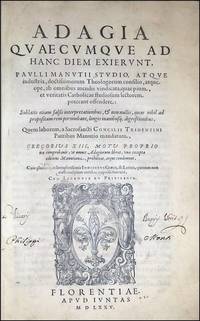
157572<p><b>FINE AND IMPORTANT ALDINE EDITION OF ERASMUS ADAGES</b>Erasmus Roterodamus. <b><i>Adagia</i></b><i> quaecumque ad hanc diem exierunt Paulli Manutii studio atque industria . ab omnibus mendis vindicata quae pium et veritatis Catholicae studiosum lectorem poterant offendere: sublatis etiam falsis interpretationibus & nonnullis . digressionibus. Quem laborem a sacrosanti Concilii Tridentini patribus Manutio mandatum Gregorius 13. motu proprio ita comprobauit vt omnes Adagiorum libros vna excepta editione Manutiana prohibeat atque condemnet. </i><i>Cum plurimis ac locupletissimis indicibus Graecis & Latinis quorum nonnulli nusquam antheac impressi fuerunt</i>. Florentiae apud Iuntas MDLXXV Florence Giunti for the Aldine Press <b>1575</b>.2° later limp <i>cartonnage</i> handwritten title and library label at spine ff. 4 columns 1454 i.e.1440 ff. 36.Giunti device at title and final leaves. Woodcut headletters. Text in Latin on two columns with some passages in Greek.Aldus Manutius' dedicatory to pope Gregory XIII.<b>Fine and important edition revised by Aldus Manutius the Younger of the renowned collection of Latin and Greek adages sayings proverbs mottos epygrams compiled by Erasmus</b>.Paul Manutius was commissioned by the Fathers of the Council of Trent to correct the work reorder purge by false interpretations and doctrinal errors in order to make this edition the only one approved by the Church the bull of Gregory XIII as stated in the title prohibits and condemns the other editions.<b>Desiderius Erasmus Roterodamus</b> 1466 – 1536 known as Erasmus of Rotterdam or simply Erasmus was a Dutch Renaissance humanist Catholic priest social critic teacher and theologian.Amongst humanists he enjoyed the sobriquet "Prince of the Humanists"; he has been called "the crowning glory of the Christian humanists". Using humanist techniques for working on texts he prepared important new Latin and Greek editions of the New Testament. These raised questions that would be influential in the Protestant Reformation and Catholic Counter-Reformation.<b>Provenance</b>: Ownership signature <i>Philippi Monti</i> at title-page beside the printer device.<b>References</b>: Renouard 220. 14. STC <i>Italian</i> 236; Adams E-443. BMC 236. CNCE 18245 & 18247.</p> Giunti for the Aldine Press paperback
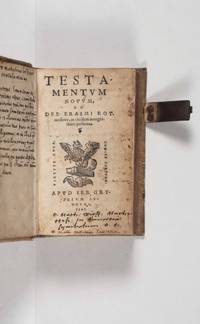
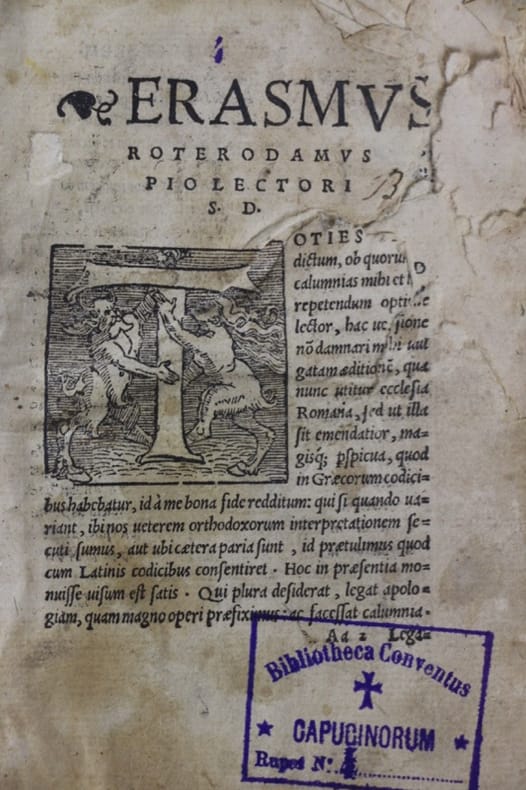
1523104094Argentorati [Strasbourg] apud Johannem Hervagium 1523 In-12, plein veau, dos à nerfs rel. XVIII, blanc déchiré, sans titre, 5 premiers ff. avec accrocs angulaires et atteintes du texte, 20 pp. pour le Paraclesis, avec léger accroc marginal, sans atteinte, 14 pp. de table sous colonnades gravées, 152 ff. ch.- 135 ff. ch.- 2 ff. Accrocs en marge sans atteinte. Lettrines gravées. Reliure post. un peu gauchie, coiffe usée en tête, titre à froid : “Novum testamentum secundum”. Etiquette de classement. Tampons bibliothèque capucine.
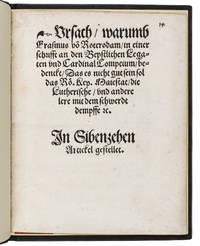
1531ABC_49886Strasbourg or Nuremberg 1531. 4to. Georg Ulricher or Wolfgang Heußler Modern blind-tooled mottled calf with a double fillet border on both boards. 3 1 blank ll. Rare German edition of a letter Erasmus sent to the papal legate Lorenzo Campeggi 1474-1539 on August 18 1530. In this letter Erasmus expresses his fear that the Holy Roman Emperor would declare war to the Protestant German princes and explains in 17 articles why violence is not the answer. He never printed the letter himself and it probably never reached Campeggi. According to Allen Erasmus wrote that "it was intercepted by the treachery of some unnamed 'evangelical' and printed without authority in Strasburg". The letter was translated into German and indeed published several times in Strasbourg Wittenberg Magdenburg and Nuremberg in 1531. The present edition does not have an imprint but was either printed in 1531 in Strasbourg by Georg Ulricher or in 1546 in Nuremberg by Wolfgang Heußler. It is quite rare as we not been able to find any other copies of the present edition in sales records of the past hundred years.With a red bookbinder's label "Period Bookbinders Bath England" mounted on the recto of the last free flyleaf. The work is lightly browned and foxed the inner margins have been reinforced. Otherwise in good condition.l Bezzel 26; Erasmus Online 1874; USTC 704493 and 704494; VD16 E 1881 and VD16 E 1882; Vander Haeghen I 88; not in Adams; BM STC German; De Reuck; cf. Allen Opus Epistolarum Erasmi vol. IX intro. to Ep. 2366. hardcover
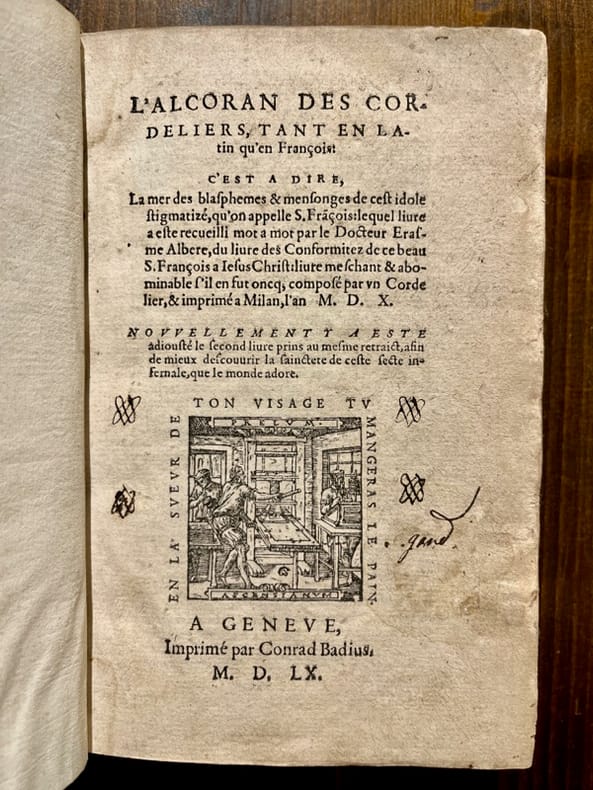
156019664A Genève, imprimé par Conrad Badius, 1560. 2 parties en un volume in-8 de 8-278-[2] et [16]-303-[1] pages [A4; a-r8; s4; *8; A-T8]. Reliure 19ème en plein veau brun, dos à nerfs orné de petits fleurons dorés. Les plats sont constitués du cuir de la reliure originale, ornés au centre d'une large pastille dorée, décorée d'arabesque; encadrés de double filets dorés et à froid, Tranches dorées.
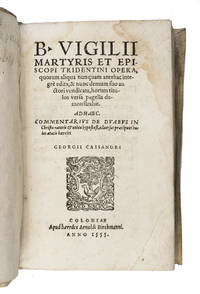
1535ABC_49895Cologne: printed by Jaspar von Gennep for Peter Quentel 1535. Limp overlapping vellum with ties. 8vo. With an elaborate woodcut border on the title page of ad 1 several decorated woodcut initials and Quentels woodcut device at the end. 2 works in 1 volume ad 2 in 2 parts. With bound before ad 1:2 VIGILIUS. Opera .Including: CASSANDER Georg. Commentarius de duabus in Christo naturis .Cologne Arnold Birckman 1555. A rare and significant edition of De veritate corporis et sanguinis Domini by Alger of Liège Algerus ca. 1060-ca. 1131 Benedictine monk of Cluny and one of the most influential medieval theologians on the Eucharist. This major treatise composed during the so-called second Eucharistic controversy defends the doctrine of the real presence of Christ in the Eucharist against the teachings of Berengarius of Tours. Admired by both medieval scholars and later by Erasmus Algers work remained central to Catholic theology well into the sixteenth century.This copy represents the Erasmian edition prepared under Erasmuss supervision with his corrections and editorial guidance. His involvement gave the text a new humanist form and authority making Algers theology newly relevant at a time when Eucharistic doctrine was again fiercely debated during the Reformation. Erasmuss careful attention to clarity and Latinity situates this edition within his broader humanist programme of restoring theological texts to philological precision and doctrinal coherence.Only a handful of copies of this edition are known and no record of it appears in recent sales databases underlining its rarity on the market. It is the second edition overall following the first printing in Freiburg im Breisgau 1530 and the first to be issued by Peter Quentel in Cologne.Bound together with the Opera of Vigilius 1555 and a Commentarius opposing the Christological views of Georg Cassander 1555 this important Sammelband reflects the continuing Catholic polemic against Reformation-era innovations in both Eucharistic theology and Christology.The vellum is slightly dampstained lacking part of the bottom closing tie on the front. Some stains and browning throughout. Otherwise in good condition.l Ad 1: BM STC German p. 20; USTC 626331; Vander Haeghen II 6; VD 16 A 1871; cf. Adams 173 1530 ed.; Ad 2: Adams V 748; BM STC German p. 893; USTC 615055; VD 16 V 1184. [printed by Jaspar von Gennep for] Peter Quentel, hardcover
1550P8126The Works of Aristotle "per Des. Eras Roterordamvm" 1550. 2 volumes in one folio 323 x 192mm. Third Edition of The Works of Aristotle of the original text in 1831 prepared by Simon Grynaeus. This edition retains the original letter from Erasmus to Thomas More's son John. Woodcut initials a few woodcut illustrations old calf a few early annotations numerous notes in Latin Greek and English on front and rear flyleaves probably nineteenth-century and in text in ink pencil and red crayon neat annotations in Greek in second volume Greek quotation from Aristotle written on first title-page occasional light staining T5 torn in margin binding rubbed rebacked. Two of history's greatest minds converge. Book #P8126. $6500. We specialize in Rare Ayn rand erotica history and science. Johann Bebel and Michael Isengrin, 1550 hardcover
1522ABC_49903Cologne: Eucharius Cervicornus 1522. Contemporary blind-tooled calf with armorial panel-stamps. Sewn on 4 supports with corresponding raised bands on the spine with remnants of 4 pairs of green closing ties re-backed. 4to. With an elaborate woodcut frame on the title page and 2 smaller woodcut frames on the first pages of the texts and 5 woodcut decorated initials. 2 parts in 1 volume. Including: ERASMUS Desiderius. Commentarius in psalmum quare fremuerunt gentes. Second edition printed in the same year as the first of Erasmus version of the Commentaries on the psalms attributed to Arnobius the Younger a Christian priest active in 5th-century Gaul. Arnobius interprets the psalms allegorically relating their content to Christ and the Church. First printed in folio by Froben in Basel in September 1522 the present 4to edition was published shortly after that same year in Cologne by Eucharius Cervicornus. It contains Erasmus preface addressed to Pope Adrian VI the commentary of Arnobius on the psalms and Erasmus own extensive commentary on psalm 2 Quare fremuerunt gentes. The present copy is bound in a contemporary Cologne binding attributed to an anonymous binder active circa 1510. Both boards feature a panel-stamped frame including three armorial shields of the city arms of Cologne ermine field with three open crowns the arms of the Archbishopric of Cologne a black cross on a silver field and a diagonally banded shield likely the binders own mark. Inside there are two identical rectangular panels made up of a stamp with bird motifs and the motto Clamo ad te Domine "I call to you Lord".With two book plates mounted on the front pastedown Thomas Brooke F.S.A. Armitage Bridge and one with the motto Pro viribus summis contendo a small manuscript cypher CP on the title page and Erasmus commentary contains manuscript annotations in the margins and on the final blank page by a near-contemporary hand. The binding has been re-backed the head of the spine is slightly damaged the corners of the boards are slightly damaged the original blind-tooled leather on the boards is somewhat dry and cracked affecting the clarity of the stamps and with some small scratched in the leather on the front board. Some occasional browning and water- staining in the margins. Otherwise in good condition.l Bezzel 554; Goldschmidt 57; Jenkins 2.1; USTC 613135; Vander Haeghen II 10; VD 16 B 3132 and VD 16 E 2460; not in: BM STC German De Reuck. Eucharius Cervicornus, hardcover
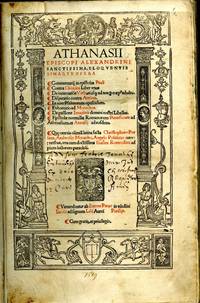
1519048644Paris: Ioanne Paruo Jean Petit 1519. First Edition. Hardcover Vellum. Very Good Condition. First part dated 1518 second 1519. Later overlapping parchment. browned new endpapers. Some soiling to title page top edge excised likely for a signature page numbers added to upper right in pencil slight scattered browning light dampstain to upper edge of final leaves. A nice wide margined copy two parts in one with the integral blank between them. Rubricated throughout. 6 255 1 bl. 64 ff.<br /> <br /> Scarce edition with the important commentary on Paul's Epistles here attributed to Athanasius but actually by Theophylact of Ohrid. They were a "profound influence" on Erasmus' new testament and his In Praise of Folly Obolensky Six Byzantine Portraits 1988. 22 copies in OCLC but only 3 in the US. Rare in commerce.<br /> <br /> <br /> contains: Commentari in Epistolas Pauli Contra gentiles liber unus : De incarnatione Verbi eiusque ad nos per corpus aduentum : Disputatio contra Arrium : In uim Psalmorum opusculum : Exhortatio ad Monachos : De passione imaginis domini nostri libellus : Epistolæ nonnullæ Romanorum pontificum ad Athanasium et Athanasii ad eosdem Size: Folio. Quantity Available: 1. Shipped Weight: Under 1 kilo. Category: Religion & Theology; Antiquarian & Rare. Inventory No: 048644. Ioanne Paruo (Jean Petit) hardcover
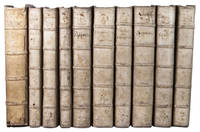
1569ABC_49477Basel: Ambrosius & Aurelius Froben 1569. Contemporary half elaborately blind-tooled pigskin over wooden boards sewn on 5 supports volume 1 on 4 with two brass clasps on the fore edge leather anchor plate brass clasp and catch plate. With the manuscript titles on the spines and the contents of each volume in manuscript on the bottom edge of all but one volume. Probably bound by Michael Hermann in Stuttgart before 1580. See for the workshop einbanddatenbank no. 502297b the rolls used: nos. r004651 and r003964. Folio 38 x 25.5 cm. With the general title page in volume 1 set within an elaborate woodcut frame all other title pages show the large woodcut Froben printer's device repeated on all but one verso of the final page in each part. Further with woodcut decorated initials. 11 parts in 10 volumes. A complete and uniformly bound set of the monumental edition of the complete works of Saint Augustine of Hippo printed by the celebrated Froben press. This edition follows the editorial tradition established by Erasmus and Johann Froben in the early 16th century and reflects the enduring influence of Augustines thought on early modern theology. The present work includes a broad range of Augustines writings: his dogmatic treatises De Trinitate De civitate Dei polemical works notably against Pelagianism and Manichaeism exegetical texts Enarrationes in Psalmos Gospel homilies ascetic and moral discourses and the Epistolae. This edition represents an early attempt to consolidate Augustines vast corpus for academic and ecclesiastical use during period following the Council of Trent. It demonstrates the persistence of Augustinian authority in Reformation-era intellectual life as well as the role of the Swiss printing houses in disseminating patristic texts throughout Europe.Aurelius Augustine 354-430 CE commonly known as Augustine of Hippo was a North African bishop theologian and philosopher widely regarded as one of the most influential figures in Western Christianity and Latin patristic thought. Born in Thagaste modern-day Souk Ahras Algeria Augustine received a classical education in rhetoric and philosophy before embracing Manichaeism and later Neoplatonism.After a period of moral and spiritual searching chronicled in his Confessiones he converted to Christianity in 386 CE under the influence of Ambrose of Milan. He was baptised in 387 ordained a priest in 391 and became bishop of Hippo Regius in 395 a position he held until his death.Augustines vast body of work addresses themes such as original sin grace free will the nature of the Church and the interpretation of Scripture. His most notable writings include Confessiones De civitate Dei the City of God and De Trinitate. His thought shaped the theological foundations of both medieval Catholicism and later Protestant traditions particularly through his doctrines of grace and predestination. He died in 430 CE during the Vandal siege of Hippo. Augustine was later declared a Doctor of the Church and his intellectual legacy remains foundational to Western theology and philosophy.With a manuscript inscription on each of the title pages and a small printed book plate mounted on the front pastedown of volume 1. The bindings are slightly stained and are occasionally slightly bumped and rubbed. The front hinge of volume one is slightly weakened lacking the upper clasp and anchor plate of volume 7 and the front board of volume 9 is slightly damaged along the fore edge. Internally the volumes are variably slightly foxed and/or browned some volumes show very minor water staining most volumes contain some minor worm holes which affect small parts of the letters. A more detailed condition report including collations etc. per volume is available upon request. The 10 volumes are overall in very good condition. A handsome and important Renaissance printing of one of the most significant corpora of Christian antiquity. Rare complete in all ten volumes here uniformly bound.l USTC 686573; VD 16 A 4153; WorldCat 1828402 1406901978 1090145458 1002789099 35656998 222081178 1322263024 1114269923; cf. for the binder see Einbanddatenbank no. 502297b rolls nos. r004651 and r003964. Ambrosius & Aurelius Froben, hardcover
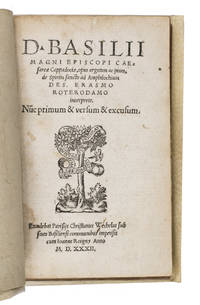
1532ABC_49897Paris 1532. Small 8vo 9.5 x 14.9 cm. Chréstien Wechel and Jean Roigny Modern limp overlapping vellum sewn on 3 supports laced through the joints red edges and with 2 sets of green cloth ties. With Wechels woodcut printers device on the title page and the verso of the otherwise blank last leaf and 2 woodcut decorated initials. 124 3 blank1 pp. Very rare second edition of Erasmus translation of a theological treatise attributed to Basil of Caesarea 330-379 CE.It was published shortly after the first edition published in May of the same year by Froben and Episcopius in Basel May 1532. The work is very rare we have traced only one other copy in sales records of the past 100 years. Erasmus' translation is accompanied by a dedicatory epistle to Joannes Dantiscus 1485-1548 Bishop of Culm and a prominent diplomat of the Polish court. The letter dated April 30 1532 reflects Erasmus conviction that direct engagement with the texts of the Church Fathers rather than with flawed Latin intermediaries was vital for the renewal of Christian piety. As Erasmus himself declared: "It would be of great benefit to sacred letters and Christian devotion if Basil himself in Greek and not the shadow of Basil a Latin translation were made available to all."His source text was a Greek edition he had published just two months prior. According to Julián 2022 Erasmus wanted to publish everything they could find from Basil lamenting that in the existing Latin versions "the greater part of him is missing." Interestingly the legacy of this work can be traced further back to the 15th century when George of Trebizond 1395-1486 a Greek scholar from Crete was commissioned by Cardinal Bessarion 1403-1472 in 1440 to translate both De spiritu sancto and Contra eunomium into Latin. George struggled with the theological complexity of the material confessing in his preface 1442 that he lacked the necessary theological training and fluency in Latin. Erasmus' later effort can be seen as a corrective and a fulfilment of that earlier humanist ambition to make the Greek Church Fathers accessible to a Western audience in an accurate and readable form.Small tear in title page not affecting the text lightly water-stained margin and slightly browned throughout. Overall in very good.l Colón 11; no. 158; Vander Haeghen II 13; Moreau IV 338; V.P. Julián Erasmo traductor y editor de los Padres de la Iglesia: Crisóstomo Basilio y Orígenes. Salmanticensis 691-22022 039-075; USTC 185205 lost book; WorldCat 150413518 913004144 3 copies; not in Adams BM STC German De Reuck; Index Aureliensis; cf. for the Basel 1532 edition: USTC 640558 1 copy; WorldCat 257292311 1374477181 150413518 3 copies. hardcover
1545314899Argentorati Strasbourg: Vuendelinus Rihelius Wendelin Rihel 1545. Fourth edition of the Calvin; second Froben folio edition of the Erasmus. Collation alpha-gamma6 delta4 A-Z6 a-s6 t-v4 v4 blank present. Pp. 431 505 3 blank. Errata at foot of index p. 43. 1 vols. Folio 11-3/4 x 8 inches. Contemporary blindstamped pigskin over wooden boards with metal clasps. With 8 pages of contemporary Latin notes loosely inserted; contemporary marginalia throughout second work. L2 in Calvin with old ink stains not affecting legibility; some wear along one bottom edge of binding. Manuscript prayer in Latin on lower pastedown. Small later paper label on upper cover "Bibliothèque de Spietz". A handsome copy. Fourth edition of the Calvin; second Froben folio edition of the Erasmus. Collation alpha-gamma6 delta4 A-Z6 a-s6 t-v4 v4 blank present. Pp. 431 505 3 blank. Errata at foot of index p. 43. 1 vols. Folio 11-3/4 x 8 inches. Calvin's 'Instutitio': Cornerstone of Liberty. "Calvin's 'Institution of the Christian Religion' was the first systematic statement of a Reformed Church. It is the most important doctrinal work of the Reformation as a whole and provided a comprehensive theological system rivaling those of the Middle Ages . Calvinism's most important role despite Calvin's authoritarian influences was to support the movement for liberty and independence in many parts of the world" Printing and the Mind of Man 65. First published in Basel in 1536 the "Institutio was much revised taking its final form in 1559" PMM. Calvin understood the importance of vernacular translations in the transmission of ideas made possible by the printing press and prepared a French edition in 1541. This fourth edition follows closely and corrects the third edition printed in 1543. All early editions are uncommon.<br/><br/>Calvin 1509-64 drew upon St. Augustine and Luther as well as upon classical sources including Plato and Seneca; his work addressed theological issues and also notably the relations between ecclesiastical and civil government. The contemporary annotations often callouts of classical authors and shoulder notes with a few pointing hands are most extensive in the first six chapters again in chapter sixteen on the Lord's Prayer where Melanchthon is cited but appear throughout. <br/><br/>The first work in this well preserved contemporary binding is the second Froben folio edition of Erasmus Ecclesiastes Basel: Froben 1539. OCLC 632887280 BSB Augsburg Univ. Basel. Collation a-z6A-M6N4O-Q6. Pp. 439 1 blank 18 index imprint date 1540 1 blank 1 Froben's device. This was first published in Basel in 1535. The manuscript notes refer to in the early passages of this work. The Bibliotheque de Spietz was dispersed at auction in 1874. The von Erlach family had been established at Bern since the early sixteenth century. Calvin: PMM 65; Adams C357; VD16 C 291; Peter & Gilmont Bib. Calviniana 45/5; En français dans le texte 59 for 1560 ed. Erasmus: Bezzel 823 Adams E632; VD16 E 2723 Vuendelinus Rihelius [Wendelin Rihel] unknown books
156374559latin version of Erasmus's new translation of the Bible 4 320 16 leaves woodcuts in text throughout "Argumenta Capitvm Capitum in Omnes Novi Testamenti libros" to rear in elegiac verse Published in Officina Froschouiana hardcover
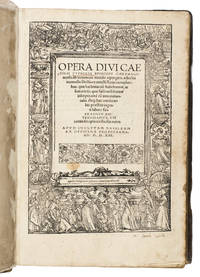
1520ABC_49926Basel 1520. Folio. Johann Froben Contemporary richly blind-tooled calf over wooden boards with brass clasps catch- and anchor plates along the fore-edge and brass edge guards around the corners and on the bottom board edge near the spine manuscript waste pastedowns re-backed. With an elaborate woodcut border on the title page and on the first page of the dedication. Further with a small woodcut illustration incorporating Frobens device on the verso of the last leaf numerous woodcut decorated initials by Ambrosius Holbein throughout and some ornamental woodcut headpieces. 24 515 1 blank 32 pp. First edition of the works of Thascius Caecilius Cyprianus Saint Cyprian ca. 210-258 CE edited by Erasmus. The present work is a landmark in the history of humanist scholarship and a cornerstone of Erasmuss lifelong effort to restore the authentic voice of the Early Church Fathers. Working in Basel Erasmus devoted himself to what he regarded as his highest calling: presenting these foundational Christian sources to a wider audience and revealing the truth of the Gospel in its original simplicity.In this edition Erasmus rescued Cyprians writings from centuries of textual corruption carefully correcting medieval errors and adding several minor treatises from ancient manuscripts that had never previously been printed. It includes Cyprians pastoral letters and doctrinal works arranged by theme and reflects the bishops deep concern with church unity moral discipline and the challenges of the early Christian community.This 1520 edition of Cyprians works marks the true beginning of Erasmus great Basel enterprise: a series of monumental editions that would soon include works by Arnobius 1522 Hilary 1523 Jerome 1524 Irenaeus 1526 Ambrose 1527 Augustine 1528-29 and Chrysostom 1530. This rapid succession of vast editorial projects reveals both Erasmuss astonishing intellectual energy and his conviction that the wisdom of these Church-Fathers could renew Christian life.More than a critical edition the present work embodies the spirit of Christian humanism itself: rigorous scholarship in the service of faith. It stands as one of Erasmus' most significant achievements and a defining moment in the recovery of patristic learning in the Renaissance.With manuscript waste pastedowns three stamps of the Roman Catholic Saint Maria-Magdalena church in Zaandam on the title page occasionally some near contemporary manuscript annotations in the margins and some of the text has been underlined. The work has been re-backed lacking the backstrip of the original binding the edges of the leather around both boards is slightly damaged revealing the wooden boards below the spine is somewhat rubbed. The edges of the first and last few leaves are slightly frayed some occasional water staining in the fore-edge margin not affecting the text some slight staining and dust soiling throughout. Otherwise in good condition.l Allen 1000; De Reuck 416; Huizinga VI p. 148; USTC 679667; Vander Haeghen II 23; VD 16 C 6508; not in Adams; Bezzel; BM STC German. hardcover
1521ABC_49920Basel 1521. Folio. Johann Froben Contemporary blind-tooled pigskin over wooden boards with brass catch- and anchor plates along the fore-edge of the boards lacking the clasps. With a detailed woodcut border on the title page and the first page of the dedication. Further with a small woodcut illustration incorporating Frobens device on the verso of the last leaf and with woodcut decorated initials throughout. 24 515 1 blank 32 pp. Second edition of Saint Cyprians works as edited by Erasmus published by Froben one year after their first edition. Between 1516 and 1521 Erasmus worked closely with Johann Froben the humanist printer in Basel on a series of editions of the Latin Church Fathers: Jerome Augustine Ambrose Hilary and Cyprian. Erasmus aim was to purify the texts of the Fathers from medieval corruptions to restore their authentic doctrine by returning to the original sources and to present the Early Church as a model for a purer form of Christianity a theme that directly reflected his theological-humanist ideal.Erasmus states that he has cleansed the text of errors added a few minor treatises from ancient manuscripts and removed the works that seemed to have been falsely attributed to Cyprian. Thascius Caecilius Cyprianus ca. 210-258 CE later known as Saint Cyprian was an influential Church Father of the early Latin Christian tradition. Shortly after his baptism he became bishop of Carthage one of the most important Christian centres in the Roman Empire. Most of his works are pastoral letters and treatises here arranged in the index by type. The manuscript appears to have been used for study as the annotations highlight portions of the text and draw comparisons between Augustine and Cyprian.With small strips of manuscript waste visible in the gutters of the pastedowns a small owners inscription H. Reimers Erlang. 1899 in the upper outer corner of the first blank flyleaf along with elaborate manuscript annotations on the recto of that same leaf numerous contemporary and later annotations in three different hands throughout and some of the text underlined. The leather around the top and fore-edge of the front board has been restored the leather on the back board is somewhat damaged some small worm holes in the leather reveal the wooden boards below. The binding is rubbed the clasps are lacking and the head and foot of the spine are somewhat damaged the structural integrity of the binding nevertheless remains intact. The first blank flyleaf has been restored in the gutter margin the last leaf has been restored in the fore-edge margin the edges of the leaves are somewhat browned. Otherwise in good condition.l Adams C3150; BM STC German p. 234; De Reuck 417; USTC 679668; Vander Haeghen II 23; Huizinga VI p. 148; VD 16 C 6509; not in Bezzel. hardcover
1532748951Basileae per Iohannem Hervagium Johannes Herwagen 1532. Full leather. Sexto 22 532 207 5 Variae Lectiones 47 Annotationes 1 pagesBinding repair by J. Taylor Seton “successor to the late James Taylor 3 Mound Place Edinburgh†Recently rebacked. Margin notes and underlining throughout. Photos upon request. Basileae per Iohannem Hervagium [Johannes Herwagen] hardcover
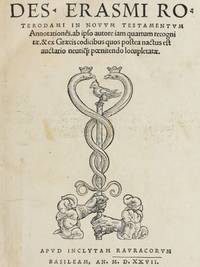
1527505487Froben 1527. Hardcover. VERY GOOD. 9 2-710 56 pp. original endpapers. Folio in sixes complete: a4 a-z6 A-Z6 Aa-Mm6 Nn8 Oo6 Qq8 Rr8. Contemporary blind-tooled alum-tawed pigskin over boards. Original clasps intact originally with corner furniture now lost. First title page with Froben device of crowned snakes and bird perching on hands enshrouded with clouds; second title page within Hans Holbein woodcut border. All edges stained Navy blue. 9 2-710 58 pp. <br /> <br /> Front hinge reattached with non-invasive Japanese paper repair; some staining and patina to the peccary bit of worming to the outer pages otherwise a few clean and fresh internal text. 17th century owner's inscription with hellenized name to FFEP. <br /> <br /> The fourth of six lifetime editions by Erasmus a great leap forward from the previous edition adding nearly 100 pages to the Third edition of 1522. <br /> <br /> First released in 1516 alongside his revised Greek Text and Latin translation of the New Testament the Annotationes are a philological tour de force examining in elaborate detail the differences between the ancient Greek text and the Vulgate in the process demonstrating the need for a new Latin translation namely his own. In the process Erasmus was dangerously frank in his discussion of Church abuses and departures from the teaching of Scripture showing himself 'An unprecedentedly formidable critic of contemporary theological and religious practice' McConicum Oxford Encyclopedia of the Reformation. <br /> <br /> The single greatest scholarly accomplishment of the renaissance was Erasmus's Annotations on the New Testament. Begun in 1516 and revised three times in his lifetime this second revision of 1527 was the greatest expansion of the work more than doubling its size from the first edition. Here the complete force of his philological powers is on full display boring away centuries of accreted dogma and ignorance that had obscured the text. "Without the notes Erasmus said the texts of the Scripture were 'naked and defenceless' open to criticism by uncomprehending readers and corruption by careless printers. The Annotations represent not only Erasmus' defence of the New Testament against such abuses but also a reflection of his own philosophy objectives and working methods. In establishing the text and defending it against his opponents Erasmus drew on manuscript sources classical literature patristic writings scholastic exegesis and the work of his immediate forerunners Valla and Lefevre. He did not hesitate to point out the errors of illustrious writers like Jerome and established medieval authorities like Peter Lombard. In general he was appreciative of the early church Fathers and contemptuous of medieval commentators. Rummel Erika. Erasmus' Annotations on the New Testament : From Philologist to Theologian. <br /> <br /> In many cases the Annotations serve to justify the most controversial renderings in his translation and defend himself against heresy charges. The most notable instance is his translation of the Greek metanoiete in Matt 3 note 1 and Acts 19 note 8. which Jerome had translated as "do penance" a rendering which shored up the Church's sacramental doctrine of a private secret confession made only to a priest. While Erasmus maintained that he himself practiced taught and supported the status quo penitential rite he did not find any grounding in Scripture where he insisted metanoiete referred to a change of mind not penitential confession and that anyway that instances of confession in Scripture were uniformly public and oral. See Rummel 152-156. Adams E-891. Froben hardcover
15411903140038Basel: Westhemerus 1541. Hardcover. Good. 2nd ed. First published in 1538. Contemporary vellum-backed pasteboard binding. Solid binding some wear to cover extremities. All edges red. Printer's snake device verso colophon. Internally clean and unmarked. Early signature of Robert Guyard Roberti Guyardi and "Carmelus Cadomensis". A collection of Erasmus letters for the use in Latin schools. Refs: Index Aurel. 163.109 9. VD-16 E-2958. Vanderhaeghen I 101. Bezzel 1043. Cat. Rotterdam 121. De Reuck 220. Not in Adams. "Adiecimus in Calcem proverbiorum & graecarum vocum interpretationem floresq ; in elocutione latina selectissimos que omnia commentarii vice esse possunt ; opus novum et recens natum. Basel: Westhemerus hardcover
1522032982Coloniae: Heronem Alopeciu 1522 An extremely scarce early edition published in September 1522 - a month after the authorised Basel edition - by Hero Alopecius in Cologne. We have only been able to find one reference to it University of Toronto. Erasmus arranged publication of the Basel edition in August 1522 in response to the appearance of an unauthorised version in Cambridge in 1521. He had originally worked on the content in 1509-1511 and this work developed from his earlier writing and lectures became a popular and important text book on the writing of letters. It was much reprinted. This copy is newly rebound in full calf with panelled design to boards and gilt titles to spine. The page edges are red although this may not be contemporary. New endpapers. Contents with 2 initial blanks - the first with ink notation on the edition - this looks likely to be 1800's in date and the paper does not look contemporary. Title with elaborate design including 2 cherubs holding a shield with 3 crowns with contemporary latin note at the top; letter from Erasmus to Nicolao Beraldo pp 2-4; text with beautiful decorative initial capitals pp 5-414 Finis. No final blanks. There is some scholarly annotation in latin and gentle underlining - this could be contemporary. There are a number of mispaginations but the ties work in all cases: 47-74-75-50; 51-78-79-54; 55-82-83-58; 59-98-87-62-63-90-65; 170-117-172; 177-168-179; 192-191-192-193. There are a number of professional paper repairs: to the side of the title page and page 13/14; from p 357 onwards where the top corner tips had been burnt out - this begins with the just the tip but towards the end of the work includes some page numbers and just clips a couple of margin notes - the final 2 leaves have repair to sides. These corners do not have the red edges. Towards the end of the work there are a few pages with some grubbiness at the bottom corners. Otherwise the work is very clean with high quality paper. Please enquire if you would like to see additional images Heronem Alopeciu hardcover
1554500039293Lugduni: Apud S. Gryphium 1554. First Edition. . Hardcover. Good. 648pp and index 12mo leather some marginalia. Nme on title page. First volume of four. <br/> <br/> Apud S. Gryphium hardcover
153194471531 Parisiis in via Iacobaea, apud Ludouicum Cyaneu sub duobus Gallis & Ionnem Roigninum sub Basilisco, 1531. Un volume in-12 (12 x 16,5 cm), [16]-746-[36] pp. (epistola nuncupatoria + lib. I-VI + index). Signatures: aii-cciiiib. Colophon: « Parisiis ex officina ludovici Cyanei sub duobus gallis in via Iacobea, Anno M.D.XXXI, mense Augusto». Livre bien complet de tous ses feuillets. Dans une reliure dépoque en cuir marron foncé, les plats estampés à froid, dos à cinq nerfs, tranches rouges. La couverture, notamment le dos, ont été habilement restaurés au XXe siècle, tout comme la page de titre et la dernière garde. Pages salies en début et fin d'ouvrage, écritures anciennes à la plume au verso de la page de titre, quelques soulignages dans le corps du texte, sinon ouvrage en bon état et parfaitement lisible.