VIVESLivre Rare Book
[Garnmann-Horodisch, Alice:]Antiquariat.de
[Blütenstängel - Wachsstift?]. -
1962900335AG1962. Blattmaß: 35,5 x 28 cm.

Antiquariat Tautenhahn · DE - Lübeck80,00 €
4 536 résultats
5175Bruxelles, Valero, Paris, Presses Universitaires de France, 1943 14 x 18, 430 pp., illustrations, non broché, bon état.
1962900335AG1962. Blattmaß: 35,5 x 28 cm.
ff. [60], 320 numbered leaves. Woodcut Aldine anchor and dolphin printer's device on the title page and last leaf. Latin Italic type. Some age stain, especially on first and last leaves. In several places the name of Erasmus is obliterated in ink by a censor. An early ownership on the title has been washed out, and a small marginal chip has resulted. Small 8vo. 160 mm. Edges decorated red. Early nineteenth century full vellum binding. Lacks front fly leaf. This second and improved Aldine edition is essentially a reprint of the edition of 1516, edited by Giovanni Battista Cipelli, called Egnazio (1478-1553), with the addition of annotations by Erasmus, which were first published in the Froben edition of 1518. Both Aldine editions contain the relevant texts of Aurelius Victor and Eutropius with the continuation by Paulus Diaconus. The full work was once the common manual of almost everyone who wished to study Roman history, and because of this long and hard use, it is extremely difficult to obtain a clean and perfect example - Renouard. This second edition is considered the more valuable, as containing an 'Index Memorabilium' and the notes of Erasmus and the Venetian philologist Joannes Baptista Egnatius (ca. 1473-1553). Gaius Suetonius Tranquillus, commonly known as Suetonius (ca. 69/75-after 130). Suetonius was a close friend to Senator and letter-writer Pliny the Younger. Pliny describes him as 'quiet and studious, a man dedicated to writing'. Through Pliny, Suetonius came into favor with Trajan and Hadrian. Under Trajan he served as secretary of studies (precise functions are uncertain) and director of Imperial archives. Under Hadrian, he became the Emperor's secretary. In 122, Hadrian dismissed him for disrespectful behavior towards Empress Vibia Sabina. Suetonius may have later regained imperial favor under Hadrian and returned to his position. It was probably in Hadrian's time that he wrote his most important surviving work - this set of biographies on the Lives of the Twelve Caesars. Entitled 'De Vita Caesarum' it deals with successive Roman rulers, from Julius Caesar to Domitian. It also includes other texts on Roman history, notably Eutropius. This collection of ancient Roman historians is dedicated to the great book collector - Jean Grolier, and is followed by a letter from Erasmus commending the edition as well as Egnatius' scholarship. Renouard 91:7; Schweiger 974-975; Adams S-2035; UCLA A4S93; Graesse VI, 521; Ahmanson-Murphy 201 (incomplete); Bibliotheca Erasmiana Bruxellensis 499 (incomplete); Dibdin II, p. 439; STC Italian p. 651. Very good. Scarce. **PRICE JUST REDUCED! ALDINE BOX SAFE
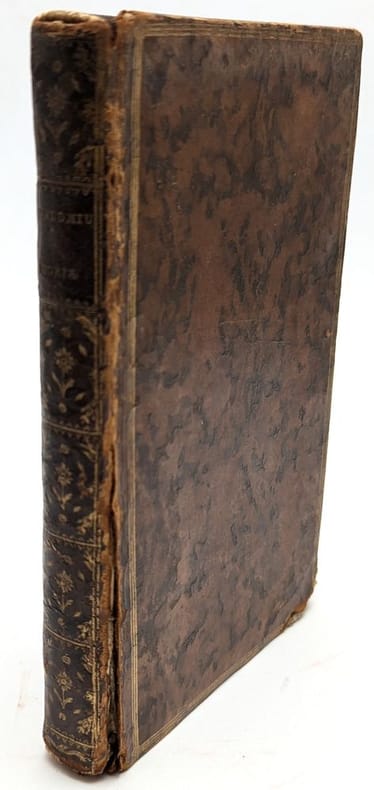
176591967Londres et Paris, Barbou, 1765, in-8, Front, [2]-XIII-[1]-214 pp, Basane marbrée de l'époque, dos lisse et fleuronné, pièce de titre grenat, tranches dorées, L'Éloge de la folie d'Érasme, a été rédigée en 1509 en latin : dans cette satire, qui n'épargne ni les théologiens, ni les savants ni les courtisans, le "prince des humanistes" dénonce le comportement de ses contemporains et annonce les thèses protestantes. La présente édition a été procurée par Anne-Gabriel Meusnier de Querlon (1702-1780). Elle est illustrée d'un frontispice représentant la folie reine du monde ("La Pazzia Regina del Mondo") gravé par Gravelot d'après de Longueil. Coiffes arasées, accroc à un coin, les autres émoussés, une charnière fendue. Pages jaunies, petites rousseurs en tête de volume. Couverture rigide
153147178Basel, Froben, 1531 + Coloniae, Petrus Quentell, 1536. Folio. Bound together in a beautiful contemporary full calf binding over wooden boards. Blindstamped ornamental frames to boards. Five raised bands to spine. Remains of brass clasps to boards. Brass at corners of boards and brass strips to bottom edges of boards. A tear through the letter at the lower capital, no loss. Some scrathing of leather, mostly to back board and upper part of spine. The titles of the two works written in contemporary hand to the outer edge. The strong vellum cords, which go through the the wooden boards can be seen on the inside of the wooden boards, which also have some initials in red and blue paint, possibly from a painted leaf that has rubbed off? First title-page a bit dusty, otherwise very nice, clean, and crisp throughout. [Eucherius:] Froben printer's device to title-page, to final leaf of the first part, to the half-title of the second part (Episcopi Commentariorum in libros Regum ad Veranium & Salonium) and to the last leaf of that part. Beautiful large woodcut initial at beginning of each new work. (8), 194, (2)" 310, (2) pp.[Radulphus:] Woodcut device to title-page. Numerous beautiful woodcut, allegorical initials, both large and smaller, throughout. (4 - title, dedications), (14 - index), (6), 314 pp.
1942900326AG1942. Blattmaß: 29,5 x 21 cm.
1946900336AG1946. Blattmaß: 34 x 26 cm.
1958900333AG1958. Blattmaß: 35 x 28 cm.
1963900317AG1963. Blattmaß: 31 x 24 cm,
1942900329AG1942. Blattmaß: 28 x 21 cm.
1943900330AG1943. Blattmaß: 34 x 26 cm.
15454725like new. unknown
1462883427.Ghardcover. Good. Access codes and supplements are not guaranteed with used items. May be an ex-library book. hardcover
1528179633.Ghardcover. Good. Access codes and supplements are not guaranteed with used items. May be an ex-library book. hardcover
B9781498196345Paperback / softback. New. paperback
152770968X.Gpaperback. Good. Access codes and supplements are not guaranteed with used items. May be an ex-library book. paperback
2010DADAX1165292912Kessinger Publishing 2010-09-10. hardcover. New. 6.00x0.81x9.00. Buy with confidence. Excellent Customer Service & Return policy. Kessinger Publishing hardcover
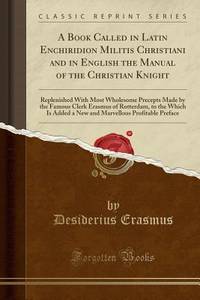
2010mon0001644094Kessinger Publishing 10/09/2010 00:00:01. paperback. Very Good. 1.9985 22.7827 15.1885. This 1905 Methuen edition presents Erasmus of Rotterdam�s influential Enchiridion Militis Christiani a Renaissance handbook urging Christians to live out sincere inner faith rather than rely on outward ritual. The work originally written in 1501 and later expanded was created at the request of a soldier�s wife who hoped to inspire moral reform in her husband and it became one of Erasmus�s most widely read texts. It draws heavily on the Pauline metaphor of the �spiritual armour� in Ephesians 6 encouraging believers to cultivate virtue discipline and steadfastness in the face of moral challenges. A significant devotional and humanist classic this edition appeals to collectors of Erasmus Reformation-era literature and early Christian ethical writings.rnrn Kessinger Publishing paperback
1498196349.Gpaperback. Good. Access codes and supplements are not guaranteed with used items. May be an ex-library book. paperback
1015491375.Ghardcover. Good. Access codes and supplements are not guaranteed with used items. May be an ex-library book. hardcover
1165292912.Ghardcover. Good. Access codes and supplements are not guaranteed with used items. May be an ex-library book. hardcover
1165273160.Gpaperback. Good. Access codes and supplements are not guaranteed with used items. May be an ex-library book. paperback